


 Скачать презентацию Connecting Cosmology the Linear Collider Mark Trodden
6f53b95d82588fa7d47f3f8452846c04.ppt
- Количество слайдов: 38
 Connecting Cosmology & the Linear Collider Mark Trodden Syracuse University Colloquium, LCWS 2004, Paris 4/21/2004
 Outline • The Big Unknowns in Modern Cosmology • Dark Matter • Baryogenesis • Cosmic Rays (brief) • Dark Energy and Inflation (!) A basic bottom line Particle physics and cosmology, as disciplines independent of one another, no longer exist. Our most fundamental questions are now the same and we are approaching them in complementary ways.
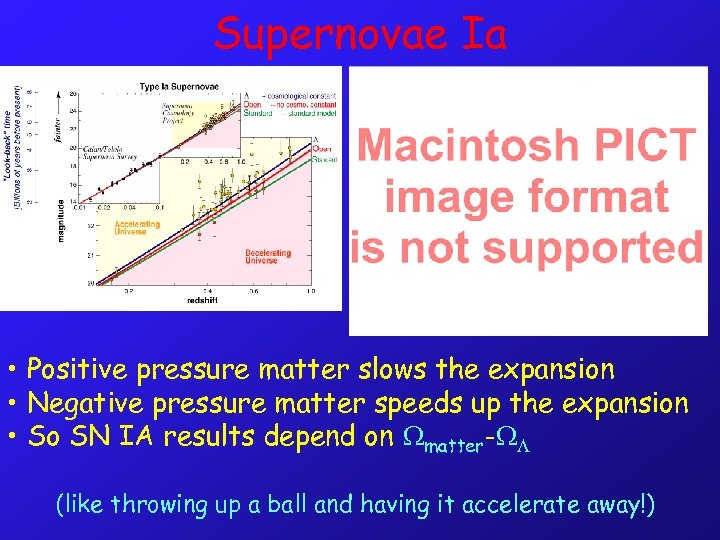 Supernovae Ia • Positive pressure matter slows the expansion • Negative pressure matter speeds up the expansion • So SN IA results depend on matter- (like throwing up a ball and having it accelerate away!)
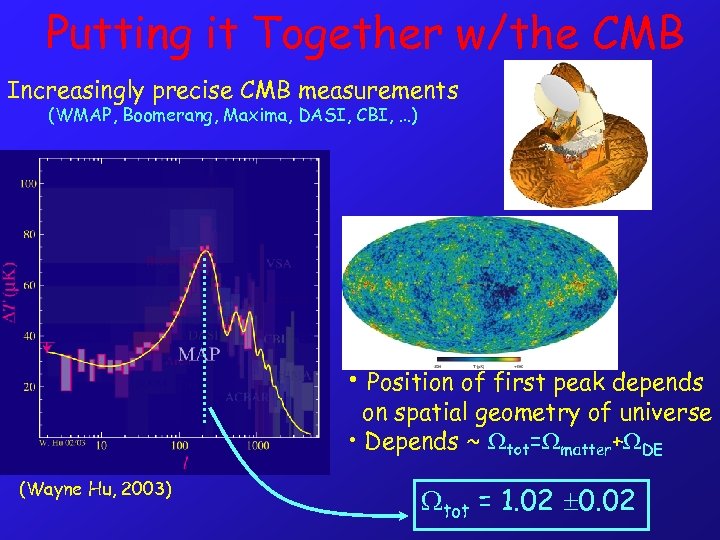 Putting it Together w/the CMB Increasingly precise CMB measurements (WMAP, Boomerang, Maxima, DASI, CBI, …) • Position of first peak depends on spatial geometry of universe • Depends ~ tot= matter+ DE (Wayne Hu, 2003) tot = 1. 02 0. 02
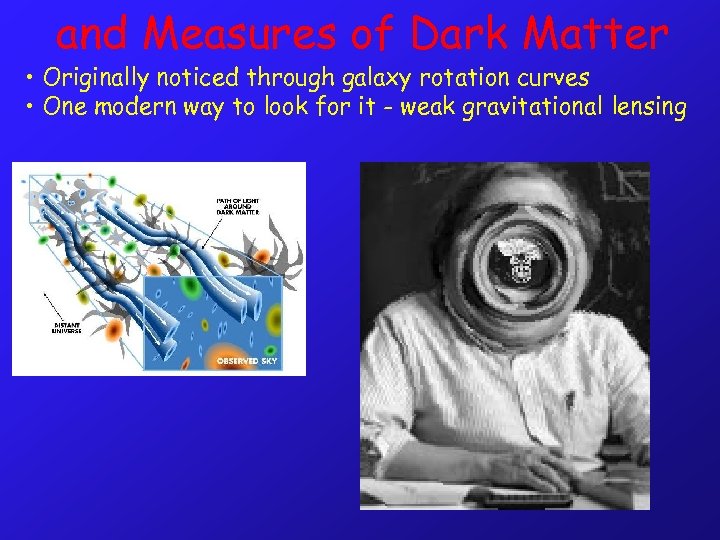 and Measures of Dark Matter • Originally noticed through galaxy rotation curves • One modern way to look for it - weak gravitational lensing
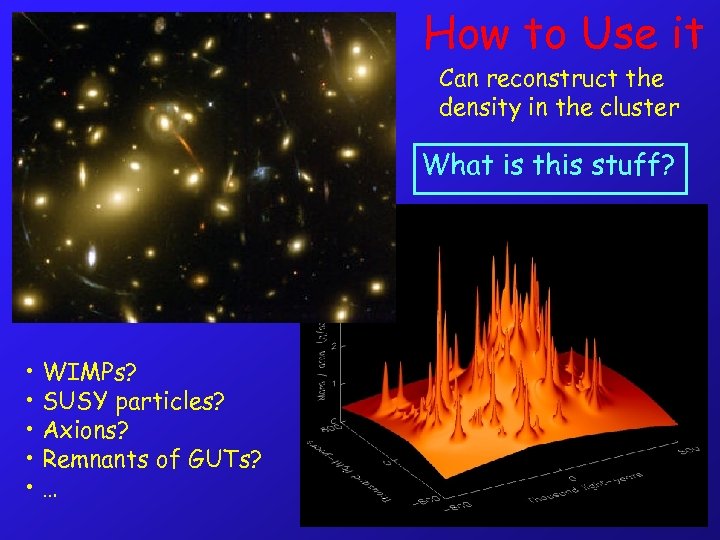 How to Use it Can reconstruct the density in the cluster What is this stuff? • WIMPs? • SUSY particles? • Axions? • Remnants of GUTs? • …
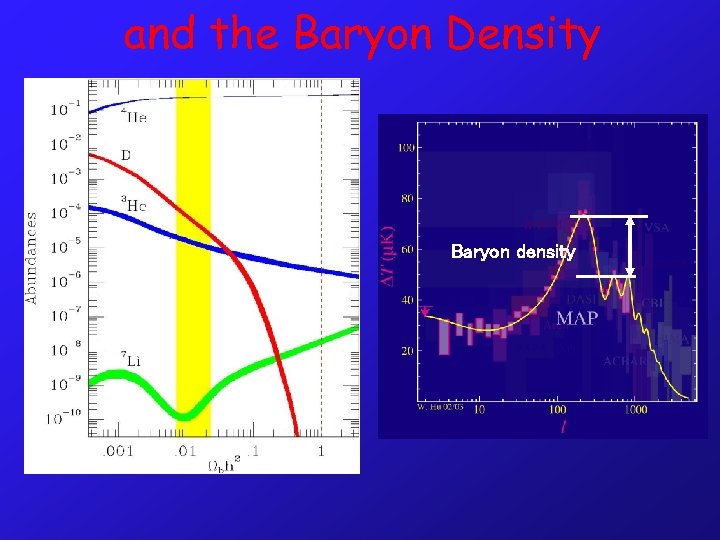 and the Baryon Density Baryon density
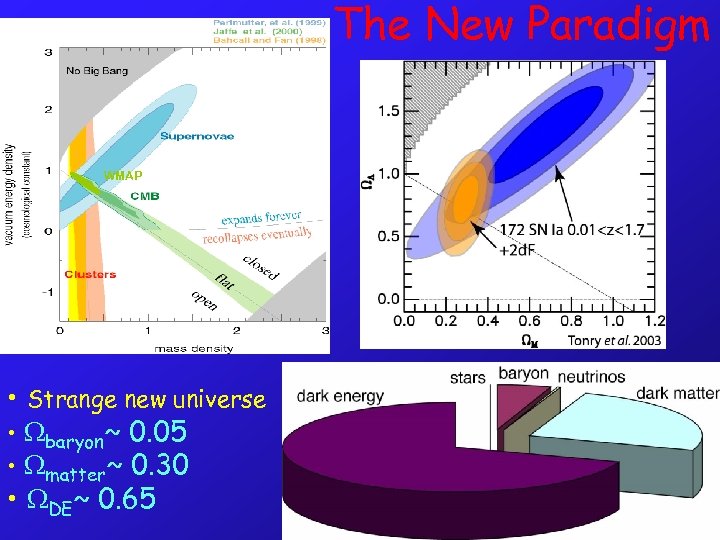 The New Paradigm WMAP • Strange new universe • baryon~ 0. 05 • matter~ 0. 30 • DE~ 0. 65
 We know what these particles are but not why they haven’t met their antiparticles We don’t know what these particles are but we have some well-motivated ideas We have absolutely no idea what this stuff is and we have no ideas that are well-motivated and well-developed!
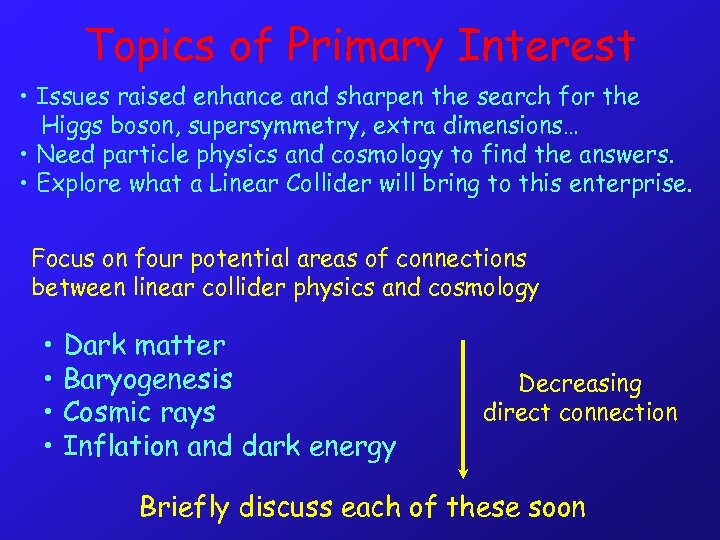 Topics of Primary Interest • Issues raised enhance and sharpen the search for the Higgs boson, supersymmetry, extra dimensions… • Need particle physics and cosmology to find the answers. • Explore what a Linear Collider will bring to this enterprise. Focus on four potential areas of connections between linear collider physics and cosmology • Dark matter • Baryogenesis • Cosmic rays • Inflation and dark energy Decreasing direct connection Briefly discuss each of these soon
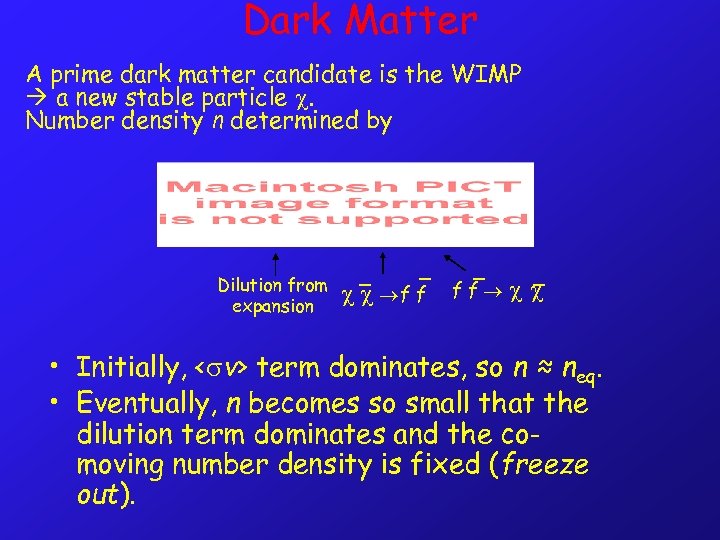 Dark Matter A prime dark matter candidate is the WIMP a new stable particle . Number density n determined by Dilution from expansion f f ff • Initially, < v> term dominates, so n ≈ neq. • Eventually, n becomes so small that the dilution term dominates and the comoving number density is fixed (freeze out).
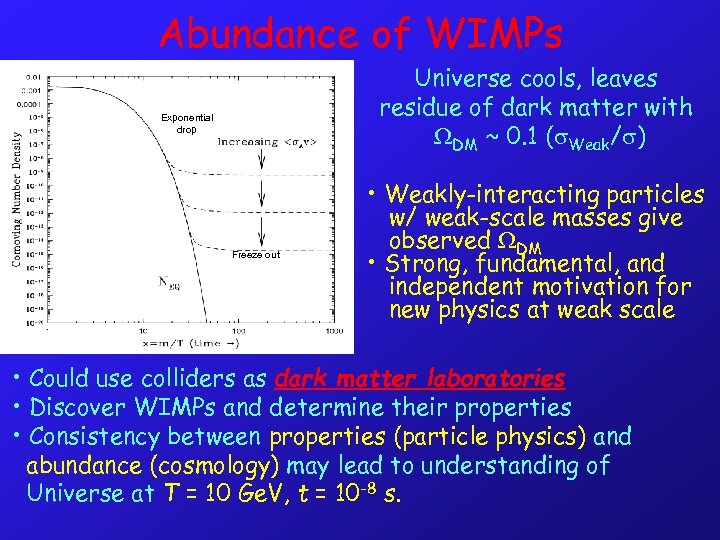 Abundance of WIMPs Universe cools, leaves residue of dark matter with DM ~ 0. 1 ( Weak/ ) Exponential drop Freeze out • Weakly-interacting particles w/ weak-scale masses give observed DM • Strong, fundamental, and independent motivation for new physics at weak scale • Could use colliders as dark matter laboratories • Discover WIMPs and determine their properties • Consistency between properties (particle physics) and abundance (cosmology) may lead to understanding of Universe at T = 10 Ge. V, t = 10 -8 s.
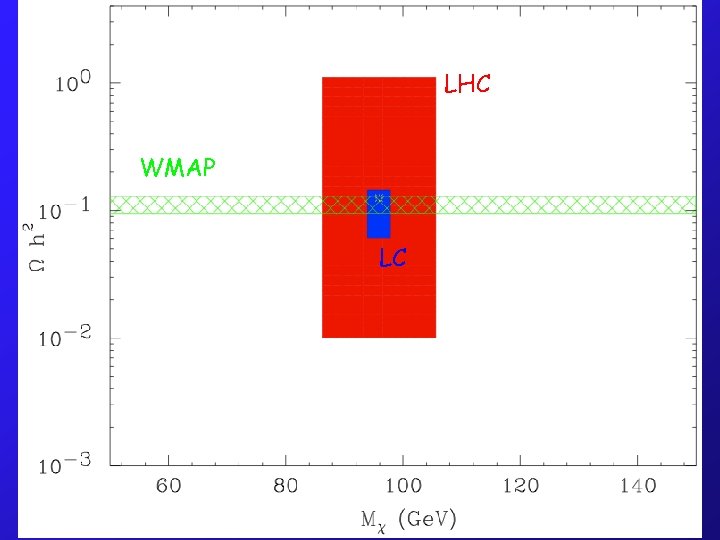
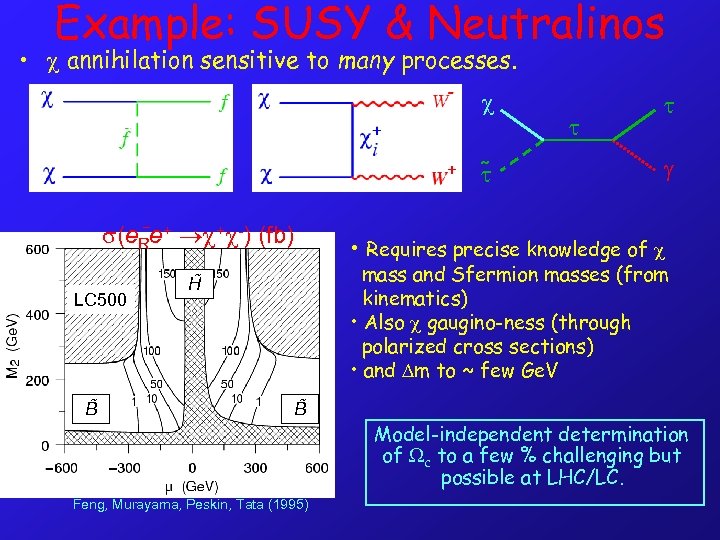 Example: SUSY & Neutralinos • annihilation sensitive to many processes. t − (e. Re+ + -) (fb) LC 500 B t t • Requires precise knowledge of mass and Sfermion masses (from kinematics) • Also gaugino-ness (through polarized cross sections) • and m to ~ few Ge. V H B Feng, Murayama, Peskin, Tata (1995) Model-independent determination of c to a few % challenging but possible at LHC/LC.
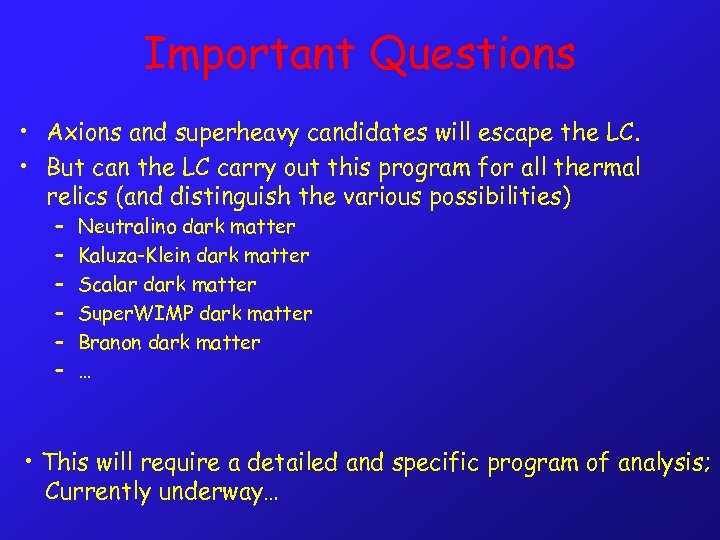 Important Questions • Axions and superheavy candidates will escape the LC. • But can the LC carry out this program for all thermal relics (and distinguish the various possibilities) – – – Neutralino dark matter Kaluza-Klein dark matter Scalar dark matter Super. WIMP dark matter Branon dark matter … • This will require a detailed and specific program of analysis; Currently underway…
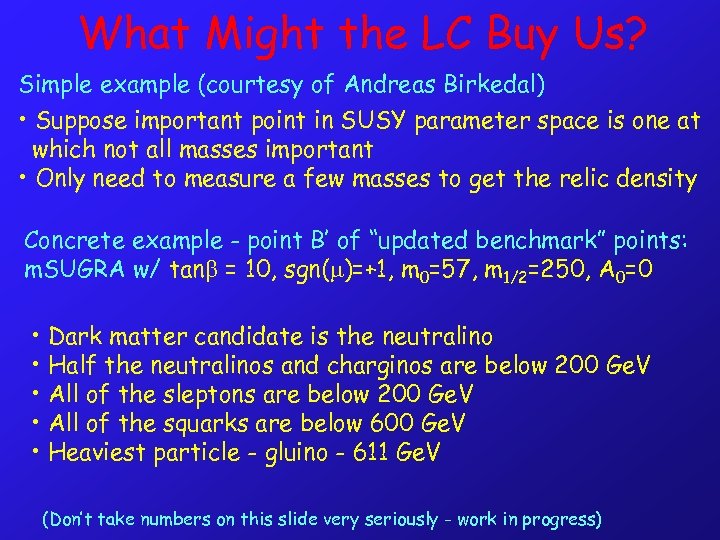 What Might the LC Buy Us? Simple example (courtesy of Andreas Birkedal) • Suppose important point in SUSY parameter space is one at which not all masses important • Only need to measure a few masses to get the relic density Concrete example - point B’ of “updated benchmark” points: m. SUGRA w/ tan = 10, sgn( )=+1, m 0=57, m 1/2=250, A 0=0 • Dark matter candidate is the neutralino • Half the neutralinos and charginos are below 200 Ge. V • All of the sleptons are below 200 Ge. V • All of the squarks are below 600 Ge. V • Heaviest particle - gluino - 611 Ge. V (Don’t take numbers on this slide very seriously - work in progress)
 LHC WMAP LC
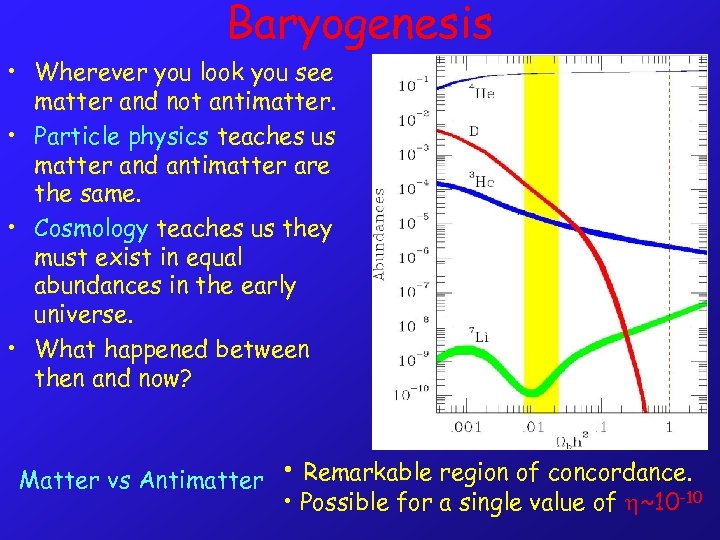 Baryogenesis • Wherever you look you see matter and not antimatter. • Particle physics teaches us matter and antimatter are the same. • Cosmology teaches us they must exist in equal abundances in the early universe. • What happened between then and now? Matter vs Antimatter • Remarkable region of concordance. • Possible for a single value of ~10 -10
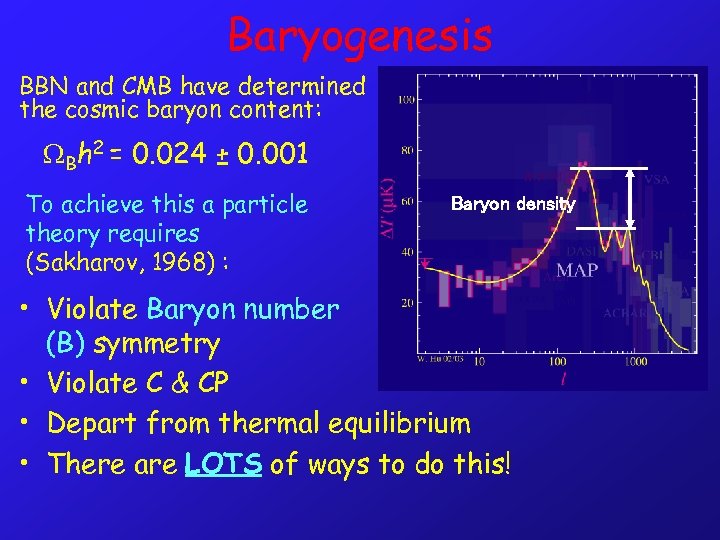 Baryogenesis BBN and CMB have determined the cosmic baryon content: Bh 2 = 0. 024 ± 0. 001 To achieve this a particle theory requires (Sakharov, 1968) : Baryon density • Violate Baryon number (B) symmetry • Violate C & CP • Depart from thermal equilibrium • There are LOTS of ways to do this!
 Clue for Particle Physics • Many scenarios for baryogenesis rely on physics at the GUT scale • However, an attractive and testable possibility is that the asymmetry is generated at the weak scale. • The Standard Model of particle physics, even though in principle it satisfies all 3 Sakharov criteria, (anomaly, CKM matrix, finite-temperature phase transition) cannot be sufficient to explain the baryon asymmetry! • This is a clear indication, from observations of the universe, of physics beyond the standard model! • What new possibilities are there in theories beyond SM? –Supersymmetric particles? , Neutrinos?
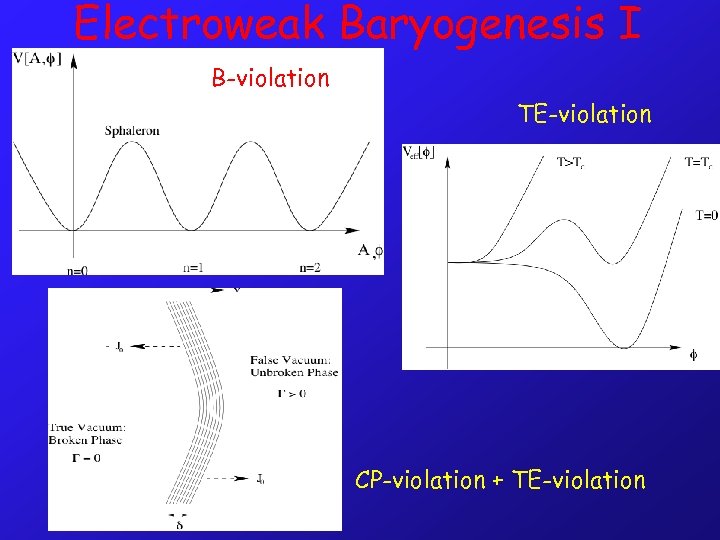 Electroweak Baryogenesis I B-violation TE-violation CP-violation + TE-violation
 Electroweak Baryogenesis II • Requires more CP violation than in SM • (Usually) requires a (sufficiently strong) 1 st order thermal EW phase transition in the early universe. • Our most popular model of recent years • Popularity of this idea is tightly bound to its testability. • Physics involved is all testable in principle at realistic colliders. • Small extensions needed can all be found in SUSY, which is an independently attractive • However, the testability of electroweak scenarios also leads to tight constraints.
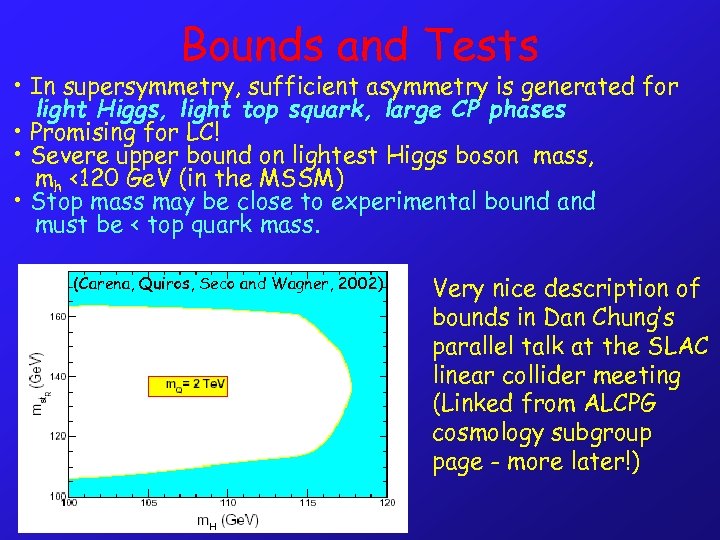 Bounds and Tests • In supersymmetry, sufficient asymmetry is generated for light Higgs, light top squark, large CP phases • Promising for LC! • Severe upper bound on lightest Higgs boson mass, mh <120 Ge. V (in the MSSM) • Stop mass may be close to experimental bound and must be < top quark mass. (Carena, Quiros, Seco and Wagner, 2002) Very nice description of bounds in Dan Chung’s parallel talk at the SLAC linear collider meeting (Linked from ALCPG cosmology subgroup page - more later!)
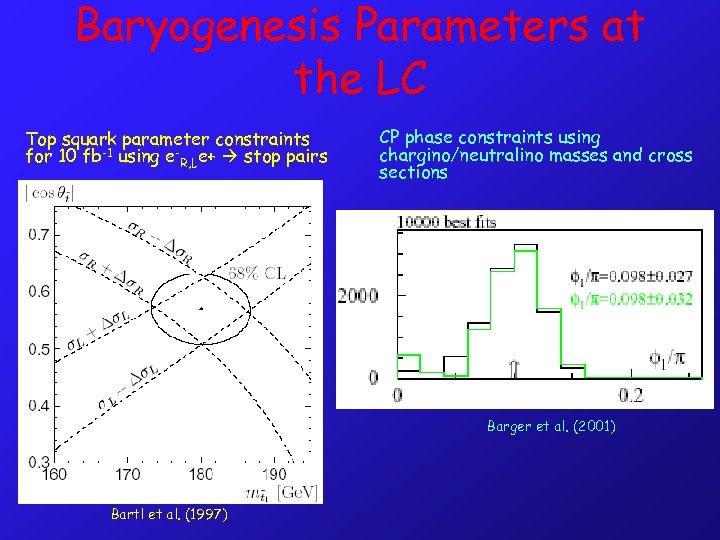 Baryogenesis Parameters at the LC Top squark parameter constraints for 10 fb-1 using e-R, Le+ stop pairs CP phase constraints using chargino/neutralino masses and cross sections Barger et al. (2001) Bartl et al. (1997)
 Other Connections • Another important test for EWBG may come from B-physics - CP-violating effects (but not guaranteed at B factories) • Essential to have new measurements of CP-violation, particularly in the B-sector • Important to remember that BG may be due to different and entirely new Te. V scale physics (e. g. Langacker et al. Z’ model) • May learn indirectly about leptogenesis (Peskin et al. ) • How well can we determine B in these scenarios? • Does the LC have anything to say about GUT-scale baryogenesis/leptogenesis?
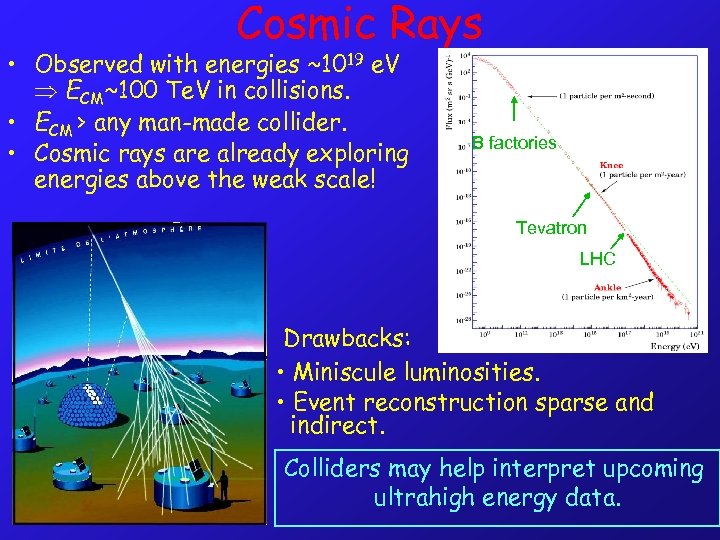 Cosmic Rays • Observed with energies ~1019 e. V ECM~100 Te. V in collisions. • ECM > any man-made collider. • Cosmic rays are already exploring energies above the weak scale! B factories Tevatron LHC Drawbacks: • Miniscule luminosities. • Event reconstruction sparse and indirect. Colliders may help interpret upcoming ultrahigh energy data.
 The GZK Paradox • Protons with ~1020 e. V energies quickly lose energy through p CMB n p+ so probably must be emitted from nearby, but no local sources found. • Solutions: – Bottom-up: e. g. , CRs are gluino-hadrons. – Top-down: CRs result from topological defect decays, should produce up-going cosmic neutralinos if SUSY exists. Testable predictions for colliders.
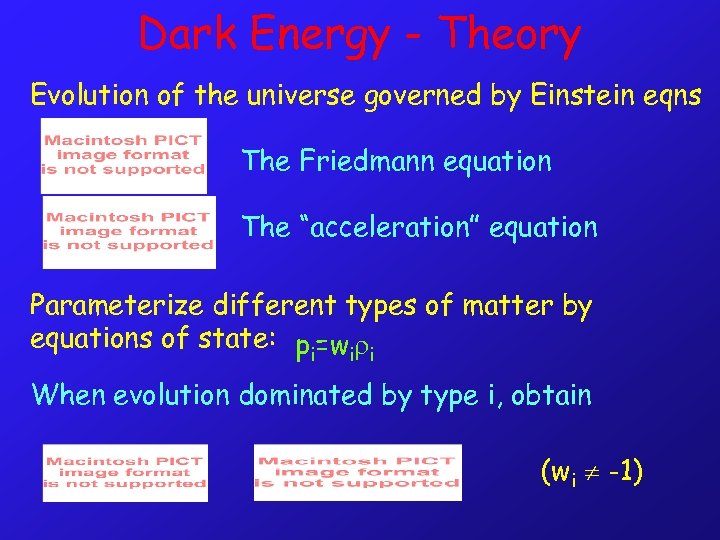 Dark Energy - Theory Evolution of the universe governed by Einstein eqns The Friedmann equation The “acceleration” equation Parameterize different types of matter by equations of state: pi=wi i When evolution dominated by type i, obtain (wi -1)
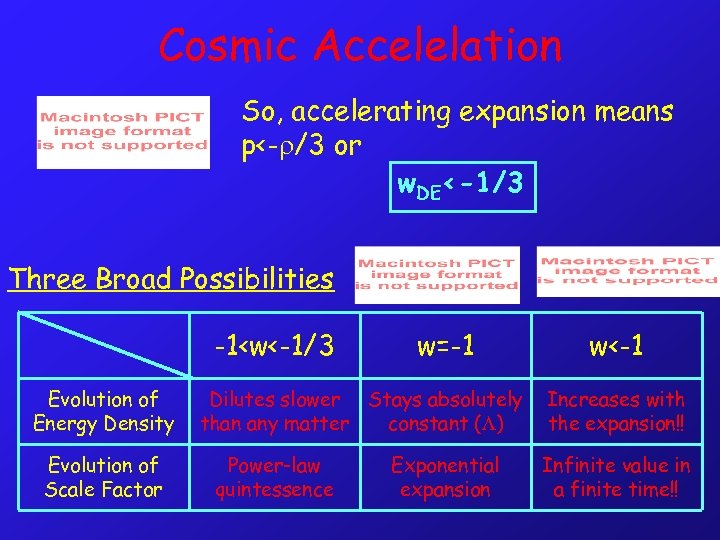 Cosmic Accelelation So, accelerating expansion means p<- /3 or w. DE<-1/3 Three Broad Possibilities -1
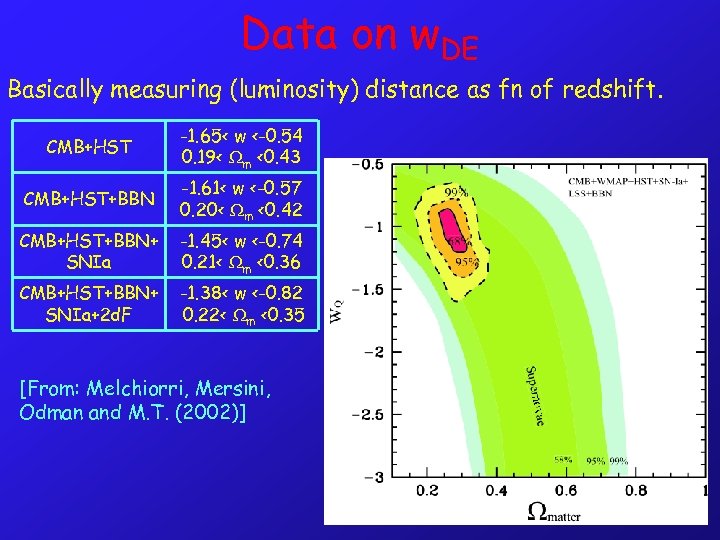 Data on w. DE Basically measuring (luminosity) distance as fn of redshift. CMB+HST -1. 65< w <-0. 54 0. 19< m <0. 43 CMB+HST+BBN -1. 61< w <-0. 57 0. 20< m <0. 42 CMB+HST+BBN+ SNIa -1. 45< w <-0. 74 0. 21< m <0. 36 CMB+HST+BBN+ SNIa+2 d. F -1. 38< w <-0. 82 0. 22< m <0. 35 [From: Melchiorri, Mersini, Odman and M. T. (2002)]
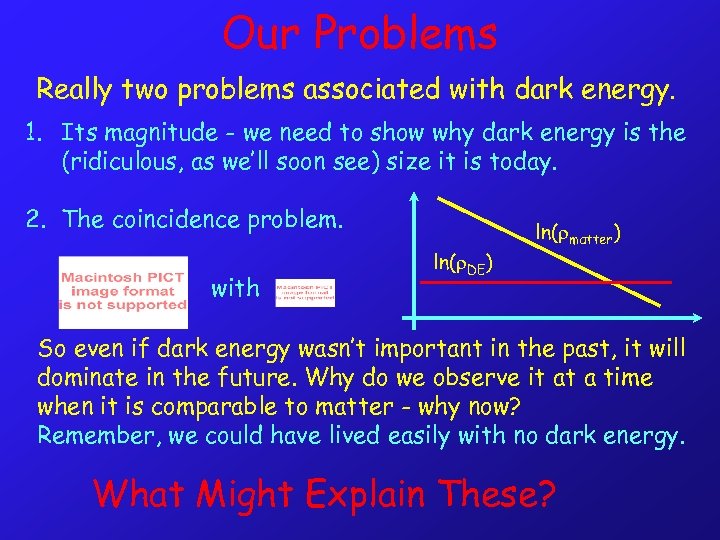 Our Problems Really two problems associated with dark energy. 1. Its magnitude - we need to show why dark energy is the (ridiculous, as we’ll soon see) size it is today. 2. The coincidence problem. with ln( DE) ln( matter) So even if dark energy wasn’t important in the past, it will dominate in the future. Why do we observe it at a time when it is comparable to matter - why now? Remember, we could have lived easily with no dark energy. What Might Explain These?
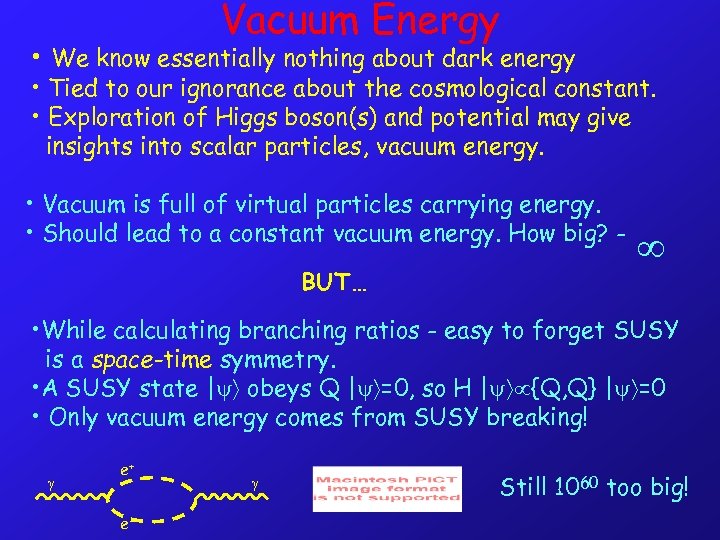 Vacuum Energy • We know essentially nothing about dark energy • Tied to our ignorance about the cosmological constant. • Exploration of Higgs boson(s) and potential may give insights into scalar particles, vacuum energy. • Vacuum is full of virtual particles carrying energy. • Should lead to a constant vacuum energy. How big? BUT… • While calculating branching ratios - easy to forget SUSY is a space-time symmetry. • A SUSY state | obeys Q | =0, so H | {Q, Q} | =0 • Only vacuum energy comes from SUSY breaking! e+ e- Still 1060 too big!
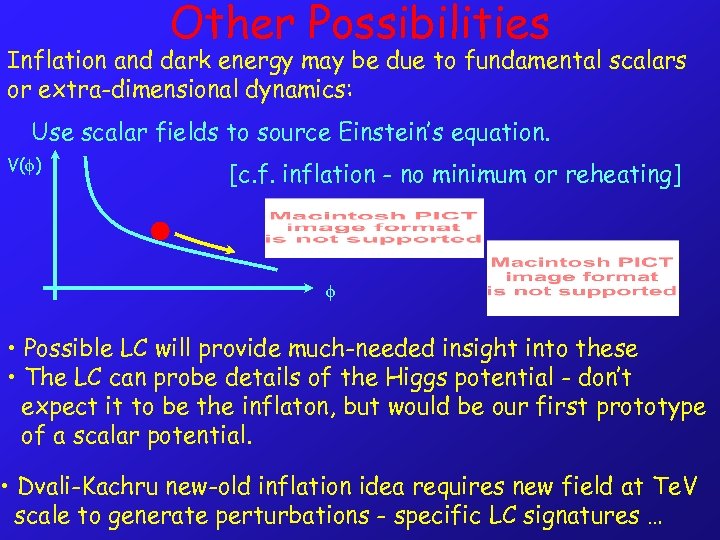 Other Possibilities Inflation and dark energy may be due to fundamental scalars or extra-dimensional dynamics: Use scalar fields to source Einstein’s equation. V( ) [c. f. inflation - no minimum or reheating] • Possible LC will provide much-needed insight into these • The LC can probe details of the Higgs potential - don’t expect it to be the inflaton, but would be our first prototype of a scalar potential. • Dvali-Kachru new-old inflation idea requires new field at Te. V scale to generate perturbations - specific LC signatures …
 Other Approaches • The Anthropic Principle In brief: Assume cosmological constant varies, either from place to place, or over time, or in different universes We live here because we can! (Don’t want to say much about it) • Holography Maybe these ideas will lead us to a new picture of the vacuum • Quantum Gravity e. g. string theory …
 Where Do We Stand? There are no compelling, natural suggestions to date. In one way this demonstrates the current ugly frog nature of particle cosmology when compared to the handsome prince of observational cosmology On the other hand, in more grant proposal-friendly terms, this makes for perhaps the most exciting and challenging time in particle cosmology. It may pay to explore radical options - but we are in the wonderful position of holding such speculation accountable to increasingly accurate data.
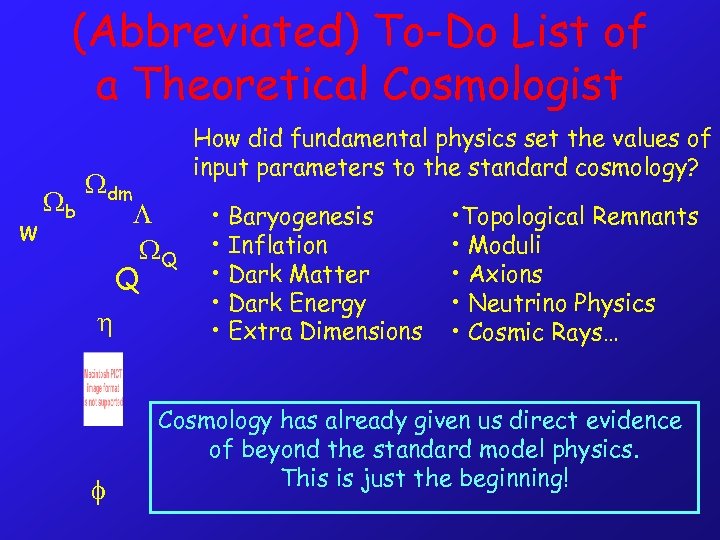 (Abbreviated) To-Do List of a Theoretical Cosmologist w b dm How did fundamental physics set the values of input parameters to the standard cosmology? Q Q • Baryogenesis • Inflation • Dark Matter • Dark Energy • Extra Dimensions • Topological Remnants • Moduli • Axions • Neutrino Physics • Cosmic Rays… Cosmology has already given us direct evidence of beyond the standard model physics. This is just the beginning!
 The ALCPG Working Group on Cosmological Connections http: //www. physics. syr. edu/~trodden/lc-cosmology/ Editorial Committee: • Marco Battaglia (Berkeley) • Jonathan Feng (Irvine, co-Chair) jlf@uci. edu • Norman Graf (SLAC) • Michael Peskin (SLAC) • Mark Trodden (Syracuse, co-Chair) trodden@physics. syr. edu Expect to produce white paper by Fall 2004 • Very successful (3 full parallel sessions) outing at SLAC • Would be great to see this duplicated at all meetings Although we are an extremely international group, would be useful to see a complementary international committee, beyond our 3 -person task force (Abdelhak Djouadi, Nobuchika Okada & M. T. ) devoted to these connections
 A Cautionary Comment (Echoing Howie Haber’s talk yesterday and Michael Peskin’s this morning) I am not a conservative! (and neither are most of you) • It is important to have a common framework - so it is extremely useful to think about m. SUGRA in this context. • However, should recognize this is a unlikely constraint on possibilities, even within SUSY. An appeal for nonminimality! • Shouldn’t fool ourselves that we are covering “a large part of parameter space” - more work is needed - don’t give up! Some of the important work of our group involves more general studies and techniques. [e. g. Interesting general work by Birkedal, Matchev & Perelstein] • On topic of not giving up - despite fairly solid theoretical arguments, too early to say we won’t learn about dark energy from terrestrial physics - we know nothing about this! • Would be nice to see a proof-of-principle model.
 Final Comments • Science: A linear collider may help address some of the biggest and most pressing issues in cosmology - dark matter, baryogenesis, cosmic rays and perhaps even give hints about dark energy and inflation. • Science: A strong collider program is a necessary and natural complement to cosmological observations if we are to unravel the fundamental physics reasons behind the universe we observe. • Obvious PR: This is important because people can see stars and galaxies, and feel that the universe is much more tangible than, say, the Higgs boson or supersymmetry - as beautiful as they may be to most of us. A plea: If the connections between the LC and cosmology are to be taken seriously by both communities, by policy-makers and by the public - will need subgroups devoted to this in each region and separate parallel sessions at all LCWS meetings -Thank You -