


 Скачать презентацию Conjugate the following words into Genitive and Dative
Lesson 6.pptx
- Количество слайдов: 9
 Conjugate the following words into Genitive and Dative cases: комната отец нос поле Write 3 ways saying time in Russian: 18. 30 17. 40 (4 ways, hint: a quarter - 20) 12. 00 (2 ways here) 0. 00 (2 ways here) 10. 10
 Translate into Russian the following words: February, 6 th May, 18 th July, 3 th November, 23 th December, 25 th June, 4 th January, 1 st
 The accusative case marks the object of the action, like the English word "letter" in the phrase "he is writing a letter". 1. To show the object of the action, most often a direct object in the sentence. Example: Студент читает книгу. – The student is reading a book. (What does the student read? ) 2. With prepositions в (into) and на (on to) to express motion to somewhere. Example: Он едет в Москву. - He is going to Moscow. (Where does he go? )
 3. In certain expressions describing duration or frequency of an action, for example: одну неделю - one week одну минуту - one minute два раза в неделю - two times a week один раз в месяц - one time a month Example: Я здесь живу одну неделю. - I've been living here for a week. (For how long have I been living here? ) 4. After certain prepositions: через – across, after a period of time за - for (in return for) про - about
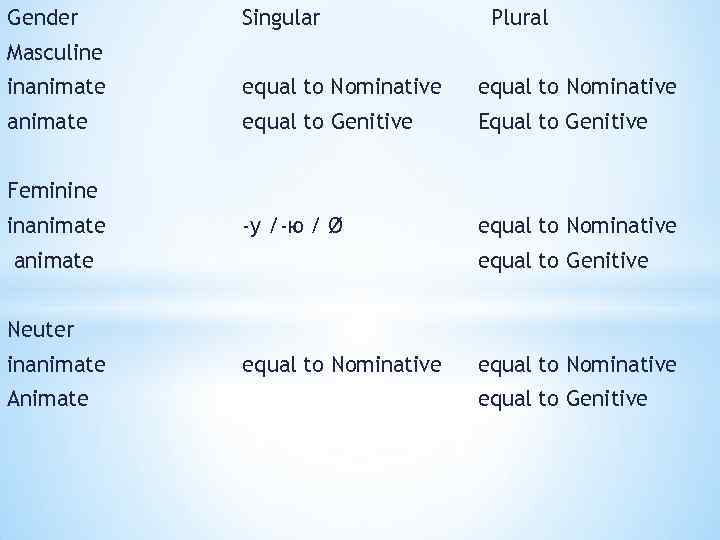 Gender Singular Plural Masculine inanimate equal to Nominative animate equal to Genitive Equal to Genitive -у /-ю / Ø equal to Nominative Feminine inanimate equal to Genitive Neuter inanimate Animate equal to Nominative equal to Genitive
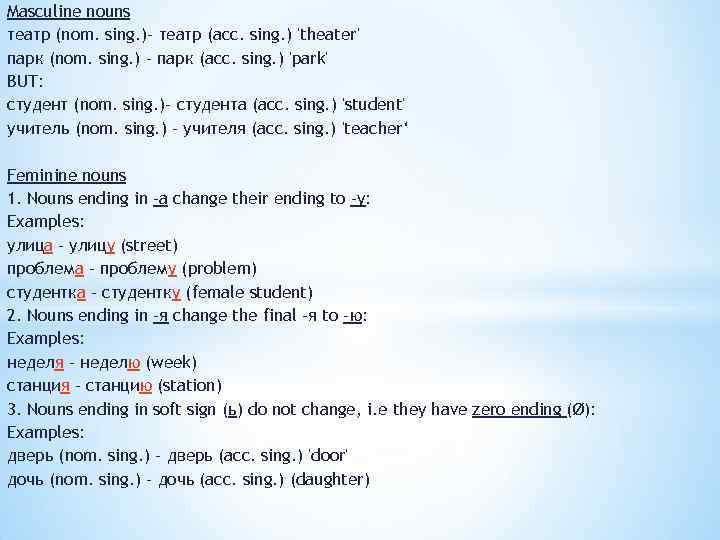 Masculine nouns театр (nom. sing. )- театр (acc. sing. ) 'theater' парк (nom. sing. ) - парк (acc. sing. ) 'park' BUT: студент (nom. sing. )- студента (acc. sing. ) 'student' учитель (nom. sing. ) - учителя (acc. sing. ) 'teacher‘ Feminine nouns 1. Nouns ending in -а change their ending to -у: Examples: улица - улицу (street) проблема - проблему (problem) студентка - студентку (female student) 2. Nouns ending in -я change the final -я to -ю: Examples: неделя - неделю (week) станция - станцию (station) 3. Nouns ending in soft sign (ь) do not change, i. e they have zero ending (Ø): Examples: дверь (nom. sing. ) - дверь (acc. sing. ) 'door' дочь (nom. sing. ) - дочь (acc. sing. ) (daughter)
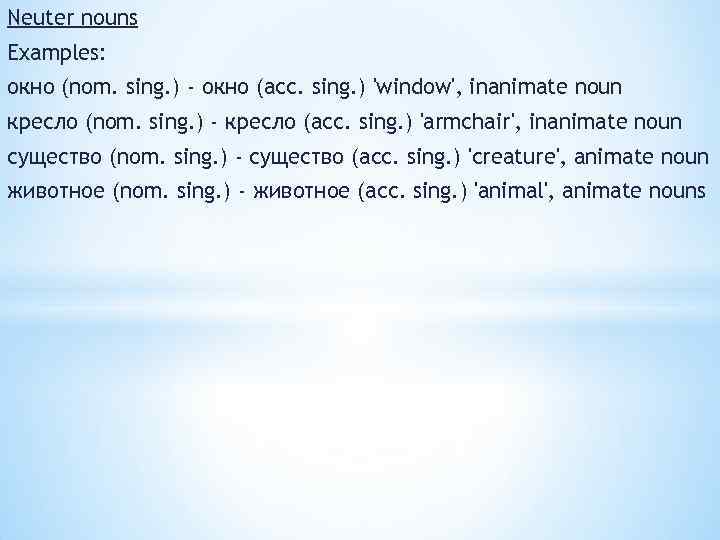 Neuter nouns Examples: окно (nom. sing. ) - окно (acc. sing. ) 'window', inanimate noun кресло (nom. sing. ) - кресло (acc. sing. ) 'armchair', inanimate noun существо (nom. sing. ) - существо (acc. sing. ) 'creature', animate noun животное (nom. sing. ) - животное (acc. sing. ) 'animal', animate nouns
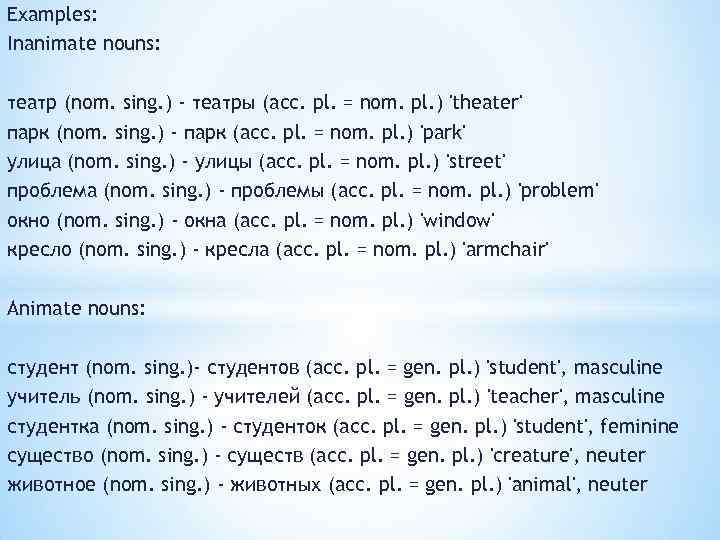 Examples: Inanimate nouns: театр (nom. sing. ) - театры (acc. pl. = nom. pl. ) 'theater' парк (nom. sing. ) - парк (acc. pl. = nom. pl. ) 'park' улица (nom. sing. ) - улицы (acc. pl. = nom. pl. ) 'street' проблема (nom. sing. ) - проблемы (acc. pl. = nom. pl. ) 'problem' окно (nom. sing. ) - окна (acc. pl. = nom. pl. ) 'window' кресло (nom. sing. ) - кресла (acc. pl. = nom. pl. ) 'armchair' Animate nouns: студент (nom. sing. )- студентов (acc. pl. = gen. pl. ) 'student', masculine учитель (nom. sing. ) - учителей (acc. pl. = gen. pl. ) 'teacher', masculine студентка (nom. sing. ) - студенток (acc. pl. = gen. pl. ) 'student', feminine существо (nom. sing. ) - существ (acc. pl. = gen. pl. ) 'creature', neuter животное (nom. sing. ) - животных (acc. pl. = gen. pl. ) 'animal', neuter
 Practice Conjugate the following words into Genitive, Dative and Accusative cases: Солнце Колодец, колодцы Дорога, дороги Мама, мамы Друг, друзья Лень День, дни