


 Скачать презентацию Congressional Actions and the National Park Service Monday
1139184b34afd362543fc81ed43488b5.ppt
- Количество слайдов: 77
 Congressional Actions and the National Park Service Monday and Tuesday January 23 and 24, 2006 1: 00 -4: 00 PM Eastern time each day 1
 Today’s course is sponsored by: Capital Training Center Supervision, Management, and Leadership Program Sandy Taylor, Program Manager 202 -354 -1413 2
 Before We Begin… • How to interact with the instructors – – ID your site Wait 1. 5 seconds before answering “Time-out” signal Designated Q&A opportunities! • You may e-mail questions to broadcast@fws. gov • If you NEED A PARTICIPANT GUIDE, please email broadcast@fws. gov (same guide for both days) 3
 Course Objectives • • • Roles and powers Key entities that affect NPS 2 reasons to provide prompt info. Communicate with outside audiences Develop a briefing statement Develop an “outreach plan” 4
 Map of Washington 5
 Origins U. S. Constitution 1787 • Outlines the government of the United States • John Locke, David Hume, C. L. Montesquieu • 3 separate, equal branches of government 6
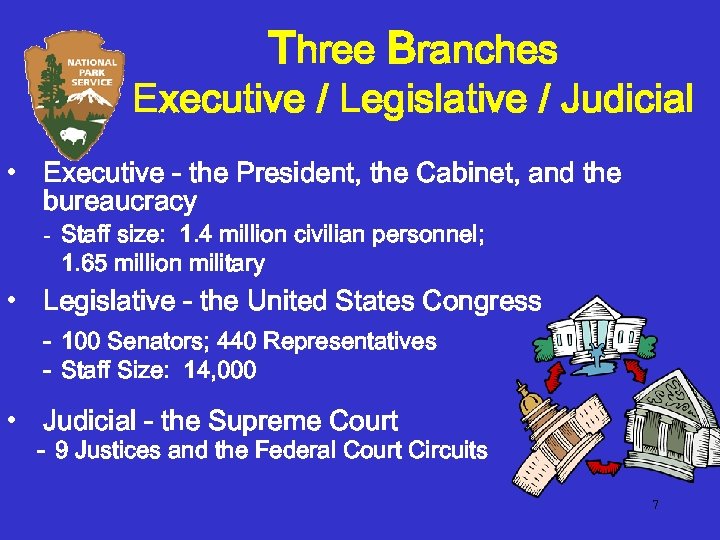 Three Branches Executive / Legislative / Judicial • Executive - the President, the Cabinet, and the bureaucracy - Staff size: 1. 4 million civilian personnel; 1. 65 million military • Legislative - the United States Congress - 100 Senators; 440 Representatives - Staff Size: 14, 000 • Judicial - the Supreme Court - 9 Justices and the Federal Court Circuits 7
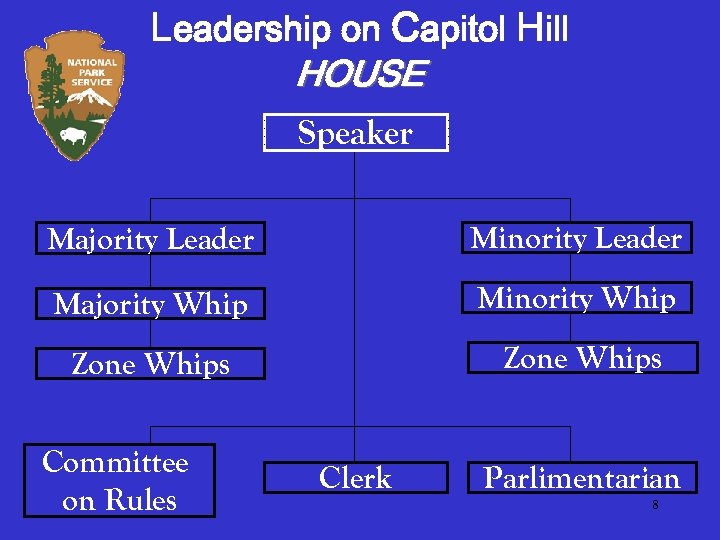 Leadership on Capitol Hill HOUSE Speaker Majority Leader Minority Leader Majority Whip Minority Whip Zone Whips Committee on Rules Clerk Parlimentarian 8
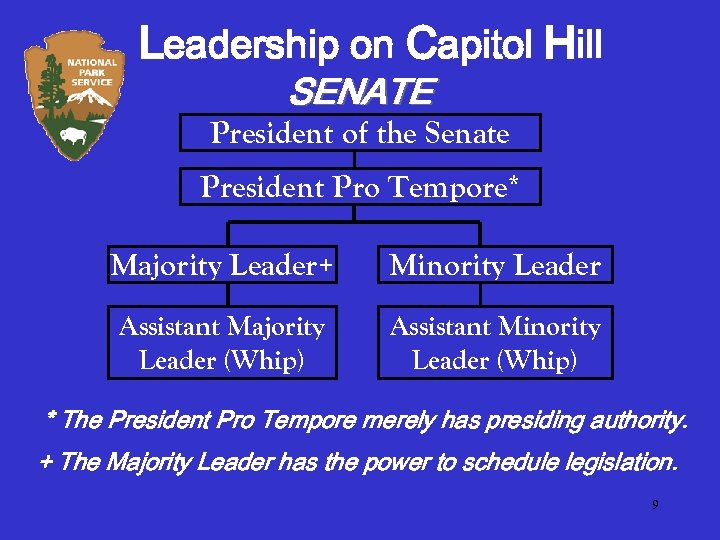 Leadership on Capitol Hill SENATE President of the Senate President Pro Tempore* Majority Leader+ Minority Leader Assistant Majority Leader (Whip) Assistant Minority Leader (Whip) * The President Pro Tempore merely has presiding authority. + The Majority Leader has the power to schedule legislation. 9
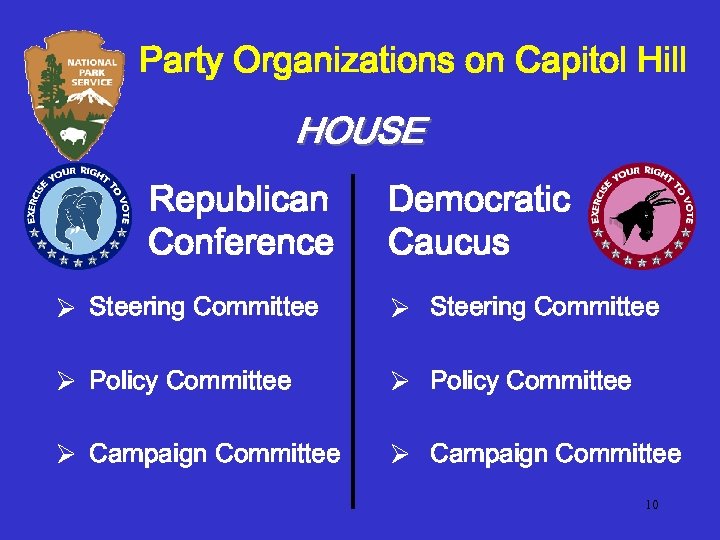 Party Organizations on Capitol Hill HOUSE Republican Conference Democratic Caucus Ø Steering Committee Ø Policy Committee Ø Campaign Committee 10
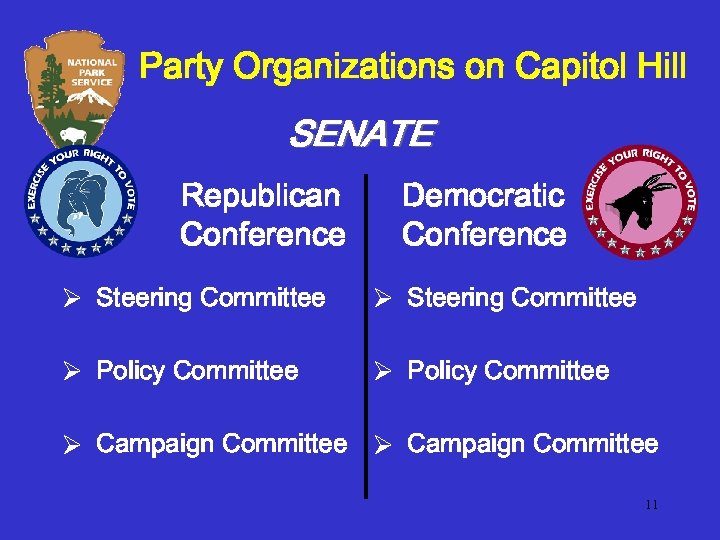 Party Organizations on Capitol Hill SENATE Republican Conference Democratic Conference Ø Steering Committee Ø Policy Committee Ø Campaign Committee 11
 Exercise: Who’s Who in Congress? Participant Guide Page 7 12
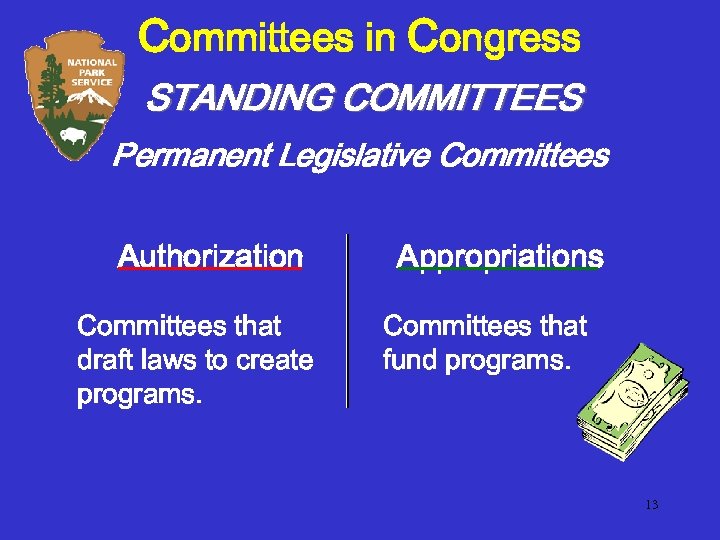 Committees in Congress STANDING COMMITTEES Permanent Legislative Committees Authorization Committees that draft laws to create programs. Appropriations Committees that fund programs. 13
 Committees That Impact NPS Participant Guide Page 34 14
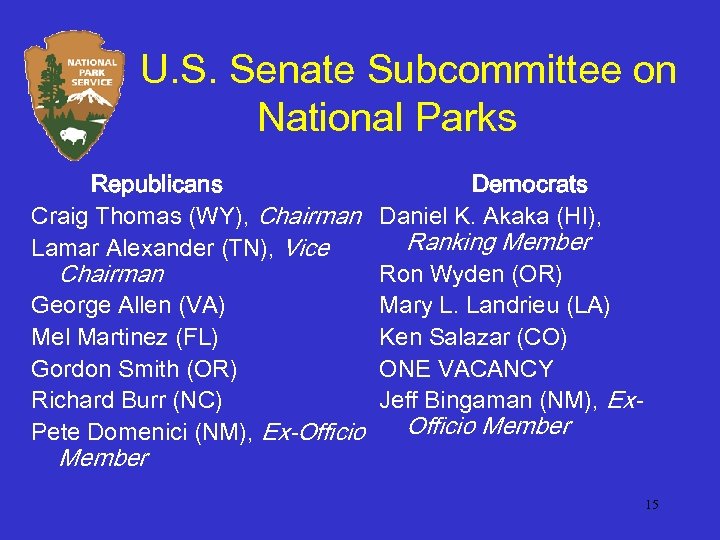 U. S. Senate Subcommittee on National Parks Republicans Democrats Craig Thomas (WY), Chairman Daniel K. Akaka (HI), Ranking Member Lamar Alexander (TN), Vice Chairman Ron Wyden (OR) George Allen (VA) Mary L. Landrieu (LA) Mel Martinez (FL) Ken Salazar (CO) Gordon Smith (OR) ONE VACANCY Richard Burr (NC) Jeff Bingaman (NM), Ex. Officio Member Pete Domenici (NM), Ex-Officio Member 15
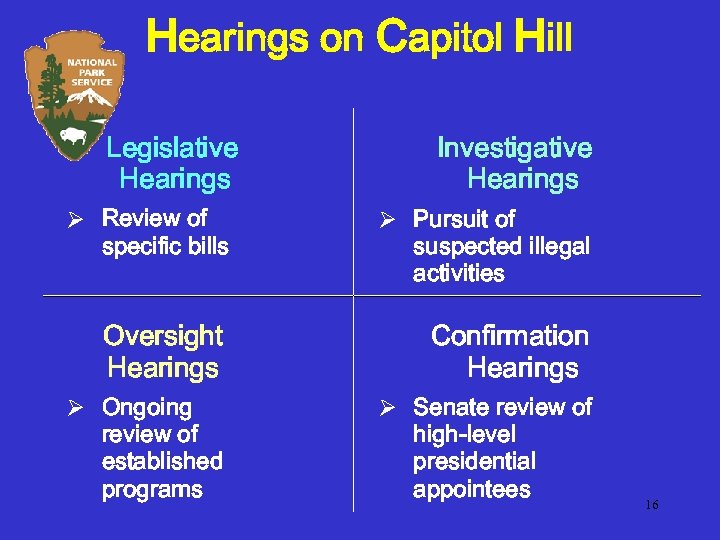 Hearings on Capitol Hill Legislative Hearings Investigative Hearings Ø Review of specific bills Ø Pursuit of suspected illegal activities Oversight Hearings Confirmation Hearings Ø Ongoing review of established programs Ø Senate review of high-level presidential appointees 16
 Committee Staff • Staff Director • General Counsel • Professional Committee Staff • Administrative Staff 17
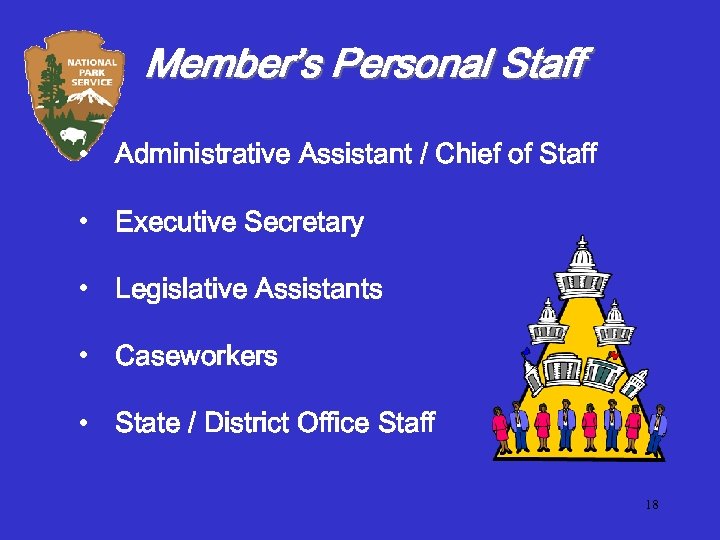 Member’s Personal Staff • Administrative Assistant / Chief of Staff • Executive Secretary • Legislative Assistants • Caseworkers • State / District Office Staff 18
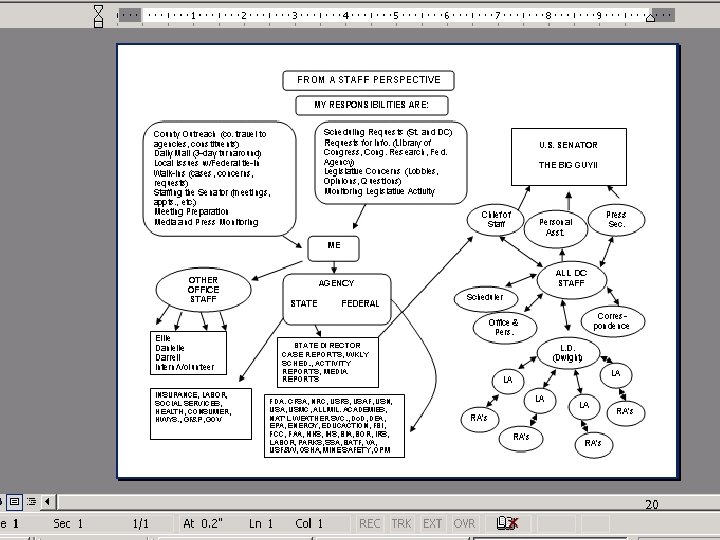
 Typical Day for Staff Participant Guide Page 10 19
 20
20
 Tips on Working with Congressional Staff Participant Guide Page 11 21
 Writing a Briefing Statement • Bureau: • Background: • Member: • Current Status: • Issue: • Prepared By: • Key Points: • Telephone: REMEMBER the Communication Tips! 22
 BREAK!! 23
 Laws That Guide the Work of the National Park Service Participant Guide Page 13 24
 Laws That Guide the Work of the NPS • General Authorities • Park Specific • Other Laws 25
 General Authorities • National Park Service Organic Act (1916) • Historic Sites Act (1935) • General Authorities Act (1970) • Historic Preservation Act (1966) • Wilderness Act (1964) • Land Water Conservation Act (1964) • Wild & Scenic Rivers Act (1968) • National Trails System Act (1968) • Archaeological Resources Protection Act (1979) • Native American Graves Protection and Repatriation Act (1990) • National Parks Omnibus Management Act (1998) and many other laws 26
 Park Specific Cumberland Island National Seashore as well as other Parks in the system 27
 Other Laws • National Environmental Policy Act • Clean Air Act • Clean Water Act and many other laws 28
 Origins of NPS Bills Participant Guide Page 14 29
 Origins of NPS Bills 30
 Summary of National Park Service Laws in 109 th Congress January 4, 2005 – Participant Guide Page 15 31
 32
32
 Office of Legislative and Congressional Affairs Functions of the Division of Legislation • • Legislative Programs Legislative Review Archival Functions Information Services Participant Guide Page 19 33
 Office of Legislative and Congressional Affairs Functions of the Congressional Liaison • • Liaison Services Information Services Special Projects Scheduling 34
 Exercise: Roles and Authorities Participant Guide Page 22 35
 Outreach Participant Guide Page 24 36
 Exercise: What Are They Saying? Participant Guide Page 25 37
 Exercise: Briefing Statement Develop a BRIEFING STATEMENT on a legislative issue related to your park or site. For 1 HOUR EXTRA COURSE CREDIT, please submit your statement by: Participant Guide Monday, February 27, 2006 to Don_Hellmann@nps. gov Page 25 38
 Managers Institute on Public Policy April 3 -7, 2006 Washington, DC Course announcement will be available at My Learning Manager by Friday, Jan. 27, 2006 (check with your Employee Development Officer for info. ) 39
 To Get Credit for this Course • Make sure you sign the student roster. • UPON RECEIPT OF E-MAIL NOTIFICATION, complete the online course evaluation. 40
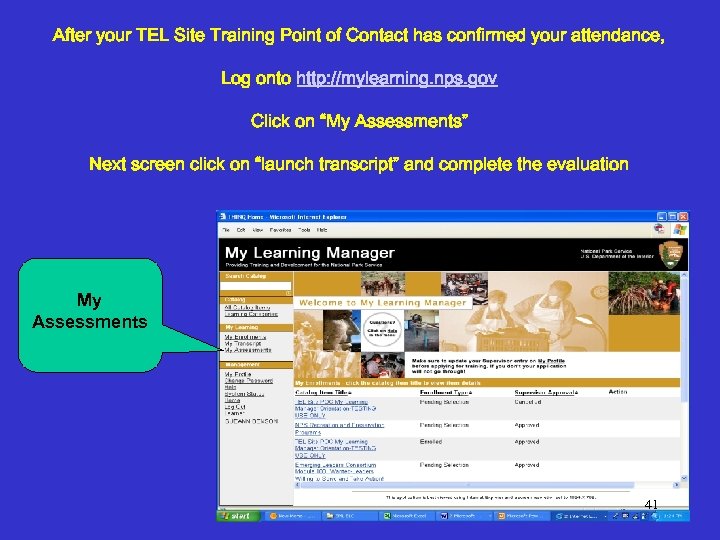 After your TEL Site Training Point of Contact has confirmed your attendance, Log onto http: //mylearning. nps. gov Click on “My Assessments” Next screen click on “launch transcript” and complete the evaluation My Assessments 41
 Today’s course is sponsored by: Capital Training Center Supervision, Management, and Leadership Program Sandy Taylor, Program Manager 202 -354 -1413 42
 Before We Begin… Participant • How to interact with the instructors Guide – – ID your site Wait 1. 5 seconds before answering “Time-out” signal Designated Q&A opportunities! Page 26 • You may e-mail questions to broadcast@fws. gov • If you NEED A PARTICIPANT GUIDE, please email broadcast@fws. gov (same guide for both days) 43
 Course Objectives • • • Roles and powers Key entities that affect NPS 2 reasons to provide prompt info. Communicate with outside audiences Develop a briefing statement Develop an “outreach plan” 44
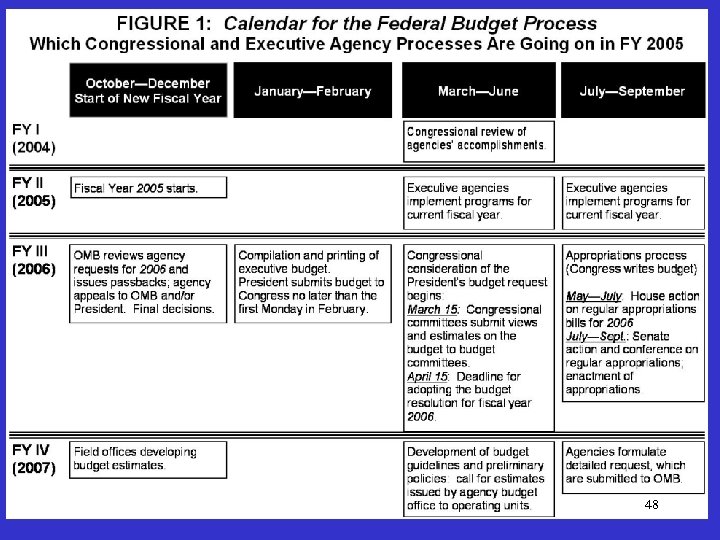
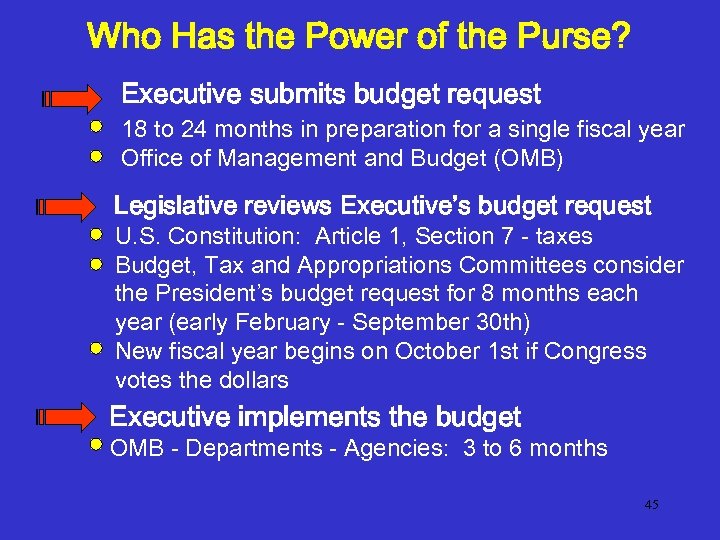 Who Has the Power of the Purse? • Executive submits budget request 18 to 24 months in preparation for a single fiscal year Office of Management and Budget (OMB) • Legislative reviews Executive’s budget request U. S. Constitution: Article 1, Section 7 - taxes Budget, Tax and Appropriations Committees consider the President’s budget request for 8 months each year (early February - September 30 th) New fiscal year begins on October 1 st if Congress votes the dollars • Executive implements the budget OMB - Departments - Agencies: 3 to 6 months 45
 Executive Submits Budget Request • 18 to 24 months in preparation for a single fiscal year • Office of Management and Budget (OMB) 46
 Executive Implements the Budget OMB - Departments – Agencies 3 to 6 months 47
 48
48
 Legislative Staff and Agencies Support Agencies • Congressional Research Service • Government Accountability Office • Congressional Budget Office 49
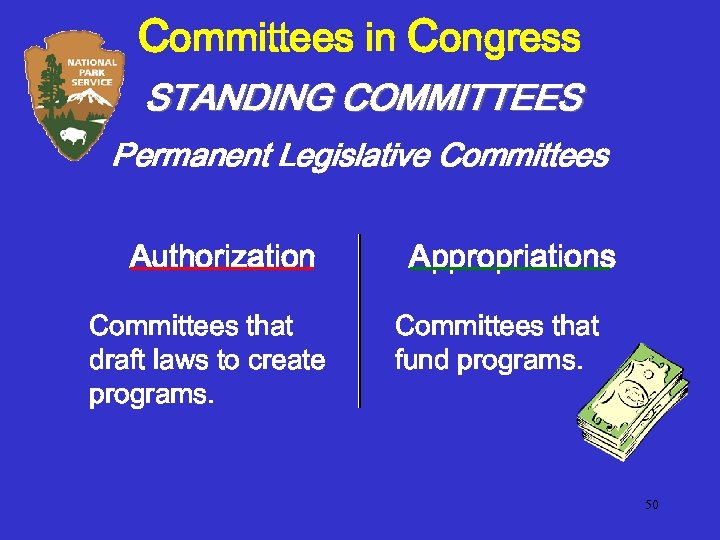 Committees in Congress STANDING COMMITTEES Permanent Legislative Committees Authorization Committees that draft laws to create programs. Appropriations Committees that fund programs. 50
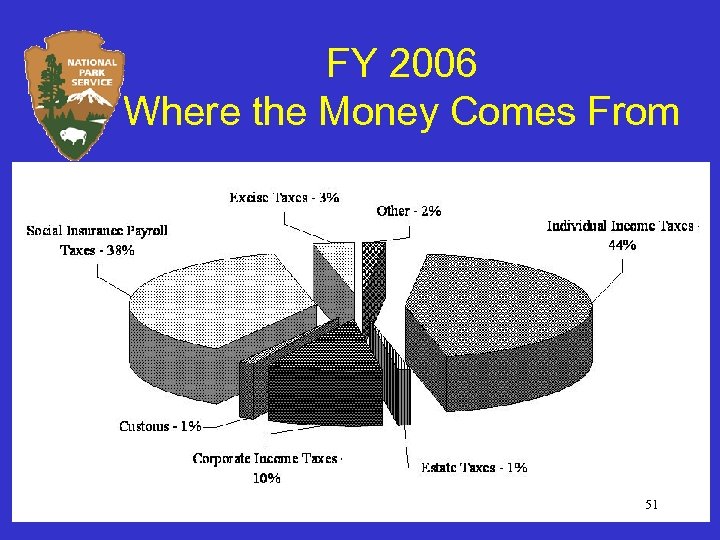 FY 2006 Where the Money Comes From 51
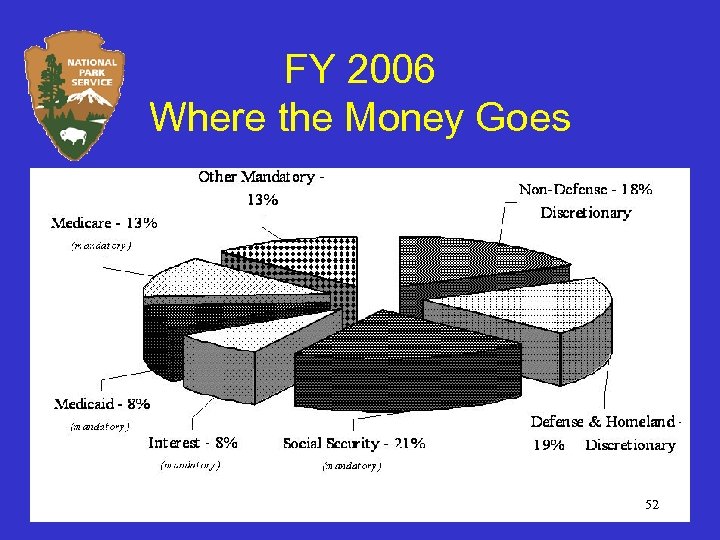 FY 2006 Where the Money Goes 52
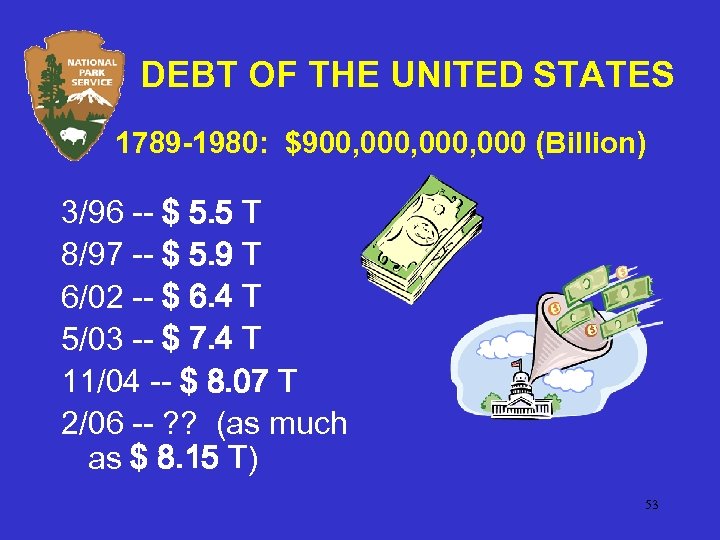 DEBT OF THE UNITED STATES 1789 -1980: $900, 000, 000 (Billion) 3/96 -- $ 5. 5 T 8/97 -- $ 5. 9 T 6/02 -- $ 6. 4 T 5/03 -- $ 7. 4 T 11/04 -- $ 8. 07 T 2/06 -- ? ? (as much as $ 8. 15 T) 53
 BREAK!! 54
 Budget Cycle • Spring – 18 mo. before FY begins – OMB/DOI instructions to bureau – NPS instructions to field to update OFS – Review construction (PMIS) – Review land acquisition 55
 Budget Cycle cont’d. • Summer – Secretarial/DOI review • Early Fall – OMB review • Late Fall – OMB passback 56
 Budget Cycle cont’d. • January – President’s budget to Congress • February – NPS budget to Congress • Early Spring – NPS appropriations hearings – Senate appropriations hearings (Secretary) 57
 Budget Cycle cont’d. • Late Spring/Summer – House markup – Senate markup • Fall – Appropriations • October – Start of Fiscal Year 58
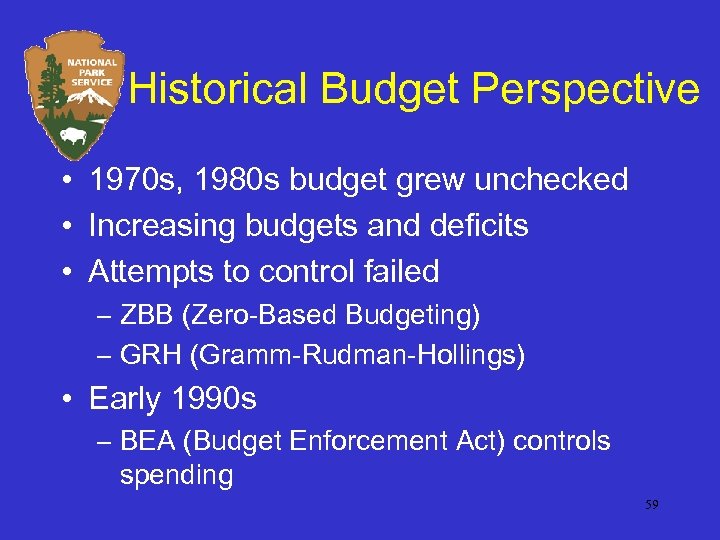 Historical Budget Perspective • 1970 s, 1980 s budget grew unchecked • Increasing budgets and deficits • Attempts to control failed – ZBB (Zero-Based Budgeting) – GRH (Gramm-Rudman-Hollings) • Early 1990 s – BEA (Budget Enforcement Act) controls spending 59
 60
60
 61
61
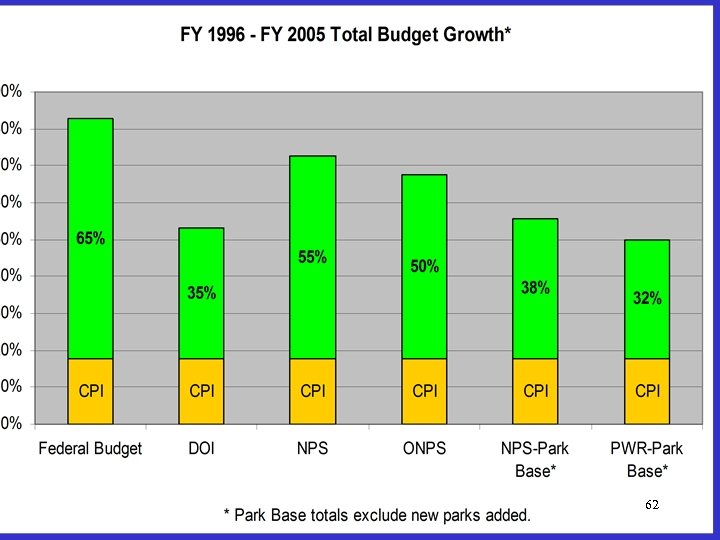 62
62
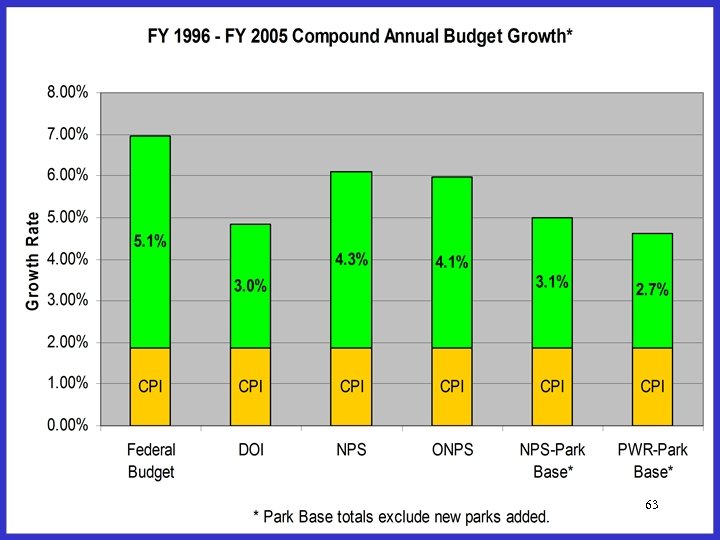 63
63
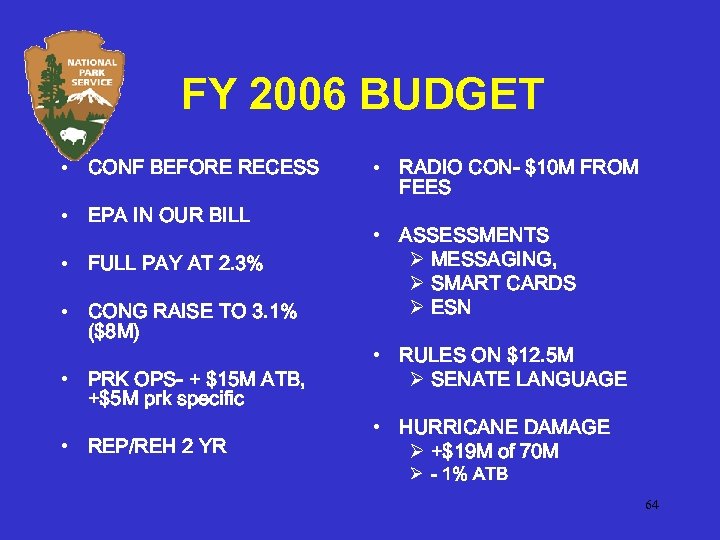 FY 2006 BUDGET • CONF BEFORE RECESS • EPA IN OUR BILL • FULL PAY AT 2. 3% • CONG RAISE TO 3. 1% ($8 M) • PRK OPS- + $15 M ATB, +$5 M prk specific • REP/REH 2 YR • RADIO CON- $10 M FROM FEES • ASSESSMENTS Ø MESSAGING, Ø SMART CARDS Ø ESN • RULES ON $12. 5 M Ø SENATE LANGUAGE • HURRICANE DAMAGE Ø +$19 M of 70 M Ø - 1% ATB 64
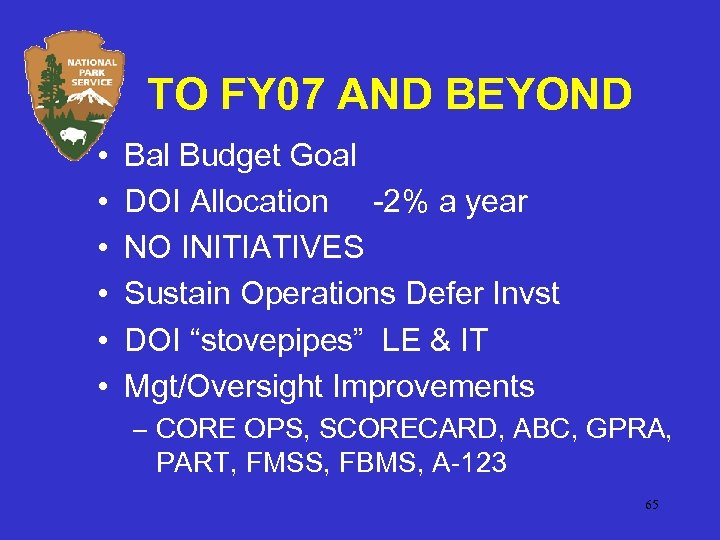 TO FY 07 AND BEYOND • • • Bal Budget Goal DOI Allocation -2% a year NO INITIATIVES Sustain Operations Defer Invst DOI “stovepipes” LE & IT Mgt/Oversight Improvements – CORE OPS, SCORECARD, ABC, GPRA, PART, FMSS, FBMS, A-123 65
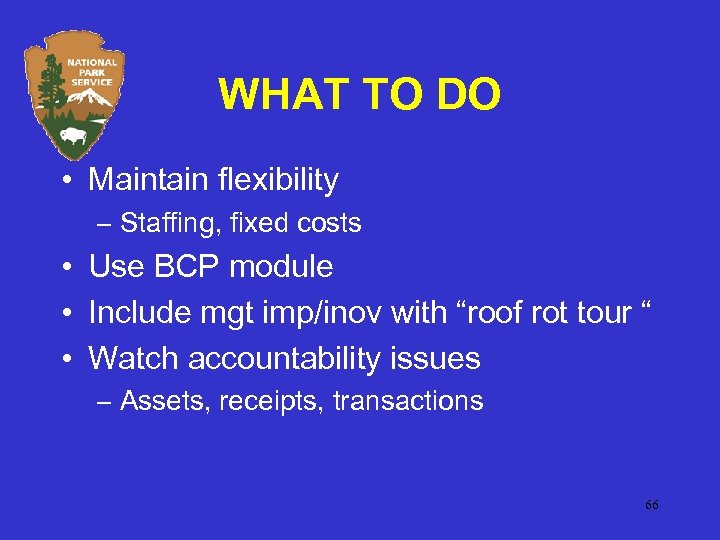 WHAT TO DO • Maintain flexibility – Staffing, fixed costs • Use BCP module • Include mgt imp/inov with “roof rot tour “ • Watch accountability issues – Assets, receipts, transactions 66
 67
67
 68
68
 Exercise: What Entities Impact the NPS Budget? Participant Guide Page 31 69
 Developing an Outreach Plan • ID your audience (Congressional staff, WASO, members of the public, community leaders, tribal leaders) • ID your message • Develop your statement (BRIEF) • Be on time • Expect a short meeting—your handout should speak for itself 70
 Present a Justification For an Operating Increase • Address a single, specific problem/need. New workload/requirement. How do you know problem exists? • Be Concise—assume reviewer knows nothing about your park/program. (Have someone else read your draft. ) • Quantitative—i. e. , # of visitors benefited, area to be covered. • Qualitative—In what way will benefits be gained? 71
 Present a Justification for an Operating Increase • Relate desired situation to current situation. – What are you SPENDING now? – What are you DOING now? • Where possible, relate to: – Business plan – Core operations – GPRA goals • Be accurate – Down 30 FTEs – Visitation up 10% 72
 Homework!! • Prepare a BUDGET JUSTIFICATION • For 1 EXTRA HOUR COURSE CREDIT, please submit your justification by Tuesday, February 28, 2006, to Kenneth_Mueller@nps. gov • Course evaluation 73
 When Leadership Finds You “If you want leadership, you shouldn’t have it. Instead, if you commit to other things, leadership will come. ” --John C. Maxwell, Ph. D. , best-selling author, speaker, trainer on leadership principles 74
 Managers Institute on Public Policy April 3 -7, 2006 Washington, DC Course announcement will be available at My Learning Manager by Friday, Jan. 27, 2006 (check with your Employee Development Officer for info. ) 75
 To Get Credit for this Course • Make sure you sign the student roster. • UPON RECEIPT OF E-MAIL NOTIFICATION, complete the online course evaluation. 76
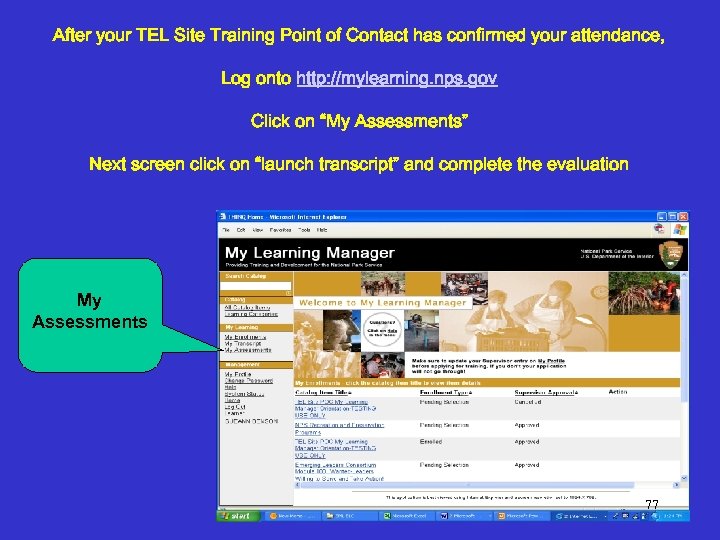 After your TEL Site Training Point of Contact has confirmed your attendance, Log onto http: //mylearning. nps. gov Click on “My Assessments” Next screen click on “launch transcript” and complete the evaluation My Assessments 77