


 Скачать презентацию Congress In Action Ch 12 Notes and Review
1c345b811d4884f22b58f25604650040.ppt
- Количество слайдов: 54
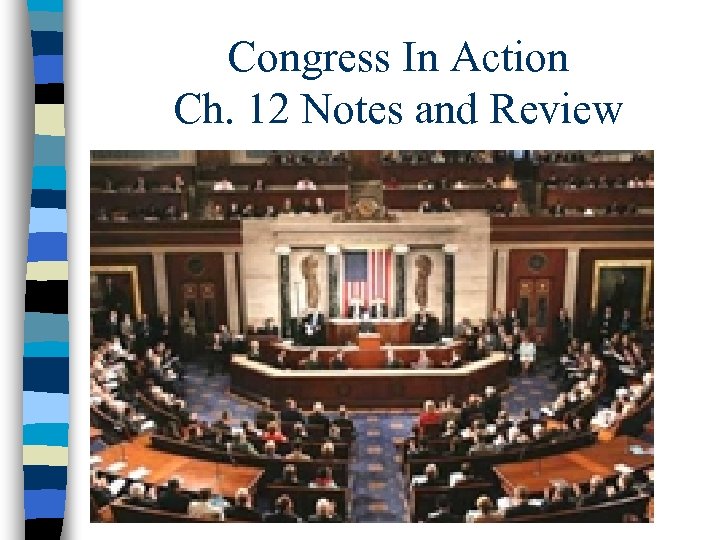 Congress In Action Ch. 12 Notes and Review
 Congress Organizes Sect. 12. 1
 Speaker of the House n Arguably the most powerful person in Congress (House or Senate) n The elected presiding officer of the House and the leader of the majority party in the House n Expected to preside in a fair and judicious manner, also expected to help their own party whenever possible
 Roles and Duties n To preside and keep order over the House n Decides who gets to speak and when n Interprets and applies the rules n Refers bills to committees n Decides when to call a vote n With careful planning, can usually decide the outcome of most votes
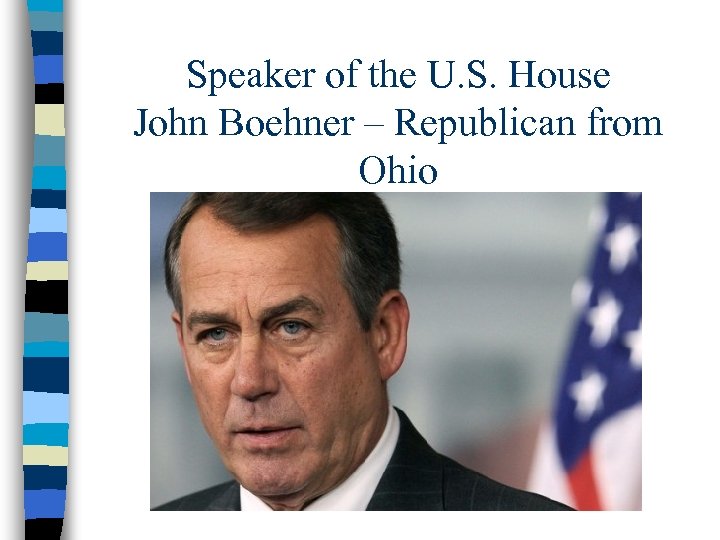 Speaker of the U. S. House John Boehner – Republican from Ohio
 President of the Senate n Sounds more important than it really is. n Not a member of the Senate at all. n The position is reserved for the Vice Pres. n When the VP is there, he or she does have the powers of the presiding officer n However, the VP is rarely present in the Senate.
 n VP usually goes to the Senate for special occasions or events of critical importance n VP (Pres. Of the Senate) most important role is to vote in case of a tie
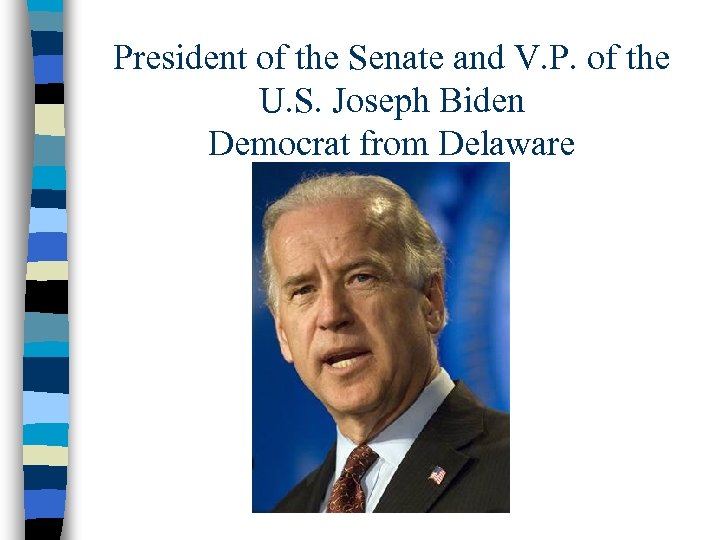 President of the Senate and V. P. of the U. S. Joseph Biden Democrat from Delaware
 President Pro Tempore of the Senate n Presides over the Senate when the VP is not present; most of the time. n Elected by the members of the Senate n A leading member of the majority party (not necessarily the same party as the VP)
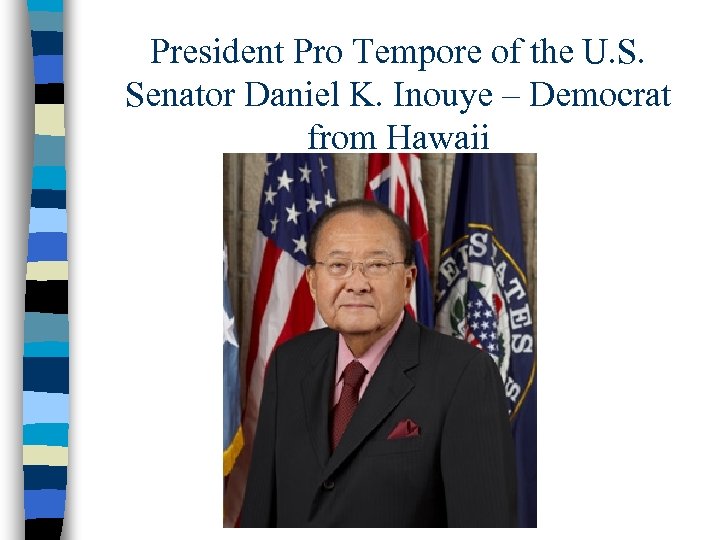 President Pro Tempore of the U. S. Senator Daniel K. Inouye – Democrat from Hawaii
 Floor Leaders and Party Whips n Floor Leaders (Majority and Minority) – These are “unofficial” positions but hold the most power next to the Speaker of the House – They are concerned with party strategy – Help to “steer” Congressional actions to best benefit their party – Chosen by their party
 n Majority and Minority Whips – Assistant to the Majority and Minority Floor Leaders – Again, chosen by their party – Try to organize the vote by their party members. Obviously, they try to convince their members to vote with the party
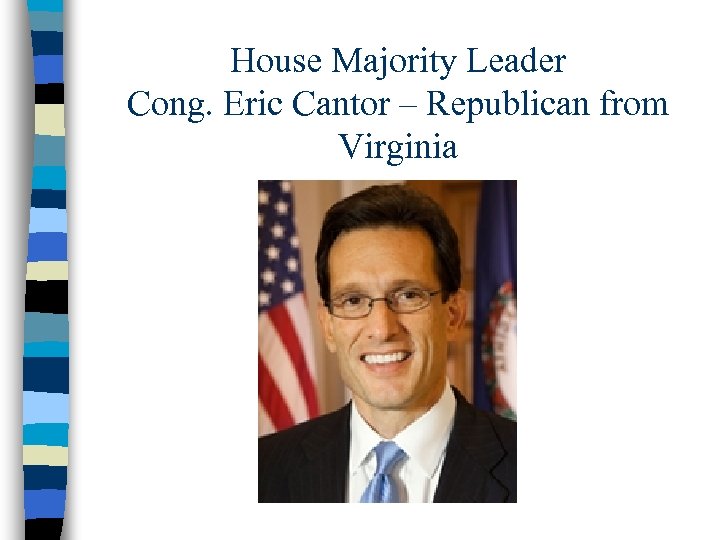 House Majority Leader Cong. Eric Cantor – Republican from Virginia
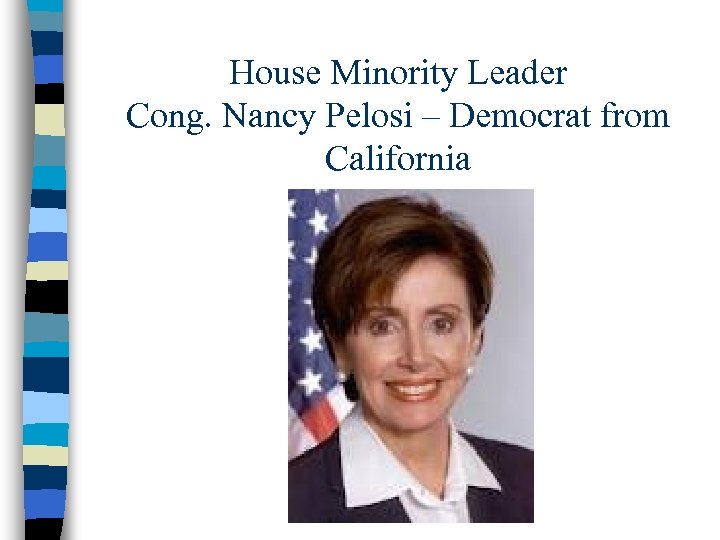 House Minority Leader Cong. Nancy Pelosi – Democrat from California
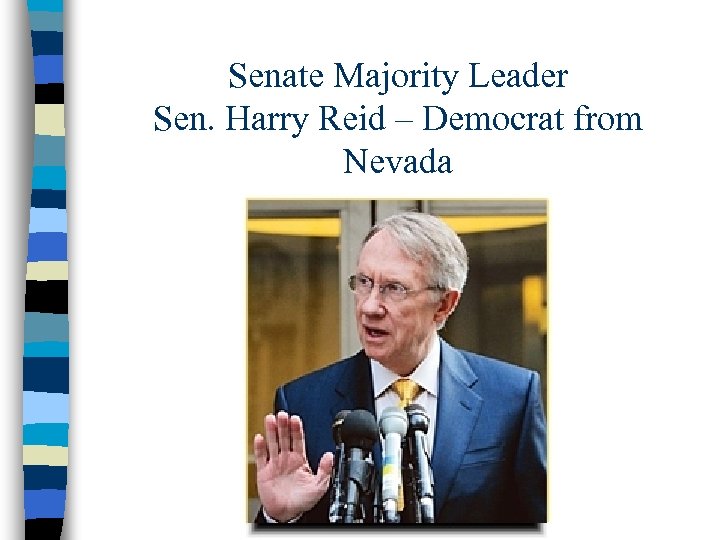 Senate Majority Leader Sen. Harry Reid – Democrat from Nevada
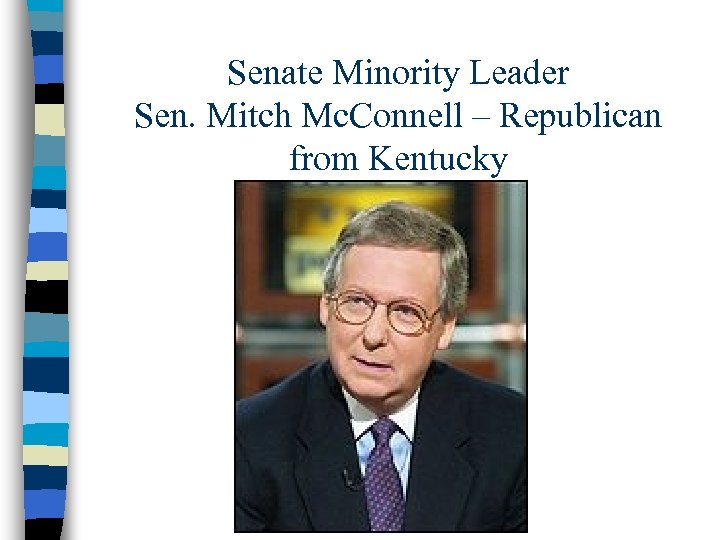 Senate Minority Leader Sen. Mitch Mc. Connell – Republican from Kentucky
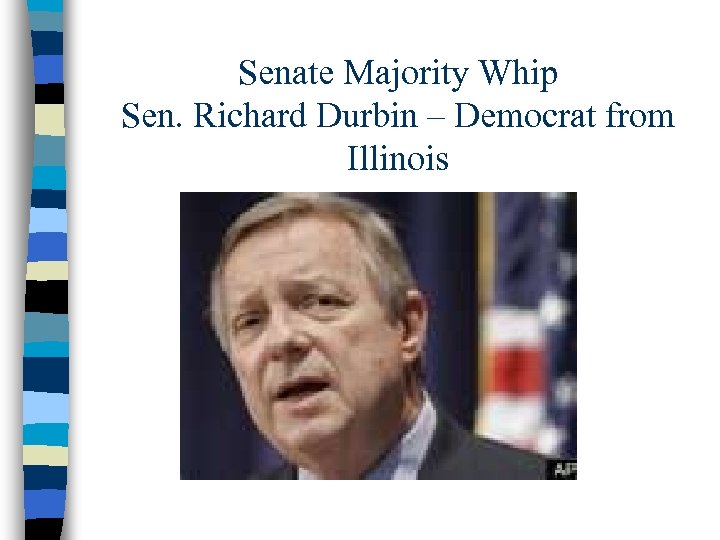 Senate Majority Whip Sen. Richard Durbin – Democrat from Illinois
 Senate Minority Whip Sen. Jon Kyl – Republican from Arizona
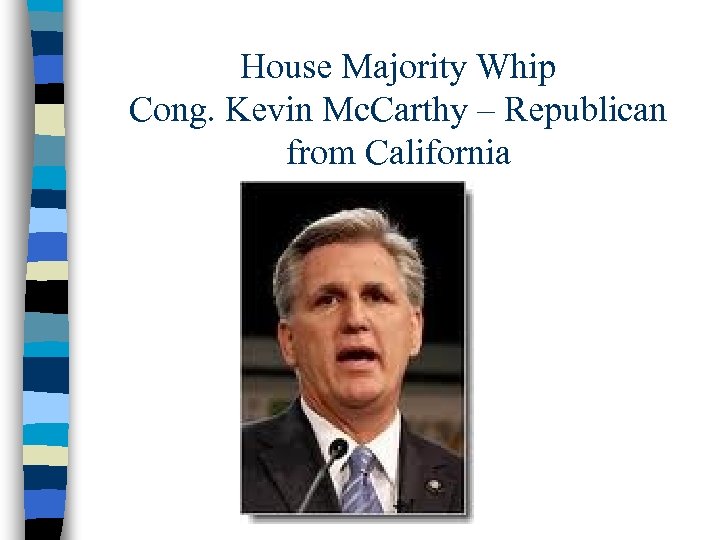 House Majority Whip Cong. Kevin Mc. Carthy – Republican from California
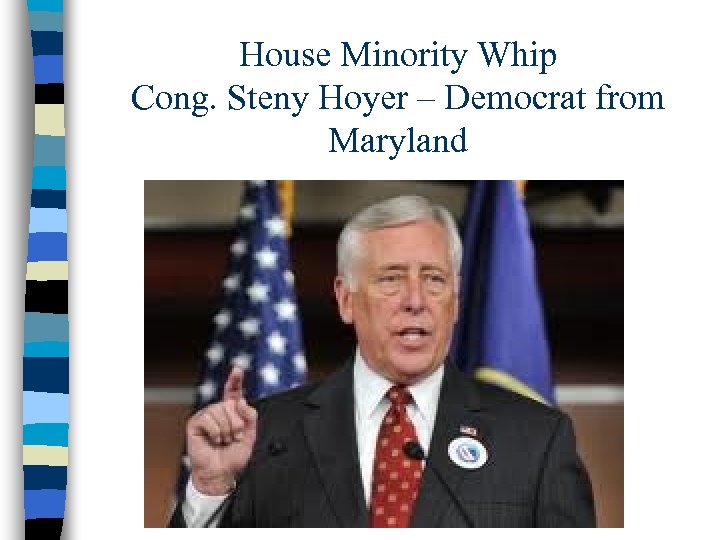 House Minority Whip Cong. Steny Hoyer – Democrat from Maryland
 Party Caucuses (Party Conference) n Closed meeting of each party in each house n Deals with party organization n Selection of party leaders n Discussion on committee selection n Issues of party strategy
 Committee Chairpersons n The head of each standing committee in each chamber of congress n Decides when the committee will meet, what bills they will discuss, when to hold public hearings and which witnesses to hear n Chairperson will try to see their committee’s bills all the way through passage
 The Seniority Rule n An unwritten custom in Congress n The most important jobs and committee assignment go to the those with the longest records of service to Congress n Particularly important in committees since that is where most of the difficult work of Congress takes place
 Seniority Rule Pros n The most experienced and respected people will hold the most important jobs n Easy rule to apply n Eliminates bickering among party members
 Seniority Rule Cons n Ignores ability or someone’s specialty n Discourages young members n Members who have been in Congress for a long time might be out of touch with the wishes of the people n No new people with new ideas
 End of 12. 1 More Later
 Making Laws 12. 3 & 12. 4
 Origin of Bills n Bills come from many sources. – Exec. Branch Agencies – Industry – Special Interest Groups – Private Citizens – Members of Congress
 House or Senate n. A Bill can begin its process in either the House or Senate. n Depends on who is sponsoring the Bill. n Tax Bills MUST begin in the House of Representatives.
 Public and Private Bills n Public Bills apply to the nation as a whole. n Private Bills apply to a select group who are uniquely affected by the Bill.
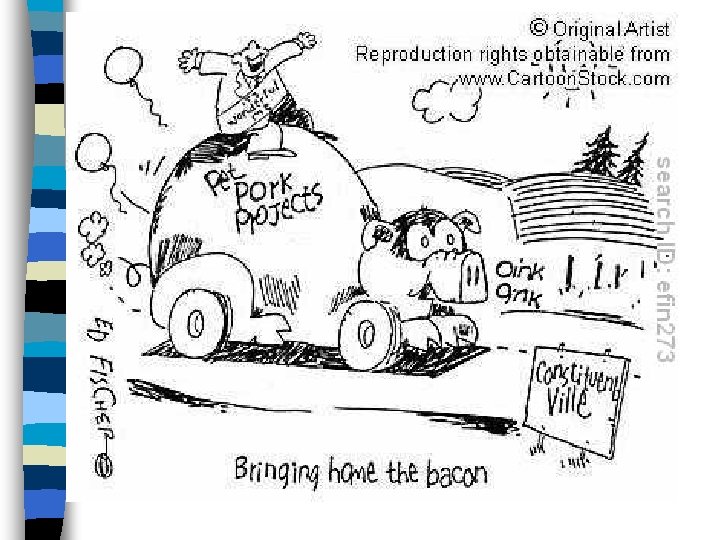
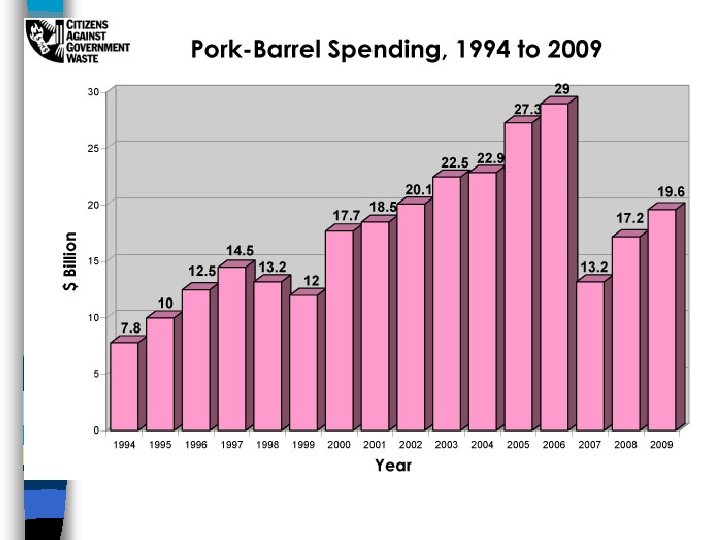
 Riders and Pork Barrel n Additions to a Bill that are unrelated to the intended subject. n Items that are unlikely to pass on their own. Included in an unrelated Bill so as to “ride” through the process and become law. n Usually a pet project of particular members of Congress. n Pork Barrel Spending!!
 Christmas Trees n. A Bill with LOTS of Riders. n Gifts for everyone.
 Introduction n Each Bill is numbered and given a title. n Copies are made for each Representative. n Entered into The Record. n The Bill is read to the whole House.
 The Speaker n The House Speaker assigns the Bill to a Committee. n Has some discretion (flexibility) where he/she sends the Bill. n This can have a huge impact on the chances for the Bill’s survival.
 Standing Committee Sieve n Standing Committees receive a huge amount of Bills. n They must sift through them and focus on only the Bills with the most merit or importance. n All others are “killed”.
 “Pigeon Holed” n Not accepted and not rejected. n Put on a shelf and never acted upon. n Requires a majority vote in the House to save it.

 Subcommittees n Needed to divide up the overall workload of the committee as a whole. n Research, hearings, debates, mark ups and revisions. n Only when subcommittee work is done, the Bill will be considered by the committee as a whole.
 Quorum n The minimum number of Representative that must be present for the House to do business (vote). n Quorum Calls – Force Reps. to drop what they are doing and go to the floor of the House.
 Consideration by the HOUSE n Read, Debated, Amended, rewritten. n Finally voted on! n On to the Senate.
 Lawmaking in the Senate 12. 4 Notes
 Formality and Strictness Rules n Senate rules are less formal and less strict. More “gentlemanly” behavior is just assumed.
 Time and Subject Rules n Strict rules in the House. n Senate: – No limits on speaking time. – No limits on subject. – Only two speeches per Senator per day.
 The Filibuster n. A notorious feature of the Senate. n Filibuster – an attempt to “talk a Bill to death”, or at least to delay a vote. n No time limits on a Senators speech. He/She can talk for as long as they are able. n Delay a vote or force changes to a Bill.
 n Effectiveness – Very effective – Many compromises are reached just by the threat of a filibuster.
 Filibuster Video Clips n http: //www. time. com/time/video/player/0 , 32068, 62728779001_1955614, 00. html n http: //www. youtube. com/watch? v=FVc 2 k. MXF_8 c n http: //www. youtube. com/watch? v=a 94 c m 4 Fv_34 n http: //www. youtube. com/watch? v=OQIG -kf. T 9 b. I
 n Fixing the Filibuster n http: //video. app. msn. com/watch/video/fi xing-thefilibuster/6 wtibiv? cpkey=bf 5 dae 20 -e 26 c 467 e-a 023 da 6634 bebded%7 C%7 C
 Cloture n The Cloture Rule, can essentially put an end to a filibuster. n Requires 3/5 vote of the Senate (60) votes. n Senators hesitate to call for Cloture. – Honor of Senate tradition – They may want to use the filibuster themselves later
 Conference Committees n. A committee with members of both the House and the Senate n Must make House and Senate versions of a bill identical. n After leaving Conference, the bill must again be passed in both houses before being sent to the President.
 The President’s Options n 1. Sign the Bill and it becomes law. n 2. Veto the Bill. Send it back to Congress with objections. – 2/3 vote in both houses to override a veto; not likely. n 3. Do nothing for 10 days and the Bill becomes law automatically. – What purpose?
 n 4. Pocket Veto: Do nothing and Congress’ session ends before the 10 day rule. The Bill dies. n What purpose?
 The Line Item Veto n Line Item Veto: Get out a marker and cross out items that the President does not like, then sign it into law. n Line Item Veto Pros? n Line Item Veto Cons?