


 Скачать презентацию Congress at Work Chapter 7 Chapter 7
d078a8d6de1a126309df2cd478dfe28b.ppt
- Количество слайдов: 35
 Congress at Work Chapter 7
 Chapter 7 Section 1 How a Bill Becomes a Law
 Legislation l Bills l Resolution
 Types of Bills l Two l types Private Individual people or places l Ex. Claims against government or person’s immigration problem (Black Farmers) l l Public General matters and apply to the entire nation l Controversial because the touch many people l Ex. tax cuts, health care, civil rights l
 Types of Resolutions Make policy on unusual or temporary matters l Three kinds l l l Simple: matters affecting only 1 house of Congress and is passed by that house alone Joint: passed in same form by both houses l l l force of law when signed by president Constitutional amendment Concurrent: actions of both houses; law not needed l Ex. adjourning Congress
 Earmarks aka Pork Barrel Projects l Way that members of Congress specify that some part of a funding bill will go toward a certain purpose l Pet projects that appeal to constituents
 Rider l Attached to a bill likely to pass l Provision on a subject other than the one covered in the bill l Can cause a president to veto a bill
 Why so few bills become law l Bill creation long and complicated l Sponsors must be willing to compromise l Introduced as a symbolic gesture l Show support for a policy, attract media attention, satisfy a group of supporters
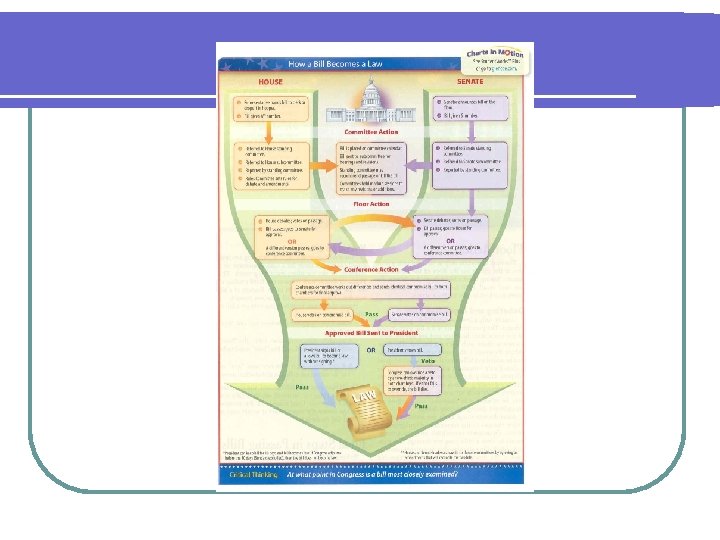
 How a Bill Becomes a Law (185) l Introduced l l l House: drops bill in hopper near clerk’s desk Senate: formal presentation after recognition Title, number (H. R. 1), printed, distributed (1 st reading) l l Ideas from citizens, interest groups, executive branch Drafted by legislators, their staffs, lawyers for Senate/House committee, interest groups
 How a Bill Becomes a Law l Committee Action Bills sent to committee that deals with their subject (143) l Chairs send bill to sub-committee l Reject (ignore or “die” or “pigeonhole”) l Kill (majority vote) l Rewrite l Amend l Recommend for adoption as is l
 How a Bill Becomes a Law l Committee Hearing When decision to act is made l Listen to testimony from experts on the bill’s subject l Gather information l Can be used to influence public opinion for or against bill l Focus public attention on issue l Outside groups influence bill l
 How a Bill Becomes a Law l Committee l Hearings Use of internet Interactive hearings using expert witnesses l Broadcast hearings, give chance for email questions l Report status of bill on individual web pages l Make info available in second language l
 How a Bill Becomes a Law l Markup Session After hearings l Go section by section through bill l Decide on what changes, if any, to make l Majority vote of committee required to change l
 How a Bill Becomes a Law l Reporting a bill After changes committee votes to kill or report bill l Send to House or Senate for action l Sent with a committee report to explain actions, describe bill, list major changes and give opinions l l Recommendations: pass or unfavorable (why? )
 How a Bill Becomes a Law l Floor l Action Debate/Amendments added to bill (unless closed) l 2 nd reading l l Types of Amends Major changes l Correct typographical errors l Slow bill’s progress l Kill bill l
 How a Bill Becomes a Law l Voting on bill Quorum: majority of members present l 3 rd reading l Vote l Voice “aye” or “no” l Standing or division to count “ayes” or “nos” l Roll call: alpha order l Electronic (1973) l
 How a Bill Becomes a Law l Final l Bill must pass both houses in identical forms l l steps Conference committee Presidential action Sign to become law l Keep bill for 10 days without signing, if Congress in session it becomes law l Veto l Pocket veto (last 10 days of session) l
 How a Bill Becomes a Law l Congressional l override of veto 2/3 vote in each house = law l Line Item Veto Reject specific lines of a bill while accepting the rest l Unconstitutional l
 How a Bill Becomes a Law l Registering Law Bill becomes law and registered with National Archives and Records Service l Labeled private or public l Numbered (Ex. PL 105 -187) http: //www. archives. gov/ l l Tracking Legislation on the Internet l l l THOMAS http: //thomas. loc. gov/ Congressional Quarterly www. cq. com Roll Call http: //www. rollcall. com/
 Taxing and Spending Bills Chapter 7 Section 2
 Making Decisions About Taxes l Most of government revenue is from taxes Revenue-income from taxes l Taxes-money that people and businesses pay to support the government l
 House of Representatives and Revenue Bills l Has exclusive power to start all revenue bills l Almost all work on tax law occurs in the Ways and Means Committee Decides whether to go along with presidential requests for tax cuts or increases l Makes rules for who will pay how much tax l l Influences tax deductions for parents or benefits for businesses
 House of Representatives and Revenue Bills l Tax bill used to be debated under closed rule Forbids amendments to bill from the floor l Only members of Ways and Means had direct hand in writing bill l l 1973: amendments from floor allowed
 Senate and Revenue Bills l No closed rule l Amendments allowed l Perception of more special interest influence l Committee matters on Finance deals with tax
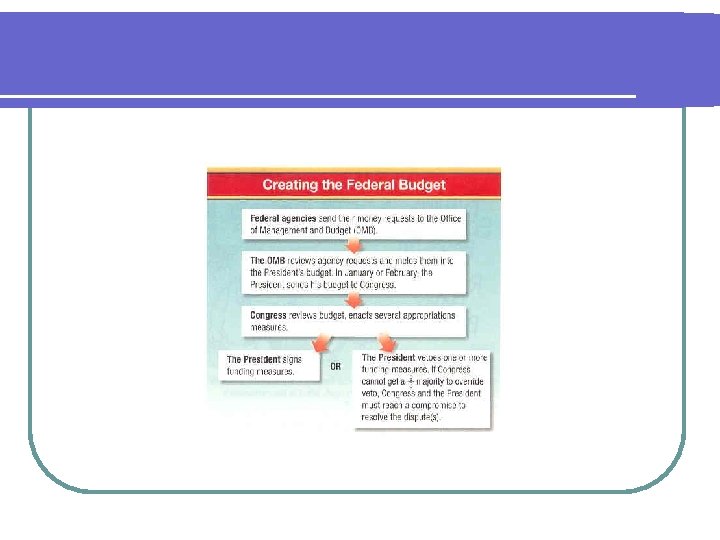
 Appropriating Money l Appropriation-approval of government spending belongs to Congress l Congress must pass laws to appropriate money l Approve spending before departments and agencies of executive branch can spend money
 How Congress Appropriates Money l Two-step procedure l Authorization Bill: sets up federal program and specifies how much money can be appropriated for it l l Ex. bill to build recreational facility in inner cities; limit of $30 million can be spent per year; administered by Dept of Housing and Urban Affairs (HUD) Appropriation Bill: when request is made to receive money that was authorized to run federal program l Ex. HUD requests money that has been authorized for rec facilities
 How Congress Appropriates Money l Each year president presents budget to Congress l Congressional Budget Office l Appropriations committee creates own appropriations bills l May only partially award grant of money l Ex. Only $15 million award for rec facilities. HUD will have to ask for more money next year
 The Appropriations Committee l House l and Senate have committees 12 subcommittees Department heads and program directors answer questions about their budgets in hearings l Explain why they need money l Return yearly to request money l Federal program familiarity l Relationships and favor to certain agencies l Special-interest influence l
 Uncontrollable Expenditures l Appropriations committees do not have voice in all current spending l Earlier laws dictate certain spending Ex. Medicare, Social Security l Entitlements: social programs that entitle individuals to a certain program or monetary benefit l
 Chapter 7 Section 3 Influencing Congress
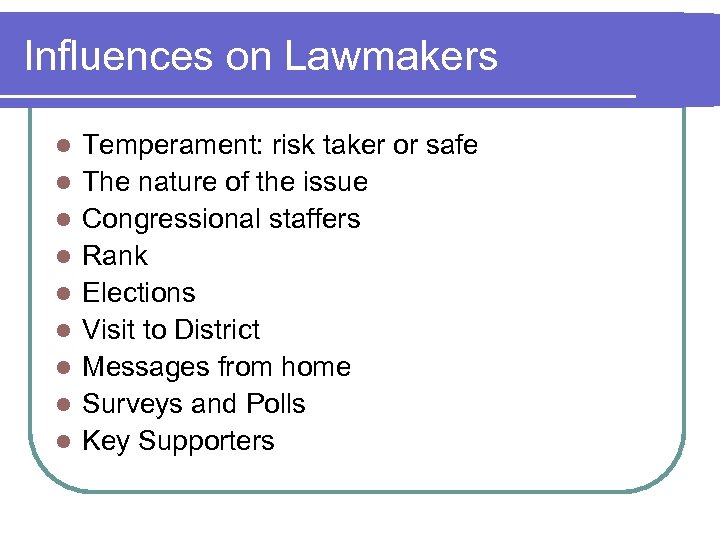 Influences on Lawmakers l l l l l Temperament: risk taker or safe The nature of the issue Congressional staffers Rank Elections Visit to District Messages from home Surveys and Polls Key Supporters
 Chapter 7 Section 4 Helping Constituents
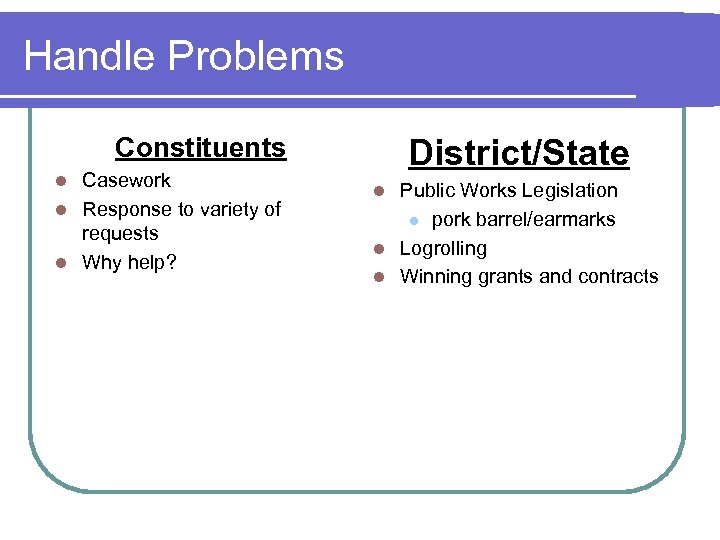 Handle Problems Constituents Casework l Response to variety of requests l Why help? l District/State Public Works Legislation l pork barrel/earmarks l Logrolling l Winning grants and contracts l