


 Скачать презентацию Congress and Lawmaking Class Notes Spring 2005
889b092ea266f4558489c1887a59f844.ppt
- Количество слайдов: 171
 Congress and Lawmaking Class Notes, Spring 2005
 February 7, 2005 • • Who’s here? Matthews What is representation? Congress as an institution for Representation
 Matthews • • • All Politics is Local It’s Better to Receive than to Give Dance with the One that Brung Ya Keep your Enemies in Front of You Don’t Get Mad; Don’t Get Even; Get Ahead • Leave No Shot Unanswered • Hang a Lantern on your Problem
 What is Representation?
 The Big Questions • What is truth? • What is justice? • What is fair? • Who decides?
 “Perceptions of the Constituency” Richard F. Fenno, Jr.
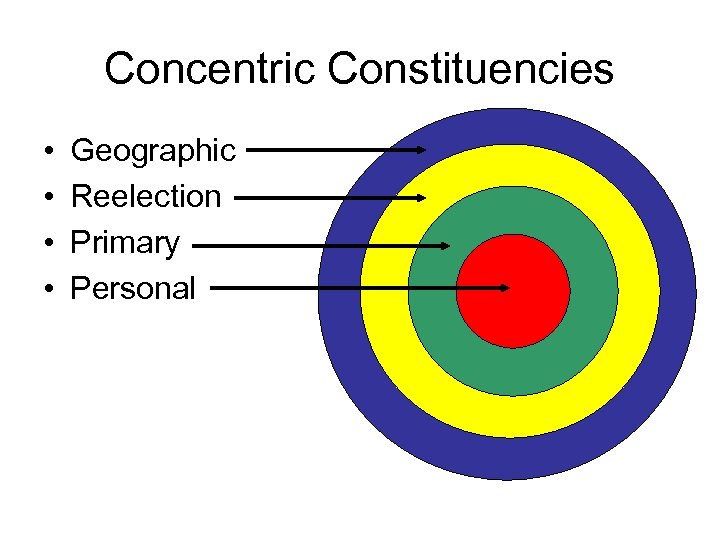 Concentric Constituencies • • Geographic Reelection Primary Personal
 Geographical Constituency • “The District” – Physical: specified by boundaries – Internal Demographic and Political Variables: socioeconomic status, ethnicity, ideology, partisanship, religion, diversity, etc. • Heterogeneity v. Homogeneity: variable that seems to determine members’ perceptions of their districts
 Reelection Constituency • “The Supporters” – – Who she thinks will vote for her Reference points in determining reelection constituency 1. Cross-Sectional 2. Longitudinal – – Partisans, Cross-Party, Least-Likely “Last Time” v. “This Time” Challenger has greatest potential for altering the size and composition of reelection constituency Issues can alter reelection constituency
 Primary Constituency • “The Strongest Supporters” – Weak supporters: follow routines (straight party) or are temporary (waiting for alternative) – Strong supporters: more political activity, will not support any challenger – Difficult to delineate primary constituency in some cases, members who recently emerged from a primary election can determine their primary constituency
 Personal Constituency • “The Intimates” – Few individuals: closest advisors and confidants, sometimes a spouse (“Kitchen Cabinet”) – Usually the people who have been by an official since their first race – Thought of as “friends”
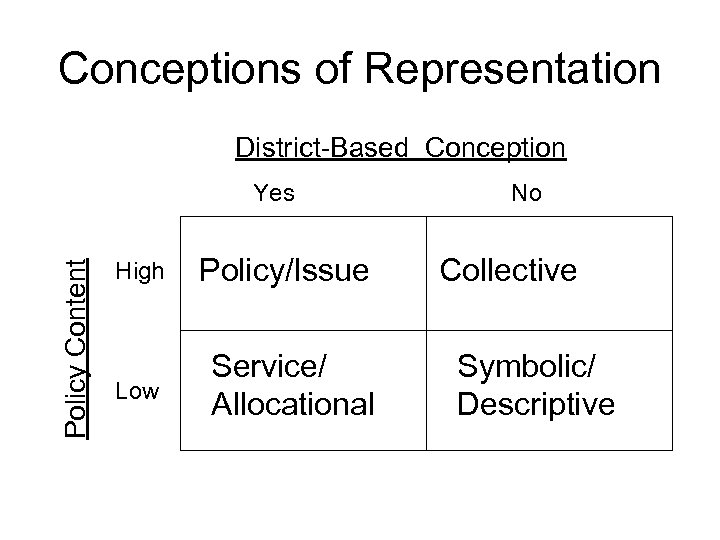 Conceptions of Representation District-Based Conception Policy Content Yes High Policy/Issue Low Service/ Allocational No Collective Symbolic/ Descriptive
 Policy/Issues • Style – Delegate: follow the mandate of constituents – Trustee: exercise independent judgment – “Politico”: switches roles or may engage be a delegate and trustee at same time • Focus – The constituency that is being represented
 Policy/Issue Studies • Wahlke et al (1952): divide members into trustee, delegate, and “politico” • Miller & Stokes (1958): attempt to link constituent opinions to legislator’s behavior – Social Welfare: Vote by Party – Civil Rights: Delegate Role – Foreign Affairs: Deference to Executive • Fenno (1977): “home style”; members convince constituents that they represent them regardless of the extent of agreement
 Policy/Issue Studies Continued • Browne (1995): constituents influence vote on agricultural legislation • Hall (1987, 1996): district influences legislator membership on committees
 Service/Allocational • Obtaining projects that help the district (“pork) or interceding in the bureacracy (“cutting through red tape) • Motives – Sense of duty – Grateful constituents = Reelection • Studies on impact of pork for reelection mixed • Issues: necessary for constituents to have help? , votes for district at expense of nation?
 Symbolic/Descriptive • Legislator as “symbol” that represents public • Representation may extend beyond geographic boundaries of the district – Individual Examples: female legislator as advocate for women nationally, minority legislator as advocate for minorities nationally – Group Example: legislative caucuses
 Collective • Represent constituents with a more collective view – political parties – Congress as representative of the nation as a whole • May lead to conflict with district constituents
 The Great Divide • Trustee Representation (Burkean) • Delegate Representation
 Congressional Procedures and the Policy Process Walter J. Oleszek
 The Constitutional Context Limited Government Separation of Powers Checks and Balances Federalism
 Functions of Rules and Procedures • Stability (and predictability) • Legitimacy • Division of Labor • Protection of Minority Rights • Conflict Resolution • Distribution of Power
 Rules and Policy Making in Congress • Procedure and Policy Procedures affect outcomes. Procedural moves express policy decisions. The nature of policy determines the use of procedure. Procedural expertise helps members impact policy. • Conventional versus Unconventional Lawmaking “I’m just a bill…” • Precedents and Folkways Precedents: “…the accumulated past decisions on matters of procedure…” Folkways: “…unwritten norms of behavior that members are expected to observe. ”
 Congressional Decision Making • Decentralized Power Structure Political and structural realities More than 200 committees and subcommittees Parties can provide cohesion. • Multiple Decision Points • Bargaining and Coalition Building Logrolling Compromise Nonlegislative Favors • The Congressional Cycle Two-Year Deadline
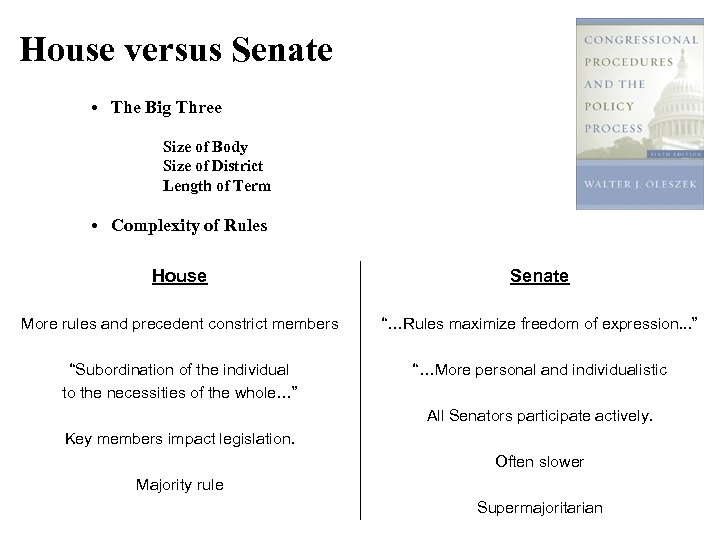 House versus Senate • The Big Three Size of Body Size of District Length of Term • Complexity of Rules House Senate More rules and precedent constrict members “…Rules maximize freedom of expression. . . ” “Subordination of the individual to the necessities of the whole…” “…More personal and individualistic All Senators participate actively. Key members impact legislation. Often slower Majority rule Supermajoritarian
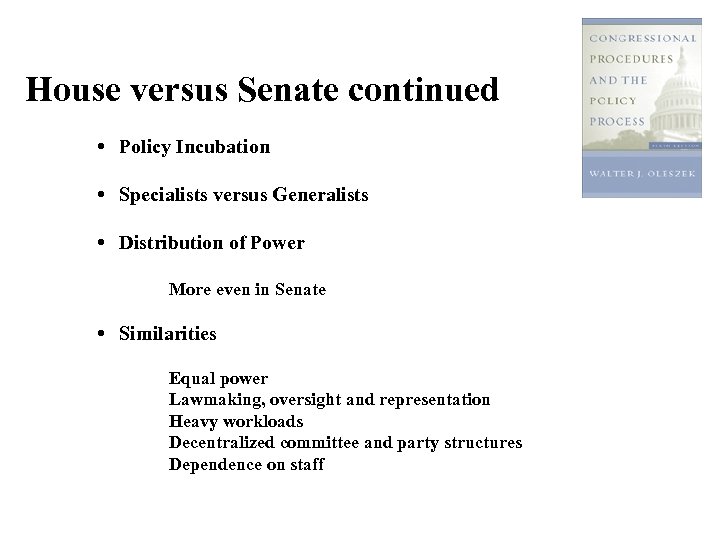 House versus Senate continued • Policy Incubation • Specialists versus Generalists • Distribution of Power More even in Senate • Similarities Equal power Lawmaking, oversight and representation Heavy workloads Decentralized committee and party structures Dependence on staff
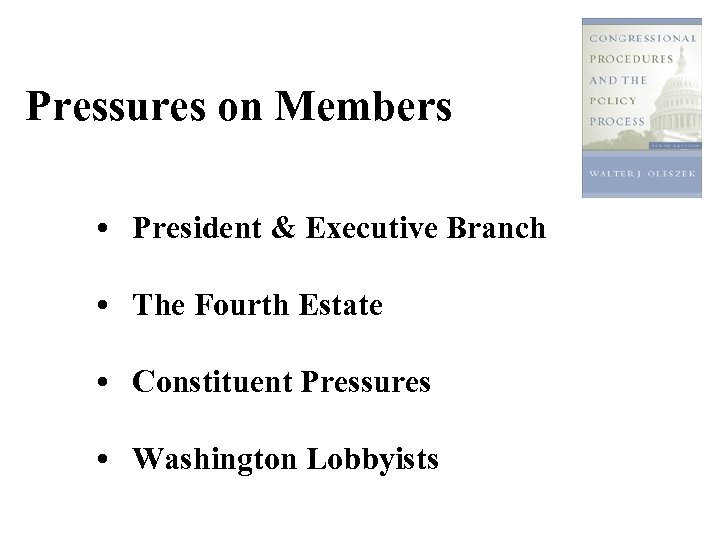 Pressures on Members • President & Executive Branch • The Fourth Estate • Constituent Pressures • Washington Lobbyists
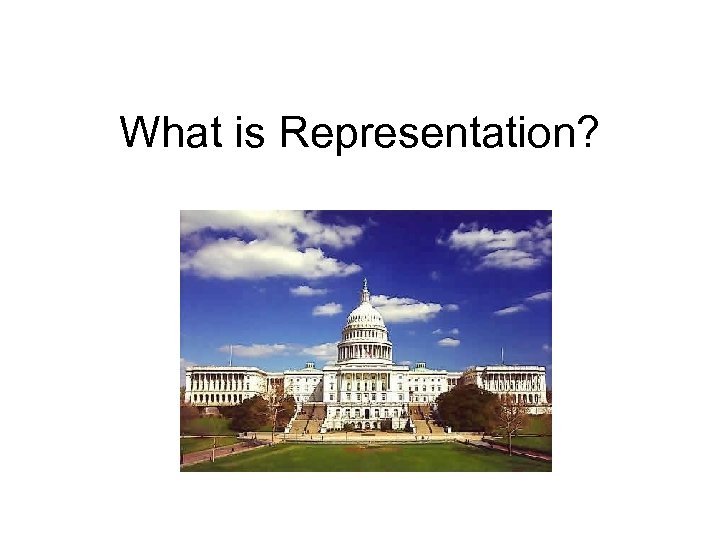
 Credits • Adrian Rodriguez & Alex Theodoridis • Presentation based on: Weisberg, Herbert F. , Eric S. Heberlig and Lisa M. Campoli, Classics in Congressional Politics “What is Representation? ”, Weisberg et al eds. (Glenview: Longman 1999) pp. 68 -82. • Image on Cover from: The Architect of the Capitol http: //www. aoc. gov/cc/capitol/c_wf_1. cfm Concepts of Representation slide based on: Table 5. 1 in Weisberg et al, p. 74. • Presentation based on: Fenno, Jr. , Richard F. , Home Style: House Members in their Districts (Glenview: Little, Brown & Company 1978), “Perceptions of the Constituency”, pp. 1 -30. • Image on Cover from: US Environmental Protection Agency http: //www. epa. gov/oaintrnt/images/water_home. jpg
 February 9, 2005 • Individual motivations and their connections to institutional design • Are institutions exogenous or endogenous? • Individuals operate within an institutional setting, but they shape that setting, too. • What are institutions?
 “The Electoral Connection and Congress” David R. Mayhew
 Proximate Goal • Reelection – Universal – Cannot achieve other goals if member is not reelected – “All members of Congress have a primary interest in getting re-elected. Some members have no other interest. ”
 Activities Useful for Reelection • Advertising – visiting constituency, non-political speeches to home audiences, letters of condolence and congratulation, newsletters, opinion editorials – Franking Privilege
 Activities Useful for Reelection • Credit Claiming: generating belief that the legislator is personally responsible for a government change – Particularized Benefits 1. Given to specific individual or group that allows the single legislator to be recognized 2. Done in an ad hoc fashion
 Activities Useful for Reelection • Position-taking: “public enunciation of a judgmental statement on anything likely to be of interest to political actors” – roll call vote, floor addresses, speeches, television appearances, letters, press releases, interviews, etc.
 Institution Meets Electoral Needs • Benefits Associated with the Office – Staff, casework capabilities, franking privilege – Seniority • Committee Structure – Platform for position-taking, particularized benefits, allows division of labor among members • Parties – Majority party could cut off particularized benefits from minority party, but this has not happened
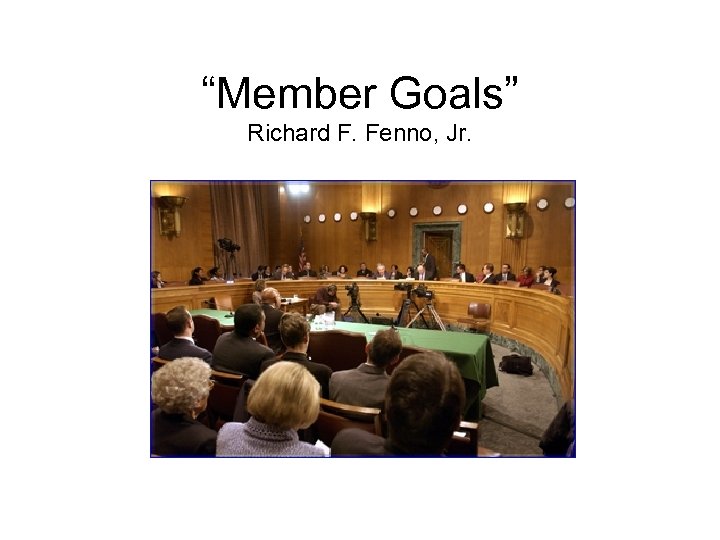 “Member Goals” Richard F. Fenno, Jr.
 Basic Goals of a Legislator 1. Reelection 2. Influence within the House 3. Good Public Policy X. (career beyond house, private gain) • Committee membership reflects the goal of a legislators
 Appropriations, Ways & Means • “Power, ” “Prestige, ” “Importance” • Reflects desire to have influence within the House
 Interior, Post Office • “District Interests, ” “Projects, ” “Political Help” • Reflects goal of reelection by helping constituents
 Education, Labor, Foreign Affairs • “Interesting, ” “Exciting, ” “Controversial, ” “Important” • Reflects goal of making good public policy
 Congress: A Political. Economic History of Roll Call Voting Keith T. Poole, Howard Rosenthal et al LIBERAL CONSERVATIVE
 Motivation of Legislator • Ideology – Liberal to Conservative Spectrum – Constraint Hypothesis: issues tend to be mapped onto a fixed ordering or placement of legislators – Voting tends to be highly consistent over a member’s time in office. – History: http: //www. voteview. com/h 461051. htm
 Annoying Gap Between Theory and Practice… • What do you make of Representative Steve Tobocman?
 Upcoming Assignments • Campaign Issues Memo, Due on Monday. – Highlight 3 or 4 issues. Specify your district. Link issues to your district, to your passions, and to your personal history. • Personal Biographies and Committee preferences due next Wednesday. • Hint: http: //cq. com
 Credits • • • Fenno, Jr. , Richard F. , “Member Goals, ” Congressmen in Committees. (Glenview: Little, Brown & Company, 1973) pp. 1 -14. Image on cover from: “HUD Testimony” U. S. Department of Housing & Urban Development http: //www. hud. gov/offices/cir/Nomination%20 Hearing%20 for%20 Act%20 co py. JPG Accessed 2/7/2005. Mayhew, David R. , “The Electoral Connection and the Congress, ” Congress: Structure and Policy, Terry Sullivan ed. (New Haven: Cambridge University Press, 1974) pp. 18 -29. Images on cover from: Tameside. gov. uk http: //www. tameside. gov. uk/include/vote 2. gif Accessed 2/7/2005; “Congressional Apportionment—What is it? ” United States Census. http: //www. census. gov/population/www/img/house 1. gif Accessed 2/7/2005; “Seal of the United States Senate, ” Wikipedia http: //en. wikipedia. org/wiki/Seal_of_the_United_States_Senate Accessed 2/7/2005 Poole, Keith T. and Howard Rosenthal et al, Congress: A Political-Economic History of Roll Call Voting. (New York: Oxford University Press, 1997) pp. 3 -26.
 The Politics of Congressional Elections Gary C. Jacobson
 Context of Congressional Elections • Constitutional Framework • Congressional Districts • Election Laws • Political Parties • Social and Political
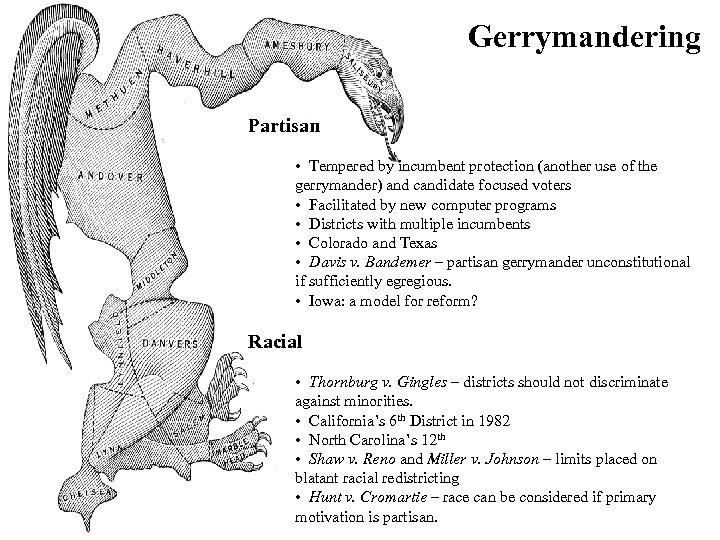 Gerrymandering Partisan • Tempered by incumbent protection (another use of the gerrymander) and candidate focused voters • Facilitated by new computer programs • Districts with multiple incumbents • Colorado and Texas • Davis v. Bandemer – partisan gerrymander unconstitutional if sufficiently egregious. • Iowa: a model for reform? Racial • Thornburg v. Gingles – districts should not discriminate against minorities. • California’s 6 th District in 1982 • North Carolina’s 12 th • Shaw v. Reno and Miller v. Johnson – limits placed on blatant racial redistricting • Hunt v. Cromartie – race can be considered if primary motivation is partisan.
 Incumbency • Reelection Rates – generally higher in House (rarely under 90%) than in Senate (ranges from 55% to 97% in post-WWII elections) • Sophomore Surge & Retirement Slump Slurge • Vanishing Marginals • Some Sources of the Incumbency Advantage Institutional Characteristics of Congress (Mayhew) Voting Behavior Constituent Service Discouraging opposition through casework, mailings. . . • Career in the District (Fenno) Expansionist Protectionist • Money Spending far more important for nonincumbents, especially challengers • So, why are there challengers? Naiveté Easy road to nomination Demonstrate party presence Rewards in simply running
 Money • FECA • Private Individuals (largest source) • PACs • Party Money • Money from Colleagues • Self-Financing
 Voting Behavior • Who votes? Educated, wealthier, older • Role of Party ID (on decline? ) • Information - Often limited to name identification - Recall versus Recognition - Big advantage for incumbents • Contacting Voters (personal, mail, mass media, indirect) - Cumulative effect of various methods - Incumbent advantage - Reason for importance of campaign spending • Winning Challengers - Better known - Better financed
 Elements of a Campaign • Organization - Some have campaign staff perpetually in place - Buying one complete (general consulting firm or team of specialists) - Assemble your own - Volunteer based (bargain basement approach) • Strategy • Media (Free/Earned & Paid) TV, Radio, Newspapers, Billboards, The Internet… • Personal Campaigning • Message Defining the choice Going Negative • GOTV or Depressing Turnout • Non-Candidate Advertising “Voter Education” “Issue Advocacy”
 Reform Options • Problem? Reelection rates are exceptionally high. • Problem? Legislators are disproportionately wealthy, well-educated, male and white. • Problem? Voting rates are low. • Problem? Legislators are strong partisans, most people are not.
 The Legend of Cincinnatus Captain John A. Atilano II Harvard, JFK School of Govt. PAL-210 U. S. Congress 14 February 2005
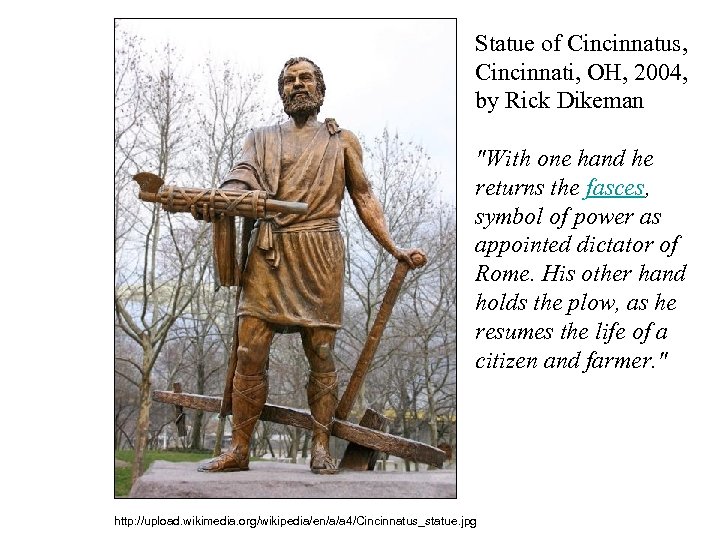 Statue of Cincinnatus, Cincinnati, OH, 2004, by Rick Dikeman "With one hand he returns the fasces, symbol of power as appointed dictator of Rome. His other hand holds the plow, as he resumes the life of a citizen and farmer. " http: //upload. wikimedia. org/wikipedia/en/a/a 4/Cincinnatus_statue. jpg
 Situation • Rome, Italy. 458 B. C. • Rome attacked by Aequians – Attack reaches nearly to the walls of Rome – Crops destroyed; people are terrified • Minucius takes on the Aequians – Failure. – 5 horsemen dispatched to Rome to get help.
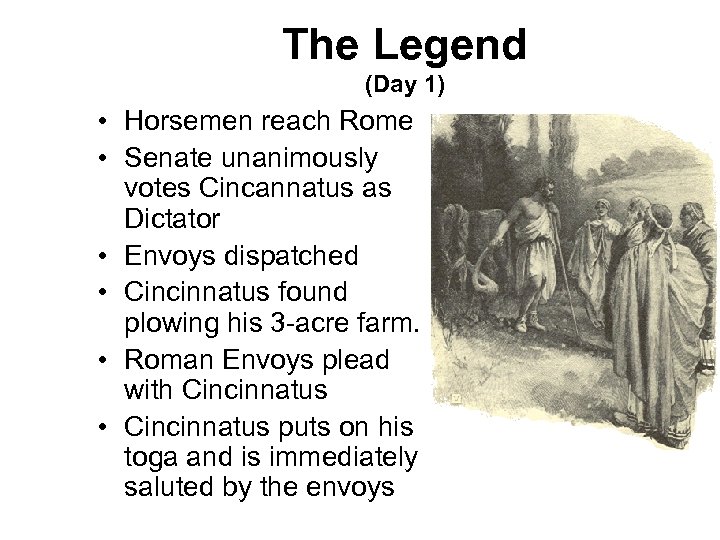 The Legend (Day 1) • Horsemen reach Rome • Senate unanimously votes Cincannatus as Dictator • Envoys dispatched • Cincinnatus found plowing his 3 -acre farm. • Roman Envoys plead with Cincinnatus • Cincinnatus puts on his toga and is immediately saluted by the envoys
 The Legend (Day 1 – continued) • Cincinnatus arrives in Rome – Met by a huge entourage, including the Senate and his Lictors (bodyguards) – People of Rome fearful of his power and the manner he would use it. • That Night – Nothing done but guard the city
 The Legend (Day 2) • Forum. Dawn. His Instructions – Legal business suspended – All shops closed; no private business – All men of military age to report at sunset with all equipment and five days rations – All men over military age were to prepare food for the younger men
 The Legend (Day 2 - Continued) • Sunset – All men in formation. Everyone prepared. No one is late. – Column moves out. Cincannutus leading the Infantry, Tarquitus leading the cavalry. • The battle lasted until dawn – Cincannatus deals a crushing blow to the Aequian Army – Aequian’s beg Cincannutus to allow them to surrender and leave with their lives
 The Legend (Day 3) • Cincannatus accepts Aequian surrender on humiliating terms – Aequian leaders to be brought before him in chains – All soldiers required to pass “under yoke” • Aequian Camp contained significant treasure – Cincannatus shares only with his soldiers; none to Minucius’ army • 'You shall have no share of the plunder taken from an enemy who nearly took you. ' • 'Until, Lucius Minucius, you learn to behave like a consul and commander, you will act as my lieutenant and take your instructions from me. '
 The Legend (Day 4) • Cincannatus enters Rome in Victory – Military Standards (flags) in lead – Followed by Aequian leaders in chains – Cincannatus follows in a chariot – Soldiers follow Cincannatus • The streets are full, the crowd cheers the triumphant Army.
 The Legend (Day 16) • No one dared ask Cincannatus to resign. • Aequian leaders found guilty at trial. Exiled. • Cincinnatus resigns as dictator after 16 days – His original appointment was for 6 months • Returns to his farm where his plow and ox still remain just as he left them
 Omnia relinquit servare rempublicam. . . He abandons everything to serve his country
 February 16, 2004
 Partisanship and Elections • • • Party-ID is a form or brand loyalty Usually passed generation to generation SD, D, I, IR, R, SR But the pillars have begun to crumble Campaigns have become ever-more candidate-focused. • Growing disconnect between the partisanship of voters and elected officials
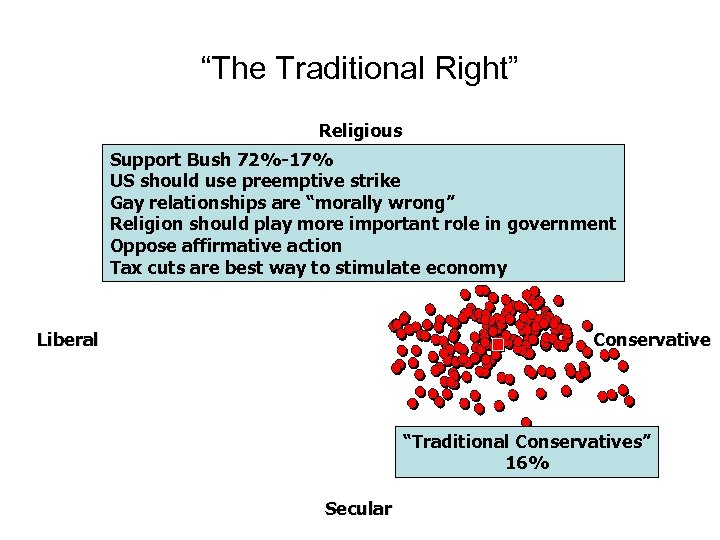 “The Traditional Right” Religious Support Bush 72%-17% US should use preemptive strike Gay relationships are “morally wrong” Religion should play more important role in government Oppose affirmative action Tax cuts are best way to stimulate economy Liberal Conservative “Traditional Conservatives” 16% Secular
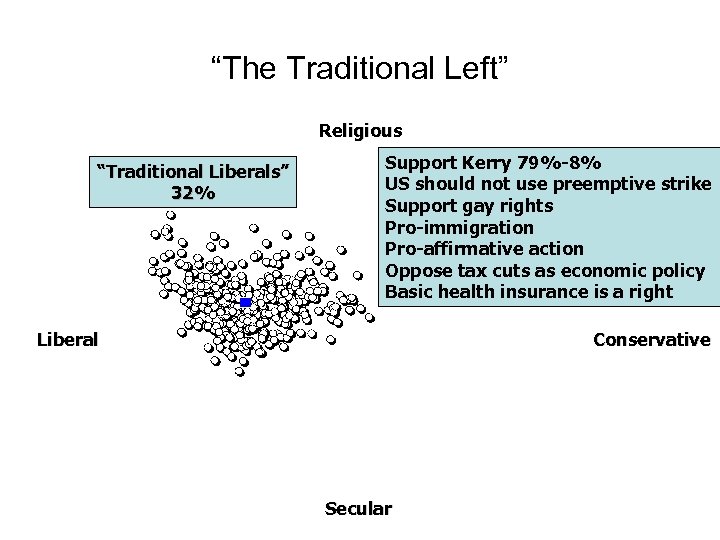 “The Traditional Left” Religious “Traditional Liberals” 32% Support Kerry 79%-8% US should not use preemptive strike Support gay rights Pro-immigration Pro-affirmative action Oppose tax cuts as economic policy Basic health insurance is a right Liberal Conservative Secular
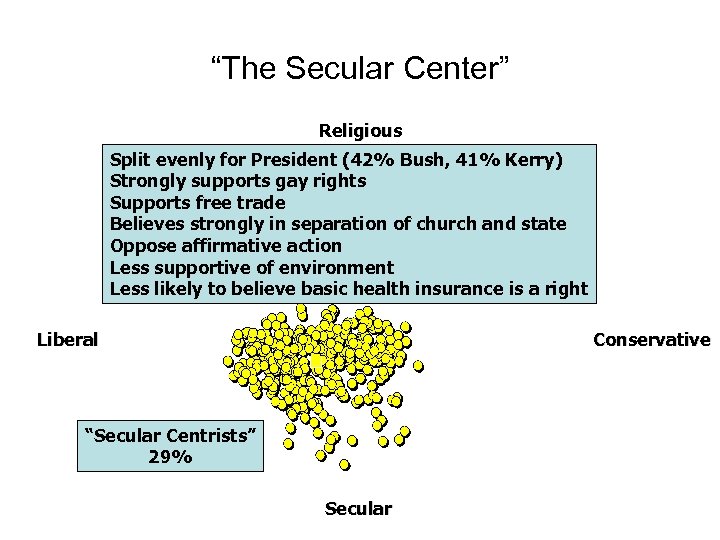 “The Secular Center” Religious Split evenly for President (42% Bush, 41% Kerry) Strongly supports gay rights Supports free trade Believes strongly in separation of church and state Oppose affirmative action Less supportive of environment Less likely to believe basic health insurance is a right Liberal Conservative “Secular Centrists” 29% Secular
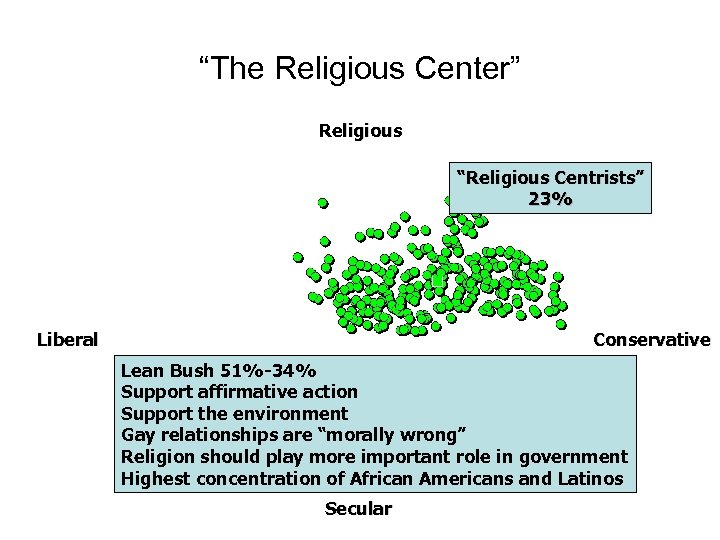 “The Religious Center” Religious “Religious Centrists” 23% Liberal Conservative Lean Bush 51%-34% Support affirmative action Support the environment Gay relationships are “morally wrong” Religion should play more important role in government Highest concentration of African Americans and Latinos Secular
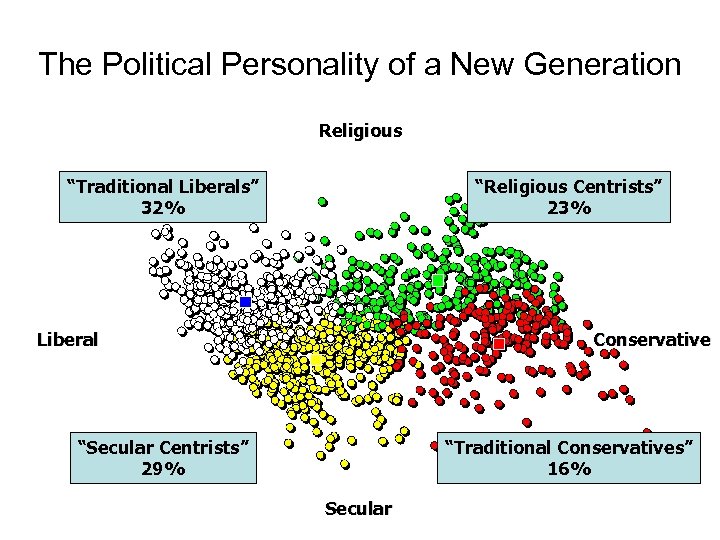 The Political Personality of a New Generation Religious “Traditional Liberals” 32% “Religious Centrists” 23% Liberal Conservative “Secular Centrists” 29% “Traditional Conservatives” 16% Secular
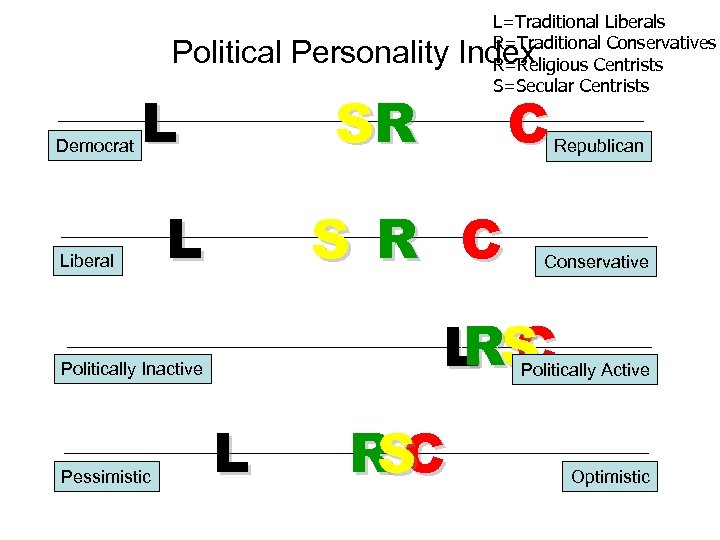 L=Traditional Liberals R=Traditional Conservatives R=Religious Centrists S=Secular Centrists Political Personality Index Democrat L Liberal SR L S R C Republican Conservative RC LS Politically Inactive Pessimistic C Politically Active L RC S Optimistic
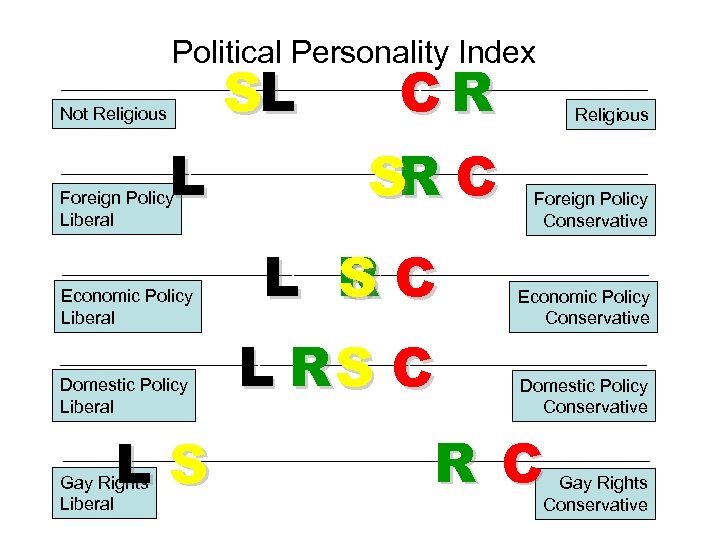 Political Personality Index SL Not Religious L Foreign Policy Liberal Economic Policy Liberal Domestic Policy Liberal LS Gay Rights Liberal CR SR C L RC S L RS C Religious Foreign Policy Conservative Economic Policy Conservative Domestic Policy Conservative R C Gay Rights Conservative
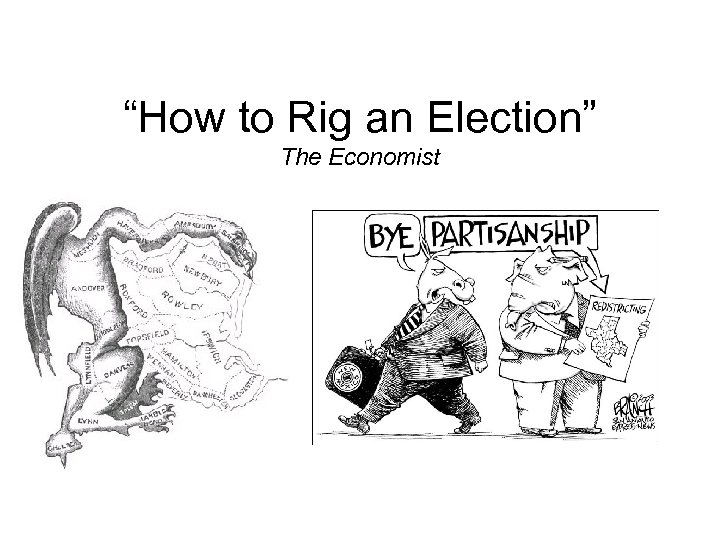 “How to Rig an Election” The Economist
 Redistricting “In a normal democracy, voters choose their representatives. In America, it is rapidly becoming the other way around. ” • Most countries hand over redistricting to an independent board • America: Every 10 years after a census, state legislature redraw congressional boundaries to be approved by the state’s governor
 Effect of Voting Rights Act • Majority-minority districts – Goal: chance for minorities to elect a candidate of the same race
 Partisan Redistricting • • • Software allows for detailed electoral maps, geographic information systems Goal of incumbent protection: safety first 2000: Reelection rate of 98% Lack of competition depresses voter turnout Categories of districts 1. Safe seats where incumbent almost assured of victory 2. Competitive districts where the parties focus their resources
 Alternative Systems • Iowa: civil servants draw maps without regard to partisanship • Five other states: authority in a bipartisan redistricting commission
 The Politics of Congressional Elections Gary C. Jacobson
 Interpreting Election Results • Based on economic conditions • National events at the time of elections – Scandals – Foreign affairs – Public dissatisfaction with Executive
 Models of Congressional Election Results “The better the economy is performing, the better the congressional candidates of the president’s party do on election day. ” • Tufte: division of Congressional vote related to economy and presidential popularity • Jacobson: 70% of change in % of House seats held by President’s party explained by Exposure, Change in Real Income per capita, Presidential approval • Most aggregate studies are based on the assumption that personal financial well-being is the criterion used by voters
 Presidential Coattails • Winning presidential candidates lead some congressional candidates of the same party to victory • Erratic and usually modest in recent elections
 National Elections and Strategic Politics • Many voters evaluate the candidates as individuals with little reference to national politics and personalities • Decision to run for Congress is strategic – Evaluate personal odds of winning – Evaluate party’s odds on aggregate level • Favored party usually fields more formidable challengers, incumbents of unfavorable party may retire • Campaign contributors make similar evaluations
 National Elections and Strategic Politics • Direct and strong relationship between relative levels of spending by challengers and size of partisan seat swing • “Quality of challenger” is a large determinant of election outcome • Effects of national conditions on a congressional election depend on how the candidate uses the national issues
 Campaign Themes • National conditions affect themes that are available for a congressional campaign • Incumbents take credit for good things in government while disassociating selves from government failures • Even during times of dissatisfaction with the government, it is difficult to unseat an incumbent
 House Elections • 1992 – 110 new members – The Year of the Woman, African-Americans and Hispanics – Partisan change modest – Environmental forces: stagnant economy, divided government, reapportionment – House Bank Overdraft Scandal
 House Elections • 1994 – Republican Revolution in the House: 230 R 204 D = largest partisan swing since 1948 – Capitalize on blaming unified Democratic government for country’s problems – Nationalized election: Local choice issues framed on national terms – Clinton Problem: alienated groups of Democratic voters, cultural perceptions – Contract with America: little impact on voters
 House Elections • 1996 – Republicans lose only 3 House seats in spite of public’s negative perception of Congress – Most of the seats Republicans won in 1992 were seats Republicans should have won before – Democrats no longer incumbents and had difficult time recruiting strong challengers – Congressional elections were not nationalized, they were individualized – Presidential campaign does not help Democratic Congressional candidates, scandal
 House Elections • 1998 – 2 nd time since Civil War that incumbent president’s party picks up seats – Voters endorse status quo in spite of Presidential scandal and impeachment – Public views impeachment as partisan – Both parties fail to recruit high quality challengers
 House Elections • 2000 – Reflect close partisan balance, national forces seem neutral – Unprecedented amounts of money spent in highly competitive districts – Republican campaigns focus on individual district issues – Few seats changed partisan control
 House Elections • 2002 – Incumbent President’s party gains seats for 2 nd mid-term election in a row (3 rd time since Civil War) – Consequence of redistricting, terrorism – Presidential popularity scares off quality Democratic challengers
 House Elections • Lessons from Last 25 years – Potent issues and vigorous challenges needed to change the makeup of the House – Strength of challenger is KEY – Jacobson defines strong challengers as already 1. Holding elected office 2. Spending at least $300, 000
 Race and the Race • The Harvey Gantt case
 Credits • Presentation based on: “How to Rig an Election, ” The Economist, 4/25/2002, http: //www. economist. com/world/na/displaystory. cfm? sto ry_id=1099030 Accessed 2/14/2005. • Images on cover from: http: //upload. wikimedia. org/wikipedia/en/3/3 a/Gerrymand er. jpeg Accessed 2/14/2005; San Antonio Express. News, 2003. • Presentation based on: Jacobson, Gary C. , The Politics of Congressional Elections, 6 th edition (New York: Pearson Longman, 2004) pp. 151 -217. • Image on cover of The Politics of Congressional Elections from www. amazon. com Accessed 2/14/2005.
 Staffing, and Committees February 23, 2004
 Setting Course: A Congressional Management Guide -Congressional Management Foundation
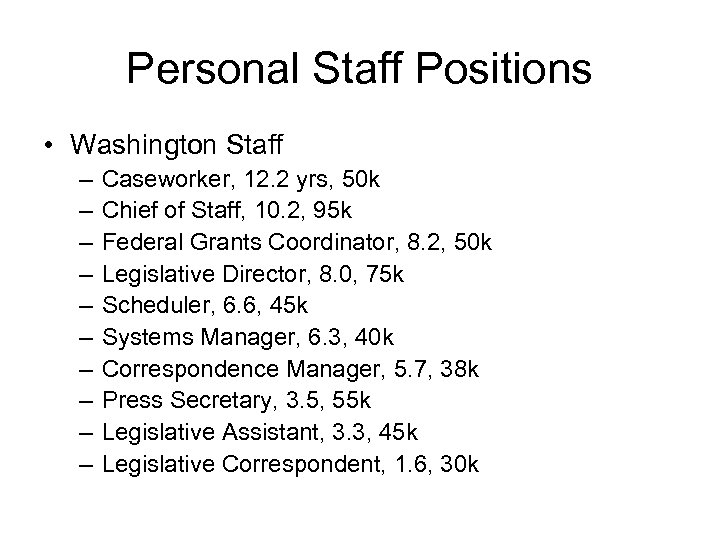 Personal Staff Positions • Washington Staff – – – – – Caseworker, 12. 2 yrs, 50 k Chief of Staff, 10. 2, 95 k Federal Grants Coordinator, 8. 2, 50 k Legislative Director, 8. 0, 75 k Scheduler, 6. 6, 45 k Systems Manager, 6. 3, 40 k Correspondence Manager, 5. 7, 38 k Press Secretary, 3. 5, 55 k Legislative Assistant, 3. 3, 45 k Legislative Correspondent, 1. 6, 30 k
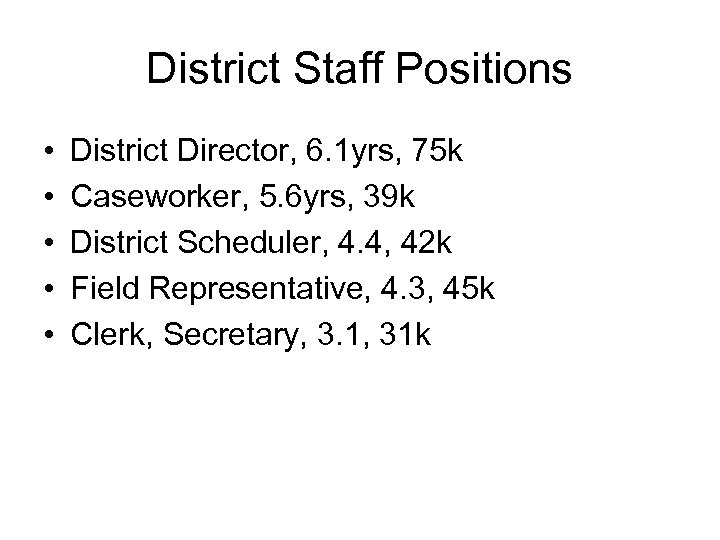 District Staff Positions • • • District Director, 6. 1 yrs, 75 k Caseworker, 5. 6 yrs, 39 k District Scheduler, 4. 4, 42 k Field Representative, 4. 3, 45 k Clerk, Secretary, 3. 1, 31 k
 Strategic Planning • • Learning how to strategically say “NO” Sensible, flexible set of overall goals Provides purpose and direction for office Cannot address many questions without articulating your strategic plan – – – First year budget Legislative agenda Scheduling objectives Press plan Job Descriptions
 Benefits of the Plan • • Clear Priorities Looking at “the big picture” Forward thinking instead of reactive Processes that allocate scarce resources Improving coordination Reducing frustration of staff Ability to measure progress
 Planning Process • Time Frame – Two year plan with annual meetings – Conduct from Nov. -Mar. to take advantage of legislative break • Mission Statement – Clearly defined broad yet distinctive goals – Written – More focus = more direction
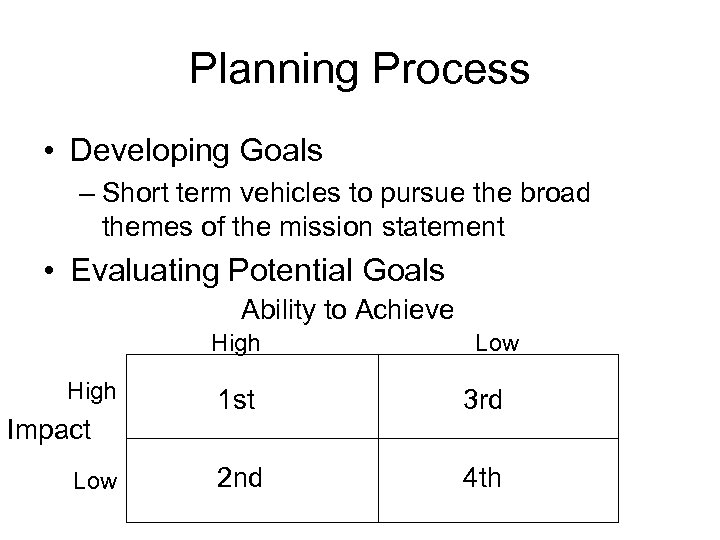 Planning Process • Developing Goals – Short term vehicles to pursue the broad themes of the mission statement • Evaluating Potential Goals Ability to Achieve High Impact Low 1 st 3 rd 2 nd 4 th
 Planning Process • Developing Action Plans – Strategies to achieve a goal – List three specific actions to achieve a goal – Goal v. Functionally-Oriented Action Plans • Implementation – Written and distributed to staff – Update and fine-tune • • • Frequent ad hoc planning meetings Weekly or monthly progress reports Monthly strategic planning meetings Quarterly senior management meetings Timelines
 Budgeting & Financial Management • Annual Size: $1. 2 million for Reps. ; $2. 2 -$3. 7 million for Senators • Decide on: – – – – Staff number Salary for each staffer Number of district offices Type of computer system to operate Travel Mail Professional training
 Avoiding Financial Problems • Don’t spend on the wrong things – Consider how purchase affects long-term goals • Don’t spend more than you have – Member is personally liable for excess expenditures – May need to forego later expenditures • Don’t give the media reason to scrutinize – Expenditure reports are public information
 Budgeting Toward Your Goals 1. Note any changes to your strategic plan or office priorities 2. Brainstorm: What resources will it take to accomplish the revised priorities 3. Look at last year’s budget with an eye toward surprises 4. Take note of the rules changes 5. Determine variable and fixed costs 6. Critically review major allocations 7. Build a new month-by-month budget reflecting changes
 Financial Procedures • Written Office Policies – Avoid questions and inconsistency, write policies on paper and provide to staff • Accounting System – Record Keeping: track paperwork – Payment Processing: determine who can authorize expenditures, set rules for travel spending, establish a good relationship with the Finance Office employees – Reconciliation: monthly financial statements – Auditing: review financial expenditures • Monthly Financial Review
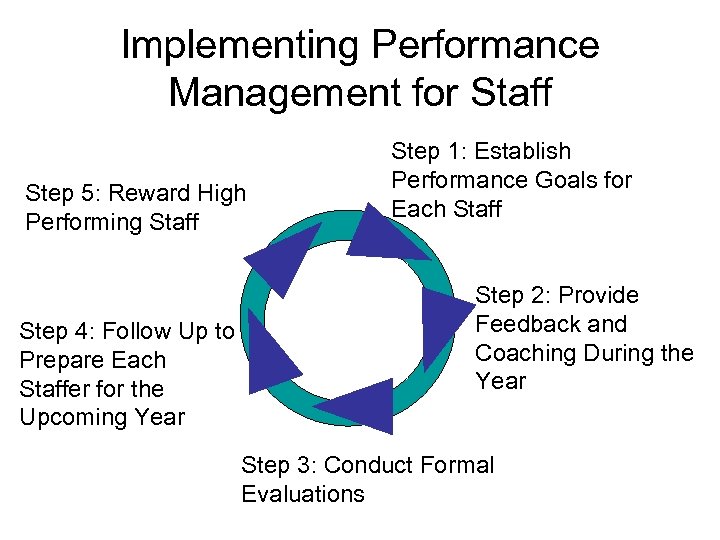 Implementing Performance Management for Staff Step 5: Reward High Performing Staff Step 4: Follow Up to Prepare Each Staffer for the Upcoming Year Step 1: Establish Performance Goals for Each Staff Step 2: Provide Feedback and Coaching During the Year Step 3: Conduct Formal Evaluations
 Challenges • Staff have different needs – Keeping star-performers motivated – Addressing sub-par performers • Managing District/Capitol Office Relations – The offices perform different functions – Communication is imperative
 Managing Ethics • Gray Area: Gap between technical compliance and behaving in a manner consistent with the public’s expectations for public officials • Institutional: House Committee on Standards & Official Conduct, Senate Select Committee on Ethics • In practice: Ethics reviewed on the frontpage or the evening news
 Ethics Lesson “An office that never proofreads letters runs a high risk of typographical errors. Similarly, an office that does not give adequate attention to managing ethics runs a high risk of ethical lapse. ”
 Guidelines • There is a difference between not violating the rules and being ethical – Examine every ethics rule with an eye to understanding its underlying principle – Use the ethics committee as a resource before you get into trouble • Don’t assume smart, honest people will always make correct ethical judgments – Develop clear, written policies for staff to follow
 Guidelines • The Member sets the ethical tone for the office – Consciously set a high ethical tone, lead by example • Staff (tend to be young and inexperienced) may avoid questions on ethical grounds – Create policies that give staff license to raise questions with other staff, management and the Member
 Guidelines • Good ethics frequently conflicts with what is quick, easy, and politically expedient – Ethics should be part of every decision a Member will make
 Questions for Political/Ethical Analysis • • • What are the relevant House rules? What are the principles underlying the rules? What is the politically advantageous course of action? From an ethical perspective, what is the right course of action? What is the source of tension inherent in the situation? What is the full range of options available? What are the likely consequences of those options? Which of these options could not be effectively defended if they became public? Of the remaining options, which best balances political and ethical interests
 Credits • Presentation based on: Congressional Management Foundation, Setting Course: A Congressional Management Guide. (Washington: Congressional Management Foundation 2004), Chapters 11 -13, 16, pp. 157212, 265 -278. • Image on Cover from: Congressional Management Foundation, http: //www. cmfweb. org Accessed 2/19/2005
 February 28, 2005 • Congressman Martin Frost • Represented the 24 th CD in Texas, 1979 -2005 • Climbed the ranks of the House Democratic Leadership throughout his tenure. Chaired the House Democratic Caucus, beginning January 2001. • Redistricted into a “stacking” scheme in Texas. • Here as the top draw on today’s “redistricting” workshop, and will be at tonight’s forum event.
 What is Power? • The ability to force someone to do something. A causes B to act, and B knows A has the “power. ” Coercive. • The ability to influence the actions of another. A persuades B to do something, though B is not aware of the persuasion. • The structure of the sets of institutions, benefiting A over B, while neither is aware of the background relationship.
 Diagrams of Power • Leadership Diagram: • The Median Voter • The Committees Relative to the Floor http: //clerk. house. gov/members/leadership_info. html
 What is Leadership? • Transformational Leadership • Transactional Leadership
 Lessons from Wilbur Mills • Influence versus Power • Leadership Types • Instrumental – task master • Affective – soothes internal tensions • Mills saw his role as… • Ensuring that W&M bills passed on the floor • Generating compromise within committee (to ensure support for final product) • Exchange • Five bases of Influence: • Expertise • Legitimacy • Rewards • Reference • Sanctions • He’s got the votes.
 Do… • Determine the right role by analyzing and balancing: • Personal strengths and weaknesses; • Your mission; • Needs of your district/state; • Political circumstances. • Define your role as: Legislative Insider; Party Insider; Ombudsman; Statesman; or Outsider. • Members can “major” in one role and “minor” in another, but the two roles can’t be incompatible with each other. • When faced with opportunities, ask yourself: “Does this opportunity or decision support the role I am carving out in Congress? ” Don’t… • Operate opportunistically without defining your role. Taking on too large a range of issues will frustrate all your efforts.
 Legislative Insider • • Work through the committee structure. Interested in national attention Some motivated by ideology, some not “Practicing the Politics of what is possible. ” Enjoy insider politics • Building close ties with colleagues and using then for political ends • Coalition building • Using expertise • Negotiating agreements • Behind the scenes deals Category includes most committee & subcommittee chairs/ranking members Motivated to move up the ladder Tend to… • Have discipline and focus • Have excellent interpersonal skills • Be good strategists • Utilize committee structure, party hierarchy, national press and interests groups to advance their activities
 Party Insider • • Promote power and ideology of Party Include leadership Devote time to electoral politics Political skills and savvy Seek out administrative/management duties • Vote counting • Fundraising Less interested in details of specific legislation Prefer “big picture” Seek out committees that offer political operative powers, such as Rules, Budget, Approps, Ways and Means
 Ombudsman • • • Primary focus is on creating strong image and record Focus on local and state issues Often motivated by electorally marginal seat Enjoy dealing with specific, manageable issues More interested in career within state than within Congress Methods… • Membership on committees that provide funds/services to their communities • Federal grants • Working with state delegation • Working with state and local parties • Local and state media
 Statesman • • “Do the right thing” Not driven by political expedience Advocate: legislative ends or procedural/institutional reforms Rise above the fray, but only when necessary Exercise both internal and external power Criticism is vocal, but not alienating They are. . • Often policy wonks • Excellent oral or written communicators • Not fans of “schmoozing” • Not interested in wielding partisan power • Not junior members (although those can set the groundwork for this role)
 Outsider • • Critics of the system Like Statesmen, but more bold/brash Tactics often generate resentment Choose public rhetoric over internal process Often lack interest or skill for other roles Lack patience Risk-seeking Transition from Outsider to Insider is difficult, but increasingly not impossible
 March 2, 2005 • Understanding the Roles and Clout of Committees • Discussion of Lobbyists Roles • Introduction of Legislation • Oleszek (Chapter 3) • King (Chapter 2) • Setting Course (Chapters 1 -7)
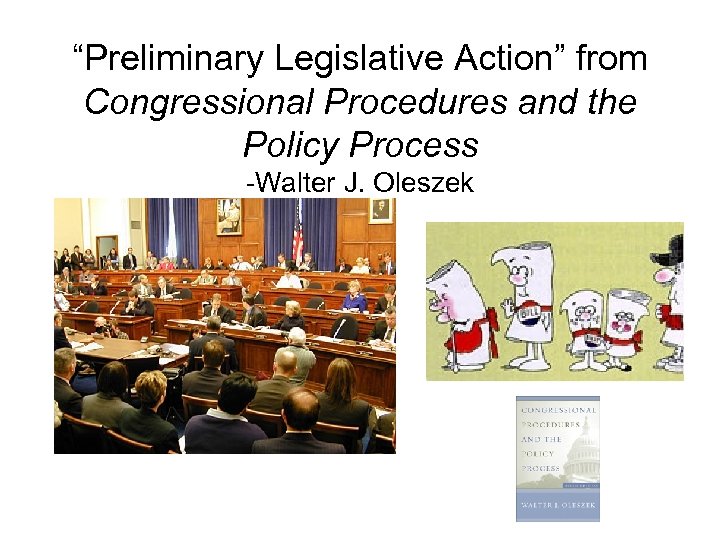 “Preliminary Legislative Action” from Congressional Procedures and the Policy Process -Walter J. Oleszek
 Categories of Bills • Bills Lacking Wide Support – Introduced with no expectation of passage – Die in committee • Noncontroversial Bills – Expedited – Passed on Floor with little debate • Major Legislation – Executive Branch Bills – Influential Members’ Bills – Must Pass Legislation
 Bill Referral Procedure • Receives a number: H. R. in House; S in Senate • Speaker assigns bill to committee – Parliamentarians make assignment on behalf of Speaker • Referrals typically routine but committees clash over turf • Representative can only appeal assignment in instances of erroneous assignment
 Legislative Drafting/ Referral Strategy • Draft bill in such a way that it is referred to a favorable committee • Technique 1: word it ambiguously so the Presiding Officer has options • Technique 2: amend existing laws over which a committee has jurisdiction • Know precedents regarding bill referral • Parliamentarians provide advice to staff about referrals
 Referral to Several Committees • Committees often share jurisdiction – Formal – Informal • Speaker allowed to refer bill to multiple committees since 1975 – Joint – Sequential – Split • May create ad hoc committees to deal with bills that overlap jurisdiction of several committees • 1995: Joint referrals abolished, but sequential and split are allowed
 Consideration in Committee • Options – Consider and Report the Bill • With amendments or recommendation • Without amendments or recommendation – Rewrite bill entirely – Reject bill – Refuse to consider bill
 Consideration in Committee • Whole Committee may consider bill • Often Chair sends bill to subcommittee – – Public hearings or No Public Hearings Approve, rewrite, amend or block bill Mark Up: consider the bill line by line Report bill to full Committee • Whole Committee may repeat subcommittee’s procedures in whole or part • If bill passes Committee, it is sent for consideration for Floor debate with a Report (statement of committee action)
 Role of Committee Chair • • Controls committees legislative agenda Refers bills to subcommittees Controls committee finances Hires/Fires committee staff May refuse to consider a bill May refuse to recognize member for questions Used to be determined by Seniority Now subject to majority selection within caucuses
 Hearings • Format – Traditional, Panel, Field, Joint, High Tech • Purpose – Public record of committee members’ and interest groups’ positions – Orchestrated – Testimony solicited and taken • Timing – Chairs may delay or schedule hearings to affect outcome of legislation
 Markup • Line-by-Line review of legislation by committee members • May implement formal or informal procedures • House markups occur at subcommittee and full committee levels usually • 1/3 membership needed for quorum, majority needed to report bill
 Markup Procedures • Usually in open session • Issues decided by voice vote or show of hands • Proxy: allowing a member to cast a vote for an absent member – Banned by Republican Majority – Modified rule allows Chairs to reschedule vote when they are certain of majority support
 Report • Written statement of committee action that accompanies a bill that has passed committee – Describes purpose and scope of bill – Explains committee revisions – Outlines proposes changes to existing laws – Outlines views of Executive Branch agencies affected – Committee members may file Minority, Supplemental or additional views
 Bypassing Committees • Committee Power has diminished compared to Party Power • Techniques to Bypass – Partisan Task Forces – Riders to Appropriations Bills – House Rules Committee can send bills to floor without previous committee consideration • Reasons – Time, Partisanship, Committee Gridlock, Electoral Salience, Consensus
 “The Nature of Committee Jurisdiction” from Turf Wars -David C. King
 Committee Borders “Jurisdictions are, at once, both rigid and flexible. ” • Sources of Jurisdictional Legitimacy – Statutory Law – Common Law
 Statutory Jurisdictions • Easy to quantify, rarely change • Based on 1946 Legislative Reorganization Act – Supposed to get rid of jurisdictional fluidity • Previous statutory jurisdictions were imprecise – “committee boundaries were like gerrymandered electoral districts”
 Common Law Jurisdictions • Precedents are KEY • Decision are made by Parliamentarians routinely • Typically affect discreet bills and not wide issue areas • The closer a bill is to committee turf increase its chances of being referred to that committee
 Policy Entrepreneurs “Jurisdictionally ambiguous bills arise in areas that are not yet clearly defined and within issues areas that are undergoing redefinition. ” • See turf as malleable • Strike claim on turf as they are motivated by policy or election
 Setting Course: A Congressional Management Guide -Congressional Management Foundation
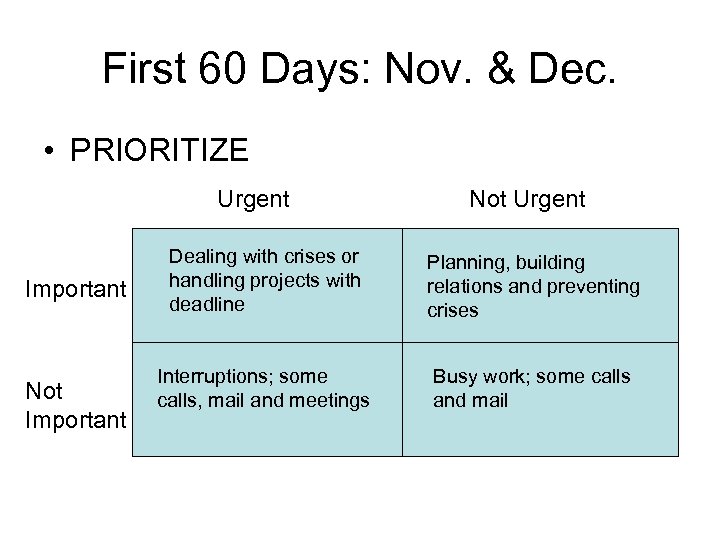 First 60 Days: Nov. & Dec. • PRIORITIZE Urgent Important Not Urgent Dealing with crises or handling projects with deadline Planning, building relations and preventing crises Interruptions; some calls, mail and meetings Busy work; some calls and mail
 Critical Transition Tasks 1. Decisions about Personal Circumstances – Family – Current job status – Relocating to Washington or commute 2. Selecting & Lobbying for Committee Assignments 3. Setting Up Your Office – – – Creating a First Year Budget Management Structure for Office Hiring Core Staff Evaluating Technological Needs Establishing District Office
 Guiding Principles • Develop and Base Decisions Around Strategic Goals • Recognize “Less is More” • Delegate • DON’T: Try to Do Everything • DONT: Procrastinate and Put off Planning Until the Next Year
 Selecting Committee Assignments • • • Committee Choices in the First Year are Not Necessarily Binding Try to Land Committee of Choice from the Start Steps 1. Party Recommendation 2. Approval by the Party Caucus (Most Important 3. House or Senate Floor Vote on Roster
 Committee Categories • House: Limit to Serve on 2 Standing Committees and 4 Subcommittees of those Standing Committees • Service Limited to 1 Exclusive Committee • Service Limited to 2 Non-Exclusive Committees
 Advice for Choosing a Committee • Start early: learn where the openings are, learn jurisdictions, talk with Members • Gather Information: Talk with other members from region • Select Committees that will Help You Achieve your Goals • Make Your Case • Consider Leadership Requests • Assess Your Chances
 Congressional Budget Primer • Allocations Fixed: Personal responsibility for finances • Funds Not Given to office, held by Treasury • Funds Authorized Annually • Funds have Limited Uses • Office Doesn’t Pay for Fringe Benefits • Office not Charged for Washington Office Space
 Developing a First Year Budget 1. Collect Expense Information 2. Make Major Allocations • • • Salaries Franking Equipment District Office Rent, Telecommunications, Utilities Travel (Member and Staff) Supplies and Materials Printing and Production Other Services (eg: newsclipping, cleaning of district office Returning Money to Treasury Contingencies ($5, 000 in reserve usually)
 Developing a First Year Budget 3. Compare Major Allocations to Your Office Goals 4. Build a Month-by-Month Budget
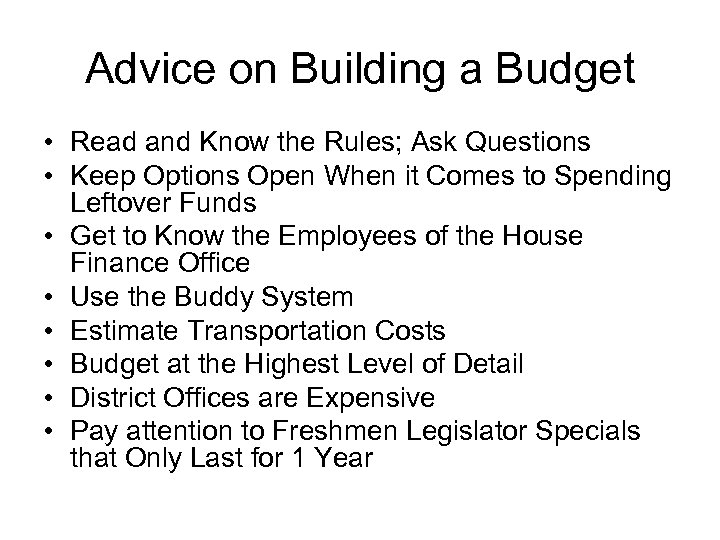 Advice on Building a Budget • Read and Know the Rules; Ask Questions • Keep Options Open When it Comes to Spending Leftover Funds • Get to Know the Employees of the House Finance Office • Use the Buddy System • Estimate Transportation Costs • Budget at the Highest Level of Detail • District Offices are Expensive • Pay attention to Freshmen Legislator Specials that Only Last for 1 Year
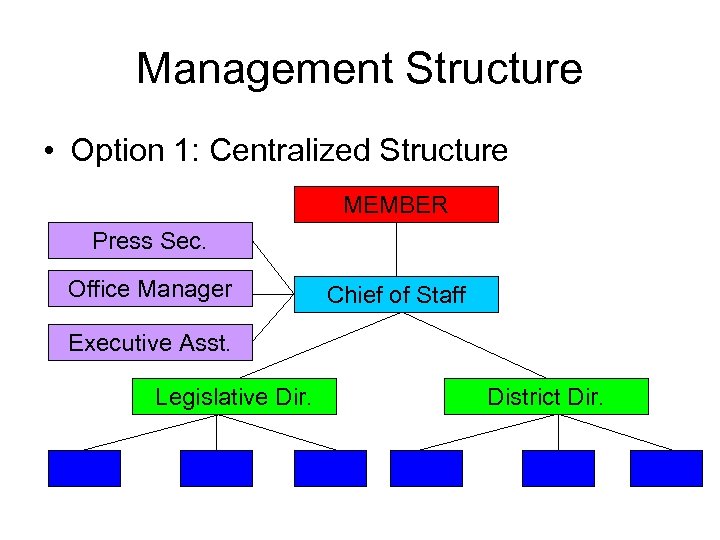 Management Structure • Option 1: Centralized Structure MEMBER Press Sec. Office Manager Chief of Staff Executive Asst. Legislative Dir. District Dir.
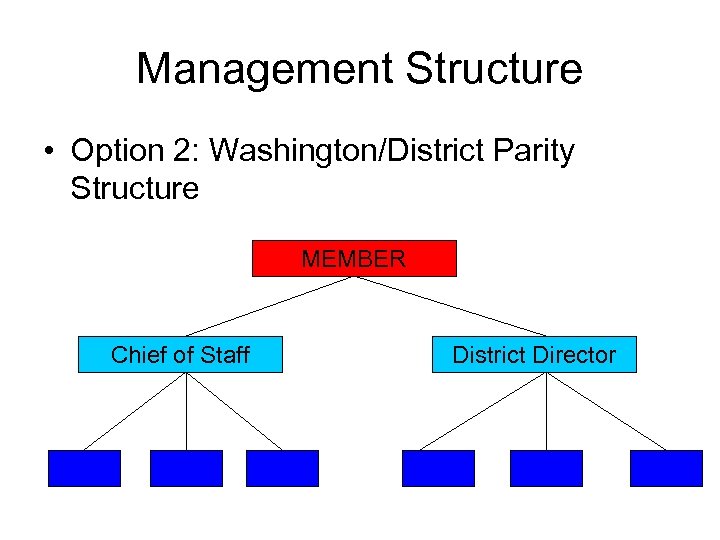 Management Structure • Option 2: Washington/District Parity Structure MEMBER Chief of Staff District Director
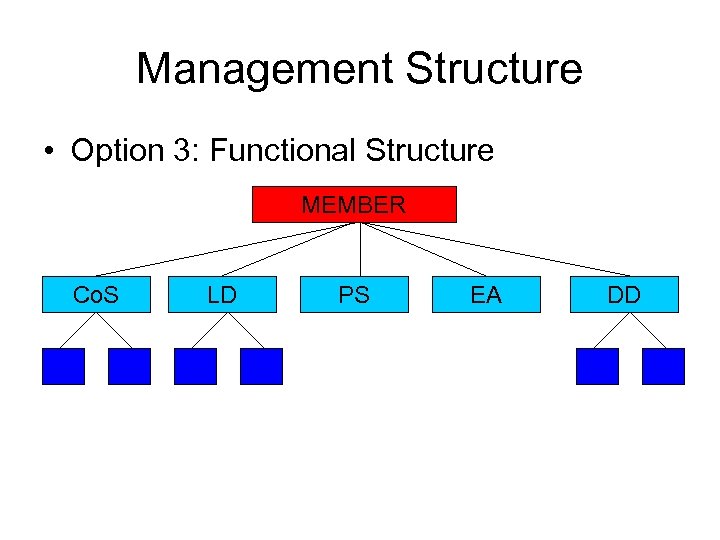 Management Structure • Option 3: Functional Structure MEMBER Co. S LD PS EA DD
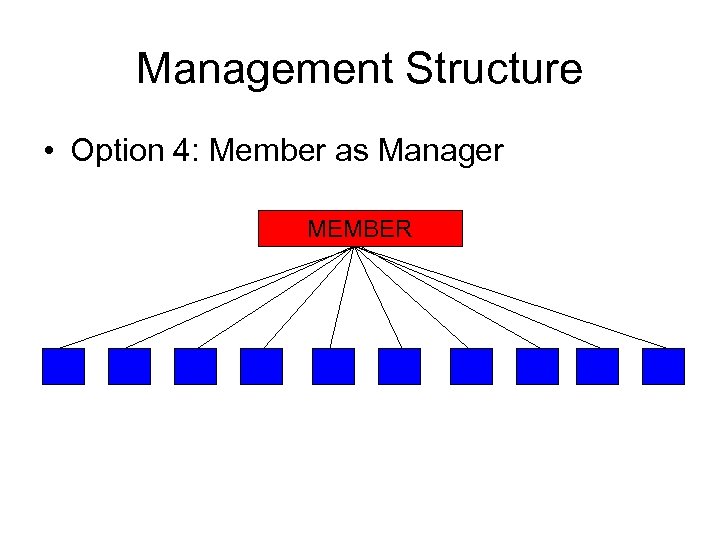 Management Structure • Option 4: Member as Manager MEMBER
 Advice for Designing Communication System • Employ a full range of methods • Draft a memo that specifies how the office intends to manage Member-Staff relations • Evenly enforce the agreed upon rules and practices • Conduct regular office-wide discussions about your communications to identify problems
 Hire a Core Staff • Scarce time • Increase the chances of hiring the “right” staff – Turnover High
 Vital Functions • • • Answering phone/greeting visitors Answering mail Conducting basic legislative research Maintaining computer system Handling scheduling requests Providing member with personal assistance Handling casework Handling press inquiries Day-to-day management
 Staff Candidate Selection Process 1. Do a job analysis for each position 2. Develop interview questions and other tests that will elicit information about whether the candidates have the skills identified in the job analysis 3. Ask the same key questions; use a rating system 4. Involve other staff in the interview 5. Don’t hesitate to conduct further interviews 6. Check references
 Technology • Freshman members inherit predecessors’ computers, unless the systems do not comply with the House’s/Senate’s standards – – – – – Staff computers Networks and file servers Printers Correspondence Management System Scheduling Software Word Processor E-mail Management Web Browser Budgeting and Accounting
 Steps to Making Wise Technology Purchases 1. Conduct an inventory of hardware, software, and functionality 2. Talk to the people who can help 3. Shop around 4. Try before you buy 5. Be sure purchases are compatible 6. Pay close attention to installation and maintenance details
 Establishing District Offices • “All politics is local” • Consider – Size of district – Accessibility to constituents – Constituent expectations • Number of offices operated by previous Member • Campaign promises – – Budget constraints Urban/Rural differences Strategic importance of constituent services Staff hiring limitations
 Office Options • Occupying predecessor’s offices • Using government vs. privately-owned space • Mobile offices
 Considerations • Symbolism Counts • Make Sure the Office can “Carry the Load” • Don’t Do Anything Just to Look Good on Day 1 • Everything not inherited must be paid by Member’s Account
 Credits • • • Presentation based on: Congressional Management Foundation, Setting Course: A Congressional Management Guide. (Washington: Congressional Management Foundation 2004), Chapters 1 -7. Image on Cover from: Congressional Management Foundation, http: //www. cmfweb. org Accessed 2/19/2005 Presentation based on: King, David C. Turf Wars: How Congressional Committees Claim Jurisdiction. (Chicago: University of Chicago Press, 1997) 33 -55. Image from: http: //www. press. uchicago. edu/cgi-bin/hfs. cgi/00/13268. ctl (Accessed 2/28/05); http: //www. ksg. harvard. edu/news/experts/2001/king_election_reform_03130 1. htm; Accessed 3/1/05) Presentation based on: Oleszek, Walter J. , Congressional Procedures and the Policy Process. (Washington, DC: CQ Press, 2004) 76 -109. Images from: http: //www. cqpress. com/product/Congressional-Proceduresand-the-Policy-2. html, http: //www. school-house-rock. com/Bill. html, http: //en. wikipedia. org/wiki/Image: US_House_Committee. jpg (Accessed 2/28/2005)