


 Скачать презентацию Confronting the challenge of climate change infectious
74cc2cdd808d196e745feb5789e42d6c.ppt
- Количество слайдов: 17
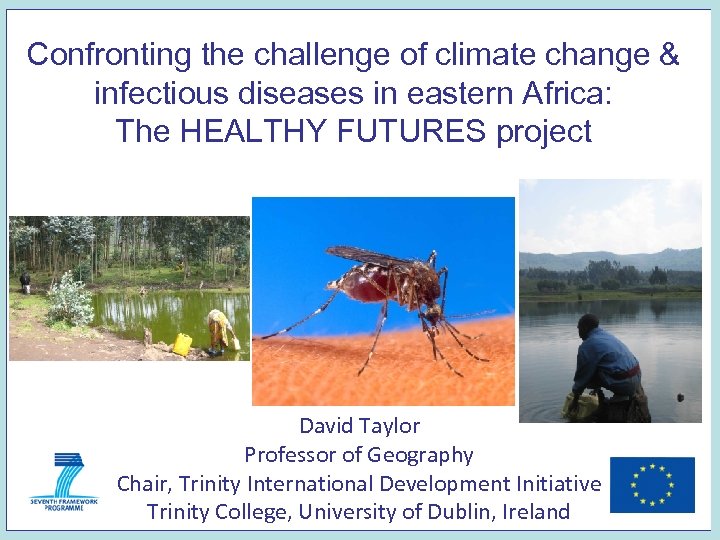 Confronting the challenge of climate change & infectious diseases in eastern Africa: The HEALTHY FUTURES project David Taylor Professor of Geography Chair, Trinity International Development Initiative Trinity College, University of Dublin, Ireland
 HEALTHY FUTURES aims to provide decision support tools that have their base in good scientific evidence/procedures to improve the efficacy of future investments in public health that target waterrelated vector-borne infectious diseases in eastern Africa Two major research-based challenges: (1) Better understanding of links between environment (including climate) and infectious diseases (2) Using this improved understanding to better anticipate future changes in these diseases as a result of environmental variability, including changes in climate & seasonality
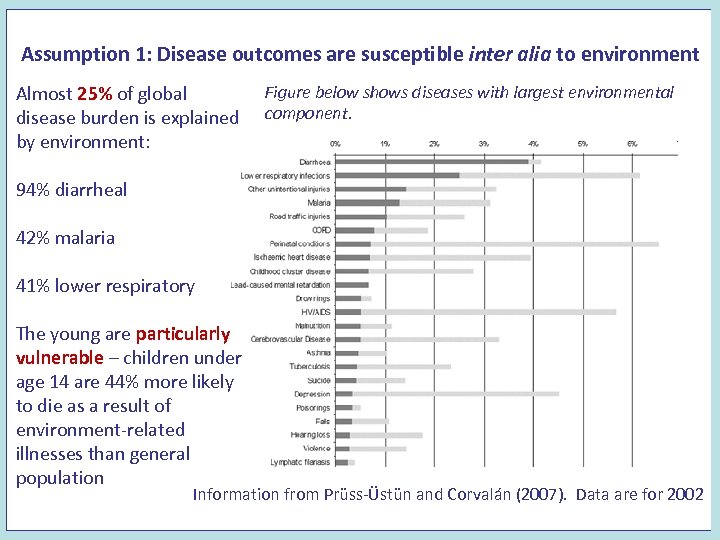 Assumption 1: Disease outcomes are susceptible inter alia to environment Almost 25% of global disease burden is explained by environment: Figure below shows diseases with largest environmental component. 94% diarrheal 42% malaria 41% lower respiratory The young are particularly vulnerable – children under age 14 are 44% more likely to die as a result of environment-related illnesses than general population Information from Prüss-Üstün and Corvalán (2007). Data are for 2002
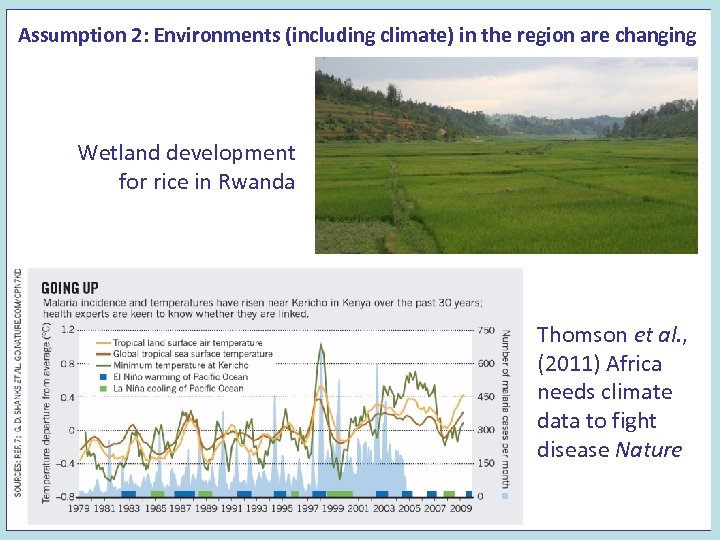 Assumption 2: Environments (including climate) in the region are changing Wetland development for rice in Rwanda Thomson et al. , (2011) Africa needs climate data to fight disease Nature
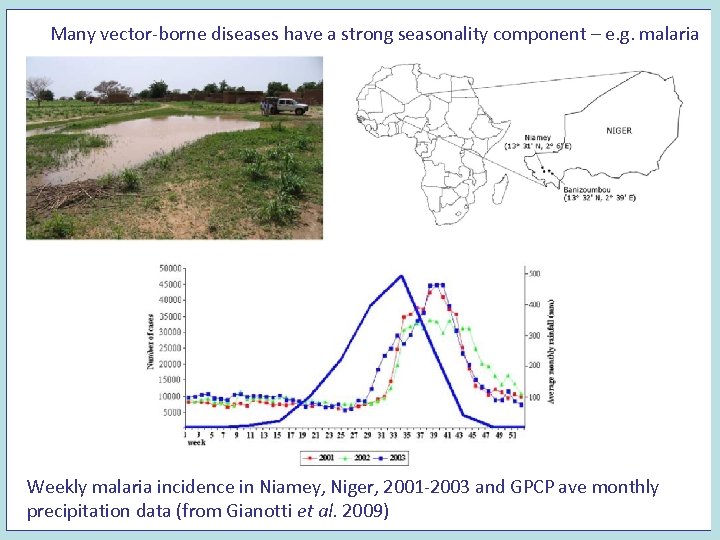 Many vector-borne diseases have a strong seasonality component – e. g. malaria Weekly malaria incidence in Niamey, Niger, 2001 -2003 and GPCP ave monthly precipitation data (from Gianotti et al. 2009)
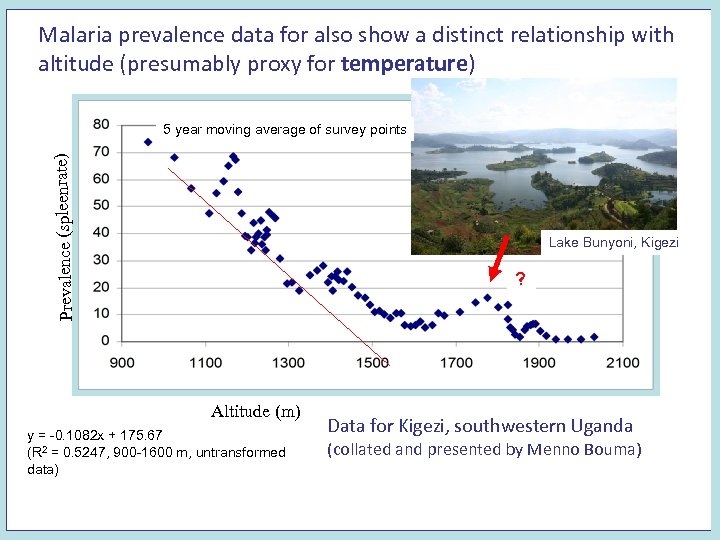 Malaria prevalence data for also show a distinct relationship with altitude (presumably proxy for temperature) Prevalence (spleenrate) 5 year moving average of survey points Lake Bunyoni, Kigezi ? Altitude (m) y = -0. 1082 x + 175. 67 (R 2 = 0. 5247, 900 -1600 m, untransformed data) Data for Kigezi, southwestern Uganda (collated and presented by Menno Bouma)
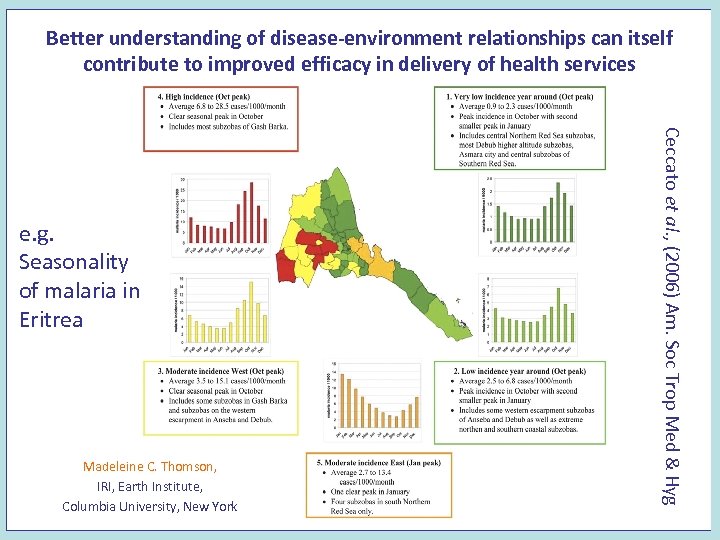 Better understanding of disease-environment relationships can itself contribute to improved efficacy in delivery of health services Madeleine C. Thomson, IRI, Earth Institute, Columbia University, New York Ceccato et al. , (2006) Am. Soc Trop Med & Hyg e. g. Seasonality of malaria in Eritrea
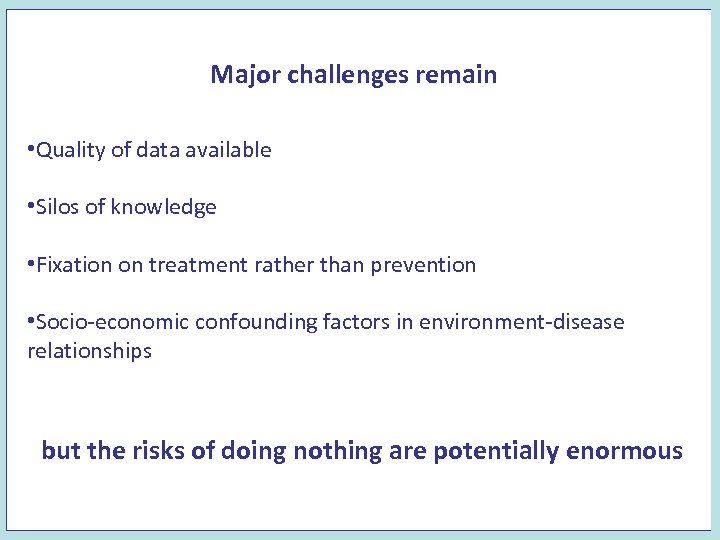 Major challenges remain • Quality of data available • Silos of knowledge • Fixation on treatment rather than prevention • Socio-economic confounding factors in environment-disease relationships but the risks of doing nothing are potentially enormous
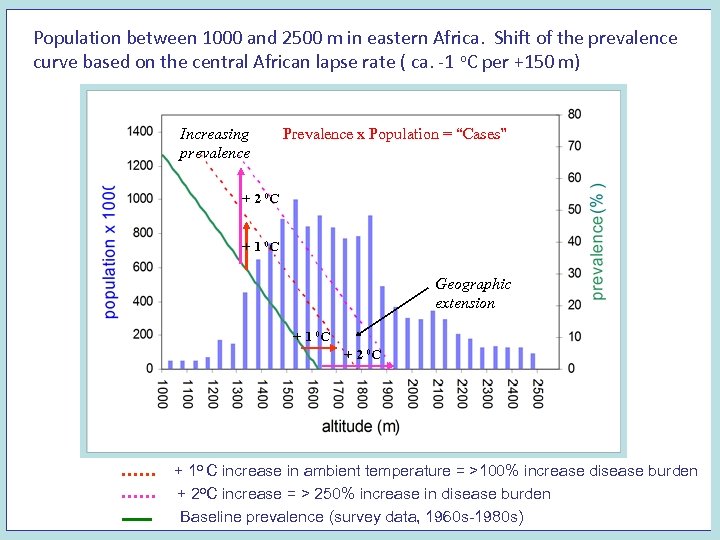 Population between 1000 and 2500 m in eastern Africa. Shift of the prevalence curve based on the central African lapse rate ( ca. -1 o. C per +150 m) Increasing prevalence Prevalence x Population = “Cases” + 2 0 C + 1 0 C Geographic extension + 1 0 C + 2 0 C + 1 o C increase in ambient temperature = >100% increase disease burden + 2 o. C increase = > 250% increase in disease burden Baseline prevalence (survey data, 1960 s-1980 s)
 Climate change - the greatest challenge to global health in the current century? Costello et al. (2009) Lancet/UCL Global Health Commission but: ‘health professionals have barely begun to engage with an issue that should be a major focal point for their research, preparedness planning and advocacy’. Costello et al. (2009: 1659) Lancet/UCL Global Health Commission And: though UN Framework Convention Climate Change (UNFCCC) mentions health, COP meetings have barely considered health as an issue until COP-16 (even then health was a focus of one side event and Cancún agreements only mention health once - under adaptation) In other words – largely ignored by the international community!
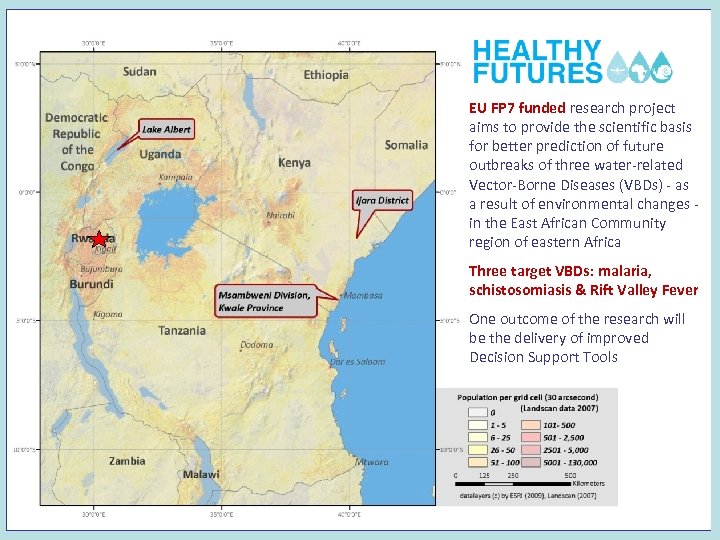 EU FP 7 funded research project aims to provide the scientific basis for better prediction of future outbreaks of three water-related Vector-Borne Diseases (VBDs) - as a result of environmental changes in the East African Community region of eastern Africa Three target VBDs: malaria, schistosomiasis & Rift Valley Fever One outcome of the research will be the delivery of improved Decision Support Tools
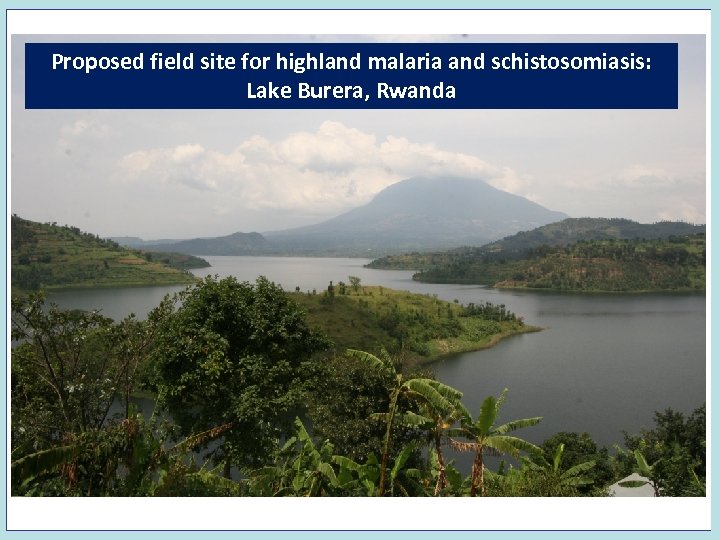 Proposed field site for highland malaria and schistosomiasis: Lake Burera, Rwanda
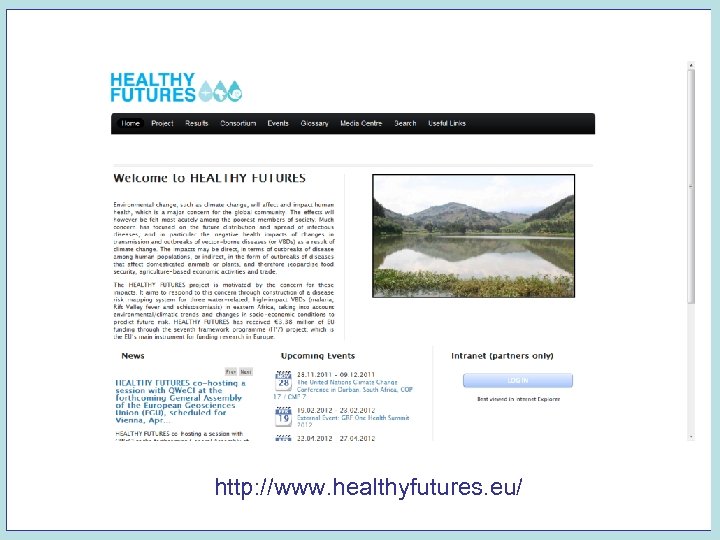 http: //www. healthyfutures. eu/
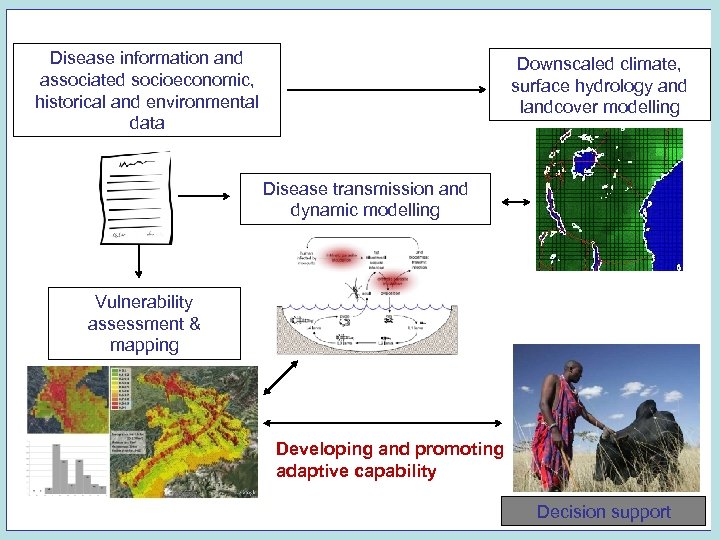 Disease information and associated socioeconomic, historical and environmental data Downscaled climate, surface hydrology and landcover modelling Disease transmission and dynamic modelling Vulnerability assessment & mapping Developing and promoting adaptive capability Decision support
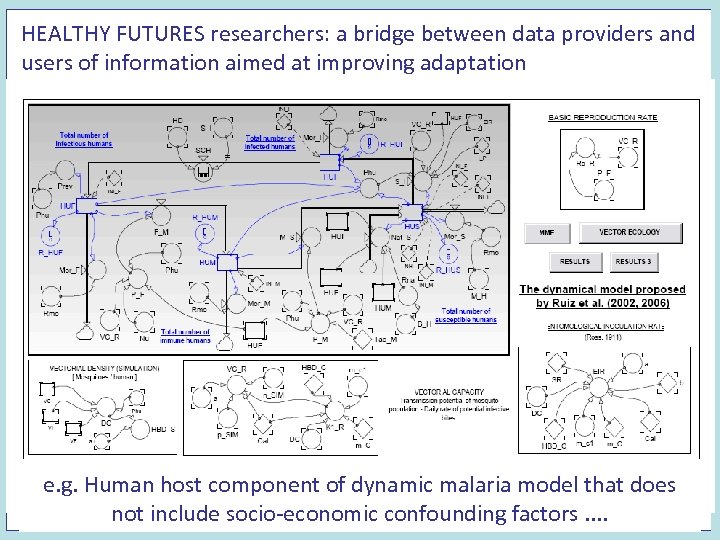 HEALTHY FUTURES researchers: a bridge between data providers and users of information aimed at improving adaptation e. g. Human host component of dynamic malaria model that does not include socio-economic confounding factors. .
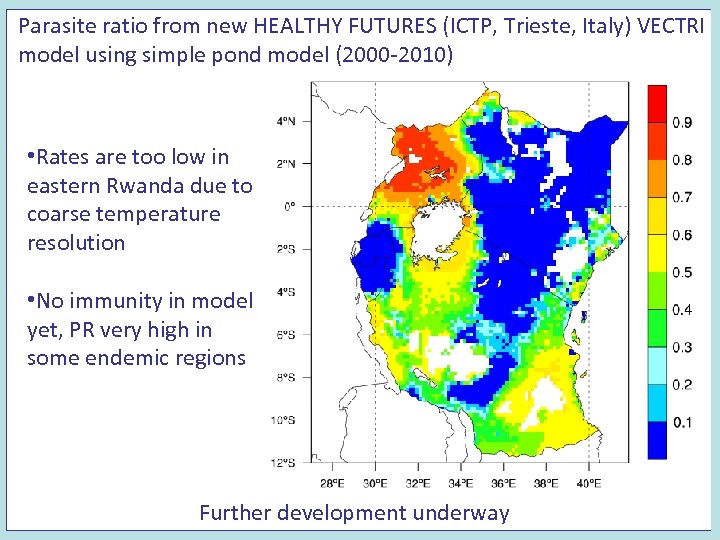 Parasite ratio from new HEALTHY FUTURES (ICTP, Trieste, Italy) VECTRI model using simple pond model (2000 -2010) • Rates are too low in eastern Rwanda due to coarse temperature resolution • No immunity in model yet, PR very high in some endemic regions Further development underway