 Скачать презентацию Conformity and Interoperability a hot topic for all
16db506c1a8ea6102e516476e9bac84e.ppt
- Количество слайдов: 48



Conformity and Interoperability: a hot topic for all the Study groups in the next Study Period and beyond ITU Americas Region Preparatory Meeting Buenos Aires, Argentina, 14 -15 May 2012 Paolo Rosa Head, WPD, Telecommunication Standardization Bureau, ITU 1
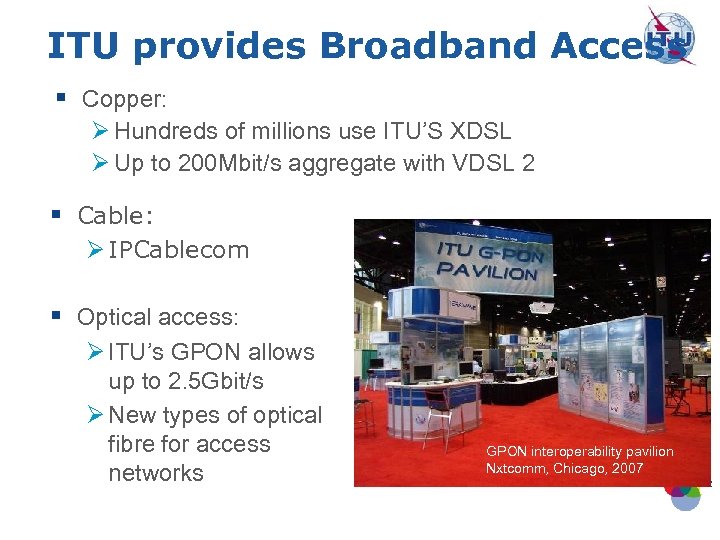
ITU provides Broadband Access § Copper: Ø Hundreds of millions use ITU’S XDSL Ø Up to 200 Mbit/s aggregate with VDSL 2 § Cable: Ø IPCablecom § Optical access: Ø ITU’s GPON allows up to 2. 5 Gbit/s Ø New types of optical fibre for access networks GPON interoperability pavilion Nxtcomm, Chicago, 2007 2
Interoperability for the 21 st century global digital economy § Developing countries experiencing huge interoperability problems and rising frustration and demand action by the ITU to redress the interoperability dilemma § Results in delays in full participation in the global digital economy and impact on social development § Delivery of e-services requires global standards and secure interoperable transport platforms
Interoperability for a true Access to Broadband § ITU’s global responsibility to ensure the interoperability and efficiency of international telecommunications; § Growing concerns about and evidence of non-compliance with ITU-T Recommendations on performance, safety and interoperability; § Counterfeit or illegally imported non-compliant and poor quality products, in particular in developing countries; § Need to facilitate market penetration by avoiding multiple testing and certification, resulting from regulatory and customer reactions to the risks of noncompliance 4
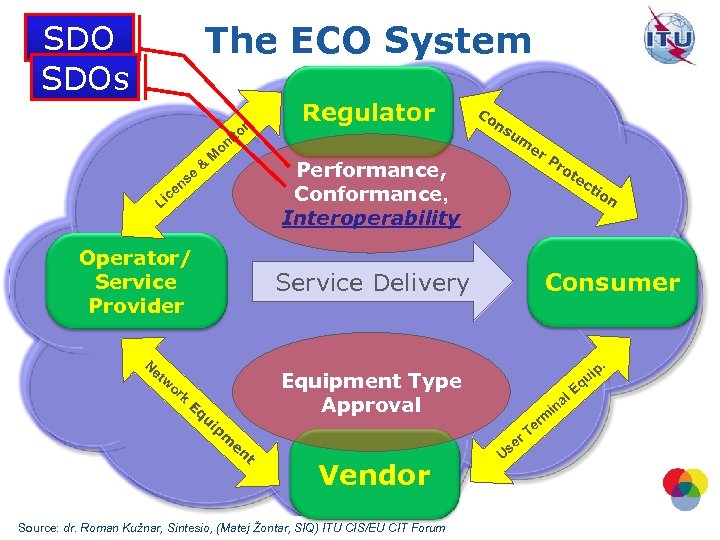
The ECO System SDOs r ito e c Li s en & M on tw Eq ui ns um er Consumer . p ui q l. E Equipment Type Approval pm en t m er r. T e Vendor Source: dr. Roman Kužnar, Sintesio, (Matej Žontar, SIQ) ITU CIS/EU CIT Forum Pr ot e ct io n Service Delivery Ne k Co Performance, Conformance, Interoperability Operator/ Service Provider or Regulator Us a in
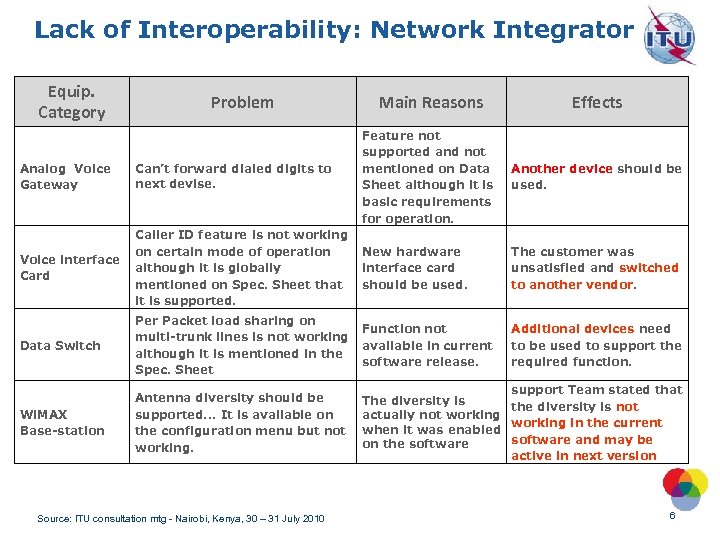
Lack of Interoperability: Network Integrator Equip. Category Problem Main Reasons Effects Another device should be used. Analog Voice Gateway Can’t forward dialed digits to next devise. Feature not supported and not mentioned on Data Sheet although it is basic requirements for operation. Voice interface Card Caller ID feature is not working on certain mode of operation although it is globally mentioned on Spec. Sheet that it is supported. New hardware interface card should be used. The customer was unsatisfied and switched to another vendor. Data Switch Per Packet load sharing on multi-trunk lines is not working although it is mentioned in the Spec. Sheet Function not available in current software release. Additional devices need to be used to support the required function. Wi. MAX Base-station Antenna diversity should be supported. . . It is available on the configuration menu but not working. support Team stated that The diversity is the diversity is not actually not working in the current when it was enabled software and may be on the software active in next version Source: ITU consultation mtg - Nairobi, Kenya, 30 – 31 July 2010 6
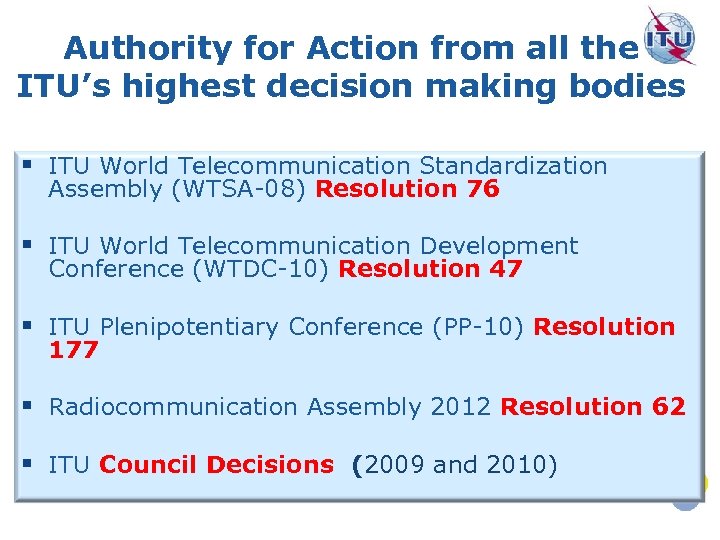
Authority for Action from all the ITU’s highest decision making bodies § ITU World Telecommunication Standardization Assembly (WTSA-08) Resolution 76 § ITU World Telecommunication Development Conference (WTDC-10) Resolution 47 § ITU Plenipotentiary Conference (PP-10) Resolution 177 § Radiocommunication Assembly 2012 Resolution 62 § ITU Council Decisions (2009 and 2010)
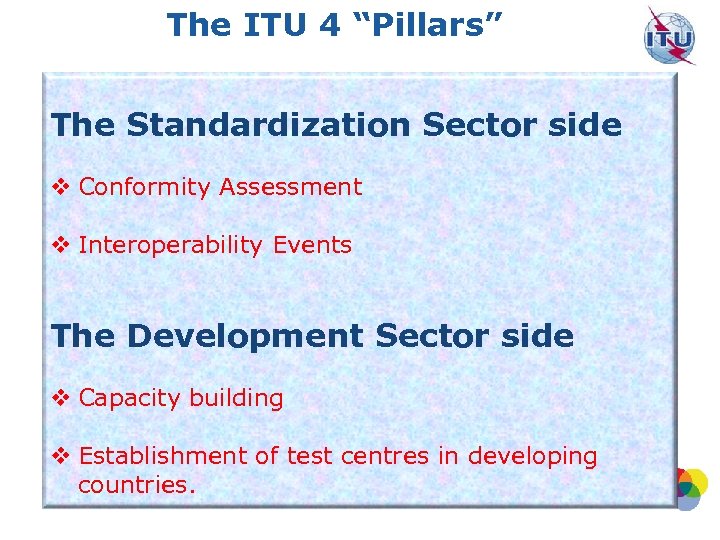
The ITU 4 “Pillars” The Standardization Sector side v Conformity Assessment v Interoperability Events The Development Sector side v Capacity building v Establishment of test centres in developing countries.
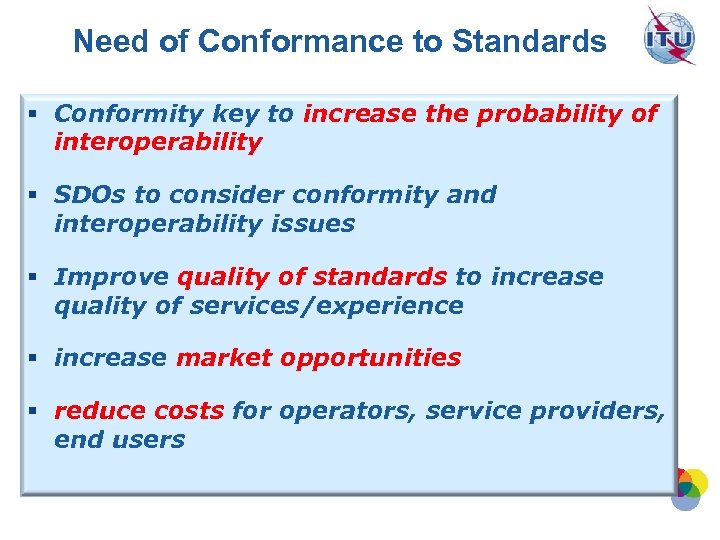
Need of Conformance to Standards § Conformity key to increase the probability of interoperability § SDOs to consider conformity and interoperability issues § Improve quality of standards to increase quality of services/experience § increase market opportunities § reduce costs for operators, service providers, end users
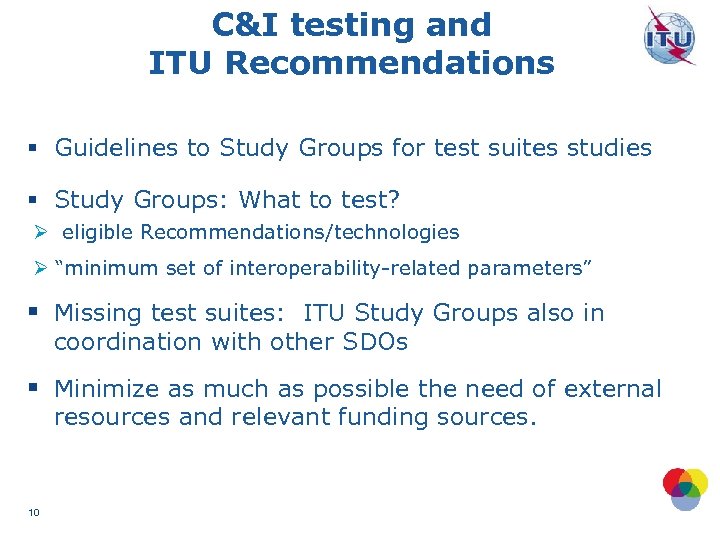
C&I testing and ITU Recommendations § Guidelines to Study Groups for test suites studies § Study Groups: What to test? Ø eligible Recommendations/technologies Ø “minimum set of interoperability-related parameters” § Missing test suites: ITU Study Groups also in coordination with other SDOs § Minimize as much as possible the need of external resources and relevant funding sources. 10
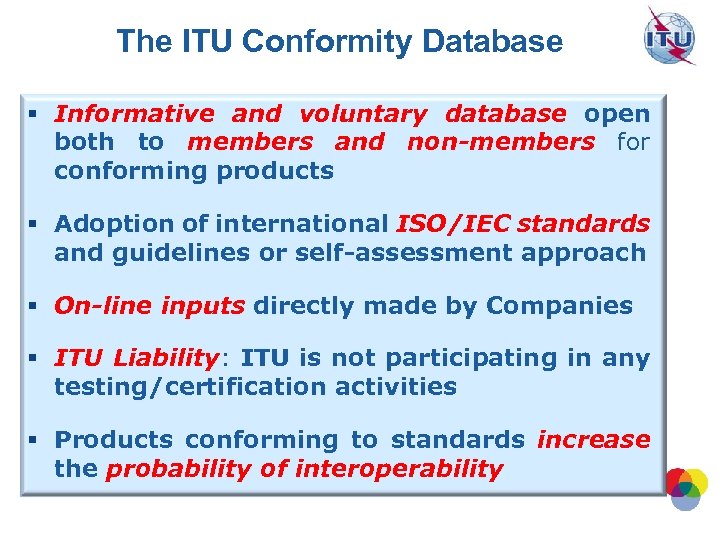
The ITU Conformity Database § Informative and voluntary database open both to members and non-members for conforming products § Adoption of international ISO/IEC standards and guidelines or self-assessment approach § On-line inputs directly made by Companies § ITU Liability: ITU is not participating in any testing/certification activities § Products conforming to standards increase the probability of interoperability
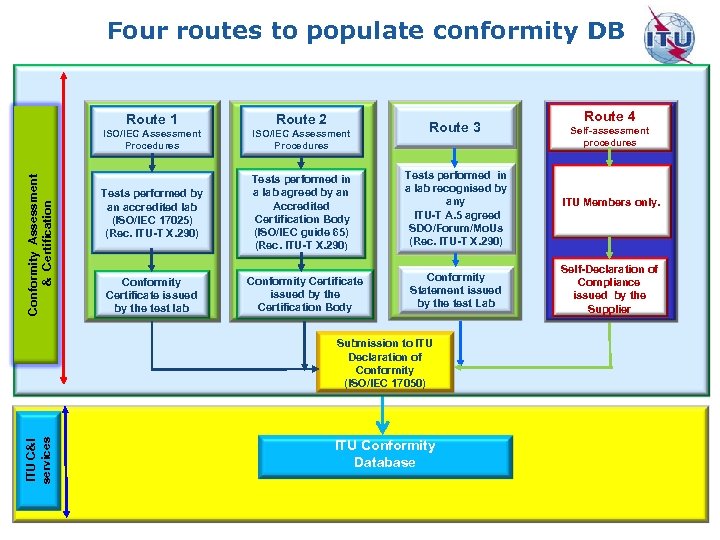
Four routes to populate conformity DB Route 2 ISO/IEC Assessment Procedures Tests performed by an accredited lab (ISO/IEC 17025) (Rec. ITU-T X. 290) Conformity Assessment & Certification Route 1 Tests performed in a lab agreed by an Accredited Certification Body (ISO/IEC guide 65) (Rec. ITU-T X. 290) Conformity Certificate issued by the test lab Conformity Certificate issued by the Certification Body Route 3 Tests performed in a lab recognised by any ITU-T A. 5 agreed SDO/Forum/Mo. Us (Rec. ITU-T X. 290) Conformity Statement issued by the test Lab ITU C&I services Submission to ITU Declaration of Conformity (ISO/IEC 17050) ITU Conformity Database Route 4 Self-assessment procedures ITU Members only. Self-Declaration of Compliance issued by the Supplier
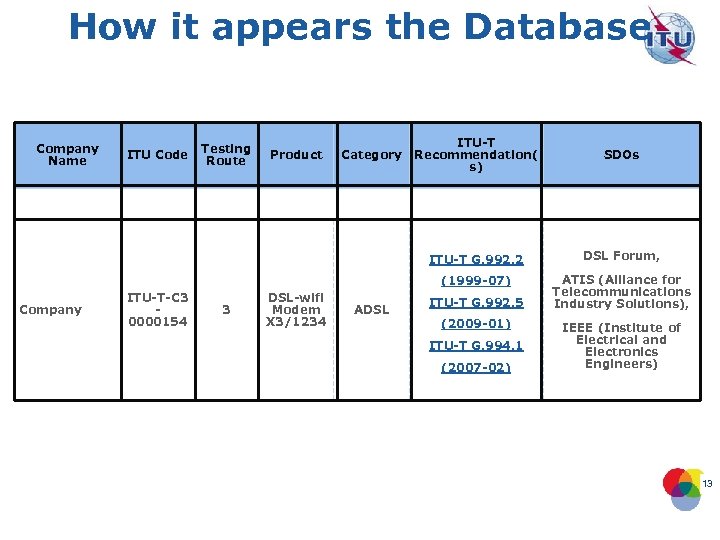
How it appears the Database Company ITU-T-C 3 0000154 Testing Route 3 Product DSL-wifi Modem X 3/1234 Category ADSL SDOs DSL Forum, (1999 -07) ITU Code ITU-T Recommendation( s) ITU-T G. 992. 2 Company Name ATIS (Alliance for Telecommunications Industry Solutions), ITU-T G. 992. 5 (2009 -01) ITU-T G. 994. 1 (2007 -02) IEEE (Institute of Electrical and Electronics Engineers) 13
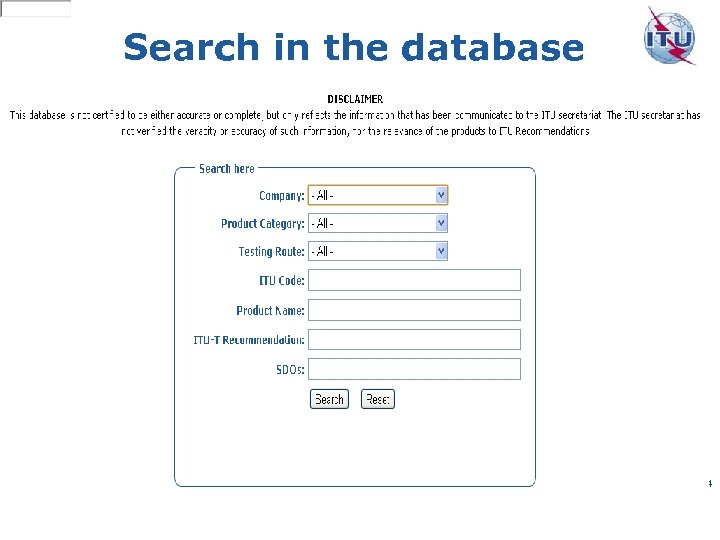
Search in the database 14
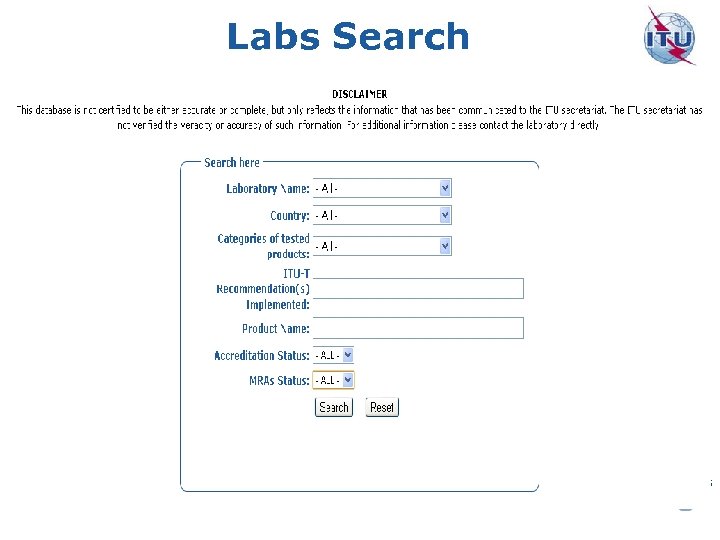
Labs Search 15
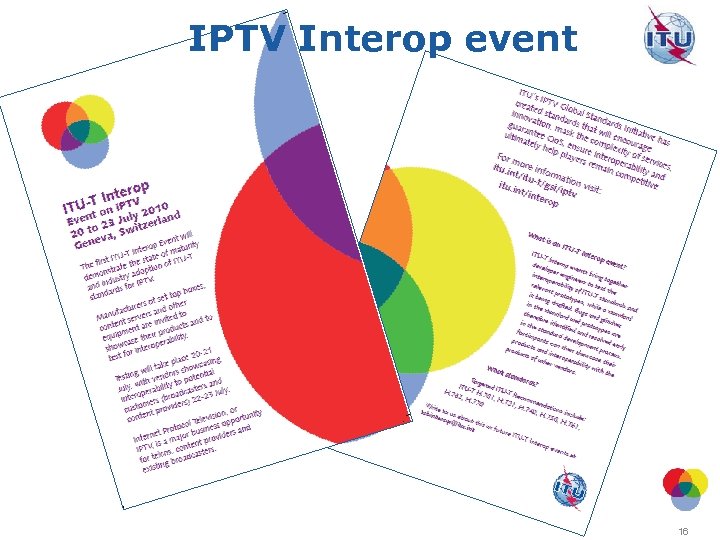
IPTV Interop event 16
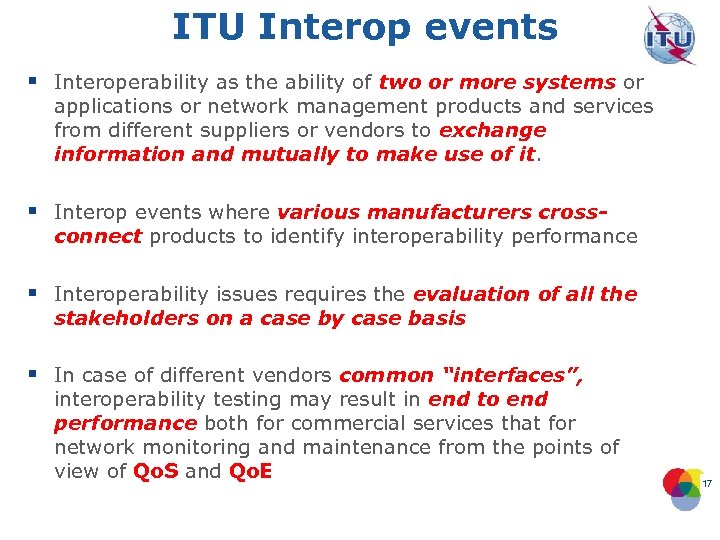
ITU Interop events § Interoperability as the ability of two or more systems or applications or network management products and services from different suppliers or vendors to exchange information and mutually to make use of it. § Interop events where various manufacturers cross- connect products to identify interoperability performance § Interoperability issues requires the evaluation of all the stakeholders on a case by case basis § In case of different vendors common “interfaces”, interoperability testing may result in end to end performance both for commercial services that for network monitoring and maintenance from the points of view of Qo. S and Qo. E 17
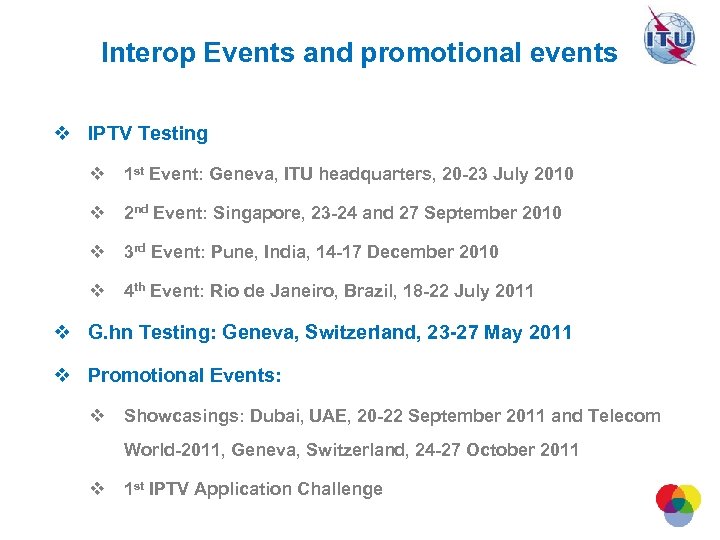
Interop Events and promotional events v IPTV Testing v 1 st Event: Geneva, ITU headquarters, 20 -23 July 2010 v 2 nd Event: Singapore, 23 -24 and 27 September 2010 v 3 rd Event: Pune, India, 14 -17 December 2010 v 4 th Event: Rio de Janeiro, Brazil, 18 -22 July 2011 v G. hn Testing: Geneva, Switzerland, 23 -27 May 2011 v Promotional Events: v Showcasings: Dubai, UAE, 20 -22 September 2011 and Telecom World-2011, Geneva, Switzerland, 24 -27 October 2011 v 1 st IPTV Application Challenge International Telecommunication Union
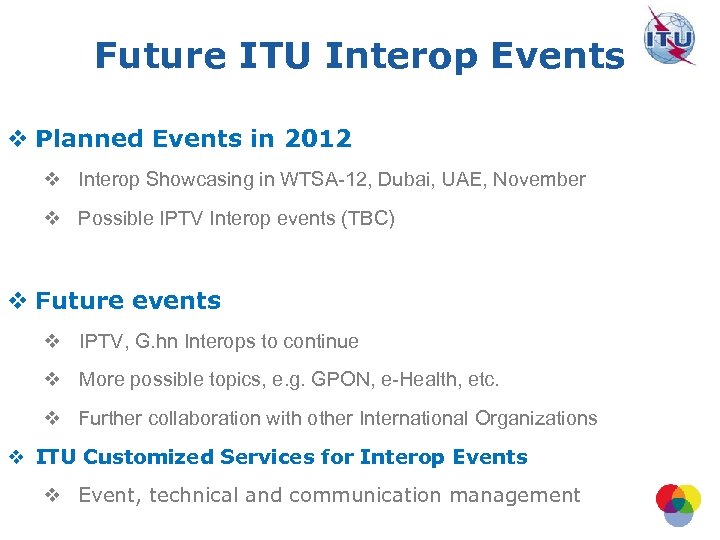
Future ITU Interop Events v Planned Events in 2012 v Interop Showcasing in WTSA-12, Dubai, UAE, November v Possible IPTV Interop events (TBC) v Future events v IPTV, G. hn Interops to continue v More possible topics, e. g. GPON, e-Health, etc. v Further collaboration with other International Organizations v ITU Customized Services for Interop Events v Event, technical and communication management International Telecommunication Union
International Telecommunication Union

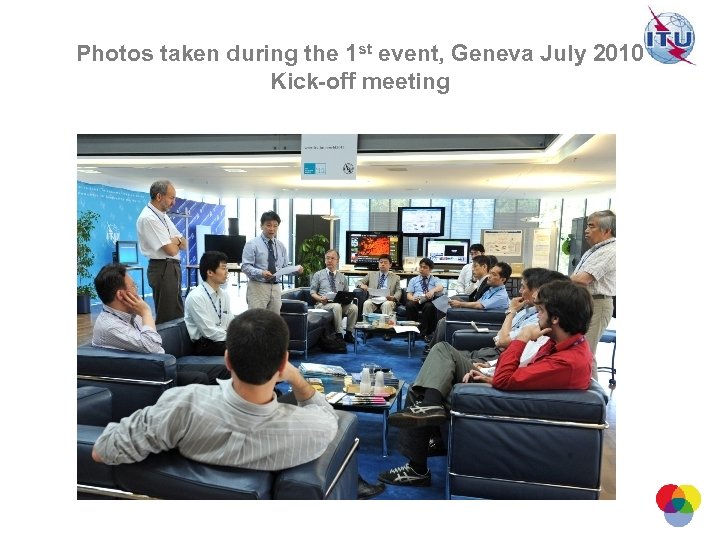
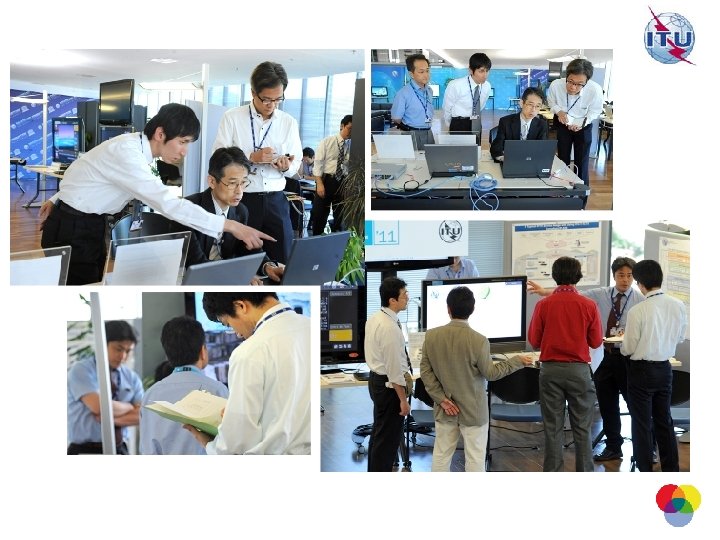
Photos taken during the 1 st event, Geneva July 2010 Kick-off meeting International Telecommunication Union
The Telecommunication Development Bureau Side v Capacity building v Establishment of test centres in developing countries. Meeting with in-deep consideration for test centres and Capacity Building in the Regions Held: v. Africa (Ghana) v. CIS (Moscow) Next: v. Arab States v. Americas
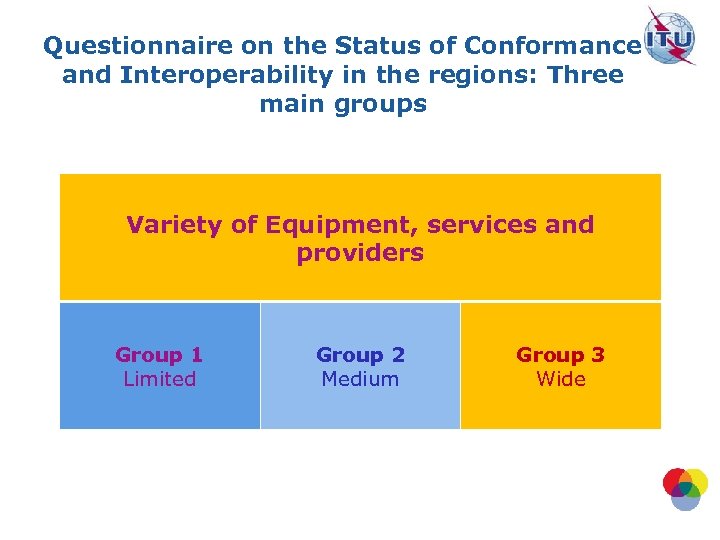
Questionnaire on the Status of Conformance and Interoperability in the regions: Three main groups Variety of Equipment, services and providers Group 1 Limited Group 2 Medium Group 3 Wide
Questionnaire: Overall results § Highlighted impact due to lack of § § interoperability food for thought as to what areas the ITU, within its scope and mandate, can provide assistance and relief capacity building and access to expertise is an essential ingredient initiatives to promote the use of global testable standards for product implementations compliance and interoperability test events welcome
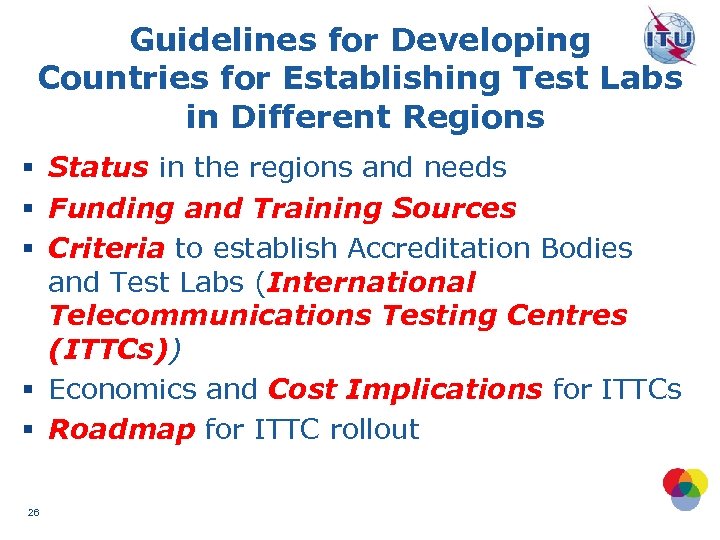
Guidelines for Developing Countries for Establishing Test Labs in Different Regions § Status in the regions and needs § Funding and Training Sources § Criteria to establish Accreditation Bodies and Test Labs (International Telecommunications Testing Centres (ITTCs)) § Economics and Cost Implications for ITTCs § Roadmap for ITTC rollout 26
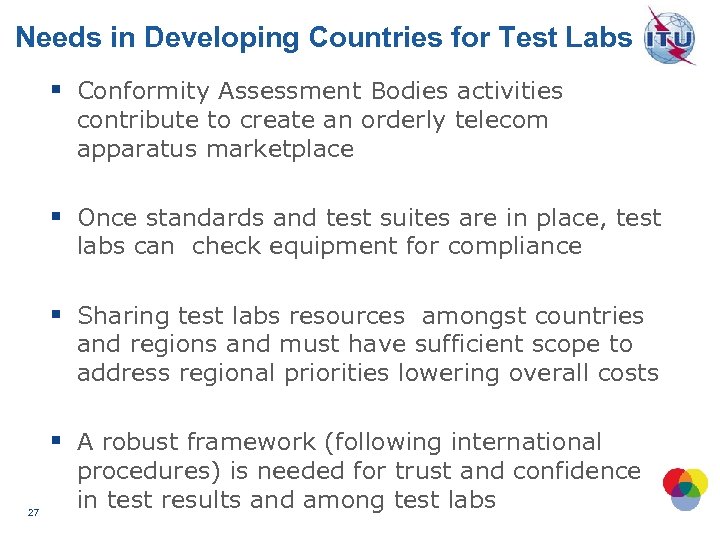
Needs in Developing Countries for Test Labs § Conformity Assessment Bodies activities contribute to create an orderly telecom apparatus marketplace § Once standards and test suites are in place, test labs can check equipment for compliance § Sharing test labs resources amongst countries and regions and must have sufficient scope to address regional priorities lowering overall costs § A robust framework (following international 27 procedures) is needed for trust and confidence in test results and among test labs
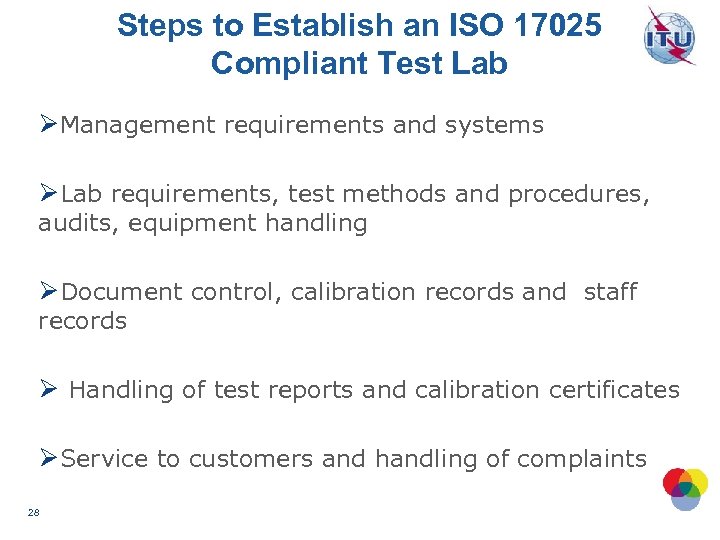
Steps to Establish an ISO 17025 Compliant Test Lab ØManagement requirements and systems ØLab requirements, test methods and procedures, audits, equipment handling ØDocument control, calibration records and staff records Ø Handling of test reports and calibration certificates ØService to customers and handling of complaints 28
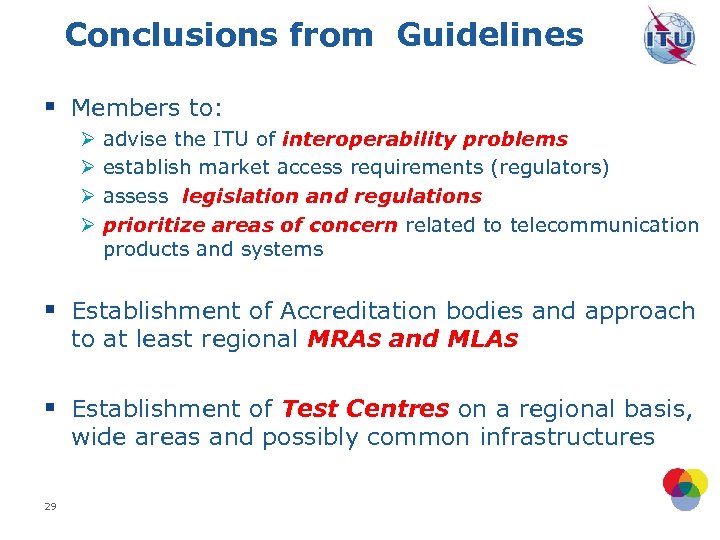
Conclusions from Guidelines § Members to: Ø Ø advise the ITU of interoperability problems establish market access requirements (regulators) assess legislation and regulations prioritize areas of concern related to telecommunication products and systems § Establishment of Accreditation bodies and approach to at least regional MRAs and MLAs § Establishment of Test Centres on a regional basis, wide areas and possibly common infrastructures 29
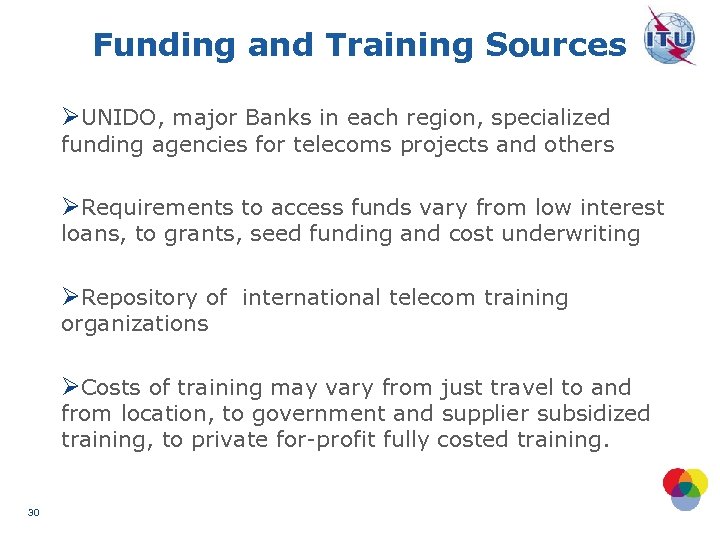
Funding and Training Sources ØUNIDO, major Banks in each region, specialized funding agencies for telecoms projects and others ØRequirements to access funds vary from low interest loans, to grants, seed funding and cost underwriting ØRepository of international telecom training organizations ØCosts of training may vary from just travel to and from location, to government and supplier subsidized training, to private for-profit fully costed training. 30
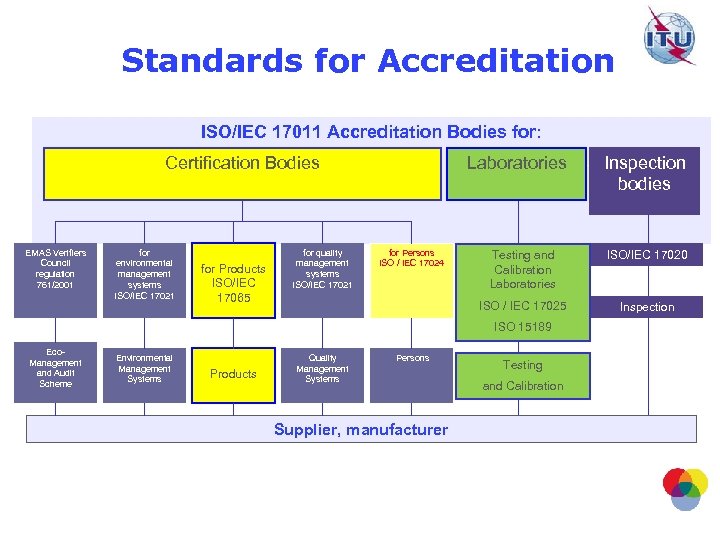
Standards for Accreditation ISO/IEC 17011 Accreditation Bodies for: Laboratories Certification Bodies EMAS Verifiers Council regulation 761/2001 for environmental management systems ISO/IEC 17021 for Products ISO/IEC 17065 for quality management systems ISO/IEC 17021 for Persons ISO / IEC 17024 Testing and Calibration Laboratories ISO/IEC 17020 ISO / IEC 17025 Inspection ISO 15189 Eco. Management and Audit Scheme Environmental Management Systems Products Inspection bodies Quality Management Systems Persons Supplier, manufacturer Testing and Calibration Manufacturer
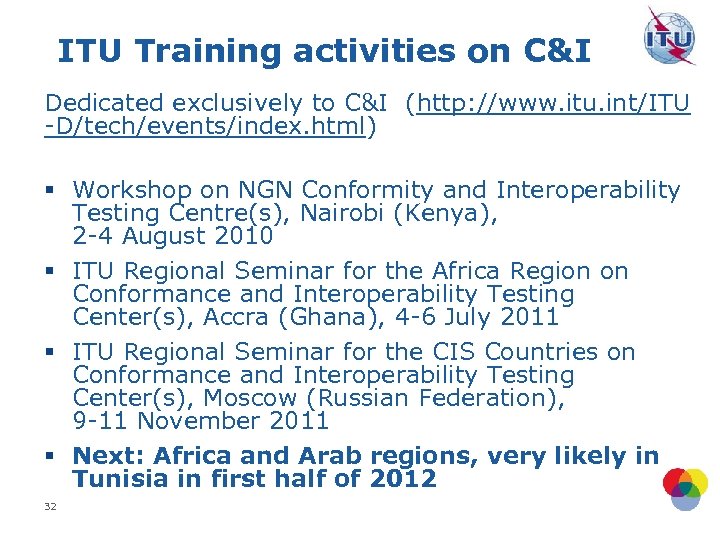
ITU Training activities on C&I Dedicated exclusively to C&I (http: //www. itu. int/ITU -D/tech/events/index. html) § Workshop on NGN Conformity and Interoperability Testing Centre(s), Nairobi (Kenya), 2 -4 August 2010 § ITU Regional Seminar for the Africa Region on Conformance and Interoperability Testing Center(s), Accra (Ghana), 4 -6 July 2011 § ITU Regional Seminar for the CIS Countries on Conformance and Interoperability Testing Center(s), Moscow (Russian Federation), 9 -11 November 2011 § Next: Africa and Arab regions, very likely in Tunisia in first half of 2012 32
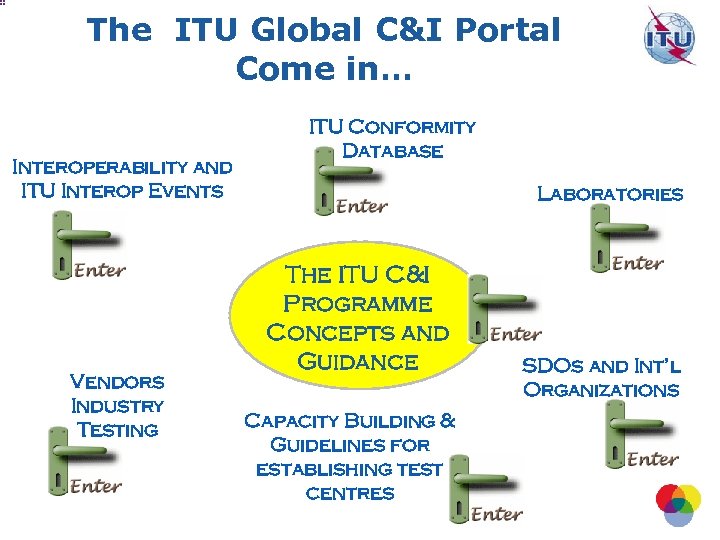
The ITU Global C&I Portal Come in… Interoperability and ITU Interop Events Vendors Industry Testing ITU Conformity Database Laboratories The ITU C&I Programme Concepts and Guidance Capacity Building & Guidelines for establishing test centres SDOs and Int’l Organizations International Telecommunication Union
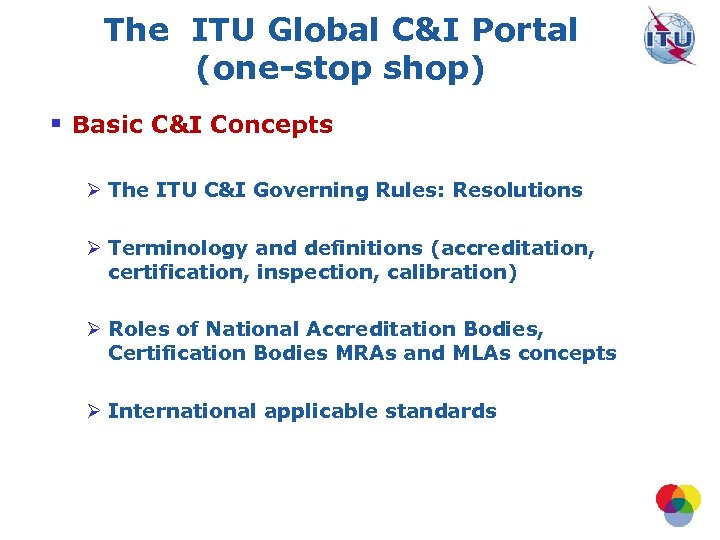
The ITU Global C&I Portal (one-stop shop) § Basic C&I Concepts Ø The ITU C&I Governing Rules: Resolutions Ø Terminology and definitions (accreditation, certification, inspection, calibration) Ø Roles of National Accreditation Bodies, Certification Bodies MRAs and MLAs concepts Ø International applicable standards International Telecommunication Union
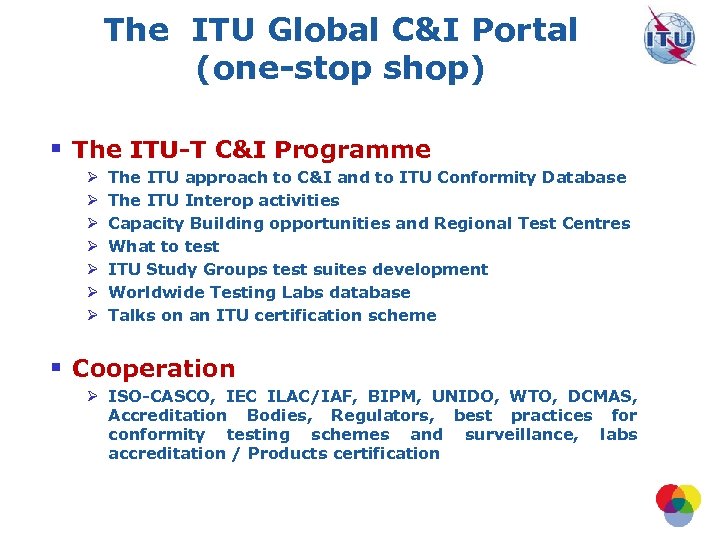
The ITU Global C&I Portal (one-stop shop) § The ITU-T C&I Programme Ø Ø Ø Ø The ITU approach to C&I and to ITU Conformity Database The ITU Interop activities Capacity Building opportunities and Regional Test Centres What to test ITU Study Groups test suites development Worldwide Testing Labs database Talks on an ITU certification scheme § Cooperation Ø ISO-CASCO, IEC ILAC/IAF, BIPM, UNIDO, WTO, DCMAS, Accreditation Bodies, Regulators, best practices for conformity testing schemes and surveillance, labs accreditation / Products certification International Telecommunication Union
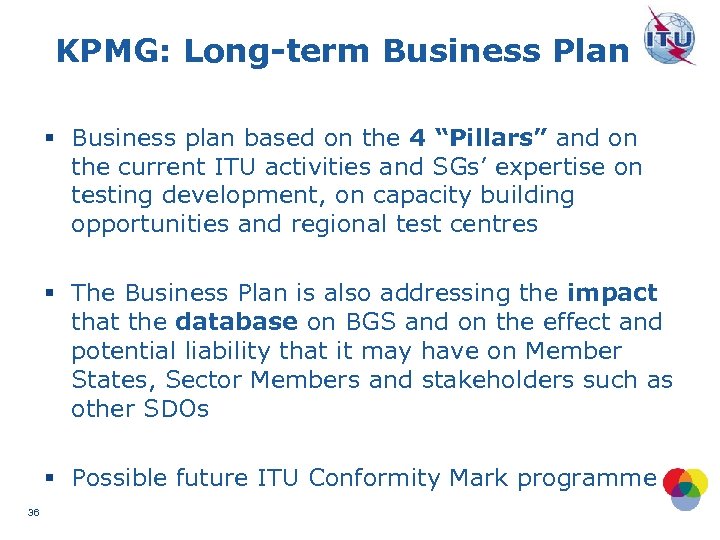
KPMG: Long-term Business Plan § Business plan based on the 4 “Pillars” and on the current ITU activities and SGs’ expertise on testing development, on capacity building opportunities and regional test centres § The Business Plan is also addressing the impact that the database on BGS and on the effect and potential liability that it may have on Member States, Sector Members and stakeholders such as other SDOs § Possible future ITU Conformity Mark programme 36
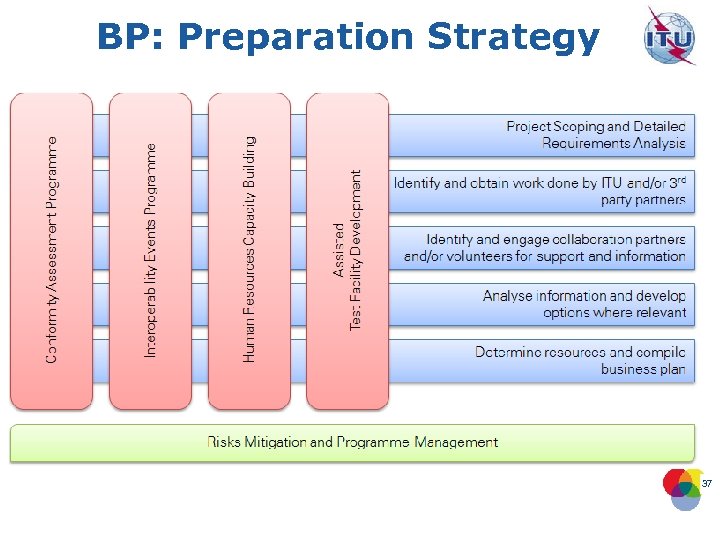
BP: Preparation Strategy 37
Some elements of the Business Plan v AS-IS Analysis v SWOT and Gap Analysis v Options and Risk analysis v Human Resource Model v Roadmap for 2012 – 2016 v Budget/Finance 38
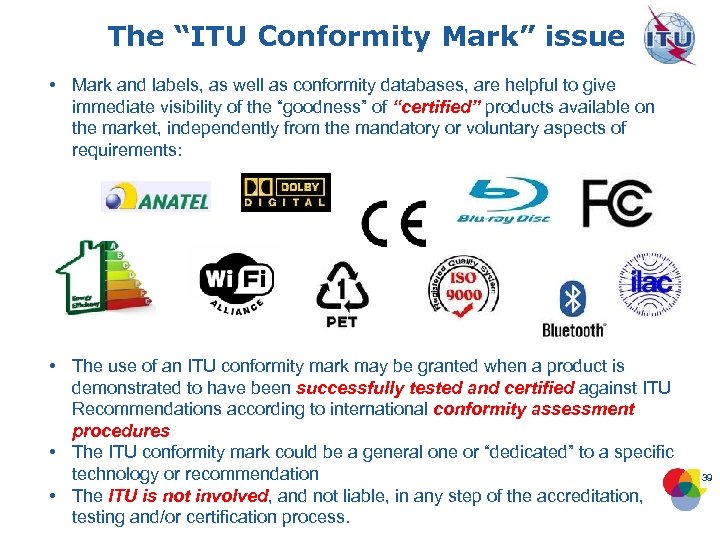
The “ITU Conformity Mark” issue • Mark and labels, as well as conformity databases, are helpful to give immediate visibility of the “goodness” of “certified” products available on the market, independently from the mandatory or voluntary aspects of requirements: • The use of an ITU conformity mark may be granted when a product is demonstrated to have been successfully tested and certified against ITU Recommendations according to international conformity assessment procedures • The ITU conformity mark could be a general one or “dedicated” to a specific technology or recommendation • The ITU is not involved, and not liable, in any step of the accreditation, testing and/or certification process. 39
Risks To Act § Resources to § manage the conformity database § Study Groups to develop test suites § Negotiate for partnerships and organization of “interop events” § Ability to effectively create needed expertise/capacity and test labs in developing countries in a timely way Risks Not to Act § Concerns from developing countries remain unaddressed and a fundamental ITU mission goal will be missed § Members could go to competitive SDOs § Continue the erosion of the ITU’s position due to lack of the essential C&I elements in its program 40
You and ITU Cooperation § Be part of the C&I Programme § Cooperating in the establishment and gathering of test suites information § Contribute to selection of the minimum set of parameters for interoperability performance for ITU-T Recs § Promotion & Population of the ITU Conformity Databases § Participation in Capacity Building activities, accreditation and certification § Participation in the creation of regional test laboratories § Participation in / Assistance for ITU interop events Further steps : Ø ITU “Recognition” of Labs performing conformity testing Ø Interleave C&I databases equipment / ITU Standard / Test suite references /Laboratories/. . .
About Benefits Certification Ø ICTs services are increasing their presence in the day-byday human life Ø Counterfeit equipment penetrate into the market Ø End users need to identify fake products on the market Ø Certification provides its contribution through validation of conformity assessment test results Ø Accreditation and MRAs are a rigorous peer to peer process able to demonstrate the competence of conformity assessment bodies in their field of activity (Ideas from Kathy Reichs: 206 Bones. Forensic Pathologist) Further steps: ØAssistance in capacity building and creation of test labs in the regions ØITU “Recognition” Programme of Labs by means of accredited certification bodies worldwide
www. itu. int Thank You ! More? Riccardo Passerini and Paolo Rosa - ITU
The FCC-Administrative Council for Terminal Attachment (ACTA) Database Ref. FCC 00 -400 of 21 December 2000 § § (item 108) the database “will permit interested parties such as the Commission, providers of telecommunications, and consumers to track and identify suppliers or importers of non-compliant equipment. As such, the database should ameliorate concerns regarding the potentially adverse impact of non-compliant terminal equipment on the PSTN by ensuring that suppliers are held accountable for any damage their equipment may cause to the PSTN” Registration Numbering and Labeling (Item 81) As stated previously, when the Commission determines that a piece of terminal equipment meets the technical requirements for that equipment, the Commission assigns a unique registration number to that piece of equipment. We tentatively conclude that although the Commission will no longer be responsible for CPE registration, some form of unique identifying label must be applied to all terminal equipment. This identifying label is necessary to adequately identify CPE as an approved piece of terminal equipment that customers are entitled to connect to the PSTN (omissis)
What To Test ? § Only Parameters that may impact interoperability requirements of functionalities as needed by the end users and the market: ØReducing time to approval ØReducing testing costs ØMutual recognition to widen protfolio and market opportunities § ITU Study Groups to establish a minimum set of parameters as needed
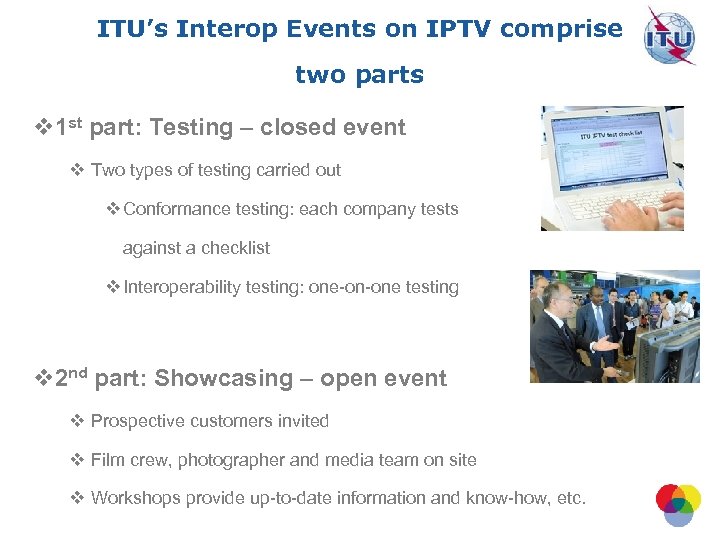
ITU’s Interop Events on IPTV comprise two parts v 1 st part: Testing – closed event v Two types of testing carried out v Conformance testing: each company tests against a checklist v Interoperability testing: one-on-one testing v 2 nd part: Showcasing – open event v Prospective customers invited v Film crew, photographer and media team on site v Workshops provide up-to-date information and know-how, etc. International Telecommunication Union
ITU Customized Services for Interop Events § Event Management: Ø Local arrangements (arranging sites with hosts, shipment, hotels, networking opportunities, visa support, etc. ), Logistical arrangements (registration/payment, legal aspects (NDAs), etc. ) § Technical Management: Ø IT support, test bed, test session scheduling, etc. § Communication Management: Ø Promotion, media involvement, press releases, event website, inviting prospective customers, etc. 47
The GCF – Certification explained § Manufacturers who certify their mobile devices to GCF rules and procedures are assured that: Ø their products will benefit from a high degree of interoperability Ø time-to-market for new products is reduced using this respected 'one-stop' verification process Ø expensive and time-consuming duplication of testing effort can be avoided § With GCF's 'tested once, use anywhere' maxim, manufacturers can significantly reduce the requirement for operator acceptance testing if presenting GCF certified devices. 48
Скачать презентацию Conformity and Interoperability a hot topic for all
16db506c1a8ea6102e516476e9bac84e.ppt