


 Скачать презентацию Conflicts In organizations people experience wide range
Conflicts.ppt
- Количество слайдов: 12
 Conflicts • In organizations people experience wide range of conflicts: incompatibility of goals, differences over interpretations of facts, disagreements based on behavioral expectations, and the like. • So conflict is a process that begins between two or more parties (group or person).
 Transitions in Conflict Thought From 1930 -th different approach to conflict and their role in organizations were developed. Three of them are: • The Traditional View of Conflict: all conflict is bad (a dysfunctional outcome resulting from poor communication, a lack of openness and trust between people, and the failure of managers to be responsive to the needs and aspirations of their employees). • The Interactionist View of Conflict: a minimal level of conflict can help keep a group viable, self-critical, and creative. Sometimes group became static, apathetic, and unresponsive and needs for change and innovation. The interactionist view does not propose that all conflicts are good. There can be functional conflict and dysfunctional conflict • Resolution-Focused View of Conflict
 Functional and dysfunctional conflict Type of conflict depend on whether it’s connected to task, relationship, or process. • Task conflict relates to the content and goals of the work. • Relationship conflict focuses on interpersonal relationships. • Process conflict relates to how the work gets done. Studies demonstrate that relationship conflicts are almost always dysfunctional. Unfortunately, managers spend a lot of effort resolving personality conflicts among staff members. One survey indicated this task takes 18 percent of their time. • Task conflicts are usually just as disruptive as relationship conflicts. For conflict to be productive, it must be kept within certain boundaries. they are not related to routine task performance. Low to moderate levels of task conflict stimulate discussion of ideas. But task conflicts sometimes escalate into relationship conflicts. • Longer-term studies show that all conflicts reduce trust, respect, and cohesion in groups, which reduces their long-term viability.
 Resolution-Focused View of Conflict (third type of conflicts understanding in historical perspective) There are some very specific cases in which conflict can be beneficial. However, workplace conflicts are not productive, they take time away from job tasks or interacting with customers, and hurt feelings • This approach focuses more on managing the whole context in which conflicts occur, both before and after the behavioral stage of conflict occurs. It’s assumed that we can minimize the negative effects of conflict by focusing on preparing people for conflicts, developing resolution strategies, and facilitating open discussion. • So, conflict is probably inevitable in most organizations, and it focuses more on productive conflict resolution.
 The Conflict Process • • • The conflict process has five stages: potential opposition or incompatibility, cognition and personalization, intentions, behavior, and outcomes.
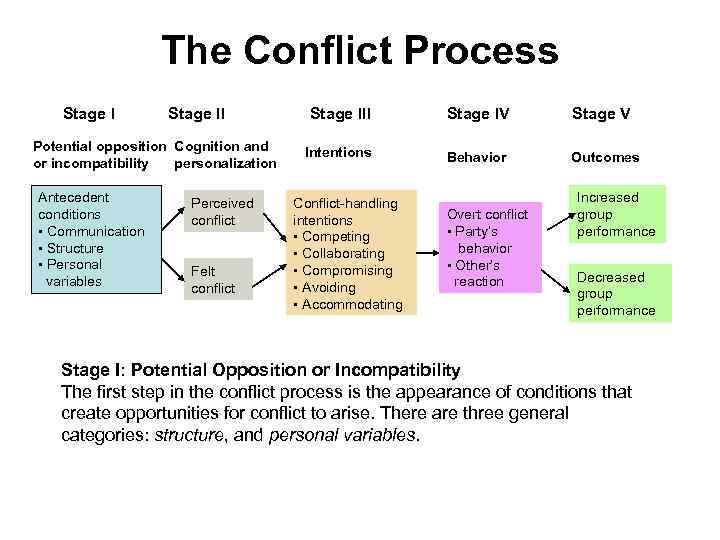 The Conflict Process Stage II Potential opposition Cognition and or incompatibility personalization Antecedent conditions • Communication • Structure • Personal variables Perceived conflict Felt conflict Stage III Stage IV Stage V Intentions Behavior Outcomes Conflict-handling intentions • Competing • Collaborating • Compromising • Avoiding • Accommodating Overt conflict • Party’s behavior • Other’s reaction Increased group performance Decreased group performance Stage I: Potential Opposition or Incompatibility The first step in the conflict process is the appearance of conditions that create opportunities for conflict to arise. There are three general categories: structure, and personal variables.
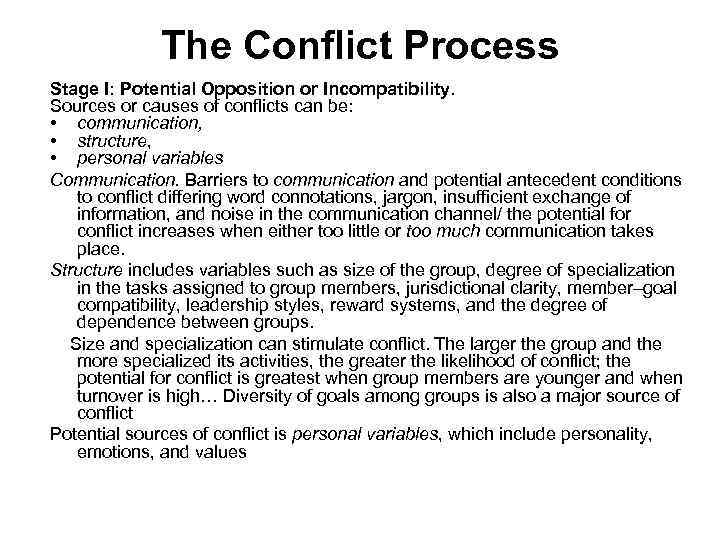 The Conflict Process Stage I: Potential Opposition or Incompatibility. Sources or causes of conflicts can be: • communication, • structure, • personal variables Communication. Barriers to communication and potential antecedent conditions to conflict differing word connotations, jargon, insufficient exchange of information, and noise in the communication channel/ the potential for conflict increases when either too little or too much communication takes place. Structure includes variables such as size of the group, degree of specialization in the tasks assigned to group members, jurisdictional clarity, member–goal compatibility, leadership styles, reward systems, and the degree of dependence between groups. Size and specialization can stimulate conflict. The larger the group and the more specialized its activities, the greater the likelihood of conflict; the potential for conflict is greatest when group members are younger and when turnover is high… Diversity of goals among groups is also a major source of conflict Potential sources of conflict is personal variables, which include personality, emotions, and values
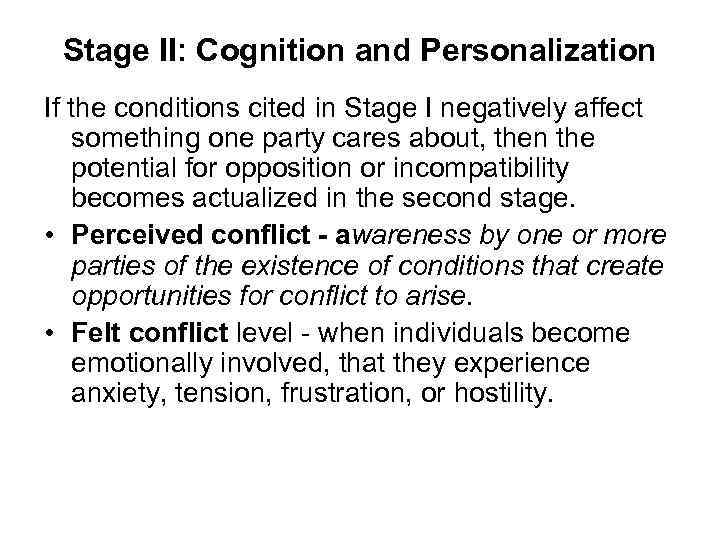 Stage II: Cognition and Personalization If the conditions cited in Stage I negatively affect something one party cares about, then the potential for opposition or incompatibility becomes actualized in the second stage. • Perceived conflict - awareness by one or more parties of the existence of conditions that create opportunities for conflict to arise. • Felt conflict level - when individuals become emotionally involved, that they experience anxiety, tension, frustration, or hostility.
 Stage III: Intentions (5 styles) Intentions intervene between people’s perceptions and emotions and their overt behavior. They are decisions to act in a given way. Many conflicts escalate simply because one party attributes the wrong intentions to the other. There is also typically a great deal of slippage between intentions and behavior, so behavior does not always accurately reflect a person’s intentions. Five conflict-handling intentions (or behavioral styles in conflict): • competing (assertive and uncooperative style, A desire to satisfy one’s interests, regardless of the impact on the other party to the conflict. • collaborating (A situation in which the parties to a conflict each desire to satisfy fully the concerns of all parties. ), • avoiding (the desire to withdraw from or suppress a conflict), • accommodating (the willingness of one party in a conflict to place the opponent’s interests above his or her own), • compromising (solution that provides incomplete satisfaction of both parties’ concerns)
 Stage IV: Behavior • The behavior stage includes the statements, actions, and reactions made by the conflicting parties, usually as overt attempts to implement their own intentions. As a result of miscalculations or unskilled enactments, overt behaviors sometimes deviate from these original intentions. • If a conflict is dysfunctional, what can the parties do to de-escalate it? Techniques of conflict management allow managers to control conflict levels.
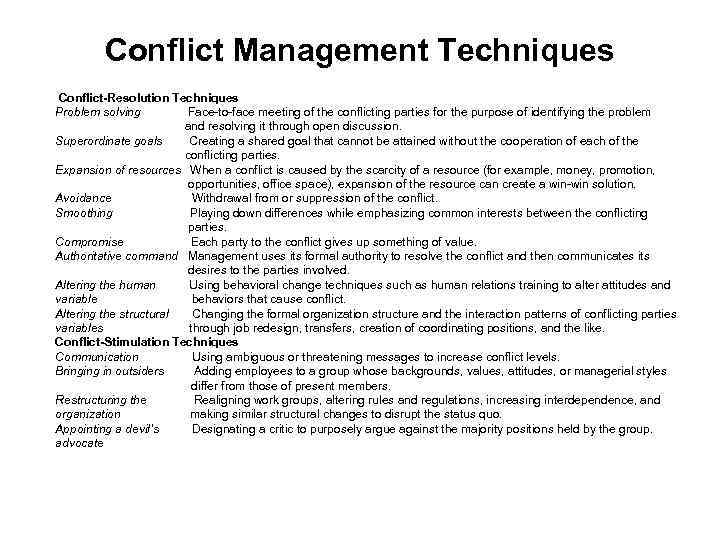 Conflict Management Techniques Conflict-Resolution Techniques Problem solving Face-to-face meeting of the conflicting parties for the purpose of identifying the problem and resolving it through open discussion. Superordinate goals Creating a shared goal that cannot be attained without the cooperation of each of the conflicting parties. Expansion of resources When a conflict is caused by the scarcity of a resource (for example, money, promotion, opportunities, office space), expansion of the resource can create a win-win solution. Avoidance Withdrawal from or suppression of the conflict. Smoothing Playing down differences while emphasizing common interests between the conflicting parties. Compromise Each party to the conflict gives up something of value. Authoritative command Management uses its formal authority to resolve the conflict and then communicates its desires to the parties involved. Altering the human Using behavioral change techniques such as human relations training to alter attitudes and variable behaviors that cause conflict. Altering the structural Changing the formal organization structure and the interaction patterns of conflicting parties variables through job redesign, transfers, creation of coordinating positions, and the like. Conflict-Stimulation Techniques Communication Using ambiguous or threatening messages to increase conflict levels. Bringing in outsiders Adding employees to a group whose backgrounds, values, attitudes, or managerial styles differ from those of present members. Restructuring the Realigning work groups, altering rules and regulations, increasing interdependence, and organization making similar structural changes to disrupt the status quo. Appointing a devil’s Designating a critic to purposely argue against the majority positions held by the group. advocate
 Stage V: Outcomes • Conflict outcomes may be functional, if the conflict improves the group’s performance, or dysfunctional, if it hinders performance. • Functional Outcomes. Conflict is constructive when it improves the quality of decisions, stimulates creativity and innovation, encourages interest and curiosity among group members. Conflict is an antidote for groupthink. It doesn’t allow the group to be passive executors. Conflict challenges the status quo and therefore furthers the creation of new ideas, promotes reassessment of group goals and activities, and increases the probability that the group will respond to change. • Dysfunctional Outcomes: destruction of the group, reduce group effectiveness, poor communication, reductions in group cohesiveness, and subordination of group goals to the primacy