


 Скачать презентацию Conflict from Cell to Colony Tom Wenseleers University
65355d4dbd1d6fe54ce76f79e6aa14d6.ppt
- Количество слайдов: 49
 Conflict from Cell to Colony Tom Wenseleers University of Leuven, Belgium Ph. D. defence May 22 nd, 2001
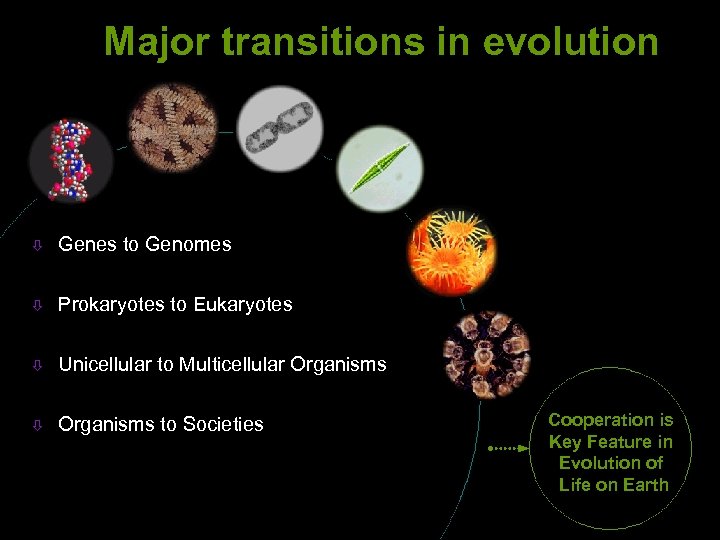 Major transitions in evolution ò Genes to Genomes ò Prokaryotes to Eukaryotes ò Unicellular to Multicellular Organisms ò Organisms to Societies Cooperation is Key Feature in Evolution of Life on Earth
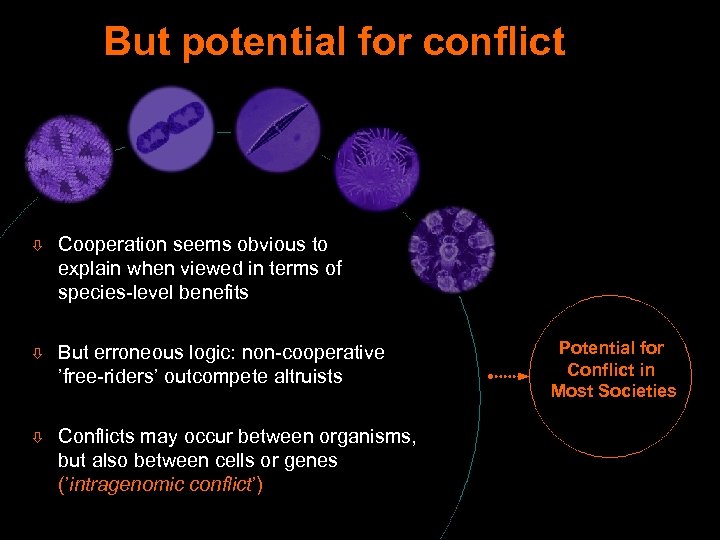 But potential for conflict ò Cooperation seems obvious to explain when viewed in terms of species-level benefits ò But erroneous logic: non-cooperative ’free-riders’ outcompete altruists ò Conflicts may occur between organisms, but also between cells or genes (’intragenomic conflict’) Potential for Conflict in Most Societies
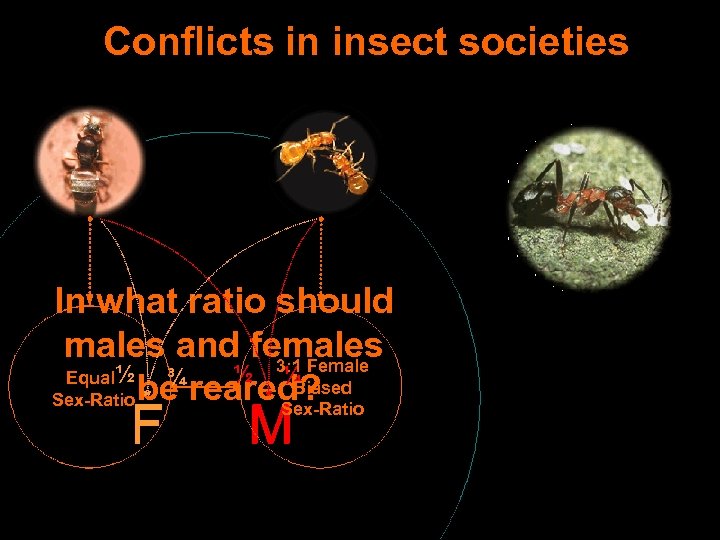 Conflicts in insect societies In what ratio should males and females ½ 3: 1 Female ¼ Equal½ ¾ Biased Sex-Ratio be reared? Sex-Ratio F M
 Cytoplasmic sex-ratio distorters ò Conflict also occurs at the genomic level: maternally transmitted genes favour more female biased sexratios than nuclear genes (“intragenomic conflict”) ò Cytoplasmic genes such as mitochondria or some bacterial symbionts may manipulate host to produce female biased broods (“cytoplasmic sex-ratio distorters”)
 Wolbachia ò Example of a maternally transmitted symbiont ò Alpha-proteobacterium ò Occurs mainly in arthropods (insects+Crustacea) + nematodes ò Manipulates host reproduction to favour own spread
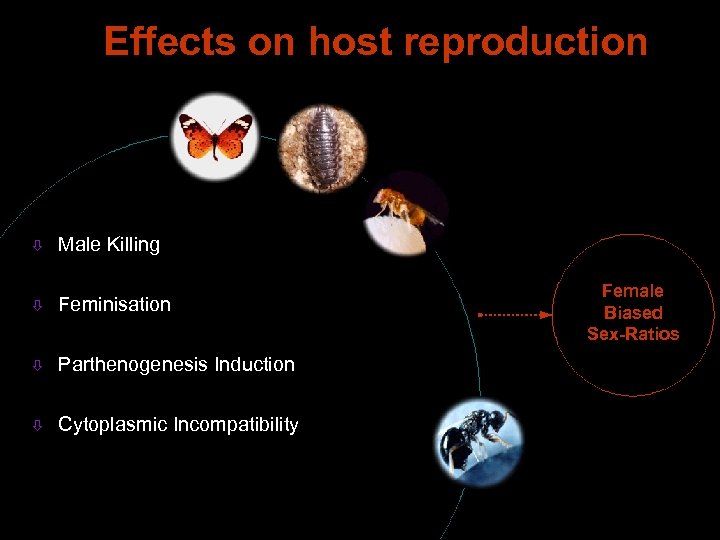 Effects on host reproduction ò Male Killing ò Feminisation ò Parthenogenesis Induction ò Cytoplasmic Incompatibility Female Biased Sex-Ratios
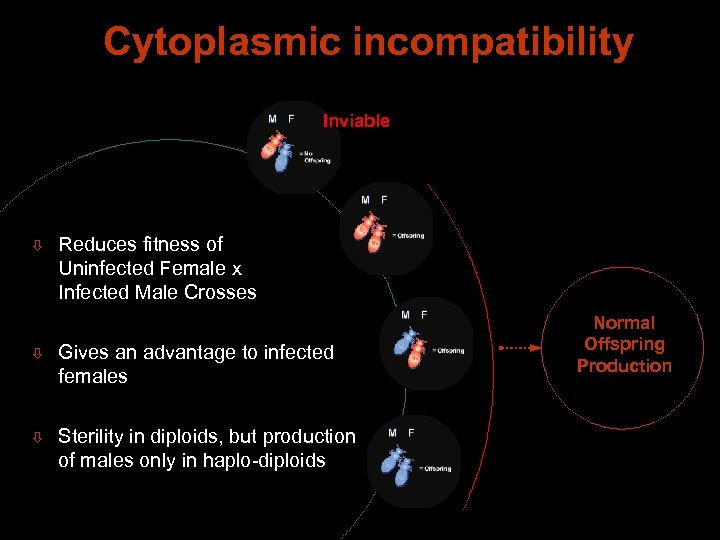 Cytoplasmic incompatibility Inviable ò Reduces fitness of Uninfected Female x Infected Male Crosses ò Gives an advantage to infected females ò Sterility in diploids, but production of males only in haplo-diploids Normal Offspring Production
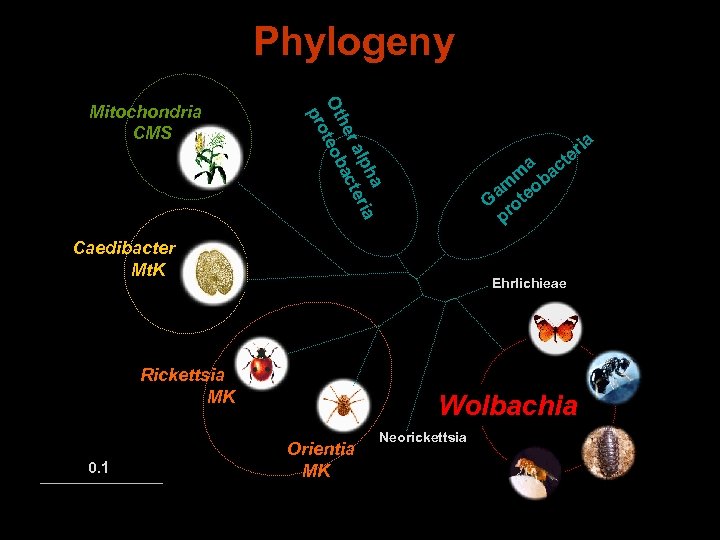 Phylogeny a lph ria r a acte he Ot teob pro Mitochondria CMS ria e a act m m eob a G rot p Caedibacter Mt. K Ehrlichieae Rickettsia MK 0. 1 Wolbachia Orientia MK Neorickettsia
 Aims of my thesis ò Part I : empirical – Does Wolbachia occur in ant societies? – Alternative explanation for female biased sex-ratios in this group? ò Part II : theoretical – What do animal and genomic conflicts have in common? – Can sociobiological theory be applied to both?
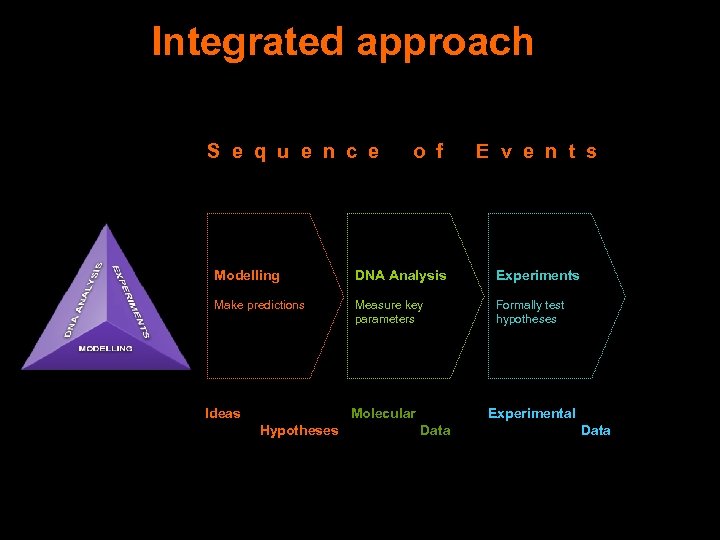 Integrated approach S e q u e n c e o f E v e n t s Modelling DNA Analysis Experiments Make predictions Measure key parameters Formally test hypotheses Ideas Molecular Hypotheses Experimental Data
 Part I. Wolbachia - a cause of intragenomic conflict in ant colonies
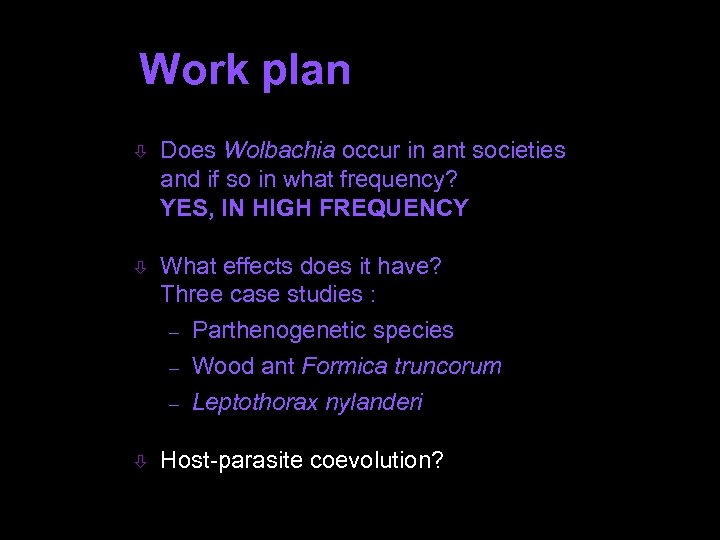
 Work plan ò Does Wolbachia occur in ant societies and if so in what frequency? ò What effects does it have? Three case studies : – Parthenogenetic species – Wood ant Formica truncorum – Leptothorax nylanderi ò Host-parasite coevolution?
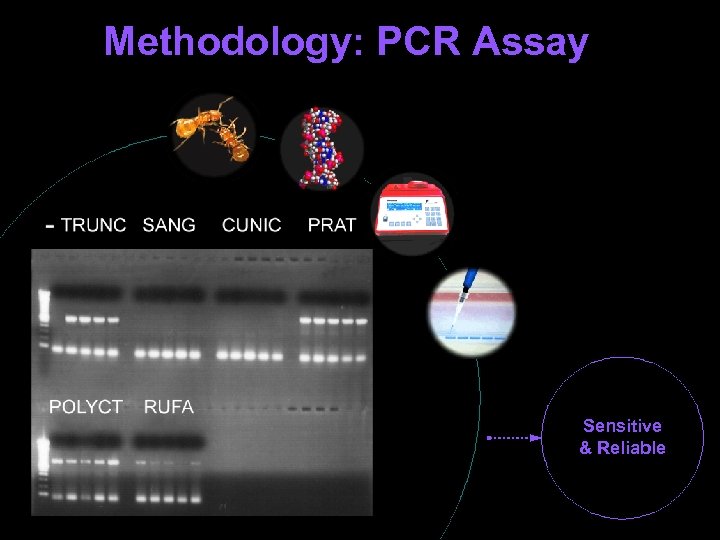 Methodology: PCR Assay ò Polymerase Chain Reaction using Specific Primers ò Targets: fts. Z and wsp Wolbachia genes ò Positive, negative and nuclear DNA (18 S r. DNA) controls ò Negative samples retested twice Sensitive & Reliable
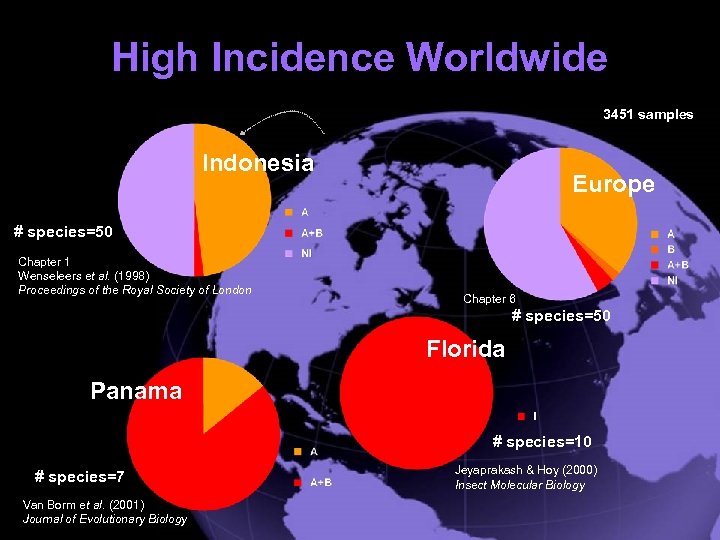 High Incidence Worldwide 3451 samples Indonesia Europe # species=50 Chapter 1 Wenseleers et al. (1998) Proceedings of the Royal Society of London Chapter 6 # species=50 Florida Panama # species=10 # species=7 Van Borm et al. (2001) Journal of Evolutionary Biology Jeyaprakash & Hoy (2000) Insect Molecular Biology
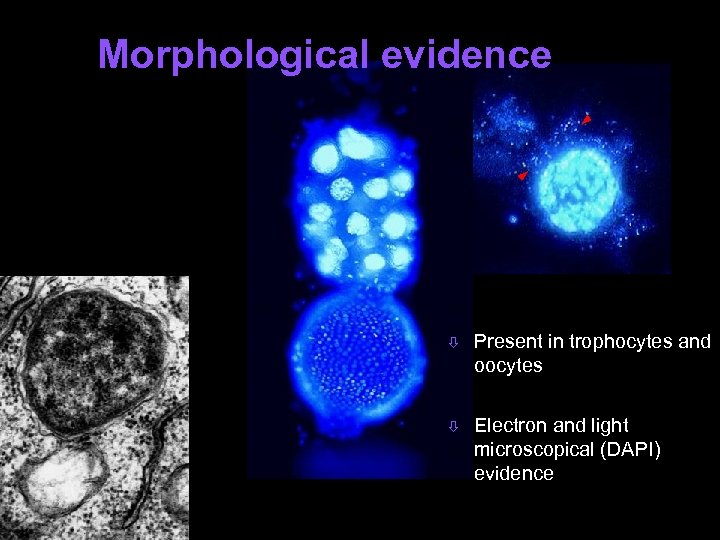 Morphological evidence ò Present in trophocytes and oocytes ò Electron and light microscopical (DAPI) evidence
 Work plan ò Does Wolbachia occur in ant societies and if so in what frequency? YES, IN HIGH FREQUENCY ò What effects does it have? Three case studies : – Parthenogenetic species – Wood ant Formica truncorum – Leptothorax nylanderi ò Host-parasite coevolution?
 Work plan ò Does Wolbachia occur in ant societies and if so in what frequency? YES, IN HIGH FREQUENCY ò What effects does it have? Three case studies : – Parthenogenetic species – Wood ant Formica truncorum – Leptothorax nylanderi ò Host-parasite coevolution?
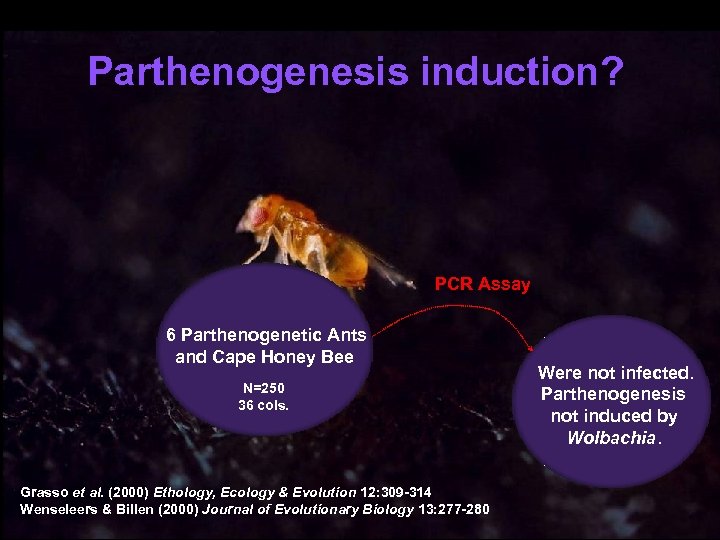 Parthenogenesis induction? PCR Assay 6 Parthenogenetic Ants and Cape Honey Bee N=250 36 cols. Grasso et al. (2000) Ethology, Ecology & Evolution 12: 309 -314 Wenseleers & Billen (2000) Journal of Evolutionary Biology 13: 277 -280 Were not infected. Parthenogenesis not induced by Wolbachia.
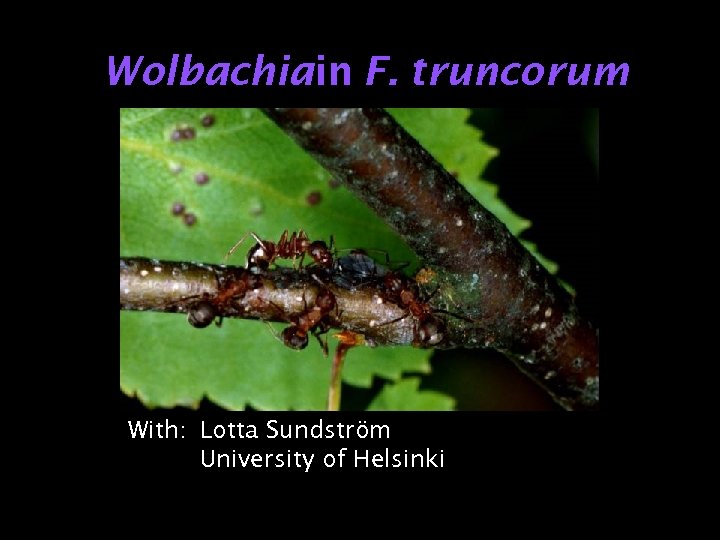 Wolbachiain F. truncorum With: Lotta Sundström University of Helsinki
 Formica truncorum ò Extensive variation in sex-ratio produced by different colonies ò Linked to facultative sex-ratio biasing : – Workers kill brothers in colonies headed by singly mated queen – But not in colonies with double mated queen ò Does Wolbachia affect the sex-ratio too?
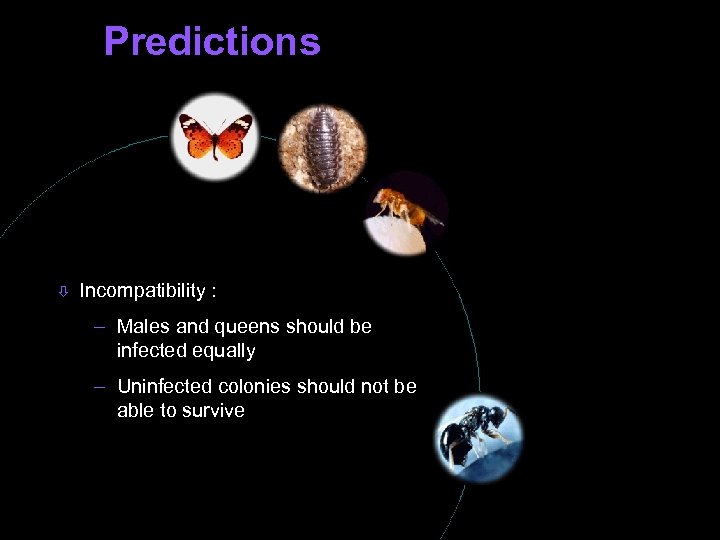 Predictions ò Incompatibility : Effect on the sex-ratio : – Males and queens shouldless than should be infected equally queens – Uninfected colonies correlated with Sex-ratio should be should not be able to survive infection rates
 Formica truncorum ò Males (96%) and queens (94%) infected equally ò All colonies infected (total # 33) despite production of 6% uninfected queens by each colony ò Consistent with an incompatibility effect : Uninfected queens do not survive past the founding stage due to incompatible matings Wenseleers, Sundström & Billen (2002) Proceedings of the Royal Society of London series B, in press.
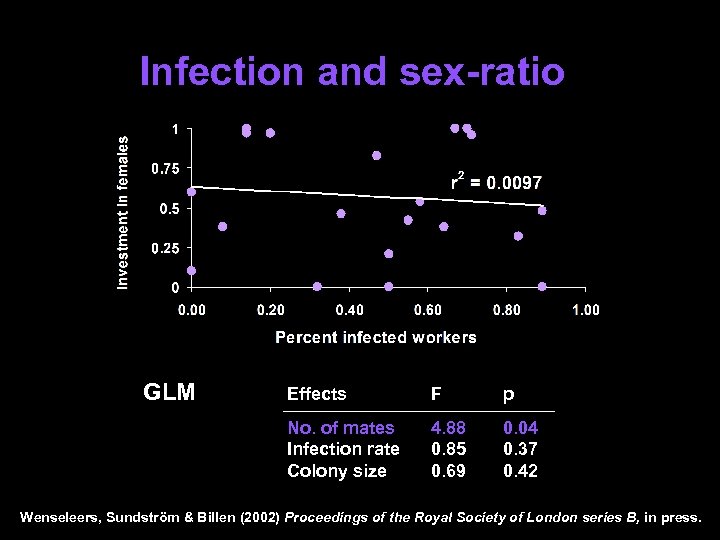 Infection and sex-ratio GLM Effects F p No. of mates Infection rate Colony size 4. 88 0. 85 0. 69 0. 04 0. 37 0. 42 Wenseleers, Sundström & Billen (2002) Proceedings of the Royal Society of London series B, in press.
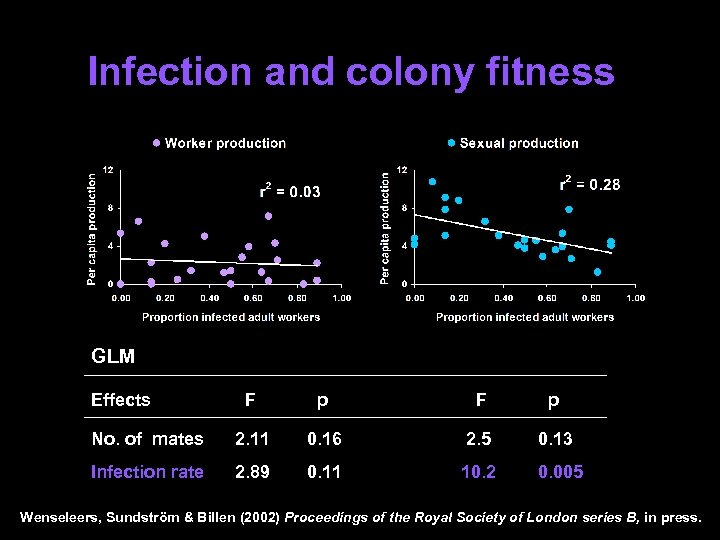 Infection and colony fitness GLM Effects F p No. of mates 2. 11 0. 16 2. 5 0. 13 Infection rate 2. 89 0. 11 10. 2 0. 005 Wenseleers, Sundström & Billen (2002) Proceedings of the Royal Society of London series B, in press.
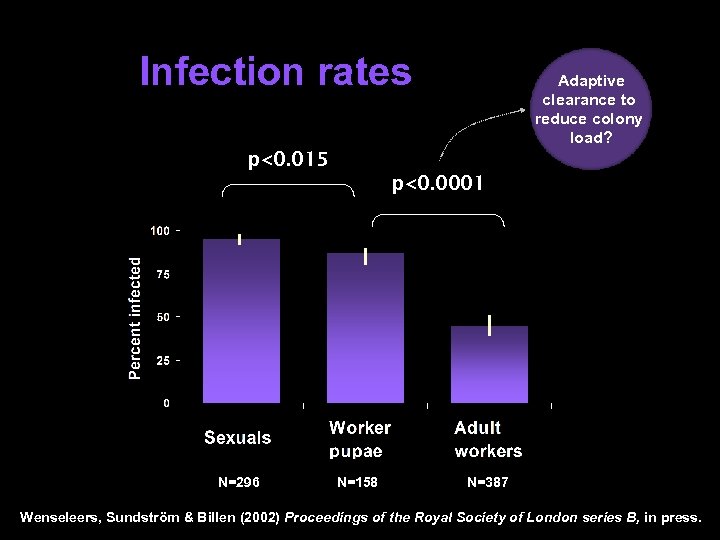 Infection rates Adaptive clearance to reduce colony load? p<0. 015 p<0. 0001 N=296 N=158 N=387 Wenseleers, Sundström & Billen (2002) Proceedings of the Royal Society of London series B, in press.
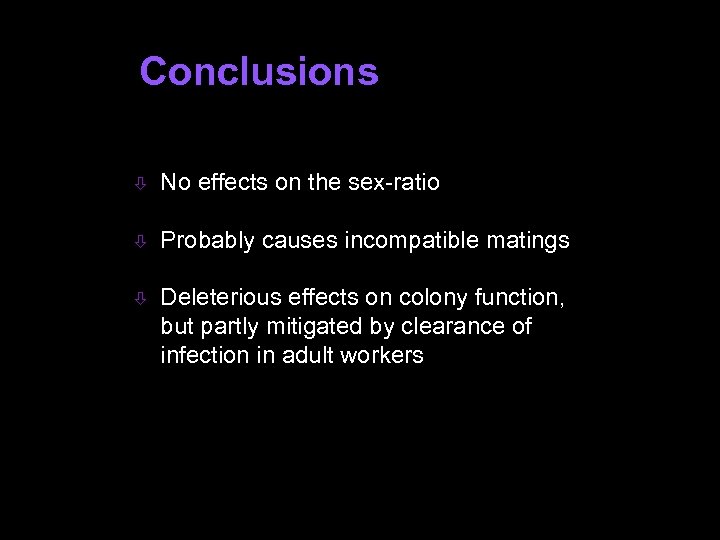 Conclusions ò No effects on the sex-ratio ò Probably causes incompatible matings ò Deleterious effects on colony function, but partly mitigated by clearance of infection in adult workers
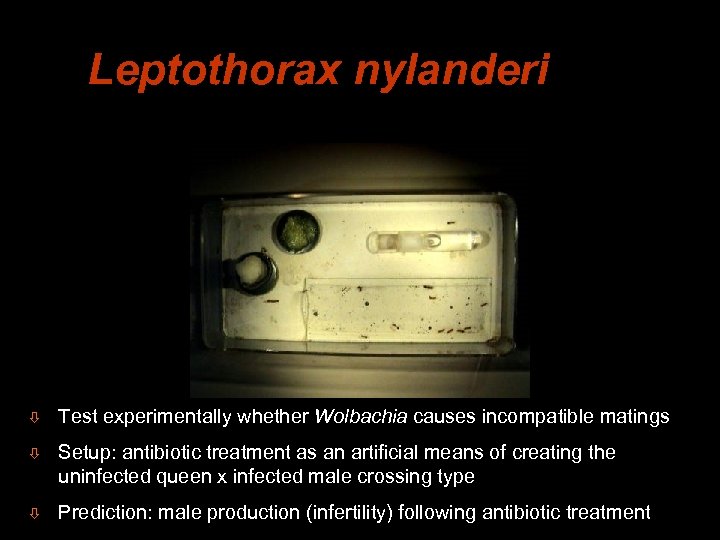 Leptothorax nylanderi ò Test experimentally whether Wolbachia causes incompatible matings ò Setup: antibiotic treatment as an artificial means of creating the uninfected queen x infected male crossing type ò Prediction: male production (infertility) following antibiotic treatment
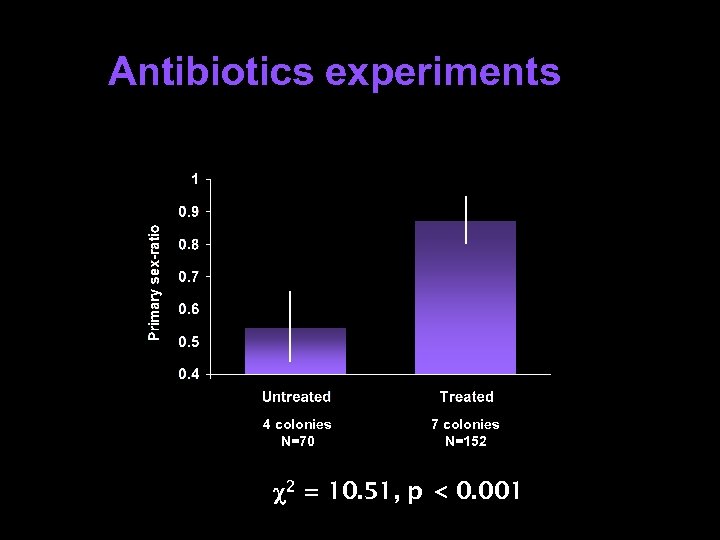 Antibiotics experiments 4 colonies N=70 7 colonies N=152 2 = 10. 51, p < 0. 001
 Work plan ò Does Wolbachia occur in ant societies and if so in what frequency? YES, IN HIGH FREQUENCY ò What effects does it have? Three case studies : – Parthenogenetic species – Wood ant Formica truncorum – Leptothorax nylanderi ò Host-parasite coevolution?
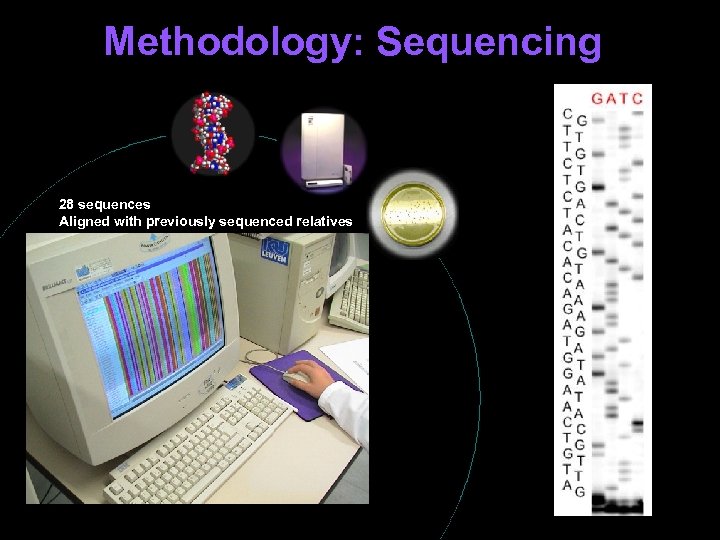 Methodology: Sequencing 28 sequences Aligned with previously sequenced relatives ò Wolbachia surface protein wsp was sequenced (approx. 550 bp) ò Direct cycle sequencing when ants were infected by single strain ò Cloning and sequencing when ants were infected by multiple strains (TA-cloning kit, p. UC 57 vector)
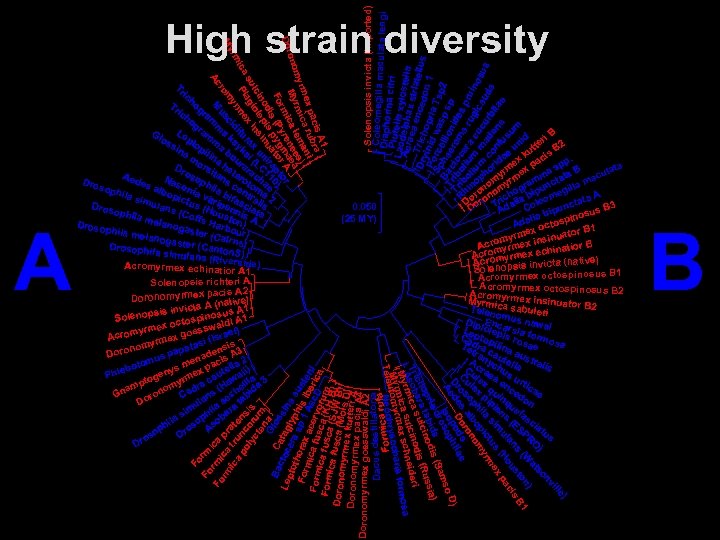 Solenopsis invicta (imported) Coleomegilla maculat a lengi Diapho Plutel rina citri Laod la xylo stella Acr elpha a x Tricea encestriatellu Dry s don h 1 P ini opr Sp orce d wa ia Tsp s 2 T Ba ha llio p s Tr rib cto erom nide p ib ol ce s ol ium ra a ru pru iu cu gic ino m m c s a co ad urb uda us en it nf us s ae um ica rm My 1 is A a pac rubr i mex ica man s) myr rm le e ono My ica ene aea r Dor rm yr m r A o Fo s (P pyg ato apt di is u ir no ep in n lci iol ins x u su ra ag x Pl me ifu d ci High strain diversity Ac ic yr 0. 050 (25 MY) Fo Fo B id ri un utte B 2 ae x k cis. rid me x pa spp o r e lata a ta B ph my rm mm ta acu o m in no my gra punc gilla A Rh oroonorichoia bi ome tata D or T dal ole B 3 C unc D A bip sus alia tospino Ad oc 1 tor B mex myr ex insinua o r. B Acrmyrm hinatio Acro myrmex ec Acro psis invicta (native) Soleno Acromyrmex octospinosus B 1 Acromyrmex octospinosus B 2 Acro Myrmmyrmex insinuator B 2 Telenica sabuleti omus nawa Di En i Le plolecarsia Ca ptop pis ro formo sa Te dra ilina sae tra ca ute austr A ny alis l Cu cra chus la Cu le ea u le x q enc rtic x u ed ae pi in pi qu on en e f s as (E ci SP atu RO s ) e) ill nv so at ) (W ton B 1 s us cis an ul (Ho pa x m si tus me ila pic yr ph lbo nom so a ro ro es o ds ae ) D d Dpo hil o. D Ae Iso sop ms (Sa dro a ) ria bid dis ssia op ta ino (Ru ch bara sulc dis Tri somica ulcino neideri A r h s My rmica rmex sc aris formosa My tomy rysoch Teleu Neoch rm rm ica Fo rm ica pr ic tru ate a po nc ns ly or is ct um en Gl a Ba Ca os Lep ctoce tagl sina toth ra yp h a For orax sp 1 is ibuste mic ace As er ni a Form r c i ica f fusca (voru. D ca usca KH m Form ica (SJ B Doronom fusca (Mo W B) yrmex k ls D)) Doronomyrmex utteri A pacis A 4 Doronomyrmex goesswaldi A 2 ia Dacus destillatorfa rmica ru Fo us M ho ic gra ho m g m Le ram a k Gl p os m sin top a ayk ilin bo ai am a u (L Dr orsi het rara C 1 tan er c 1 os Aed Dro es Naso ophi s c oto hae 0) sop alb e m l hila opi nia vi a bif ntra a 2 sim ctu trip as lis ulan s c Dros s (C (Hou ennisiata ophi offs sto A la me n) H lanog Droso aster arbour phila m (Cair ) elanog ns) aster ( C Drosoph ila simula anton. S) ns (Riv Acromyrmex echinati erside) or A 1 Solenopsis richteri A pacis A 2 Doronomyrmex e) A (nativ is invicta osus A 1 s Solenop pin di A 1 octos al yrmex goessw ael) r crom A rmex tasi (Is is omy a n ap ens 3 Doro us p nad cis A 2 e tom pa ella ) sm ebo eny rmex aut waii a Phl g c a lli 3 pto a my ra nam rono Cad s (H che bid G o an se ta D ul la a sim phi bar a hil oso Aso op s Dr ro D Tr A m ro Tr B
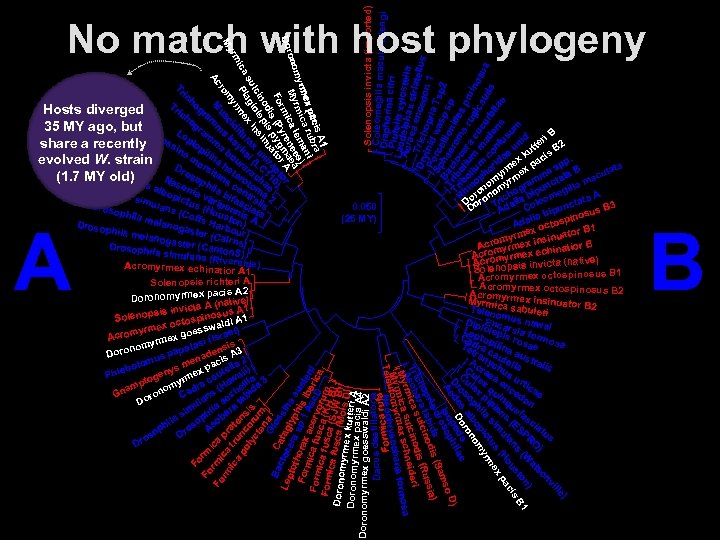 Solenopsis invicta (imported) Coleomegilla maculat a lengi Diapho Plutel rina citri Laod la xylo stella Acr elpha a x Tricea encestriatellu Dry s don h 1 P ini opr Sp orce d wa ia Tsp s 2 T Ba ha llio p s Tr rib cto erom nide p ib ol ce s ol ium ra a ru pru iu cu gic ino m m c s a co ad urb uda us en it nf us s ae um My A 1 i A a acis bra x a r b i ex pi a ru ani y y m rmica lema es) m myr n m Myr ica le neeaea ono ca ne ae A D r Dor mi yr rm yre m r A or r Fo s (P pyg ato apt F s ( pyg a o i s u r od is nu i no ep in n cn i e i lci iol ins x u su su x ra l lag ex ica P me ifu ica P rm r yr yr id m sc r ro u M A Ac No match with host phylogeny Tr Tr ic ho ic gra Hosts diverged ho m 35 MY ago, but G L gram ma e k l share a recently ossin ptopi ma b ayk a m lin o ai a u (L evolved W. strain Dr orsi het rara C 1 tan er c 1 os (1. 7 Dro old)des Nas oph s c oto ha 0) MY Ae Fo Fo A 0. 050 (25 MY) rm rm ica Fo rm ica pr ic tru ate a po nc ns ly or is ct um en Gl a Ba Ca os Lep ctoce tagl sina toth ra yp h a For orax sp 1 is ibuste mic ace As er ni a Form r c i ica f fusca (voru. D ca usca KH m Form ica (SJ B Doronom fusca (Mo W B) yrmex k ls D)) Doronomyrmex utteri A pacis A 4 Doronomyrmex goesswaldi A 2 ia Dacus destillatorfa rmica ru Fo hila e) ill nv so at ) (W ton B 1 s us cis an ci ul (Ho pa x x m si tus me m ila pic yr ph lbo nom so a ro r ro es Do ds ae ) D d Dpo hil o. D Ae Iso sop ms (Sa dro a ) ria bid dis ssia op ta ino (Ru ch bara sulc dis Tri somica ulcino neideri A r h s My rmica rmex sc aris formosa My tomy rysoch Teleu Neoch alb onia ila e m e a opi b n sim ctu vitrip ifas trali 2 ulan s (H en cia s Dros s (C ophi of ous nis ta la me lanog fs Harbton) A Droso aster our) phila m ( elanog aster ( Cairns) C Drosoph ila simula anton. S) ns (Rivers ide) Acromyrmex echinati or A 1 Solenopsis richteri A pacis A 2 Doronomyrmex e) A (nativ is invicta osus A 1 s Solenop pin di A 1 octos al yrmex goessw ael) r crom A rmex tasi (Is is omy a n ap ens 3 Doro us p nad cis A 2 e tom pa ella ) sm ebo eny rmex aut waii a Phl g c a lli 3 pto a my ra nam rono Cad s (H che bid G o an se ta D ul la a sim phi bar a hil oso Aso op s Dr ro D sop B id ri un utte B 2 ae x k cis. rid me x pa spp o r e lata a ta B ph my rm mm ta acu o m in no my gra punc gilla A Rh oroonorichoia bi ome tata D or T dal ole B 3 C unc D A bip sus alia tospino Ad oc 1 tor B mex myr ex insinua o r. B Acrmyrm hinatio Acro myrmex ec Acro psis invicta (native) Soleno Acromyrmex octospinosus B 1 Acromyrmex octospinosus B 2 Acro Myrmmyrmex insinuator B 2 Telenica sabuleti omus nawa Di En i Le plolecarsia Ca ptop pis ro formo sa Te dra ilina sae tra ca ute austr A ny alis l Cu cra chus la Cu le ea u le x q enc rtic x u ed ae pi in pi qu on en e f s as (E ci SP atu RO s ) B
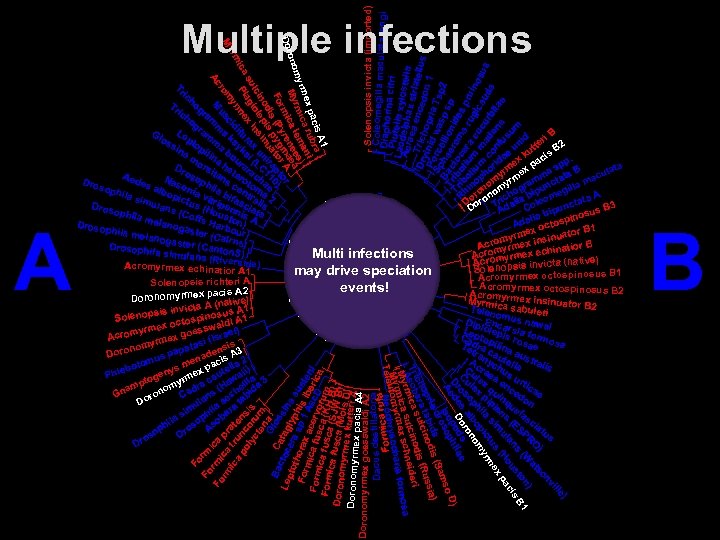 Solenopsis invicta (imported) Coleomegilla maculat a lengi Diapho Plutel rina citri Laod la xylo stella Acr elpha a x Tricea encestriatellu Dry s don h 1 P ini opr Sp orce d wa ia Tsp s 2 T Ba ha llio p s Tr rib cto erom nide p ib ol ce s ol ium ra a ru pru iu cu gic ino m m c s a co ad urb uda us en it nf us s ae um ica rm My A 1 i A acis bra x a ex p ru ni y m mica ma s) myr n m Myr ica le neeaea ono D r Dor rm yre m r A or Fo s (P pyg ato apt di is u ir no ep in n lci iol ins x u su ra ag x Pl me ifu d ci Multiple infections Ac ic yr 0. 050 (25 MY) Multi infections may drive speciation events! Fo Fo B id ri un utte B 2 ae x k cis. rid me x pa spp o r e lata a ta B ph my rm mm ta acu o m in no my gra punc gilla A Rh oroonorichoia bi ome tata D or T dal ole B 3 C unc D A bip sus alia tospino Ad oc 1 tor B mex myr ex insinua o r. B Acrmyrm hinatio Acro myrmex ec Acro psis invicta (native) Soleno Acromyrmex octospinosus B 1 Acromyrmex octospinosus B 2 Acro Myrmmyrmex insinuator B 2 Telenica sabuleti omus nawa Di En i Le plolecarsia Ca ptop pis ro formo sa Te dra ilina sae tra ca ute austr A ny alis l Cu cra chus la Cu le ea u le x q enc rtic x u ed ae pi in pi qu on en e f s as (E ci SP atu RO s ) e) ill nv so at ) (W ton B 1 s us cis an ci ul (Ho pa x x m si tus me m ila pic yr ph lbo nom so a ro r ro es Do ds ae ) D d Dpo hil o. D Ae Iso sop ms (Sa dro a ) ria bid dis ssia op ta ino (Ru ch bara sulc dis Tri somica ulcino neideri A r h s My rmica rmex sc aris formosa My tomy rysoch Teleu Neoch rm rm ica Fo rm ica pr ic tru ate a po nc ns ly or is ct um en Gl a Ba Ca os Lep ctoce tagl sina toth ra yp h a For orax sp 1 is ibuste mic ace As er ni a Form r c i ica f fusca (voru. D ca usca KH m Form ica (SJ B Doronom fusca (Mo W B) yrmex k ls D)) Doronomyrmex utteri A pacis A 4 Doronomyrmex goesswaldi A 2 ia Dacus destillatorfa rmica ru Fo us M ho ic gra ho m g m Le ram a k Gl p os m sin top a ayk ilin bo ai am a u (L Dr orsi het rara C 1 tan er c 1 os Aed Dro es Naso ophi s c oto hae 0) sop alb e m l hila opi nia vi a bif ntra a 2 sim ctu trip as lis ulan s c Dros s (C (Hou ennisiata ophi offs sto A la me n) H lanog Droso aster arbour phila m (Cair ) elanog ns) aster ( C Drosoph ila simula anton. S) ns (Riv Acromyrmex echinati erside) or A 1 Solenopsis richteri A pacis A 2 Doronomyrmex e) A (nativ is invicta osus A 1 s Solenop pin di A 1 octos al yrmex goessw ael) r crom A rmex tasi (Is is omy a n ap ens 3 Doro us p nad cis A 2 e tom pa ella ) sm ebo eny rmex aut waii a Phl g c a lli 3 pto a my ra nam rono Cad s (H che bid G o an se ta D ul la a sim phi bar a hil oso Aso op s Dr ro D Tr A m ro Tr B
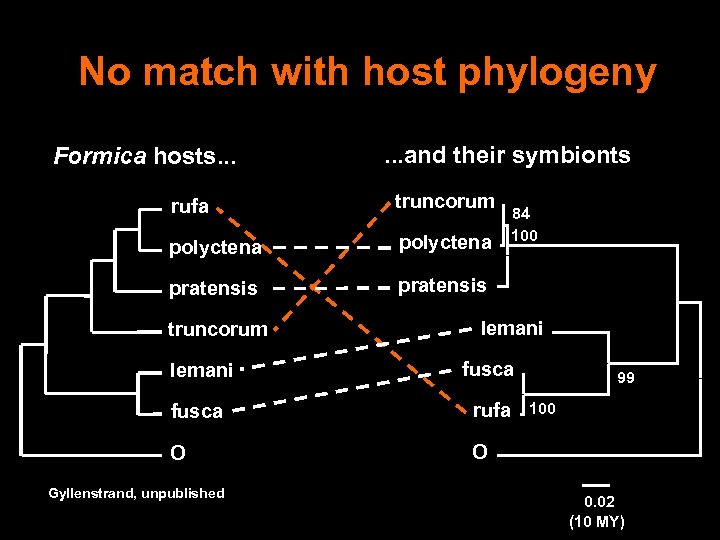 No match with host phylogeny Formica hosts. . . and their symbionts rufa truncorum polyctena pratensis truncorum 84 100 lemani fusca rufa O O Gyllenstrand, unpublished 99 100 0. 02 (10 MY)
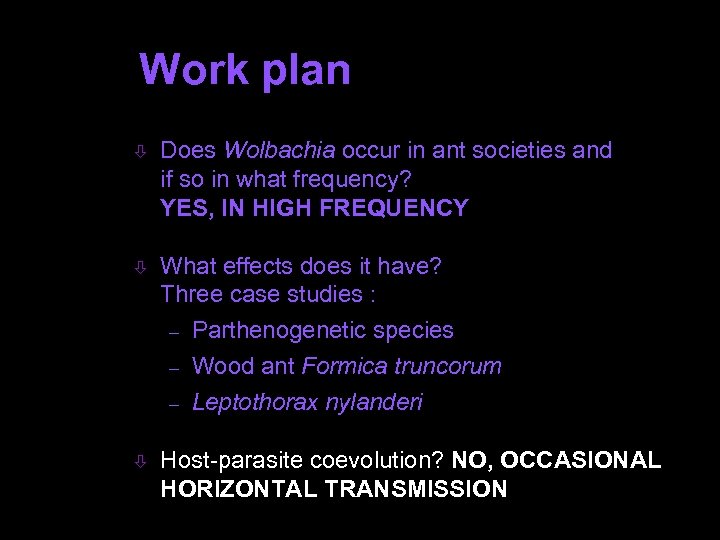 Work plan ò Does Wolbachia occur in ant societies and if so in what frequency? YES, IN HIGH FREQUENCY ò What effects does it have? Three case studies : – Parthenogenetic species – Wood ant Formica truncorum – Leptothorax nylanderi ò Host-parasite coevolution? NO, OCCASIONAL HORIZONTAL TRANSMISSION
 Part II. Theoretical aspects of conflict and cooperation With: Francis Ratnieks and Kevin Foster University of Sheffield
 Animal vs. intragenomic conflict ò What do animal and intragenomic conflict have in common? ò Is there a “general theory of conflict” that provides insight into the evolution of conflict at both levels?
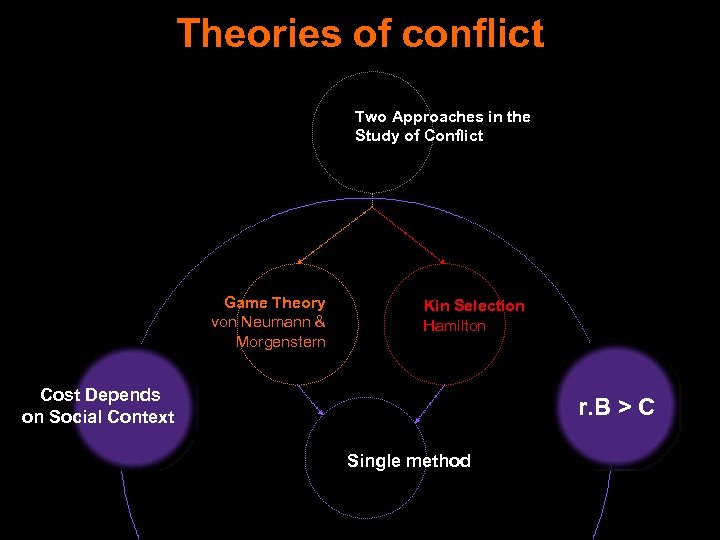 Theories of conflict Two Approaches in the Study of Conflict Game Theory von Neumann & Morgenstern Kin Selection Hamilton Cost Depends on Social Context r. B > C Single method
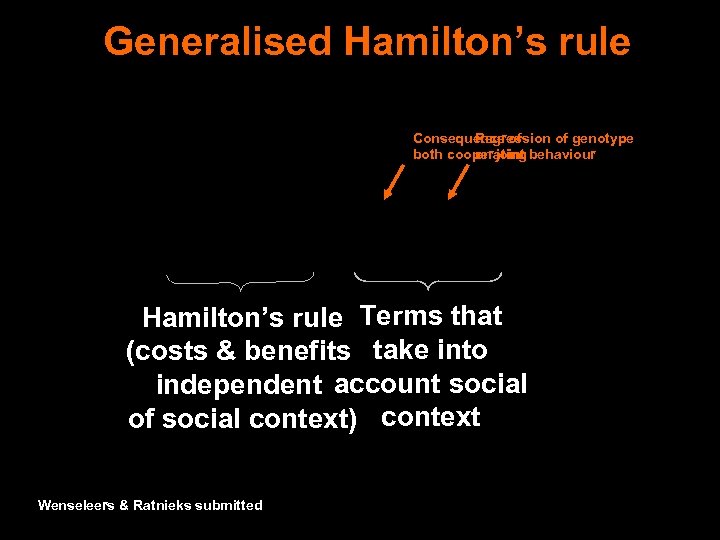 Generalised Hamilton’s rule Consequence of Regression of genotype both cooperating behaviour on joint Hamilton’s rule Terms that (costs & benefits take into independent account social of social context) context Wenseleers & Ratnieks submitted
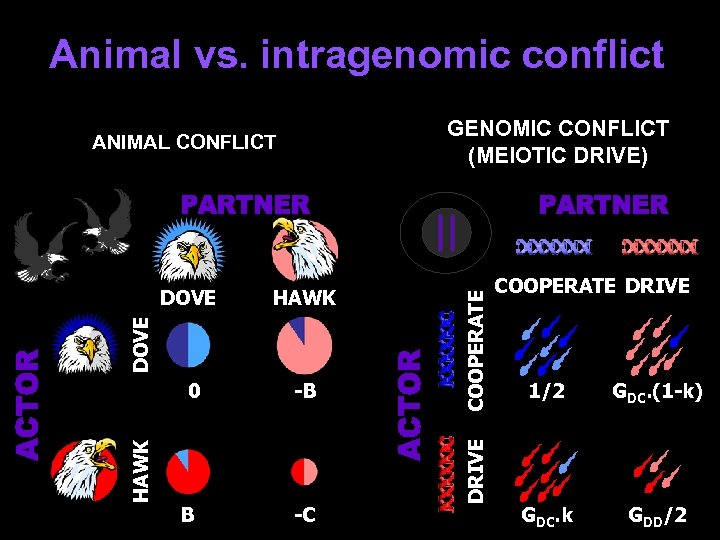 Animal vs. intragenomic conflict 0 -B HAWK B -C DRIVE HAWK DOVE COOPERATE GENOMIC CONFLICT (MEIOTIC DRIVE) ANIMAL CONFLICT COOPERATE DRIVE 1/2 GDC. (1 -k) GDC. k GDD/2
 Animal vs. intragenomic conflict ò Shows that game theoretic logic of conflict at both levels is the same ò But can genes also be related? ò Yes, kinship measures genetic correlation and for 2 genes at a locus this is the inbreeding coefficient FIT ò When genes are related they are selected to be altruistic ! ò Application of generalised Hamilton’s rule allows detailed analysis
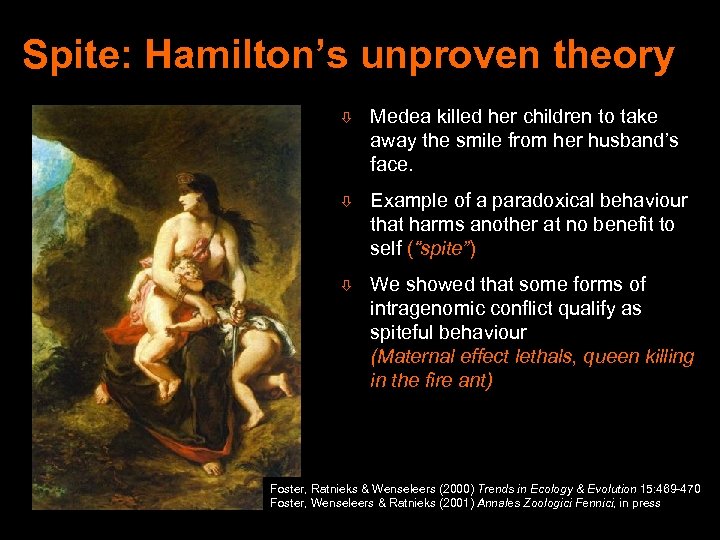 Spite: Hamilton’s unproven theory ò Medea killed her children to take away the smile from her husband’s face. ò Example of a paradoxical behaviour that harms another at no benefit to self (“spite”) ò We showed that some forms of intragenomic conflict qualify as spiteful behaviour (Maternal effect lethals, queen killing in the fire ant) Foster, Ratnieks & Wenseleers (2000) Trends in Ecology & Evolution 15: 469 -470 Foster, Wenseleers & Ratnieks (2001) Annales Zoologici Fennici, in press
 Why become a worker? ò Why do social insect females work for the benefit of others? ò Usual explanation: indirect genetic benefit when altruism is directed towards relatives (’kin selection’) ò But is relatedness in insect societies high enough? ò E. g. honey bee: queen mates with several males so that workers mostly rear half-sisters (r=0. 3)
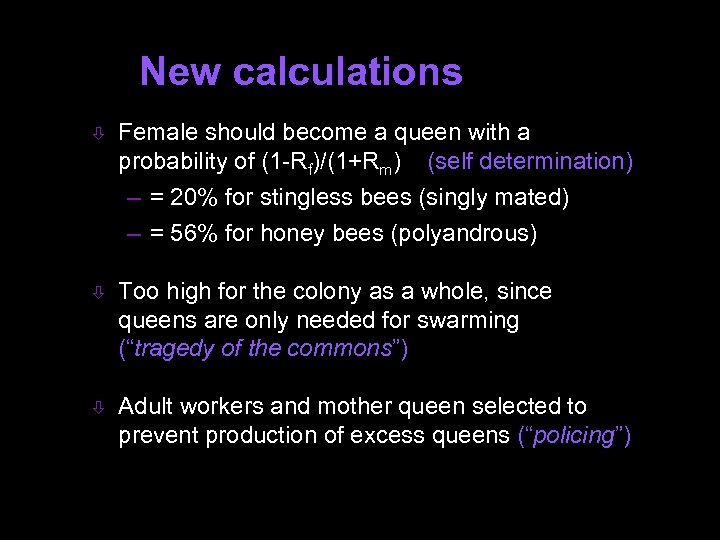 New calculations ò Female should become a queen with a probability of (1 -Rf)/(1+Rm) (self determination) – = 20% for stingless bees (singly mated) – = 56% for honey bees (polyandrous) ò Too high for the colony as a whole, since queens are only needed for swarming (“tragedy of the commons”) ò Adult workers and mother queen selected to prevent production of excess queens (“policing”)
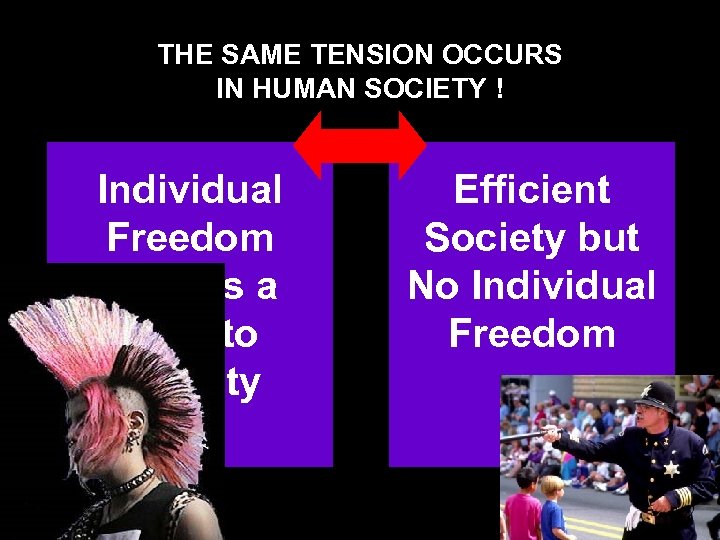 Comparative. TENSION OCCURS THE SAME predictions hold IN HUMAN SOCIETY ! stingless bees honey bees Individual Freedom Causes a Cost to Society Efficient But females Society but prefer to become queen with No Individual probability Freedom of 56% ! Self determination 20% queen production Policing of caste fate 0. 02% queen production
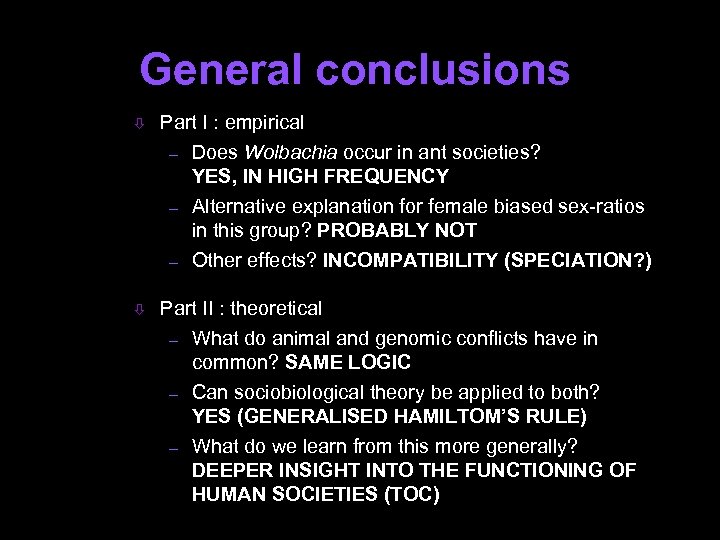 General conclusions ò Part I : empirical – Does Wolbachia occur in ant societies? YES, IN HIGH FREQUENCY – Alternative explanation for female biased sex-ratios in this group? PROBABLY NOT – Other effects? INCOMPATIBILITY (SPECIATION? ) ò Part II : theoretical – What do animal and genomic conflicts have in common? SAME LOGIC – Can sociobiological theory be applied to both? YES (GENERALISED HAMILTOM’S RULE) – What do we learn from this more generally? DEEPER INSIGHT INTO THE FUNCTIONING OF HUMAN SOCIETIES (TOC)
 The End
 Acknowledgements Prof. Dr. J. Billen Prof. Dr. J. J. Boomsma Dr. K. R. Foster Prof. S. A. Frank Dr. D. A. Grasso Prof. Dr. R. Huybrechts Dr. F. Ito Dr. F. L. W. Ratnieks Dr. L. Sundström Drs. S. Van Borm Prof. Dr. F. Volckaert Academy of Finland, British Council, FWO-Vlaanderen, Vlaamse Leergangen, EU Network “Social Evolution”