


 Скачать презентацию Confined Rescue A Timeline to Rescue and
0d29625fb266358560f036c9db7a2043.ppt
- Количество слайдов: 48
 Confined Rescue – A Timeline to Rescue and Rescue Systems By Michael Lafreniere Ohio University-Chillicothe Environmental Training and Research Center (ETRC) www. ohiou. edu/chillicothe/etrc/
 Defining Response Time l l l Reaction Time Contact Time Response Time Assessment Time Preparation Time Rescue Time
 Reaction Time l Time between the entrant having a problem requiring rescue and the safety attendant’s recognition that the entrant has problem
 Contact Time l The time taken by the attendant to contact the rescue team.
 Response Time l The time taken by the rescuers to arrive at the scene of the rescue after contact.
 Assessment Time l The time taken by a rescue team to size up the problem and determine the strategy to perform a safe, efficient rescue
 Preparation Time l The time take by a rescue team to set up for the rescue.
 Rescue Time l The time taken for the team to reach, treat, package, and evacuate the victim from the confined space.
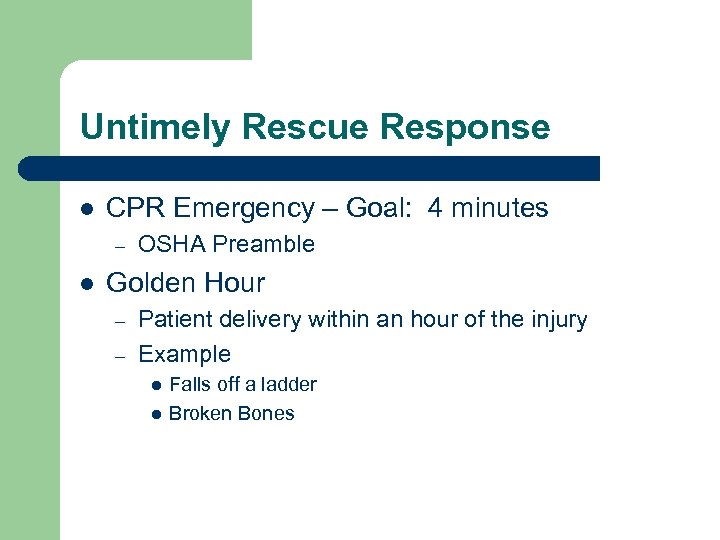 Untimely Rescue Response l CPR Emergency – Goal: 4 minutes – l OSHA Preamble Golden Hour – – Patient delivery within an hour of the injury Example l l Falls off a ladder Broken Bones
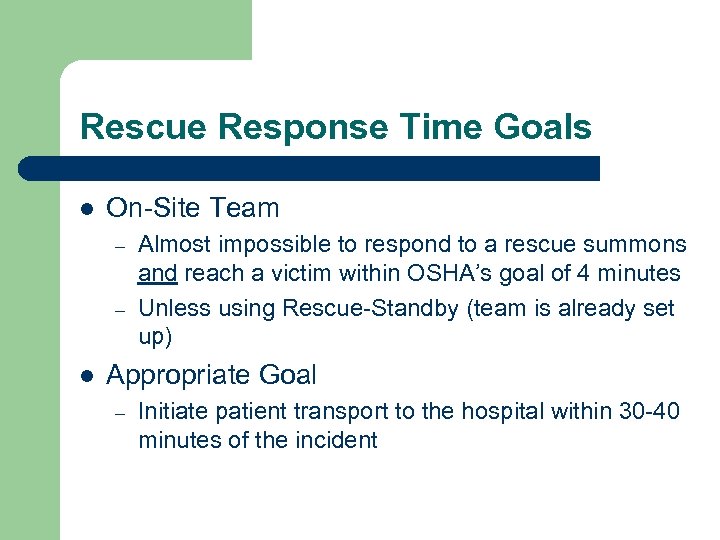 Rescue Response Time Goals l On-Site Team – – l Almost impossible to respond to a rescue summons and reach a victim within OSHA’s goal of 4 minutes Unless using Rescue-Standby (team is already set up) Appropriate Goal – Initiate patient transport to the hospital within 30 -40 minutes of the incident
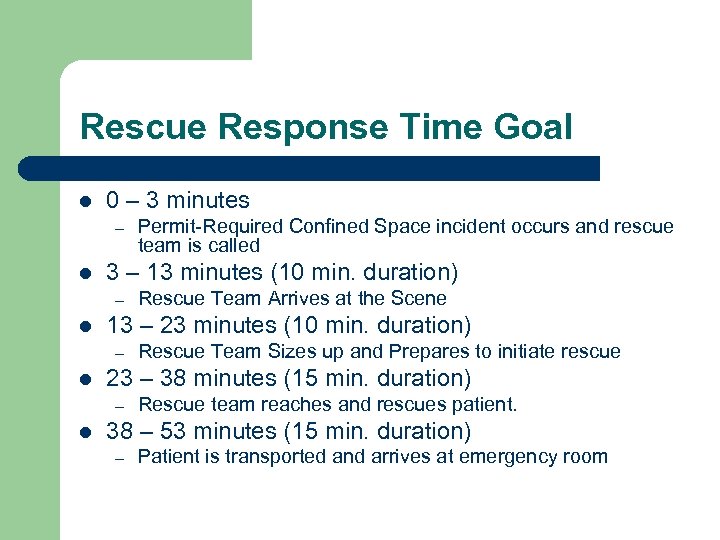 Rescue Response Time Goal l 0 – 3 minutes – l 3 – 13 minutes (10 min. duration) – l Rescue Team Sizes up and Prepares to initiate rescue 23 – 38 minutes (15 min. duration) – l Rescue Team Arrives at the Scene 13 – 23 minutes (10 min. duration) – l Permit-Required Confined Space incident occurs and rescue team is called Rescue team reaches and rescues patient. 38 – 53 minutes (15 min. duration) – Patient is transported and arrives at emergency room
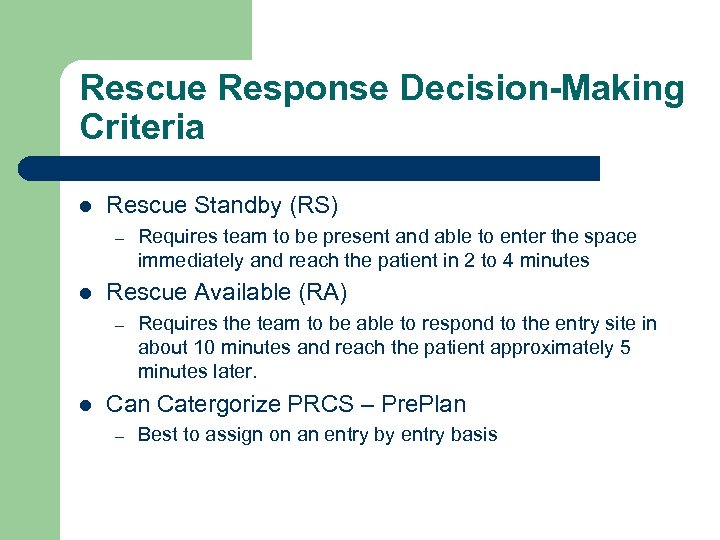 Rescue Response Decision-Making Criteria l Rescue Standby (RS) – l Rescue Available (RA) – l Requires team to be present and able to enter the space immediately and reach the patient in 2 to 4 minutes Requires the team to be able to respond to the entry site in about 10 minutes and reach the patient approximately 5 minutes later. Can Catergorize PRCS – Pre. Plan – Best to assign on an entry by entry basis
 Rescue Response Categories l Rescue Available – – Do not require entrants to wear fresh air breathing equipment Do not expose the entrant to any obvious IDLH or potential IDLH hazard Do not warrant rescue personnel standing by during the entry, and Do not require the entrant to have assistance to exit the space, under normal circumstances
 Rescue Response Categories l l l Space in which entrants are required to use fresh air breathing equipment Spaces in which an obvious IDLH hazard exists or potentially exists, and/or Spaces from which an entrant would be expected to have difficulty exiting without help
 Determining Rescue Response l l Entry Supervisor must decide for each entry Three questions should be asked – – – l Is the hazard or potential hazard immediately dangerous to life or health (IDLH)? Is breathing air required for entry? Would the entrant have difficulty exiting the space unassisted? Any “yes” – then Rescue Standby (RS)
 References l Confined Space and Structural Rope Rescue, Michael Roop, Thomas Vines, and Richard Wright, Published by Mosby, Inc. , 1998. l Confined Space: Entry and Rescue – A Training Manual, Published by CMC Rescue, Inc. , 1996.
 Rescue Systems and Equipment
 Standards and Regulations l NFPA – l ANSI – – – l U. S. & international standards Consensus standards – voluntary compliance. Mandatory when referenced by OSHA in regulations ASTM – – l Consensus standards – voluntary compliance Currently writing standards on Search and Rescue Consensus Standards – voluntary compliance OSHA – None on rope rescue
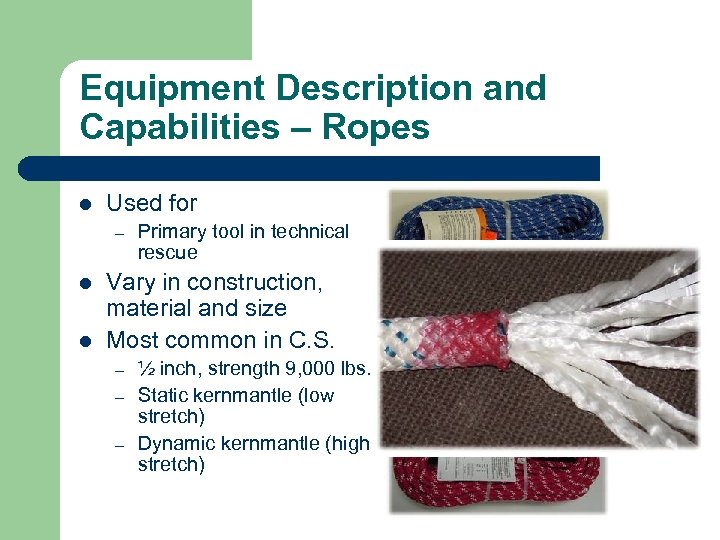 Equipment Description and Capabilities – Ropes l Used for – l l Primary tool in technical rescue Vary in construction, material and size Most common in C. S. – – – ½ inch, strength 9, 000 lbs. Static kernmantle (low stretch) Dynamic kernmantle (high stretch)
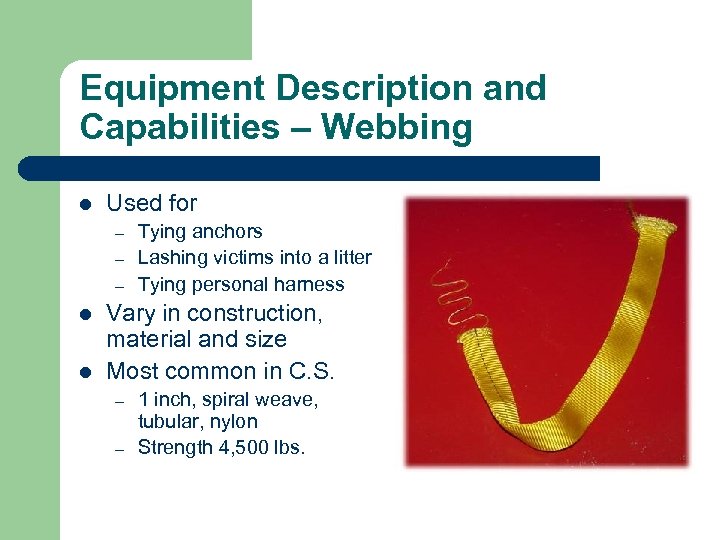 Equipment Description and Capabilities – Webbing l Used for – – – l l Tying anchors Lashing victims into a litter Tying personal harness Vary in construction, material and size Most common in C. S. – – 1 inch, spiral weave, tubular, nylon Strength 4, 500 lbs.
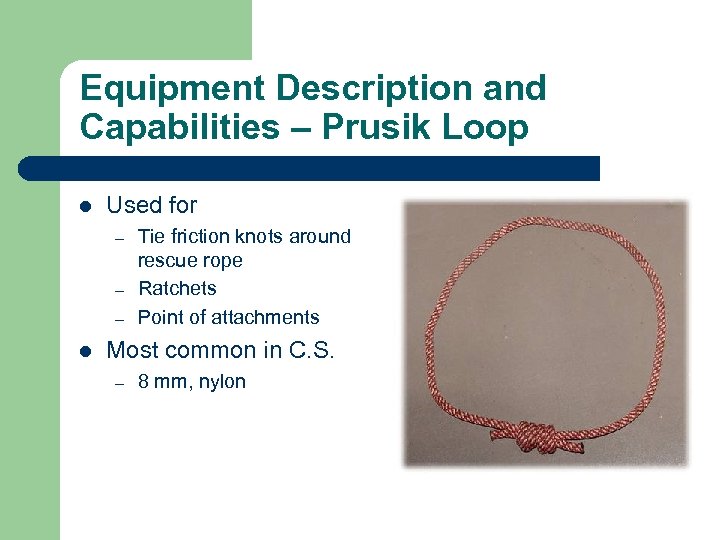 Equipment Description and Capabilities – Prusik Loop l Used for – – – l Tie friction knots around rescue rope Ratchets Point of attachments Most common in C. S. – 8 mm, nylon
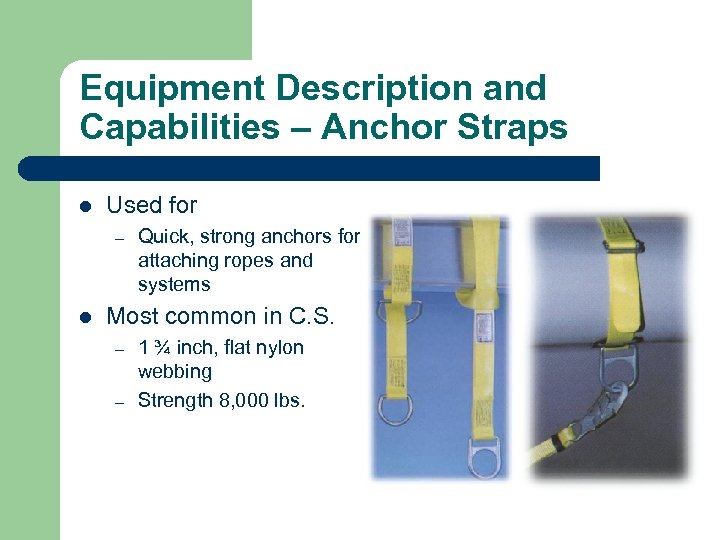 Equipment Description and Capabilities – Anchor Straps l Used for – l Quick, strong anchors for attaching ropes and systems Most common in C. S. – – 1 ¾ inch, flat nylon webbing Strength 8, 000 lbs.
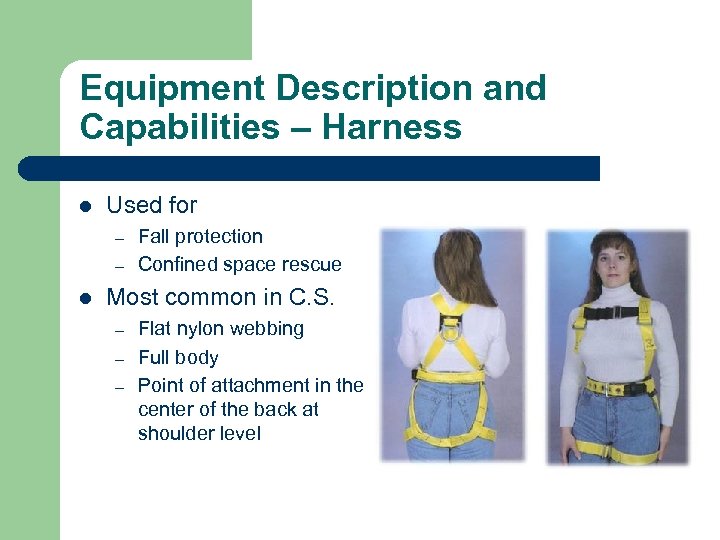 Equipment Description and Capabilities – Harness l Used for – – l Fall protection Confined space rescue Most common in C. S. – – – Flat nylon webbing Full body Point of attachment in the center of the back at shoulder level
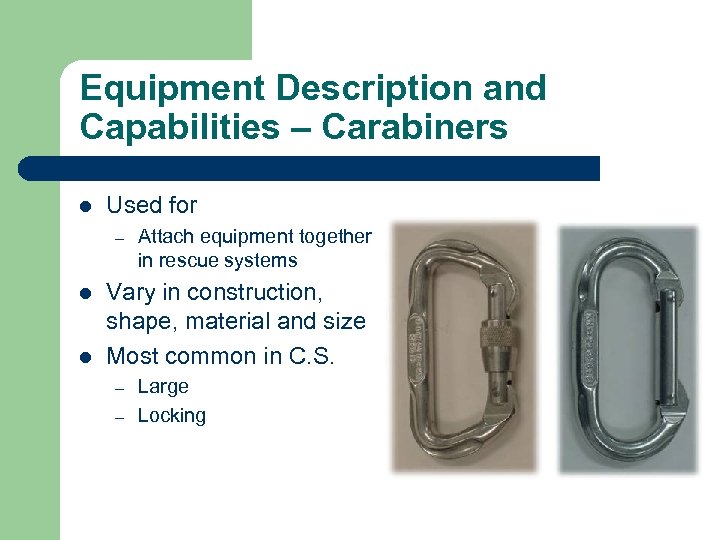 Equipment Description and Capabilities – Carabiners l Used for – l l Attach equipment together in rescue systems Vary in construction, shape, material and size Most common in C. S. – – Large Locking
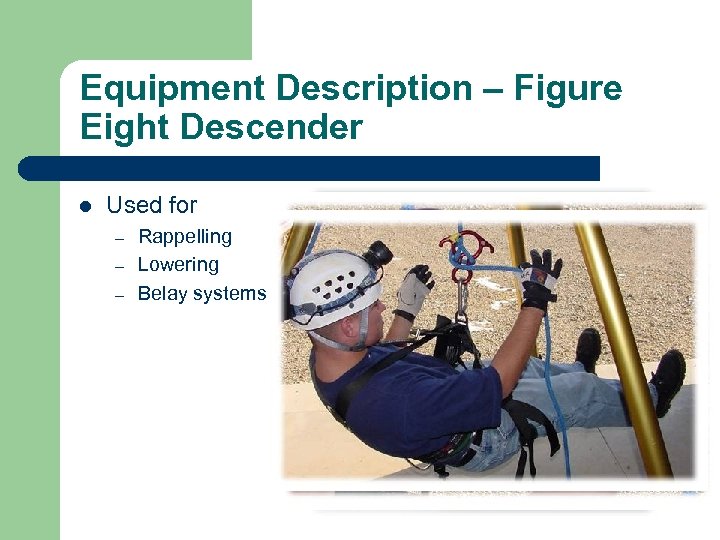 Equipment Description – Figure Eight Descender l Used for – – – Rappelling Lowering Belay systems
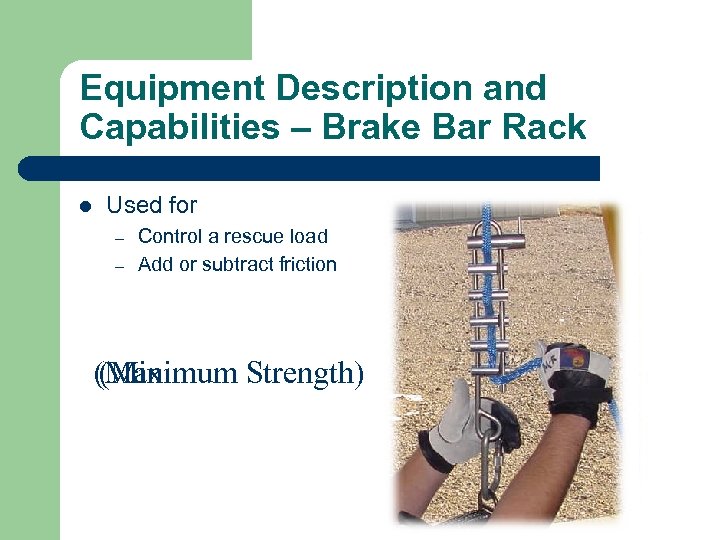 Equipment Description and Capabilities – Brake Bar Rack l Used for – – Control a rescue load Add or subtract friction (Maximum Strength) (Minimum
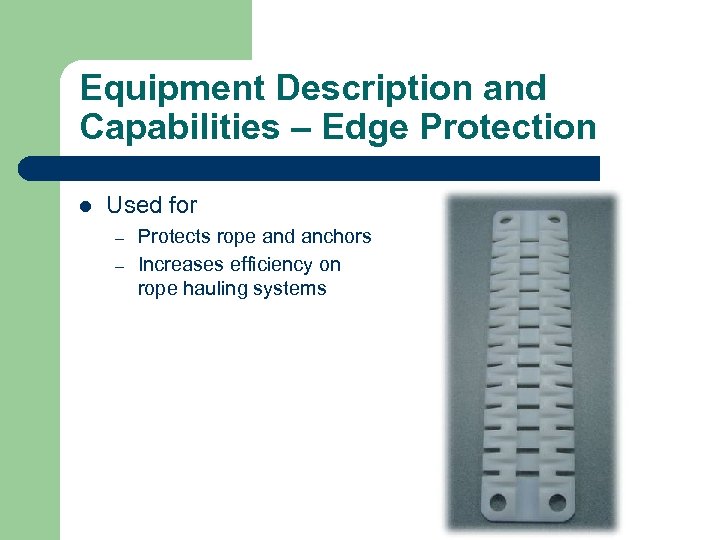 Equipment Description and Capabilities – Edge Protection l Used for – – Protects rope and anchors Increases efficiency on rope hauling systems
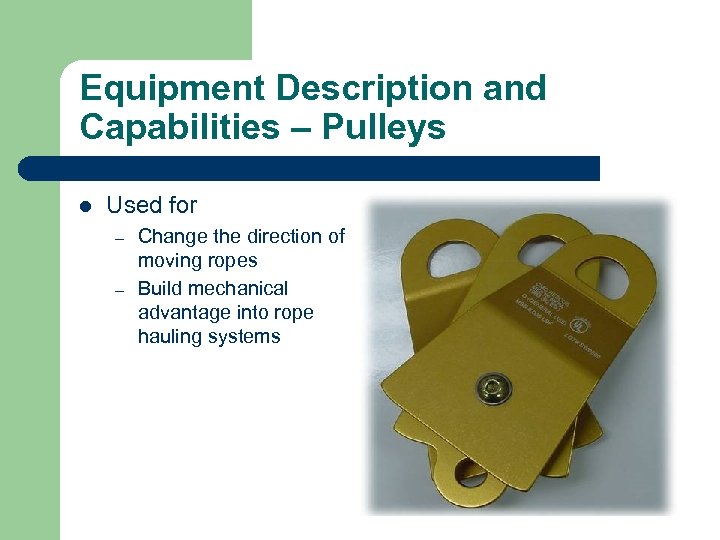 Equipment Description and Capabilities – Pulleys l Used for – – Change the direction of moving ropes Build mechanical advantage into rope hauling systems
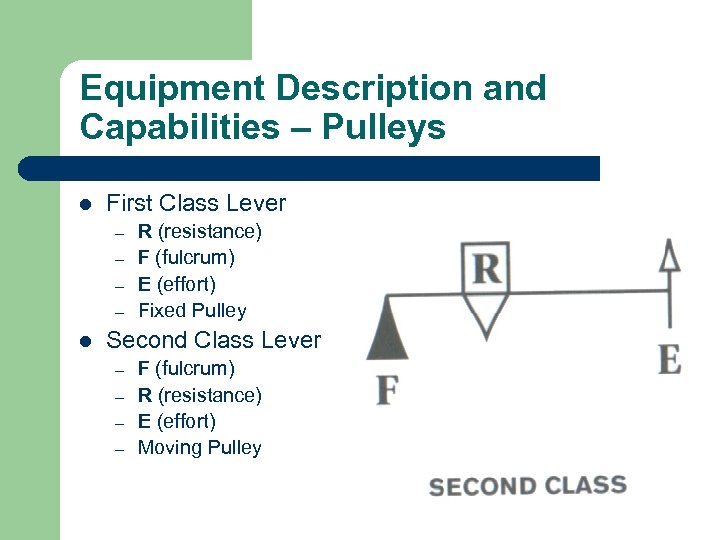 Equipment Description and Capabilities – Pulleys l First Class Lever – – l R (resistance) F (fulcrum) E (effort) Fixed Pulley Second Class Lever – – F (fulcrum) R (resistance) E (effort) Moving Pulley
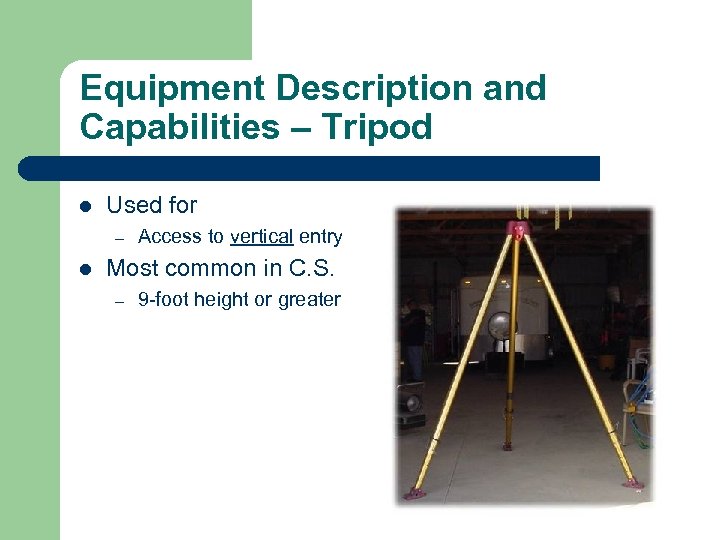 Equipment Description and Capabilities – Tripod l Used for – l Access to vertical entry Most common in C. S. – 9 -foot height or greater
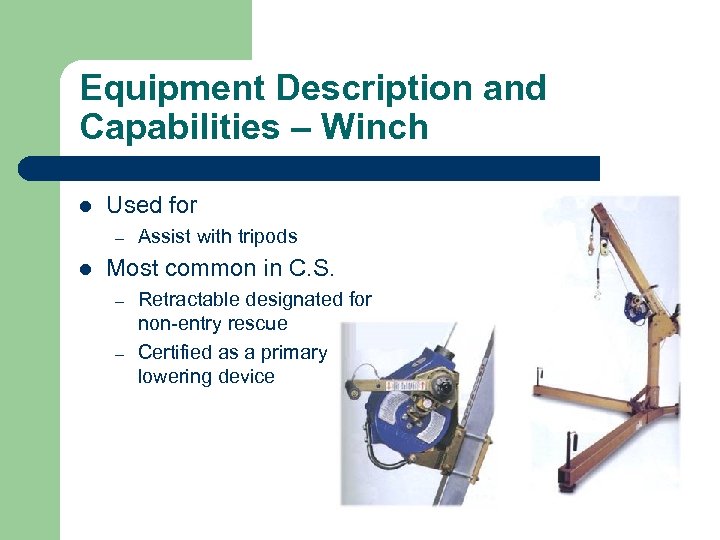 Equipment Description and Capabilities – Winch l Used for – l Assist with tripods Most common in C. S. – – Retractable designated for non-entry rescue Certified as a primary lowering device
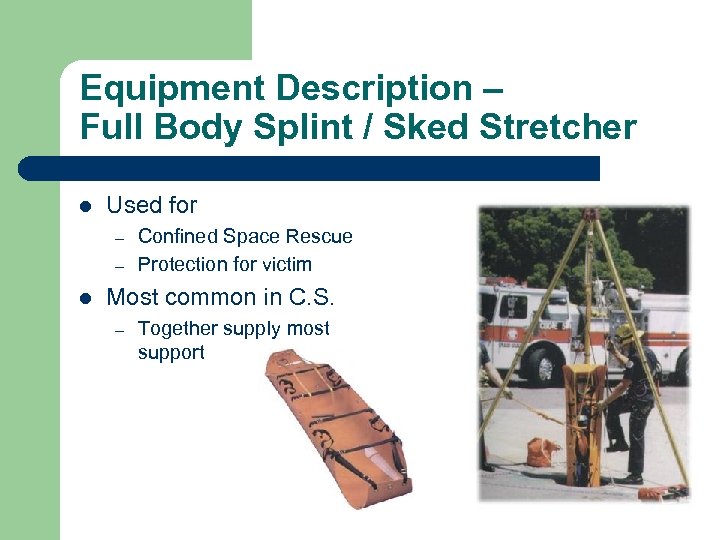 Equipment Description – Full Body Splint / Sked Stretcher l Used for – – l Confined Space Rescue Protection for victim Most common in C. S. – Together supply most support
 Static System Safety Factor (SSSF) l Safety factor – l Ratio between minimum breaking strength of a piece of equipment and the greatest force it is expected to experience during a rescue. Standard – – No standard mandating what the SSSF should be. Mountain rescue teams use 4: 1 Rescue organizations use 10: 1 Fire service teams use 15: 1 l (NFPA Standard 1983 specified the strength of a life support line to be 15 times the load. )
 Knots l Knot efficiency – – Knots rated for strength by the percentage of rope strength that remain when a knot is tied in the rope. Knots should always be tied off.
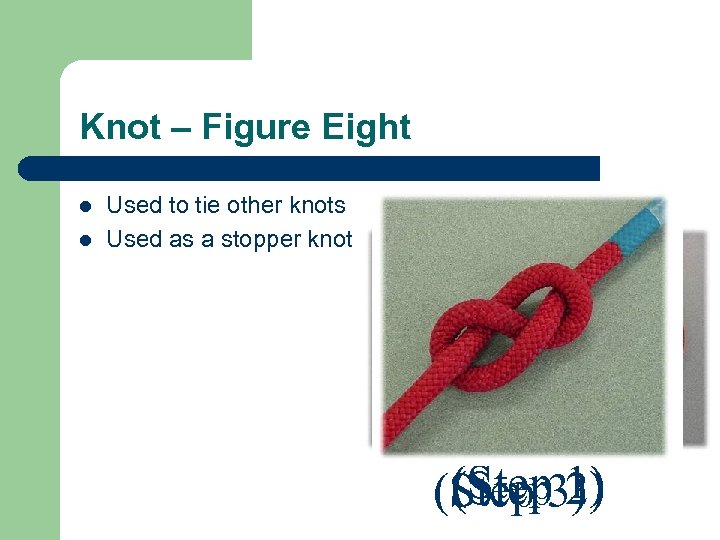 Knot – Figure Eight l l Used to tie other knots Used as a stopper knot (Step 1) 2) (Step 3)
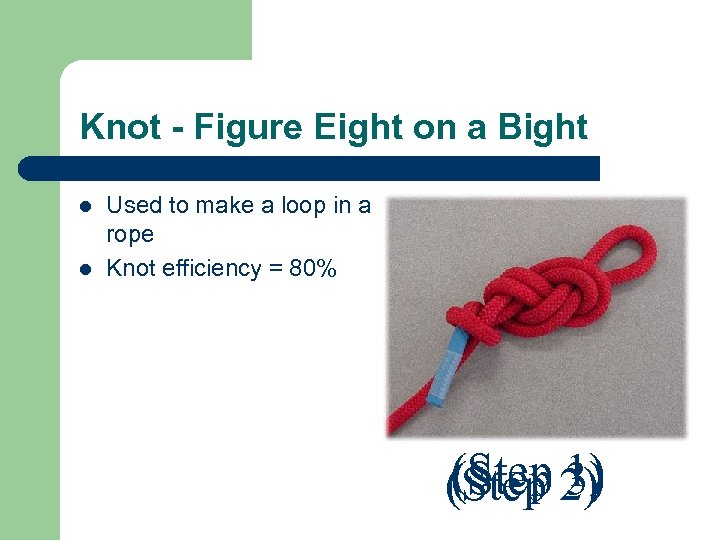 Knot - Figure Eight on a Bight l l Used to make a loop in a rope Knot efficiency = 80% (Step 3) 1) (Step 2)
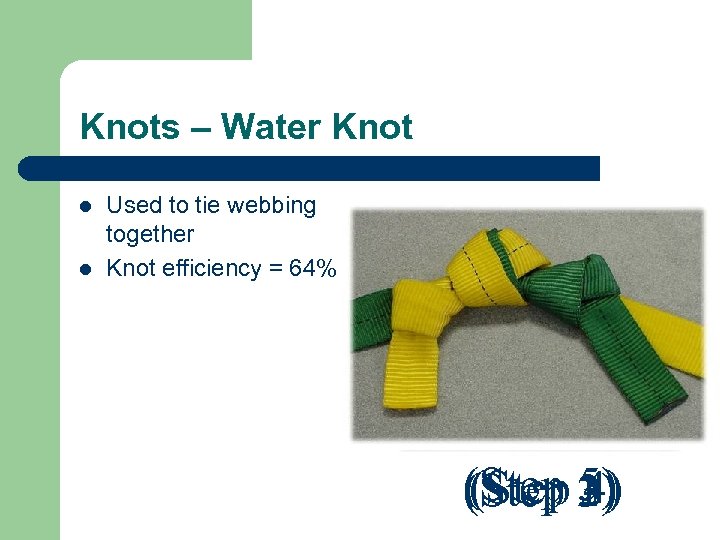 Knots – Water Knot l l Used to tie webbing together Knot efficiency = 64% (Step 5) (Step 1) 4) 3) 2)
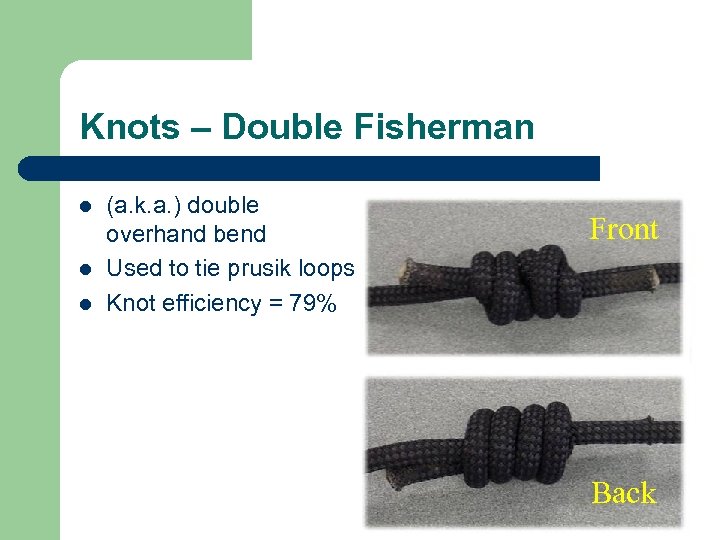 Knots – Double Fisherman l l l (a. k. a. ) double overhand bend Used to tie prusik loops Knot efficiency = 79% Front (Step 5) (Step 3)Back (Step 1) 4) (Step 2)
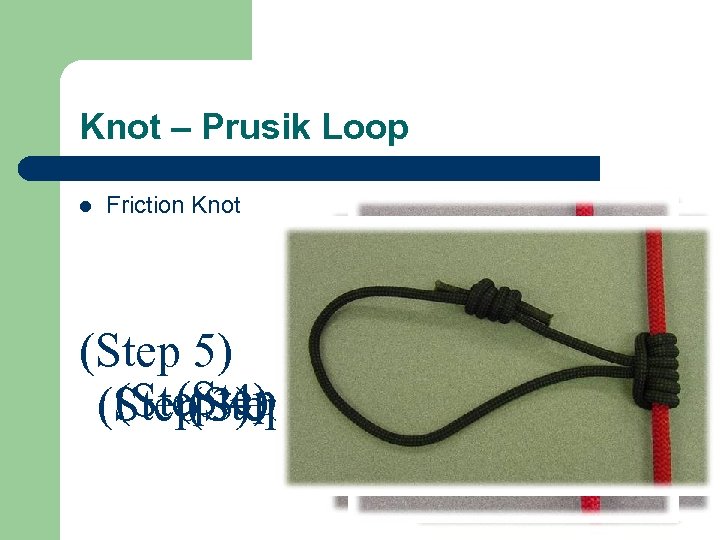 Knot – Prusik Loop l Friction Knot (Step 5) (Step 4) 1) (Step 3) 2) (Step
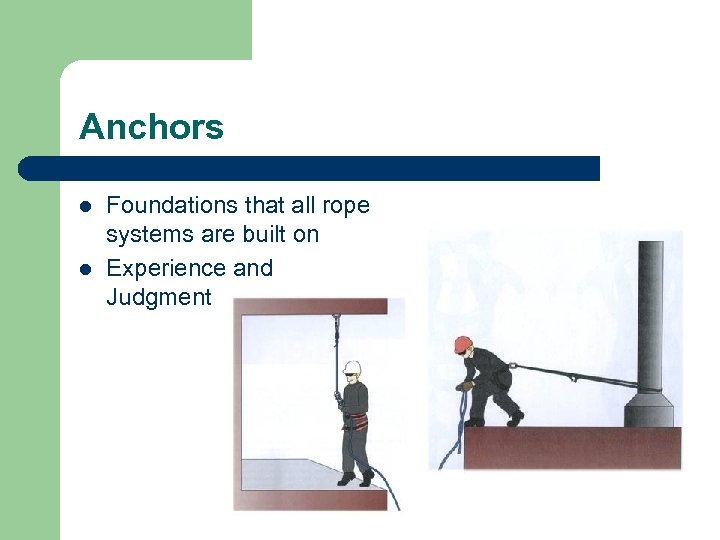 Anchors l l Foundations that all rope systems are built on Experience and Judgment
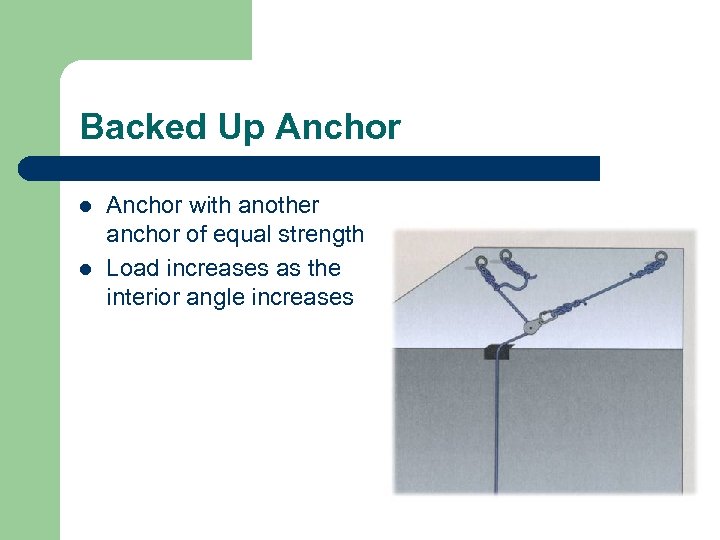 Backed Up Anchor l l Anchor with another anchor of equal strength Load increases as the interior angle increases
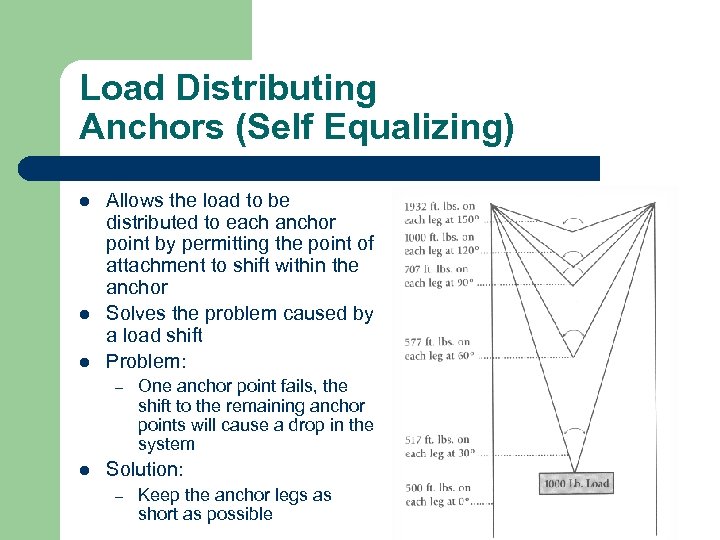 Load Distributing Anchors (Self Equalizing) l l l Allows the load to be distributed to each anchor point by permitting the point of attachment to shift within the anchor Solves the problem caused by a load shift Problem: – l One anchor point fails, the shift to the remaining anchor points will cause a drop in the system Solution: – Keep the anchor legs as short as possible
 Rescue Systems l l l Starts with an anchor Next, hardware and rope to complete the system Be prepared to modify the system during the rescue
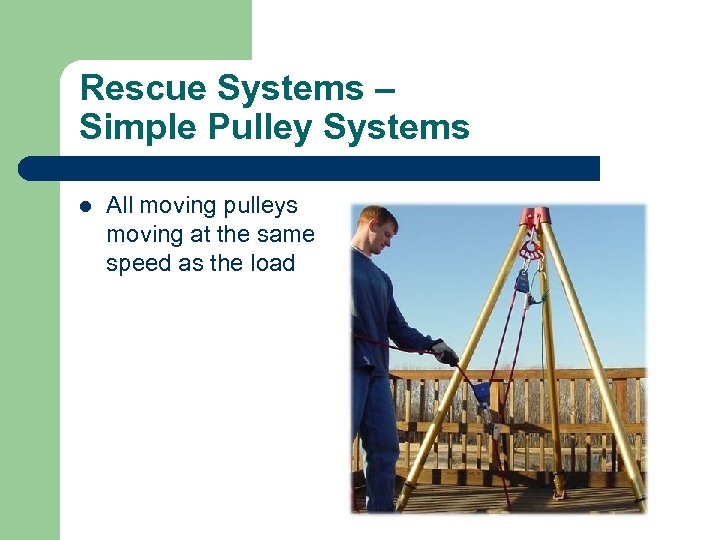 Rescue Systems – Simple Pulley Systems l All moving pulleys moving at the same speed as the load
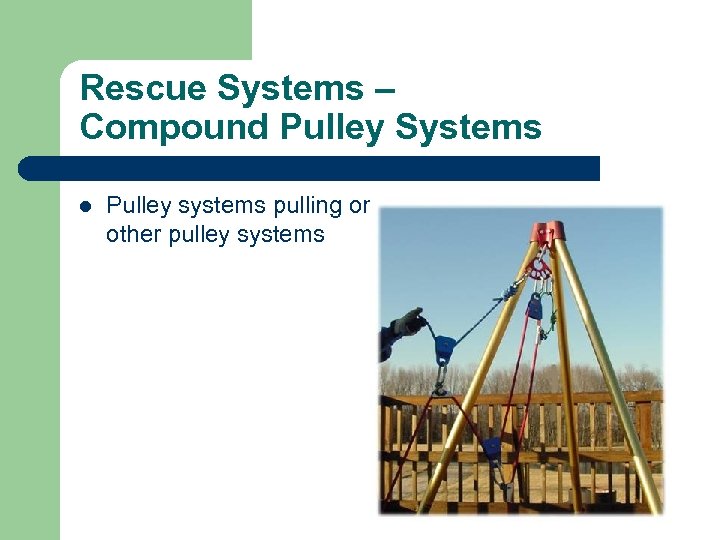 Rescue Systems – Compound Pulley Systems l Pulley systems pulling on other pulley systems
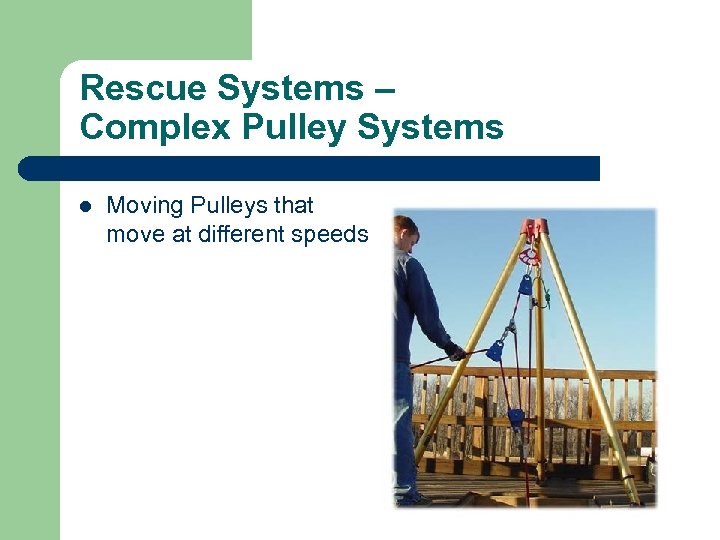 Rescue Systems – Complex Pulley Systems l Moving Pulleys that move at different speeds
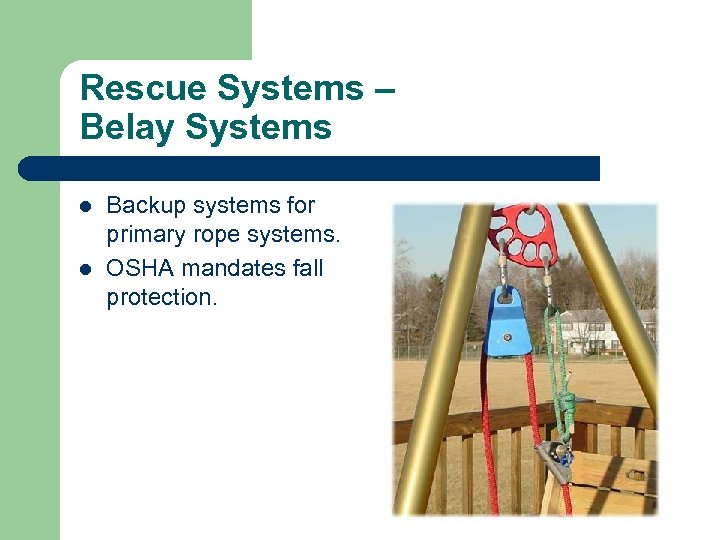 Rescue Systems – Belay Systems l l Backup systems for primary rope systems. OSHA mandates fall protection.
 For assistance/more information: Contact: Michael Lafreniere Ohio University-Chillicothe Environmental Training and Research Center 101 University Drive Chillicothe, OH 45601 Phone: (740) 774 -7278 Email: lafrenie@ohio. edu Web: www. ohiou. edu/chillicothe/etrc/