


 Скачать презентацию Configuration management l l Managing the products of
a08defcf639665e5057af784c63e51a9.ppt
- Количество слайдов: 29
 Configuration management l l Managing the products of system change Objectives • • l To explain the importance of software configuration management (CM) To describe key CM activities namely CM planning, change management, version management and system building Topics covered • • Configuration management planning Change management Version and release management System building ©Ian Sommerville 2000 Software Engineering, 6 th edition. Chapter 29 Slide 1
 Configuration management – Why l New versions of software systems are created as they change • • • l For different machines/OS Offering different functionality Tailored for particular user requirements Configuration management is concerned with managing evolving software systems • • System change is a team activity CM aims to control the costs and effort involved in making changes to a system ©Ian Sommerville 2000 Software Engineering, 6 th edition. Chapter 29 Slide 2
 Configuration management – Why l l l Involves the development and application of procedures and standards to manage an evolving software product May be seen as part of a more general quality management process When released to CM, software systems are sometimes called baselines as they are a starting point for further development ©Ian Sommerville 2000 Software Engineering, 6 th edition. Chapter 29 Slide 3
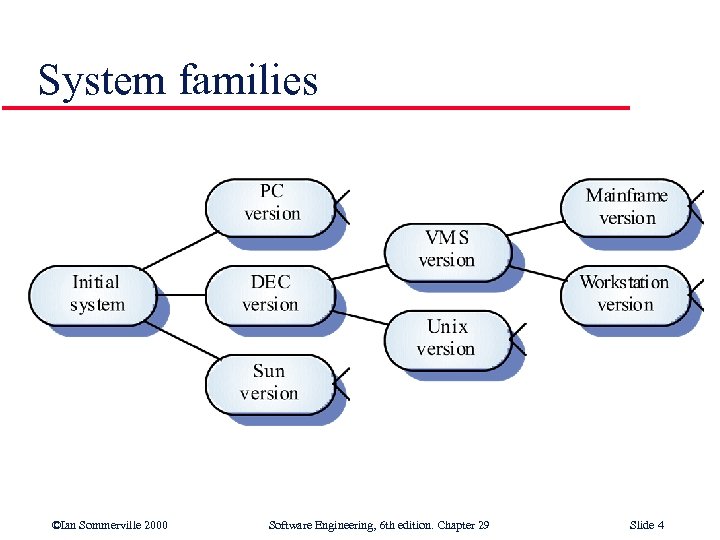 System families ©Ian Sommerville 2000 Software Engineering, 6 th edition. Chapter 29 Slide 4
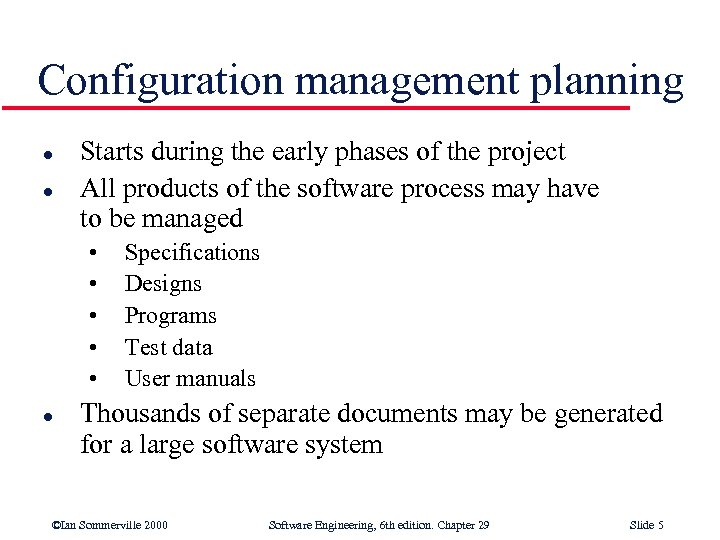 Configuration management planning l l Starts during the early phases of the project All products of the software process may have to be managed • • • l Specifications Designs Programs Test data User manuals Thousands of separate documents may be generated for a large software system ©Ian Sommerville 2000 Software Engineering, 6 th edition. Chapter 29 Slide 5
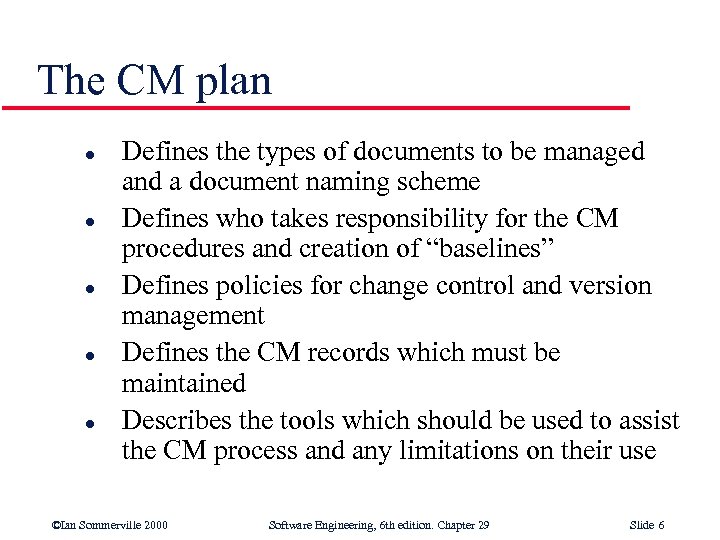 The CM plan l l l Defines the types of documents to be managed and a document naming scheme Defines who takes responsibility for the CM procedures and creation of “baselines” Defines policies for change control and version management Defines the CM records which must be maintained Describes the tools which should be used to assist the CM process and any limitations on their use ©Ian Sommerville 2000 Software Engineering, 6 th edition. Chapter 29 Slide 6
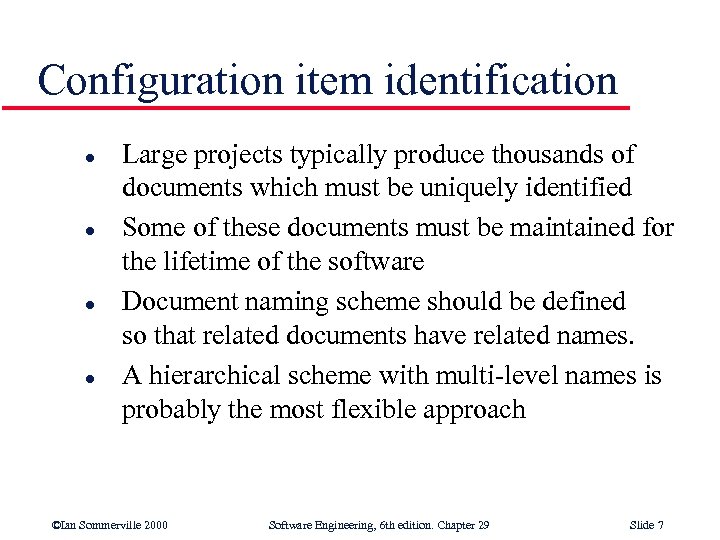 Configuration item identification l l Large projects typically produce thousands of documents which must be uniquely identified Some of these documents must be maintained for the lifetime of the software Document naming scheme should be defined so that related documents have related names. A hierarchical scheme with multi-level names is probably the most flexible approach ©Ian Sommerville 2000 Software Engineering, 6 th edition. Chapter 29 Slide 7
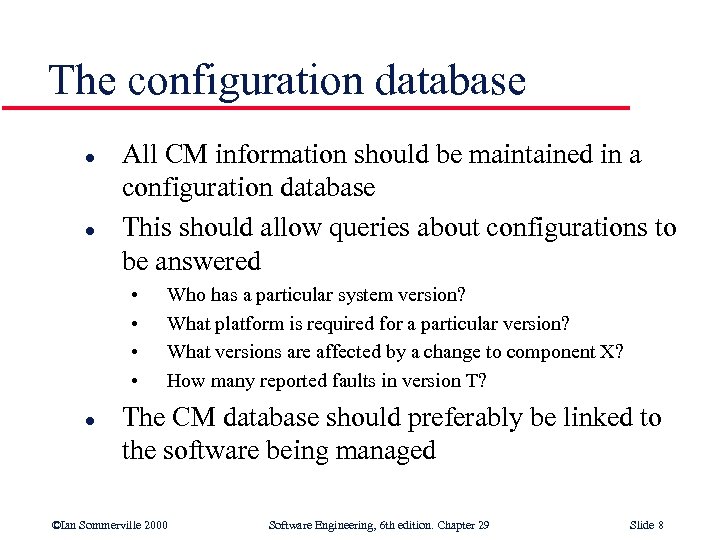 The configuration database l l All CM information should be maintained in a configuration database This should allow queries about configurations to be answered • • l Who has a particular system version? What platform is required for a particular version? What versions are affected by a change to component X? How many reported faults in version T? The CM database should preferably be linked to the software being managed ©Ian Sommerville 2000 Software Engineering, 6 th edition. Chapter 29 Slide 8
 Change management l Software systems are subject to continual change requests • • • l From users From developers From market forces Change management is concerned with keeping track of these changes and ensuring that they are implemented in the most cost-effective way ©Ian Sommerville 2000 Software Engineering, 6 th edition. Chapter 29 Slide 9
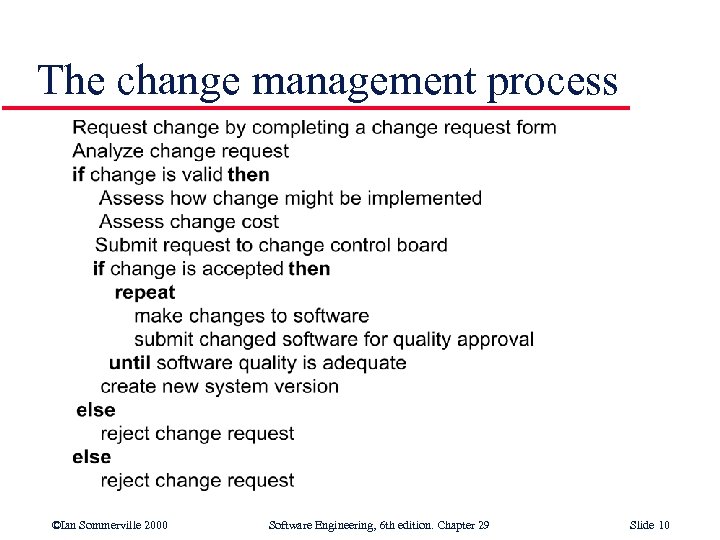 The change management process ©Ian Sommerville 2000 Software Engineering, 6 th edition. Chapter 29 Slide 10
 Change tracking tools l l A major problem in change management is tracking change status Change tracking tools track the status of each change request • l Automatically ensure that change requests are sent to the right people at the right time Integrated with E-mail systems allowing electronic change request distribution ©Ian Sommerville 2000 Software Engineering, 6 th edition. Chapter 29 Slide 11
 Derivation history l l l Record of changes applied to a document or code component Should record, in outline, the change made, the rationale for the change, who made the change and when it was implemented May be included as a comment in code • If a standard prologue style is used for the derivation history, tools can process this automatically ©Ian Sommerville 2000 Software Engineering, 6 th edition. Chapter 29 Slide 12
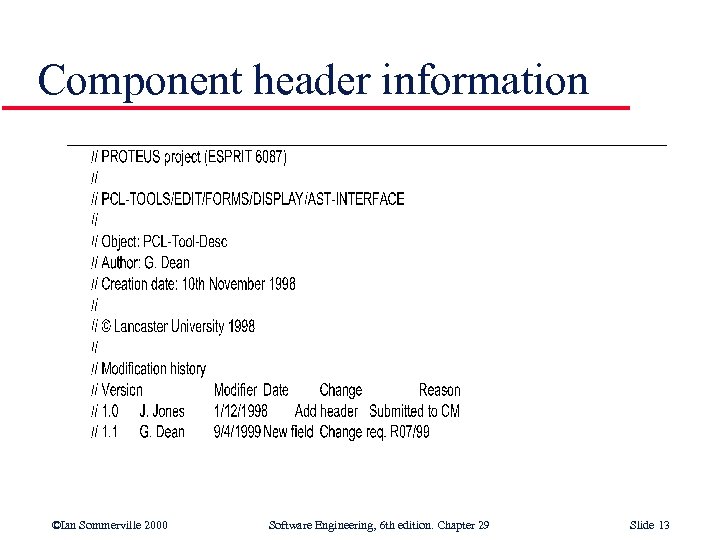 Component header information ©Ian Sommerville 2000 Software Engineering, 6 th edition. Chapter 29 Slide 13
 Version and release management l l Invent identification scheme for system versions Plan when new system version is to be produced Ensure that version management procedures and tools are properly applied Plan and distribute new system releases ©Ian Sommerville 2000 Software Engineering, 6 th edition. Chapter 29 Slide 14
 Versions/variants/releases l l l Version An instance of a system which is functionally distinct in some way from other system instances Variant An instance of a system which is functionally identical but non-functionally distinct from other instances of a system Release An instance of a system which is distributed to users outside of the development team ©Ian Sommerville 2000 Software Engineering, 6 th edition. Chapter 29 Slide 15
 Version identification l l Procedures for version identification should define an unambiguous way of identifying component versions Three basic techniques for component identification • • • Version numbering Attribute-based identification Change-oriented identification ©Ian Sommerville 2000 Software Engineering, 6 th edition. Chapter 29 Slide 16
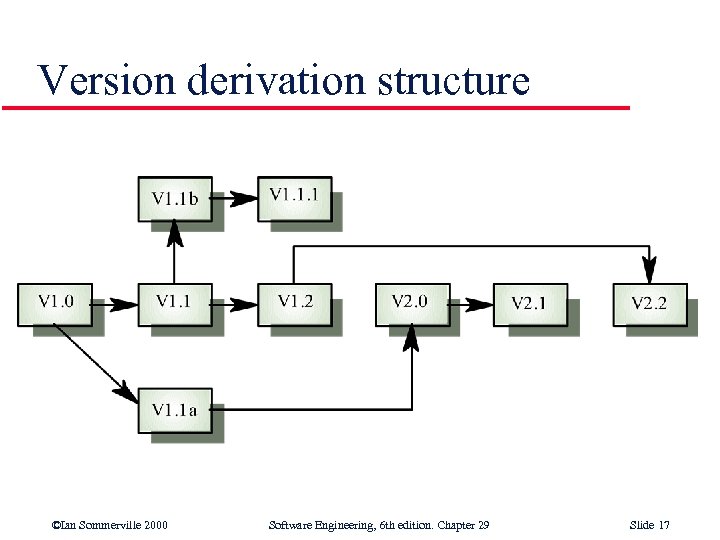 Version derivation structure ©Ian Sommerville 2000 Software Engineering, 6 th edition. Chapter 29 Slide 17
 Version management tools l Version and release identification • l Storage management. • l System stores the differences between versions rather than all the version code Change history recording • l Systems assign identifiers automatically when a new version is submitted to the system Record reasons for version creation Independent development • • Only one version at a time may be checked out for change Parallel working on different versions ©Ian Sommerville 2000 Software Engineering, 6 th edition. Chapter 29 Slide 18
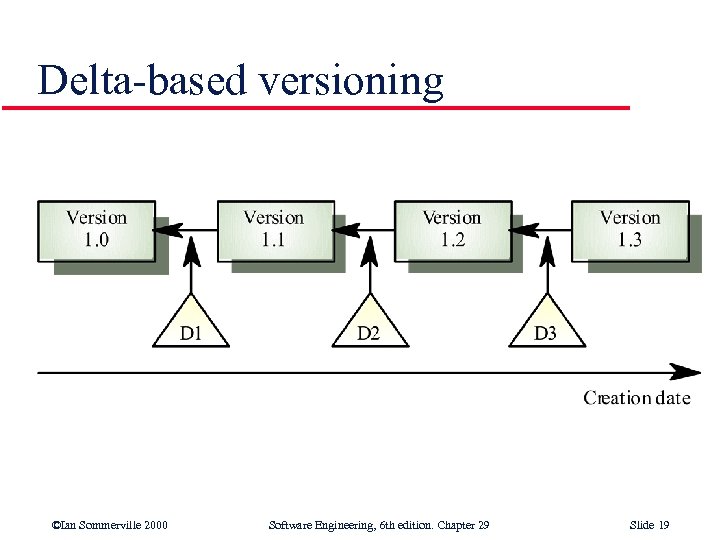 Delta-based versioning ©Ian Sommerville 2000 Software Engineering, 6 th edition. Chapter 29 Slide 19
 Release management l l l Releases incorporate changes forced on the system by errors discovered by users and by hardware changes They also incorporate new system functionality Release planning is concerned with when to issue a system version as a release ©Ian Sommerville 2000 Software Engineering, 6 th edition. Chapter 29 Slide 20
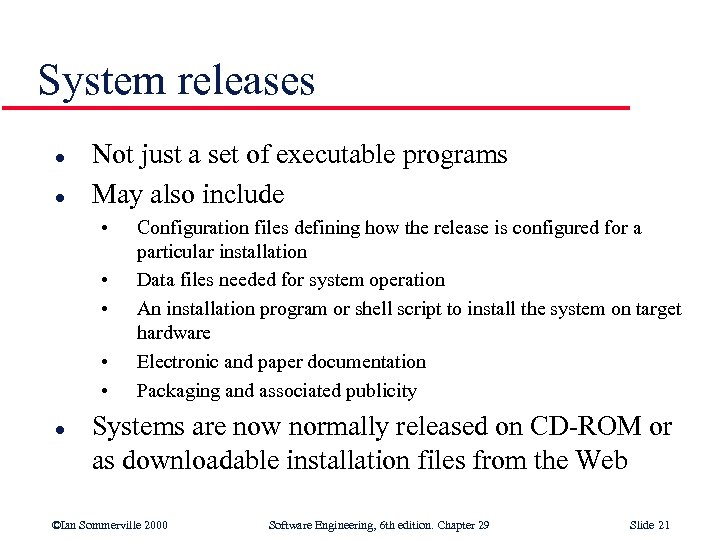 System releases l l Not just a set of executable programs May also include • • • l Configuration files defining how the release is configured for a particular installation Data files needed for system operation An installation program or shell script to install the system on target hardware Electronic and paper documentation Packaging and associated publicity Systems are now normally released on CD-ROM or as downloadable installation files from the Web ©Ian Sommerville 2000 Software Engineering, 6 th edition. Chapter 29 Slide 21
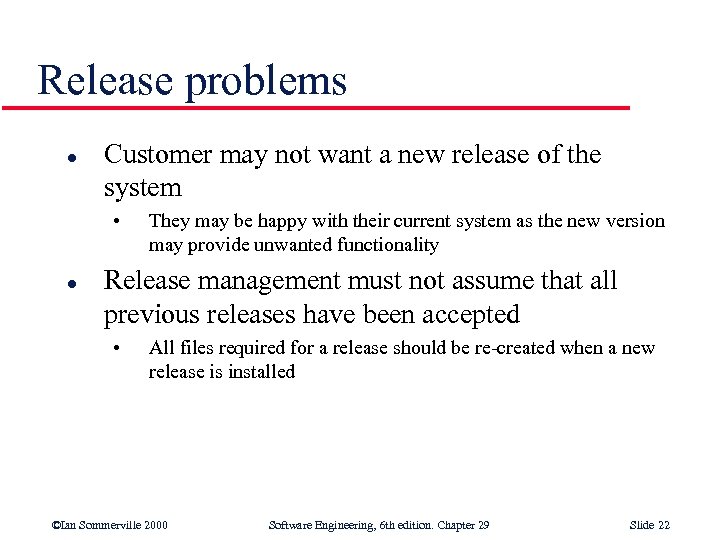 Release problems l Customer may not want a new release of the system • l They may be happy with their current system as the new version may provide unwanted functionality Release management must not assume that all previous releases have been accepted • All files required for a release should be re-created when a new release is installed ©Ian Sommerville 2000 Software Engineering, 6 th edition. Chapter 29 Slide 22
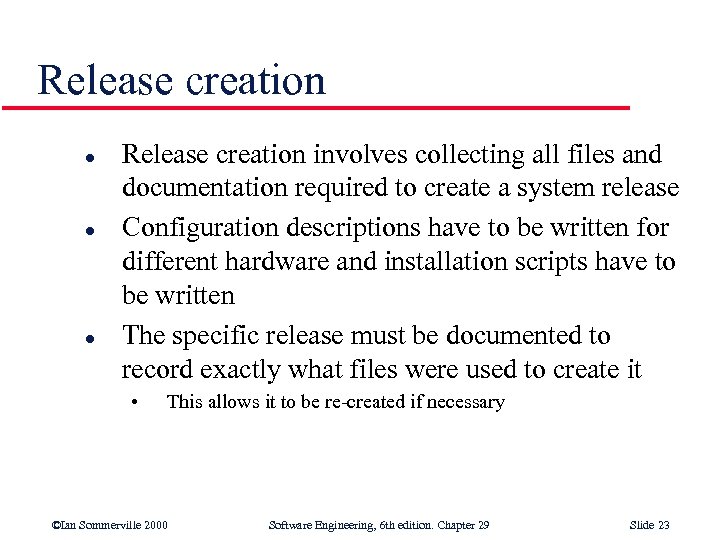 Release creation l l l Release creation involves collecting all files and documentation required to create a system release Configuration descriptions have to be written for different hardware and installation scripts have to be written The specific release must be documented to record exactly what files were used to create it • This allows it to be re-created if necessary ©Ian Sommerville 2000 Software Engineering, 6 th edition. Chapter 29 Slide 23
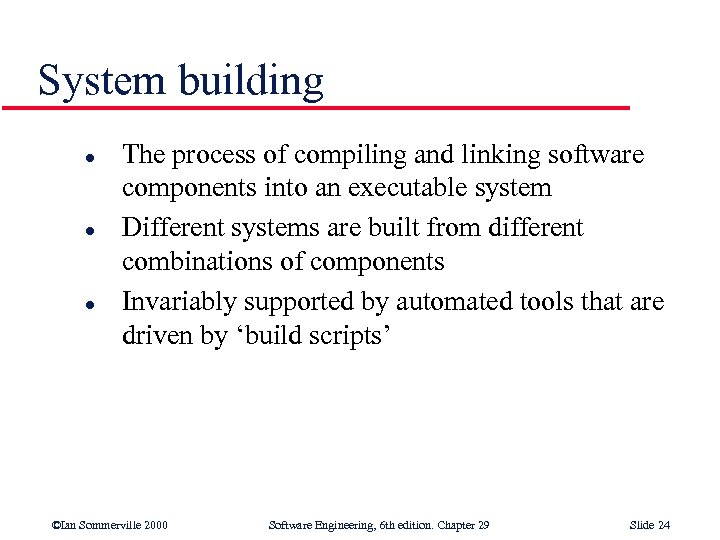 System building l l l The process of compiling and linking software components into an executable system Different systems are built from different combinations of components Invariably supported by automated tools that are driven by ‘build scripts’ ©Ian Sommerville 2000 Software Engineering, 6 th edition. Chapter 29 Slide 24
 System building problems l Do the build instructions include all required components? • • l Is the appropriate component version specified? • l When there are many hundreds of components making up a system, it is easy to miss one out This should normally be detected by the linker A more significant problem. A system built with the wrong version may work initially but fail after delivery Are all data files available? • • The build should not rely on 'standard' data files Standards vary from place to place ©Ian Sommerville 2000 Software Engineering, 6 th edition. Chapter 29 Slide 25
 System building problems l Are data file references within components correct? • l Is the system being built for the right platform • l Embedding absolute names in code almost always causes problems as naming conventions differ from place to place Sometimes must build for a specific OS version or hardware configuration Is the right version of the compiler and other software tools specified? • Different compiler versions may actually generate different code and the compiled component will exhibit different behaviour ©Ian Sommerville 2000 Software Engineering, 6 th edition. Chapter 29 Slide 26
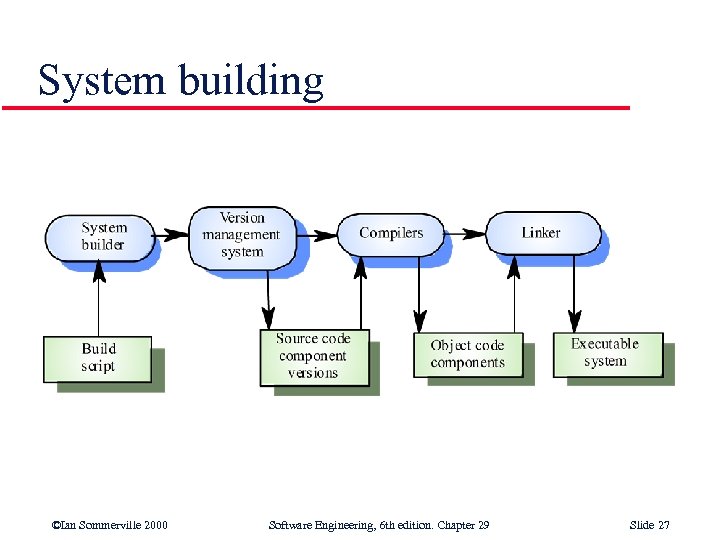 System building ©Ian Sommerville 2000 Software Engineering, 6 th edition. Chapter 29 Slide 27
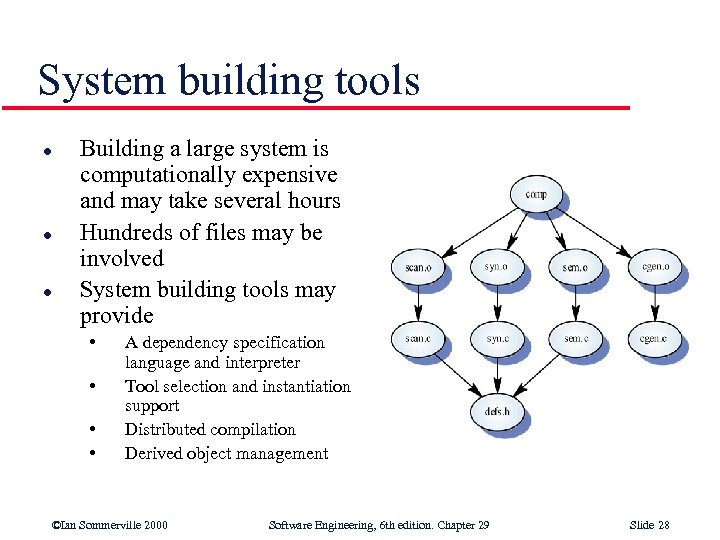 System building tools l l l Building a large system is computationally expensive and may take several hours Hundreds of files may be involved System building tools may provide • • A dependency specification language and interpreter Tool selection and instantiation support Distributed compilation Derived object management ©Ian Sommerville 2000 Software Engineering, 6 th edition. Chapter 29 Slide 28
 Key points l l l Configuration management is the management of system change to software products A formal document naming scheme should be established and documents should be managed in a database The configuration database should record information about changes and change requests A consistent scheme of version identification should be established using version numbers, attributes or change sets System releases include executable code, data, configuration files and documentation System building involves assembling components into a system ©Ian Sommerville 2000 Software Engineering, 6 th edition. Chapter 29 Slide 29