 Скачать презентацию Configuration and Adaptation of Semantic Web Processes Kunal
c987b622f34ba1101d9b09b14dfc54fa.ppt
- Количество слайдов: 84



Configuration and Adaptation of Semantic Web Processes Kunal Verma Ph. D. Thesis Defense (6/13/2006) LSDIS Lab, Dept of Computer Science, University of Georgia Advisors: John A. Miller and Amit P. Sheth Advisory Committee: Budak Arpinar, Robert Bostrom, Ling Liu
Outline • Motivation • Dynamic Process Configuration • Process Adaptation • Empirical Evaluation • Conclusions, Related Work and Future Agenda
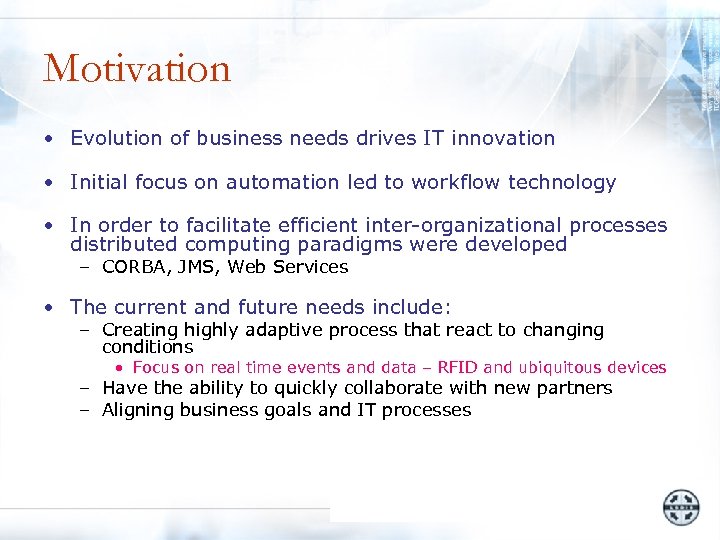
Motivation • Evolution of business needs drives IT innovation • Initial focus on automation led to workflow technology • In order to facilitate efficient inter-organizational processes distributed computing paradigms were developed – CORBA, JMS, Web Services • The current and future needs include: – Creating highly adaptive process that react to changing conditions • Focus on real time events and data – RFID and ubiquitous devices – Have the ability to quickly collaborate with new partners – Aligning business goals and IT processes
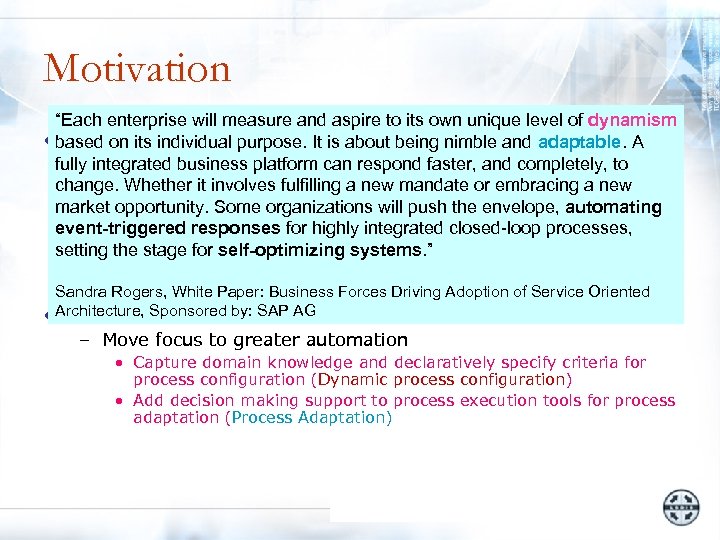
Motivation “Each enterprise will measure and aspire to its own unique level of dynamism • based on its Tools focus on allowing businessesand have greater Current individual purpose. It is about being nimble to adaptable. A dynamism and agility fully integrated business platform can respond faster, and completely, to change. Whether. Dynamics, fulfilling a new mandate or embracing a new SAP – Microsoft it involves IBM Websphere Business Integration, Netweaver market opportunity. Some organizations will push the envelope, automating • All of these Current focus on dynamic closed-loop processes, event-triggered responses for highly integratedand agility through human interaction using GUIs setting the stage for self-optimizing systems. ” • All of them list SOA (WS) as a technology for realization Sandra Rogers, White Paper: Business Forces Driving Adoption of Service Oriented • Architecture, Sponsored by: SAP AG The future – Move focus to greater automation • Capture domain knowledge and declaratively specify criteria for process configuration (Dynamic process configuration) • Add decision making support to process execution tools for process adaptation (Process Adaptation)
Web Services and Semantics • Web services deployment increasing in industry – Standards based interoperability – Loosely coupled systems – Still based on manual integration • Adding semantics can take us to the next level of automation – Use ontologies for shared understanding – Move towards semi-automated integration
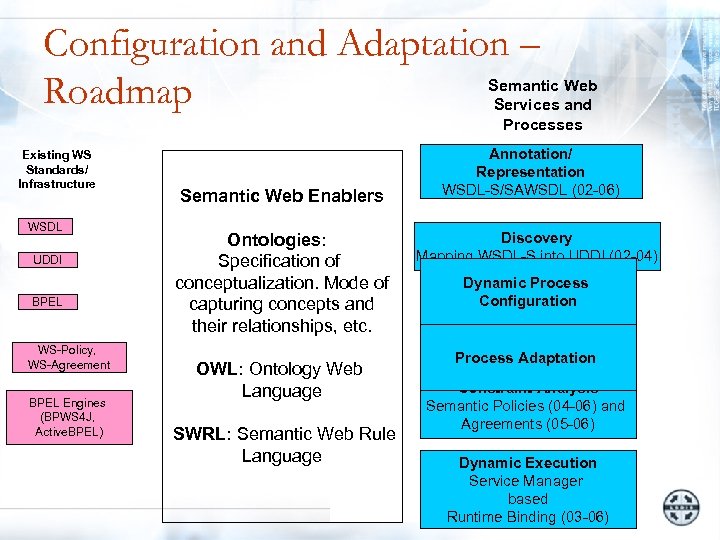
Configuration and Adaptation – Roadmap Semantic Web Services and Processes Existing WS Standards/ Infrastructure WSDL UDDI BPEL WS-Policy, WS-Agreement BPEL Engines (BPWS 4 J, Active. BPEL) Semantic Web Enablers Ontologies: Specification of conceptualization. Mode of capturing concepts and their relationships, etc. OWL: Ontology Web Language SWRL: Semantic Web Rule Language Annotation/ Representation WSDL-S/SAWSDL (02 -06) Discovery Mapping WSDL-S into UDDI (02 -04) Dynamic Process Configuration Composition Creating abstract BPEL Process (03 -06) Process Adaptation Constraint Analysis Semantic Policies (04 -06) and Agreements (05 -06) Dynamic Execution Service Manager based Runtime Binding (03 -06)
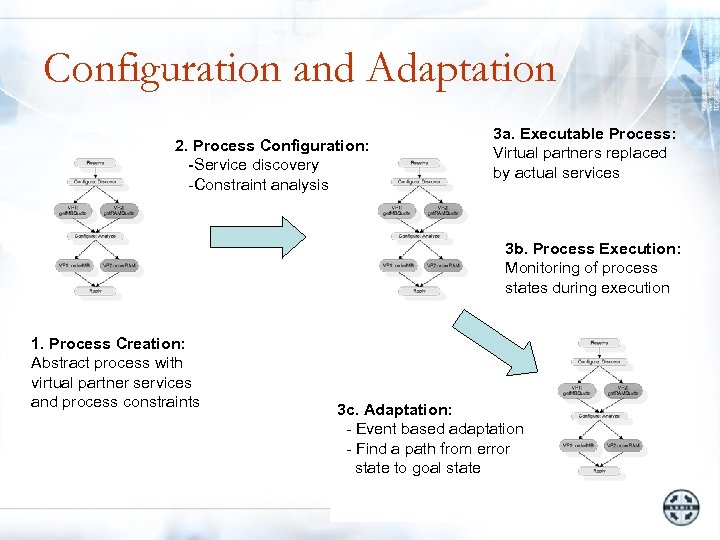
Configuration and Adaptation 2. Process Configuration: -Service discovery -Constraint analysis 3 a. Executable Process: Virtual partners replaced by actual services 3 b. Process Execution: Monitoring of process states during execution 1. Process Creation: Abstract process with virtual partner services and process constraints 3 c. Adaptation: - Event based adaptation - Find a path from error state to goal state
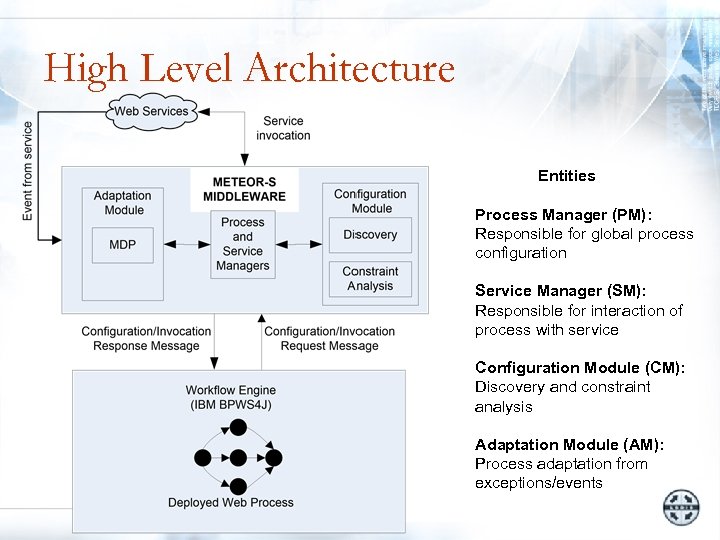
High Level Architecture Entities Process Manager (PM): Responsible for global process configuration Service Manager (SM): Responsible for interaction of process with service Configuration Module (CM): Discovery and constraint analysis Adaptation Module (AM): Process adaptation from exceptions/events
Motivating Scenario • Consider a simplified supply chain process of a computer manufacturer – Most parts are multiple sourced (overseas and internal suppliers) • Overseas goods cheaper but greater lead times – There often exist part compatibility constraints • Choosing a certain motherboard restricts choices of RAMs, processors – Must respect relationship with preferred suppliers • Suppliers characterized as preferred or secondary – Sometimes important to maintain production schedule in the presence of delayed orders
Dynamic Process Configuration
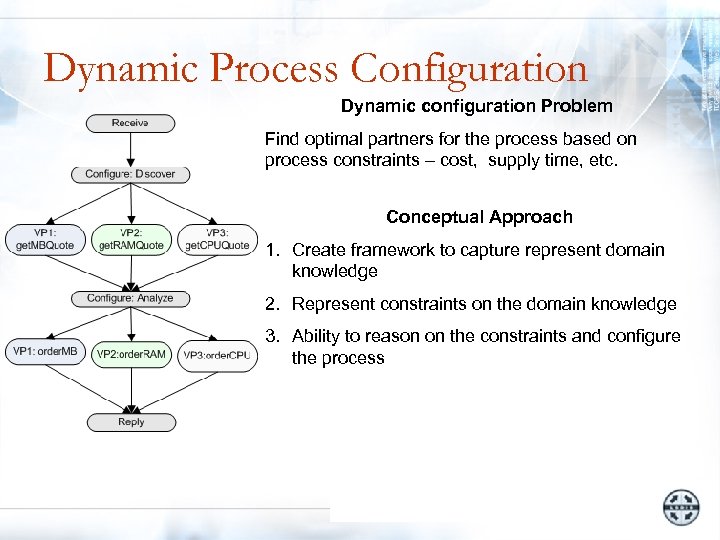
Dynamic Process Configuration Dynamic configuration Problem Find optimal partners for the process based on process constraints – cost, supply time, etc. Conceptual Approach 1. Create framework to capture represent domain knowledge 2. Represent constraints on the domain knowledge 3. Ability to reason on the constraints and configure the process
Dynamic Process Configuration Research Challenges – Capturing functional and non-functional requirements of the Web process (Abstract process specification) – Discovering service partners based on functional requirements (Semantic Web service discovery) – Choosing optimal partners that satisfy nonfunctional requirements (Constraint Analysis) K. Verma, R. Akkiraju, R. Goodwin, P. Doshi, J. Lee, On Accommodating Inter Service Dependencies in Web Process Flow, AAAI Spring Symposium on Semantic Web Services, 2004 R. Aggarwal, K. Verma, J. A. Miller, Constraint Driven Composition in METEOR-S, SCC 2004. K. Verma, K. Gomadam, J. Miller and A. Sheth, Configuration and Execution of Dynamic Web Processes, LSDIS Lab Technical Report, 2005.
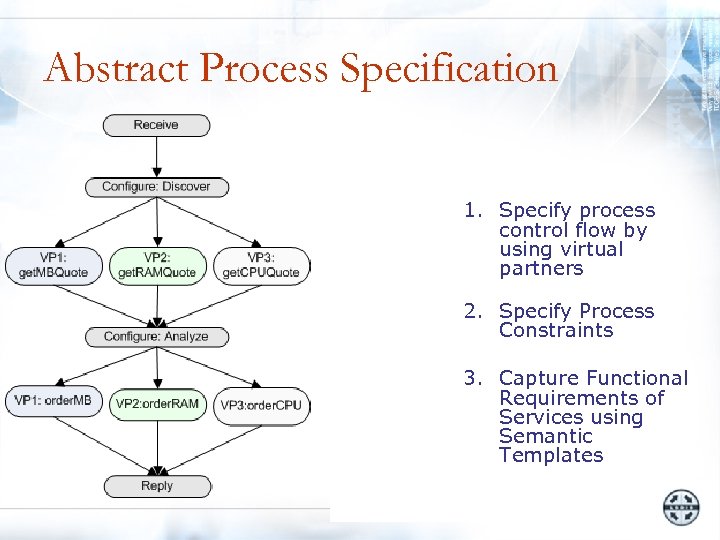
Abstract Process Specification 1. Specify process control flow by using virtual partners 2. Specify Process Constraints 3. Capture Functional Requirements of Services using Semantic Templates
Process Constraints • Constraints can be specified on a partner, an activity or the process as a whole. • An objective function can also be specified e. g. , minimize cost and supply-time, etc. • Two types of constraints: – Quantitative (Q) (Time < 5 sec) – Logical (L) (preferred. Partner, Security, etc. )
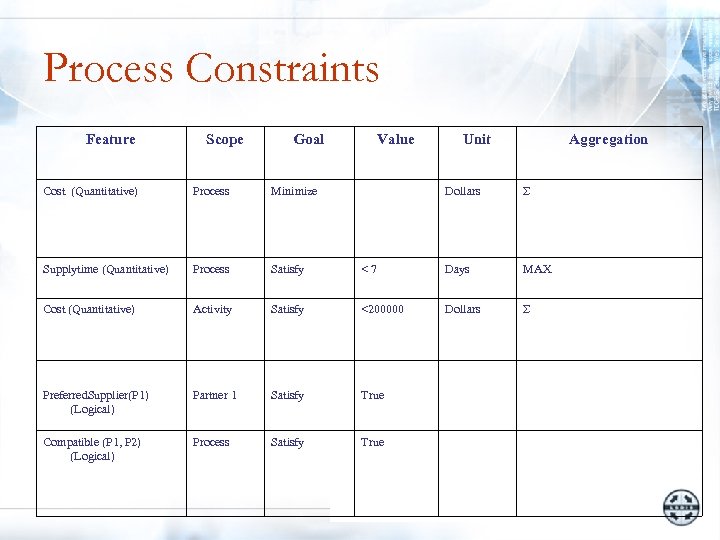
Process Constraints Feature Scope Goal Cost (Quantitative) Process Minimize Supplytime (Quantitative) Process Satisfy Cost (Quantitative) Activity Preferred. Supplier(P 1) (Logical) Compatible (P 1, P 2) (Logical) Value Unit Aggregation Dollars Σ <7 Days MAX Satisfy <200000 Dollars Σ Partner 1 Satisfy True Process Satisfy True
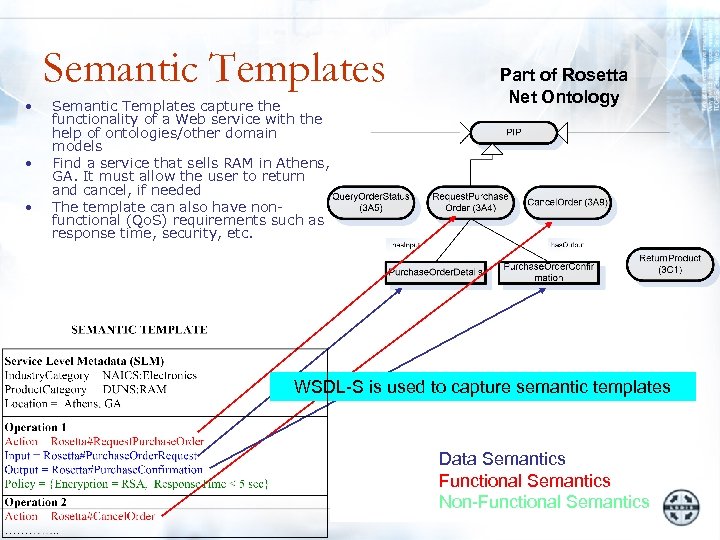
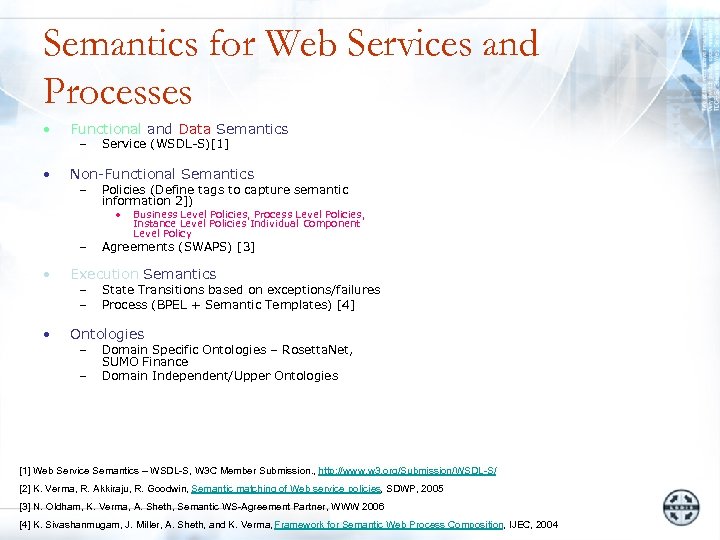
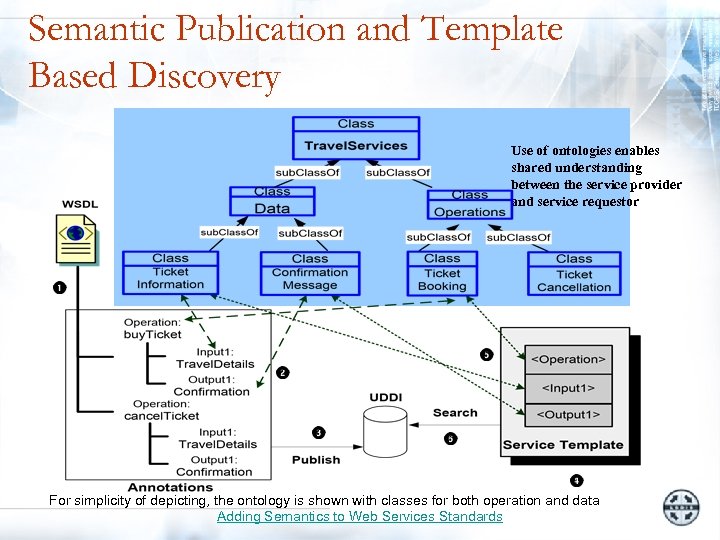
Semantic Templates • • • Semantic Templates capture the functionality of a Web service with the help of ontologies/other domain models Find a service that sells RAM in Athens, GA. It must allow the user to return and cancel, if needed The template can also have nonfunctional (Qo. S) requirements such as response time, security, etc. Part of Rosetta Net Ontology WSDL-S is used to capture semantic templates Data Semantics Functional Semantics Non-Functional Semantics
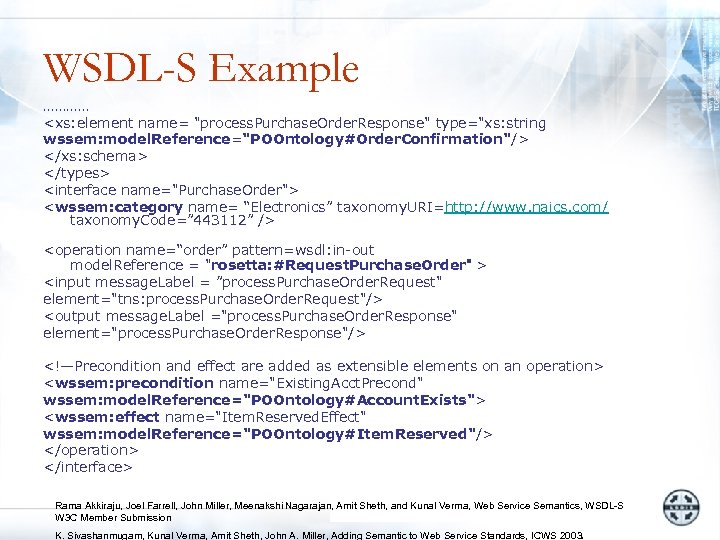
WSDL-S Example ………… <xs: element name= "process. Purchase. Order. Response" type="xs: string wssem: model. Reference="POOntology#Order. Confirmation"/> </xs: schema> </types> <interface name="Purchase. Order"> <wssem: category name= “Electronics” taxonomy. URI=http: //www. naics. com/ taxonomy. Code=” 443112” /> <operation name=“order” pattern=wsdl: in-out model. Reference = "rosetta: #Request. Purchase. Order" > <input message. Label = ”process. Purchase. Order. Request" element="tns: process. Purchase. Order. Request"/> <output message. Label ="process. Purchase. Order. Response" element="process. Purchase. Order. Response"/> <!—Precondition and effect are added as extensible elements on an operation> <wssem: precondition name="Existing. Acct. Precond" wssem: model. Reference="POOntology#Account. Exists"> <wssem: effect name="Item. Reserved. Effect" wssem: model. Reference="POOntology#Item. Reserved"/> </operation> </interface> Rama Akkiraju, Joel Farrell, John Miller, Meenakshi Nagarajan, Amit Sheth, and Kunal Verma, Web Service Semantics, WSDL-S W 3 C Member Submission . K. Sivashanmugam, Kunal Verma, Amit Sheth, John A. Miller, Adding Semantic to Web Service Standards, ICWS 2003
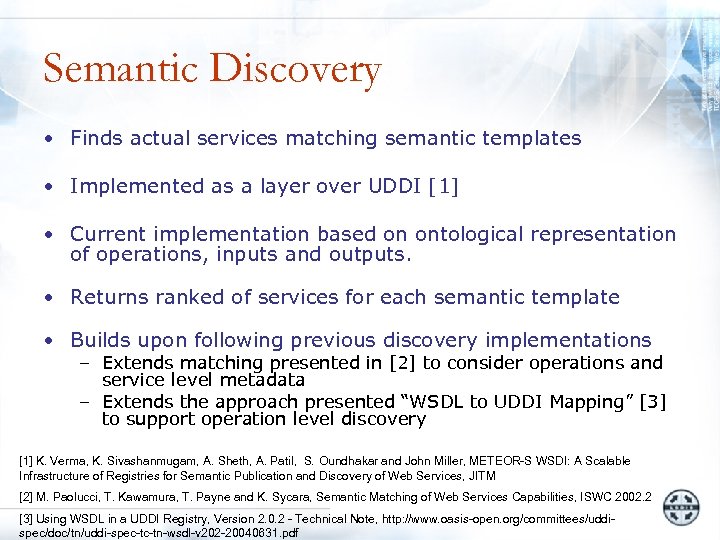
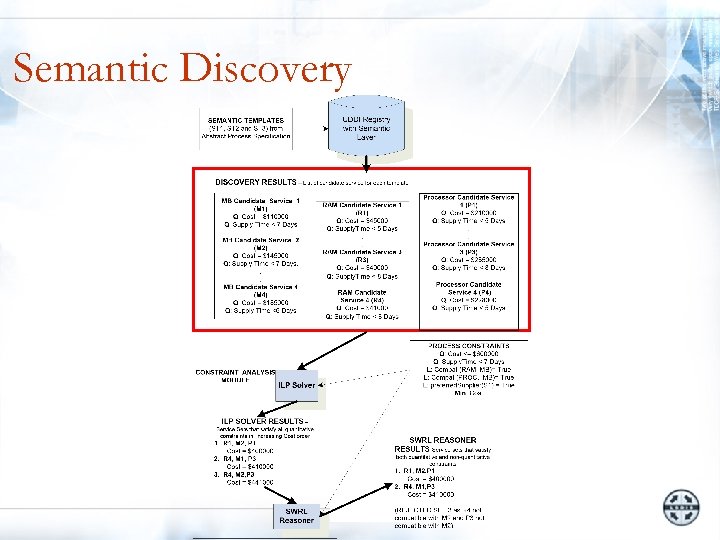
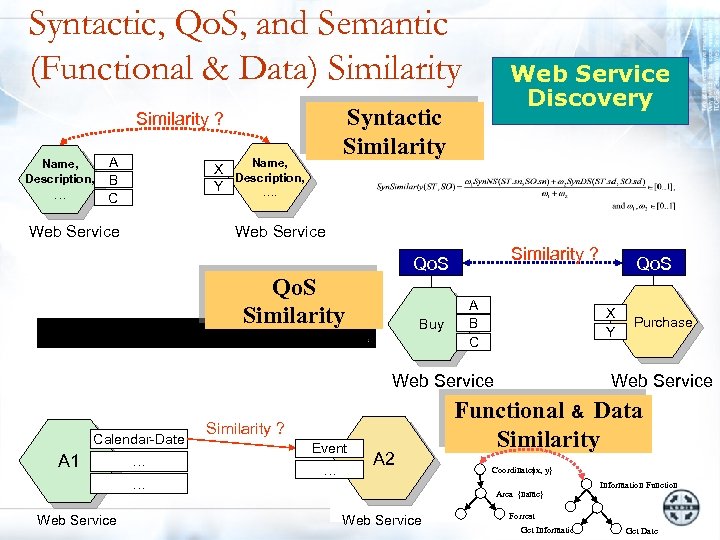
Semantic Discovery • Finds actual services matching semantic templates • Implemented as a layer over UDDI [1] • Current implementation based on ontological representation of operations, inputs and outputs. • Returns ranked of services for each semantic template • Builds upon following previous discovery implementations – Extends matching presented in [2] to consider operations and service level metadata – Extends the approach presented “WSDL to UDDI Mapping” [3] to support operation level discovery [1] K. Verma, K. Sivashanmugam, A. Sheth, A. Patil, S. Oundhakar and John Miller, METEOR-S WSDI: A Scalable Infrastructure of Registries for Semantic Publication and Discovery of Web Services, JITM [2] M. Paolucci, T. Kawamura, T. Payne and K. Sycara, Semantic Matching of Web Services Capabilities, ISWC 2002. 2 [3] Using WSDL in a UDDI Registry, Version 2. 0. 2 - Technical Note, http: //www. oasis-open. org/committees/uddispec/doc/tn/uddi-spec-tc-tn-wsdl-v 202 -20040631. pdf
Semantic Discovery
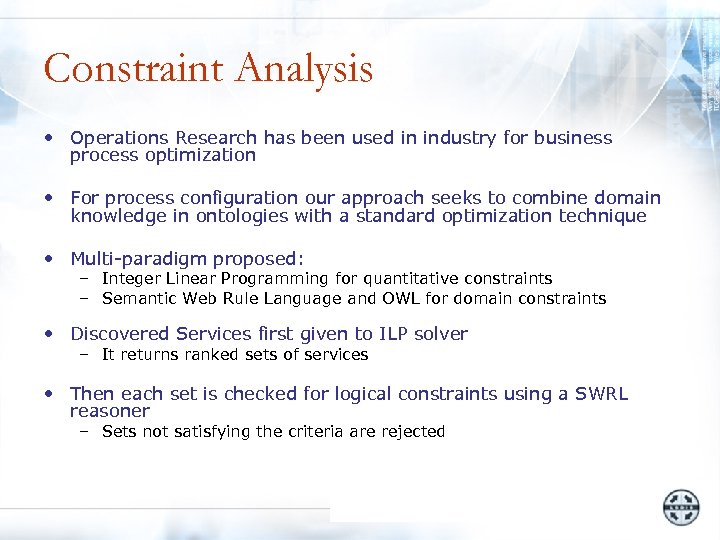
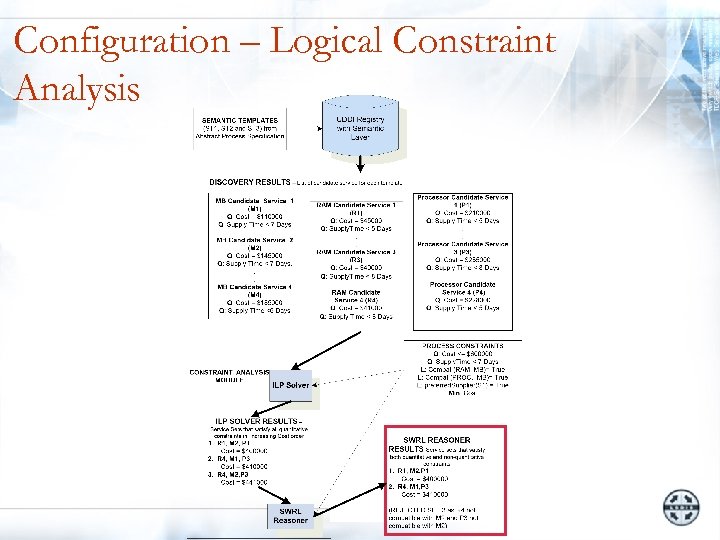
Constraint Analysis • Operations Research has been used in industry for business process optimization • For process configuration our approach seeks to combine domain knowledge in ontologies with a standard optimization technique • Multi-paradigm proposed: – Integer Linear Programming for quantitative constraints – Semantic Web Rule Language and OWL for domain constraints • Discovered Services first given to ILP solver – It returns ranked sets of services • Then each set is checked for logical constraints using a SWRL reasoner – Sets not satisfying the criteria are rejected
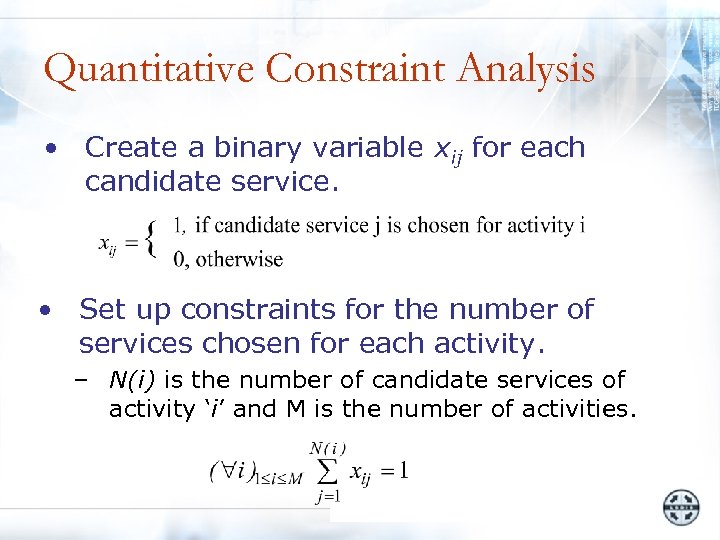
Quantitative Constraint Analysis • Create a binary variable xij for each candidate service. • Set up constraints for the number of services chosen for each activity. – N(i) is the number of candidate services of activity ‘i’ and M is the number of activities.
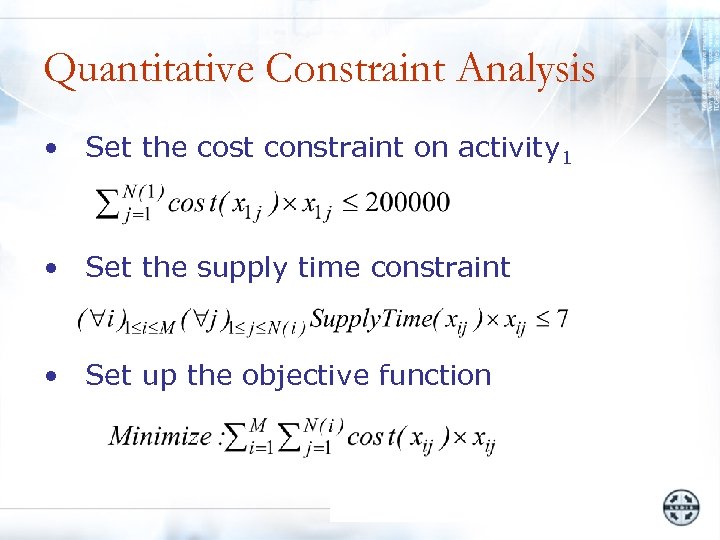
Quantitative Constraint Analysis • Set the cost constraint on activity 1 • Set the supply time constraint • Set up the objective function
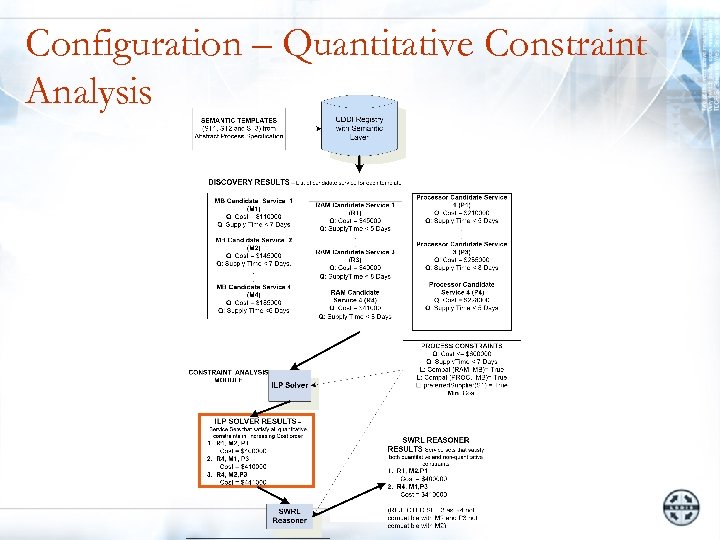
Configuration – Quantitative Constraint Analysis
Logical Constraint Analysis • Use a SWRL reasoner to perform logical constraint analysis • Domain knowledge is captured as ontologies • Rules are created with the help of the knowledge in the ontology • Implemented using IBM’s ABLE and SNOBASE – SNOBASE stores OWL ontologies using ABLE Rule Language (ARL) – Our implementation is based on SWRL rules written in ARL K. Verma, R. Akkiraju, R. Goodwin, Semantic Matching of Web Service Policies SDWP 2005 & Filed Patent N. Oldham, K. Verma, A. Sheth, Semantic WS-Agreement Based Partner Selection, WWW 2006
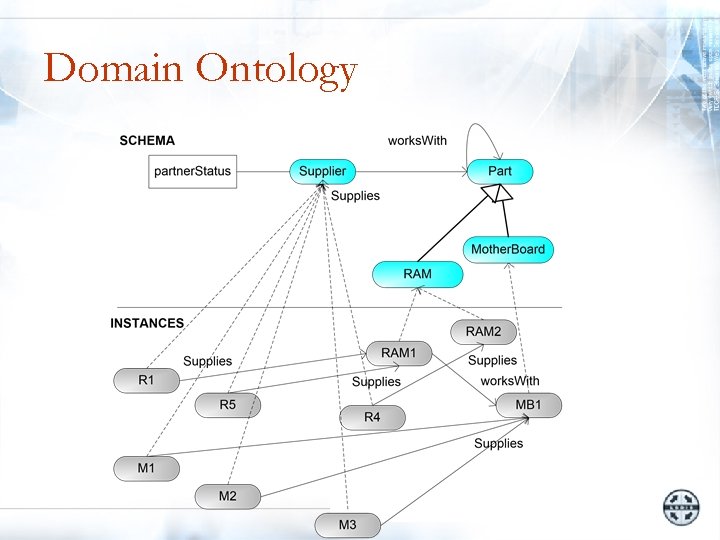
Domain Ontology
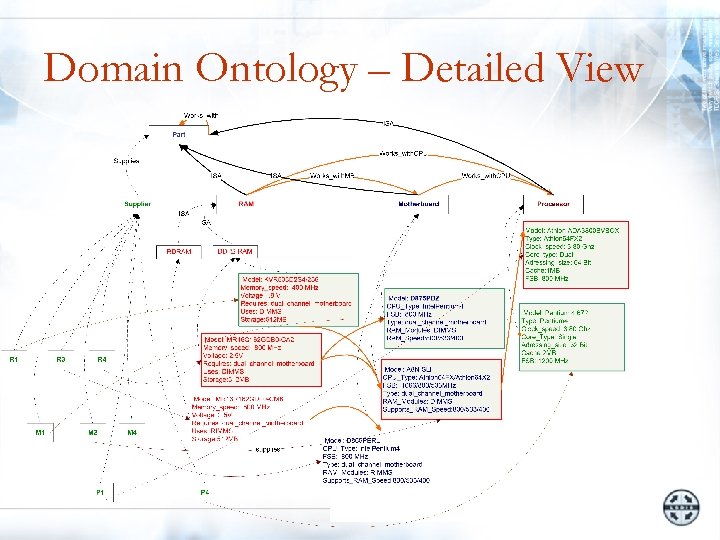
Domain Ontology – Detailed View
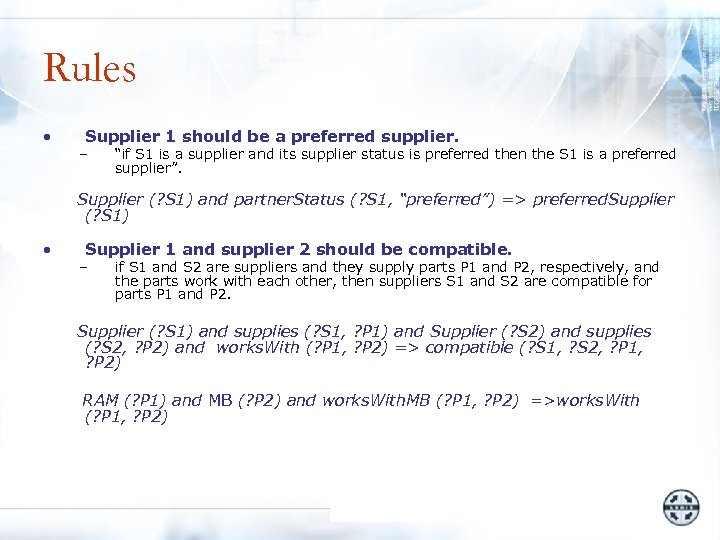
Rules • Supplier 1 should be a preferred supplier. – “if S 1 is a supplier and its supplier status is preferred then the S 1 is a preferred supplier”. Supplier (? S 1) and partner. Status (? S 1, “preferred”) => preferred. Supplier (? S 1) • Supplier 1 and supplier 2 should be compatible. – if S 1 and S 2 are suppliers and they supply parts P 1 and P 2, respectively, and the parts work with each other, then suppliers S 1 and S 2 are compatible for parts P 1 and P 2. Supplier (? S 1) and supplies (? S 1, ? P 1) and Supplier (? S 2) and supplies (? S 2, ? P 2) and works. With (? P 1, ? P 2) => compatible (? S 1, ? S 2, ? P 1, ? P 2) RAM (? P 1) and MB (? P 2) and works. With. MB (? P 1, ? P 2) =>works. With (? P 1, ? P 2)
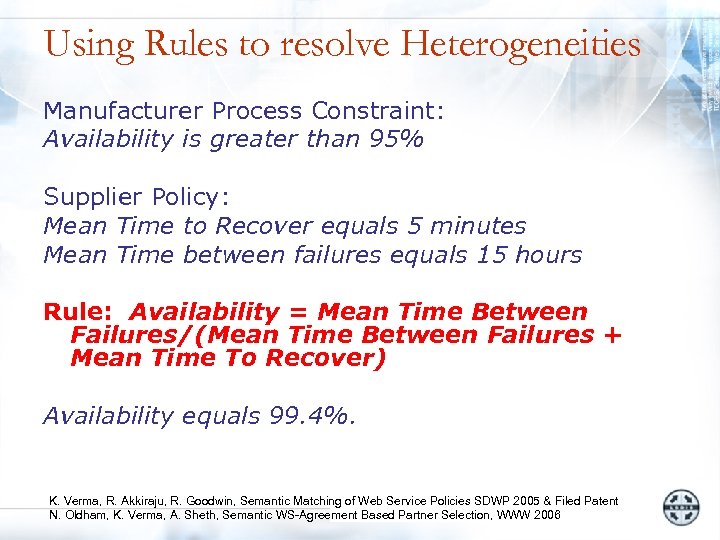
Using Rules to resolve Heterogeneities Manufacturer Process Constraint: Availability is greater than 95% Supplier Policy: Mean Time to Recover equals 5 minutes Mean Time between failures equals 15 hours Rule: Availability = Mean Time Between Failures/(Mean Time Between Failures + Mean Time To Recover) Availability equals 99. 4%. K. Verma, R. Akkiraju, R. Goodwin, Semantic Matching of Web Service Policies SDWP 2005 & Filed Patent N. Oldham, K. Verma, A. Sheth, Semantic WS-Agreement Based Partner Selection, WWW 2006
Configuration – Logical Constraint Analysis
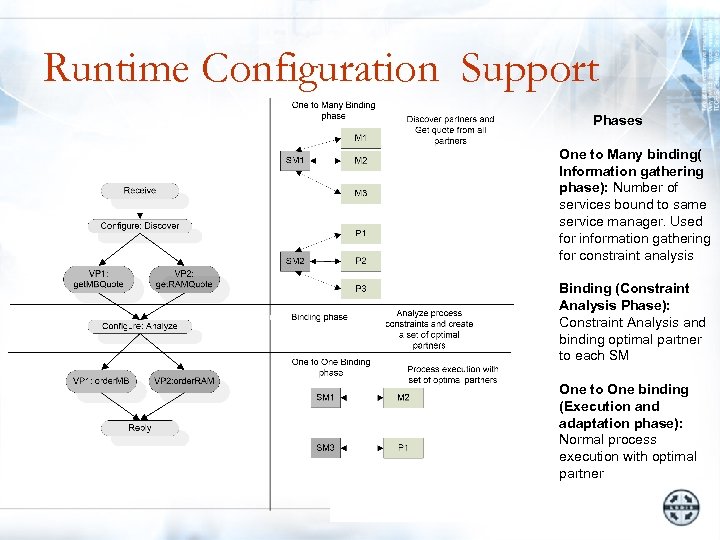
Runtime Configuration Support Phases One to Many binding( Information gathering phase): Number of services bound to same service manager. Used for information gathering for constraint analysis Binding (Constraint Analysis Phase): Constraint Analysis and binding optimal partner to each SM One to One binding (Execution and adaptation phase): Normal process execution with optimal partner
Process Adaptation
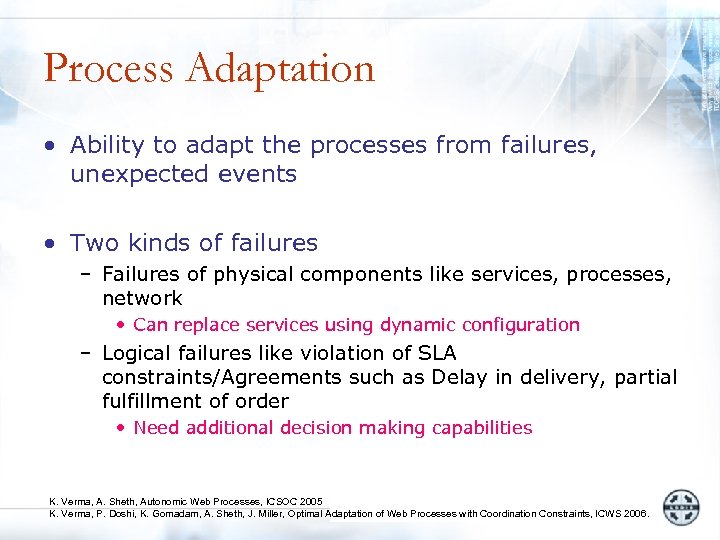
Process Adaptation • Ability to adapt the processes from failures, unexpected events • Two kinds of failures – Failures of physical components like services, processes, network • Can replace services using dynamic configuration – Logical failures like violation of SLA constraints/Agreements such as Delay in delivery, partial fulfillment of order • Need additional decision making capabilities K. Verma, A. Sheth, Autonomic Web Processes, ICSOC 2005 K. Verma, P. Doshi, K. Gomadam, A. Sheth, J. Miller, Optimal Adaptation of Web Processes with Coordination Constraints, ICWS 2006.
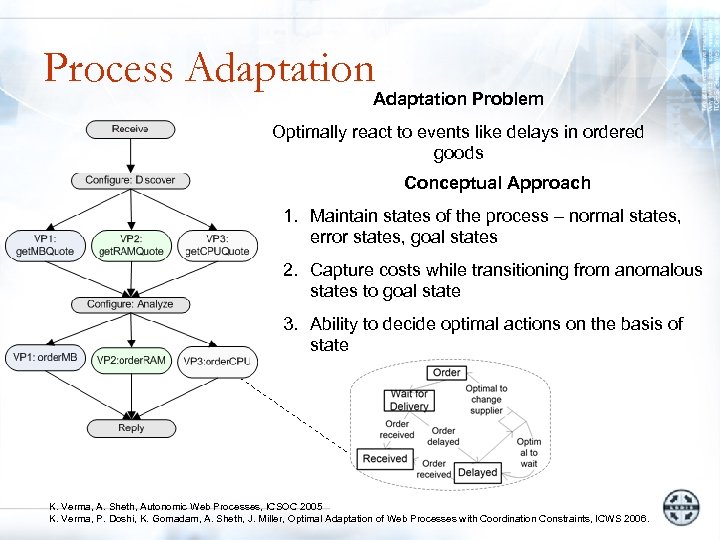
Process Adaptation Problem Optimally react to events like delays in ordered goods Conceptual Approach 1. Maintain states of the process – normal states, error states, goal states 2. Capture costs while transitioning from anomalous states to goal state 3. Ability to decide optimal actions on the basis of state K. Verma, A. Sheth, Autonomic Web Processes, ICSOC 2005 K. Verma, P. Doshi, K. Gomadam, A. Sheth, J. Miller, Optimal Adaptation of Web Processes with Coordination Constraints, ICWS 2006.
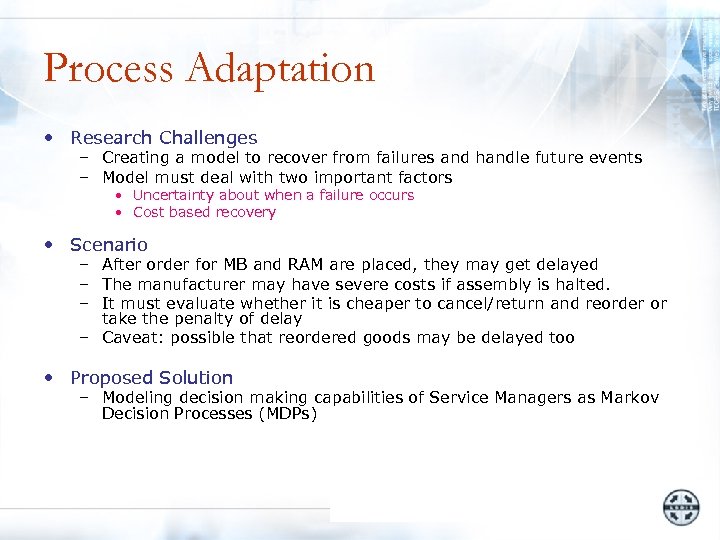
Process Adaptation • Research Challenges – Creating a model to recover from failures and handle future events – Model must deal with two important factors • Uncertainty about when a failure occurs • Cost based recovery • Scenario – After order for MB and RAM are placed, they may get delayed – The manufacturer may have severe costs if assembly is halted. – It must evaluate whether it is cheaper to cancel/return and reorder or take the penalty of delay – Caveat: possible that reordered goods may be delayed too • Proposed Solution – Modeling decision making capabilities of Service Managers as Markov Decision Processes (MDPs)
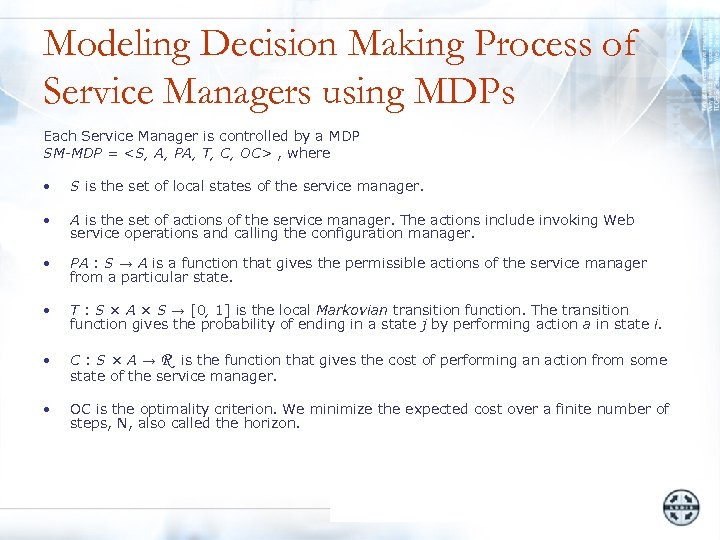
Modeling Decision Making Process of Service Managers using MDPs Each Service Manager is controlled by a MDP SM-MDP = <S, A, PA, T, C, OC> , where • S is the set of local states of the service manager. • A is the set of actions of the service manager. The actions include invoking Web service operations and calling the configuration manager. • PA : S → A is a function that gives the permissible actions of the service manager from a particular state. • T : S × A × S → [0, 1] is the local Markovian transition function. The transition function gives the probability of ending in a state j by performing action a in state i. • C : S × A → R is the function that gives the cost of performing an action from some state of the service manager. • OC is the optimality criterion. We minimize the expected cost over a finite number of steps, N, also called the horizon.
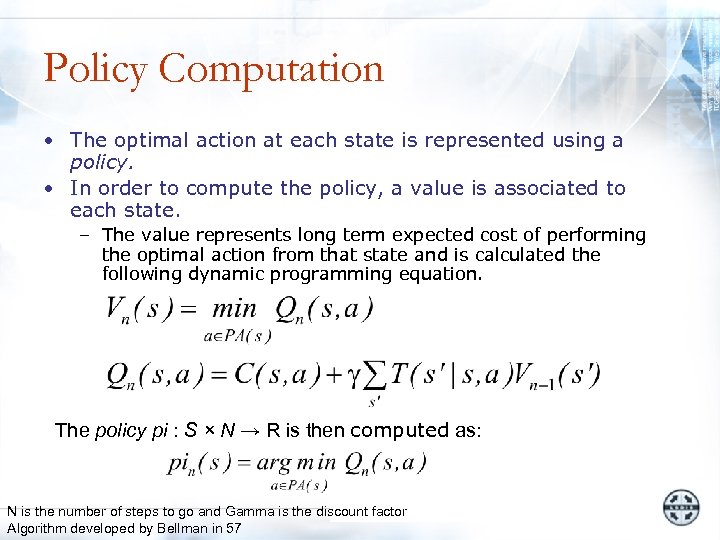
Policy Computation • The optimal action at each state is represented using a policy. • In order to compute the policy, a value is associated to each state. – The value represents long term expected cost of performing the optimal action from that state and is calculated the following dynamic programming equation. The policy pi : S × N → R is then computed as: N is the number of steps to go and Gamma is the discount factor Algorithm developed by Bellman in 57
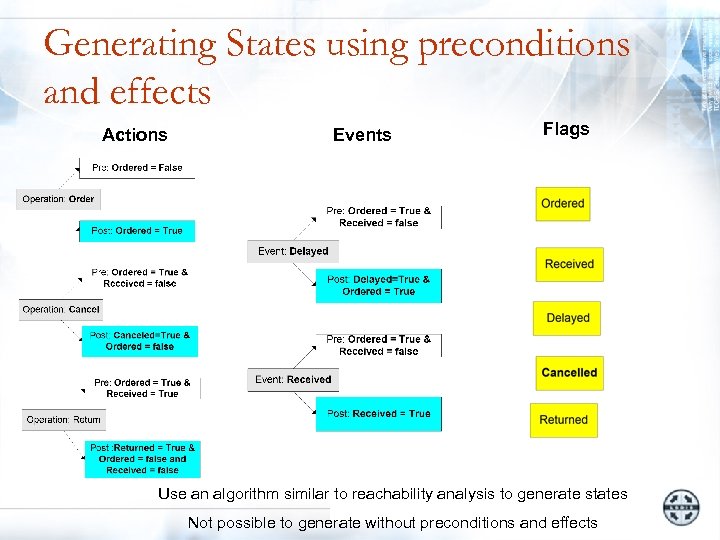
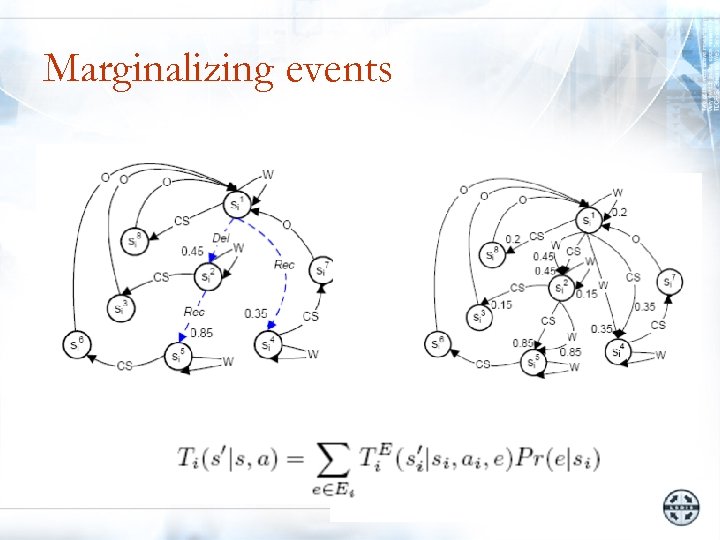
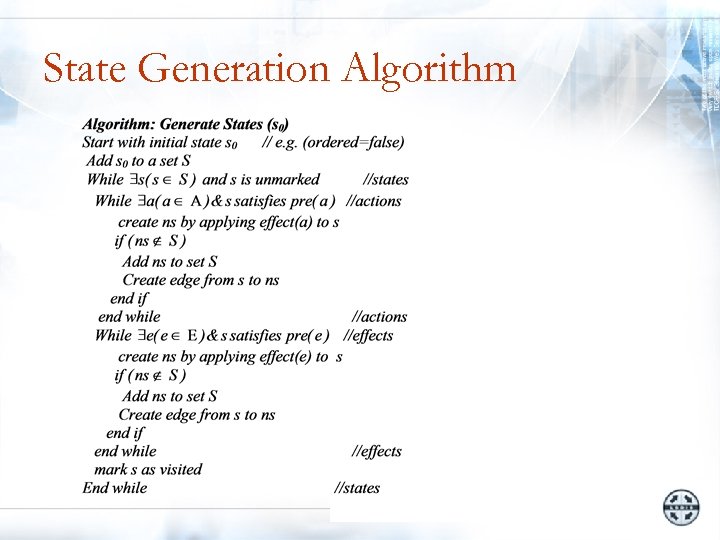
Generating States using preconditions and effects Actions Events Flags Use an algorithm similar to reachability analysis to generate states Not possible to generate without preconditions and effects
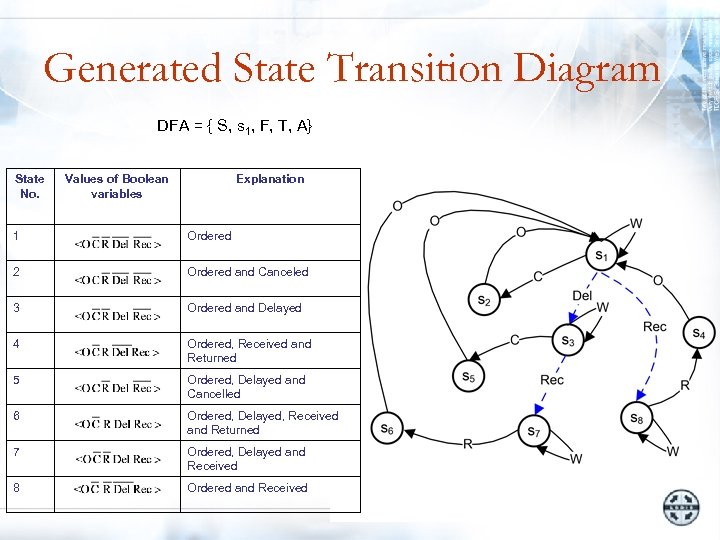
Generated State Transition Diagram DFA = { S, s 1, F, T, A} State No. Values of Boolean variables Explanation 1 Ordered 2 Ordered and Canceled 3 Ordered and Delayed 4 Ordered, Received and Returned 5 Ordered, Delayed and Cancelled 6 Ordered, Delayed, Received and Returned 7 Ordered, Delayed and Received 8 Ordered and Received
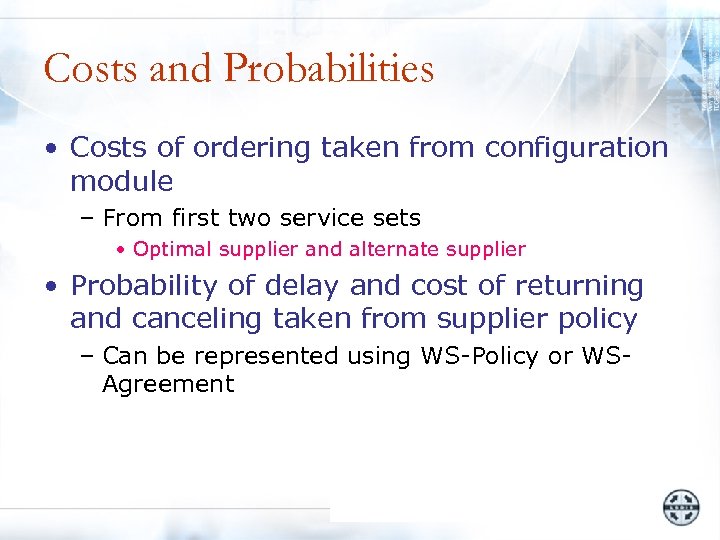
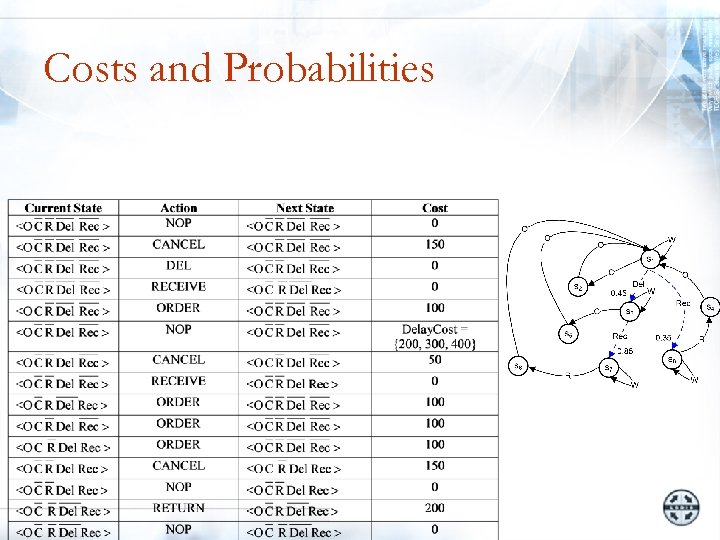
Costs and Probabilities • Costs of ordering taken from configuration module – From first two service sets • Optimal supplier and alternate supplier • Probability of delay and cost of returning and canceling taken from supplier policy – Can be represented using WS-Policy or WSAgreement
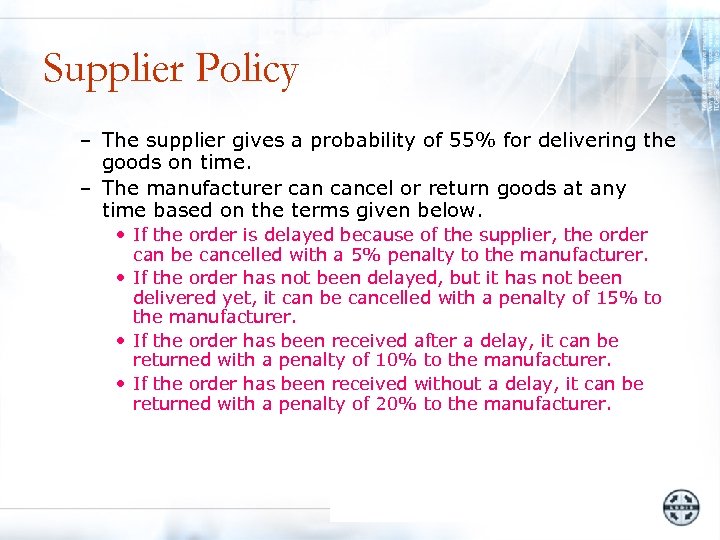
Supplier Policy – The supplier gives a probability of 55% for delivering the goods on time. – The manufacturer cancel or return goods at any time based on the terms given below. • If the order is delayed because of the supplier, the order can be cancelled with a 5% penalty to the manufacturer. • If the order has not been delayed, but it has not been delivered yet, it can be cancelled with a penalty of 15% to the manufacturer. • If the order has been received after a delay, it can be returned with a penalty of 10% to the manufacturer. • If the order has been received without a delay, it can be returned with a penalty of 20% to the manufacturer.
Costs and Probabilities
Handling Inter-Service dependencies • Since the RAM and Motherboard must be compatible, the actions of service managers (SMs) must be coordinated • For example, if MB delivery is delayed, and MB SM wants to cancel order and change supplier, the RAM SM must do the same • Hence, coordination must be introduced in SMMDPs
Centralized Approach • State space created by Cartesian product of transition diagrams • Joint actions from each state • Transition probability created by multiplying states • Costs created by adding cost per action from each state – Compatible actions given rewards – Incompatible actions given penalties • Optimal but exponential with number of manager
Decentralized Approach • Simple coordination mechanism • If one service manager changes suppliers – All dependent managers must change suppliers • Low complexity but sub-optimal
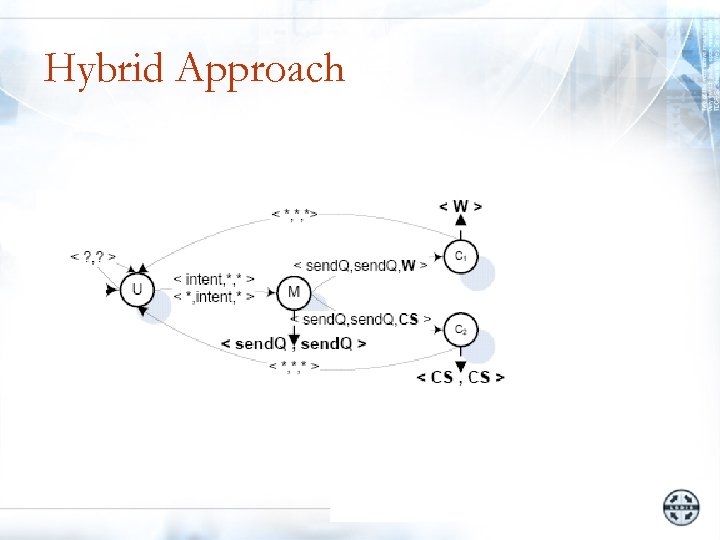
Hybrid Approach • If the policy of some SM dictates it to change suppliers, the following actions happen: – – it sends a coordinate request to PM PM gets the current cost of changing suppliers or current optimal action by polling all SMs • It takes the cheapest action (change supplier or continue) • A bit like decentralized voting- will change suppliers if majority are delayed • It mirrors performance of centralized approach and has complexity like the decentralized approach
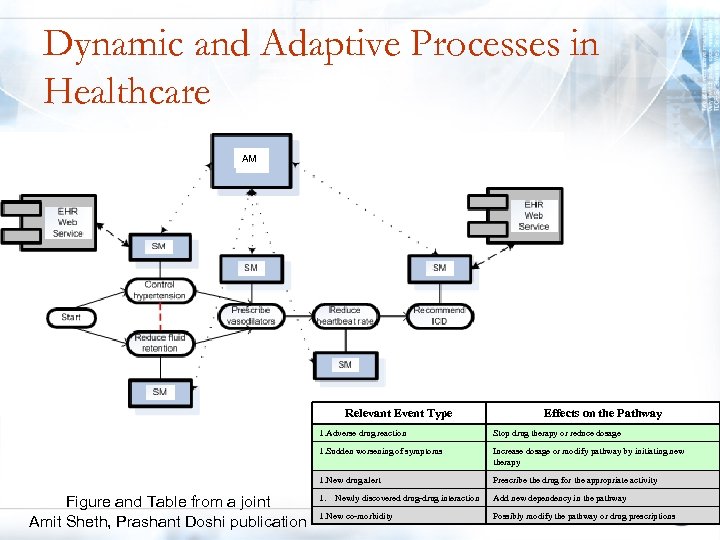
Dynamic and Adaptive Processes in Healthcare AM Relevant Event Type Effects on the Pathway 1. Adverse drug reaction 1. Sudden worsening of symptoms Increase dosage or modify pathway by initiating new therapy 1. New drug alert Figure and Table from a joint Amit Sheth, Prashant Doshi publication Stop drug therapy or reduce dosage Prescribe the drug for the appropriate activity 1. Newly discovered drug-drug interaction Add new dependency in the pathway 1. New co-morbidity Possibly modify the pathway or drug prescriptions
Empirical Evaluation
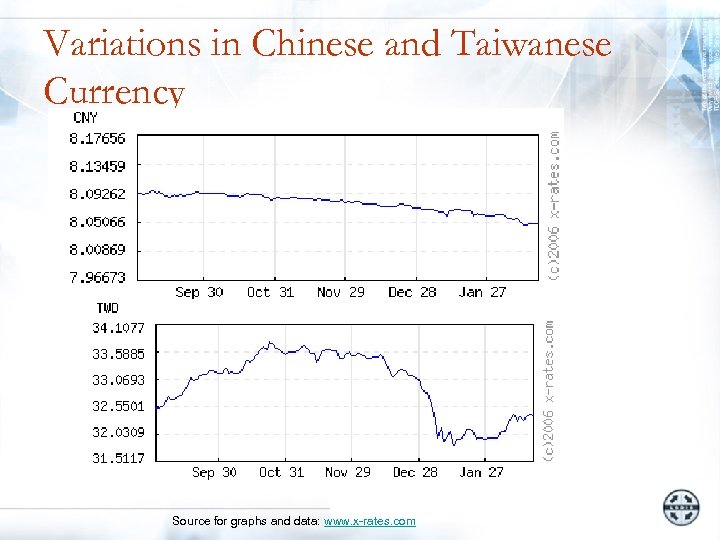
Evaluating Dynamic Configuration • Evaluation with help of the supply chain scenario • Use the variations in currency exchange rates of China and Taiwan as the primary factor affecting supplier prices • Assume that process is dynamically configured every fortnight
Observations • Static binding – Configured at the first run and same partners are persisted with for all subsequent runs – Cost changes due to variations in currency • Dynamic binding – Dynamically configured with latest prices for all runs – With just ILP (Dynamic 1) Always the lowest cost, logical constraints not guaranteed – With ILP and SWRL (Dynamic 2) Lowest cost for partners satisfying all constraints
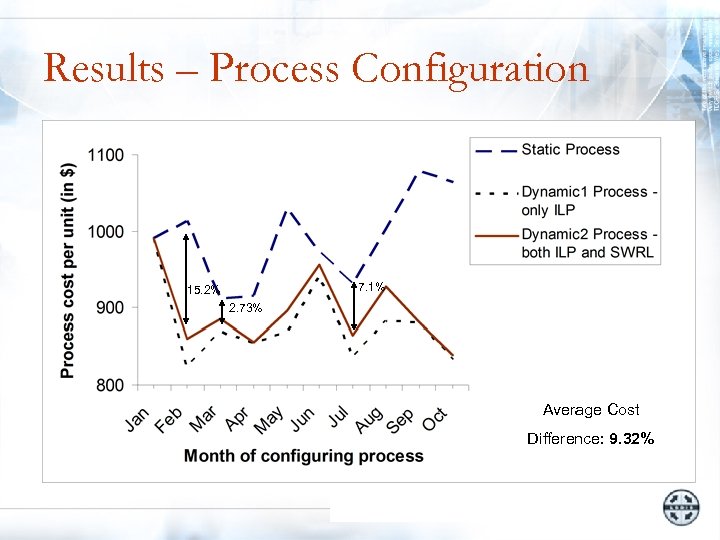
Results – Process Configuration 7. 1% 15. 2% 2. 73% Average Cost Difference: 9. 32%
Evaluating Process Adaptation • Evaluation with the help of the supply chain scenario • Two main parameters used for the evaluation – Probability of Delay – (probability that an item ordered from a supplier will be delayed) – Penalty of Delay – (cost for the manufacturer for not reacting to delay) • Total process cost = $1000 and cost of changing suppliers (CS) =$200
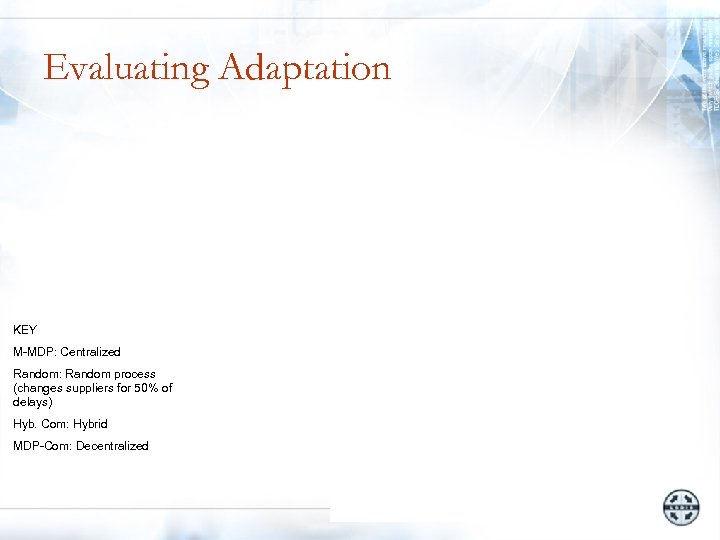
Evaluating Adaptation KEY M-MDP: Centralized Random: Random process (changes suppliers for 50% of delays) Hyb. Com: Hybrid MDP-Com: Decentralized
Evaluating Adaptation
Evaluating Adaptation
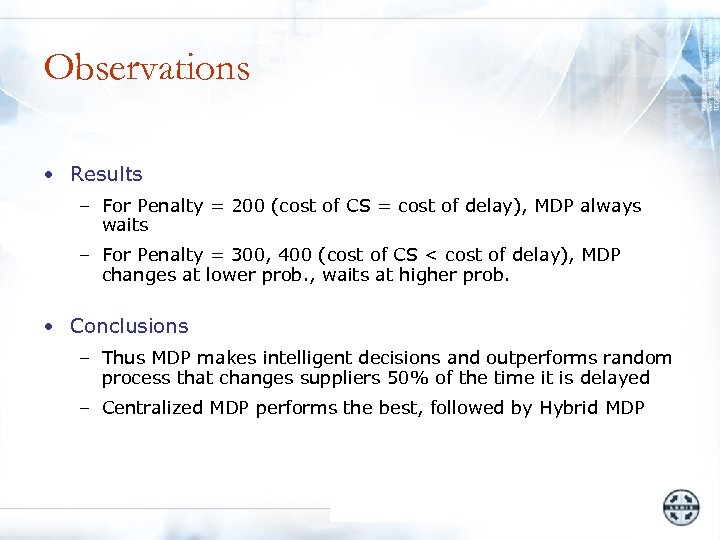
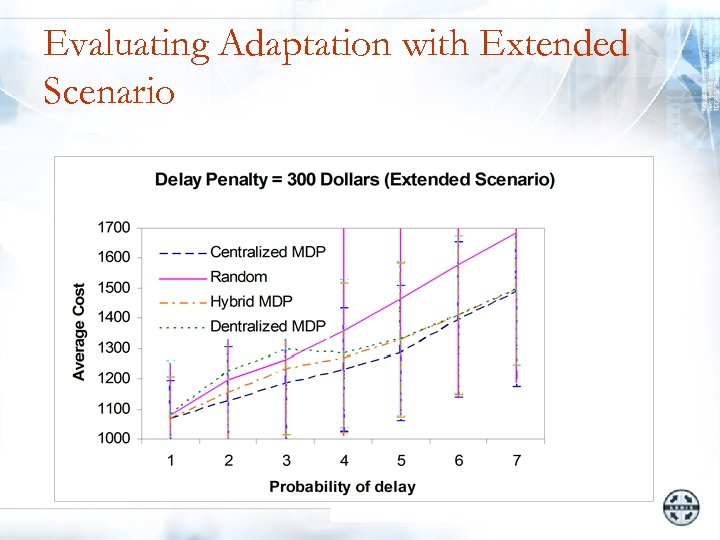
Observations • Results – For Penalty = 200 (cost of CS = cost of delay), MDP always waits – For Penalty = 300, 400 (cost of CS < cost of delay), MDP changes at lower prob. , waits at higher prob. • Conclusions – Thus MDP makes intelligent decisions and outperforms random process that changes suppliers 50% of the time it is delayed – Centralized MDP performs the best, followed by Hybrid MDP
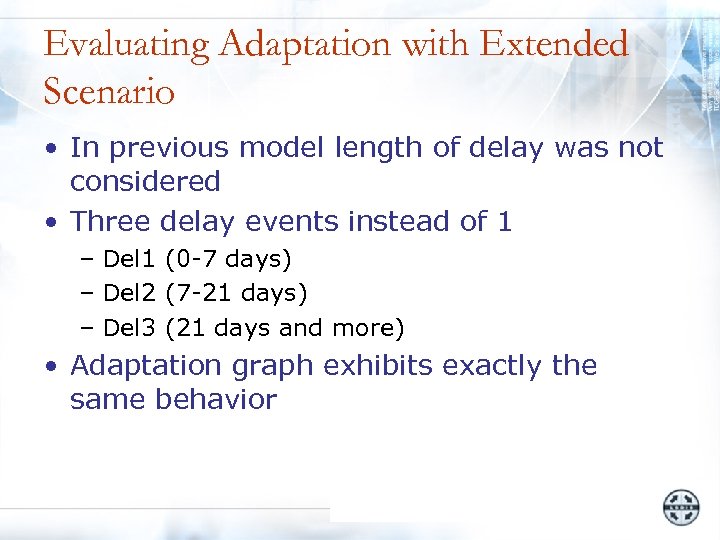
Evaluating Adaptation with Extended Scenario • In previous model length of delay was not considered • Three delay events instead of 1 – Del 1 (0 -7 days) – Del 2 (7 -21 days) – Del 3 (21 days and more) • Adaptation graph exhibits exactly the same behavior
Evaluating Adaptation with Extended Scenario
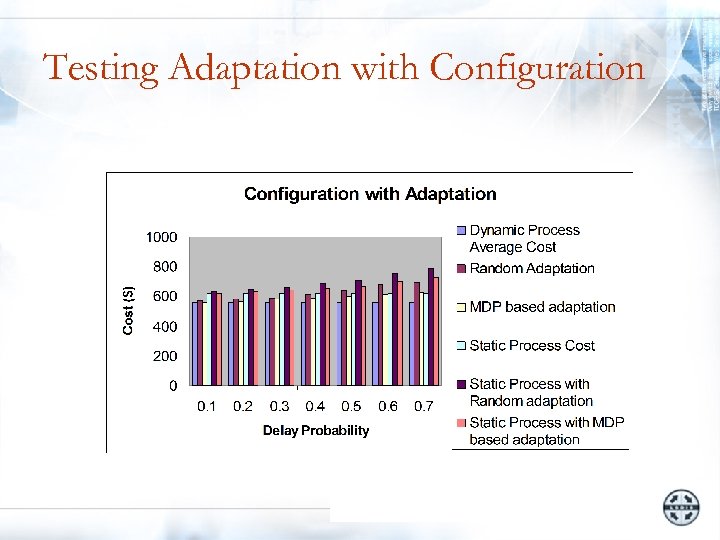
Testing Adaptation with Configuration • Process executed in two modes – Configuration with random adaptation – Configuration with Hybrid MDP based adaptation • Tested across different probabilities • MDP based adaptation outperforms random adaptation
Testing Adaptation with Configuration
Architecture
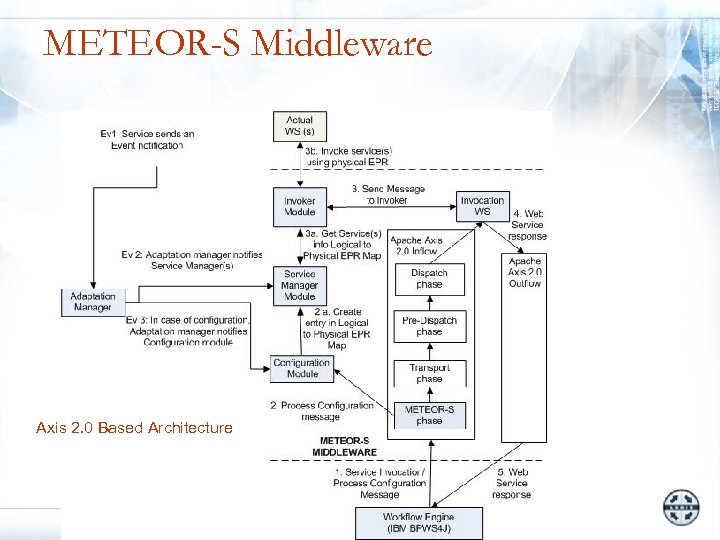
METEOR-S Middleware Axis 2. 0 Based Architecture
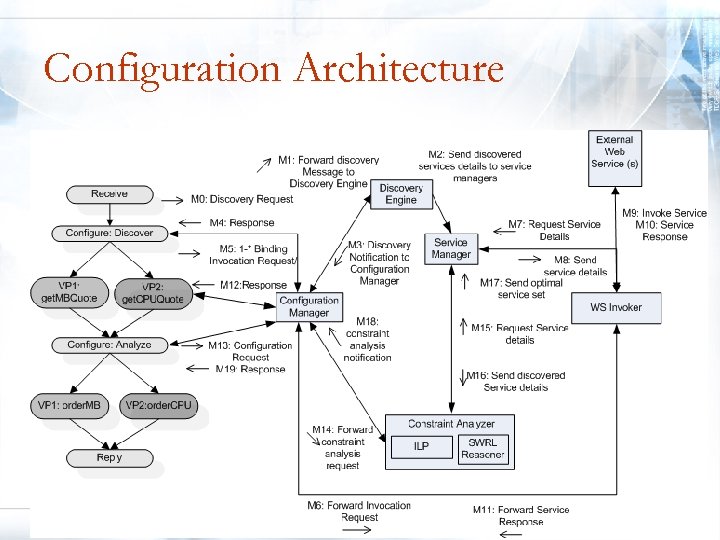
Configuration Architecture
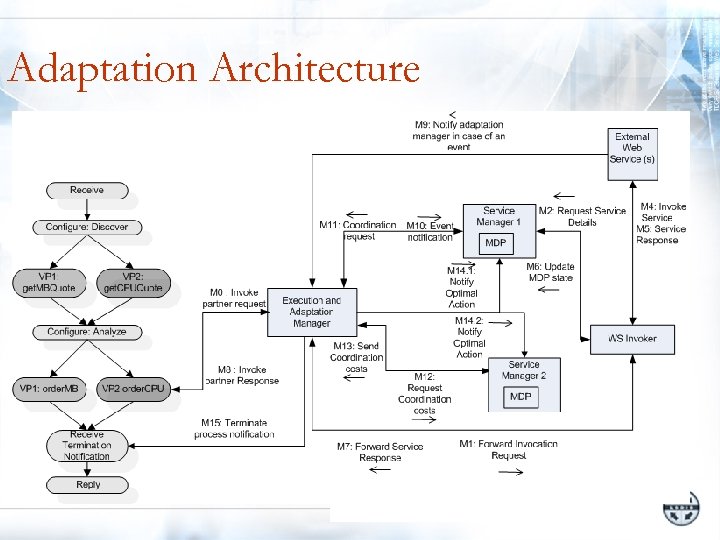
Adaptation Architecture
Conclusions, Related Work and Future Agenda
Summary - Dynamic Process Configuration • Showed how domain knowledge in ontologies can be used with ILP for configuration • Multi-paradigm approach for constraint analysis to handle broader set of constraints • In business and scientific processes, configuration is an important problem – Especially in WS based systems where businesses are seeking to create dynamic processes – This thesis is the first comprehensive work in this area.
Summary - Adaptation • Showed the utility of Markov Decision Processes for optimal adaptation of Web processes – Adaptation is need to handle logical failures and events – Whether to adapt or not depends on the cost of the failure • For this evaluation it was the cost of the delay • In the real world things often go wrong or not as expected – Earlier processes were static or real time events were not available as easily – Many researchers/industry vendors seeking to create adaptive business process frameworks – This is one of the first works that provides cost based adaptation
![Related Work • Semantic Web Services • Quality driven composition [1] • Support in](https://present5.com/presentation/c987b622f34ba1101d9b09b14dfc54fa/image-67.jpg "Related Work • Semantic Web Services • Quality driven composition [1] • Support in")
Related Work • Semantic Web Services • Quality driven composition [1] • Support in Websphere [2] and Oracle BPEL Engine for runtime binding. • Automated workflow composition – OWL-S, WSMO, FLOWS – Uses ILP for optimizing processes – Our work uses a multi-paradigm approach to considering a broader set of constraints – Based on replacing services with same interfaces. Service selection is not the focus – Our focus is on finding optimal services based on process constraints – Plethora of work based on automatically generating processes based on high level goals. [3] – Our focus is on configuring pre-existing processes. [1] L. Zeng, B. Benatallah, M. Dumas, J. Kalagnanam, Q. Sheng: Quality driven Web services composition, WWW 2003 [2] Dynamic service binding with Web. Sphere Process Choreographer, http: //www 128. ibm. com/developerworks/webservices/library/ws-dbind/ [3] J. Rao and X. Su. "A Survey of Automated Web Service Composition Methods". SWSWPC 2004.
![Related work • Focus on correctness of changes to control flow structure – Adept[1],](https://present5.com/presentation/c987b622f34ba1101d9b09b14dfc54fa/image-68.jpg "Related work • Focus on correctness of changes to control flow structure – Adept[1],")
Related work • Focus on correctness of changes to control flow structure – Adept[1], Workflow inheritance [2], METEOR • Use of ECA rules [3] to automatically make changes • Change of service providers based on migration rules in EFlow [4] • We extend previous work in this area by using: – Cost based adaptation – Coordination Constraints across services [1] M. Reichert and P. Dadam. Adeptflex-supporting dynamic changes of workflows without losing control. Journal of Intelligent Information Systems, 10(2): 93– 129, 1998 [2] W. van der Aalst and T. Basten. Inheritance of workflows: an approach to tackling problems related to change. Theoretical Computer Science, 270(1 -2): 125– 203, 2002. [3] R. Muller, U. Greiner, and E. Rahm. Agentwork: a workflow system supporting rule-based workflow adaptation. Journal of Data and Knowledge Engineering, 51(2): 223– 256, 2004. [4] Fabio Casati, Ski Ilnicki, Li-jie Jin, Vasudev Krishnamoorthy, Ming-Chien Shan: Adaptive and Dynamic Service Composition in e. Flow. CAi. SE 2000: 13 -31
Future Work • To apply this framework to more business and scientific problems • Study impact of ubiquitous computing (especially event generation) on dynamic process configuration • Move towards autonomic Web processes
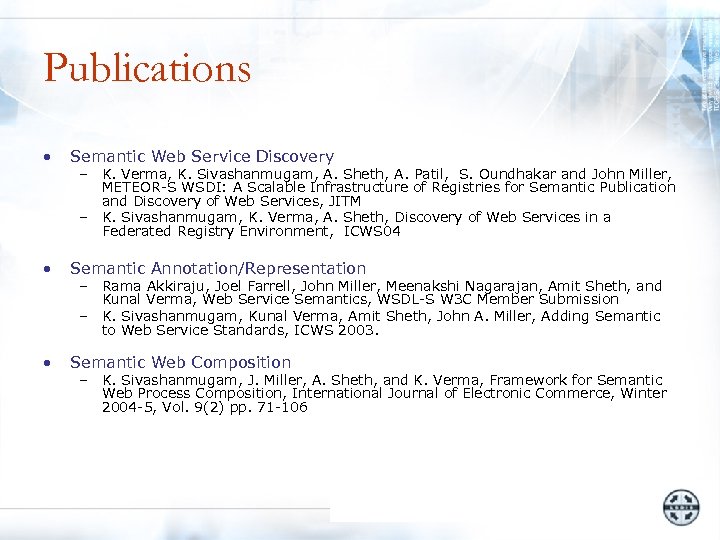
Publications • Dynamic Process Configuration • Adaptation • Semantic Policy/SLA Representation and Matching – K. Verma, R. Akkiraju, R. Goodwin, P. Doshi, J. Lee, On Accommodating Inter Service Dependencies in Web Process Flow Composition, Proceedings of the AAAI Spring Symposium on Semantic Web Services, March, 2004, pp. 37 -43 – R. Aggarwal, K. Verma, J. A. Miller, Constraint Driven Composition in METEOR-S, SCC 2004. – K. Verma, K. Gomadam, J. Miller and A. Sheth, Configuration and Execution of Dynamic Web Processes, LSDIS Lab Technical Report, 2005. – K. Verma, A. Sheth, Autonomic Web Processes, ICSOC 2005 – K. Verma, P. Doshi, K. Gomadam, A. Sheth, J. Miller, Optimal Adaptation of Web Processes with Co-ordination Constraints, ICWS 2006. – K. Verma, R. Akkiraju, R. Goodwin, Semantic Matching of Web Service Policies SDWP 2005 & Filed Patent – N. Oldham, K. Verma, A. Sheth, Semantic WS-Agreement Based Partner Selection, WWW 2006 (nominated for best student paper)
Publications • Semantic Web Service Discovery • Semantic Annotation/Representation • Semantic Web Composition – K. Verma, K. Sivashanmugam, A. Sheth, A. Patil, S. Oundhakar and John Miller, METEOR-S WSDI: A Scalable Infrastructure of Registries for Semantic Publication and Discovery of Web Services, JITM – K. Sivashanmugam, K. Verma, A. Sheth, Discovery of Web Services in a Federated Registry Environment, ICWS 04 – Rama Akkiraju, Joel Farrell, John Miller, Meenakshi Nagarajan, Amit Sheth, and Kunal Verma, Web Service Semantics, WSDL-S W 3 C Member Submission – K. Sivashanmugam, Kunal Verma, Amit Sheth, John A. Miller, Adding Semantic to Web Service Standards, ICWS 2003. – K. Sivashanmugam, J. Miller, A. Sheth, and K. Verma, Framework for Semantic Web Process Composition, International Journal of Electronic Commerce, Winter 2004 -5, Vol. 9(2) pp. 71 -106
Backup Slides
Semantics for Web Services and Processes • Functional and Data Semantics • Non-Functional Semantics – – Service (WSDL-S)[1] Policies (Define tags to capture semantic information 2]) • – Business Level Policies, Process Level Policies, Instance Level Policies Individual Component Level Policy Agreements (SWAPS) [3] • Execution Semantics • Ontologies – – State Transitions based on exceptions/failures Process (BPEL + Semantic Templates) [4] Domain Specific Ontologies – Rosetta. Net, SUMO Finance Domain Independent/Upper Ontologies [1] Web Service Semantics – WSDL-S, W 3 C Member Submission. , http: //www. w 3. org/Submission/WSDL-S/ [2] K. Verma, R. Akkiraju, R. Goodwin, Semantic matching of Web service policies, SDWP, 2005 [3] N. Oldham, K. Verma, A. Sheth, Semantic WS-Agreement Partner, WWW 2006 [4] K. Sivashanmugam, J. Miller, A. Sheth, and K. Verma, Framework for Semantic Web Process Composition, IJEC, 2004
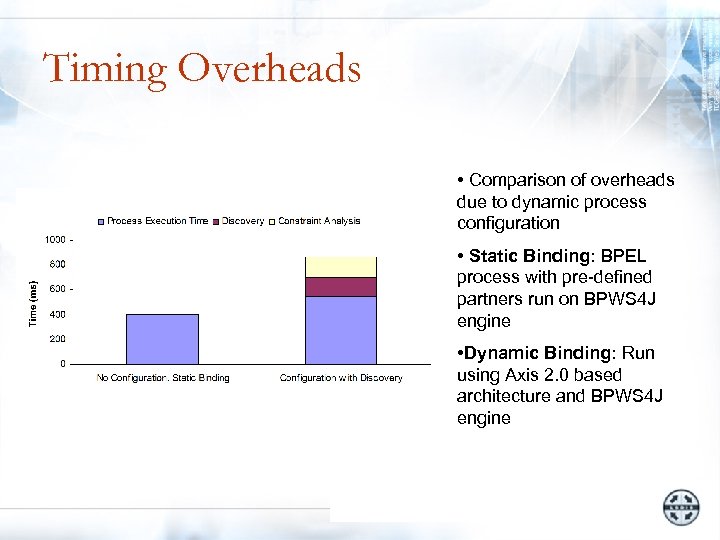
Timing Overheads • Comparison of overheads due to dynamic process configuration • Static Binding: BPEL process with pre-defined partners run on BPWS 4 J engine • Dynamic Binding: Run using Axis 2. 0 based architecture and BPWS 4 J engine

Convergence of Value Function
Marginalizing events
Hybrid Approach
State Generation Algorithm
Semantic Publication and Template Based Discovery Use of ontologies enables shared understanding between the service provider and service requestor For simplicity of depicting, the ontology is shown with classes for both operation and data Adding Semantics to Web Services Standards
Syntactic, Qo. S, and Semantic (Functional & Data) Similarity Syntactic Similarity ? Name, Description, … A B C Name, X Description, Y …. Web Service Discovery Web Service Similarity ? Qo. S Similarity Buy A B C X Y Web Service Calendar-Date A 1 … … Web Service Similarity ? Event … A 2 Purchase Web Service Functional & Data Similarity {x, Coordinates y} Area {name} Web Service Qo. S Information Function Forrest Get Information Get Date
METEOR-S Web Service Discovery Infrastructure (MWSDI) • MWSDI deals with adding semantics to UDDI registries • Provides transparent access to UDDI registries based on their domain or federation • Implementation of UDDI Best Practices and Semantic Discovery 1 http: //lsdis. cs. uga. edu/Projects/METEOR-S
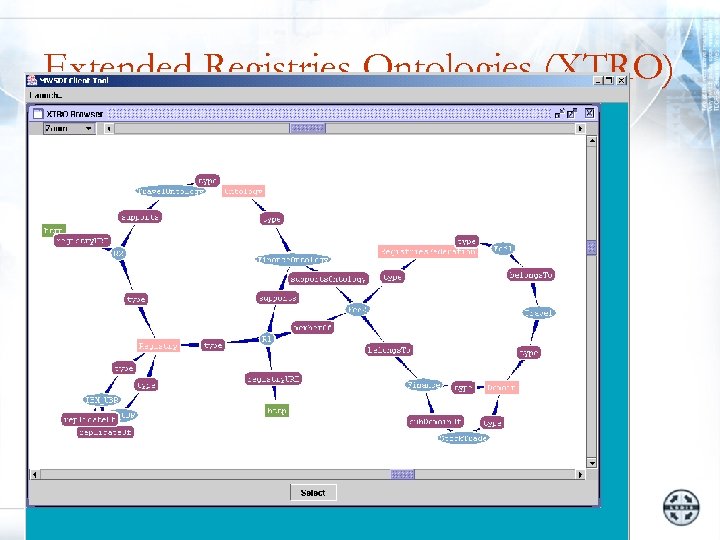
Extended Registries Ontologies (XTRO) • Provides a multifaceted view of all registries in MWSDI – Federations – Domains – Registries Registry Federation belongs. To Registry supports Domain sub. Domain. Of Ontology consists. Of
Variations in Chinese and Taiwanese Currency Source for graphs and data: www. x-rates. com
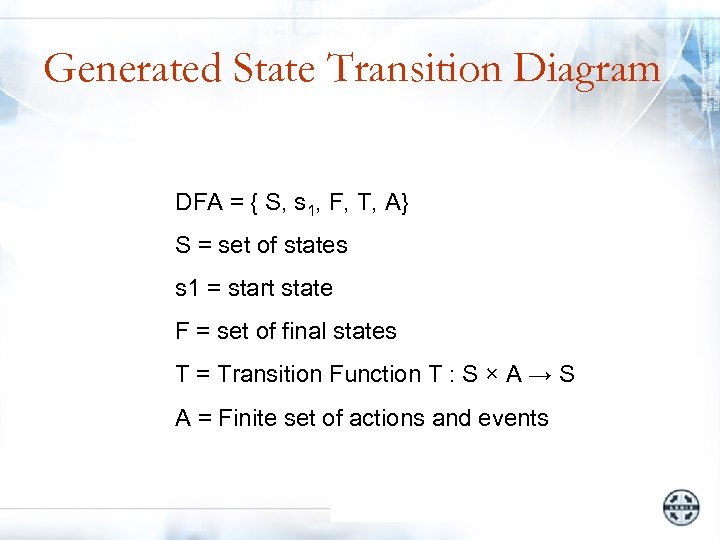
Generated State Transition Diagram DFA = { S, s 1, F, T, A} S = set of states s 1 = start state F = set of final states T = Transition Function T : S × A → S A = Finite set of actions and events
Скачать презентацию Configuration and Adaptation of Semantic Web Processes Kunal
c987b622f34ba1101d9b09b14dfc54fa.ppt