 Скачать презентацию Confidential Presentation to Kellogg Business School Anatomy of
848a95ae35cd6b4a7c80ccc23f797f13.ppt
- Количество слайдов: 37



Confidential Presentation to: Kellogg Business School Anatomy of a Credit Collapse The Market and Macro Economic Fallout of the Sub Prime Mess Lehman Brothers MBS and Rates Research November 13 th, 2007
Agenda u. Laying the blame – Underwriting practices – The changing intermediation process u Reaping the whirlwind – The magnitude of losses – The entities at risk – ABCP and SIVs u Will bank losses exacerbate the economic weakness?

The Altered Origination Landscape
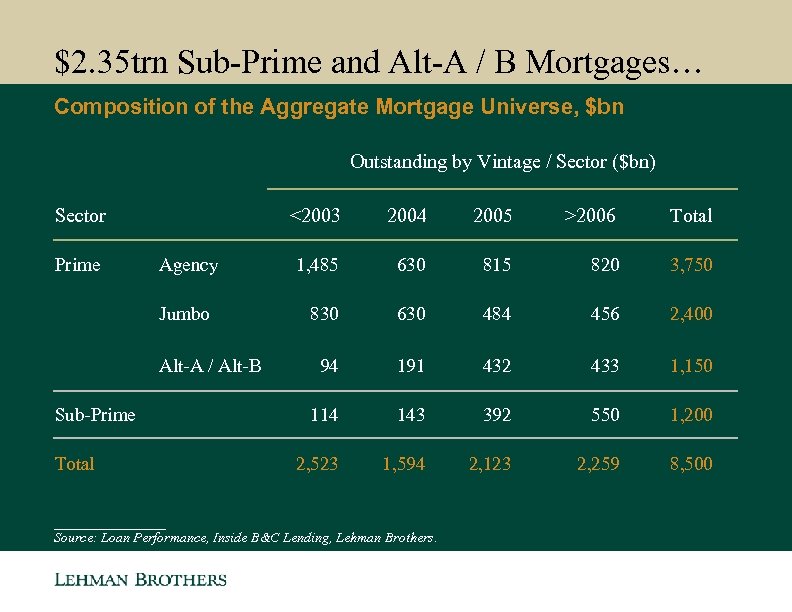
$2. 35 trn Sub-Prime and Alt-A / B Mortgages… Composition of the Aggregate Mortgage Universe, $bn Outstanding by Vintage / Sector ($bn) Sector Prime Agency Jumbo Alt-A / Alt-B Sub-Prime Total <2003 2004 2005 >2006 Total 1, 485 630 815 820 3, 750 830 630 484 456 2, 400 94 191 432 433 1, 150 114 143 392 550 1, 200 2, 523 1, 594 2, 123 2, 259 8, 500 ________ Source: Loan Performance, Inside B&C Lending, Lehman Brothers. 1
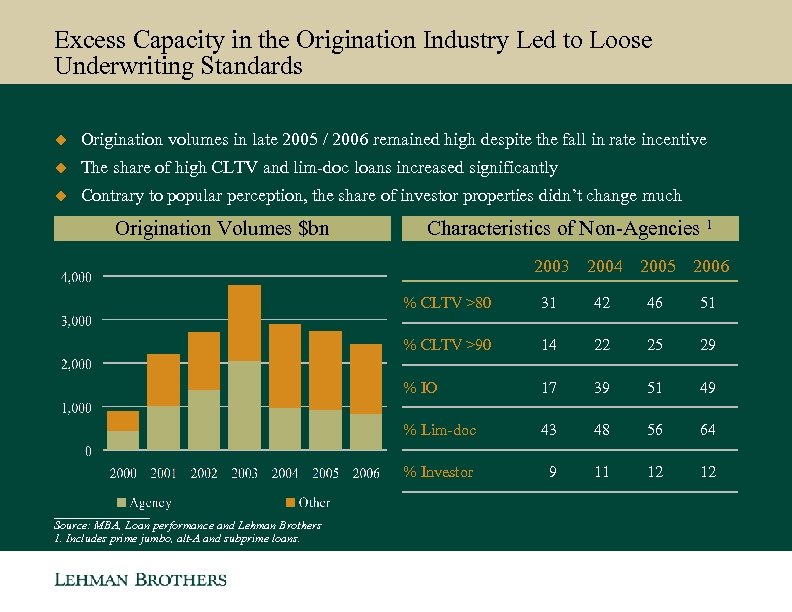
Excess Capacity in the Origination Industry Led to Loose Underwriting Standards u Origination volumes in late 2005 / 2006 remained high despite the fall in rate incentive u The share of high CLTV and lim-doc loans increased significantly u Contrary to popular perception, the share of investor properties didn’t change much Origination Volumes $bn Characteristics of Non-Agencies 1 2003 2004 2005 2006 % CLTV >80 46 51 14 22 25 29 % IO 17 39 51 49 % Lim-doc 43 48 56 64 % Investor 2 42 % CLTV >90 ________ Source: MBA, Loan performance and Lehman Brothers 1. Includes prime jumbo, alt-A and subprime loans. 31 9 11 12 12
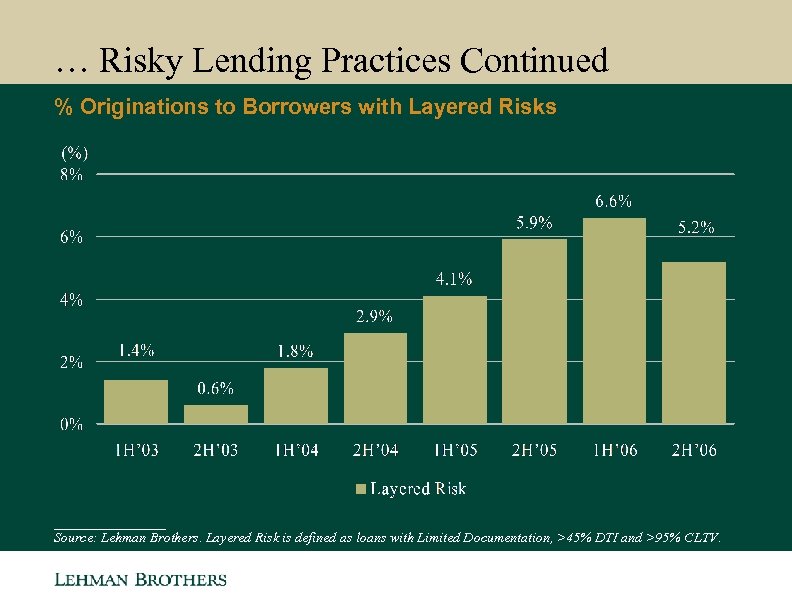
… Risky Lending Practices Continued % Originations to Borrowers with Layered Risks ________ Source: Lehman Brothers. Layered Risk is defined as loans with Limited Documentation, >45% DTI and >95% CLTV. 3
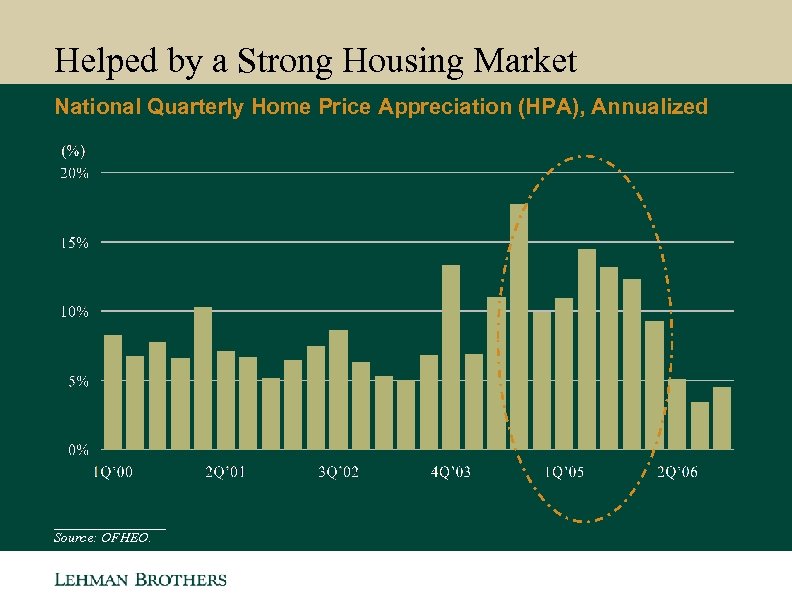
Helped by a Strong Housing Market National Quarterly Home Price Appreciation (HPA), Annualized ________ Source: OFHEO. 4
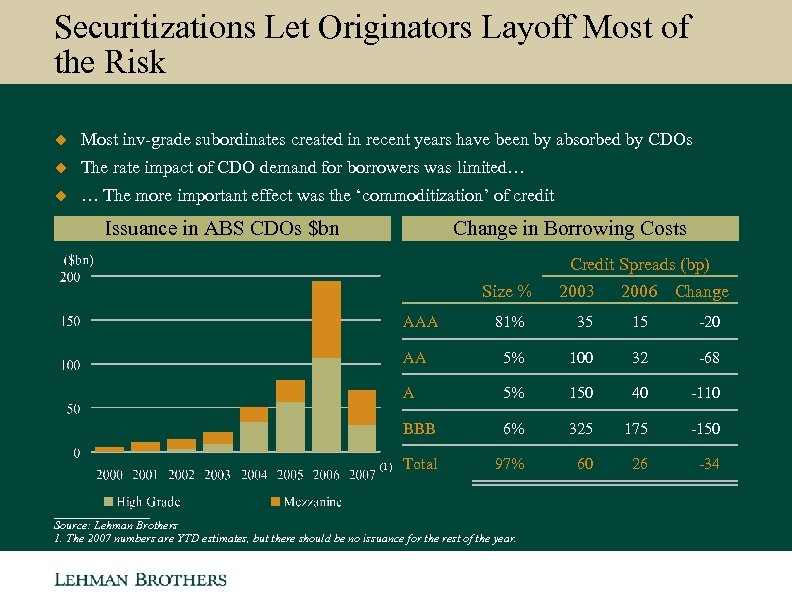
Securitizations Let Originators Layoff Most of the Risk u Most inv-grade subordinates created in recent years have been by absorbed by CDOs u The rate impact of CDO demand for borrowers was limited… u … The more important effect was the ‘commoditization’ of credit Issuance in ABS CDOs $bn Change in Borrowing Costs Size % AAA Credit Spreads (bp) 2003 2006 Change 35 15 -20 AA 5% 100 32 -68 A 5% 150 40 -110 BBB 6% 325 175 -150 Total (1) 81% 97% 60 26 -34 ________ Source: Lehman Brothers 1. The 2007 numbers are YTD estimates, but there should be no issuance for the rest of the year. 5
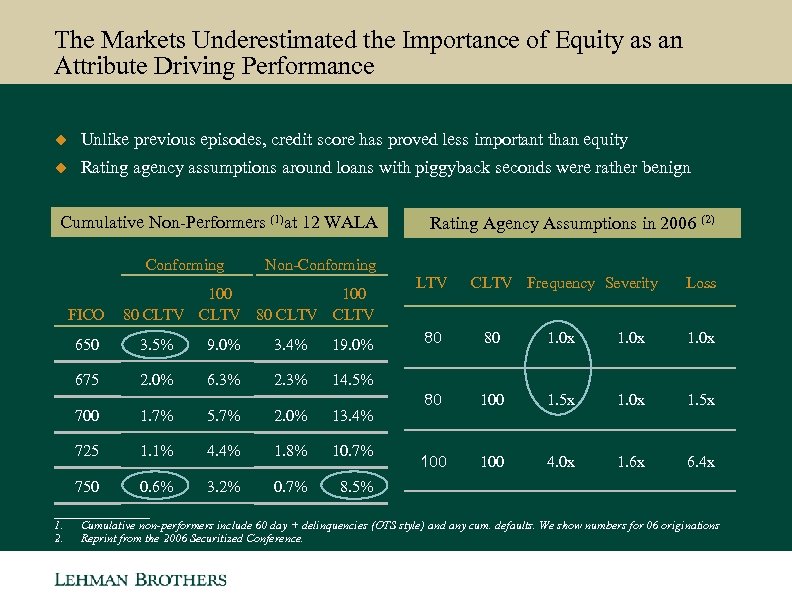
The Markets Underestimated the Importance of Equity as an Attribute Driving Performance u Unlike previous episodes, credit score has proved less important than equity u Rating agency assumptions around loans with piggyback seconds were rather benign Cumulative Non-Performers (1)at 12 WALA FICO Conforming Rating Agency Assumptions in 2006 (2) Non-Conforming LTV 100 80 CLTV 650 3. 5% 9. 0% 3. 4% 2. 0% 6. 3% 2. 3% Loss 80 80 1. 0 x 80 100 1. 5 x 1. 0 x 1. 5 x 100 19. 0% 675 CLTV Frequency Severity 100 4. 0 x 1. 6 x 6. 4 x 14. 5% 700 1. 7% 5. 7% 2. 0% 13. 4% 725 1. 1% 4. 4% 1. 8% 10. 7% 750 0. 6% 3. 2% 0. 7% 8. 5% ________ 1. Cumulative non-performers include 60 day + delinquencies (OTS style) and any cum. defaults. We show numbers for 06 originations 2. Reprint from the 2006 Securitized Conference. 6
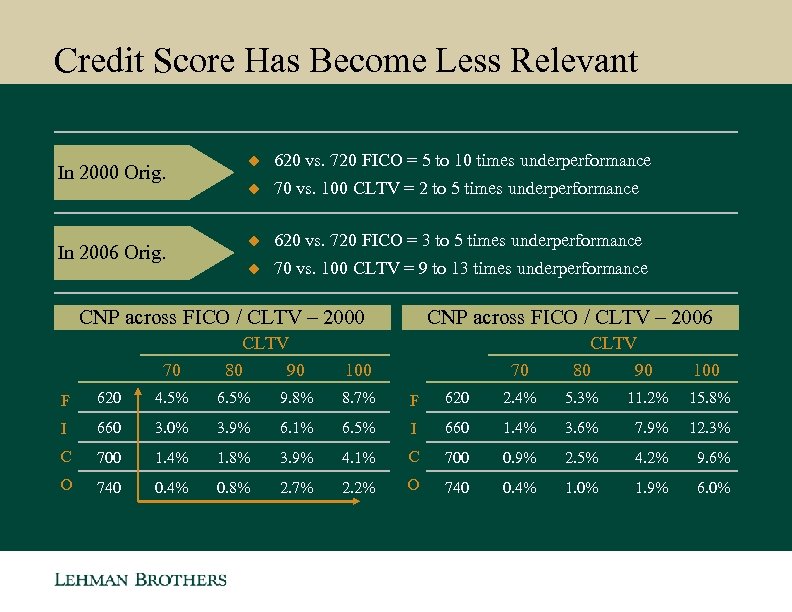
Credit Score Has Become Less Relevant In 2000 Orig. In 2006 Orig. u 620 vs. 720 FICO = 5 to 10 times underperformance u 70 vs. 100 CLTV = 2 to 5 times underperformance u 620 vs. 720 FICO = 3 to 5 times underperformance u 70 vs. 100 CLTV = 9 to 13 times underperformance CNP across FICO / CLTV – 2000 70 CLTV 80 90 CNP across FICO / CLTV – 2006 100 70 CLTV 80 90 100 F 620 4. 5% 6. 5% 9. 8% 8. 7% F 620 2. 4% 5. 3% 11. 2% 15. 8% I 660 3. 0% 3. 9% 6. 1% 6. 5% I 660 1. 4% 3. 6% 7. 9% 12. 3% C 700 1. 4% 1. 8% 3. 9% 4. 1% C 700 0. 9% 2. 5% 4. 2% 9. 6% O 740 0. 4% 0. 8% 2. 7% 2. 2% O 740 0. 4% 1. 0% 1. 9% 6. 0% 12
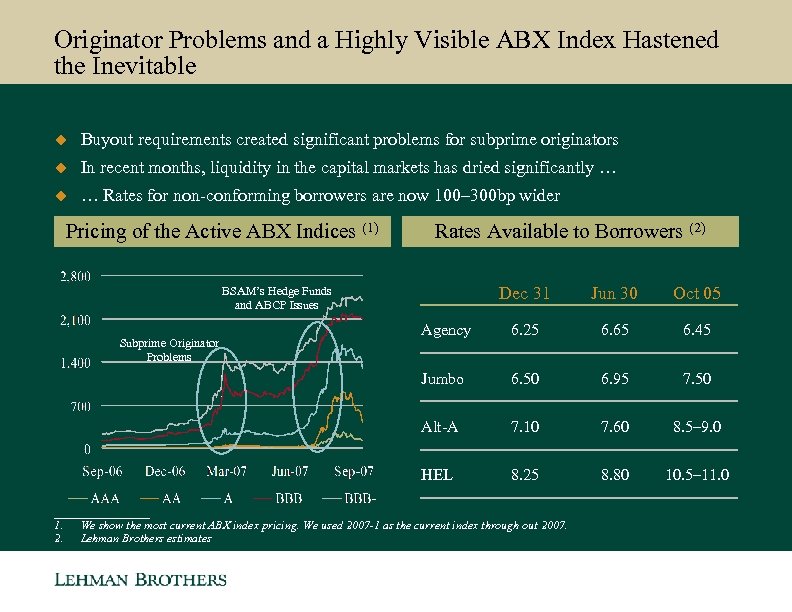
Originator Problems and a Highly Visible ABX Index Hastened the Inevitable u Buyout requirements created significant problems for subprime originators u In recent months, liquidity in the capital markets has dried significantly … u … Rates for non-conforming borrowers are now 100– 300 bp wider Pricing of the Active ABX Indices (1) Rates Available to Borrowers (2) Dec 31 Jun 30 Oct 05 Agency 6. 25 6. 65 6. 45 Jumbo 6. 50 6. 95 7. 50 Alt-A 7. 10 7. 60 8. 5– 9. 0 HEL 8. 25 8. 80 10. 5– 11. 0 BSAM’s Hedge Funds and ABCP Issues Subprime Originator Problems ________ 1. We show the most current ABX index pricing. We used 2007 -1 as the current index through out 2007. 2. Lehman Brothers estimates 7

CDOs – the New Intermediation Technology
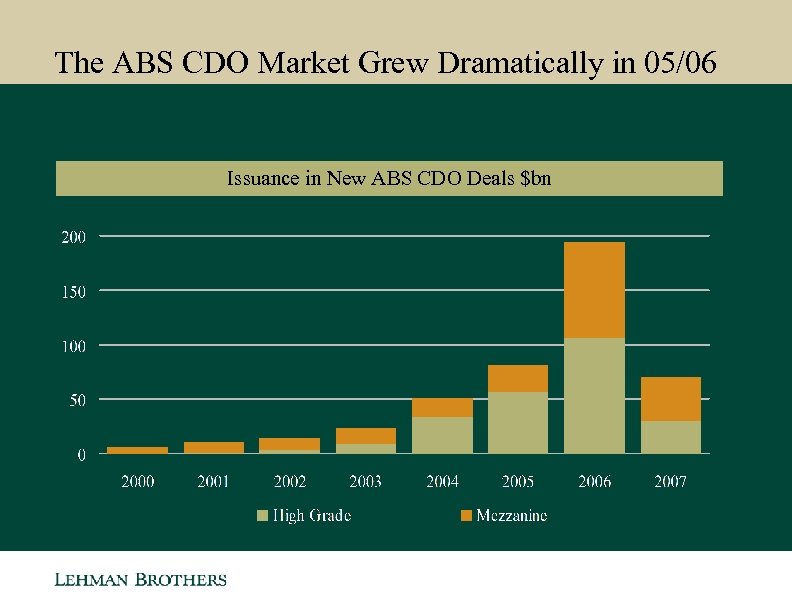
The ABS CDO Market Grew Dramatically in 05/06 Issuance in New ABS CDO Deals $bn 11
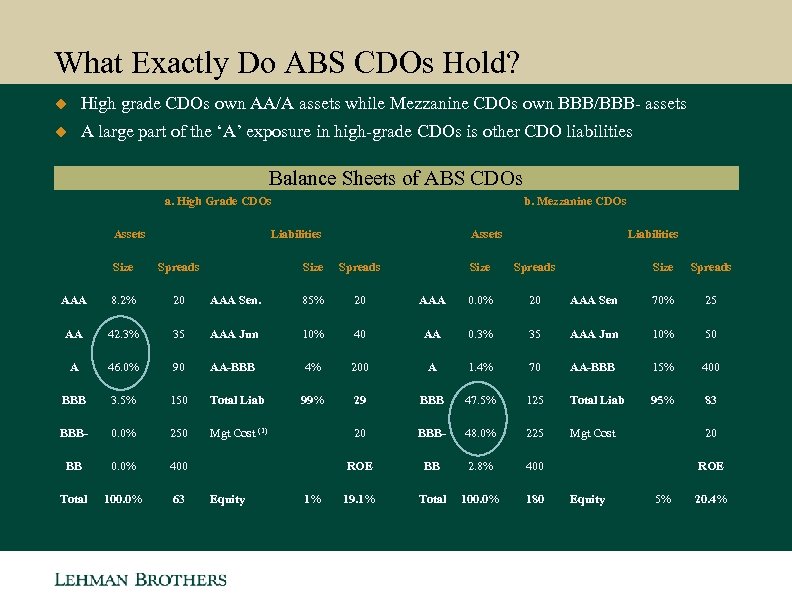
What Exactly Do ABS CDOs Hold? u High grade CDOs own AA/A assets while Mezzanine CDOs own BBB/BBB- assets u A large part of the ‘A’ exposure in high-grade CDOs is other CDO liabilities Balance Sheets of ABS CDOs a. High Grade CDOs Assets b. Mezzanine CDOs Liabilities Size Spreads AAA 8. 2% 20 AA 42. 3% A Assets Size Spreads AAA Sen. 85% 20 35 AAA Jun 10% 46. 0% 90 AA-BBB 3. 5% 150 Total Liab BBB- 0. 0% 250 Mgt Cost (1) BB 0. 0% 400 Total 100. 0% 63 Liabilities Spreads AAA 0. 0% 20 40 AA 0. 3% 4% 200 A 99% 29 Spreads AAA Sen 70% 25 35 AAA Jun 10% 50 1. 4% 70 AA-BBB 15% 400 BBB 47. 5% 125 Total Liab 95% 83 20 1% Size BBB- 48. 0% 225 Mgt Cost ROE Equity Size BB 2. 8% 400 19. 1% Total 100. 0% 180 12 20 ROE Equity 5% 20. 4%
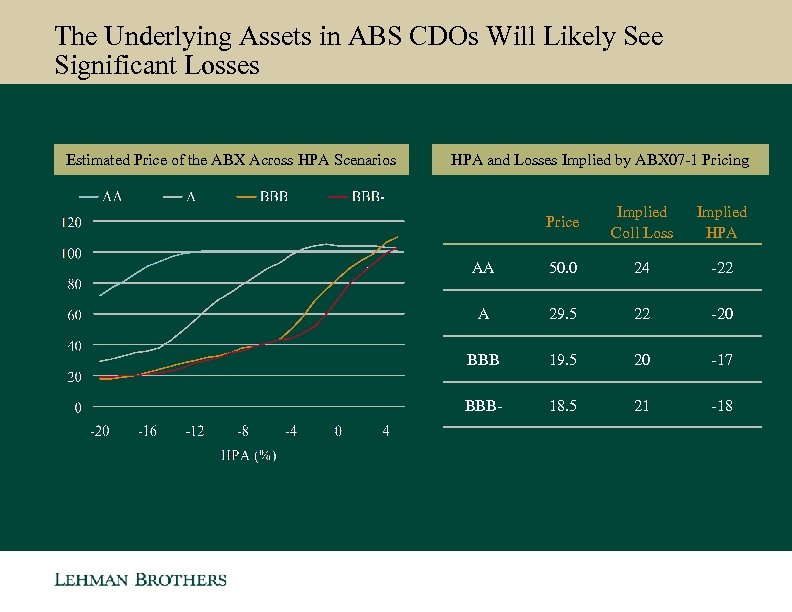
The Underlying Assets in ABS CDOs Will Likely See Significant Losses Estimated Price of the ABX Across HPA Scenarios HPA and Losses Implied by ABX 07 -1 Pricing Price Implied HPA AA 50. 0 24 -22 A 29. 5 22 -20 BBB 19. 5 20 -17 BBB- 13 Implied Coll Loss 18. 5 21 -18
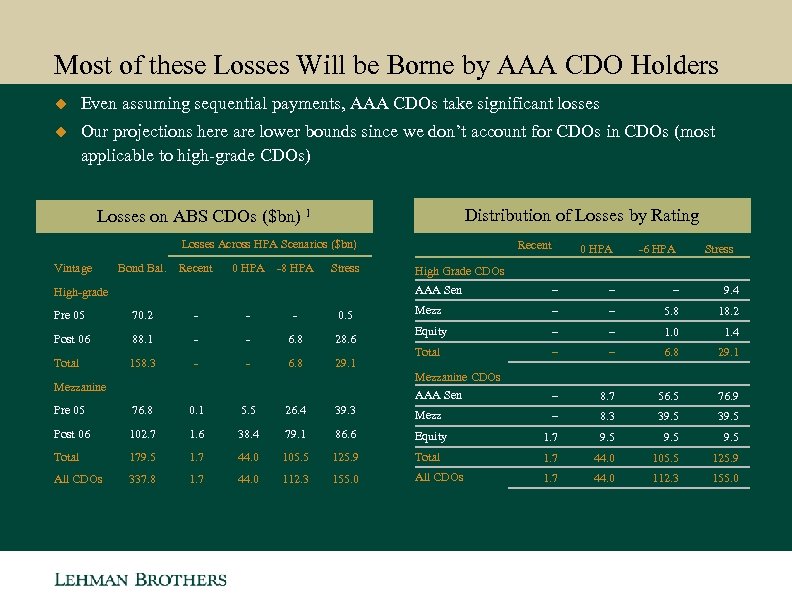
Most of these Losses Will be Borne by AAA CDO Holders u Even assuming sequential payments, AAA CDOs take significant losses u Our projections here are lower bounds since we don’t account for CDOs in CDOs (most applicable to high-grade CDOs) Distribution of Losses by Rating Losses on ABS CDOs ($bn) 1 Losses Across HPA Scenarios ($bn) Vintage Bond Bal. Recent 0 HPA -8 HPA Recent Stress 0 HPA -6 HPA Stress High Grade CDOs AAA Sen 70. 2 - - - Post 06 88. 1 - - 6. 8 Total 158. 3 - - 6. 8 29. 1 9. 4 – – 5. 8 18. 2 – – 1. 0 1. 4 Total 28. 6 – Equity 0. 5 – – – 6. 8 29. 1 AAA Sen Pre 05 – Mezz High-grade – 8. 7 56. 5 76. 9 – 8. 3 39. 5 Mezzanine CDOs Mezzanine Pre 05 76. 8 0. 1 5. 5 26. 4 39. 3 Mezz Post 06 102. 7 1. 6 38. 4 79. 1 86. 6 Equity 1. 7 9. 5 Total 179. 5 1. 7 44. 0 105. 5 125. 9 Total 1. 7 44. 0 105. 5 125. 9 All CDOs 337. 8 1. 7 44. 0 112. 3 155. 0 All CDOs 1. 7 44. 0 112. 3 155. 0 14
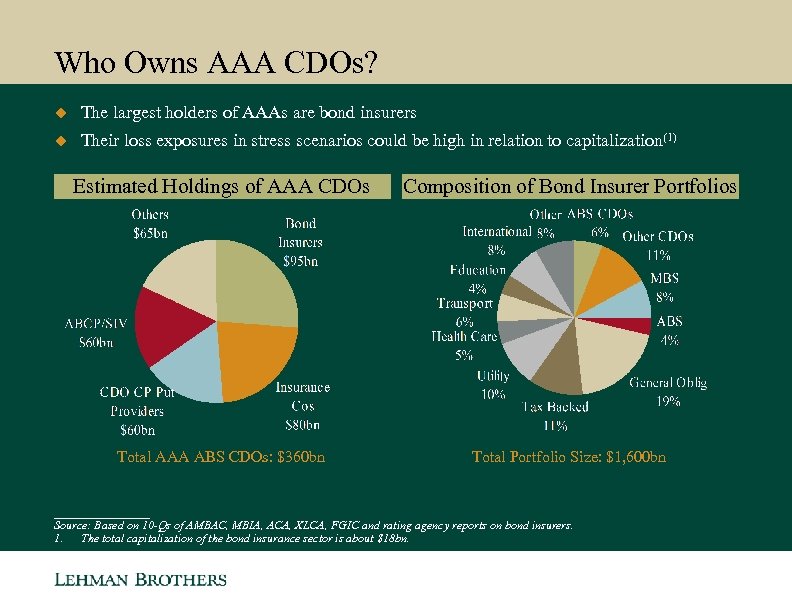
Who Owns AAA CDOs? u The largest holders of AAAs are bond insurers u Their loss exposures in stress scenarios could be high in relation to capitalization (1) Estimated Holdings of AAA CDOs Composition of Bond Insurer Portfolios Total AAA ABS CDOs: $360 bn Total Portfolio Size: $1, 600 bn ________ Source: Based on 10 -Qs of AMBAC, MBIA, ACA, XLCA, FGIC and rating agency reports on bond insurers. 1. The total capitalization of the bond insurance sector is about $18 bn. 15

Who will Eat the Loss?
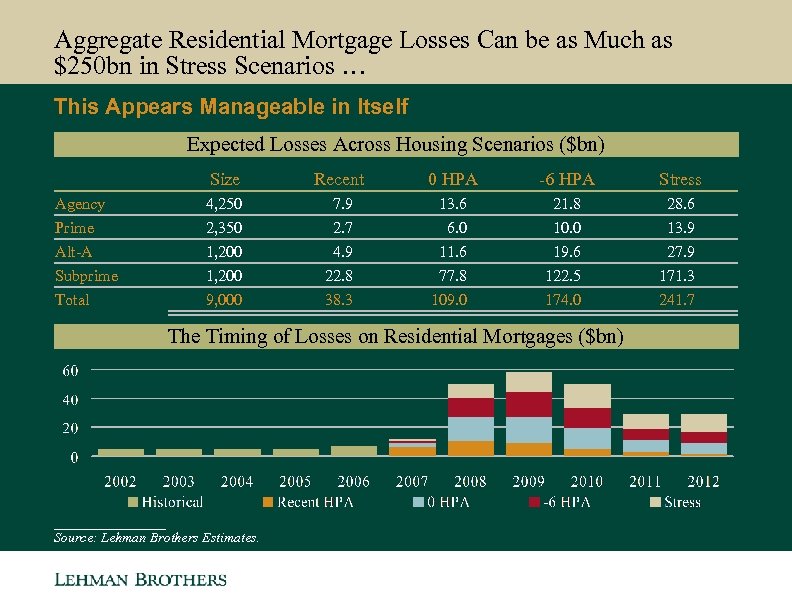
Aggregate Residential Mortgage Losses Can be as Much as $250 bn in Stress Scenarios … This Appears Manageable in Itself Expected Losses Across Housing Scenarios ($bn) Size Recent 0 HPA -6 HPA Stress Agency Prime 4, 250 2, 350 7. 9 2. 7 13. 6 6. 0 21. 8 10. 0 28. 6 13. 9 Alt-A Subprime Total 1, 200 9, 000 4. 9 22. 8 38. 3 11. 6 77. 8 109. 0 19. 6 122. 5 174. 0 27. 9 171. 3 241. 7 The Timing of Losses on Residential Mortgages ($bn) ________ Source: Lehman Brothers Estimates. 8
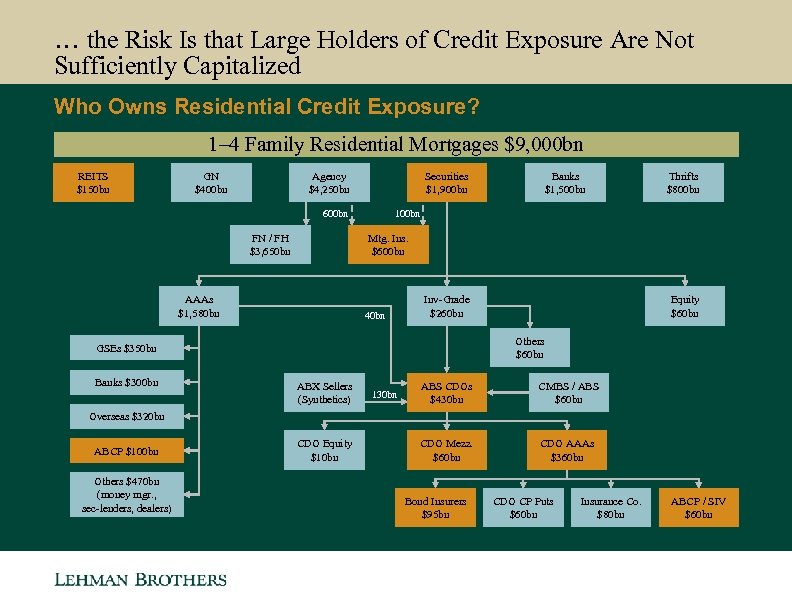
… the Risk Is that Large Holders of Credit Exposure Are Not Sufficiently Capitalized Who Owns Residential Credit Exposure? 1– 4 Family Residential Mortgages $9, 000 bn REITS $150 bn GN $400 bn Agency $4, 250 bn Securities $1, 900 bn 600 bn FN / FH $3, 650 bn Thrifts $800 bn 100 bn Mtg. Ins. $600 bn AAAs $1, 580 bn Inv-Grade $260 bn 40 bn Equity $60 bn Others $60 bn GSEs $350 bn Banks $300 bn Banks $1, 500 bn ABX Sellers (Synthetics) ABS CDOs $430 bn CMBS / ABS $60 bn CDO Mezz. $60 bn 130 bn CDO AAAs $360 bn Overseas $320 bn ABCP $100 bn CDO Equity $10 bn Others $470 bn (money mgr. , sec-lenders, dealers) Bond Insurers $95 bn 9 CDO CP Puts $60 bn Insurance Co. $80 bn ABCP / SIV $60 bn
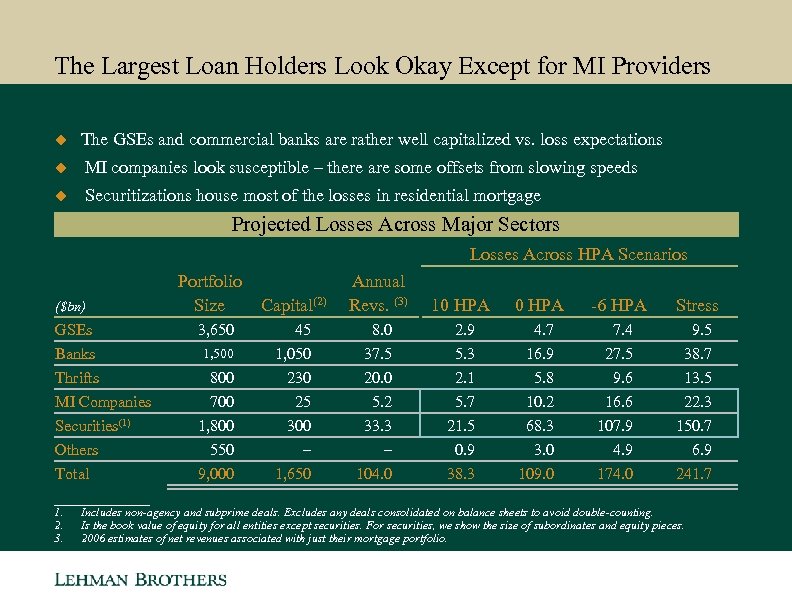
The Largest Loan Holders Look Okay Except for MI Providers u The GSEs and commercial banks are rather well capitalized vs. loss expectations u MI companies look susceptible – there are some offsets from slowing speeds u Securitizations house most of the losses in residential mortgage Projected Losses Across Major Sectors Losses Across HPA Scenarios ($bn) GSEs Banks Thrifts MI Companies Securities(1) Others Total Portfolio Annual Size Capital(2) Revs. (3) 3, 650 1, 500 800 700 1, 800 550 9, 000 45 1, 050 230 25 300 – 1, 650 8. 0 37. 5 20. 0 5. 2 33. 3 – 104. 0 10 HPA -6 HPA Stress 2. 9 5. 3 2. 1 5. 7 21. 5 0. 9 38. 3 4. 7 16. 9 5. 8 10. 2 68. 3 3. 0 109. 0 7. 4 27. 5 9. 6 16. 6 107. 9 4. 9 174. 0 9. 5 38. 7 13. 5 22. 3 150. 7 6. 9 241. 7 ________ 1. Includes non-agency and subprime deals. Excludes any deals consolidated on balance sheets to avoid double-counting. 2. Is the book value of equity for all entities except securities. For securities, we show the size of subordinates and equity pieces. 3. 2006 estimates of net revenues associated with just their mortgage portfolio. 10

ABCP Conduits and SIVs
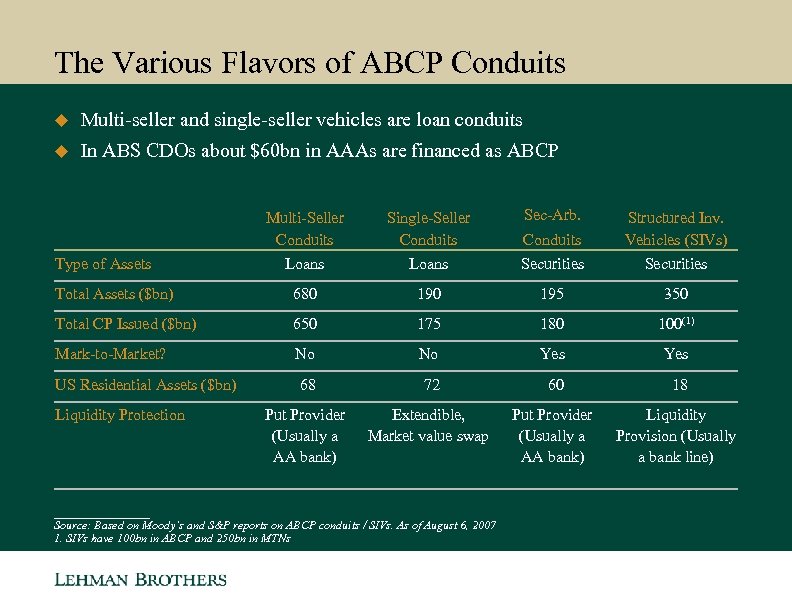
The Various Flavors of ABCP Conduits u Multi-seller and single-seller vehicles are loan conduits u In ABS CDOs about $60 bn in AAAs are financed as ABCP Sec-Arb. Multi-Seller Conduits Loans Single-Seller Conduits Loans Conduits Securities Structured Inv. Vehicles (SIVs) Securities Total Assets ($bn) 680 195 350 Total CP Issued ($bn) 650 175 180 100(1) Mark-to-Market? No No Yes 68 72 60 18 Put Provider (Usually a AA bank) Extendible, Market value swap Put Provider (Usually a AA bank) Liquidity Provision (Usually a bank line) Type of Assets US Residential Assets ($bn) Liquidity Protection ________ Source: Based on Moody’s and S&P reports on ABCP conduits / SIVs. As of August 6, 2007 1. SIVs have 100 bn in ABCP and 250 bn in MTNs 16
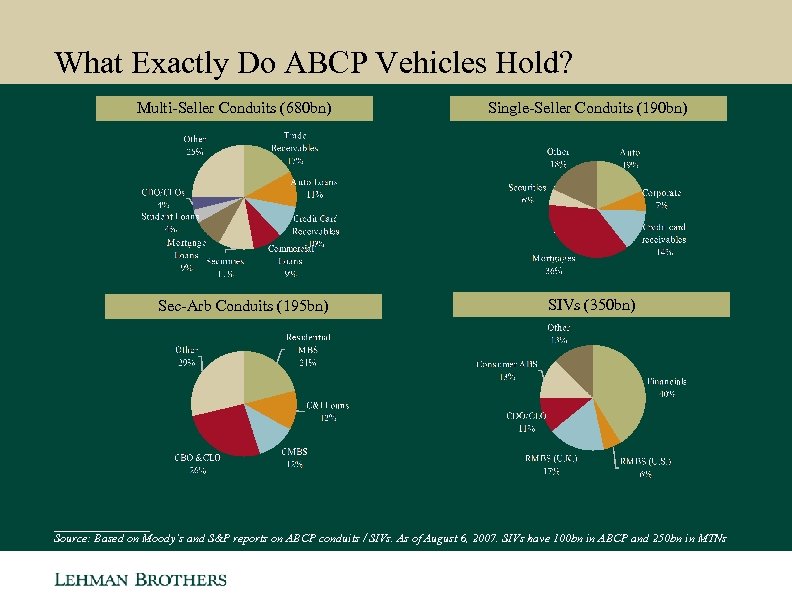
What Exactly Do ABCP Vehicles Hold? Multi-Seller Conduits (680 bn) Single-Seller Conduits (190 bn) SIVs (350 bn) Sec-Arb Conduits (195 bn) ________ Source: Based on Moody’s and S&P reports on ABCP conduits / SIVs. As of August 6, 2007. SIVs have 100 bn in ABCP and 250 bn in MTNs 17
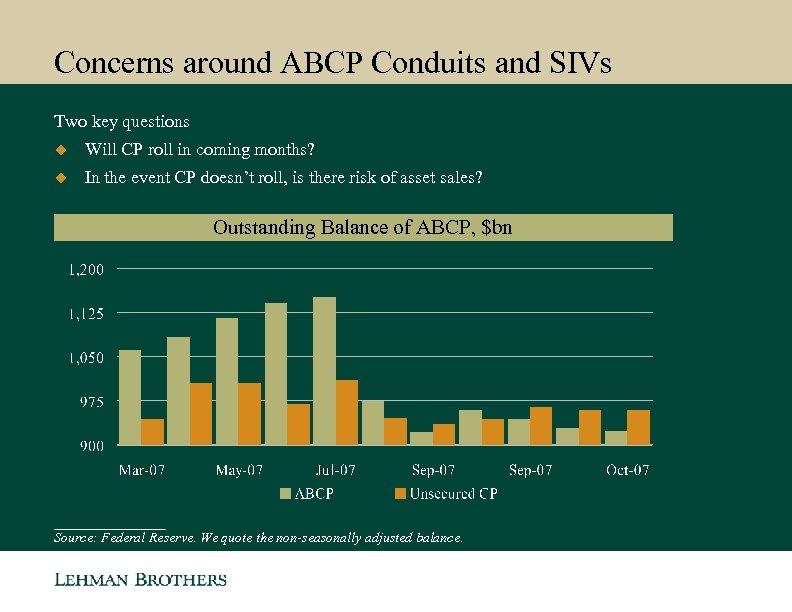
Concerns around ABCP Conduits and SIVs Two key questions u Will CP roll in coming months? u In the event CP doesn’t roll, is there risk of asset sales? Outstanding Balance of ABCP, $bn ________ Source: Federal Reserve. We quote the non-seasonally adjusted balance. 18
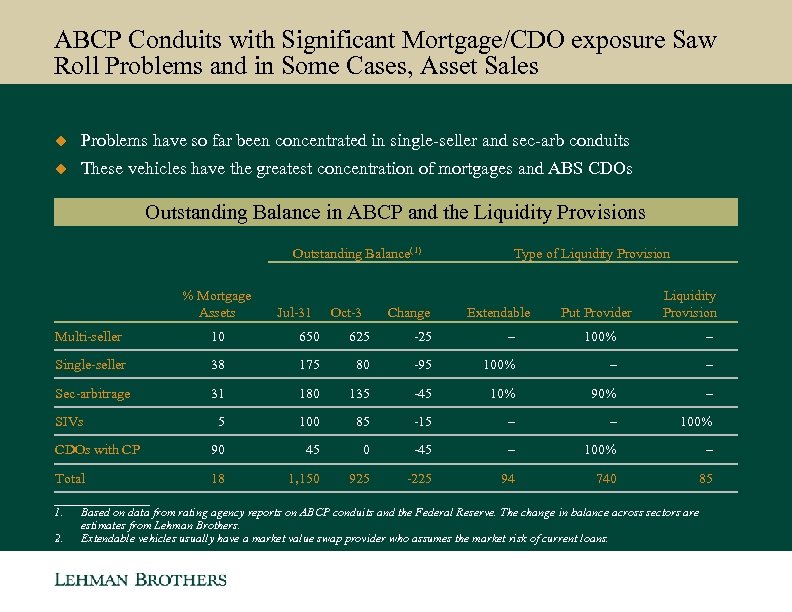
ABCP Conduits with Significant Mortgage/CDO exposure Saw Roll Problems and in Some Cases, Asset Sales u Problems have so far been concentrated in single-seller and sec-arb conduits u These vehicles have the greatest concentration of mortgages and ABS CDOs Outstanding Balance in ABCP and the Liquidity Provisions Outstanding Balance(1) % Mortgage Assets Jul-31 Oct-3 Change Type of Liquidity Provision Extendable Put Provider Liquidity Provision Multi-seller 10 650 625 -25 – 100% – Single-seller 38 175 80 -95 100% – – Sec-arbitrage 31 180 135 -45 10% 90% – 5 100 85 -15 – – 100% CDOs with CP 90 45 0 -45 – 100% – Total 18 1, 150 925 -225 94 740 85 SIVs ________ 1. Based on data from rating agency reports on ABCP conduits and the Federal Reserve. The change in balance across sectors are estimates from Lehman Brothers. 2. Extendable vehicles usually have a market value swap provider who assumes the market risk of current loans. 19
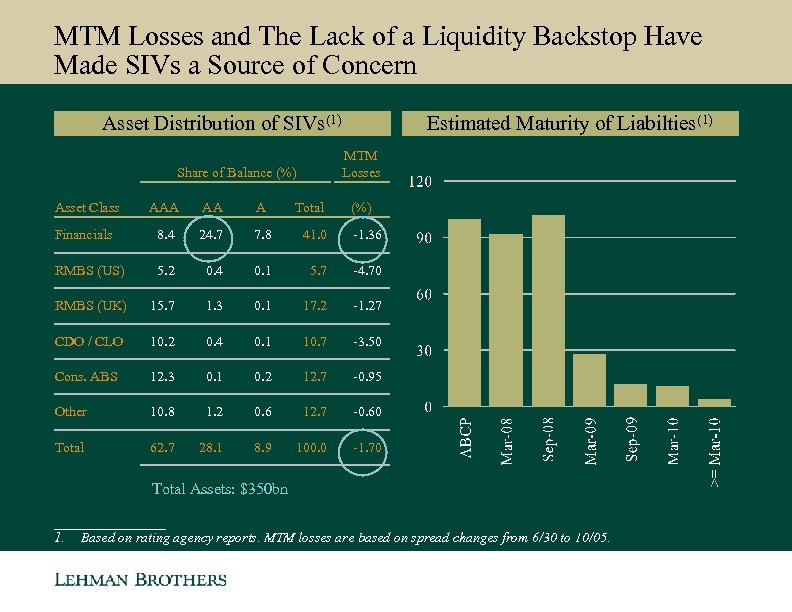
MTM Losses and The Lack of a Liquidity Backstop Have Made SIVs a Source of Concern Asset Distribution of SIVs(1) Estimated Maturity of Liabilties(1) MTM Losses Share of Balance (%) Asset Class AAA AA A Total (%) Financials 8. 4 24. 7 7. 8 41. 0 -1. 36 RMBS (US) 5. 2 0. 4 0. 1 5. 7 -4. 70 RMBS (UK) 15. 7 1. 3 0. 1 17. 2 -1. 27 CDO / CLO 10. 2 0. 4 0. 1 10. 7 -3. 50 Cons. ABS 12. 3 0. 1 0. 2 12. 7 -0. 95 Other 10. 8 1. 2 0. 6 12. 7 -0. 60 Total 62. 7 28. 1 8. 9 100. 0 -1. 70 Total Assets: $350 bn ________ 1. Based on rating agency reports. MTM losses are based on spread changes from 6/30 to 10/05. 20

Buyers of Last Resort : Do Banks have Enough Balance Sheet

FOMC September Meeting Minutes “…Given existing commitments to customers and the increased resistance of investors to purchasing some securitized products, banks might need to take a large volume of assets onto their balance sheets over coming weeks, including leveraged loans, asset-backed commercial paper, and some types of mortgages. Banks' concerns about the implications of rapid growth in their balance sheets for their capital ratios and for their liquidity, as well as the recent deterioration in various term funding markets, might well lead banks to tighten the availability of credit to households and firms…” 1
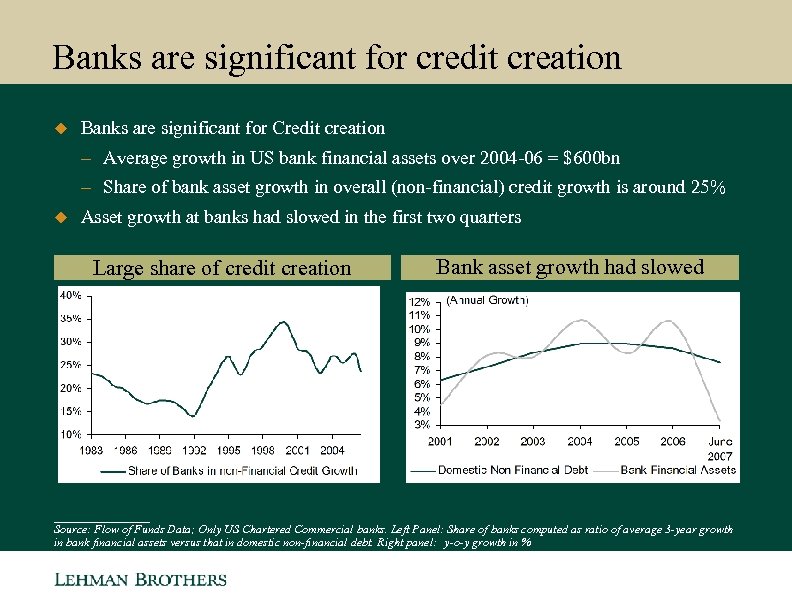
Banks are significant for credit creation u Banks are significant for Credit creation – Average growth in US bank financial assets over 2004 -06 = $600 bn – Share of bank asset growth in overall (non-financial) credit growth is around 25% u Asset growth at banks had slowed in the first two quarters Bank asset growth had slowed Large share of credit creation ________ Source: Flow of Funds Data; Only US Chartered Commercial banks. Left Panel: Share of banks computed as ratio of average 3 -year growth in bank financial assets versus that in domestic non-financial debt. Right panel: y-o-y growth in % 2
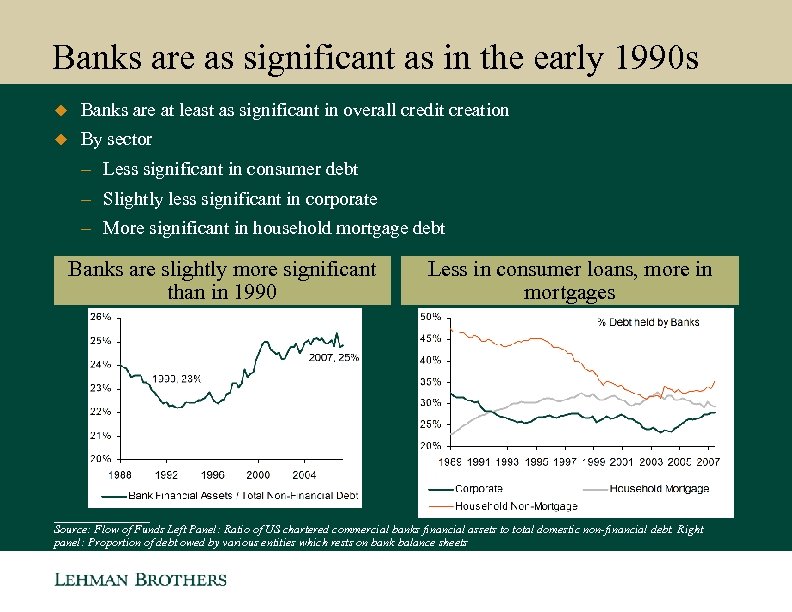
Banks are as significant as in the early 1990 s u Banks are at least as significant in overall credit creation u By sector – Less significant in consumer debt – Slightly less significant in corporate – More significant in household mortgage debt Banks are slightly more significant than in 1990 Less in consumer loans, more in mortgages ________ Source: Flow of Funds Left Panel: Ratio of US chartered commercial banks financial assets to total domestic non-financial debt. Right panel: Proportion of debt owed by various entities which rests on bank balance sheets 11
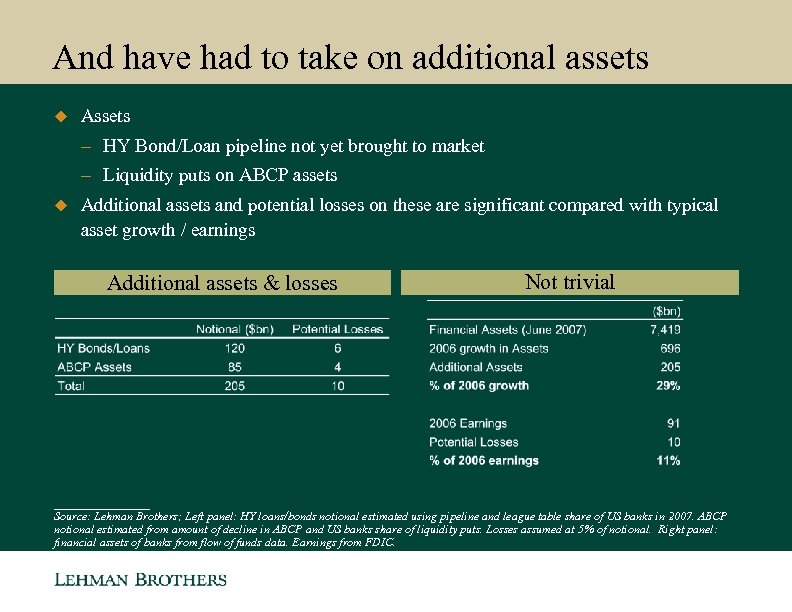
And have had to take on additional assets u Assets – HY Bond/Loan pipeline not yet brought to market – Liquidity puts on ABCP assets u Additional assets and potential losses on these are significant compared with typical asset growth / earnings Not trivial Additional assets & losses ________ Source: Lehman Brothers; Left panel: HY loans/bonds notional estimated using pipeline and league table share of US banks in 2007. ABCP notional estimated from amount of decline in ABCP and US banks share of liquidity puts. Losses assumed at 5% of notional. Right panel: financial assets of banks from flow of funds data. Earnings from FDIC. 3
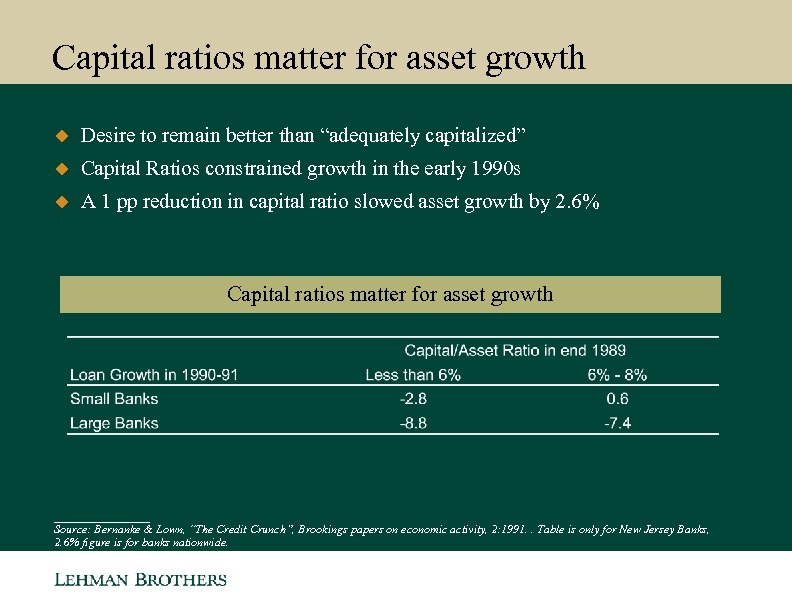
Capital ratios matter for asset growth u Desire to remain better than “adequately capitalized” u Capital Ratios constrained growth in the early 1990 s u A 1 pp reduction in capital ratio slowed asset growth by 2. 6% Capital ratios matter for asset growth ________ Source: Bernanke & Lown, “The Credit Crunch”, Brookings papers on economic activity, 2: 1991. . Table is only for New Jersey Banks, 2. 6% figure is for banks nationwide. 6
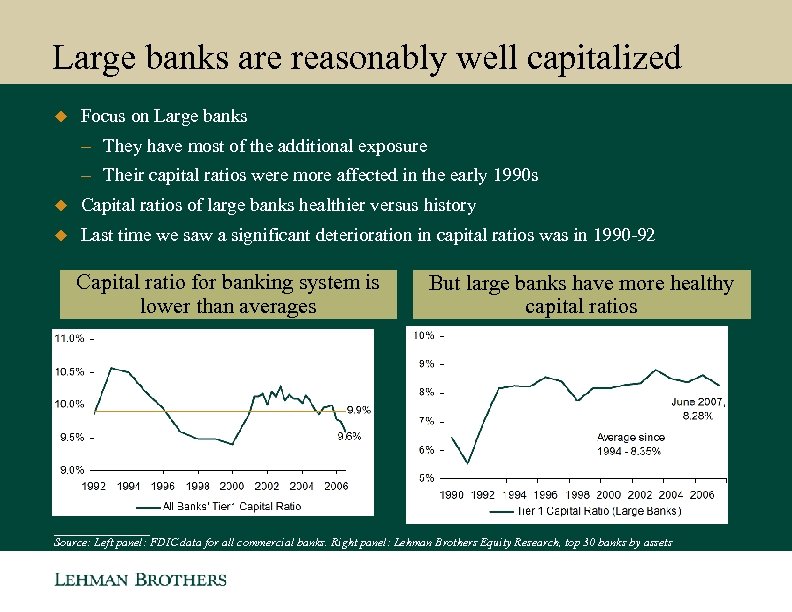
Large banks are reasonably well capitalized u Focus on Large banks – They have most of the additional exposure – Their capital ratios were more affected in the early 1990 s u Capital ratios of large banks healthier versus history u Last time we saw a significant deterioration in capital ratios was in 1990 -92 Capital ratio for banking system is lower than averages But large banks have more healthy capital ratios ________ Source: Left panel: FDIC data for all commercial banks. Right panel: Lehman Brothers Equity Research, top 30 banks by assets 7
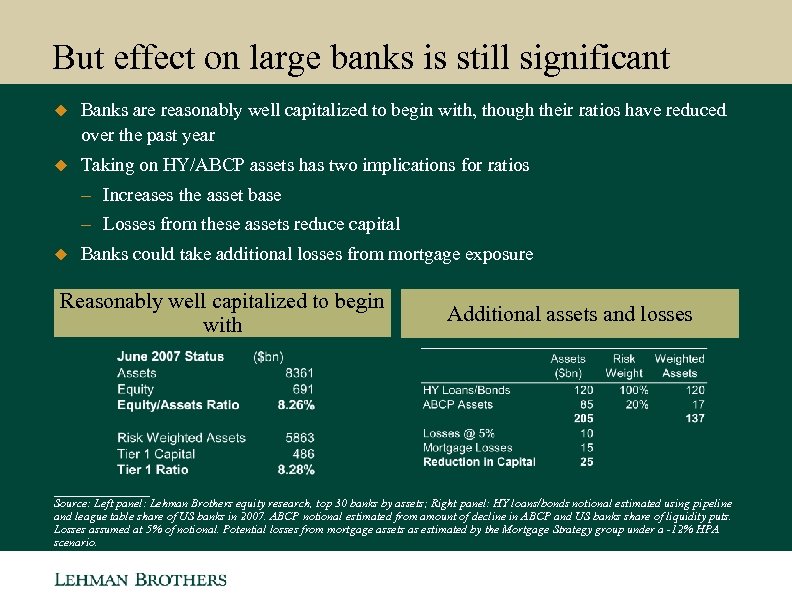
But effect on large banks is still significant u Banks are reasonably well capitalized to begin with, though their ratios have reduced over the past year u Taking on HY/ABCP assets has two implications for ratios – Increases the asset base – Losses from these assets reduce capital u Banks could take additional losses from mortgage exposure Reasonably well capitalized to begin with Additional assets and losses ________ Source: Left panel: Lehman Brothers equity research, top 30 banks by assets; Right panel: HY loans/bonds notional estimated using pipeline and league table share of US banks in 2007. ABCP notional estimated from amount of decline in ABCP and US banks share of liquidity puts. Losses assumed at 5% of notional. Potential losses from mortgage assets as estimated by the Mortgage Strategy group under a -12% HPA scenario. 8
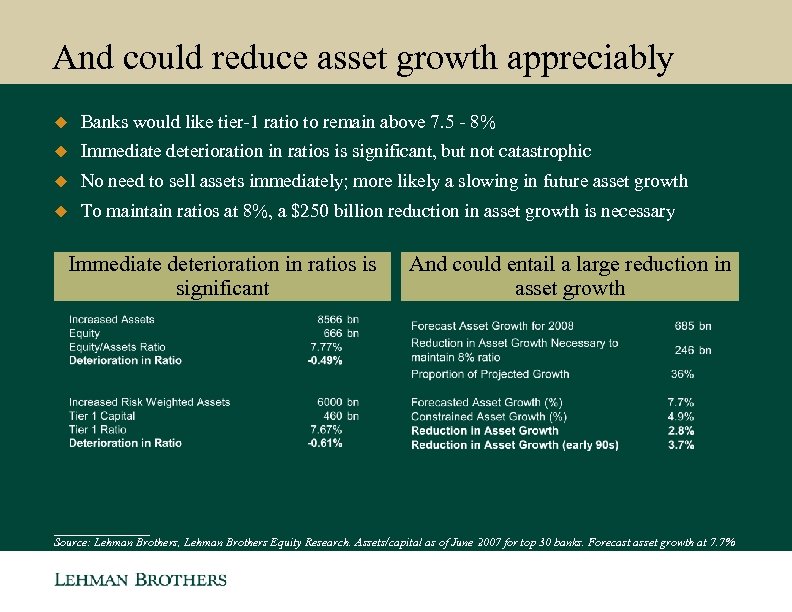
And could reduce asset growth appreciably u Banks would like tier-1 ratio to remain above 7. 5 - 8% u Immediate deterioration in ratios is significant, but not catastrophic u No need to sell assets immediately; more likely a slowing in future asset growth u To maintain ratios at 8%, a $250 billion reduction in asset growth is necessary Immediate deterioration in ratios is significant And could entail a large reduction in asset growth ________ Source: Lehman Brothers, Lehman Brothers Equity Research. Assets/capital as of June 2007 for top 30 banks. Forecast asset growth at 7. 7% 9

Disclaimer Analyst Certification The views expressed in this report accurately reflect the personal views of Kurush Mistry & Amitabh Arora, the primary analyst responsible for this report, about the subject securities or issuers referred to herein, and no part of such analyst’s compensation was, is or will be directly or indirectly related to the specific recommendations or views expressed herein. Important Disclosures Lehman Brothers, Inc. and / or an affiliate thereof (the “firm”) regularly trades, generally deals as principal and generally provides liquidity (as market maker or otherwise) in the fixed income securities that are the subject of this research report (and related derivatives thereof). The firm’s trading desks may have either a long and / or short position in such securities and / or derivative instruments, which may pose a potential conflict with the interests of investing customers. Where permitted and subject to appropriate information barrier restrictions, the firm’s fixed income research analysts regularly interact with its trading desk personnel to determine current prices of fixed income securities. The firm’s fixed income research analyst(s) receive compensation based on various factors including, but not limited to, the quality of their work, the overall performance of the firm (including the profitability of the investment banking department), the profitability and revenues of the Fixed Income Division and the outstanding principal amount and trading value of, the profitability of, and the potential interest of the firm’s investing clients in research with respect to, the asset class covered by the analyst. Lehman Brothers generally does and seeks to do investment banking and other business with the companies discussed in its research reports. As a result, investors should be aware that the firm may have a potential conflict of interest. To the extent that any historical pricing information was obtained from Lehman Brothers trading desks, the firm makes no representation that it is accurate or complete. All levels, prices and spreads are historical and do not represent current market levels, prices or spreads, some or all of which may have changed since the publication of this document. Lehman Brothers’ global policy for managing conflicts of interest in connection with investment research is available at www. lehman. com/researchconflictspolicy. To obtain copies of fixed income research reports published by Lehman Brothers please contact Valerie Monchi (vmonchi@lehman. com; 212 -526 -3173) or clients may go to https: //live. lehman. com/ Company-Specific Disclosures Lehman Brothers, Inc. or one of its affiliates has managed or co-managed a public offering of securities or Rule 144 A offering of securities for the following issuers within the past twelve months the Federal Home Loan Mortgage Corporation (FHLMC), the Federal National Mortgage Association (FNMA), and the Government National Mortgage Association (GNMA). These companies are current investment banking clients of Lehman Brothers or companies for which Lehman Brothers would like to perform investment banking services. As a frequent dealer in interest rates and currency investments, you should assume that Lehman Brothers has a significant financial interest in one or more of the products that are discussed in this publication. Legal Disclaimer This material has been prepared and / or issued by Lehman Brothers, Inc. , member SIPC, and / or one of its affiliates (“Lehman Brothers”). Lehman Brothers, Inc. accepts responsibility for the content of this material in connection with its distribution in the United States. This material has been approved by Lehman Brothers International (Europe), authorized and regulated by the Financial Services Authority, in connection with its distribution in the European Economic Area. This material is distributed in Japan by Lehman Brothers Japan, Inc. , and in Hong Kong by Lehman Brothers Asia Limited. This material is distributed in Australia by Lehman Brothers Australia Pty. Limited, and in Singapore by Lehman Brothers, Inc. , Singapore Branch (“LBIS”). Where this material is distributed by LBIS, please note that it is intended for general circulation only and the recommendations contained herein do not take into account the specific investment objectives, financial situation or particular needs of any particular person. An investor should consult his Lehman Brothers’ representative regarding the suitability of the product and take into account his specific investment objectives, financial situation or particular needs before he makes a commitment to purchase the investment product. This material is distributed in Korea by Lehman Brothers International (Europe) Seoul Branch. Any U. S. person who receives this material and places an order as result of information contained herein should do so only through Lehman Brothers, Inc. This document is for information purposes only and it should not be regarded as an offer to sell or as a solicitation of an offer to buy the securities or other instruments mentioned in it. No part of this document may be reproduced in any manner without the written permission of Lehman Brothers. With exception of the disclosures relating to Lehman Brothers, this report is based on current public information that Lehman Brothers considers reliable, but we do not represent that this information, including any third party information, is accurate or complete and it should not be relied upon as such. It is provided with the understanding that Lehman Brothers is not acting in a fiduciary capacity. Opinions expressed herein reflect the opinion of Lehman Brothers’ Fixed Income Research Department and are subject to change without notice. The products mentioned in this document may not be eligible for sale in some states or countries, and they may not be suitable for all types of investors. If an investor has any doubts about product suitability, he should consult his Lehman Brothers representative. The value of and the income produced by products may fluctuate, so that an investor may get back less than he invested. Value and income may be adversely affected by exchange rates, interest rates, or other factors. Past performance is not necessarily indicative of future results. If a product is income producing, part of the capital invested may be used to pay that income. Lehman Brothers may, from time to time, perform investment banking or other services for, or solicit investment banking or other business from any company mentioned in this document. No part of this document may be reproduced in any manner without the written permission of Lehman Brothers. © 2006 Lehman Brothers. All rights reserved. Additional information is available on request. Please contact a Lehman Brothers’ entity in your home jurisdiction. 14
Скачать презентацию Confidential Presentation to Kellogg Business School Anatomy of
848a95ae35cd6b4a7c80ccc23f797f13.ppt