


 Скачать презентацию Confidential Presentation Dickreuter Analytics Testing of trading strategies
bbd2b46245c57e7fed277162e65ccfdf.ppt
- Количество слайдов: 21
 Confidential Presentation Dickreuter Analytics Testing of trading strategies Nicolas Dickreuter 14 March 2009 Phone: +44 7889 112 886 SW 5 0 HQ London, UK nicolas@dickreuter. com
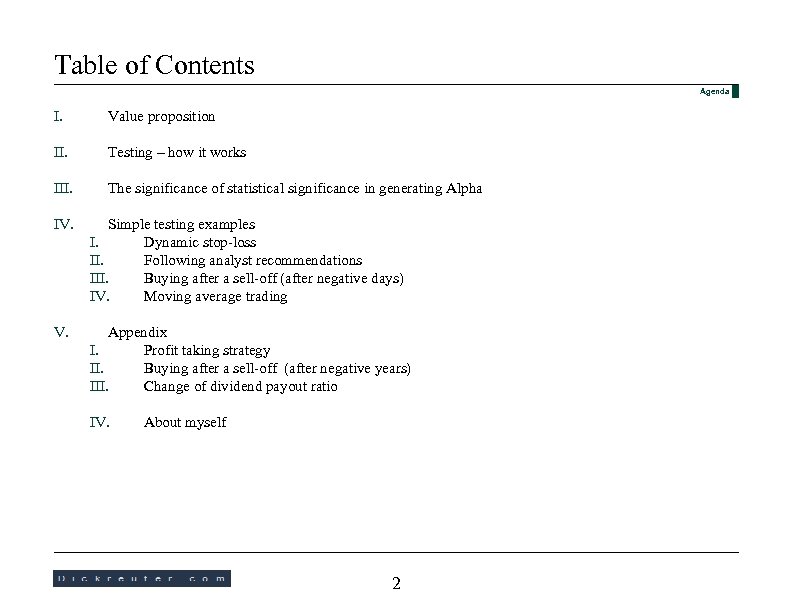 Table of Contents Agenda I. Value proposition II. Testing – how it works III. The significance of statistical significance in generating Alpha IV. Simple testing examples I. Dynamic stop-loss II. Following analyst recommendations III. Buying after a sell-off (after negative days) IV. Moving average trading V. Appendix I. Profit taking strategy II. Buying after a sell-off (after negative years) III. Change of dividend payout ratio IV. About myself 2
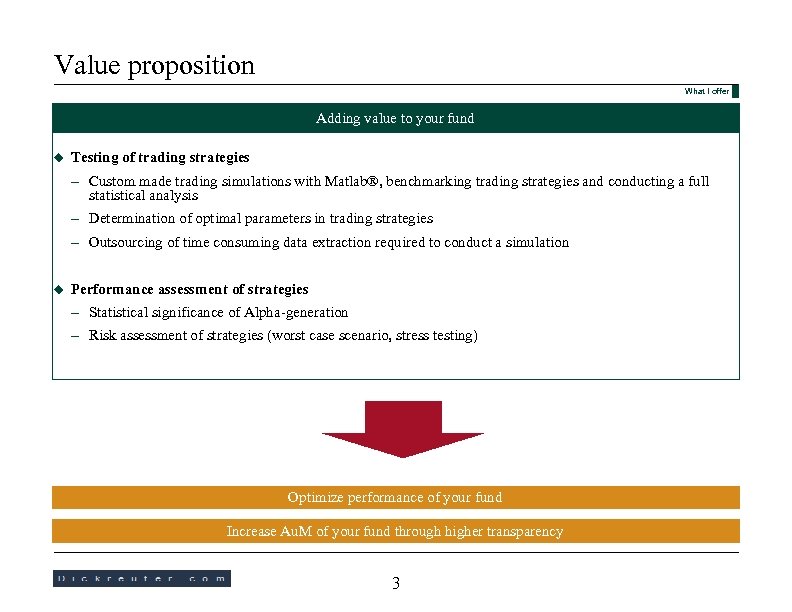 Value proposition What I offer Adding value to your fund u Testing of trading strategies – Custom made trading simulations with Matlab®, benchmarking trading strategies and conducting a full statistical analysis – Determination of optimal parameters in trading strategies – Outsourcing of time consuming data extraction required to conduct a simulation u Performance assessment of strategies – Statistical significance of Alpha-generation – Risk assessment of strategies (worst case scenario, stress testing) Optimize performance of your fund Increase Au. M of your fund through higher transparency 3
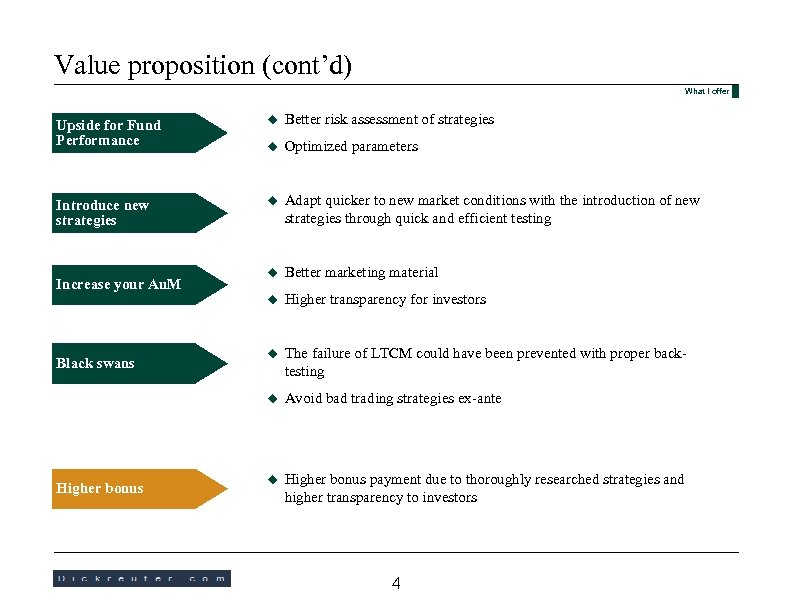 Value proposition (cont’d) What I offer Upside for Fund Performance u Better risk assessment of strategies u Optimized parameters Introduce new strategies u Adapt quicker to new market conditions with the introduction of new strategies through quick and efficient testing u Better marketing material u Higher transparency for investors u The failure of LTCM could have been prevented with proper backtesting u Avoid bad trading strategies ex-ante u Higher bonus payment due to thoroughly researched strategies and higher transparency to investors Increase your Au. M Black swans Higher bonus 4
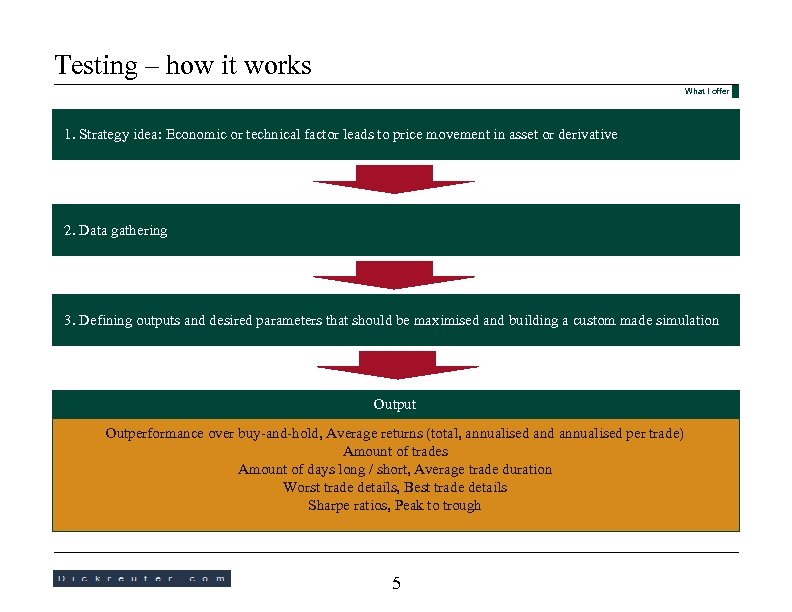 Testing – how it works What I offer 1. Strategy idea: Economic or technical factor leads to price movement in asset or derivative 2. Data gathering 3. Defining outputs and desired parameters that should be maximised and building a custom made simulation Output Outperformance over buy-and-hold, Average returns (total, annualised per trade) Amount of trades Amount of days long / short, Average trade duration Worst trade details, Best trade details Sharpe ratios, Peak to trough 5
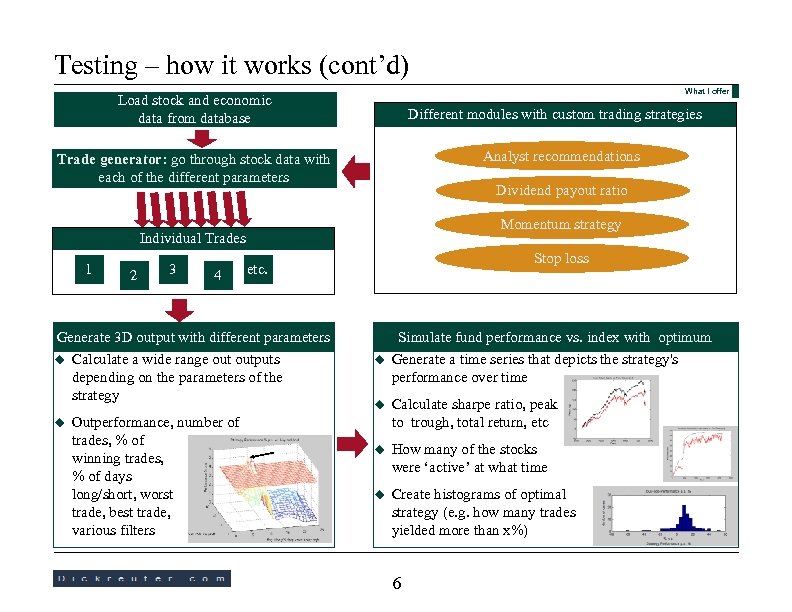 Testing – how it works (cont’d) What I offer Load stock and economic data from database Different modules with custom trading strategies Analyst recommendations Trade generator: go through stock data with each of the different parameters Dividend payout ratio Momentum strategy Individual Trades 1 2 3 4 Stop loss etc. Generate 3 D output with different parameters u u Calculate a wide range outputs depending on the parameters of the strategy Outperformance, number of trades, % of winning trades, % of days long/short, worst trade, best trade, various filters u Simulate fund performance vs. index with optimum Generate a time series that depicts the strategy's performance over time u Calculate sharpe ratio, peak to trough, total return, etc u How many of the stocks were ‘active’ at what time u Create histograms of optimal strategy (e. g. how many trades yielded more than x%) 6
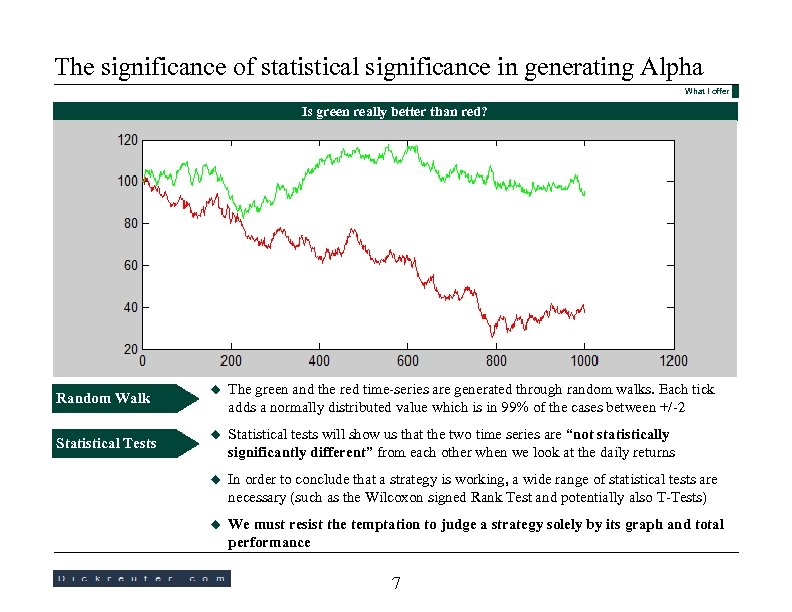 The significance of statistical significance in generating Alpha What I offer Is green really better than red? Random Walk Statistical Tests u The green and the red time-series are generated through random walks. Each tick adds a normally distributed value which is in 99% of the cases between +/-2 u Statistical tests will show us that the two time series are “not statistically significantly different” from each other when we look at the daily returns u In order to conclude that a strategy is working, a wide range of statistical tests are necessary (such as the Wilcoxon signed Rank Test and potentially also T-Tests) u We must resist the temptation to judge a strategy solely by its graph and total performance 7
 Simple testing examples 8
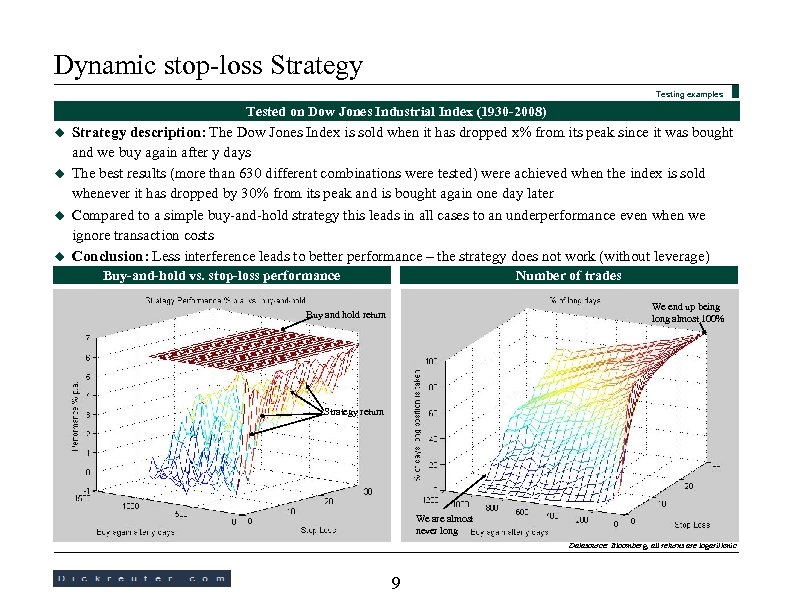 Dynamic stop-loss Strategy Testing examples Tested on Dow Jones Industrial Index (1930 -2008) u u Strategy description: The Dow Jones Index is sold when it has dropped x% from its peak since it was bought and we buy again after y days The best results (more than 630 different combinations were tested) were achieved when the index is sold whenever it has dropped by 30% from its peak and is bought again one day later Compared to a simple buy-and-hold strategy this leads in all cases to an underperformance even when we ignore transaction costs Conclusion: Less interference leads to better performance – the strategy does not work (without leverage) Buy-and-hold vs. stop-loss performance Number of trades We end up being long almost 100% Buy and hold return Strategy return We are almost never long Datasource: Bloomberg, all returns are logarithmic 9
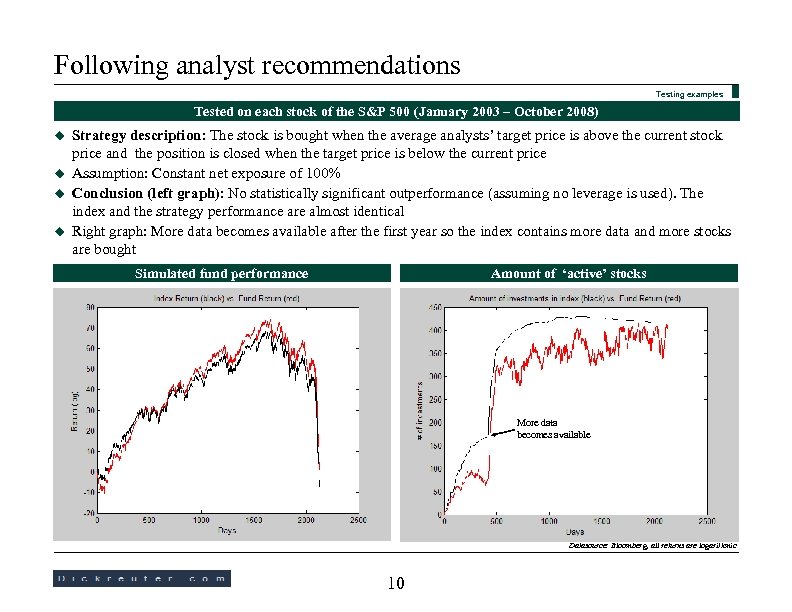 Following analyst recommendations Testing examples Tested on each stock of the S&P 500 (January 2003 – October 2008) u u Strategy description: The stock is bought when the average analysts’ target price is above the current stock price and the position is closed when the target price is below the current price Assumption: Constant net exposure of 100% Conclusion (left graph): No statistically significant outperformance (assuming no leverage is used). The index and the strategy performance are almost identical Right graph: More data becomes available after the first year so the index contains more data and more stocks are bought Simulated fund performance Amount of ‘active’ stocks More data becomes available Datasource: Bloomberg, all returns are logarithmic 10
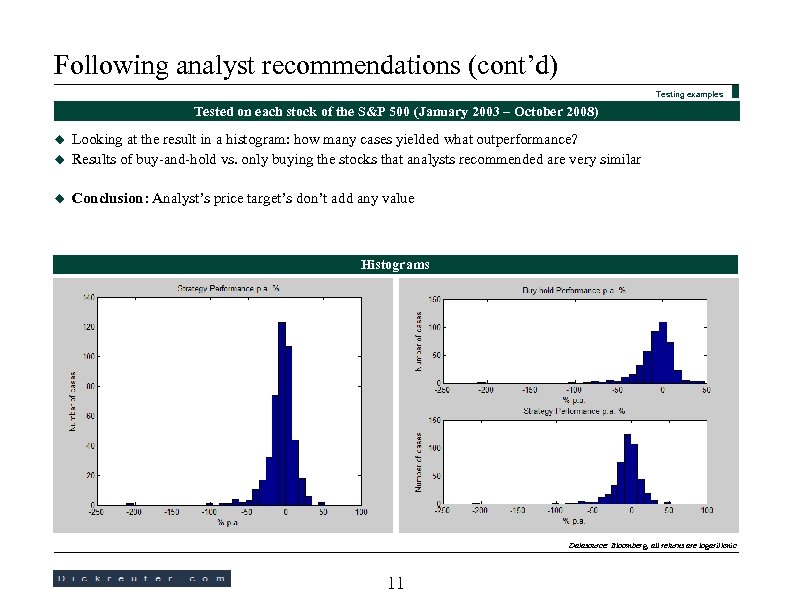 Following analyst recommendations (cont’d) Testing examples Tested on each stock of the S&P 500 (January 2003 – October 2008) u Looking at the result in a histogram: how many cases yielded what outperformance? Results of buy-and-hold vs. only buying the stocks that analysts recommended are very similar u Conclusion: Analyst’s price target’s don’t add any value u Histograms Datasource: Bloomberg, all returns are logarithmic 11
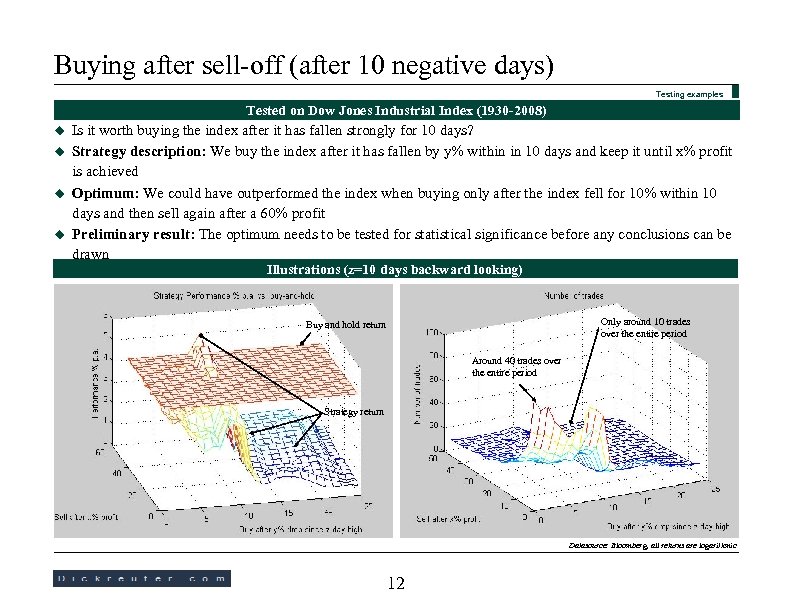 Buying after sell-off (after 10 negative days) Testing examples Tested on Dow Jones Industrial Index (1930 -2008) u u Is it worth buying the index after it has fallen strongly for 10 days? Strategy description: We buy the index after it has fallen by y% within in 10 days and keep it until x% profit is achieved Optimum: We could have outperformed the index when buying only after the index fell for 10% within 10 days and then sell again after a 60% profit Preliminary result: The optimum needs to be tested for statistical significance before any conclusions can be drawn Illustrations (z=10 days backward looking) Only around 10 trades over the entire period Buy and hold return Around 40 trades over the entire period Strategy return Datasource: Bloomberg, all returns are logarithmic 12
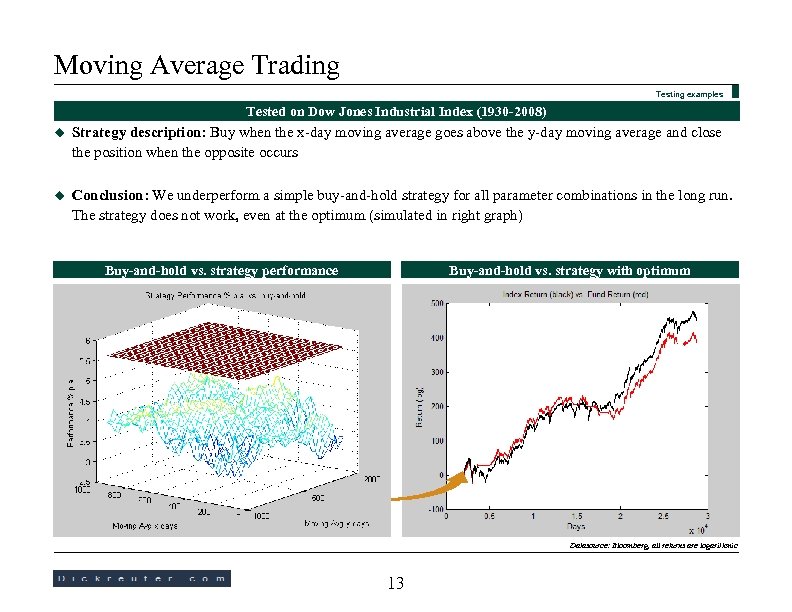 Moving Average Trading Testing examples Tested on Dow Jones Industrial Index (1930 -2008) u Strategy description: Buy when the x-day moving average goes above the y-day moving average and close the position when the opposite occurs u Conclusion: We underperform a simple buy-and-hold strategy for all parameter combinations in the long run. The strategy does not work, even at the optimum (simulated in right graph) Buy-and-hold vs. strategy performance Buy-and-hold vs. strategy with optimum Datasource: Bloomberg, all returns are logarithmic 13
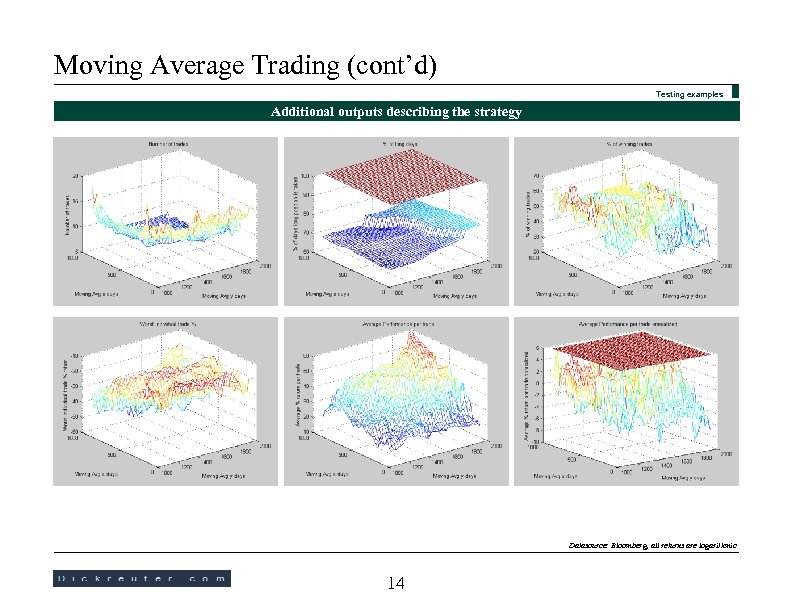 Moving Average Trading (cont’d) Testing examples Additional outputs describing the strategy Datasource: Bloomberg, all returns are logarithmic 14
 Appendix 15
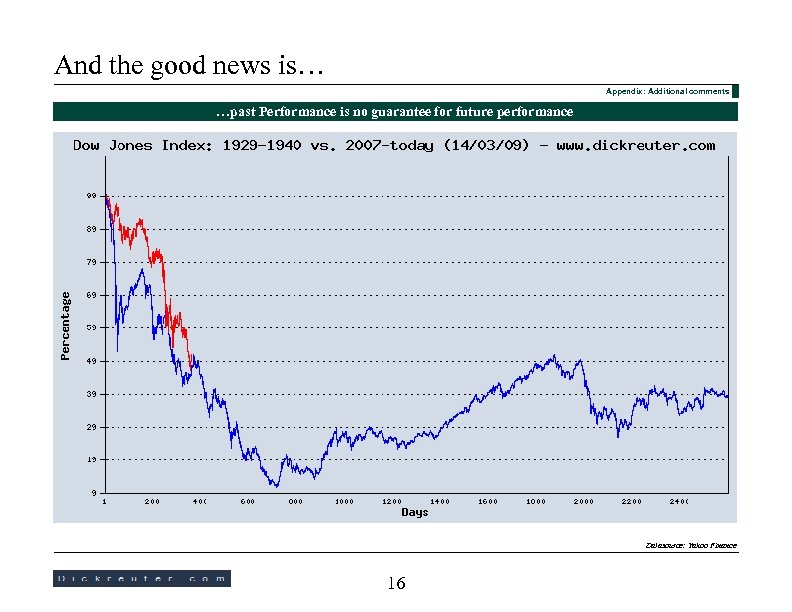 And the good news is… Appendix: Additional comments …past Performance is no guarantee for future performance Datasource: Yahoo Finance 16
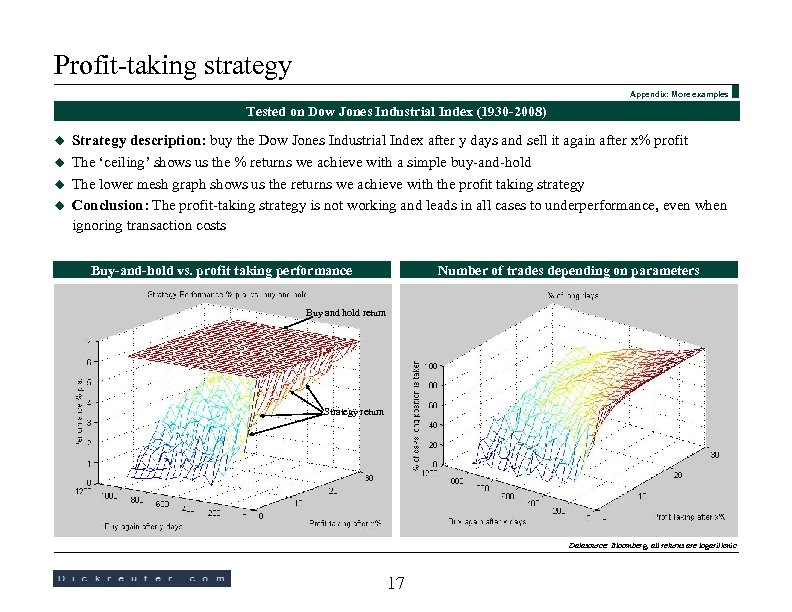 Profit-taking strategy Appendix: More examples Tested on Dow Jones Industrial Index (1930 -2008) u u Strategy description: buy the Dow Jones Industrial Index after y days and sell it again after x% profit The ‘ceiling’ shows us the % returns we achieve with a simple buy-and-hold The lower mesh graph shows us the returns we achieve with the profit taking strategy Conclusion: The profit-taking strategy is not working and leads in all cases to underperformance, even when ignoring transaction costs Buy-and-hold vs. profit taking performance Number of trades depending on parameters Buy and hold return Strategy return Datasource: Bloomberg, all returns are logarithmic 17
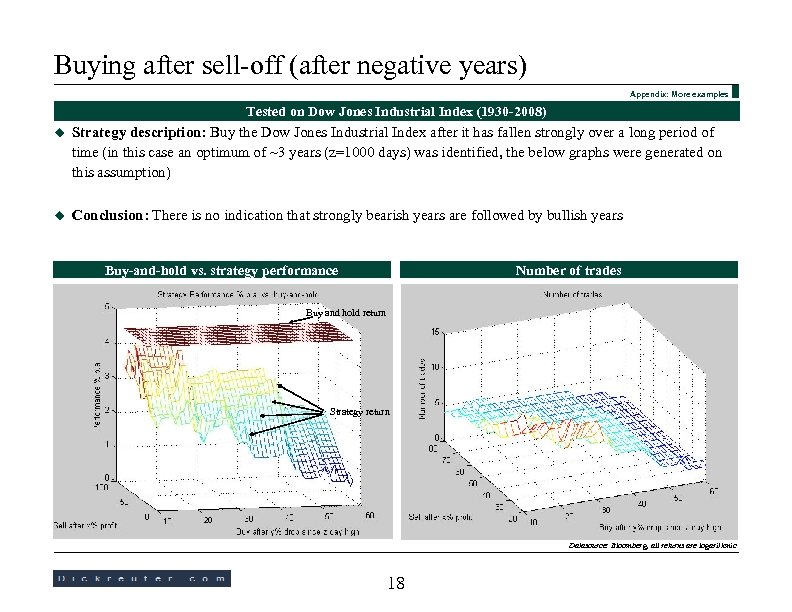 Buying after sell-off (after negative years) Appendix: More examples Tested on Dow Jones Industrial Index (1930 -2008) u Strategy description: Buy the Dow Jones Industrial Index after it has fallen strongly over a long period of time (in this case an optimum of ~3 years (z=1000 days) was identified, the below graphs were generated on this assumption) u Conclusion: There is no indication that strongly bearish years are followed by bullish years Buy-and-hold vs. strategy performance Number of trades Buy and hold return Strategy return Datasource: Bloomberg, all returns are logarithmic 18
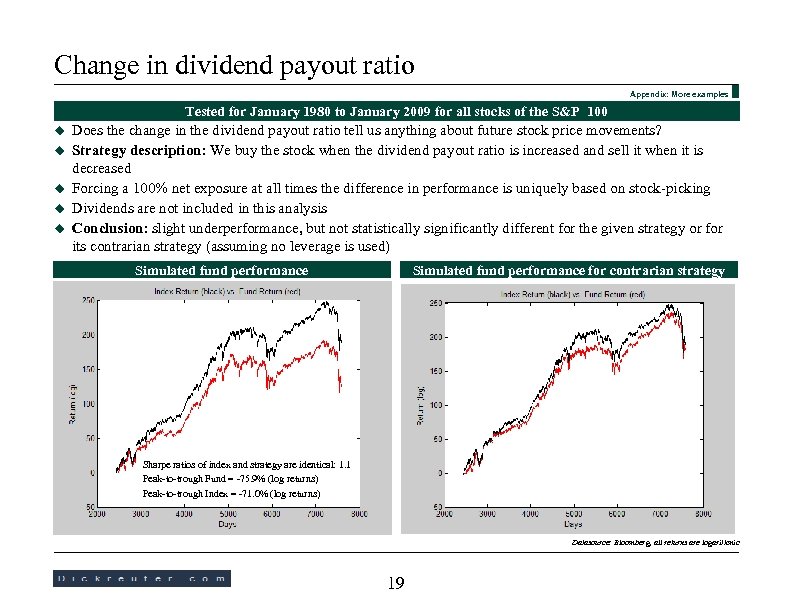 Change in dividend payout ratio Appendix: More examples Tested for January 1980 to January 2009 for all stocks of the S&P 100 u u u Does the change in the dividend payout ratio tell us anything about future stock price movements? Strategy description: We buy the stock when the dividend payout ratio is increased and sell it when it is decreased Forcing a 100% net exposure at all times the difference in performance is uniquely based on stock-picking Dividends are not included in this analysis Conclusion: slight underperformance, but not statistically significantly different for the given strategy or for its contrarian strategy (assuming no leverage is used) Simulated fund performance for contrarian strategy Sharpe ratios of index and strategy are identical: 1. 1 Peak-to-trough Fund = -75. 9% (log returns) Peak-to-trough Index = -71. 0% (log returns) Datasource: Bloomberg, all returns are logarithmic 19
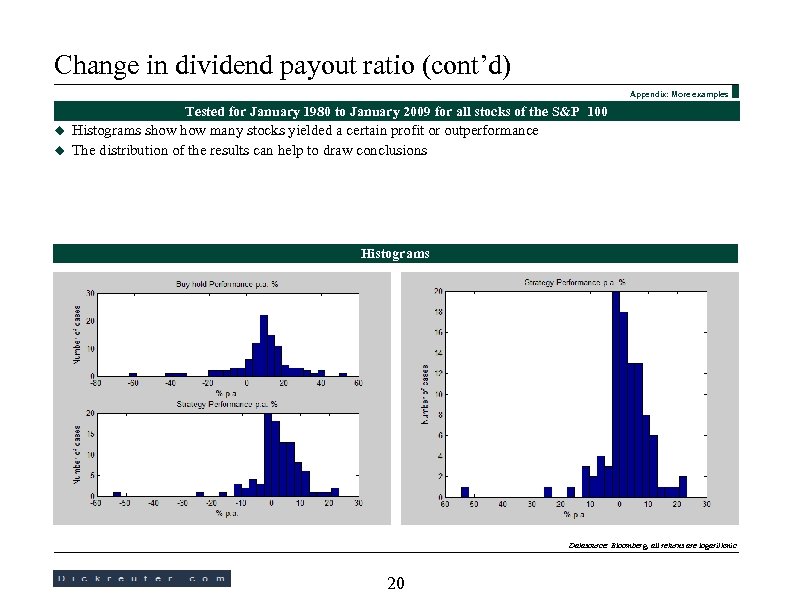 Change in dividend payout ratio (cont’d) Appendix: More examples Tested for January 1980 to January 2009 for all stocks of the S&P 100 u u Histograms show many stocks yielded a certain profit or outperformance The distribution of the results can help to draw conclusions Histograms Datasource: Bloomberg, all returns are logarithmic 20
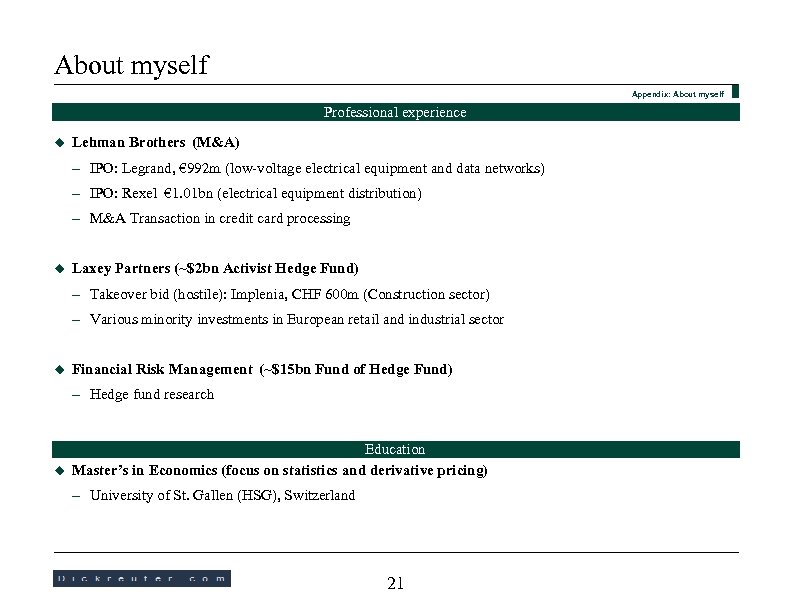 About myself Appendix: About myself Professional experience u Lehman Brothers (M&A) – IPO: Legrand, € 992 m (low-voltage electrical equipment and data networks) – IPO: Rexel € 1. 01 bn (electrical equipment distribution) – M&A Transaction in credit card processing u Laxey Partners (~$2 bn Activist Hedge Fund) – Takeover bid (hostile): Implenia, CHF 600 m (Construction sector) – Various minority investments in European retail and industrial sector u Financial Risk Management (~$15 bn Fund of Hedge Fund) – Hedge fund research u Education Master’s in Economics (focus on statistics and derivative pricing) – University of St. Gallen (HSG), Switzerland 21