 Скачать презентацию CONFIDENTIAL Options for Structuring the Transition October 1
8711726c21d3e005236e2fe40178a9a4.ppt
- Количество слайдов: 13



CONFIDENTIAL Options for Structuring the Transition October 1, 2008
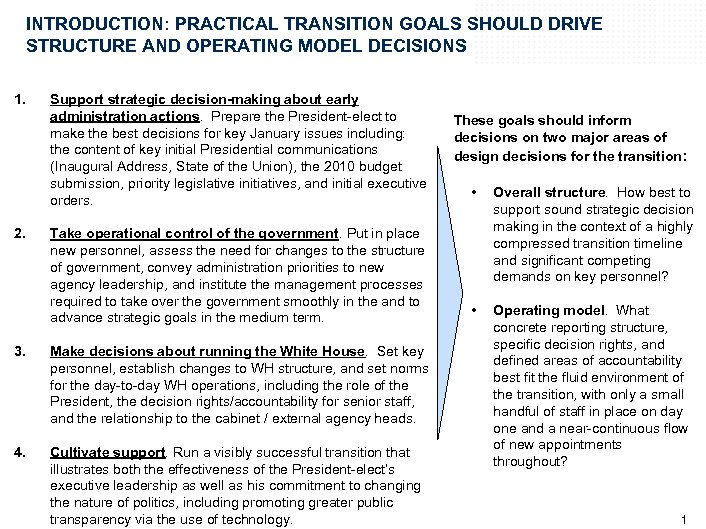
INTRODUCTION: PRACTICAL TRANSITION GOALS SHOULD DRIVE STRUCTURE AND OPERATING MODEL DECISIONS 1. 2. Support strategic decision-making about early administration actions. Prepare the President-elect to make the best decisions for key January issues including: the content of key initial Presidential communications (Inaugural Address, State of the Union), the 2010 budget submission, priority legislative initiatives, and initial executive orders. Take operational control of the government. Put in place new personnel, assess the need for changes to the structure of government, convey administration priorities to new agency leadership, and institute the management processes required to take over the government smoothly in the and to advance strategic goals in the medium term. 3. Make decisions about running the White House. Set key personnel, establish changes to WH structure, and set norms for the day-to-day WH operations, including the role of the President, the decision rights/accountability for senior staff, and the relationship to the cabinet / external agency heads. 4. Cultivate support. Run a visibly successful transition that illustrates both the effectiveness of the President-elect’s executive leadership as well as his commitment to changing the nature of politics, including promoting greater public transparency via the use of technology. These goals should inform decisions on two major areas of design decisions for the transition: • Overall structure. How best to support sound strategic decision making in the context of a highly compressed transition timeline and significant competing demands on key personnel? • Operating model. What concrete reporting structure, specific decision rights, and defined areas of accountability best fit the fluid environment of the transition, with only a small handful of staff in place on day one and a near-continuous flow of new appointments throughout? 1
• Context: Transition functions, timeline, and available resources • Options: Structure + operating model
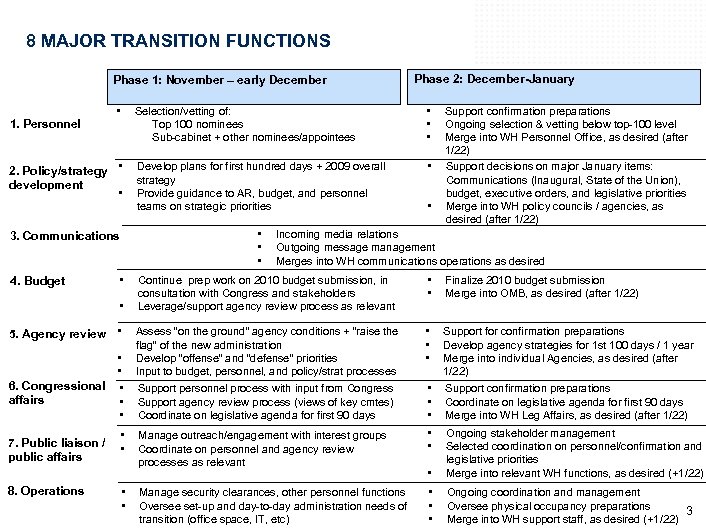
8 MAJOR TRANSITION FUNCTIONS Phase 1: November – early December 1. Personnel • Phase 2: December-January Selection/vetting of: Top 100 nominees Sub-cabinet + other nominees/appointees 2. Policy/strategy • development • • Develop plans for first hundred days + 2009 overall strategy Provide guidance to AR, budget, and personnel teams on strategic priorities • • 3. Communications Incoming media relations Outgoing message management Merges into WH communications operations as desired Continue prep work on 2010 budget submission, in consultation with Congress and stakeholders Leverage/support agency review process as relevant • • Finalize 2010 budget submission Merge into OMB, as desired (after 1/22) • • 4. Budget • • Support confirmation preparations Ongoing selection & vetting below top-100 level Merge into WH Personnel Office, as desired (after 1/22) Support decisions on major January items: Communications (Inaugural, State of the Union), budget, executive orders, and legislative priorities Merge into WH policy councils / agencies, as desired (after 1/22) Assess “on the ground” agency conditions + “raise the flag” of the new administration Develop “offense” and “defense” priorities Input to budget, personnel, and policy/strat processes • • • Support for confirmation preparations Develop agency strategies for 1 st 100 days / 1 year Merge into individual Agencies, as desired (after 1/22) • • • Support personnel process with input from Congress Support agency review process (views of key cmtes) Coordinate on legislative agenda for first 90 days • • • Support confirmation preparations Coordinate on legislative agenda for first 90 days Merge into WH Leg Affairs, as desired (after 1/22) • • Manage outreach/engagement with interest groups Coordinate on personnel and agency review processes as relevant • • • Ongoing stakeholder management Selected coordination on personnel/confirmation and legislative priorities Merge into relevant WH functions, as desired (+1/22) Manage security clearances, other personnel functions Oversee set-up and day-to-day administration needs of transition (office space, IT, etc) • • • Ongoing coordination and management Oversee physical occupancy preparations 3 Merge into WH support staff, as desired (+1/22) • 5. Agency review • 6. Congressional affairs 7. Public liaison / public affairs 8. Operations • •
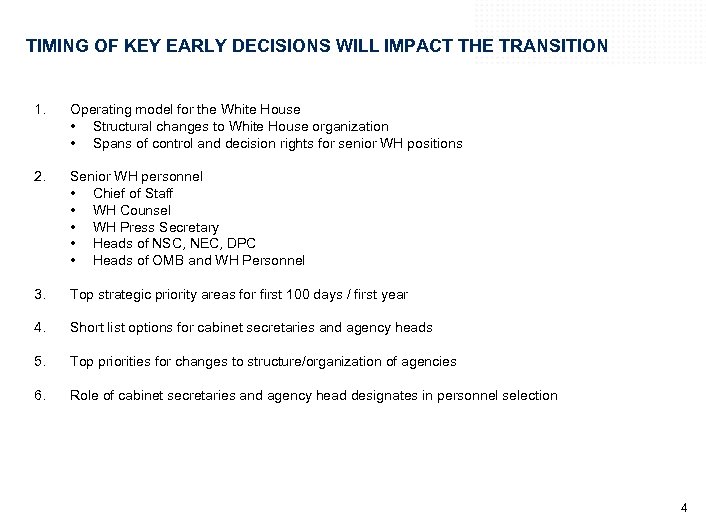
TIMING OF KEY EARLY DECISIONS WILL IMPACT THE TRANSITION 1. Operating model for the White House • Structural changes to White House organization • Spans of control and decision rights for senior WH positions 2. Senior WH personnel • Chief of Staff • WH Counsel • WH Press Secretary • Heads of NSC, NEC, DPC • Heads of OMB and WH Personnel 3. Top strategic priority areas for first 100 days / first year 4. Short list options for cabinet secretaries and agency heads 5. Top priorities for changes to structure/organization of agencies 6. Role of cabinet secretaries and agency head designates in personnel selection 4
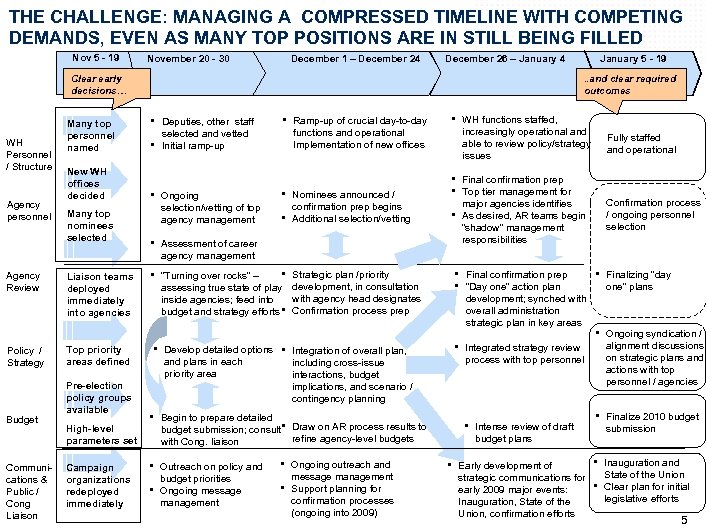
THE CHALLENGE: MANAGING A COMPRESSED TIMELINE WITH COMPETING DEMANDS, EVEN AS MANY TOP POSITIONS ARE IN STILL BEING FILLED Nov 5 - 19 November 20 - 30 December 1 – December 24 . . and clear required outcomes Clear early decisions… WH Personnel / Structure Agency personnel Agency Review Policy / Strategy Budget Communications & Public / Cong Liaison Many top personnel named New WH offices decided Many top nominees selected Liaison teams deployed immediately into agencies Top priority areas defined Pre-election policy groups available High-level parameters set Campaign organizations redeployed immediately January 5 - 19 December 26 – January 4 • • • Deputies, other staff selected and vetted Initial ramp-up Ongoing selection/vetting of top agency management • • • “Turning over rocks” – assessing true state of play inside agencies; feed into budget and strategy efforts • Nominees announced / confirmation prep begins Additional selection/vetting • WH functions staffed, increasingly operational and able to review policy/strategy issues • • Develop detailed options and plans in each priority area • • • Integration of overall plan, including cross-issue interactions, budget implications, and scenario / contingency planning • Begin to prepare detailed budget submission; consult • Draw on AR process results to refine agency-level budgets with Cong. liaison • Outreach on policy and budget priorities Ongoing message management • • • Ongoing outreach and message management Support planning for confirmation processes (ongoing into 2009) Final confirmation prep “Day one” action plan development; synched with overall administration strategic plan in key areas • Strategic plan /priority development, in consultation with agency head designates Confirmation process prep Confirmation process / ongoing personnel selection Integrated strategy review process with top personnel • • Fully staffed and operational Final confirmation prep Top tier management for major agencies identifies As desired, AR teams begin “shadow” management responsibilities Assessment of career agency management • Ramp-up of crucial day-to-day functions and operational Implementation of new offices Intense review of draft budget plans Early development of strategic communications for early 2009 major events: Inauguration, State of the Union, confirmation efforts • Finalizing “day one” plans • Ongoing syndication / alignment discussions on strategic plans and actions with top personnel / agencies • Finalize 2010 budget submission • Inauguration and State of the Union Clear plan for initial legislative efforts • 5
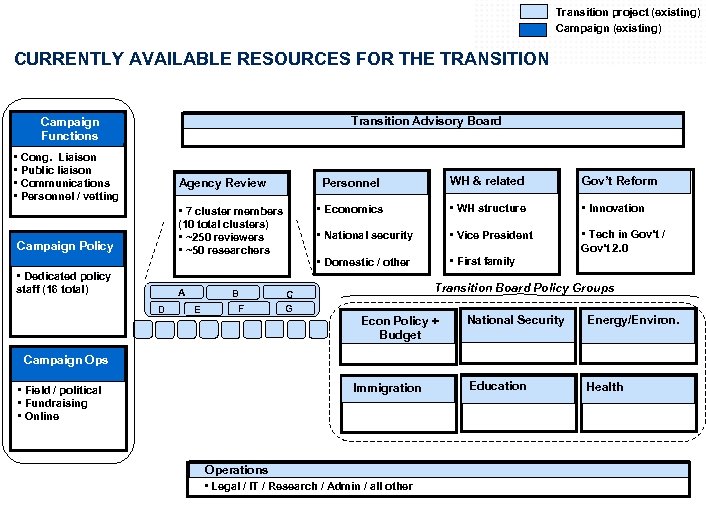
Transition project (existing) Campaign (existing) CURRENTLY AVAILABLE RESOURCES FOR THE TRANSITION Transition Advisory Board Campaign Functions • Cong. Liaison • Public liaison • Communications • Personnel / vetting Personnel WH & related Gov’t Reform • 7 cluster members • Economics • WH structure • Innovation (10 total clusters) • ~250 reviewers • ~50 researchers • National security • Vice President • Tech in Gov’t / • Domestic / other • First family Agency Review Campaign Policy • Dedicated policy staff (16 total) A D E B F C G Gov’t 2. 0 Transition Board Policy Groups Econ Policy + Budget National Security Energy/Environ. Education Health Campaign Ops Immigration • Field / political • Fundraising • Online Operations • Legal / IT / Research / Admin / all other
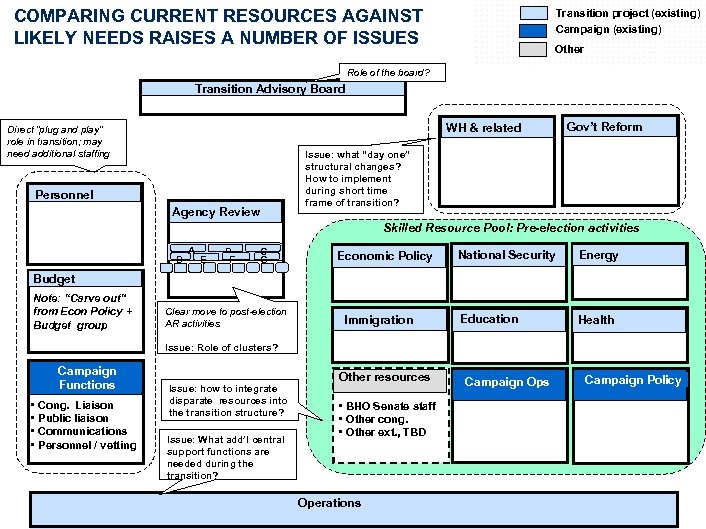
COMPARING CURRENT RESOURCES AGAINST LIKELY NEEDS RAISES A NUMBER OF ISSUES Transition project (existing) Campaign (existing) Other Role of the board? Transition Advisory Board WH & related Direct “plug and play” role in transition; may need additional staffing Personnel Agency Review Gov’t Reform Issue: what “day one” structural changes? How to implement during short time frame of transition? Skilled Resource Pool: Pre-election activities D A E B F C G Economic Policy National Security Energy Education Health Budget Note: “Carve out” from Econ Policy + Budget group Clear move to post-election AR activities Immigration Issue: Role of clusters? Campaign Functions • Cong. Liaison • Public liaison • Communications • Personnel / vetting Issue: how to integrate disparate resources into the transition structure? Issue: What add’l central support functions are needed during the transition? Other resources • BHO Senate staff • Other cong. • Other ext. , TBD Operations Campaign Ops Campaign Policy
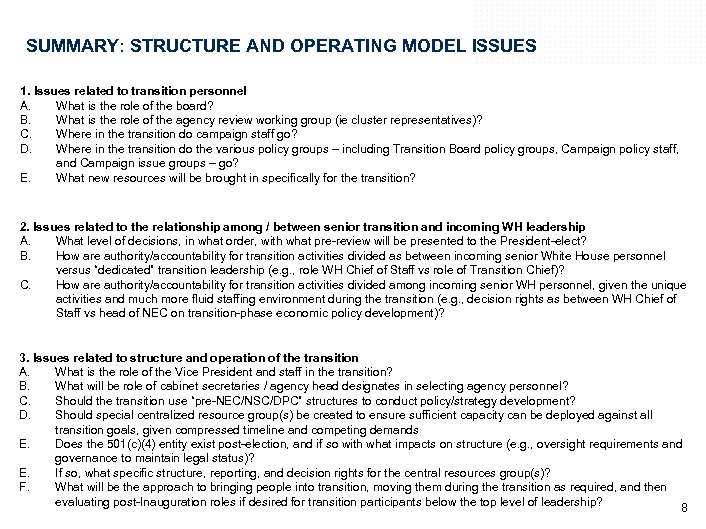
SUMMARY: STRUCTURE AND OPERATING MODEL ISSUES 1. Issues related to transition personnel A. What is the role of the board? B. What is the role of the agency review working group (ie cluster representatives)? C. Where in the transition do campaign staff go? D. Where in the transition do the various policy groups – including Transition Board policy groups, Campaign policy staff, and Campaign issue groups – go? E. What new resources will be brought in specifically for the transition? 2. Issues related to the relationship among / between senior transition and incoming WH leadership A. What level of decisions, in what order, with what pre-review will be presented to the President-elect? B. How are authority/accountability for transition activities divided as between incoming senior White House personnel versus “dedicated” transition leadership (e. g. , role WH Chief of Staff vs role of Transition Chief)? C. How are authority/accountability for transition activities divided among incoming senior WH personnel, given the unique activities and much more fluid staffing environment during the transition (e. g. , decision rights as between WH Chief of Staff vs head of NEC on transition-phase economic policy development)? 3. Issues related to structure and operation of the transition A. What is the role of the Vice President and staff in the transition? B. What will be role of cabinet secretaries / agency head designates in selecting agency personnel? C. Should the transition use “pre-NEC/NSC/DPC” structures to conduct policy/strategy development? D. Should special centralized resource group(s) be created to ensure sufficient capacity can be deployed against all transition goals, given compressed timeline and competing demands E. Does the 501(c)(4) entity exist post-election, and if so with what impacts on structure (e. g. , oversight requirements and governance to maintain legal status)? E. If so, what specific structure, reporting, and decision rights for the central resources group(s)? F. What will be the approach to bringing people into transition, moving them during the transition as required, and then evaluating post-Inauguration roles if desired for transition participants below the top level of leadership? 8
• Context: Transition functions, timeline, and available resources • Options: Structure + operating model
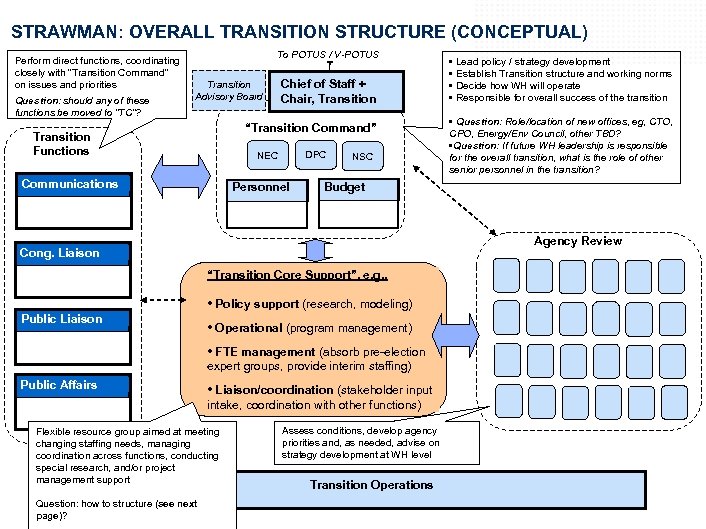
STRAWMAN: OVERALL TRANSITION STRUCTURE (CONCEPTUAL) Perform direct functions, coordinating closely with “Transition Command” on issues and priorities Question: should any of these functions be moved to “TC”? To POTUS / V-POTUS Transition Advisory Board Chief of Staff + Chair, Transition “Transition Command” Transition Functions DPC NEC Communications Personnel NSC Agency Review “Transition Core Support”, e. g. , • Policy support (research, modeling) • Operational (program management) • FTE management (absorb pre-election expert groups, provide interim staffing) Public Affairs • Liaison/coordination (stakeholder input intake, coordination with other functions) Flexible resource group aimed at meeting changing staffing needs, managing coordination across functions, conducting special research, and/or project management support Question: how to structure (see next page)? • Question: Role/location of new offices, eg, CTO, CPO, Energy/Env Council, other TBD? • Question: If future WH leadership is responsible for the overall transition, what is the role of other senior personnel in the transition? Budget Cong. Liaison Public Liaison • Lead policy / strategy development • Establish Transition structure and working norms • Decide how WH will operate • Responsible for overall success of the transition Assess conditions, develop agency priorities and, as needed, advise on strategy development at WH level Transition Operations
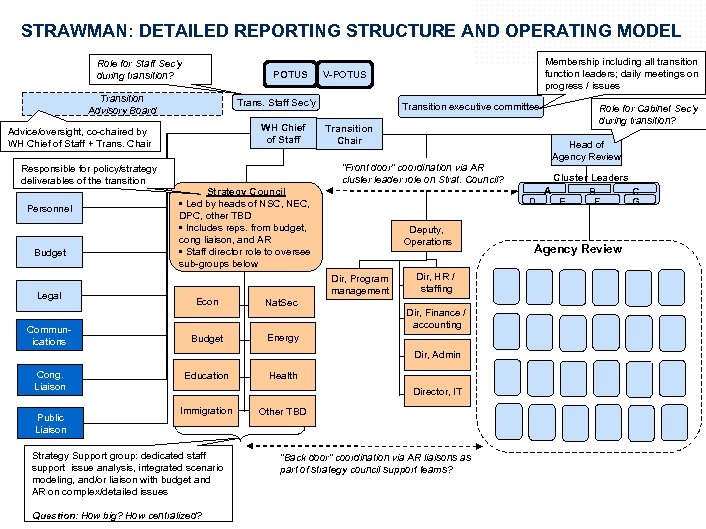
STRAWMAN: DETAILED REPORTING STRUCTURE AND OPERATING MODEL Role for Staff Sec’y during transition? POTUS Transition Advisory Board Trans. Staff Sec’y WH Chief of Staff Advice/oversight, co-chaired by WH Chief of Staff + Trans. Chair Budget Legal Communications Transition executive committee Strategy Council • Led by heads of NSC, NEC, DPC, other TBD • Includes reps. from budget, cong liaison, and AR • Staff director role to oversee sub-groups below Head of Agency Review Nat. Sec Budget Deputy, Operations Dir, HR / staffing Energy Dir, Finance / accounting Dir, Admin Cong. Liaison Public Liaison Education Health Director, IT Immigration Strategy Support group: dedicated staff support issue analysis, integrated scenario modeling, and/or liaison with budget and AR on complex/detailed issues Question: How big? How centralized? A D Dir, Program management Econ Role for Cabinet Sec’y during transition? Transition Chair “Front door” coordination via AR cluster leader role on Strat. Council? Responsible for policy/strategy deliverables of the transition Personnel Membership including all transition function leaders; daily meetings on progress / issues V-POTUS Other TBD “Back door” coordination via AR liaisons as part of strategy council support teams? Cluster Leaders B C F G E Agency Review
NEXT STEPS 1. Finalize detailed reporting relationships, secondary linkages, and governance approach to implement conceptual structure 2. Specify primary activities, decision rights, and deliverables for each structural element 3. Define sub-team structures for each structural element (e. g. , composition of AR teams) 4. Set detailed management calendar, including interim deadlines and major decision dates 5. Finalize budget and day one FTE assignments for all structural elements 6. Finalize operational preparation for day-to-day transition activities 12
Скачать презентацию CONFIDENTIAL Options for Structuring the Transition October 1
8711726c21d3e005236e2fe40178a9a4.ppt