


 Скачать презентацию Conference on the Future of Energy in Enlarged
5020b351edbb184acaec40c363369d77.ppt
- Количество слайдов: 14
 Conference on the Future of Energy in Enlarged Europe: Perspectives for R&D Co-operation Warsaw, 7 -8 October 2004 Roundtable: Hydrogen energy technologies and economy Hydrogen Technologies Leading to a Hydrogen Economy Hanns-Joachim Neef h. j. neef@fz-juelich. de Project Management Organisation Jülich (Projektträger Jülich, PTJ)
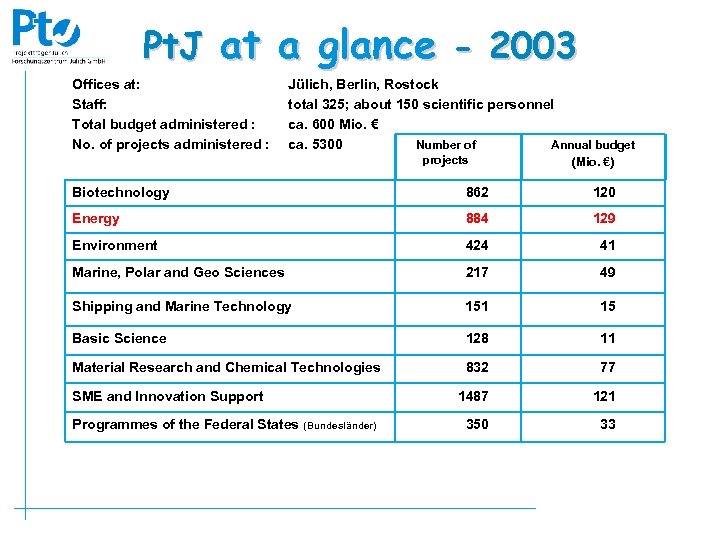 Pt. J at a glance - 2003 Offices at: Staff: Total budget administered : No. of projects administered : Jülich, Berlin, Rostock total 325; about 150 scientific personnel ca. 600 Mio. € Number of Annual budget ca. 5300 projects (Mio. €) Biotechnology 862 120 Energy 884 129 Environment 424 41 Marine, Polar and Geo Sciences 217 49 Shipping and Marine Technology 151 15 Basic Science 128 11 Material Research and Chemical Technologies 832 77 1487 121 350 33 SME and Innovation Support Programmes of the Federal States (Bundesländer)
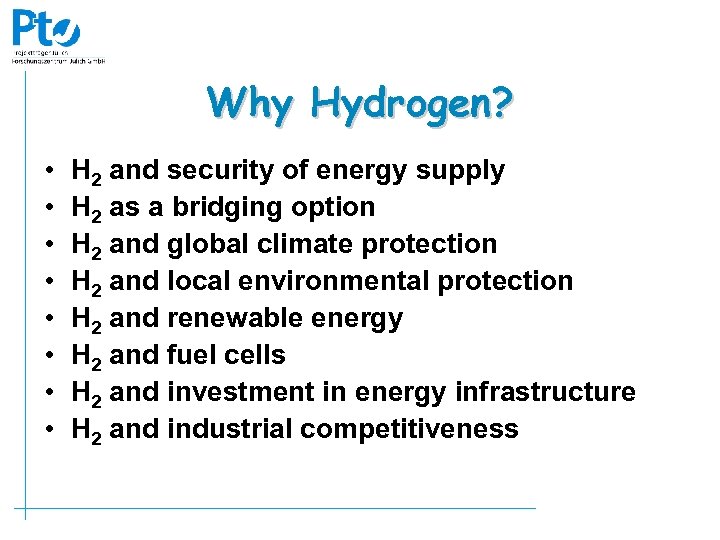 Why Hydrogen? • • H 2 and security of energy supply H 2 as a bridging option H 2 and global climate protection H 2 and local environmental protection H 2 and renewable energy H 2 and fuel cells H 2 and investment in energy infrastructure H 2 and industrial competitiveness
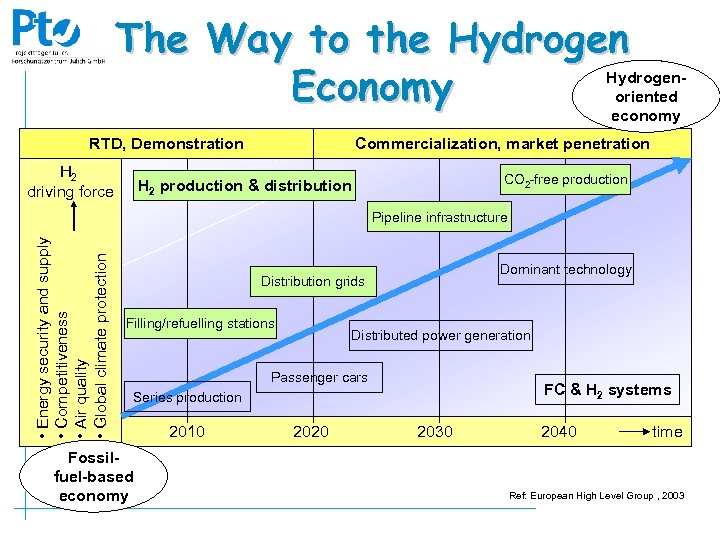 The Way to the Hydrogen Economy Hydrogenoriented economy RTD, Demonstration H 2 driving force Commercialization, market penetration CO 2 -free production H 2 production & distribution • Energy security and supply • Competitiveness • Air quality • Global climate protection Pipeline infrastructure Dominant technology Distribution grids Filling/refuelling stations Distributed power generation Passenger cars FC & H 2 systems Series production Fossilfuel-based economy 2010 2020 2030 2040 time Ref: European High Level Group , 2003
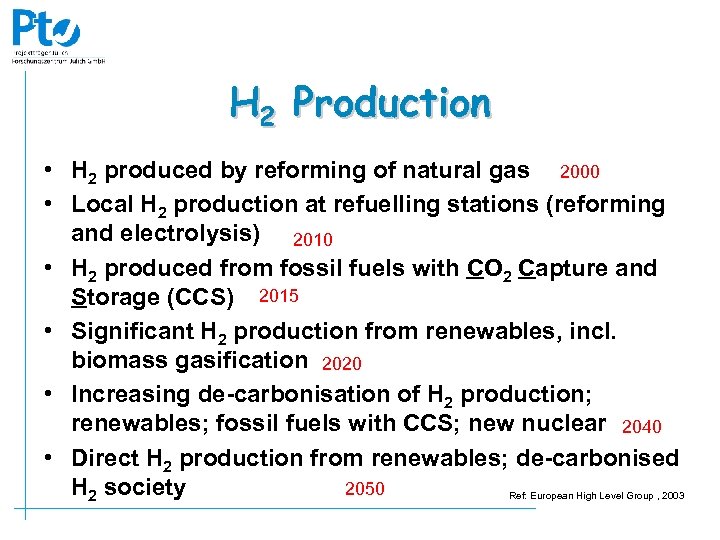 H 2 Production • H 2 produced by reforming of natural gas 2000 • Local H 2 production at refuelling stations (reforming and electrolysis) 2010 • H 2 produced from fossil fuels with CO 2 Capture and Storage (CCS) 2015 • Significant H 2 production from renewables, incl. biomass gasification 2020 • Increasing de-carbonisation of H 2 production; renewables; fossil fuels with CCS; new nuclear 2040 • Direct H 2 production from renewables; de-carbonised H 2 society 2050 Ref: European High Level Group , 2003
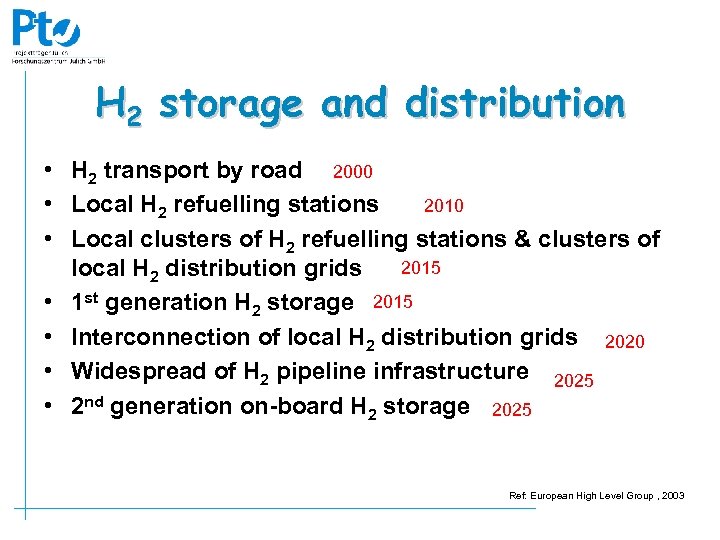 H 2 storage and distribution • H 2 transport by road 2000 2010 • Local H 2 refuelling stations • Local clusters of H 2 refuelling stations & clusters of 2015 local H 2 distribution grids • 1 st generation H 2 storage 2015 • Interconnection of local H 2 distribution grids 2020 • Widespread of H 2 pipeline infrastructure 2025 • 2 nd generation on-board H 2 storage 2025 Ref: European High Level Group , 2003
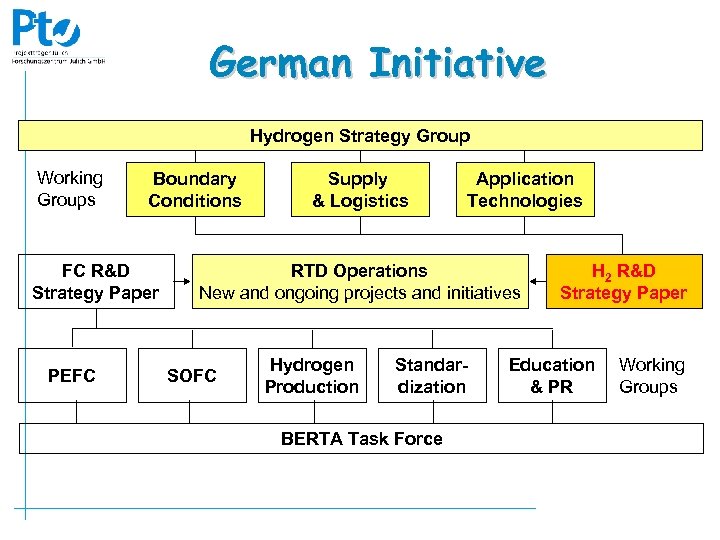 German Initiative Hydrogen Strategy Group Working Groups Boundary Conditions FC R&D Strategy Paper PEFC Supply & Logistics Application Technologies RTD Operations New and ongoing projects and initiatives SOFC Hydrogen Production Standardization BERTA Task Force H 2 R&D Strategy Paper Education & PR Working Groups
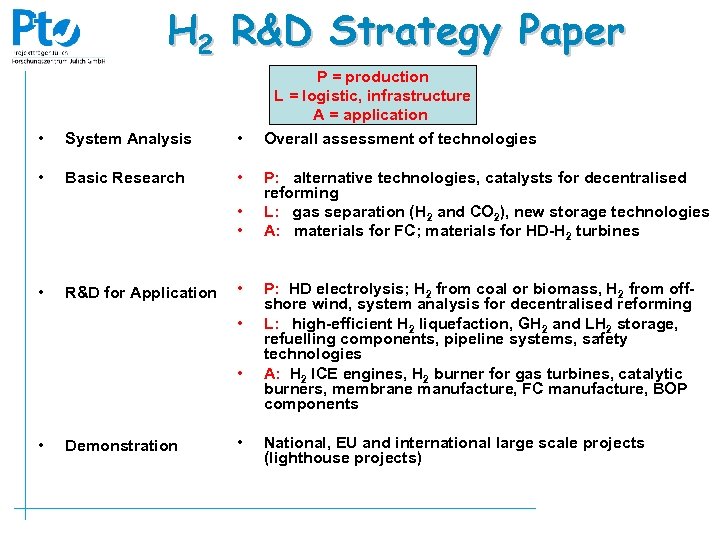 H 2 R&D Strategy Paper • System Analysis • • Basic Research • • R&D for Application • • Demonstration • P = production L = logistic, infrastructure A = application Overall assessment of technologies P: alternative technologies, catalysts for decentralised reforming L: gas separation (H 2 and CO 2), new storage technologies A: materials for FC; materials for HD-H 2 turbines P: HD electrolysis; H 2 from coal or biomass, H 2 from offshore wind, system analysis for decentralised reforming L: high-efficient H 2 liquefaction, GH 2 and LH 2 storage, refuelling components, pipeline systems, safety technologies A: H 2 ICE engines, H 2 burner for gas turbines, catalytic burners, membrane manufacture, FC manufacture, BOP components National, EU and international large scale projects (lighthouse projects)
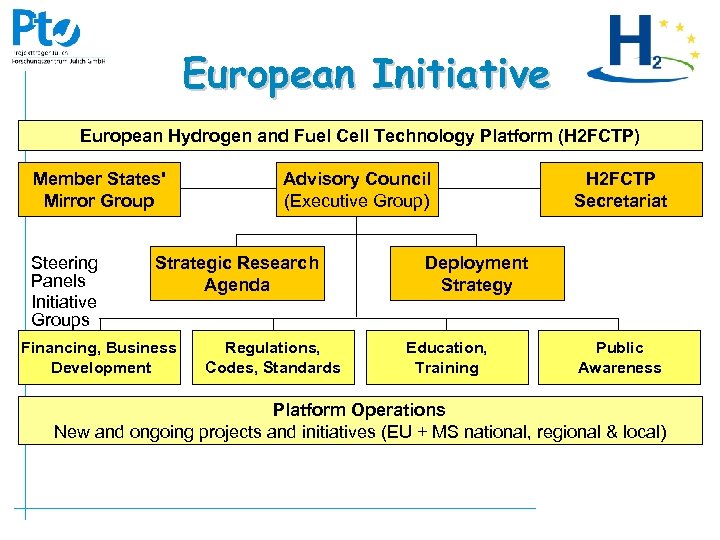 European Initiative European Hydrogen and Fuel Cell Technology Platform (H 2 FCTP) Member States' Mirror Group Steering Panels Initiative Groups Advisory Council (Executive Group) Strategic Research Agenda Financing, Business Development Regulations, Codes, Standards H 2 FCTP Secretariat Deployment Strategy Education, Training Public Awareness Platform Operations New and ongoing projects and initiatives (EU + MS national, regional & local)
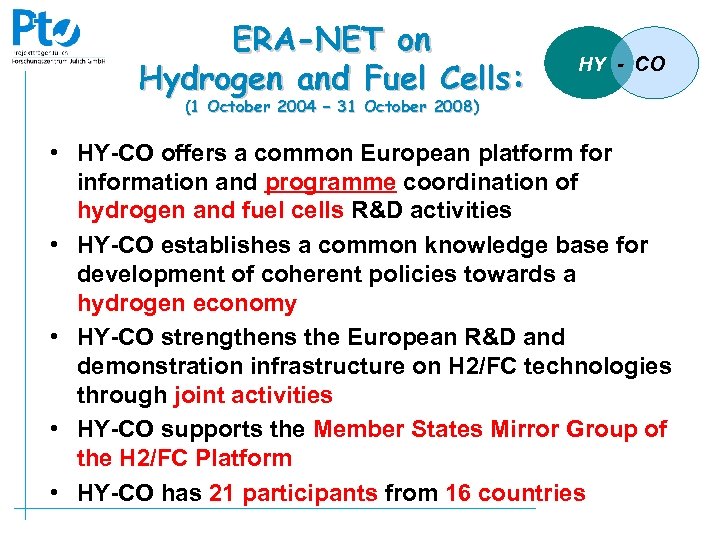 ERA-NET on Hydrogen and Fuel Cells: HY - CO (1 October 2004 – 31 October 2008) • HY-CO offers a common European platform for information and programme coordination of hydrogen and fuel cells R&D activities • HY-CO establishes a common knowledge base for development of coherent policies towards a hydrogen economy • HY-CO strengthens the European R&D and demonstration infrastructure on H 2/FC technologies through joint activities • HY-CO supports the Member States Mirror Group of the H 2/FC Platform • HY-CO has 21 participants from 16 countries
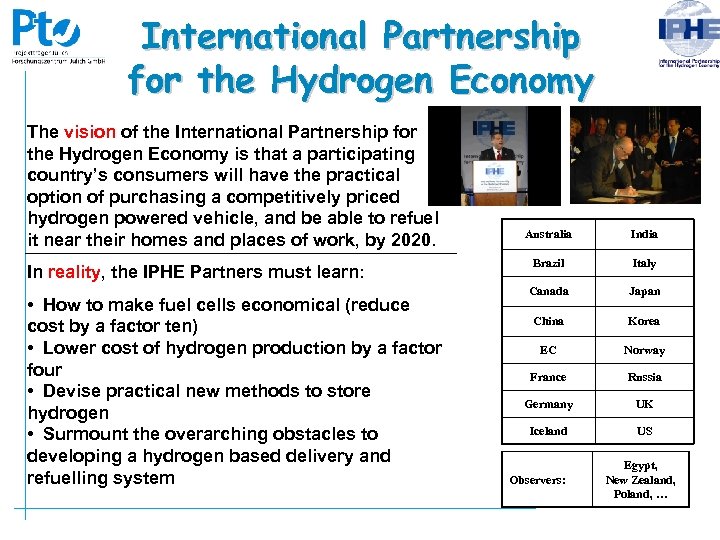 International Partnership for the Hydrogen Economy The vision of the International Partnership for the Hydrogen Economy is that a participating country’s consumers will have the practical option of purchasing a competitively priced hydrogen powered vehicle, and be able to refuel it near their homes and places of work, by 2020. In reality, the IPHE Partners must learn: • How to make fuel cells economical (reduce cost by a factor ten) • Lower cost of hydrogen production by a factor four • Devise practical new methods to store hydrogen • Surmount the overarching obstacles to developing a hydrogen based delivery and refuelling system Australia India Brazil Italy Canada Japan China Korea EC Norway France Russia Germany UK Iceland US Observers: Egypt, New Zealand, Poland, …
 IPHE Analysis of Options for International Co-operation • Innovative and Alternative Production Processes of Hydrogen • Collaborative Fuel Cell R&D under the IPHE • Hydrogen Storage • Collaborative Activities on Regulations, Codes and Standards for the Hydrogen Economy • Socio-economics of Hydrogen
 H 2/FC Activities at the International Energy Agency • International Cooperation Projects (Implementing Agreements, IAs) – Hydrogen IA – Advanced Fuel Cells IA – Several other IAs related to H 2/FC (Alternative Motor Fuels; Greenhouse Gas R&D; System Analysis; …) • Hydrogen Co-ordination Group (HCG) • Energy Technology Perspective Project (Markalbased technical-economic modelling)
 Conclusions • We need new and improved technologies – otherwise the Hydrogen Economy will not be competitive • Incentives to develop advanced technologies could speed their deployment and alter energy investment patterns • Rules for successful international cooperation – – You need added value – like the other partners You get most out of it if you invest your own resources You need internal coordination and dissemination You need a contractual framework with Ø Clear objectives Ø Clear programme of work Ø Clear rules Ø Efficient management Thank you