 Скачать презентацию Conference Feedback For 6 th UK-CAB 8 th
55391dbc0fe4b5034bbad57e2dac6077.ppt
- Количество слайдов: 27



Conference Feedback For 6 th UK-CAB 8 th August 2003 Simon Collins HIV i-Base UK-CAB August 2003
Online abstracts • XII Resistance Workshop, Mexico http: //www. mediscover. net/journals. cfm • 5 th Lipodystrophy Workshop, Paris http: //www. intmedpress. com • 2 nd IAS Conference, Paris http: //ww 2. aegis. org/conferences/2 nd. IASHIVPT/ias. pdf Require Adobe Acrobat Reader (free software) from http: //www. adobe. com Or follow link from i-Base home page http: //www. i-Base. info UK-CAB August 2003
XII Resistance Meeting • Resistance meeting usually based on research more than clinical studies, but an indication of the importance of research is that most discoveries that lead to changes in treatment practice were first presented as early data to these annual meetings. • Only around 120 scientists attend [+ very few community – this isn’t so good…] • Every scientist presents a paper – and every paper is very interesting • The next studies were all new, and relevant to clinical care UK-CAB August 2003
Clinical Studies • • Transmission of drug resistance Co-infection, reinfection, superinfection Single dose nevirapine (75% MTCT) Effectiveness of resistance tests Cross resistance between NNRTIs Resisdual activity of drugs Tenofovir resistance UK-CAB August 2003
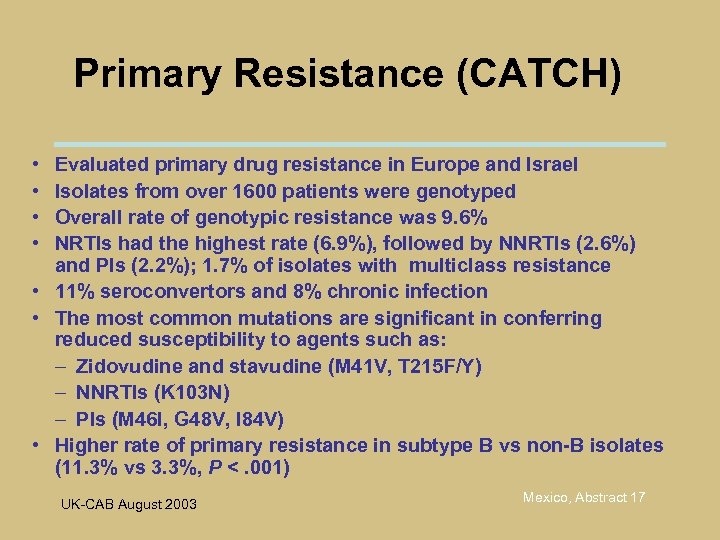
Primary Resistance (CATCH) • • Evaluated primary drug resistance in Europe and Israel Isolates from over 1600 patients were genotyped Overall rate of genotypic resistance was 9. 6% NRTIs had the highest rate (6. 9%), followed by NNRTIs (2. 6%) and PIs (2. 2%); 1. 7% of isolates with multiclass resistance • 11% seroconvertors and 8% chronic infection • The most common mutations are significant in conferring reduced susceptibility to agents such as: – Zidovudine and stavudine (M 41 V, T 215 F/Y) – NNRTIs (K 103 N) – PIs (M 46 I, G 48 V, I 84 V) • Higher rate of primary resistance in subtype B vs non-B isolates (11. 3% vs 3. 3%, P <. 001) UK-CAB August 2003 Mexico, Abstract 17
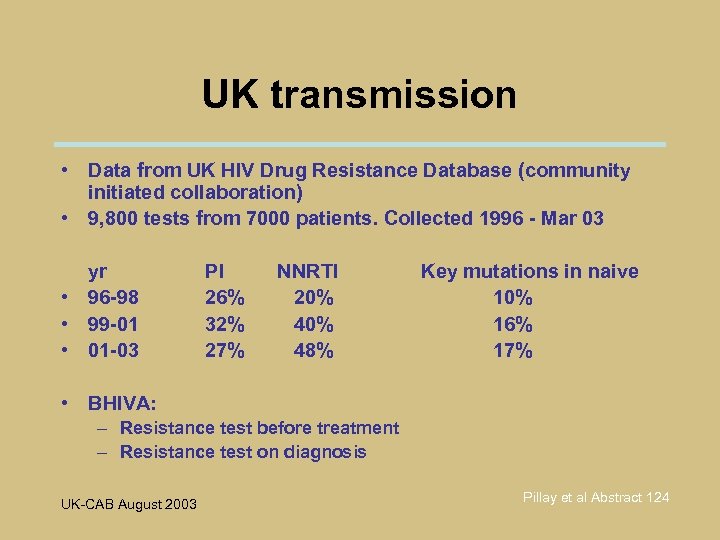
UK transmission • Data from UK HIV Drug Resistance Database (community initiated collaboration) • 9, 800 tests from 7000 patients. Collected 1996 - Mar 03 yr • 96 -98 • 99 -01 • 01 -03 PI 26% 32% 27% NNRTI 20% 48% Key mutations in naive 10% 16% 17% • BHIVA: – Resistance test before treatment – Resistance test on diagnosis UK-CAB August 2003 Pillay et al Abstract 124
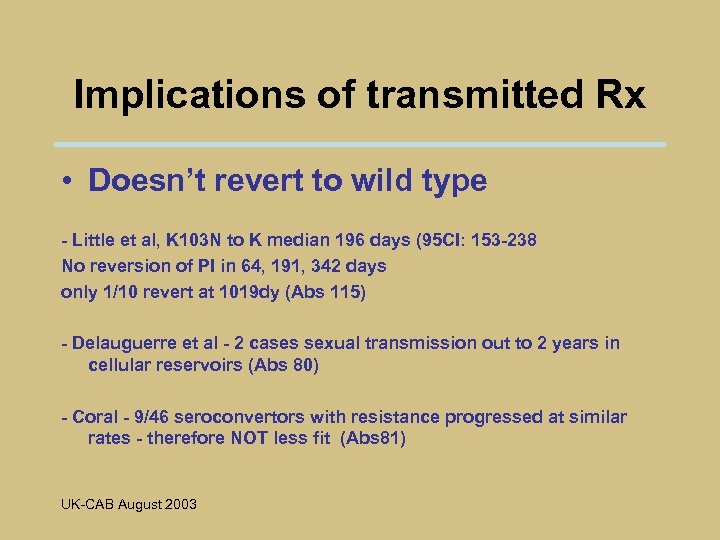
Implications of transmitted Rx • Doesn’t revert to wild type - Little et al, K 103 N to K median 196 days (95 CI: 153 -238 No reversion of PI in 64, 191, 342 days only 1/10 revert at 1019 dy (Abs 115) - Delauguerre et al - 2 cases sexual transmission out to 2 years in cellular reservoirs (Abs 80) - Coral - 9/46 seroconvertors with resistance progressed at similar rates - therefore NOT less fit (Abs 81) UK-CAB August 2003
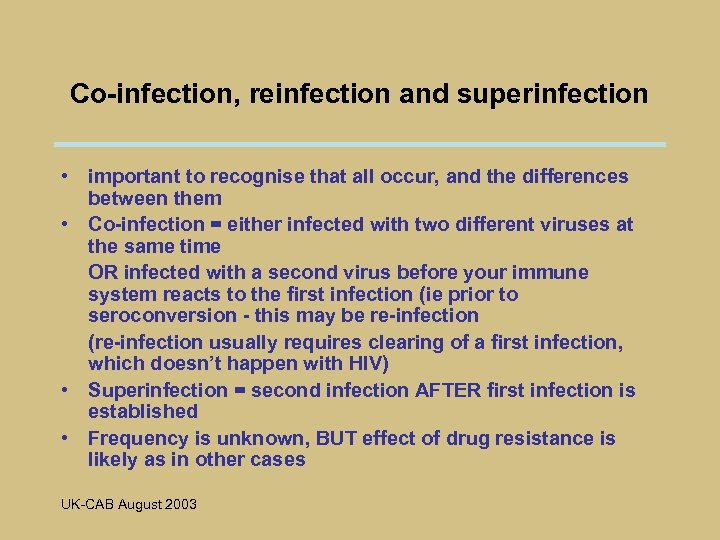
Co-infection, reinfection and superinfection • important to recognise that all occur, and the differences between them • Co-infection = either infected with two different viruses at the same time OR infected with a second virus before your immune system reacts to the first infection (ie prior to seroconversion - this may be re-infection (re-infection usually requires clearing of a first infection, which doesn’t happen with HIV) • Superinfection = second infection AFTER first infection is established • Frequency is unknown, BUT effect of drug resistance is likely as in other cases UK-CAB August 2003
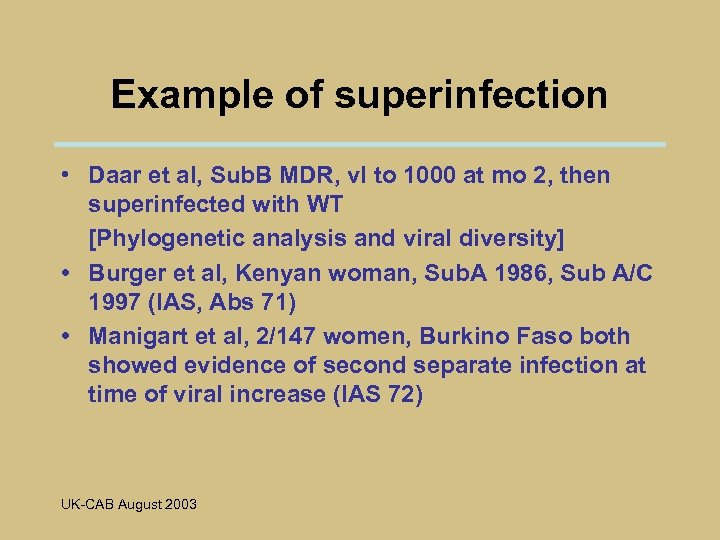
Example of superinfection • Daar et al, Sub. B MDR, vl to 1000 at mo 2, then superinfected with WT [Phylogenetic analysis and viral diversity] • Burger et al, Kenyan woman, Sub. A 1986, Sub A/C 1997 (IAS, Abs 71) • Manigart et al, 2/147 women, Burkino Faso both showed evidence of second separate infection at time of viral increase (IAS 72) UK-CAB August 2003
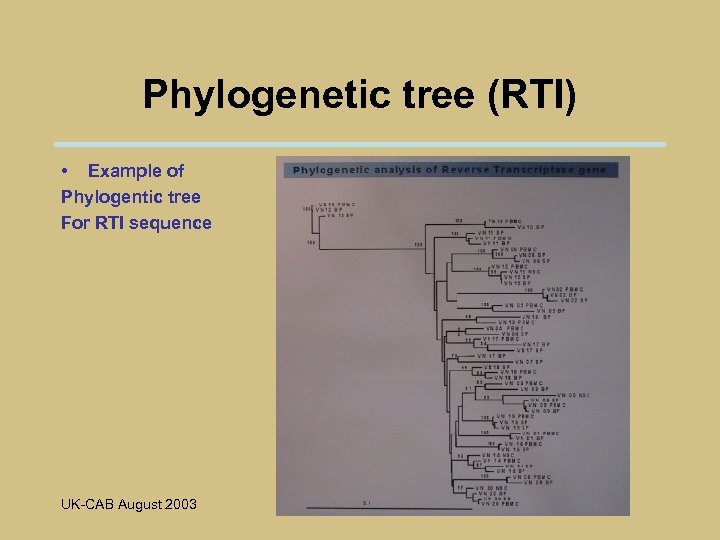
Phylogenetic tree (RTI) • Example of Phylogentic tree For RTI sequence UK-CAB August 2003
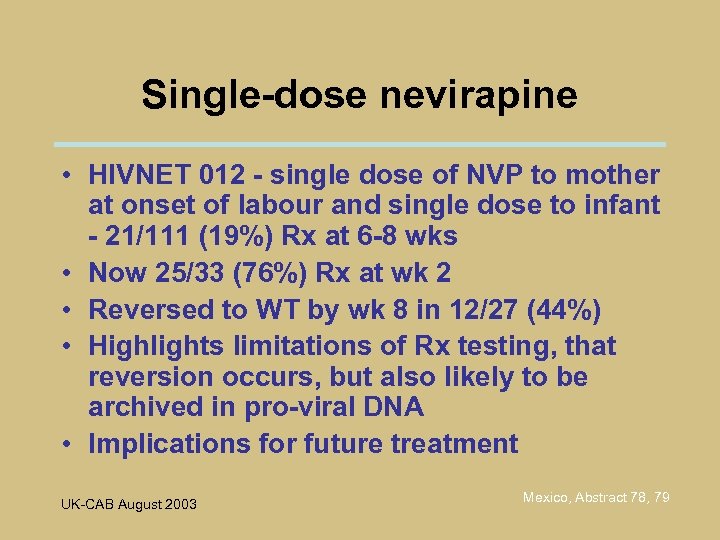
Single-dose nevirapine • HIVNET 012 - single dose of NVP to mother at onset of labour and single dose to infant - 21/111 (19%) Rx at 6 -8 wks • Now 25/33 (76%) Rx at wk 2 • Reversed to WT by wk 8 in 12/27 (44%) • Highlights limitations of Rx testing, that reversion occurs, but also likely to be archived in pro-viral DNA • Implications for future treatment UK-CAB August 2003 Mexico, Abstract 78, 79
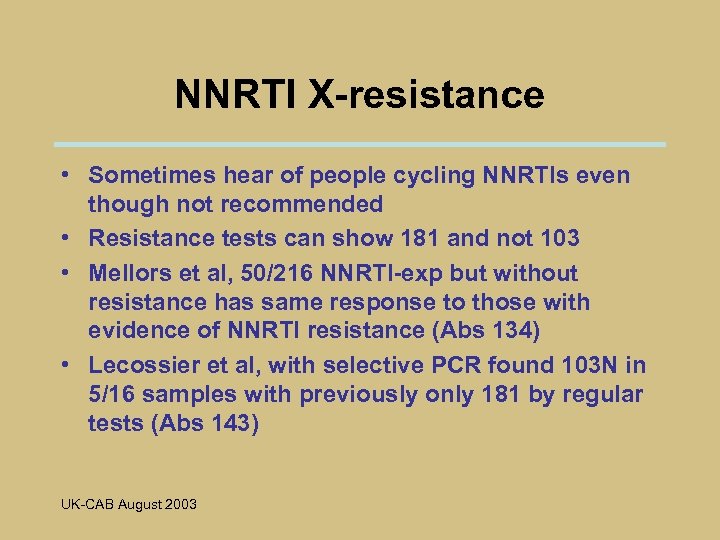
NNRTI X-resistance • Sometimes hear of people cycling NNRTIs even though not recommended • Resistance tests can show 181 and not 103 • Mellors et al, 50/216 NNRTI-exp but without resistance has same response to those with evidence of NNRTI resistance (Abs 134) • Lecossier et al, with selective PCR found 103 N in 5/16 samples with previously only 181 by regular tests (Abs 143) UK-CAB August 2003
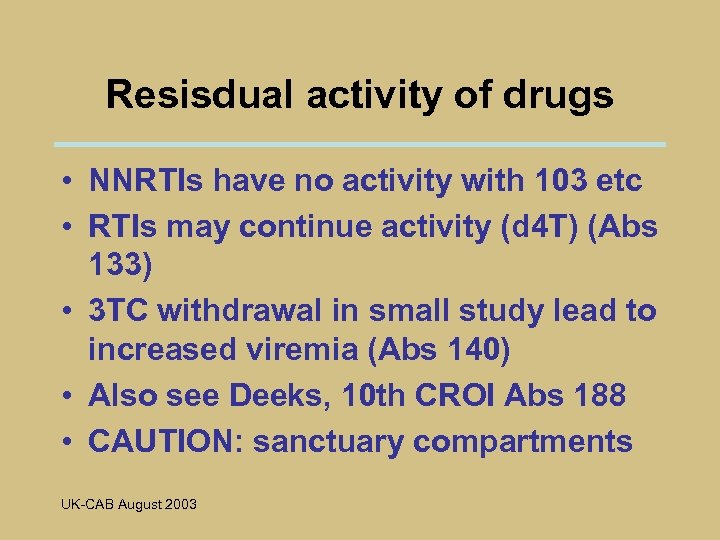
Resisdual activity of drugs • NNRTIs have no activity with 103 etc • RTIs may continue activity (d 4 T) (Abs 133) • 3 TC withdrawal in small study lead to increased viremia (Abs 140) • Also see Deeks, 10 th CROI Abs 188 • CAUTION: sanctuary compartments UK-CAB August 2003
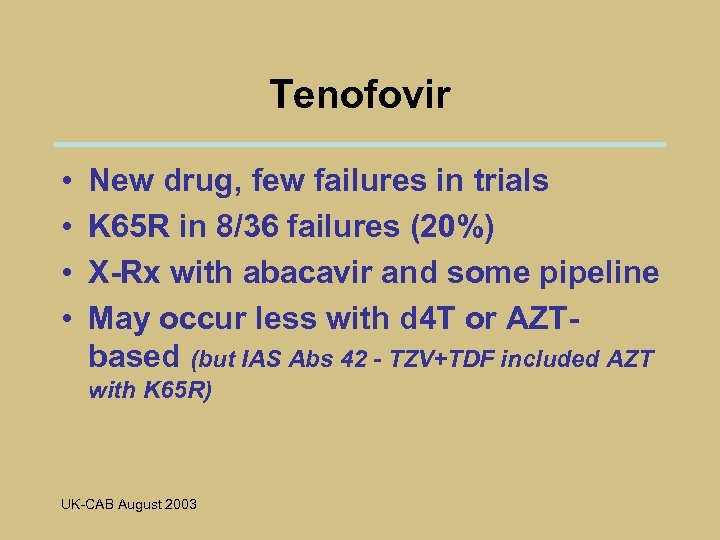
Tenofovir • • New drug, few failures in trials K 65 R in 8/36 failures (20%) X-Rx with abacavir and some pipeline May occur less with d 4 T or AZTbased (but IAS Abs 42 - TZV+TDF included AZT with K 65 R) UK-CAB August 2003
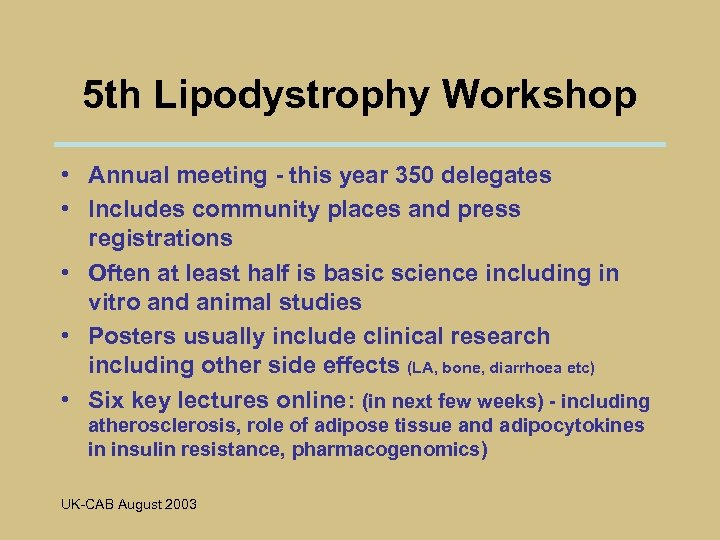
5 th Lipodystrophy Workshop • Annual meeting - this year 350 delegates • Includes community places and press registrations • Often at least half is basic science including in vitro and animal studies • Posters usually include clinical research including other side effects (LA, bone, diarrhoea etc) • Six key lectures online: (in next few weeks) - including atherosclerosis, role of adipose tissue and adipocytokines in insulin resistance, pharmacogenomics) UK-CAB August 2003
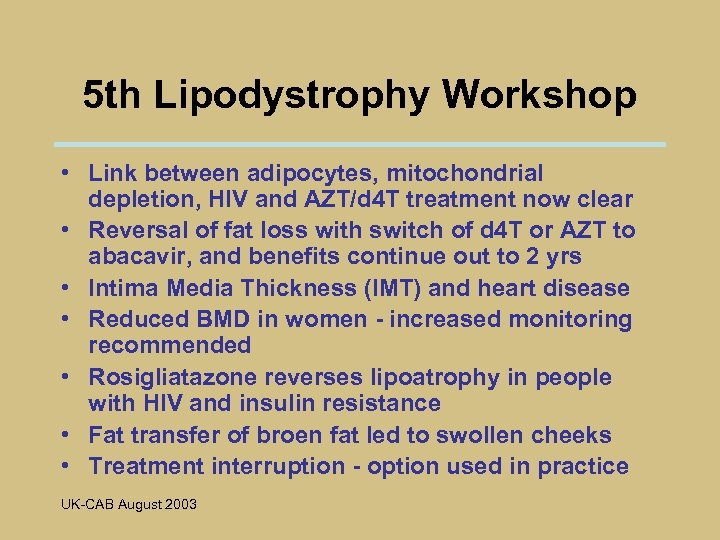
5 th Lipodystrophy Workshop • Link between adipocytes, mitochondrial depletion, HIV and AZT/d 4 T treatment now clear • Reversal of fat loss with switch of d 4 T or AZT to abacavir, and benefits continue out to 2 yrs • Intima Media Thickness (IMT) and heart disease • Reduced BMD in women - increased monitoring recommended • Rosigliatazone reverses lipoatrophy in people with HIV and insulin resistance • Fat transfer of broen fat led to swollen cheeks • Treatment interruption - option used in practice UK-CAB August 2003
Morphology of adipose tissue • Several groups are reporting very exciting and important work looking closely at fat cells and comparing HIV-negative, HIV-positive untreated, and by exposure to different treatment (ie d 4 T, AZT and other nukes or PI) Caron, Bastard et al, Lancet 2003] Nolan, Mallal et al, AIDS 2003; 17(9): 1329 -1338 • The Australian group (Nolan et al) also reported looking at mitochondrial differences in fat cells form these different groups, and showed correlation of damage to treatment: d 4 T use > AZT use > HIV+ naïve > HIV-negative UK-CAB August 2003
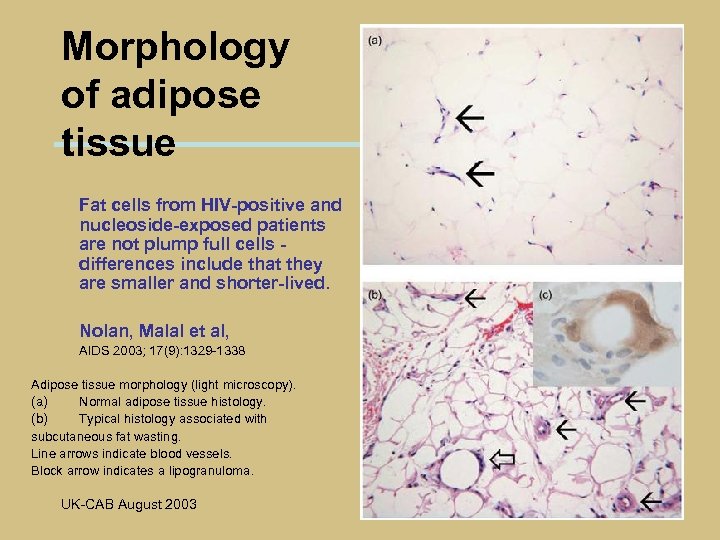
Morphology of adipose tissue Fat cells from HIV-positive and nucleoside-exposed patients are not plump full cells differences include that they are smaller and shorter-lived. Nolan, Malal et al, AIDS 2003; 17(9): 1329 -1338 Adipose tissue morphology (light microscopy). (a) Normal adipose tissue histology. (b) Typical histology associated with subcutaneous fat wasting. Line arrows indicate blood vessels. Block arrow indicates a lipogranuloma. UK-CAB August 2003
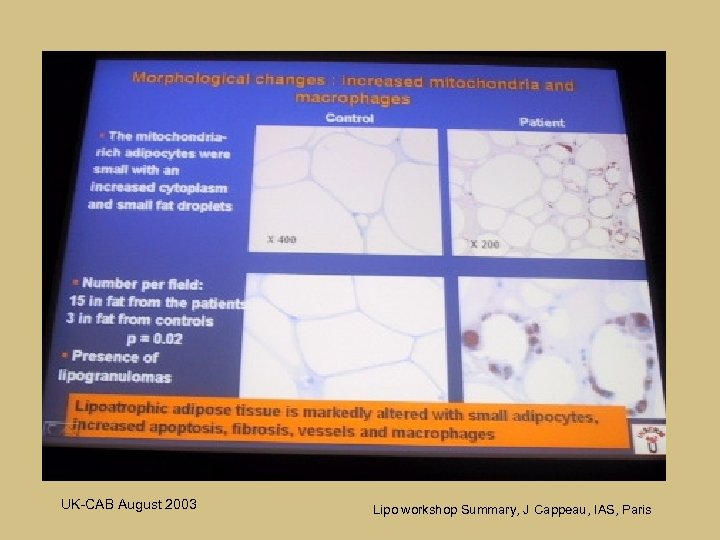
Lipoatrophic tissue UK-CAB August 2003 Lipo workshop Summary, J Cappeau, IAS, Paris
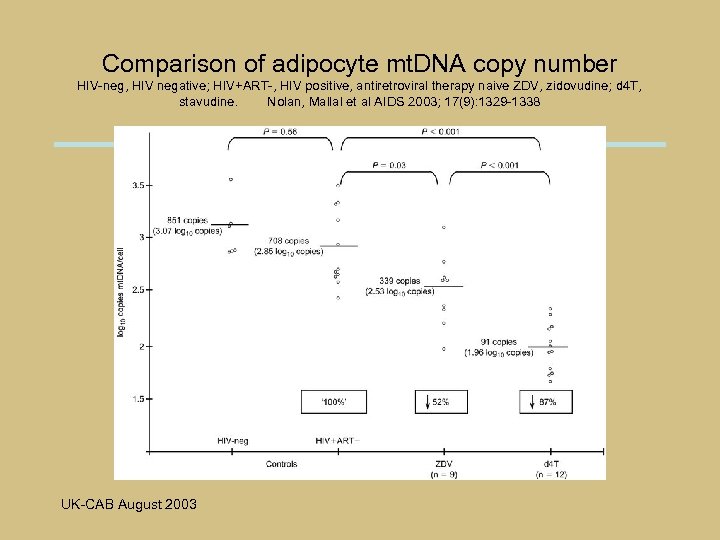
Comparison of adipocyte mt. DNA copy number HIV-neg, HIV negative; HIV+ART-, HIV positive, antiretroviral therapy naive ZDV, zidovudine; d 4 T, stavudine. Nolan, Mallal et al AIDS 2003; 17(9): 1329 -1338 UK-CAB August 2003
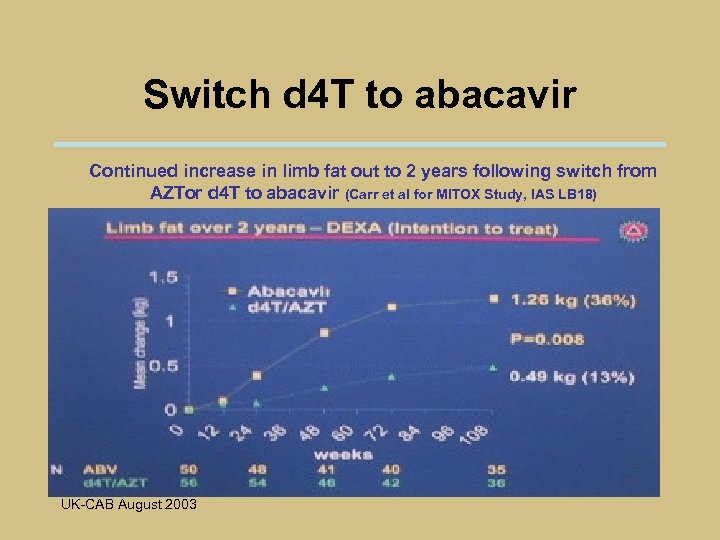
Switch d 4 T to abacavir Continued increase in limb fat out to 2 years following switch from AZTor d 4 T to abacavir (Carr et al for MITOX Study, IAS LB 18) UK-CAB August 2003
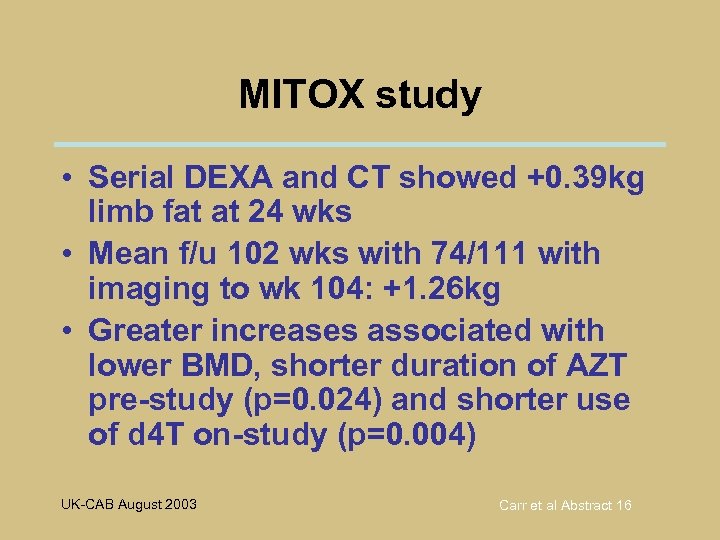
MITOX study • Serial DEXA and CT showed +0. 39 kg limb fat at 24 wks • Mean f/u 102 wks with 74/111 with imaging to wk 104: +1. 26 kg • Greater increases associated with lower BMD, shorter duration of AZT pre-study (p=0. 024) and shorter use of d 4 T on-study (p=0. 004) UK-CAB August 2003 Carr et al Abstract 16
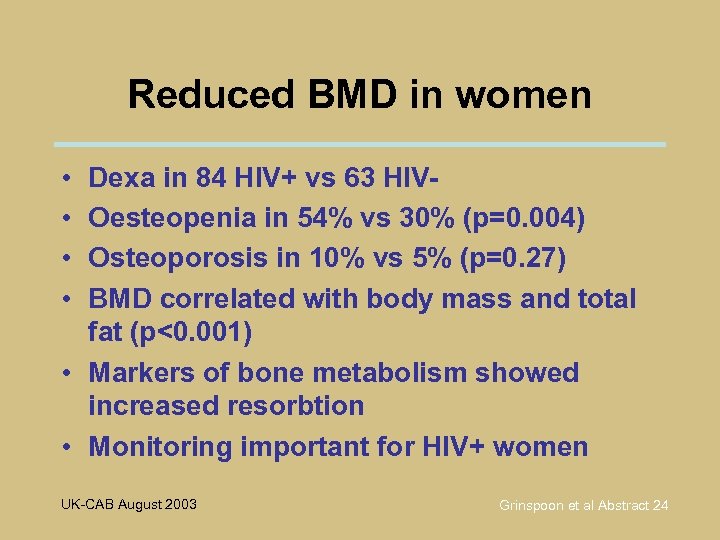
Reduced BMD in women • • Dexa in 84 HIV+ vs 63 HIVOesteopenia in 54% vs 30% (p=0. 004) Osteoporosis in 10% vs 5% (p=0. 27) BMD correlated with body mass and total fat (p<0. 001) • Markers of bone metabolism showed increased resorbtion • Monitoring important for HIV+ women UK-CAB August 2003 Grinspoon et al Abstract 24
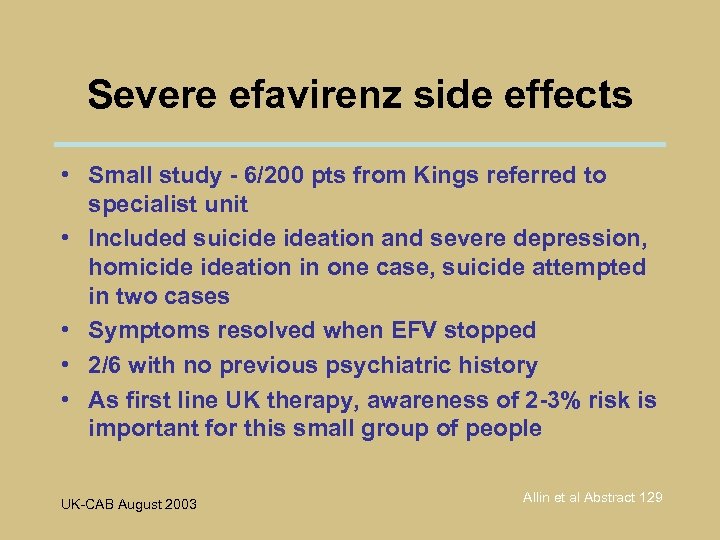
Severe efavirenz side effects • Small study - 6/200 pts from Kings referred to specialist unit • Included suicide ideation and severe depression, homicide ideation in one case, suicide attempted in two cases • Symptoms resolved when EFV stopped • 2/6 with no previous psychiatric history • As first line UK therapy, awareness of 2 -3% risk is important for this small group of people UK-CAB August 2003 Allin et al Abstract 129
Further Reading Reports by Mark Mascolini: (Each approx 30 pages) • XII Resistance Workshop, Mexico http: //www. ias. se/pdf/625. pdf • 2 nd IAS Meeting http: //www. ias. se/pdf/632. pdf UK-CAB August 2003
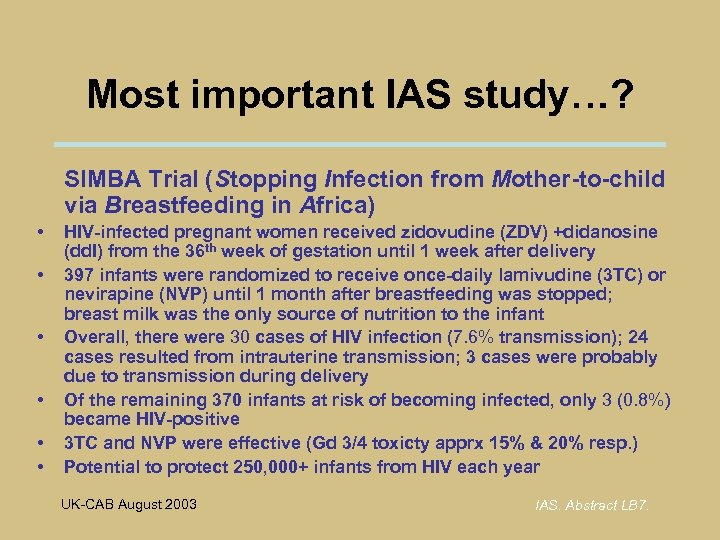
Most important IAS study…? SIMBA Trial (Stopping Infection from Mother-to-child via Breastfeeding in Africa) • • • HIV-infected pregnant women received zidovudine (ZDV) +didanosine (dd. I) from the 36 th week of gestation until 1 week after delivery 397 infants were randomized to receive once-daily lamivudine (3 TC) or nevirapine (NVP) until 1 month after breastfeeding was stopped; breast milk was the only source of nutrition to the infant Overall, there were 30 cases of HIV infection (7. 6% transmission); 24 cases resulted from intrauterine transmission; 3 cases were probably due to transmission during delivery Of the remaining 370 infants at risk of becoming infected, only 3 (0. 8%) became HIV-positive 3 TC and NVP were effective (Gd 3/4 toxicty apprx 15% & 20% resp. ) Potential to protect 250, 000+ infants from HIV each year UK-CAB August 2003 IAS. Abstract LB 7.

UK-CAB. 6 • 8 th August 2003 • Training sessions: Conference Feedback Sessions • Afternoon: GSK UK-CAB August 2003
Скачать презентацию Conference Feedback For 6 th UK-CAB 8 th
55391dbc0fe4b5034bbad57e2dac6077.ppt