 Скачать презентацию Conduction heat transfer Bogdan Mirzakabilov 1001200 Conduction
heat transf.pptx
- Количество слайдов: 6



Conduction heat transfer Bogdan Mirzakabilov, 1001200
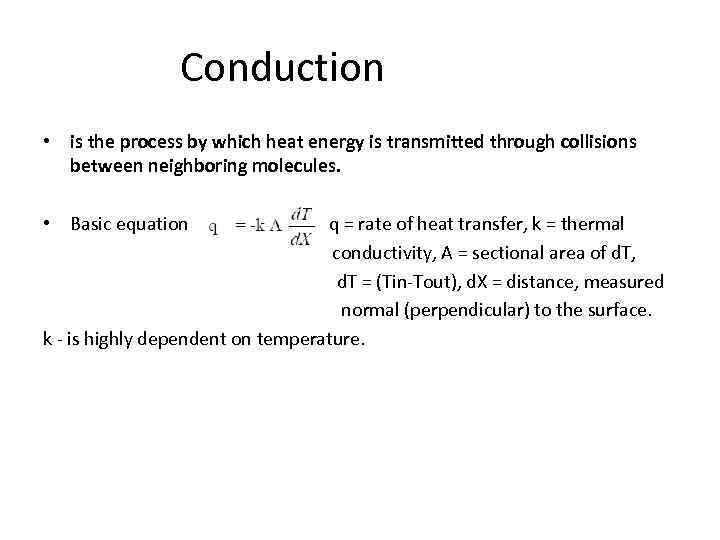
Conduction • is the process by which heat energy is transmitted through collisions between neighboring molecules. • Basic equation q = rate of heat transfer, k = thermal conductivity, A = sectional area of d. T, d. T = (Tin-Tout), d. X = distance, measured normal (perpendicular) to the surface. k - is highly dependent on temperature.
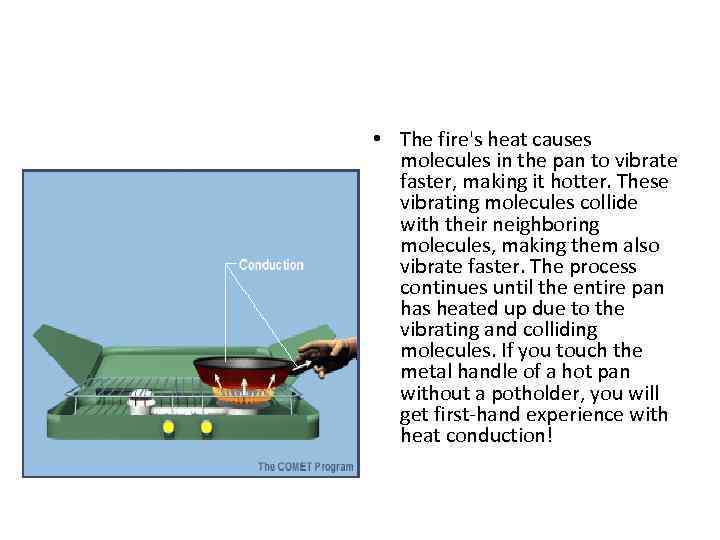
• The fire's heat causes molecules in the pan to vibrate faster, making it hotter. These vibrating molecules collide with their neighboring molecules, making them also vibrate faster. The process continues until the entire pan has heated up due to the vibrating and colliding molecules. If you touch the metal handle of a hot pan without a potholder, you will get first-hand experience with heat conduction!
• Solids, such as metals, are good heat conductors, while others, such as wood, are poor conductors. Metals have more free electrons than insulators, which is why are very good conductors of heat. • Air and water are relatively poor conductors and thus are called insulators.
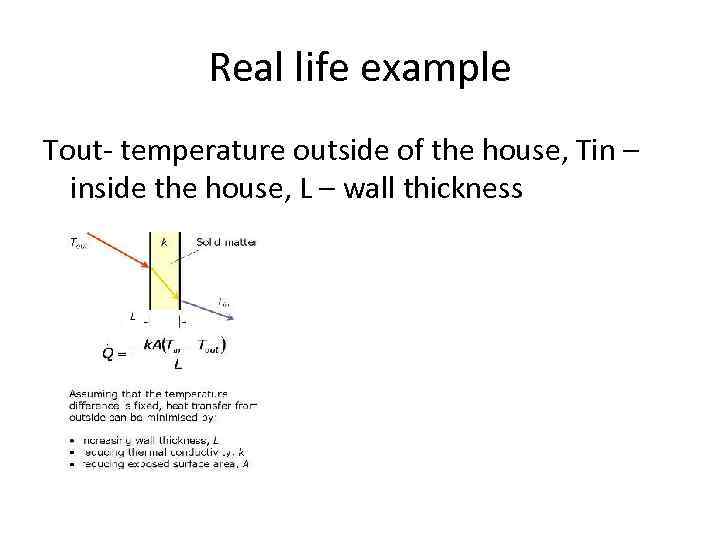
Real life example Tout- temperature outside of the house, Tin – inside the house, L – wall thickness
sources: • http: //www. ucar. edu/learn/1_1_2_6 t. htm • http: //www. ehow. com/way_5179543_heatconduction-experiments. html • http: //www. air-conditionerselection. com/radiation-conductionconvection. html • http: //steamofboiler. blogspot. com/2011/08/c onduction-heat-transfer. html
Скачать презентацию Conduction heat transfer Bogdan Mirzakabilov 1001200 Conduction
heat transf.pptx