


 Скачать презентацию Conducting Clinical Trials Under HIPAA — Implications For
ccff957a41399418ef2aaecc19f71bd6.ppt
- Количество слайдов: 63
 Conducting Clinical Trials Under HIPAA - Implications For Sponsors Pharmaceutical Regulatory and Compliance Congress and Best Practices Forum Philadelphia, November 13 -15, 2002 Carol A. Pratt, Ph. D. , JD Davis Wright Tremaine LLP Portland, OR Seattle, San Francisco, Los Angeles, NY, Wash. . DC, Anchorage, Honolulu (503) 778 -5279 carolpratt@dwt. com Copyright 2002 Carol A. Pratt 1
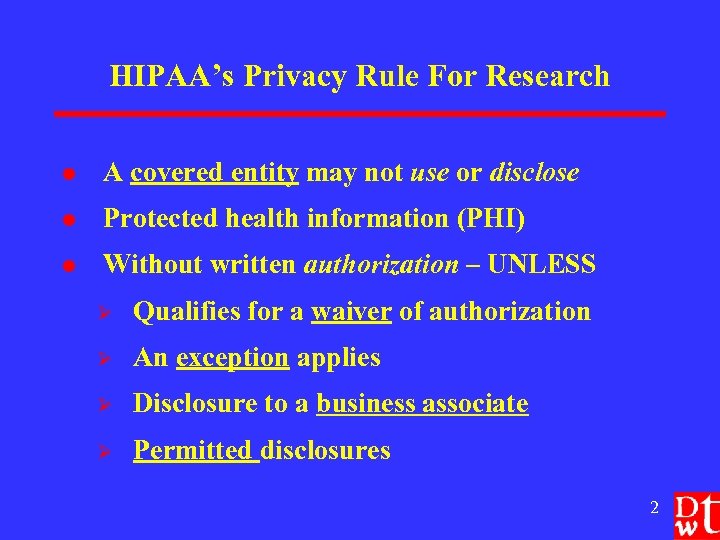 HIPAA’s Privacy Rule For Research l A covered entity may not use or disclose l Protected health information (PHI) l Without written authorization – UNLESS Ø Qualifies for a waiver of authorization Ø An exception applies Ø Disclosure to a business associate Ø Permitted disclosures 2
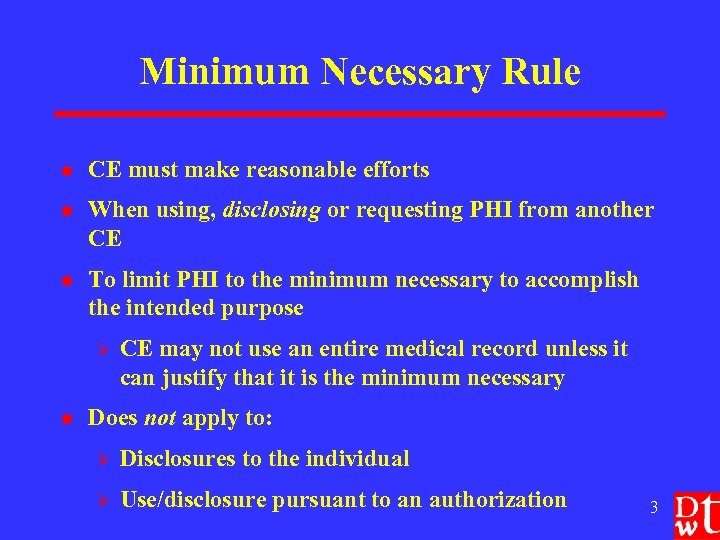 Minimum Necessary Rule l CE must make reasonable efforts l When using, disclosing or requesting PHI from another CE l To limit PHI to the minimum necessary to accomplish the intended purpose Ø l CE may not use an entire medical record unless it can justify that it is the minimum necessary Does not apply to: Ø Disclosures to the individual Ø Use/disclosure pursuant to an authorization 3
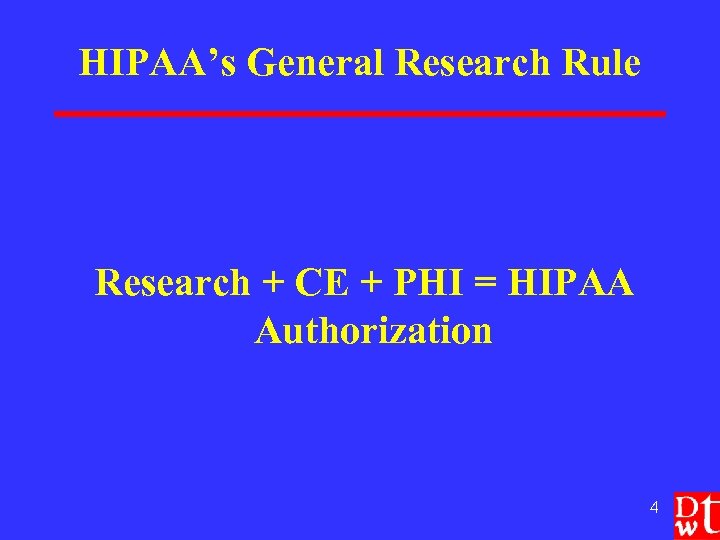 HIPAA’s General Research Rule Research + CE + PHI = HIPAA Authorization 4
 Does HIPAA Apply? Research + CE + PHI = HIPAA Authorization 1. Is it “research”? 2. Is a “covered entity” involved? 3. Is it “PHI”? 5
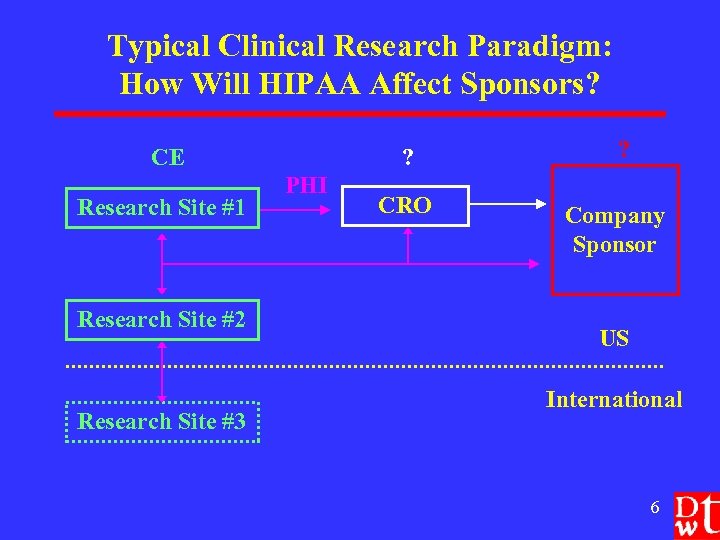 Typical Clinical Research Paradigm: How Will HIPAA Affect Sponsors? CE Research Site #1 Research Site #2 Research Site #3 ? PHI CRO ? Company Sponsor US International 6
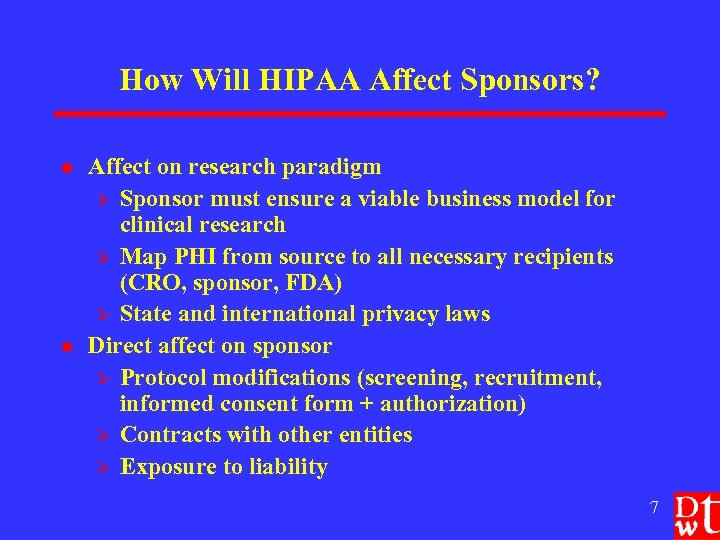 How Will HIPAA Affect Sponsors? l l Affect on research paradigm Ø Sponsor must ensure a viable business model for clinical research Ø Map PHI from source to all necessary recipients (CRO, sponsor, FDA) Ø State and international privacy laws Direct affect on sponsor Ø Protocol modifications (screening, recruitment, informed consent form + authorization) Ø Contracts with other entities Ø Exposure to liability 7
 How Will HIPAA Affect Sponsors? HIPAA will increase the liability risk for failure to protect privacy in medical research 8
 HIPAA’s Enforcement Provisions Who is subject to HIPAA’s penalties? Ø Any “person” who Ø l Civil penalty Ø l Obtains or discloses PHI in violation of HIPAA $100 each violation, up to $25, 000/person/year Criminal Penalties Ø Knowingly: < $50, 000, 1 yr. jail Ø False pretenses: < 100, 000, 5 yrs. jail Ø With intent to sell, transfer, or use for commercial advantage or personal gain: < $250, 000, 10 yrs. jail 9
 Does HIPAA Apply? Research + CE + PHI = HIPAA Authorization 1. Is it “research”? 2. Is a “covered entity” involved? 3. Is it “PHI”? 10
 What is “Research”? l l HIPAA = Common Rule Any systematic investigation, Designed to develop or contribute to generalizable knowledge (not just for knowledge or treatment of that subject) and Involves human subjects Ø HIPAA: applies to living and deceased persons Ø Common Rule and FDA regulations: apply only to “living” persons 11
 What is “Research”? l l Protocol development Development of research registries or databases Ø OHRP: Development of a repository or database for future research purposes is research. http: //ohrp. osophs. dhhs. gov/humansubjects/guidance/reposit. htm. Ø l HHS: “[T]he development of research repositories and databases for future research is considered research for purposes of the Privacy Rule. ” (Preamble to 8/14/02 final Privacy Rule) Subject recruitment Ø Ø HHS: subject recruitment is research – not marketing or health care operations (preamble to 8/14/02 final Privacy Rule) Common Rule: Recruitment ads must be reviewed and approved by IRB ( part of informed consent process) 12
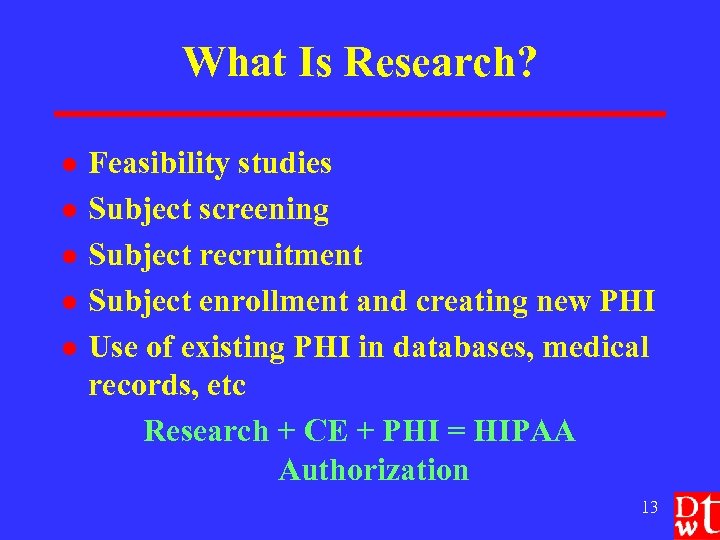 What Is Research? l l l Feasibility studies Subject screening Subject recruitment Subject enrollment and creating new PHI Use of existing PHI in databases, medical records, etc Research + CE + PHI = HIPAA Authorization 13
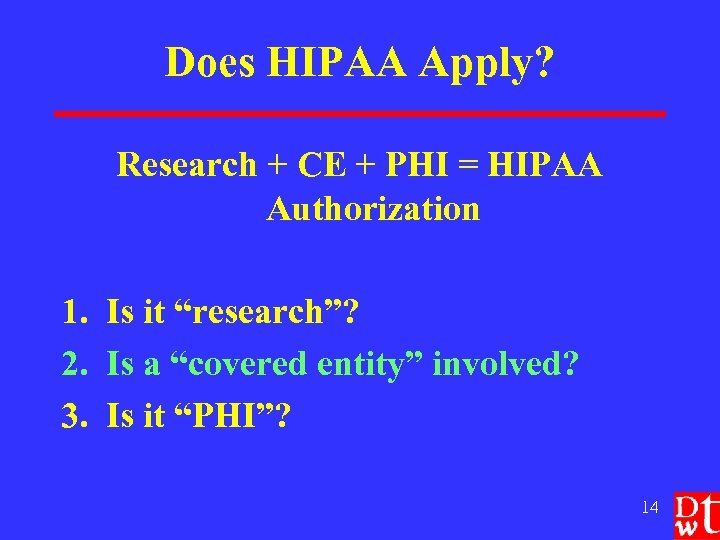 Does HIPAA Apply? Research + CE + PHI = HIPAA Authorization 1. Is it “research”? 2. Is a “covered entity” involved? 3. Is it “PHI”? 14
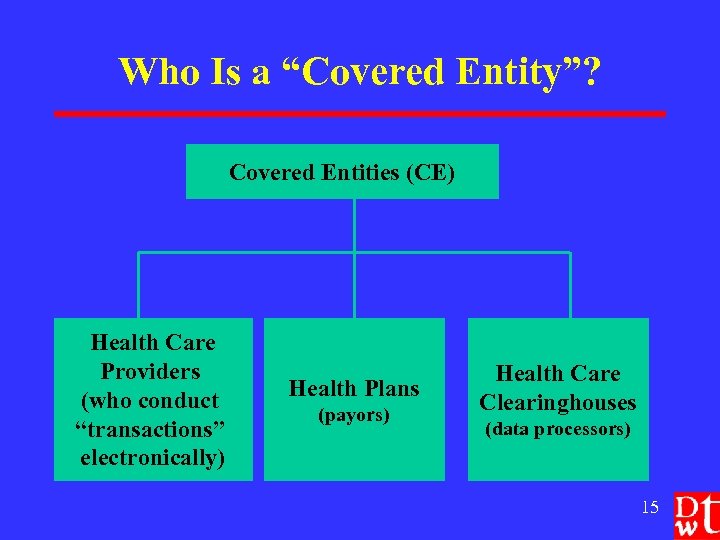 Who Is a “Covered Entity”? Covered Entities (CE) Health Care Providers (who conduct “transactions” electronically) Health Plans (payors) Health Care Clearinghouses (data processors) 15
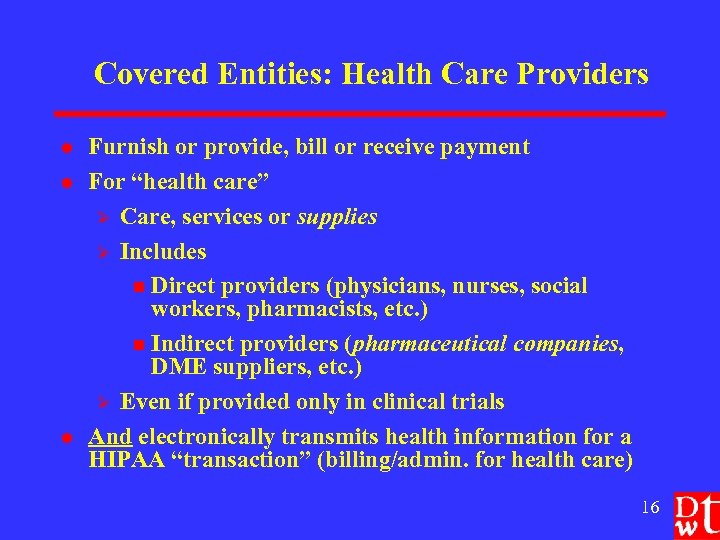 Covered Entities: Health Care Providers l l l Furnish or provide, bill or receive payment For “health care” Ø Care, services or supplies Ø Includes n Direct providers (physicians, nurses, social workers, pharmacists, etc. ) n Indirect providers (pharmaceutical companies, DME suppliers, etc. ) Ø Even if provided only in clinical trials And electronically transmits health information for a HIPAA “transaction” (billing/admin. for health care) 16
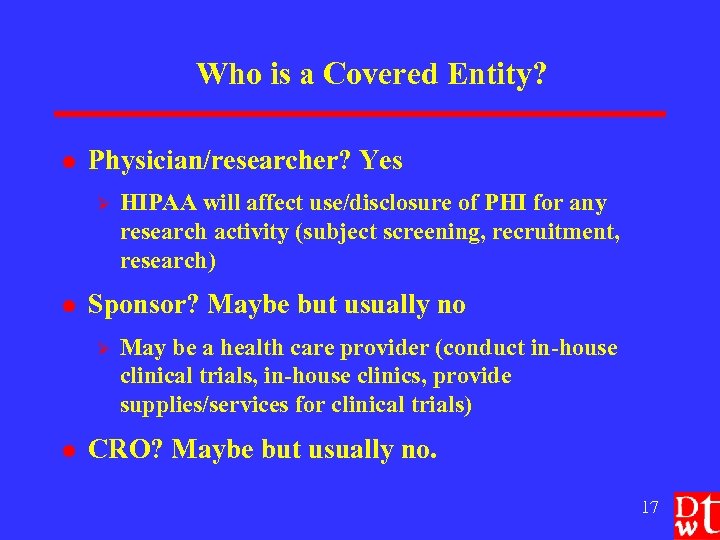 Who is a Covered Entity? l Physician/researcher? Yes Ø l Sponsor? Maybe but usually no Ø l HIPAA will affect use/disclosure of PHI for any research activity (subject screening, recruitment, research) May be a health care provider (conduct in-house clinical trials, in-house clinics, provide supplies/services for clinical trials) CRO? Maybe but usually no. 17
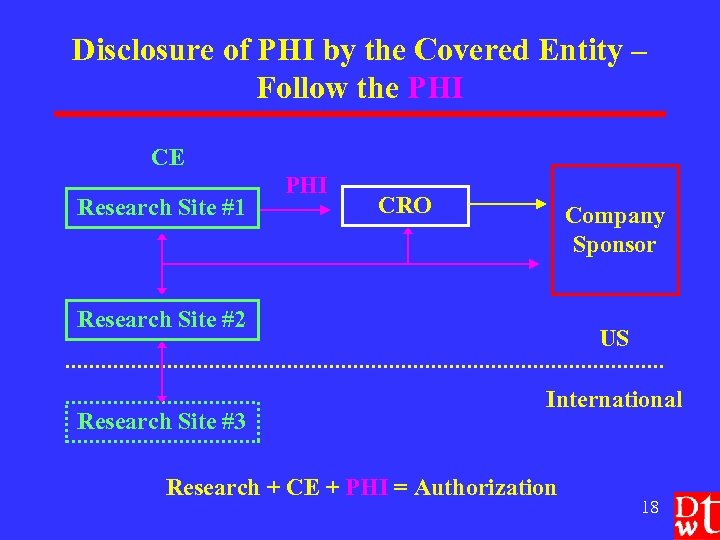 Disclosure of PHI by the Covered Entity – Follow the PHI CE Research Site #1 PHI CRO Company Sponsor Research Site #2 Research Site #3 US International Research + CE + PHI = Authorization 18
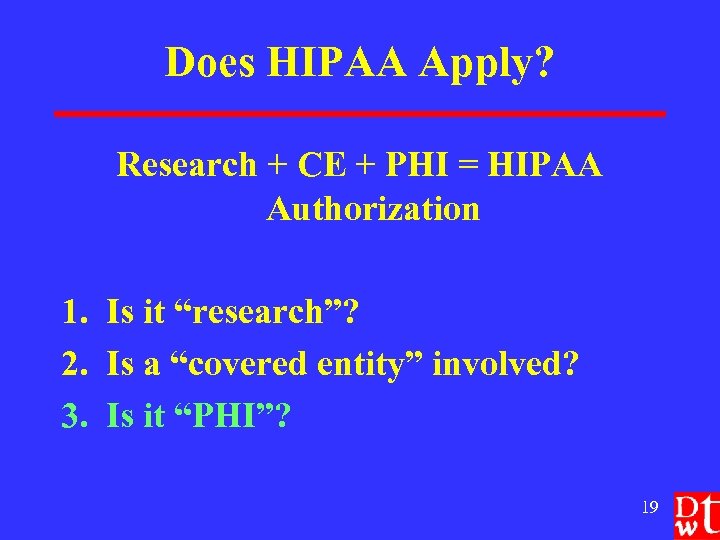 Does HIPAA Apply? Research + CE + PHI = HIPAA Authorization 1. Is it “research”? 2. Is a “covered entity” involved? 3. Is it “PHI”? 19
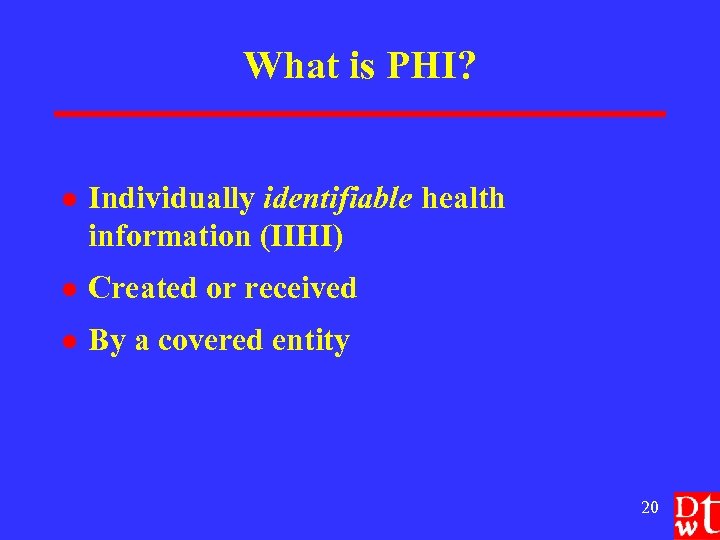 What is PHI? l Individually identifiable health information (IIHI) l Created or received l By a covered entity 20
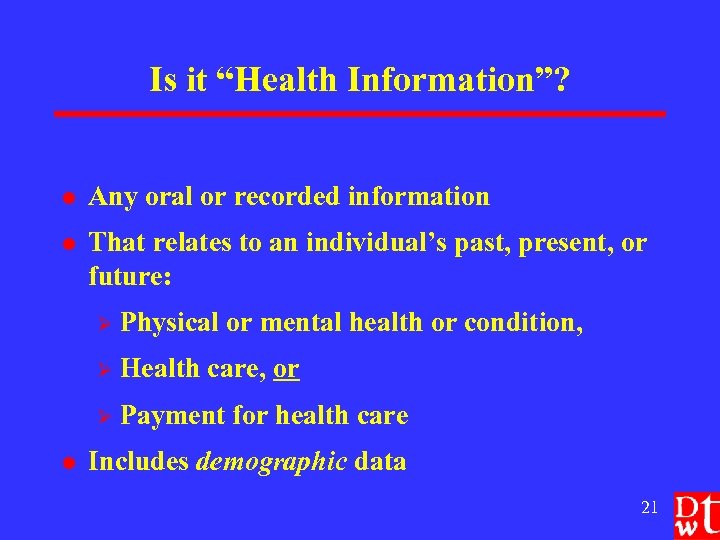 Is it “Health Information”? l Any oral or recorded information l That relates to an individual’s past, present, or future: Ø Ø Health care, or Ø l Physical or mental health or condition, Payment for health care Includes demographic data 21
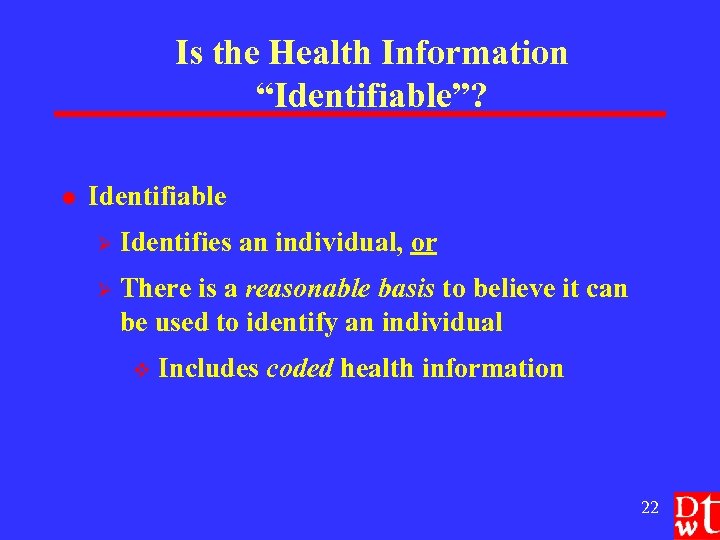 Is the Health Information “Identifiable”? l Identifiable Ø Identifies an individual, or Ø There is a reasonable basis to believe it can be used to identify an individual v Includes coded health information 22
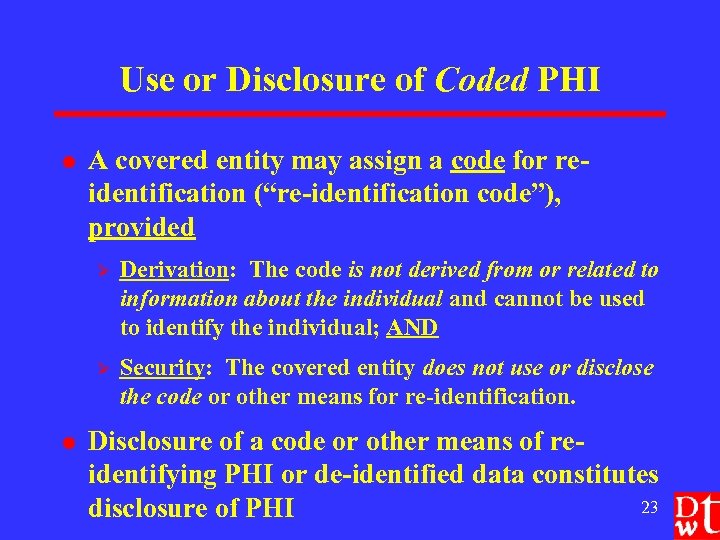 Use or Disclosure of Coded PHI l A covered entity may assign a code for reidentification (“re-identification code”), provided Ø Ø l Derivation: The code is not derived from or related to information about the individual and cannot be used to identify the individual; AND Security: The covered entity does not use or disclose the code or other means for re-identification. Disclosure of a code or other means of reidentifying PHI or de-identified data constitutes 23 disclosure of PHI
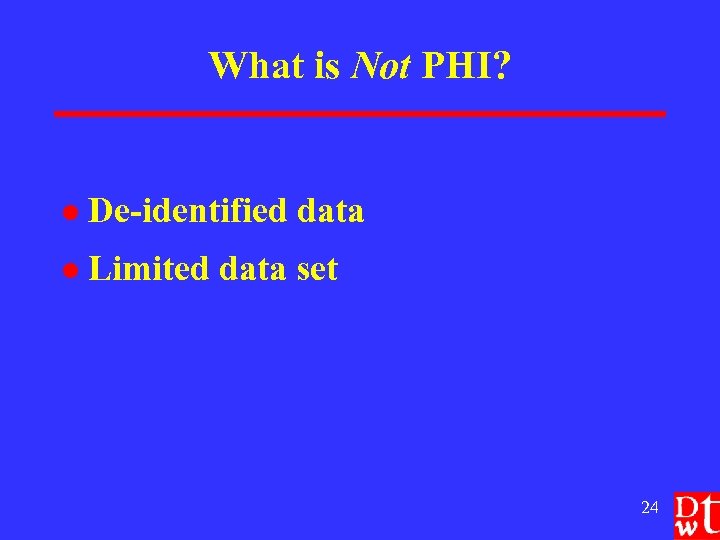 What is Not PHI? l De-identified data l Limited data set 24
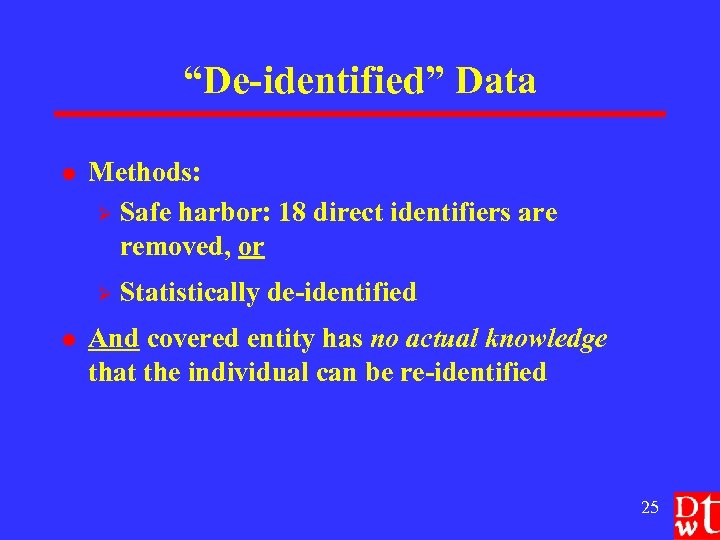 “De-identified” Data l Methods: Ø Safe harbor: 18 direct identifiers are removed, or Ø l Statistically de-identified And covered entity has no actual knowledge that the individual can be re-identified 25
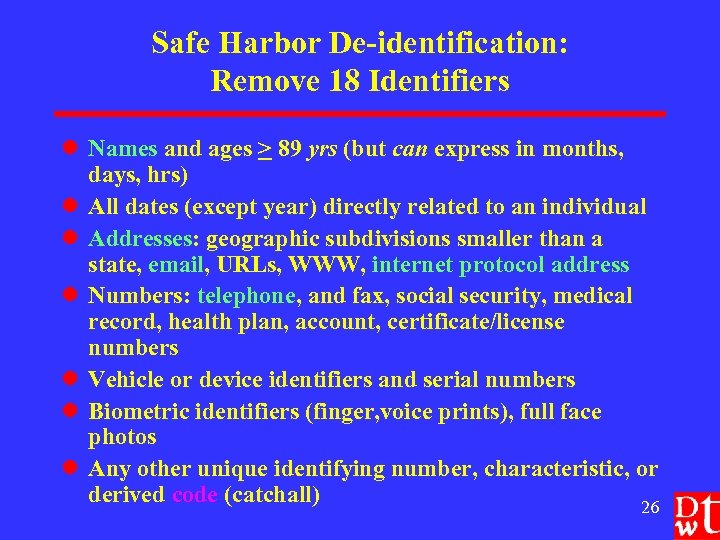 Safe Harbor De-identification: Remove 18 Identifiers l Names and ages > 89 yrs (but can express in months, days, hrs) l All dates (except year) directly related to an individual l Addresses: geographic subdivisions smaller than a state, email, URLs, WWW, internet protocol address l Numbers: telephone, and fax, social security, medical record, health plan, account, certificate/license numbers l Vehicle or device identifiers and serial numbers l Biometric identifiers (finger, voice prints), full face photos l Any other unique identifying number, characteristic, or derived code (catchall) 26
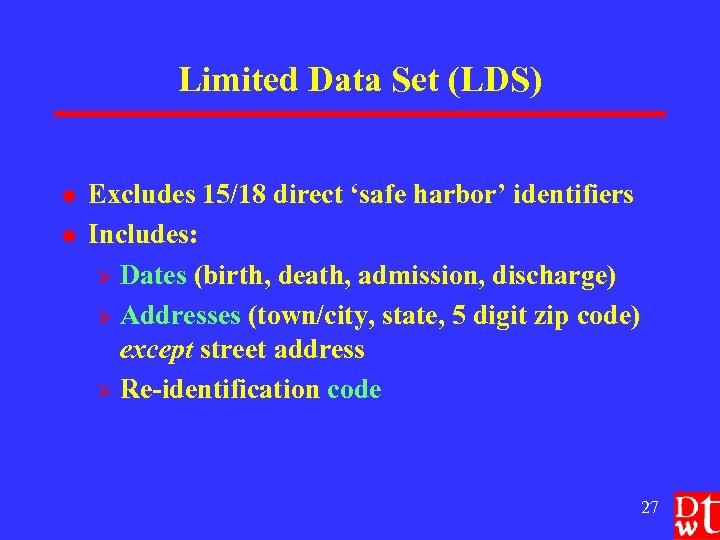 Limited Data Set (LDS) l l Excludes 15/18 direct ‘safe harbor’ identifiers Includes: Ø Dates (birth, death, admission, discharge) Ø Addresses (town/city, state, 5 digit zip code) except street address Ø Re-identification code 27
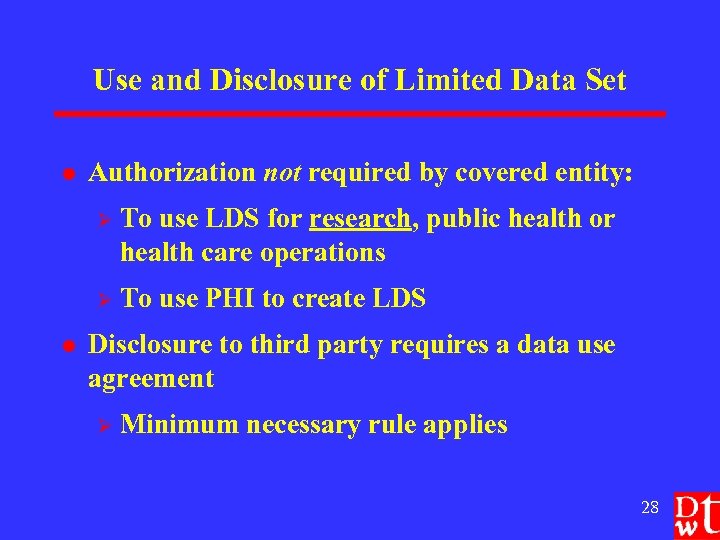 Use and Disclosure of Limited Data Set l Authorization not required by covered entity: Ø Ø l To use LDS for research, public health or health care operations To use PHI to create LDS Disclosure to third party requires a data use agreement Ø Minimum necessary rule applies 28
 Disclosure of Limited Data Set: Data Use Agreements l Permitted uses (research, public health, HCO) l Who is permitted to use or receive the LDS l Recipient responsibilities: Ø To not use LDS to contact individuals (may not use for recruitment) or identify the information Ø Report to CE unpermitted uses/disclosures of “which it is aware” Ø Use appropriate safeguards to comply with data use agreement Ø Ensure downstream compliance with agents & subcontractors 29
 HIPAA’s Privacy Rule For Research l Research + CE + PHI = Authorization l Exceptions: Ø Qualifies for a waiver of authorization Ø An exception applies Ø Disclosure to a business associate Ø Permitted disclosures 30
 Criteria for Waivers or Alterations of Authorizations 1. The use/disclosure of PHI involves no more than minimal risk to the PRIVACY of the individual l Additional criteria 2. The research could not practicably be conducted without the alteration or waiver 3. The research could not practicably be conducted without access to and use of PHI 31
 Criteria for Waivers or Alterations of Authorizations l Adequate plan to protect the identifiers from improper use and disclosure; l Adequate plan to destroy the identifiers at the earliest opportunity; and l Adequate written assurances that the PHI will not be reused or disclosed to any other person or entity unless authorized 32
 Waiver or Alteration of Authorization Requirements For Research l Who must approve the waiver/alteration? Ø Ø l Institutional Review Board (IRB), or Privacy board Waiver or alteration must be requested and approval documented in writing 33
 Exceptions to the General Rule – When is an Authorization Not Required? l Research qualifies for a waiver of authorization l An exception applies (n = 2) l Disclosure to a business associate l Permitted disclosures 34
 Exceptions to Authorization Requirements 1. Reviews preparatory to research Ø Use/disclosure of PHI is solely to prepare a research protocol or for a similar purpose (preparatory to research), Ø PHI may not be removed from the covered entity, and Ø PHI is necessary for research purposes 2. Research on PHI from decedents 35
 Reviews Preparatory to Research: Process l Covered entity must obtain a “representation” from the researcher that Ø PHI will not be removed from CE’s site, Ø PHI will be used solely for protocol development or equivalent, and Ø PHI is necessary for research l No IRB/privacy board approval required l Who processes the representations at the CE? 36
 Exceptions to the General Rule – When is an Authorization Not Required? l Research qualifies for a waiver of authorization l An exception applies (n = 2) l Disclosure to a business associate l Permitted disclosures 37
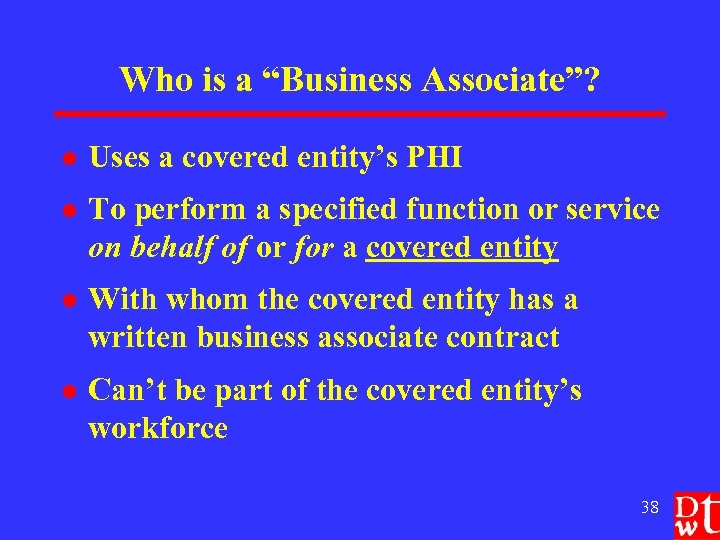 Who is a “Business Associate”? l Uses a covered entity’s PHI l To perform a specified function or service on behalf of or for a covered entity l With whom the covered entity has a written business associate contract l Can’t be part of the covered entity’s workforce 38
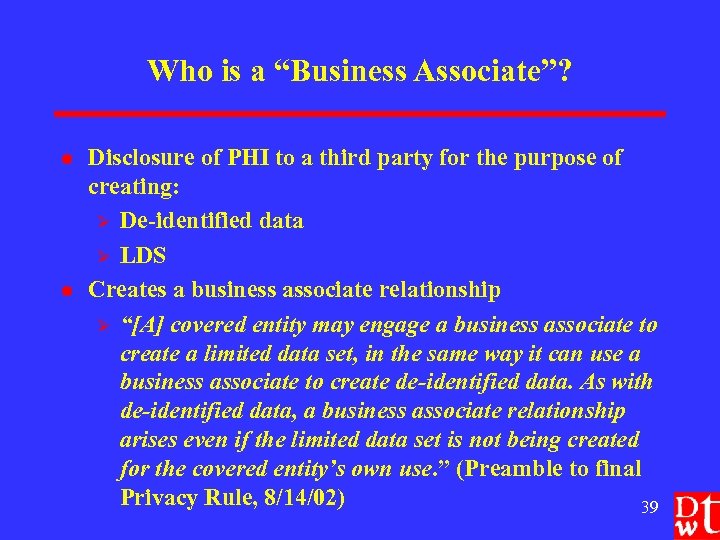 Who is a “Business Associate”? l l Disclosure of PHI to a third party for the purpose of creating: Ø De-identified data Ø LDS Creates a business associate relationship Ø “[A] covered entity may engage a business associate to create a limited data set, in the same way it can use a business associate to create de-identified data. As with de-identified data, a business associate relationship arises even if the limited data set is not being created for the covered entity’s own use. ” (Preamble to final Privacy Rule, 8/14/02) 39
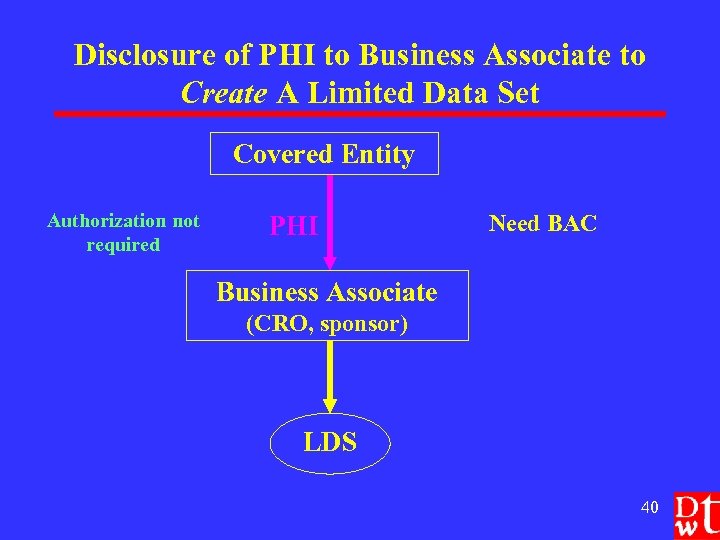 Disclosure of PHI to Business Associate to Create A Limited Data Set Covered Entity Authorization not required PHI Need BAC Business Associate (CRO, sponsor) LDS 40
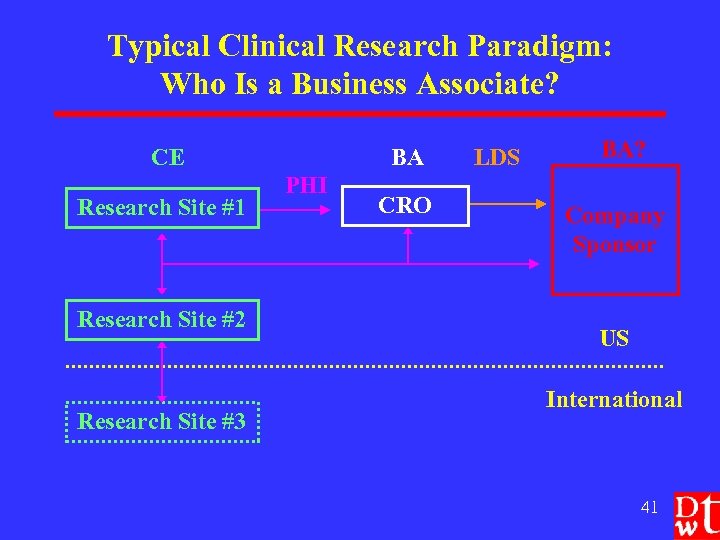 Typical Clinical Research Paradigm: Who Is a Business Associate? CE Research Site #1 Research Site #2 Research Site #3 BA PHI CRO LDS BA? Company Sponsor US International 41
 Exceptions to the General Rule – When is an Authorization Not Required? l Research qualifies for a waiver of authorization l An exception applies (n = 2) l Disclosure to a business associate l Permitted disclosures 42
 Permitted Public Health Disclosures Under HIPAA: FDA Reporting l l CEs may disclose PHI w/o authorization to: Ø Persons subject to FDA jurisdiction Ø “Person” includes companies (sponsors) With respect to an FDA-regulated product Regarding the safety, effectiveness or quality of the product Ø Includes: Adverse events, device tracking, product recalls, lookbacks, post-marketing surveillance Ø Excludes: marketing Minimum necessary applies 43
 Subject Screening and Recruitment Under HIPAA 1. Subject screening Ø Ø Ø No subject contact Medical records review Screen databases or repositories 2. Subject recruitment Ø Ø Ø Subject contact Non-targeted advertising n Passive (one-way flow of information) n Interactive (two-way flow of information) Targeted contacts (phone calls, letters, emails, physician-patient contact) 44
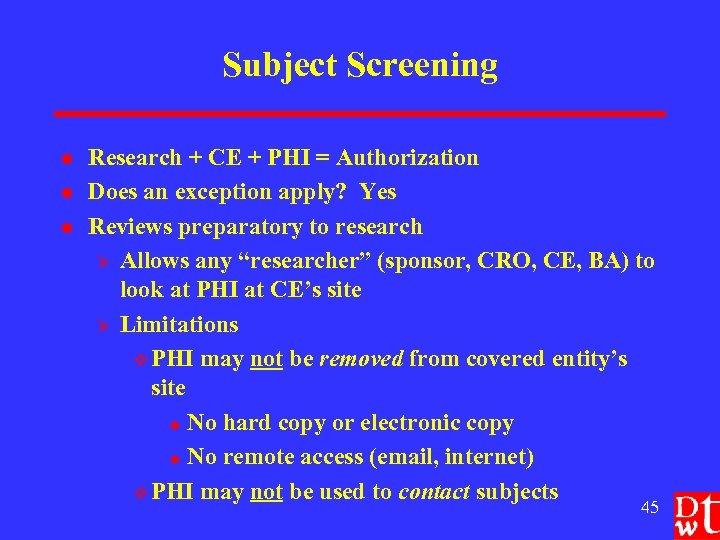 Subject Screening l l l Research + CE + PHI = Authorization Does an exception apply? Yes Reviews preparatory to research Ø Allows any “researcher” (sponsor, CRO, CE, BA) to look at PHI at CE’s site Ø Limitations v PHI may not be removed from covered entity’s site u No hard copy or electronic copy u No remote access (email, internet) v PHI may not be used to contact subjects 45
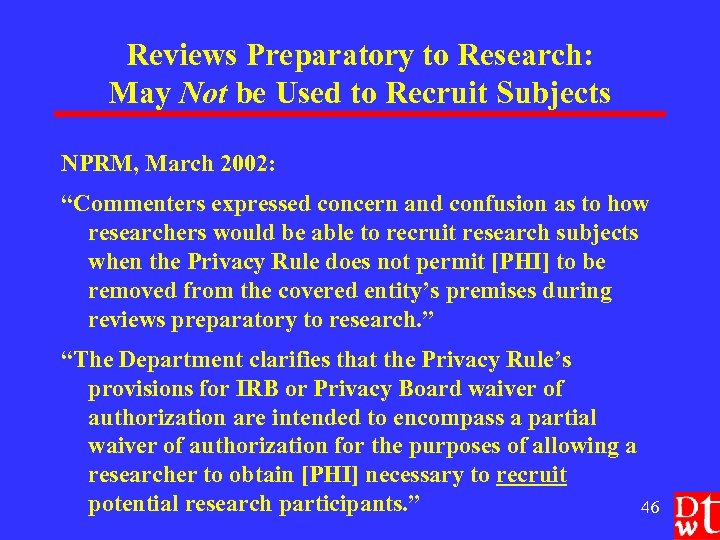 Reviews Preparatory to Research: May Not be Used to Recruit Subjects NPRM, March 2002: “Commenters expressed concern and confusion as to how researchers would be able to recruit research subjects when the Privacy Rule does not permit [PHI] to be removed from the covered entity’s premises during reviews preparatory to research. ” “The Department clarifies that the Privacy Rule’s provisions for IRB or Privacy Board waiver of authorization are intended to encompass a partial waiver of authorization for the purposes of allowing a researcher to obtain [PHI] necessary to recruit potential research participants. ” 46
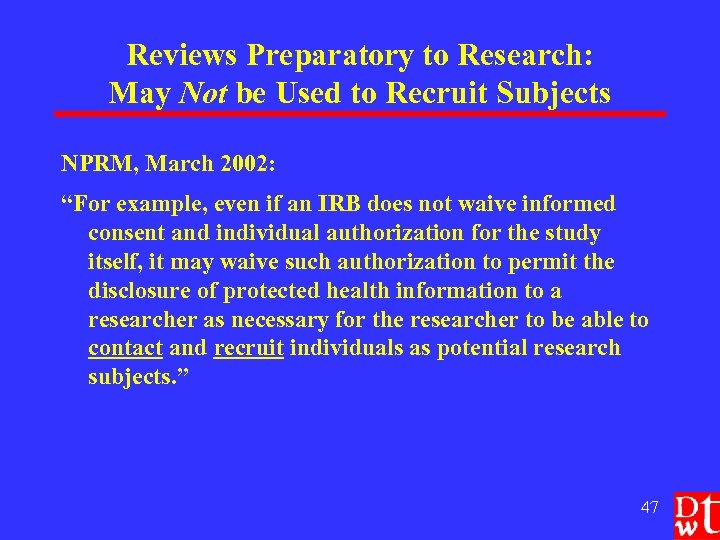 Reviews Preparatory to Research: May Not be Used to Recruit Subjects NPRM, March 2002: “For example, even if an IRB does not waive informed consent and individual authorization for the study itself, it may waive such authorization to permit the disclosure of protected health information to a researcher as necessary for the researcher to be able to contact and recruit individuals as potential research subjects. ” 47
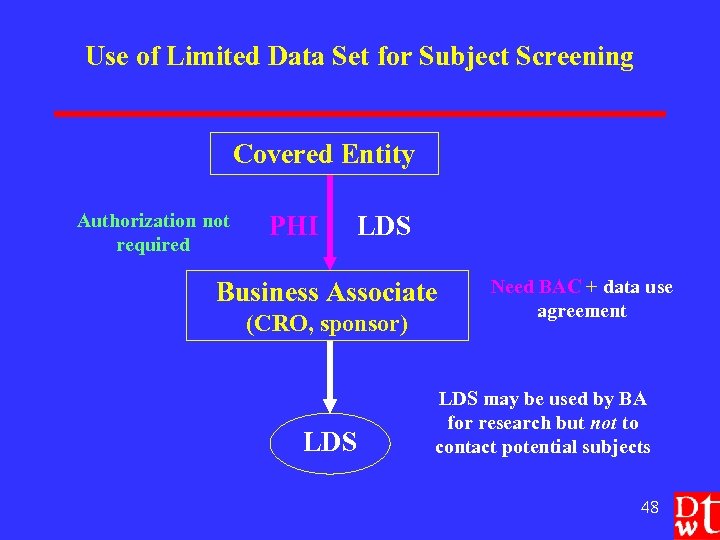 Use of Limited Data Set for Subject Screening Covered Entity Authorization not required PHI LDS Business Associate (CRO, sponsor) LDS Need BAC + data use agreement LDS may be used by BA for research but not to contact potential subjects 48
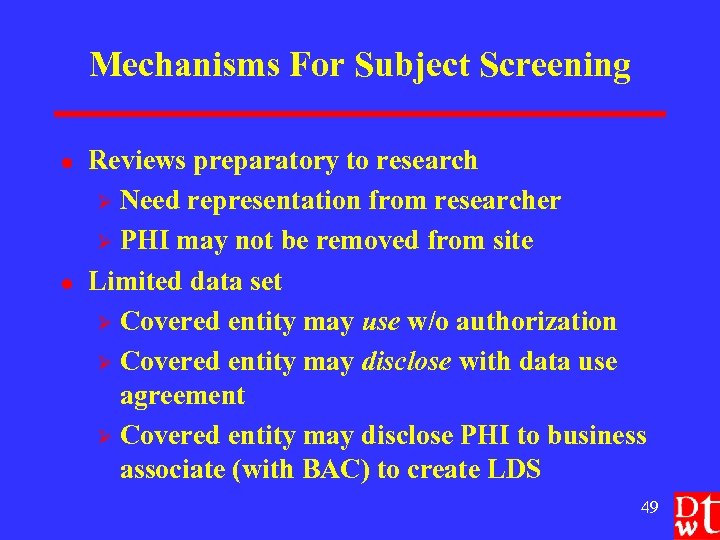 Mechanisms For Subject Screening l l Reviews preparatory to research Ø Need representation from researcher Ø PHI may not be removed from site Limited data set Ø Covered entity may use w/o authorization Ø Covered entity may disclose with data use agreement Ø Covered entity may disclose PHI to business associate (with BAC) to create LDS 49
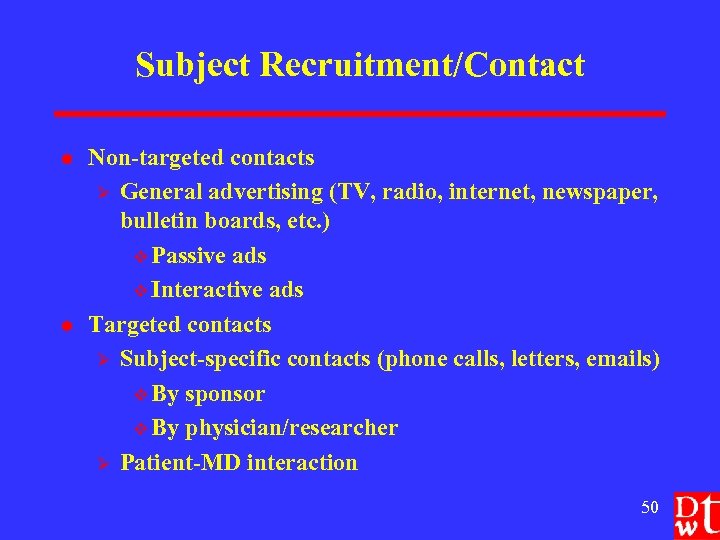 Subject Recruitment/Contact l l Non-targeted contacts Ø General advertising (TV, radio, internet, newspaper, bulletin boards, etc. ) v Passive ads v Interactive ads Targeted contacts Ø Subject-specific contacts (phone calls, letters, emails) v By sponsor v By physician/researcher Ø Patient-MD interaction 50
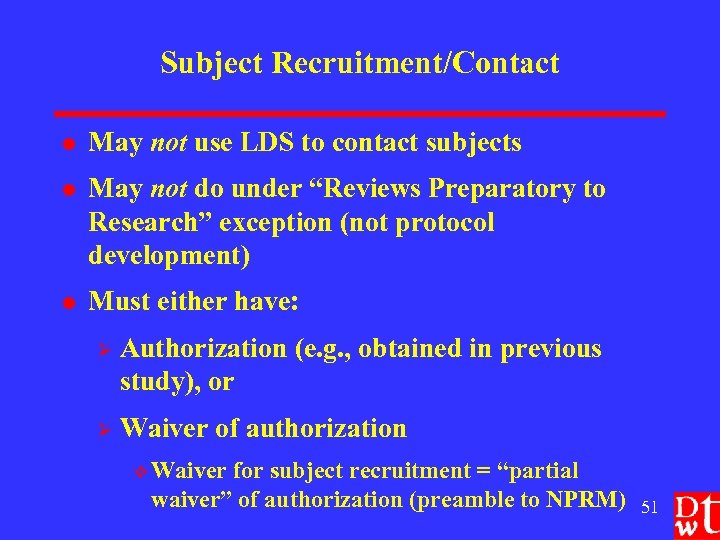 Subject Recruitment/Contact l May not use LDS to contact subjects l May not do under “Reviews Preparatory to Research” exception (not protocol development) l Must either have: Ø Authorization (e. g. , obtained in previous study), or Ø Waiver of authorization v Waiver for subject recruitment = “partial waiver” of authorization (preamble to NPRM) 51
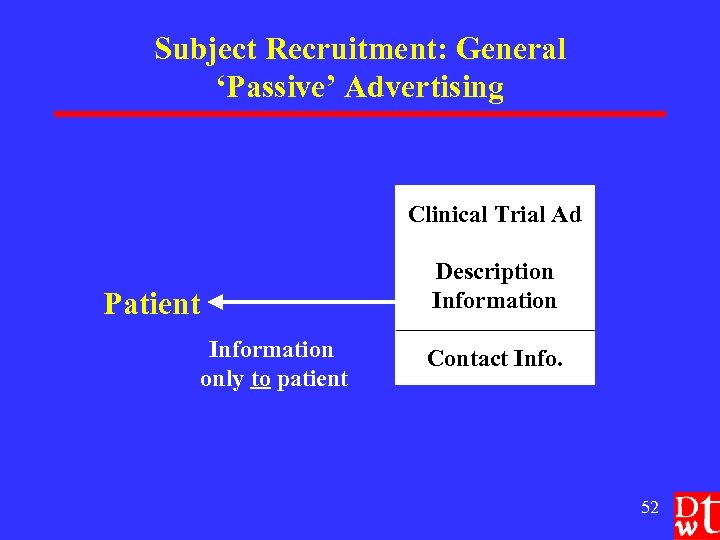 Subject Recruitment: General ‘Passive’ Advertising Clinical Trial Ad Patient Information only to patient Description Information Contact Info. 52
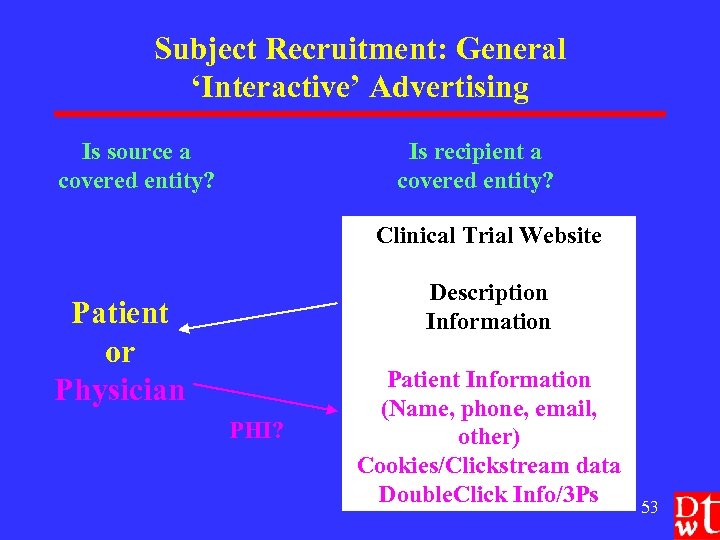 Subject Recruitment: General ‘Interactive’ Advertising Is source a covered entity? Is recipient a covered entity? Clinical Trial Website Description Information Patient or Physician PHI? Patient Information (Name, phone, email, other) Cookies/Clickstream data Double. Click Info/3 Ps 53
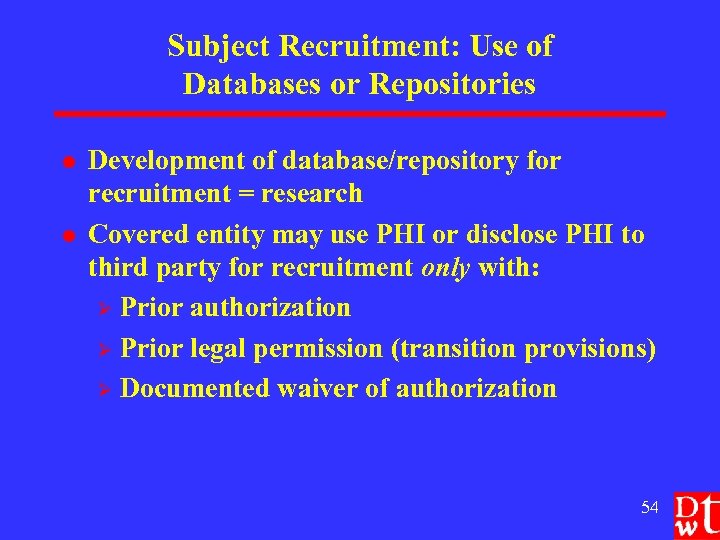 Subject Recruitment: Use of Databases or Repositories l l Development of database/repository for recruitment = research Covered entity may use PHI or disclose PHI to third party for recruitment only with: Ø Prior authorization Ø Prior legal permission (transition provisions) Ø Documented waiver of authorization 54
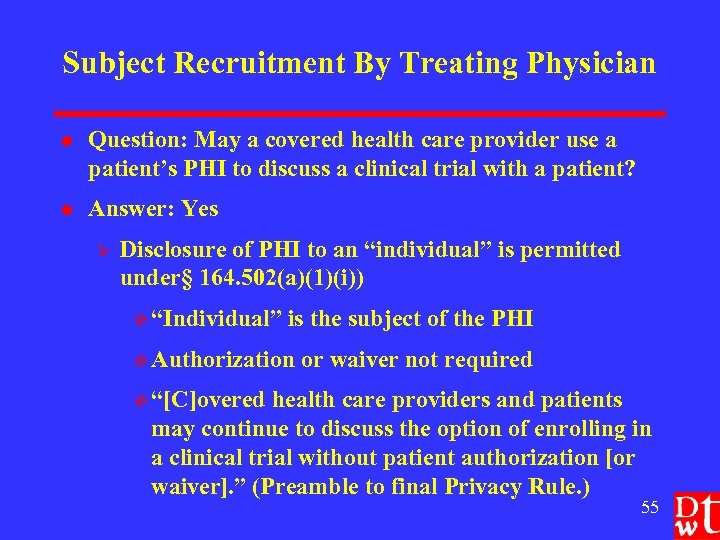 Subject Recruitment By Treating Physician l Question: May a covered health care provider use a patient’s PHI to discuss a clinical trial with a patient? l Answer: Yes Ø Disclosure of PHI to an “individual” is permitted under§ 164. 502(a)(1)(i)) v “Individual” is the subject of the PHI v Authorization or waiver not required v “[C]overed health care providers and patients may continue to discuss the option of enrolling in a clinical trial without patient authorization [or waiver]. ” (Preamble to final Privacy Rule. ) 55
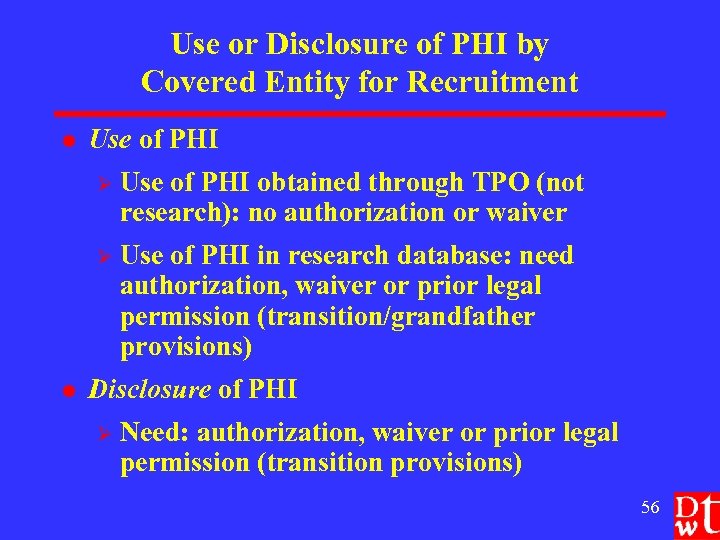 Use or Disclosure of PHI by Covered Entity for Recruitment l Use of PHI Ø Ø l Use of PHI obtained through TPO (not research): no authorization or waiver Use of PHI in research database: need authorization, waiver or prior legal permission (transition/grandfather provisions) Disclosure of PHI Ø Need: authorization, waiver or prior legal permission (transition provisions) 56
 HIPAA’s Grandfather Provisions l l Covered entity may use/disclose PHI That it created or received before or after the HIPAA compliance date (4/14/03) For a research study IF the covered entity obtained either Ø Ø Ø l Informed consent, IRB-approved waiver of informed consent, or Express legal permission Before the compliance date 57
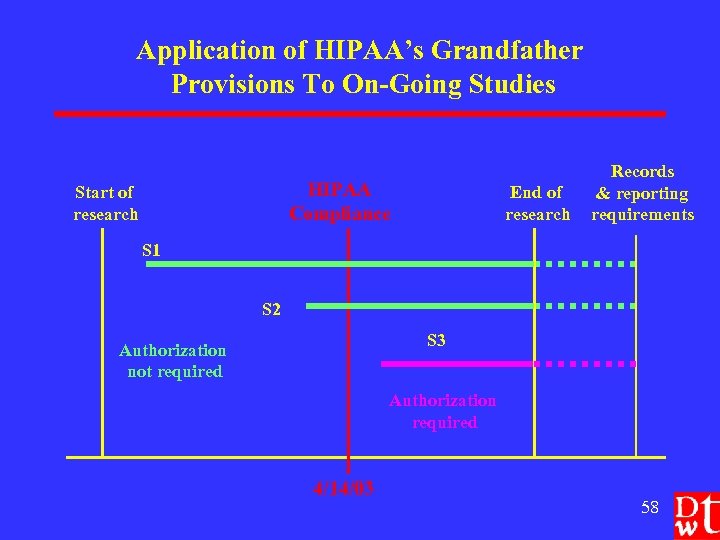 Application of HIPAA’s Grandfather Provisions To On-Going Studies HIPAA Compliance Start of research End of research Records & reporting requirements S 1 S 2 S 3 Authorization not required Authorization required 4/14/03 58
 HIPAA Authorizations: Right To Revoke l l l Right to revoke at any time Ø Statement that individual may revoke in writing at any time unless the covered entity has acted “in reliance on” authorization CE may continue to use/disclose PHI collected before the revocation as needed “to preserve the integrity of the research study” Ø Does not apply to tissue Permitted uses/disclosures: Ø Accounting of subject’s withdrawal Ø Required reports to FDA or other agencies Ø To investigate scientific misconduct allegations 59
 Multi-site Studies l State laws Ø Ø l HIPAA preempts state laws that are contrary to and less stringent than HIPAA Need to determine the floor of privacy protection in each state (preemption analysis) General medical confidentiality laws v Research exceptions (variable) Specific confidentiality laws (e. g. , HIV/AIDS, mental illness, genetic privacy acts) International laws 60
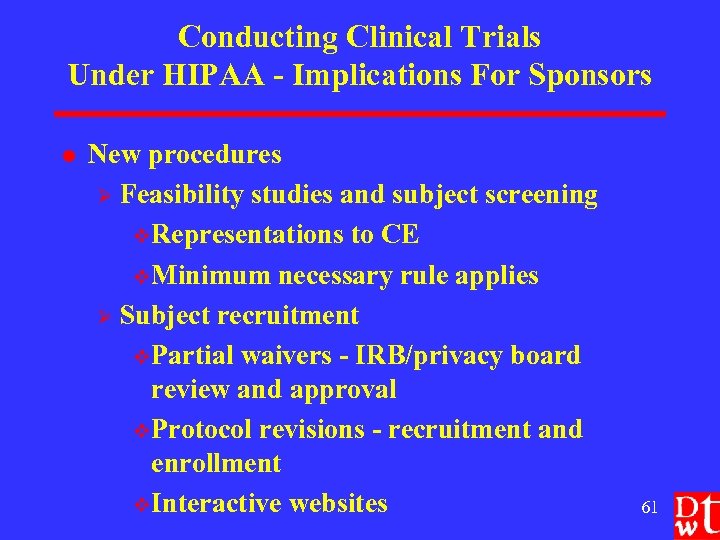 Conducting Clinical Trials Under HIPAA - Implications For Sponsors l New procedures Ø Feasibility studies and subject screening v. Representations to CE v. Minimum necessary rule applies Ø Subject recruitment v. Partial waivers - IRB/privacy board review and approval v. Protocol revisions - recruitment and enrollment v. Interactive websites 61
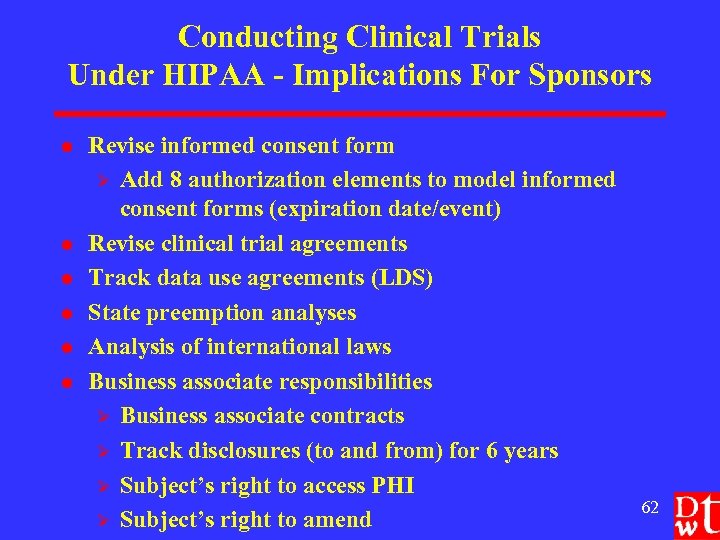 Conducting Clinical Trials Under HIPAA - Implications For Sponsors l l l Revise informed consent form Ø Add 8 authorization elements to model informed consent forms (expiration date/event) Revise clinical trial agreements Track data use agreements (LDS) State preemption analyses Analysis of international laws Business associate responsibilities Ø Business associate contracts Ø Track disclosures (to and from) for 6 years Ø Subject’s right to access PHI Ø Subject’s right to amend 62
 Conducting Clinical Trials Under HIPAA - Implications For Sponsors Questions? 63