


 Скачать презентацию Concurrency Concepts Models and Programs Jeff Kramer and
576be36ec2e3f68b1683f4c0b8ed0452.ppt
- Количество слайдов: 32
 Concurrency Concepts, Models and Programs Jeff Kramer and Jeff Magee 1 2015 Concurrency: introduction ©Magee/Kramer 2 nd Edition
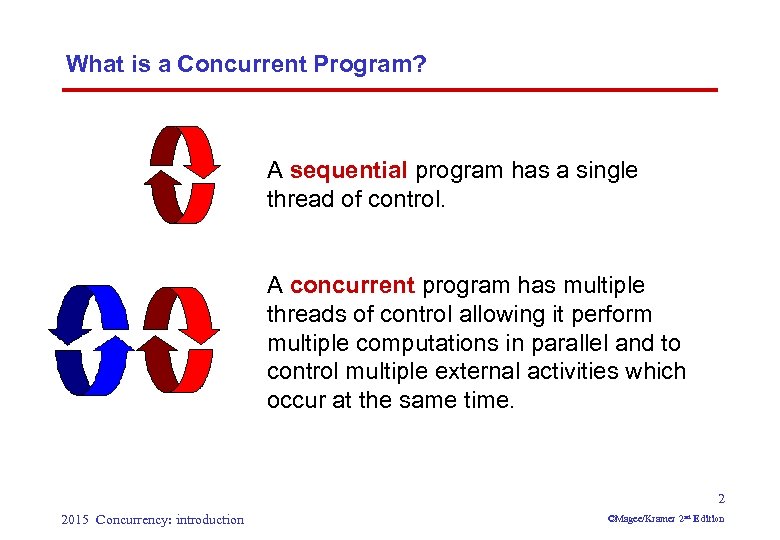 What is a Concurrent Program? A sequential program has a single thread of control. A concurrent program has multiple threads of control allowing it perform multiple computations in parallel and to control multiple external activities which occur at the same time. 2 2015 Concurrency: introduction ©Magee/Kramer 2 nd Edition
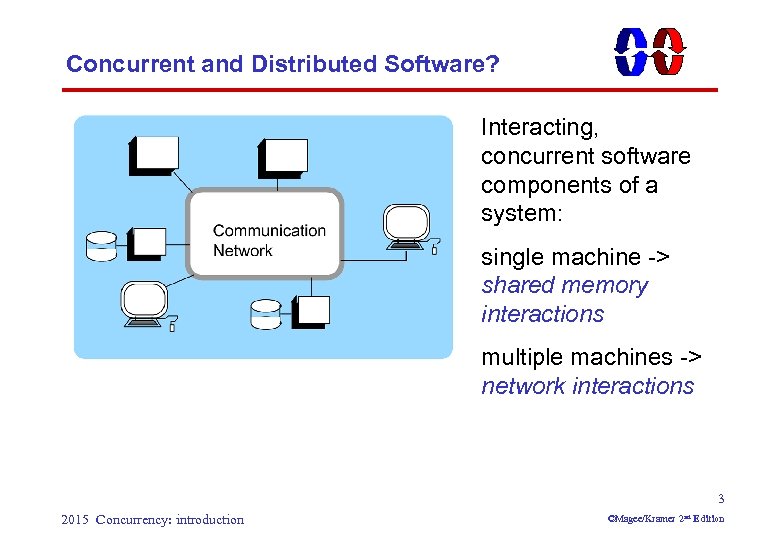 Concurrent and Distributed Software? Interacting, concurrent software components of a system: single machine -> shared memory interactions multiple machines -> network interactions 3 2015 Concurrency: introduction ©Magee/Kramer 2 nd Edition
 Why Concurrent Programming? u Performance gain from multiprocessing hardware l eg. fine grain parallelism on multicore hardware : low level memory models l eg. coarse grain parallelism for partitioned scientific calculations : processes u Increased application throughput : avoid polling (busy waiting)! l eg. an I/O call need only block one thread u Increased application responsiveness l eg. high priority thread for user requests. u More appropriate structure 2015 Concurrency: introduction which l for programs 4 ©Magee/Kramer 2 Edition interact with the environment, control multiple nd
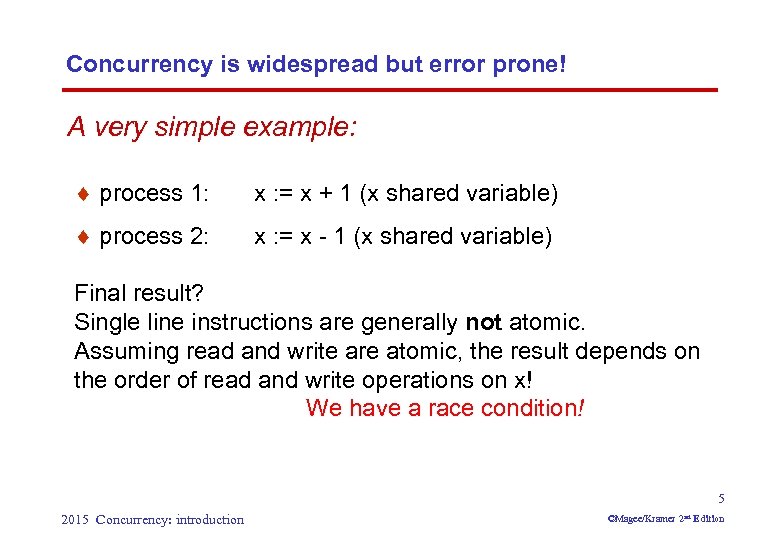 Concurrency is widespread but error prone! A very simple example: ¨ process 1: x : = x + 1 (x shared variable) ¨ process 2: x : = x - 1 (x shared variable) Final result? Single line instructions are generally not atomic. Assuming read and write are atomic, the result depends on the order of read and write operations on x! We have a race condition! 5 2015 Concurrency: introduction ©Magee/Kramer 2 nd Edition
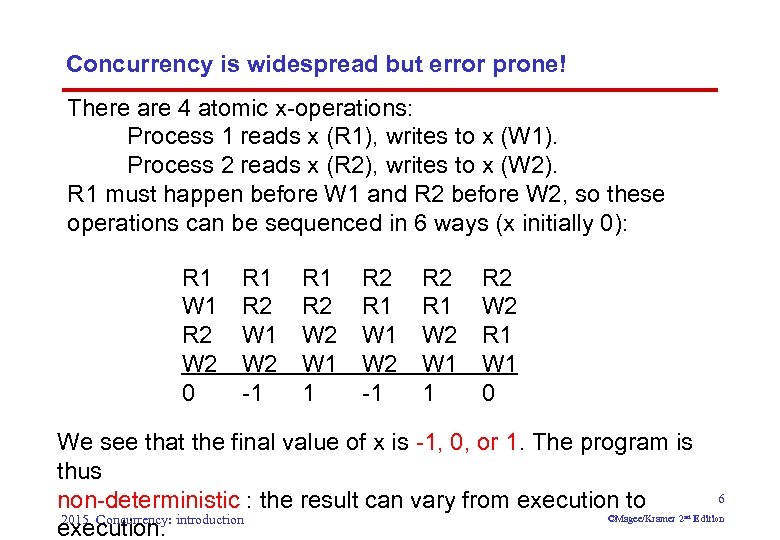 Concurrency is widespread but error prone! There are 4 atomic x-operations: Process 1 reads x (R 1), writes to x (W 1). Process 2 reads x (R 2), writes to x (W 2). R 1 must happen before W 1 and R 2 before W 2, so these operations can be sequenced in 6 ways (x initially 0): R 1 W 1 R 2 W 2 0 R 1 R 2 W 1 W 2 -1 R 2 W 1 1 R 2 R 1 W 2 -1 R 2 R 1 W 2 W 1 1 R 2 W 2 R 1 W 1 0 We see that the final value of x is -1, 0, or 1. The program is thus 6 non-deterministic : the result can vary from execution to ©Magee/Kramer 2 Edition 2015 Concurrency: introduction execution. nd
 Concurrency is widespread but error prone! ¨ Therac - 25 computerised radiation therapy machine Concurrent programming errors contributed to accidents causing deaths and serious injuries. ¨ Mars Rover Problems with interaction between concurrent tasks caused periodic software resets reducing availability for exploration. 7 2015 Concurrency: introduction ©Magee/Kramer 2 nd Edition
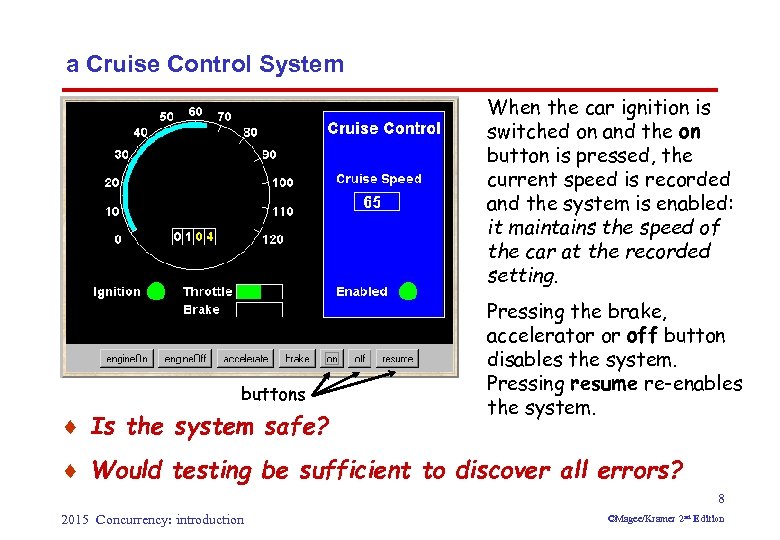 a Cruise Control System When the car ignition is switched on and the on button is pressed, the current speed is recorded and the system is enabled: it maintains the speed of the car at the recorded setting. buttons ¨ Is the system safe? Pressing the brake, accelerator or off button disables the system. Pressing resume re-enables the system. ¨ Would testing be sufficient to discover all errors? 8 2015 Concurrency: introduction ©Magee/Kramer 2 nd Edition
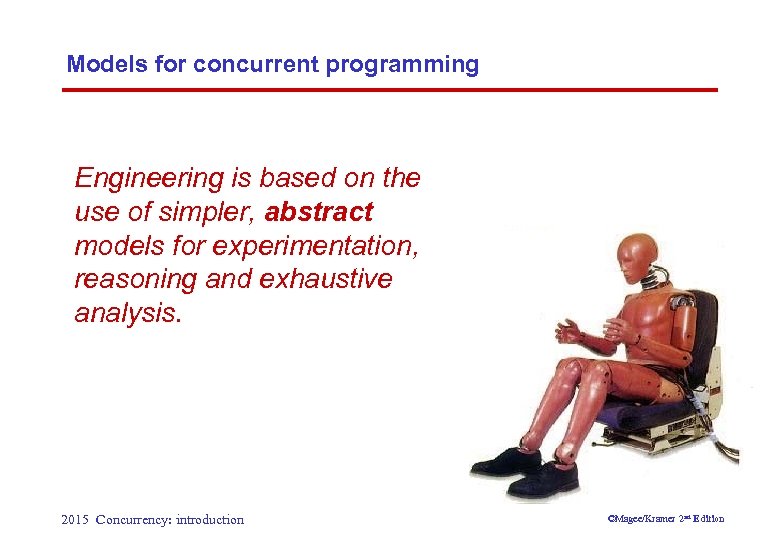 Models for concurrent programming Engineering is based on the use of simpler, abstract models for experimentation, reasoning and exhaustive analysis. 9 2015 Concurrency: introduction ©Magee/Kramer 2 nd Edition
 Abstraction? definitions … Ø the act of withdrawing or removing something Ø the act or process of leaving out of consideration one or more properties of a complex object so as to attend to others Remove detail (simplify) and focus (selection based on purpose) Ø a general concept formed by extracting common features from specific examples Ø the process of formulating general concepts by abstracting common properties of instances Generalisation (core or essence) 10 2015 Concurrency: introduction ©Magee/Kramer 2 nd Edition
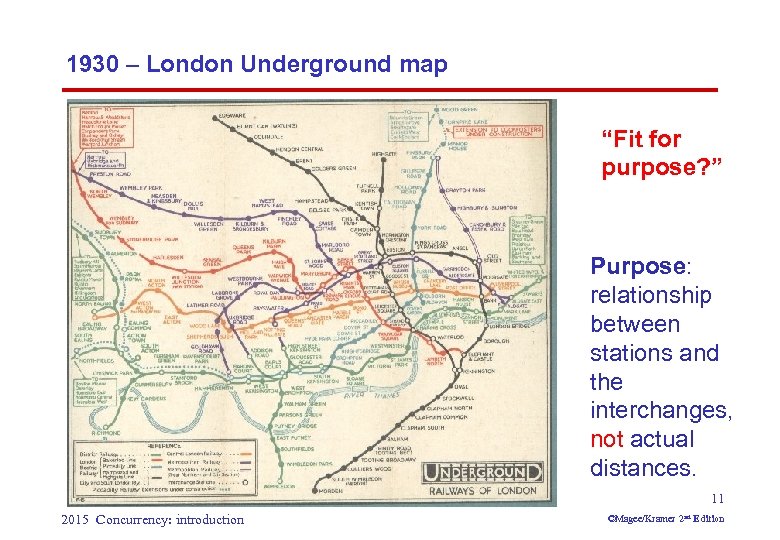 1930 – London Underground map “Fit for purpose? ” Purpose: relationship between stations and the interchanges, not actual distances. 11 2015 Concurrency: introduction ©Magee/Kramer 2 nd Edition
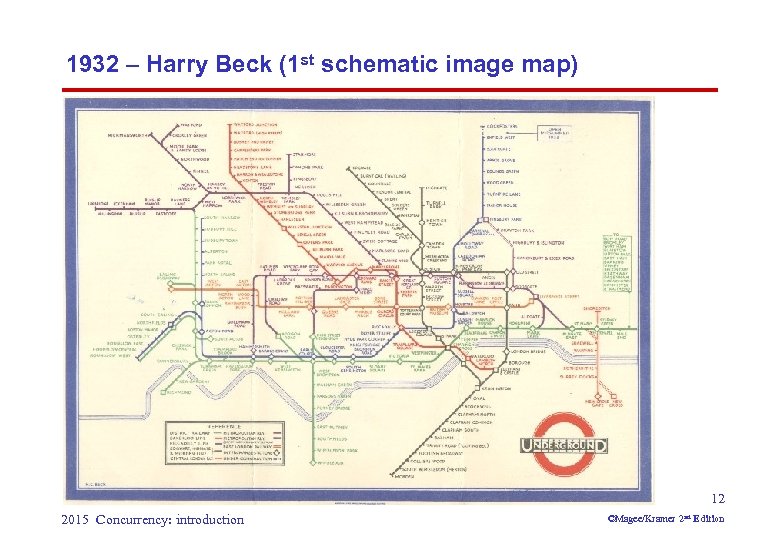 1932 – Harry Beck (1 st schematic image map) 12 2015 Concurrency: introduction ©Magee/Kramer 2 nd Edition
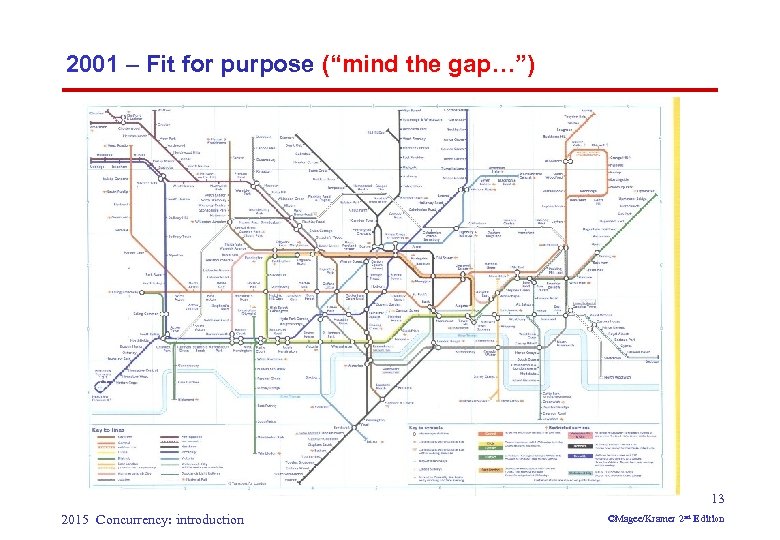 2001 – Fit for purpose (“mind the gap…”) 13 2015 Concurrency: introduction ©Magee/Kramer 2 nd Edition
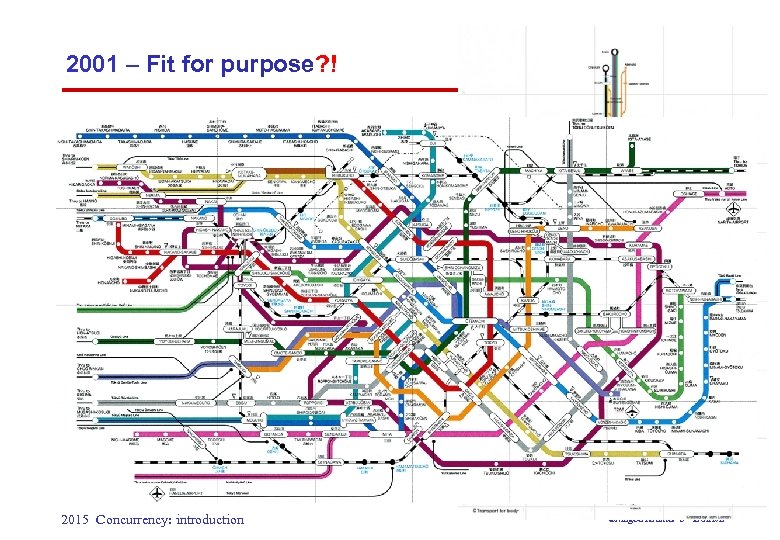 2001 – Fit for purpose? ! “Underskin” by Samantha Loman 14 2015 Concurrency: introduction ©Magee/Kramer 2 nd Edition
 Why is abstraction important in Software Engineering? Software is “Once you abstract!computing is all about realize that constructing, manipulating, and reasoning about abstractions, it becomes clear that an important prerequisite for writing (good) computer programs is the ability to handle abstractions in a precise manner. ” Keith Devlin CACM Sept. 2003 Perhaps abstraction is the key to computing …. ? CACM April 2007 2015 Concurrency: introduction 15 15 ©Magee/Kramer 2 nd Edition
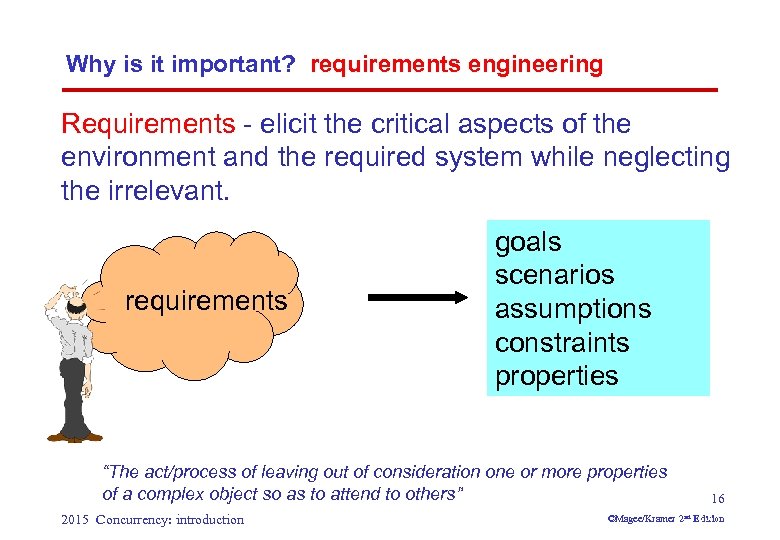 Why is it important? requirements engineering Requirements - elicit the critical aspects of the environment and the required system while neglecting the irrelevant. requirements goals scenarios assumptions constraints properties “The act/process of leaving out of consideration one or more properties of a complex object so as to attend to others” 2015 Concurrency: introduction 16 16 ©Magee/Kramer 2 nd Edition
 Why is it important? design Design - articulate the software architecture and component functionalities which satisfy functional and non-functional requirements while avoiding unnecessary implementation constraints. eg. Compiler design (Ghezzi): • abstract syntax to focus on essential features of language constructs; • design to generate intermediate code for an abstract machine “The act/process of leaving out of consideration one or more properties of a complex object so as to attend to others” 2015 Concurrency: introduction 17 17 ©Magee/Kramer 2 nd Edition
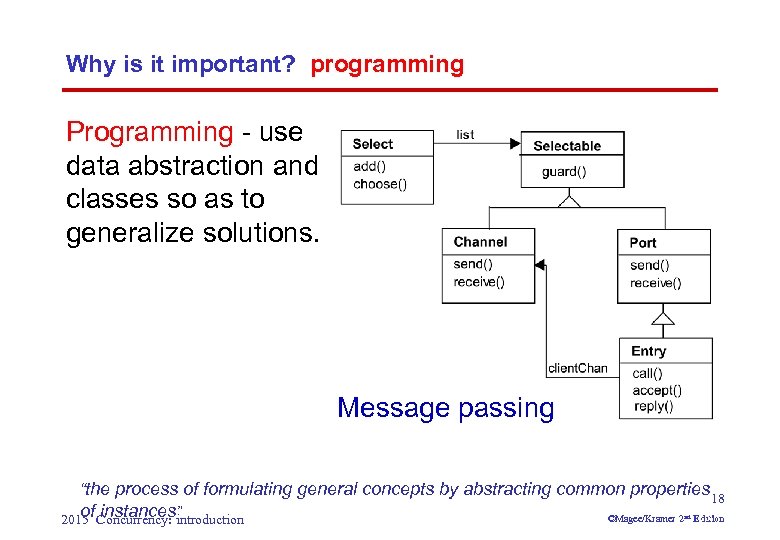 Why is it important? programming Programming - use data abstraction and classes so as to generalize solutions. Message passing “the process of formulating general concepts by abstracting common properties 18 of instances” 18 ©Magee/Kramer 2 nd Edition 2015 Concurrency: introduction
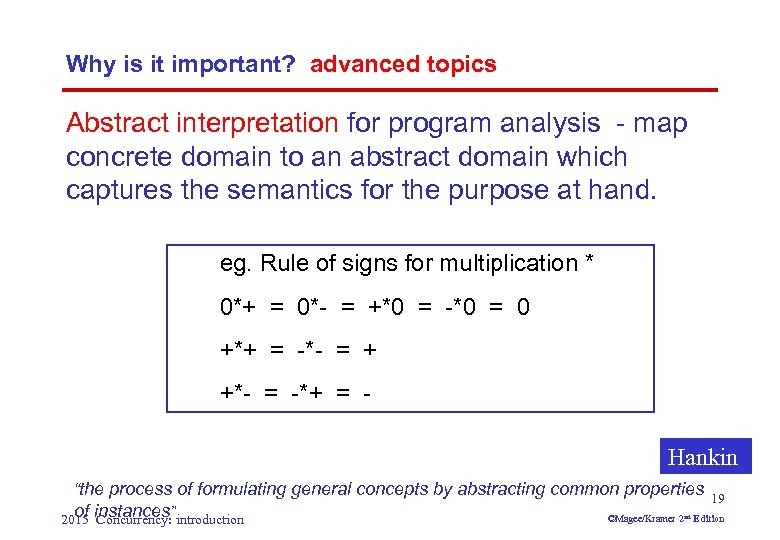 Why is it important? advanced topics Abstract interpretation for program analysis - map concrete domain to an abstract domain which captures the semantics for the purpose at hand. eg. Rule of signs for multiplication * 0*+ = 0*- = +*0 = -*0 = 0 +*+ = -*- = + +*- = -*+ = Hankin “the process of formulating general concepts by abstracting common properties 19 of instances” ©Magee/Kramer 2 nd Edition 2015 Concurrency: introduction
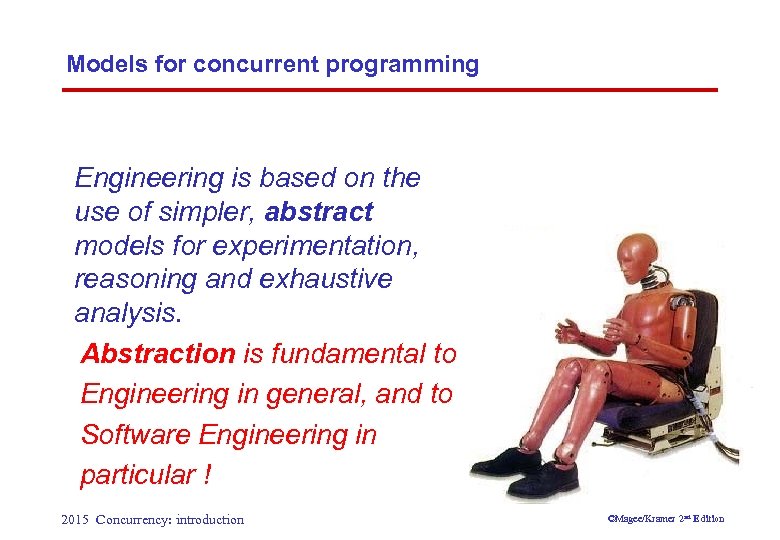 Models for concurrent programming Engineering is based on the use of simpler, abstract models for experimentation, reasoning and exhaustive analysis. Abstraction is fundamental to Engineering in general, and to Software Engineering in particular ! 20 2015 Concurrency: introduction ©Magee/Kramer 2 nd Edition
 Models and Model Checking A model is an abstract, simplified representation of the real world. Engineers use models to gain confidence in the adequacy and validity of a proposed design: ¨ focus on an aspect of interest - concurrency ¨ model animation to visualise a behaviour ¨ automated model checking of properties (safety & progress) Models are needed to ¨ experiment, test, and check a design before it is implemented 2015 ¨ airplane software before test flight ¨ net bank services before customer use ¨ medical sensor system before patient use Concurrency: introduction 21 ©Magee/Kramer 2 nd Edition
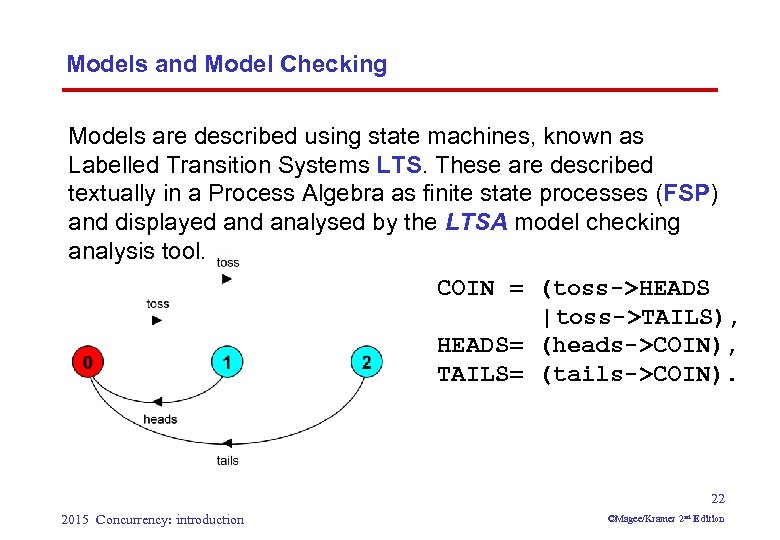 Models and Model Checking Models are described using state machines, known as Labelled Transition Systems LTS. These are described textually in a Process Algebra as finite state processes (FSP) and displayed analysed by the LTSA model checking analysis tool. COIN = (toss->HEADS |toss->TAILS), HEADS= (heads->COIN), TAILS= (tails->COIN). 22 2015 Concurrency: introduction ©Magee/Kramer 2 nd Edition
 Finite State Machines and Model Checking Turing awards related to Model Checking u (2007) Edmund M. Clarke, E. Allen Emerson, Joseph Sifakis: • “for their role in developing Model-Checking into a highly effective verification technology that is widely adopted in the hardware and software industries. ” u (1996) Amir Pnueli: • “For seminal work introducing temporal logic into computing science and for outstanding contributions to program and system verification. ” u (1986) John E Hopcroft, “Bob” Tarjan: • foundation of formal languages for state machines u (1976) Michael O. Rabin, Dana S. Scott: 2015 • Finite Automata and Their Decision Problem, which introduced 23 ©Magee/Kramer Edition Concurrency: introduction the idea of nondeterministic machines, which has proved to 2 be an nd
 Process Algebra Turing awards related to Process Algebra u (1991) “Robin” Milner: For three distinct and complete achievements: • LCF the mechanization of Scott’s Logic of Computable Functions, for machine assisted proof construction; • ML the first language to include polymorphic type inference together with a type-safe exception-handling mechanism; • Process Algebra: CCS (Calculus of Communicating Systems) a general theory of concurrency. u (1980) “Tony” Hoare. For his fundamental contributions to the definition and design of programming languages. ” . • Process Algebra: the language and theory around CSP (Communicating Sequential Processes) 2015 Concurrency: introduction 24 ©Magee/Kramer 2 nd Edition
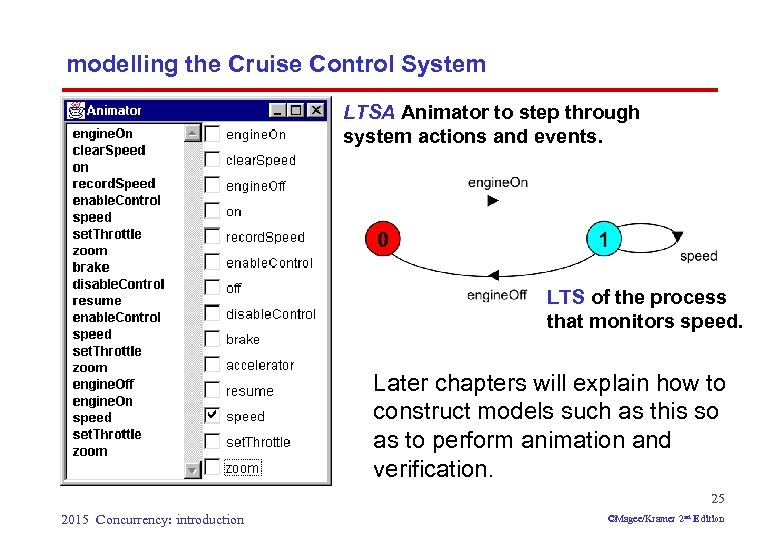 modelling the Cruise Control System LTSA Animator to step through system actions and events. LTS of the process that monitors speed. Later chapters will explain how to construct models such as this so as to perform animation and verification. 25 2015 Concurrency: introduction ©Magee/Kramer 2 nd Edition
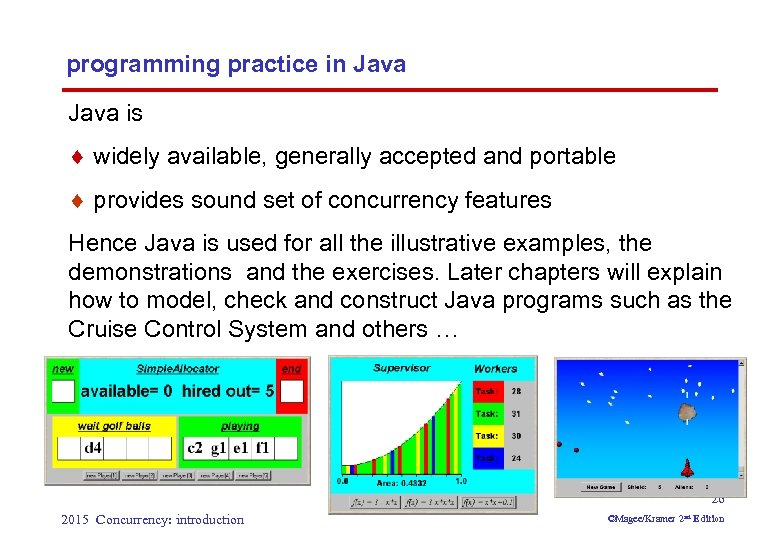 programming practice in Java is ¨ widely available, generally accepted and portable ¨ provides sound set of concurrency features Hence Java is used for all the illustrative examples, the demonstrations and the exercises. Later chapters will explain how to model, check and construct Java programs such as the Cruise Control System and others … 26 2015 Concurrency: introduction ©Magee/Kramer 2 nd Edition
 course objectives This course is intended to provide a sound understanding of the basic concepts, models and practice involved in designing concurrent software. The emphasis on principles and concepts provides a thorough understanding of the issues and the solutions. Modelling provides insight into concurrent behavior and aids reasoning about particular designs. Concurrent programming in Java provides the programming practice and experience. 27 2015 Concurrency: introduction ©Magee/Kramer 2 nd Edition
 Learning outcomes… After completing this course, you will know u how to model, analyze, and program concurrent objectoriented systems. u the most important concepts and techniques for concurrent programming. u what are the problems which arise in concurrent programming. u what techniques you can use to solve these problems. 28 2015 Concurrency: introduction ©Magee/Kramer 2 nd Edition
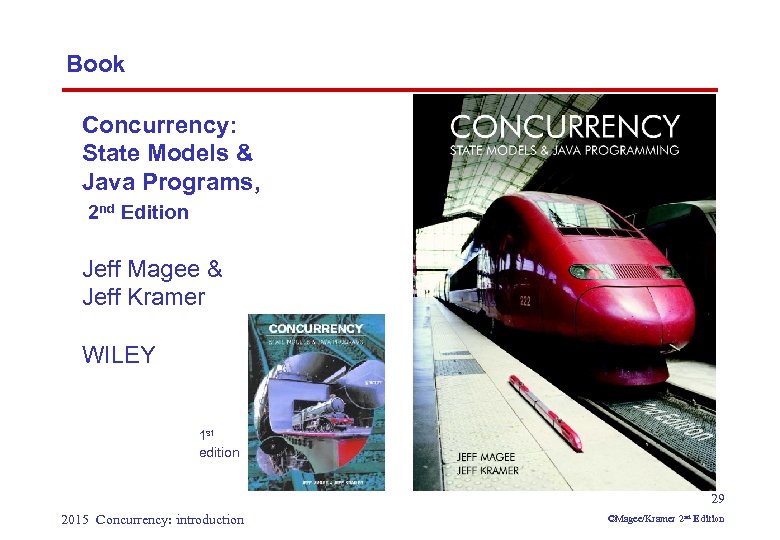 Book Concurrency: State Models & Java Programs, 2 nd Edition Jeff Magee & Jeff Kramer WILEY 1 st edition 29 2015 Concurrency: introduction ©Magee/Kramer 2 nd Edition
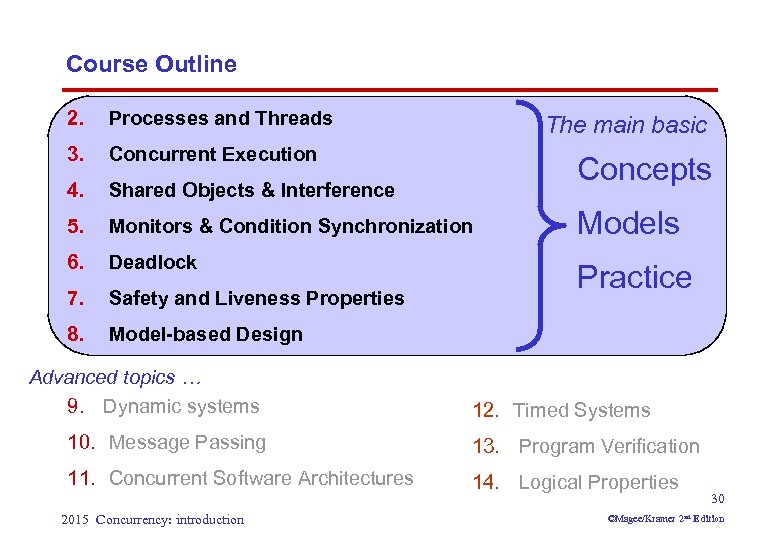 Course Outline 2. Processes and Threads 3. Concurrent Execution 4. Shared Objects & Interference 5. Monitors & Condition Synchronization Models 6. Deadlock 7. Safety and Liveness Properties Practice 8. Model-based Design Advanced topics … 9. Dynamic systems The main basic Concepts 12. Timed Systems 10. Message Passing 13. Program Verification 11. Concurrent Software Architectures 14. Logical Properties 2015 Concurrency: introduction 30 ©Magee/Kramer 2 nd Edition
 Web based course material http: //www-dse. doc. ic. ac. uk/concurrency/ u Java examples and demonstration programs u State models for the examples u Labelled Transition System Analyser (LTSA) for modelling concurrency, model animation and model property checking. 31 2015 Concurrency: introduction ©Magee/Kramer 2 nd Edition
 Summary u Concepts l we adopt a model-based approach for the design, analysis and construction of concurrent programs u Models l we use finite state models to represent concurrent behaviour. u Practice l we use Java for constructing concurrent programs. Examples are used to illustrate the concepts, models and demonstration programs. 32 2015 Concurrency: introduction ©Magee/Kramer 2 nd Edition