


 Скачать презентацию Conceptual Design Agenda a How to come up with
5cf1770d26d9b823a0e6b95f3d4045e3.ppt
- Количество слайдов: 23
 Conceptual Design Agenda (a)How to come up with design concepts (b)(b) How to evaluate whether our concept is worth developing (c) Using concurrent engineering in the Product Development Process (d) Related issues, e. g. Styling, Ergonomics, Marketing strategies.
 STEP 1. How to come up with design concepts Inspirational: e. g. Yoshiro Nakamastsu (Floppy disk; holds ~2300 patents ) Systematic: e. g. Altshuller (Theory of Inventive Problem Solving, TIPS/TRIZ) Essential components a) Generate many, many alternative ideas, b) Systematically select the best one.
 Pugh Concept Selection Method Stage 1. Generate the design alternatives (i) Specify main objectives: preliminary product specifications. (ii) Specify Selection criteria (functional requirements) (iii) Select one design as a datum (reference design) (iv) Rate all other designs: worse (-) almost same (s) better (+)
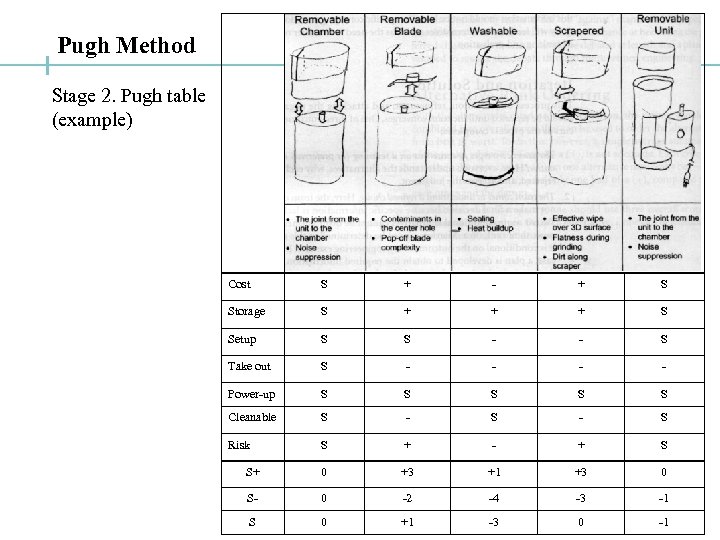 Pugh Method Stage 2. Pugh table (example) Cost S + - + S Storage S + + + S Setup S S - - S Take out S - - Power-up S S S Cleanable S - S Risk S + - + S S+ 0 +3 +1 +3 0 S- 0 -2 -4 -3 -1 S 0 +1 -3 0 -1
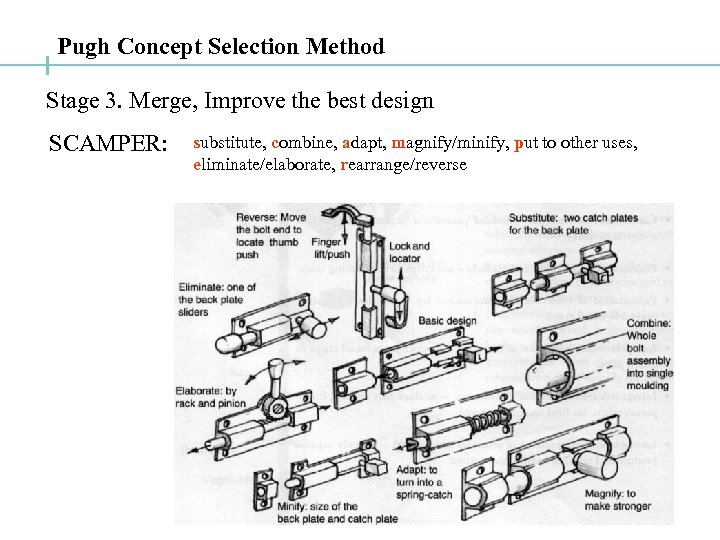 Pugh Concept Selection Method Stage 3. Merge, Improve the best design SCAMPER: substitute, combine, adapt, magnify/minify, put to other uses, eliminate/elaborate, rearrange/reverse
 STEP 2. Evaluate if a concept is worth developing (a) Technical issues Can we deliver the product to meet the required specs? (b) Legal issues Will there be legal problems (patents, copyrights etc. )? How to check for existing patents ? All US patents www. uspto. gov Soviet patents: Invention Machine (www. invention-machine. com) [TRIZ]
 STEP 2. Evaluate if a concept is worth developing. . (c) Sales/Market analysis issues Is there sufficient demand? What is the competition? (d) Financial issues Can we produce it profitably? (e) Business issues Do we have the capital? Personnel? Make-or-buy components?
 STEP 2. Evaluate if a concept is worth developing… SWOT analysis Strengths, Weaknesses, Opportunities and Threats. Strengths/Weaknesses: advantages/disadvantages of the technology used, distribution channels, existing suppliers, manufacturing capacity and facilities, available personnel Opportunities/Threats: marketability, threat of competition, ability/failure to deliver the product on schedule, costs, ability to evolve the product into a family or generations, … Read a Business Plan !
 STEP 2. Evaluate if a concept is worth developing. … Output of Step 2: (i) The functional requirements list of product specs (ii) Conceptual sketches/Industrial Design Drawing (IDD) (iii) SWOT documentation
 STEP 3. Embodiment design and Concurrent Engineering Goals: (a) The detailed, or engineering specs (b) The product architecture (c) The engineering drawings
 STEP 3. Embodiment design and Concurrent Engineering. . Concurrent Engineering vs Sequential Engineering Concept of Design Teams [Chrysler example] Goal: reduction in re-work due to manufacturability Important engineering protocol: Engineering Change Notice, or ECN
 STEP X. Ergonomics, Marketing strategies, and Styling Ergonomics: Safety no injury in expected usage Example: children’s toys: no sharp points, no loose balls Example: Cooking utensils (e. g. Wok) thermally insulated handles Example: Seat belts and air-bags in automobiles Comfort Example: Mobile phone small buttons, too close dialing problems Example: Adjusting back-rest, height of chairs allow adjustment for comfort
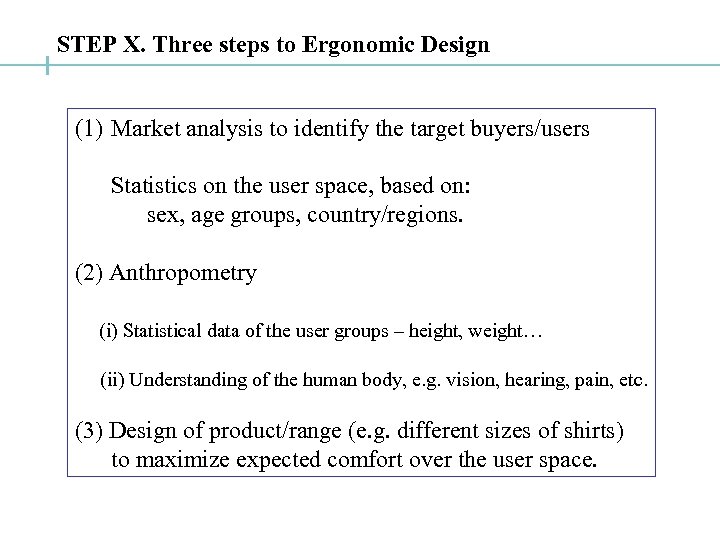 STEP X. Three steps to Ergonomic Design (1) Market analysis to identify the target buyers/users Statistics on the user space, based on: sex, age groups, country/regions. (2) Anthropometry (i) Statistical data of the user groups – height, weight… (ii) Understanding of the human body, e. g. vision, hearing, pain, etc. (3) Design of product/range (e. g. different sizes of shirts) to maximize expected comfort over the user space.
 STEP X. Styling The geometric and material characteristics that have no affect on the functionality, but affect the looks and other perceptual properties of the product functionally equivalent “visually attractive” product is preferred
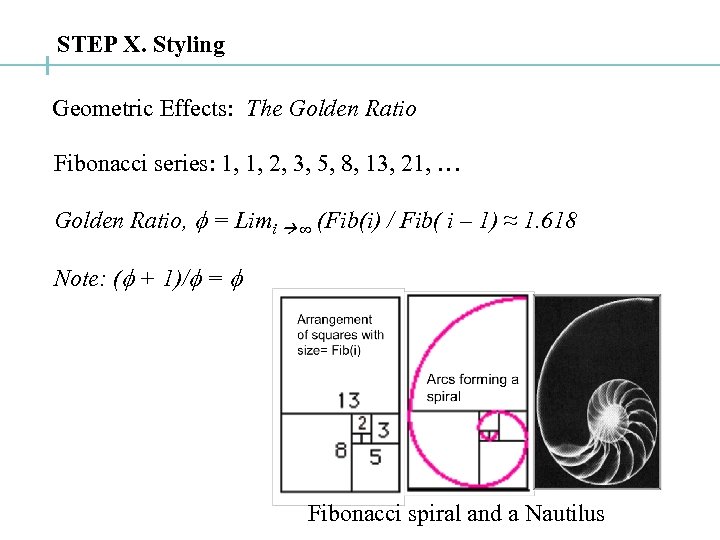 STEP X. Styling Geometric Effects: The Golden Ratio Fibonacci series: 1, 1, 2, 3, 5, 8, 13, 21, … Golden Ratio, f = Limi ∞ (Fib(i) / Fib( i – 1) ≈ 1. 618 Note: (f + 1)/f = f Fibonacci spiral and a Nautilus
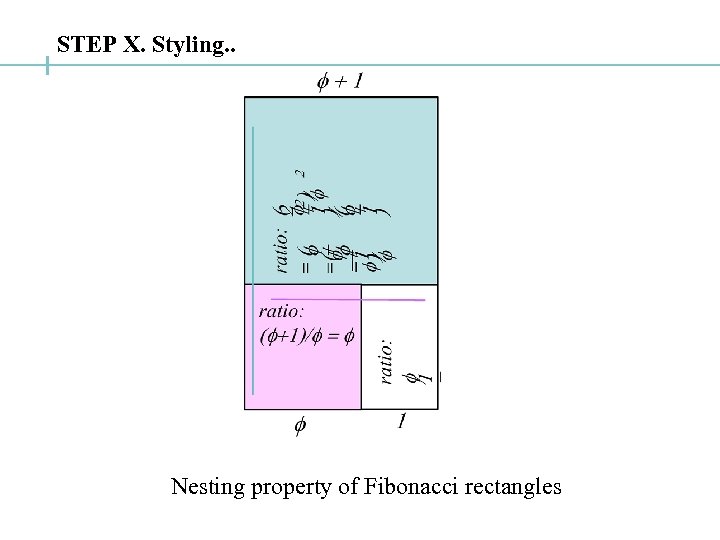 STEP X. Styling. . Nesting property of Fibonacci rectangles
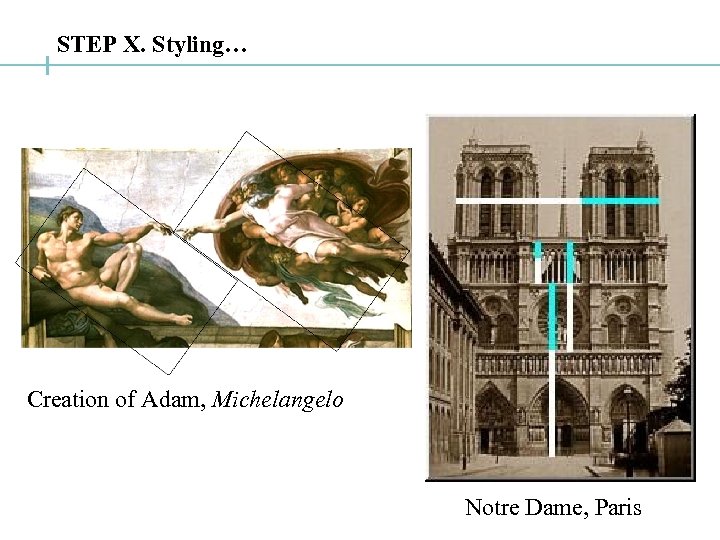 STEP X. Styling… Creation of Adam, Michelangelo Notre Dame, Paris
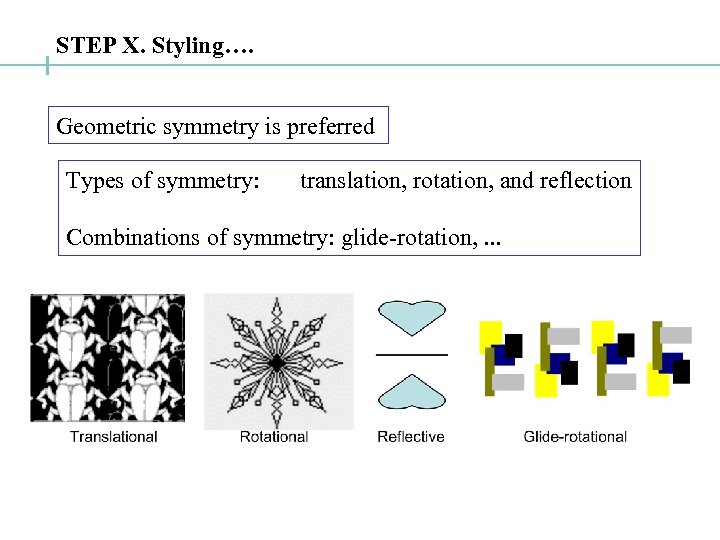 STEP X. Styling…. Geometric symmetry is preferred Types of symmetry: translation, rotation, and reflection Combinations of symmetry: glide-rotation, . . .
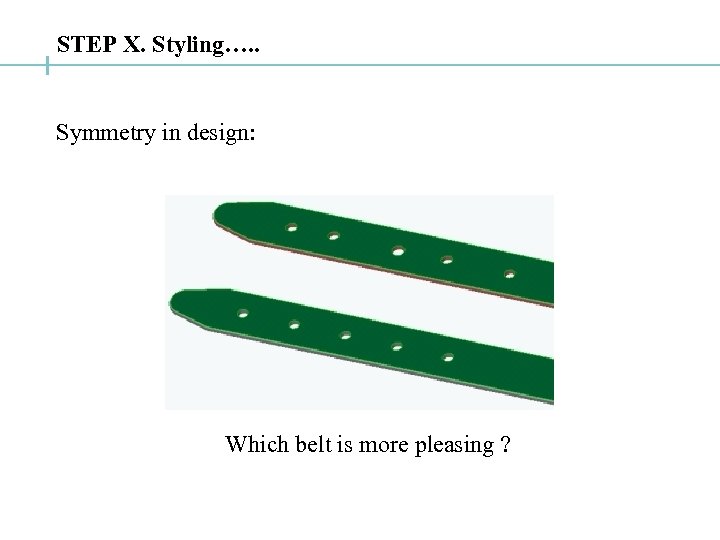 STEP X. Styling…. . Symmetry in design: Which belt is more pleasing ?
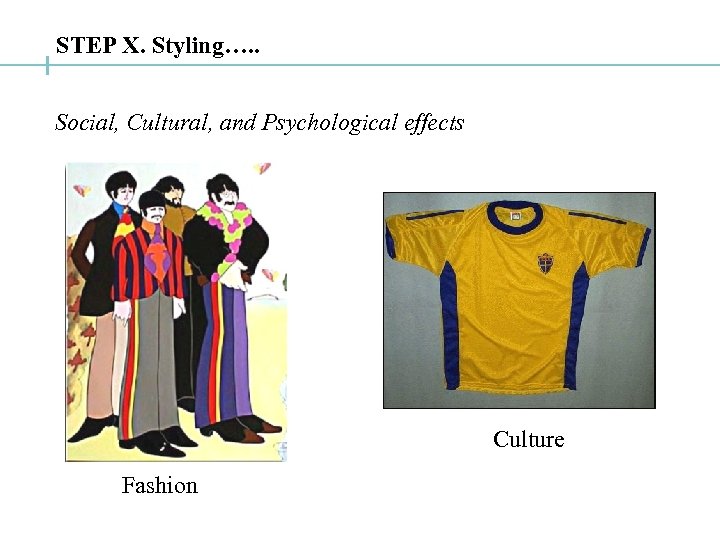 STEP X. Styling…. . Social, Cultural, and Psychological effects Culture Fashion
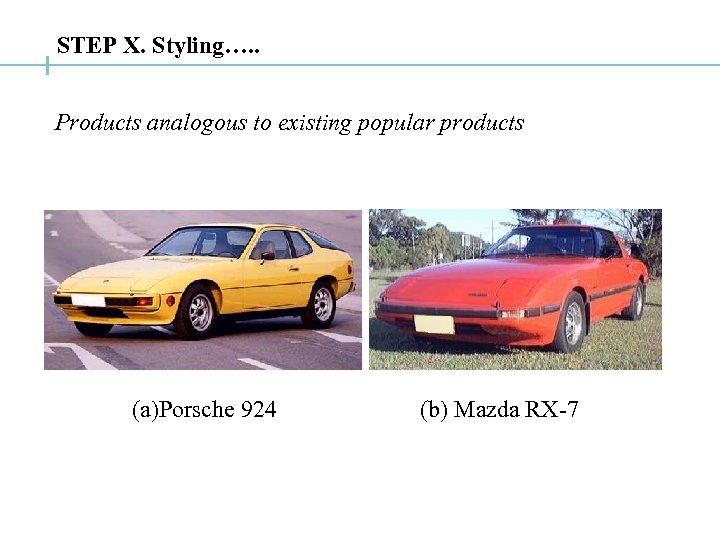 STEP X. Styling…. . Products analogous to existing popular products (a)Porsche 924 (b) Mazda RX-7
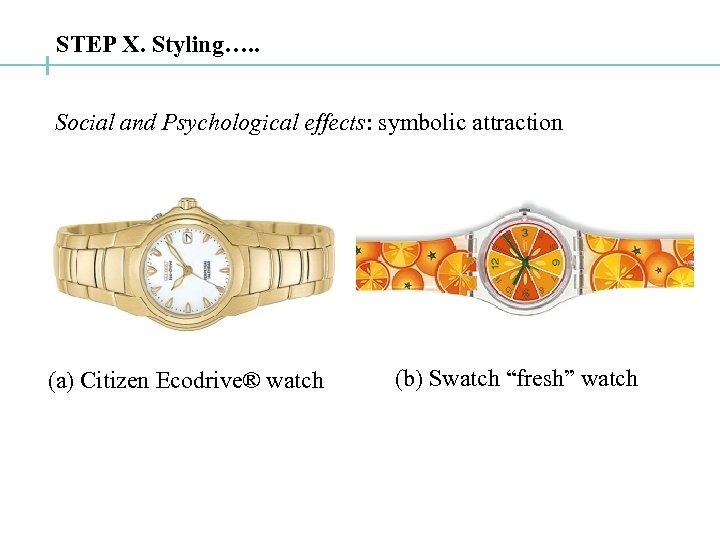 STEP X. Styling…. . Social and Psychological effects: symbolic attraction (a) Citizen Ecodrive® watch (b) Swatch “fresh” watch
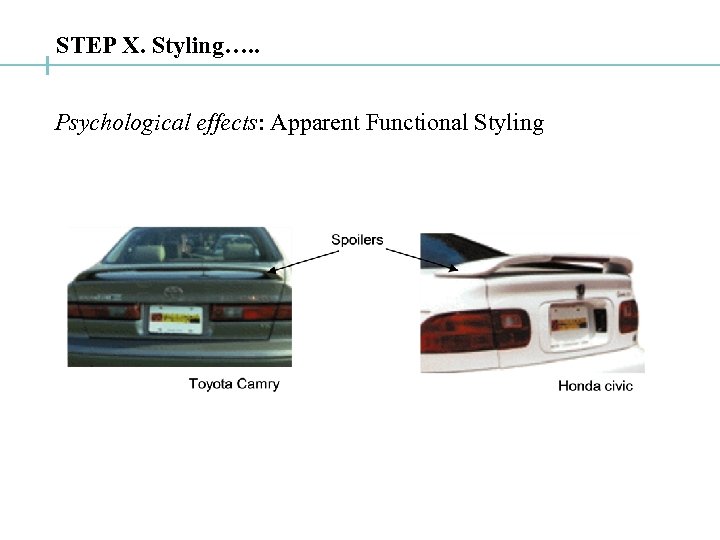 STEP X. Styling…. . Psychological effects: Apparent Functional Styling