


 Скачать презентацию CONCEPTS OF FORGIVENESS ACADEMIC TEXTS AND OTHER EXPERIENCES
c78287d3ab6c5b15e92a442a562f3957.ppt
- Количество слайдов: 19
 CONCEPTS OF FORGIVENESS: ACADEMIC TEXTS AND OTHER EXPERIENCES PEACE & JUSTICE STUDIES COMMUNITY Presented October 12, 2013 John E. Daniel, Student Montgomery College-Rockville Faculty Sponsor: Tülin Levitas, Professor, Montgomery College-Rockville
 Course Description l l l 2 Introduce students to the concept of forgiveness as it has been applied by the Truth and Reconciliation Commission in South Africa; Explore the sources of the concept—its Judeo-Christian roots and South African roots of Ubuntu; Address whether the Commission’s work did lead to justice; and
 Course Description (cont’d) l Investigate relationship between concepts of amnesty, justice, and accountability. The course was a collaborative teaching and learning process. All texts and outside classroom experiences were chosen jointly by faculty and students. Not all texts were used in each offering of the course. 3
 Background Texts Used in Initial Classes l l l 4 Desmond Tutu, No Future Without Forgiveness. New York: Doubleday, 1999. 294 pp. Pumla Gobodo-Madikizela, A Human Being Died That Night. New York: Houghton Mifflin, 2003. 193 pp. Dalai Lama and Victor Chan, The Wisdom of Forgiveness. New York: Riverhead Books, 2004. 266 pp.
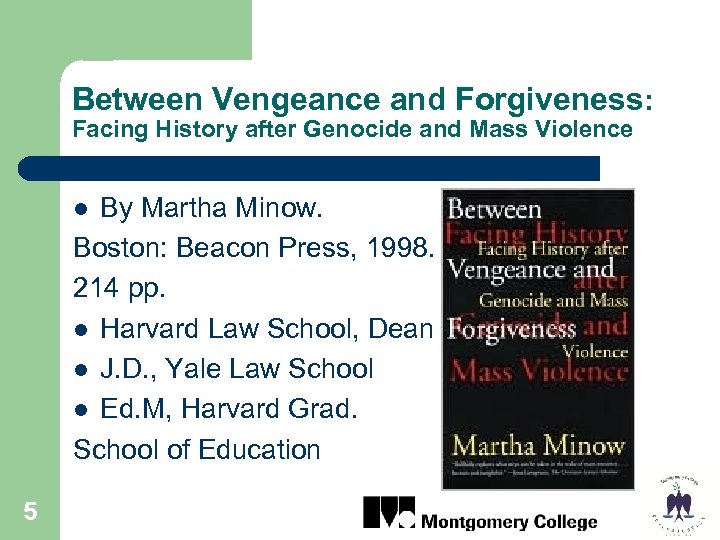 Between Vengeance and Forgiveness: Facing History after Genocide and Mass Violence By Martha Minow. Boston: Beacon Press, 1998. 214 pp. l Harvard Law School, Dean l J. D. , Yale Law School l Ed. M, Harvard Grad. School of Education l 5
 Between Vengeance and Forgiveness l l l 6 Minow examines process of rebuilding lives and society in the aftermath of atrocity Scrutinizes social and historic roots of genocide and mass violence Challenge is to negotiate path securing justice for victims and rebuilding a society
 Minow: Truth Commissions l l 7 Studies strategies of national experiments in justice and healing Central task of truth commissions is to write a history of a nation’s troubled past Obviously favors South African model-TRC Primary focus is restoring dignity to victims
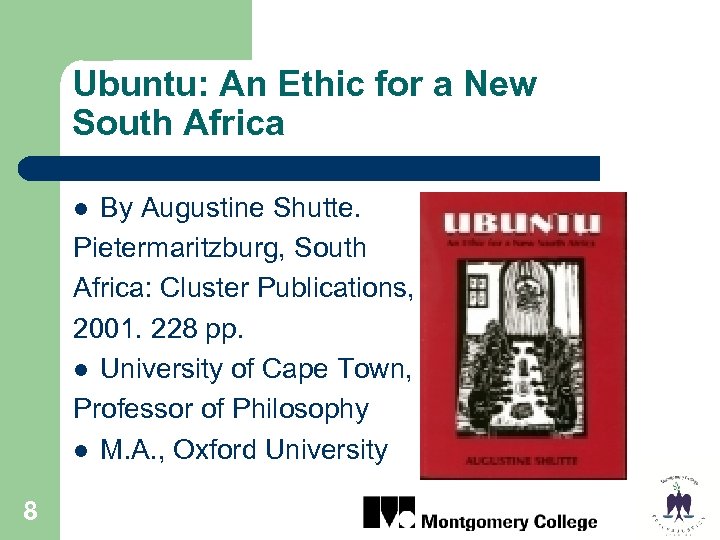 Ubuntu: An Ethic for a New South Africa By Augustine Shutte. Pietermaritzburg, South Africa: Cluster Publications, 2001. 228 pp. l University of Cape Town, Professor of Philosophy l M. A. , Oxford University l 8
 Bringing South Africa Together l l l l 9 Bring together what apartheid kept apart New ethic mirrors European ideas: freedom, individual power of free choice Persons exist only in relation to other persons Ubuntu: A person is a person through persons Spirit of Ubuntu helping dissipate the spirit of apartheid African philosophy: I am because we are Manifested in forgiveness in TRC hearings
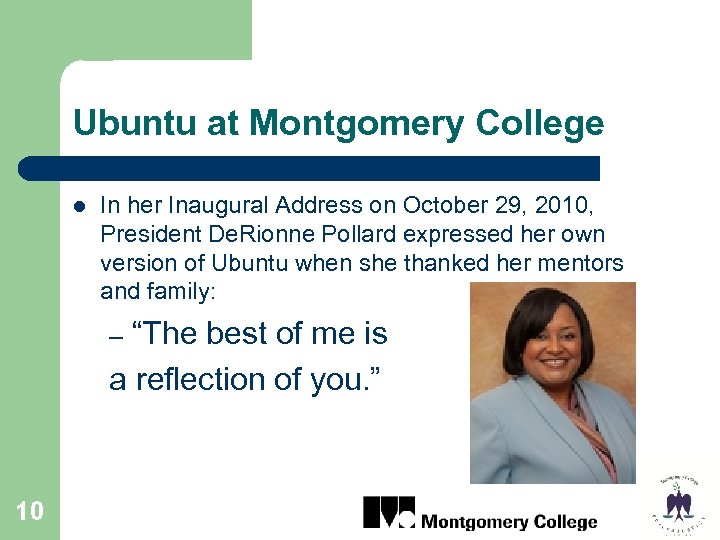 Ubuntu at Montgomery College l In her Inaugural Address on October 29, 2010, President De. Rionne Pollard expressed her own version of Ubuntu when she thanked her mentors and family: “The best of me is a reflection of you. ” – 10
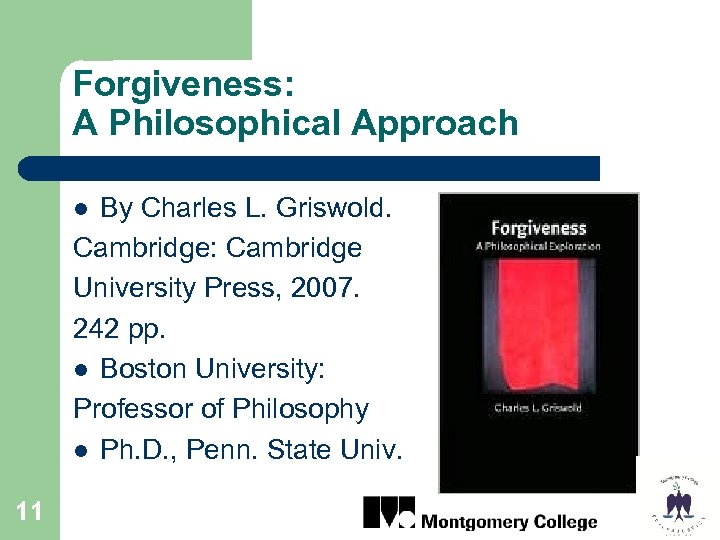 Forgiveness: A Philosophical Approach By Charles L. Griswold. Cambridge: Cambridge University Press, 2007. 242 pp. l Boston University: Professor of Philosophy l Ph. D. , Penn. State Univ. l 11
 Forgiveness at Its Best l l l 12 Ethical response to injury and the injurer Not required to forswear resentment, only to moderate it and forswear revenge Both parties must satisfy certain conditions to qualify for paradigm case of dyadic forgiveness – Six criteria: Offender: 1 - Repudiate one’s prior actions 2 – Express regret
 Forgiveness at Its Best (cont’d) l 3 – Commit to be a better person l 4 – Understand nature of harm from the injured party’s perspective 5 – Offer narrative account of how she came to do the wrong and is now worthy of approbation, and Victim: 6 – Forswear revenge and commit to eventually let go of, resentment altogether l l 13
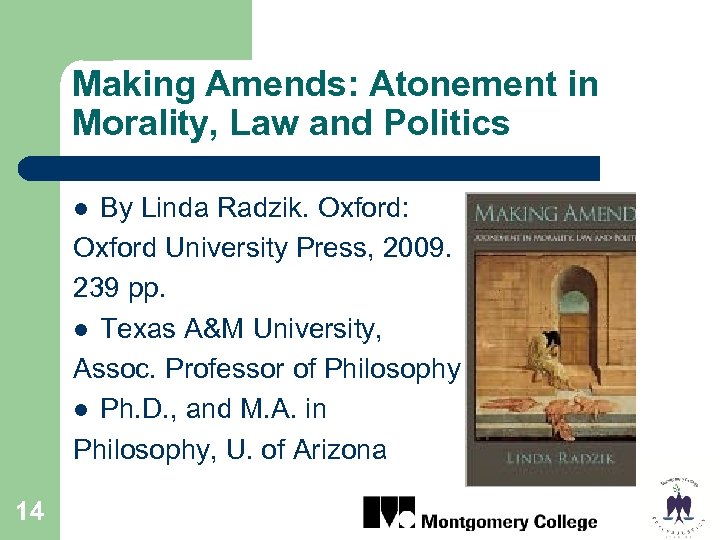 Making Amends: Atonement in Morality, Law and Politics By Linda Radzik. Oxford: Oxford University Press, 2009. 239 pp. l Texas A&M University, Assoc. Professor of Philosophy l Ph. D. , and M. A. in Philosophy, U. of Arizona l 14
 An Ethic for Wrongdoers l l 15 Approaches question of atonement from the wrongdoer’s point of view Wrong sends message that wrongdoer is worth more that the victim Explores responses that wrongdoers should make to their own misdeeds Responses can be apology, repentance, reparations, and self-punishment
 An Ethic for Wrongdoers (cont’d) l l l 16 Offers wrongdoers opportunity to earn redemption within the moral community Views atonement as repaying a moral debt Unlike Griswold, Radzik argues that should a victim wrongfully refuse to reconcile after wrongdoer’s thoroughgoing atonement, wrongdoer may consider herself redeemed
 Other Books and Texts l l 17 Simon Wiesenthal, The Sunflower. New York: Random House, 1988. 304 pp. Eric Lomax, The Railway Man. New York: Norton, 1995. 278 pp.
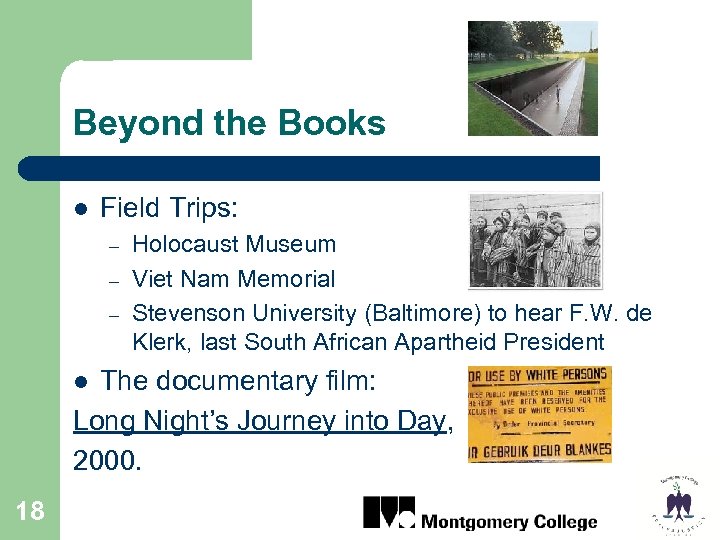 Beyond the Books l Field Trips: – – – Holocaust Museum Viet Nam Memorial Stevenson University (Baltimore) to hear F. W. de Klerk, last South African Apartheid President The documentary film: Long Night’s Journey into Day, 2000. l 18
 Conclusion l l 19 Wrongdoing and suffering wrong are all too common occurrences today Society’s need to face events of genocide, mass violence and forceful conflict raises questions of how we ought to respond to them Seeking forgiveness, making amends, pursuing redemption are all worthy paths to take Our authors have given us the conceptual tools to begin to address these complex topics