


 Скачать презентацию Concepts in Enterprise Resource Planning 4 th Edition
a9f34b9227360f12fa53340fb9070004.ppt
- Количество слайдов: 43
 Concepts in Enterprise Resource Planning 4 th Edition Chapter Five Accounting in ERP Systems Concepts in Enterprise Resource Planning, 4 th Edition 1
 Objectives After completing this chapter, you will be able to: • Describe the differences between financial and managerial accounting • Identify and describe problems associated with accounting and financial reporting in unintegrated information systems • Describe how ERP systems can help solve accounting and financial reporting problems in an unintegrated system • Describe how the Enron scandal and the Sarbanes-Oxley Act have affected accounting information systems • Explain accounting and management-reporting benefits that accrue from having an ERP system Concepts in Enterprise Resource Planning, 4 th Edition Planning 2
 Accounting Activities • Areas of accounting: – Financial accounting – Managerial accounting • Financial accounting – Documenting all transactions of a company that have an impact on the financial state of the firm – Using documented transactions to create reports for external parties and agencies – Reports, or financial statements, must follow prescribed rules and guidelines of various agencies Concepts in Enterprise Resource Planning, 4 th Edition 3
 Accounting Activities (cont’d. ) • Common financial statements: balance sheets and income statements • Balance sheet – Statement that shows account balances such as: • • • Cash held Amounts owed to company by customers Cost of raw materials and finished-goods inventory Long-term assets such as buildings Amounts owed to vendors, banks, and other creditors Amounts owners have invested in company Concepts in Enterprise Resource Planning, 4 th Edition 4
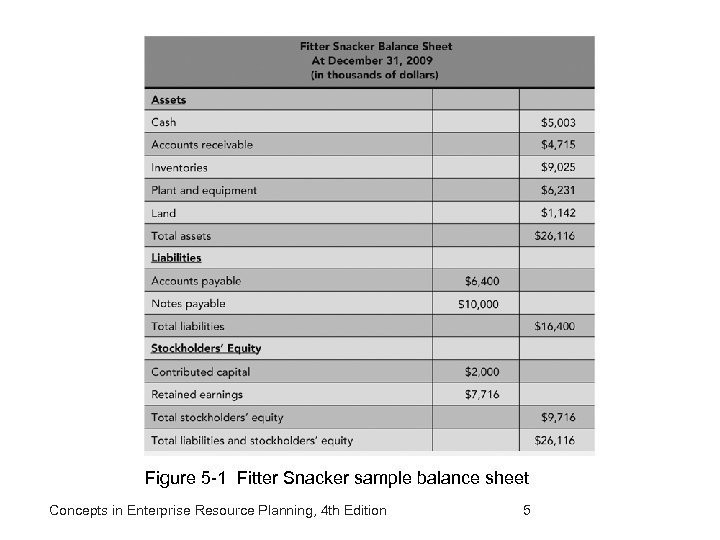 Figure 5 -1 Fitter Snacker sample balance sheet Concepts in Enterprise Resource Planning, 4 th Edition 5
 Accounting Activities (cont’d. ) • Income statement – Profit and loss (P&L) statement – Shows company’s sales, cost of sales, and profit or loss for a period of time (typically a quarter or year) • Integrated information system simplifies the process of closing the books and preparing financial statements • Managerial accounting – is a field of accounting that analyzes and provides cost information to the internal management for the purposes of planning, controlling and decision making. • Cost accounts are not preserved under Management Accounting. • The necessary data from financial statements and cost ledgers are analyzed Concepts in Enterprise Resource Planning, 4 th Edition 6
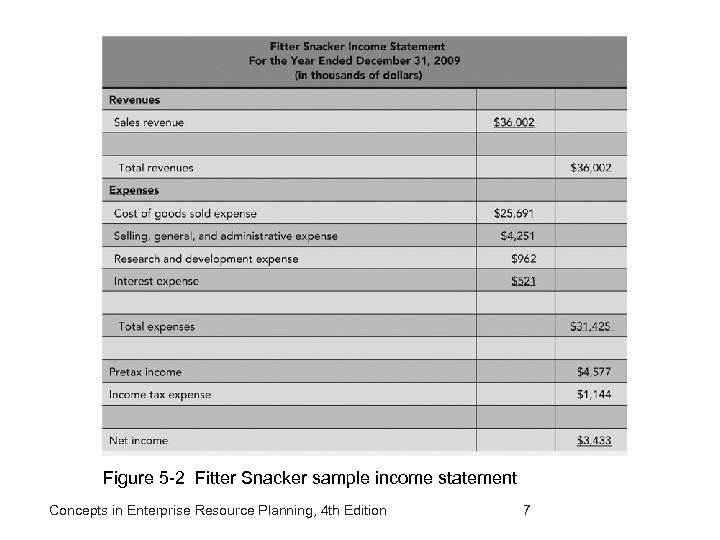 Figure 5 -2 Fitter Snacker sample income statement Concepts in Enterprise Resource Planning, 4 th Edition 7
 Using ERP for Accounting Information • Problems associated with unintegrated systems – Data sharing usually did not occur in real time • Accounting’s data were often out of date – Accounting personnel had to do significant research • ERP system, with its centralized database, avoids these problems • In traditional accounting, company’s accounts are kept in a record called a general ledger Concepts in Enterprise Resource Planning, 4 th Edition 8
 Using ERP for Accounting Information (cont’d. ) • In the SAP ERP system, input to general ledger occurs simultaneously with business transactions • Many SAP ERP modules cause transaction data to be entered into general ledger, including: – – – Sales and Distribution (SD) Materials Management (MM) Financial Accounting (FI) Controlling (CO) Human Resources (HR) Asset Management (AM) Concepts in Enterprise Resource Planning, 4 th Edition 9
 Operational Decision-Making Problem: Credit Management • Unintegrated information system – Out-of-date or inaccurate accounting data • can cause problems when a company is making operational decisions • Industrial credit management • Fitter Snacker’s credit management procedures • Credit management in SAP ERP Concepts in Enterprise Resource Planning, 4 th Edition 10
 Industrial Credit Management • Credit management requires a good balance between: – Granting sufficient credit to support sales and – Making sure that the company does not lose too much money • Setting a limit on how much money a customer can owe at any one time and then – Monitoring that limit as orders come in and payments are received – Example Concepts in Enterprise Resource Planning, 4 th Edition 11
 Industrial Credit Management (cont’d. ) • to make this system work, – a sales representative needs to have access to up-to-date accounts receivable balances for all customers. • Problems arise if Marketing and Accounting have unintegrated information systems – Accounting may not immediately record sales and/or payment receipt • Problems should not arise with an integrated information system – Accounts receivable is immediately updated Concepts in Enterprise Resource Planning, 4 th Edition 12
 Fitter Snacker’s Credit Management Procedures • FS sales clerk refers to a weekly printout of a customer’s current balance and credit limit to see if credit should be granted • Sales data are transferred to Accounting by disk three times a week • Accounting clerk can use sales input to prepare a customer invoice • Accounting must make any adjustments for partial shipments before preparing the invoice – The accuracy of the adjustment process depends on whether the warehouse transmits order changes to Accounting in a timely fashion • Accounting clerks process customer payments Concepts in Enterprise Resource Planning, 4 th Edition 13
 Credit Management in SAP ERP • SAP ERP would allow FS to set a credit limit for each customer • Company can configure any number of credit-check options in SAP ERP system – for instance, at order creation, at creation of the delivery document, or at the goods issue • Advantages of using SAP ERP to manage credit – Process is automated – Data are available in real time Concepts in Enterprise Resource Planning, 4 th Edition 14
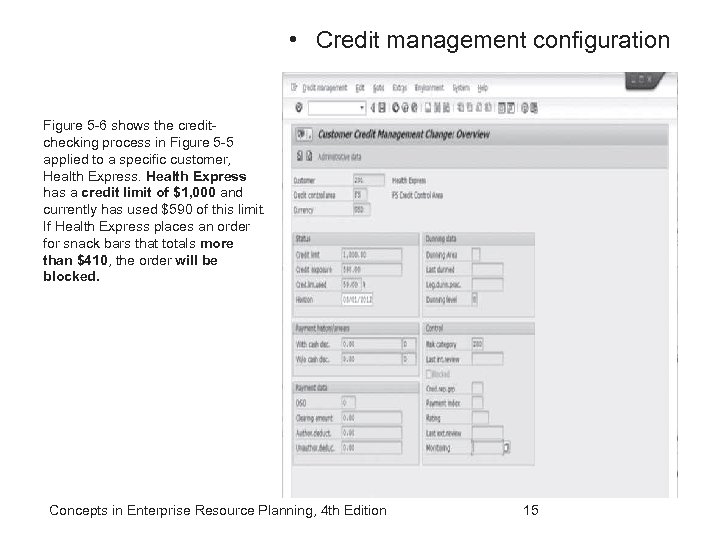 • Credit management configuration Figure 5 -6 shows the creditchecking process in Figure 5 -5 applied to a specific customer, Health Express has a credit limit of $1, 000 and currently has used $590 of this limit. If Health Express places an order for snack bars that totals more than $410, the order will be blocked. Concepts in Enterprise Resource Planning, 4 th Edition 15
 Product Profitability Analysis • Business managers use accounting data to perform profitability analyses of a company and its products • When data are inaccurate or incomplete, the analyses are flawed • Main reasons for inaccurate or incomplete data – Inconsistent recordkeeping – Inaccurate inventory costing systems – Problems consolidating data from subsidiaries Concepts in Enterprise Resource Planning, 4 th Edition 16
 Inconsistent Recordkeeping • Each of FS’s marketing divisions maintains its own records and keeps track of sales data differently • Paper records might be inaccurate or missing, making validity of the final report questionable • Without integrated information systems, accounting and reporting to management requires: – Working around limitations of information systems to produce useful output • ERP system minimizes or eliminates these problems because both divisions record and store their data in the same way, in the same database. Concepts in Enterprise Resource Planning, 4 th Edition 17
 Inaccurate Inventory Costing Systems • Correctly calculating inventory costs – One of the most important and challenging accounting tasks in any manufacturing company • Inventory cost accounting background – Manufactured item’s cost has three elements: • Cost of raw materials • Cost of labor employed directly in production of item • Overhead: all other costs – such as factory utilities, factory managers’ salaries, storage, insurance, …. Concepts in Enterprise Resource Planning, 4 th Edition 18
 Inaccurate Inventory Costing Systems (cont’d. ) • Inventory cost accounting background (cont’d. ) – Direct costs: materials and labor • Can be estimated fairly accurately – Indirect costs: overhead items • Difficult to associate with specific product(s) • A common method is to use total machine hours – If $1, 000 per machine hour. And fitter can make 10, 000 bars in an hour, then each bar would be allocated $0. 10 of overhead ($1, 000 ÷ 10, 000). – Fitter Snacker’s uses Standard costs for each batch of bars it produces (As explained in Chapter 4) • Example (see next slide) – Cost variances: differences between actual costs and standard costs Concepts in Enterprise Resource Planning, 4 th Edition 19
 • For example, Fitter might determine that each NRG-A bar should cost $0. 75 to make • A given month, Fitter makes 1 million NRG-A bars • Using the standard cost, it would increase its balance sheet inventory account by $750, 000 • assume that the company sells 800, 000 bars in the month • In the income statement, the cost of the sales would be shown as $600, 000 (800, 000 × $0. 75) • The inventory account would be reduced by $600, 000 • Cost variances= $750, 000 - $600, 000 Concepts in Enterprise Resource Planning, 4 th Edition 20
 Inaccurate Inventory Costing Systems (cont’d. ) • ERP and inventory cost accounting – Many companies with unintegrated accounting systems analyze their cost variances infrequently • Often, they do not know how much it actually costs to produce a unit of a product • Example – Fitter has an opportunity to sell 300, 000 NRG-A bars to a new customer (The customer wants a price of $0. 90 per bar) – If FS had an ERP system, employees throughout the company would have recorded costs in a company-wide database as they occurred – ERP system configurations allow analysts to track costs using many bases • allowing an analyst to play “what if” with product profitability decisions Concepts in Enterprise Resource Planning, 4 th Edition 21
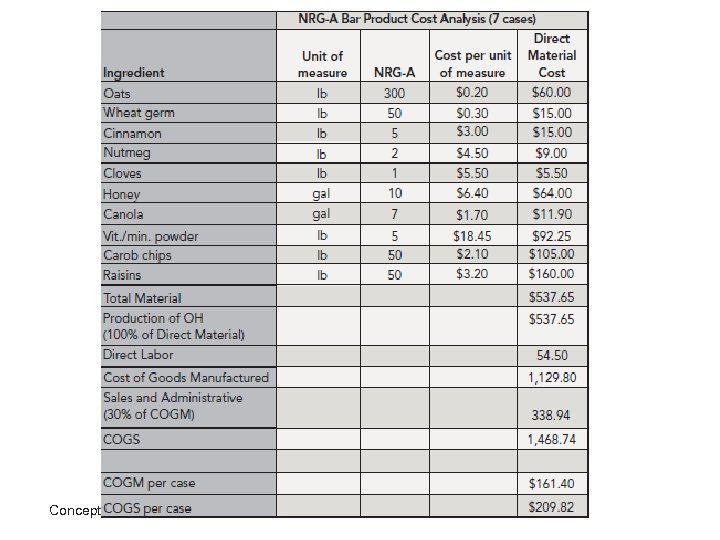
 Inaccurate Inventory Costing Systems (cont’d. ) • Product costing example – Suppose Fitter Snacker wishes to update standard costs for NRG-A bars – Product cost analysis for NRG-A bar • Product cost analysis in SAP ERP – Product cost variant: method for developing a product cost in an ERP system Concepts in Enterprise Resource Planning, 4 th Edition 22
 Concepts in Enterprise Resource Planning, 4 th Edition 23
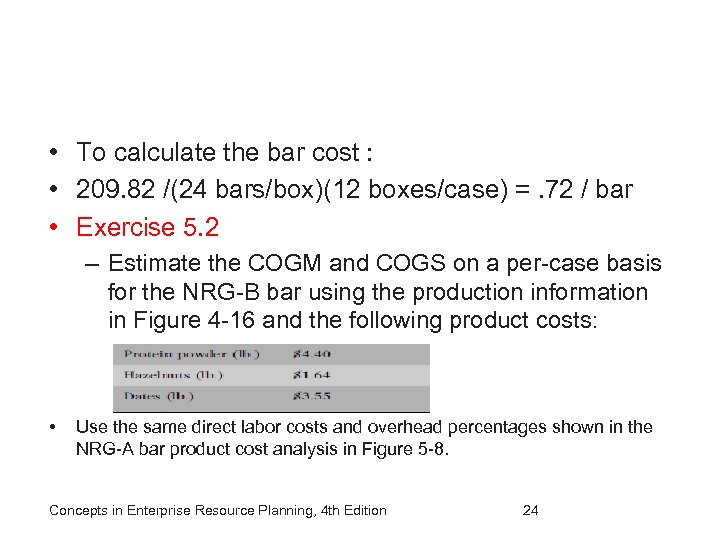 • To calculate the bar cost : • 209. 82 /(24 bars/box)(12 boxes/case) =. 72 / bar • Exercise 5. 2 – Estimate the COGM and COGS on a per-case basis for the NRG-B bar using the production information in Figure 4 -16 and the following product costs: • Use the same direct labor costs and overhead percentages shown in the NRG-A bar product cost analysis in Figure 5 -8. Concepts in Enterprise Resource Planning, 4 th Edition 24
 Companies with Subsidiaries • Account balances for each entity must be compiled and forwarded to the home office • Consolidated statement for the company as a whole must be created • Currency translation – Problems when currency translation is needed for a subsidiary’s accounts • Intercompany transactions – Transactions that occur between companies and their subsidiaries Concepts in Enterprise Resource Planning, 4 th Edition 25
 Management Reporting with ERP Systems • Generating the right reports for the right situation is often challenging • Without an ERP system, the job of tracking all the numbers that need to go into a report is a monumental undertaking • With ERP system, vast amount of information is available for reporting purposes Concepts in Enterprise Resource Planning, 4 th Edition 26
 Document Flow for Customer Service • With an ERP system, all transactions in all areas of a company get posted in a centralized database • Each transaction posted in SAP ERP gets its own unique document number – Allows quick access to the data • In SAP ERP, document numbers for related transactions are associated in the database – Provides an electronic audit trail Concepts in Enterprise Resource Planning, 4 th Edition 27
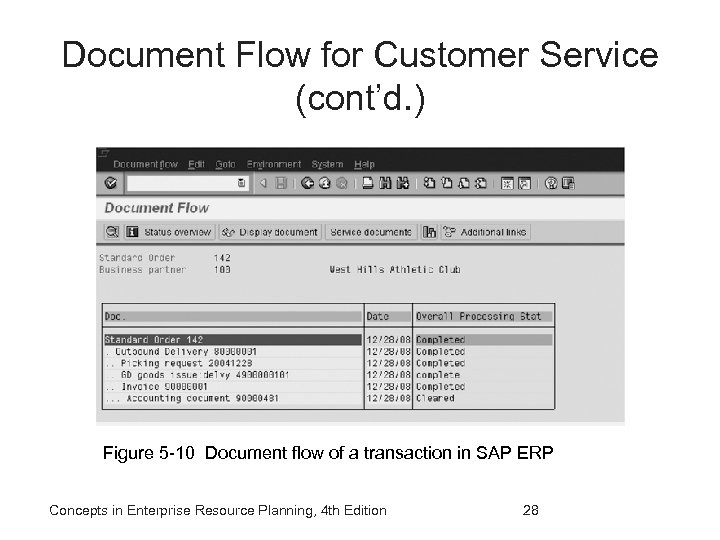 Document Flow for Customer Service (cont’d. ) Figure 5 -10 Document flow of a transaction in SAP ERP Concepts in Enterprise Resource Planning, 4 th Edition 28
 Built-In Management-Reporting and Analysis Tools • Accounting records maintained in the common database • Advantage of using a database is the ability to query the records to: – Produce standard reports – Answer ad hoc questions • SAP provides a data warehouse within each major module – Data warehouse: repository for data from various sources Concepts in Enterprise Resource Planning, 4 th Edition 29
 The Enron Collapse • October 16, 2001: Enron was one of the world’s largest electricity and natural gas traders – Reported a $618 million third-quarter loss and disclosed a $1. 2 billion reduction in shareholder equity • U. S. Securities and Exchange Commission (SEC) inquiry into possible conflict of interest related to company’s dealings with partnerships run by CFO Fastow Concepts in Enterprise Resource Planning, 4 th Edition 30
 The Enron Collapse (cont’d. ) • Volume of financial contracts was far greater than volume of contracts to actually deliver commodities • Some partnerships were faked to mask billions of dollars in debt • Enron’s financial statements had been audited by Arthur Andersen, a highly regarded accounting firm • Andersen employees on the Enron engagement team were instructed to destroy documentation relating to Enron Concepts in Enterprise Resource Planning, 4 th Edition 31
 Outcome of the Enron Scandal • Shareholders lost an estimated $40 billion dollars • Thousands of workers lost their jobs • 31 individuals were either charged or pled guilty to criminal charges • Jurors convicted accounting firm Arthur Andersen for obstructing justice by destroying Enron documents • U. S. Congress passed Sarbanes-Oxley Act of 2002 – Act was designed to prevent the kind of fraud and abuse that led to the Enron downfall Concepts in Enterprise Resource Planning, 4 th Edition 32
 Sarbanes-Oxley Act • U. S. Congress passed Sarbanes-Oxley Act of 2002 – Act was designed to prevent the kind of fraud and abuse that led to the Enron downfall • Designed to encourage top management accountability in firms that are publicly traded in the United States Concepts in Enterprise Resource Planning, 4 th Edition 33
 Implications of the Sarbanes-Oxley Act for ERP Systems • To meet the internal control report requirement, a company must: – Document the controls that are in place – Verify that the controls are not subject to error or manipulation • Companies with ERP systems in place will have an easier time complying with the Sarbanes-Oxley Act than will companies without ERP Concepts in Enterprise Resource Planning, 4 th Edition 34
 Archiving • SAP ERP software offers very few ways to delete items • Data are removed from SAP ERP system only after they have been recorded to media (tape backup, DVD-R) for permanent storage • Archive: permanent storage • SAP ERP systems keep track of when data are created or changed – Change Record Concepts in Enterprise Resource Planning, 4 th Edition 35
 User Authorizations • SAP ERP has sophisticated user administration tools that allow different levels of authorization management – Ensure that employees can perform only the transactions required for their jobs • Profile Generator – Provides a simple method for selecting functions that a user should be allowed to perform Concepts in Enterprise Resource Planning, 4 th Edition 36
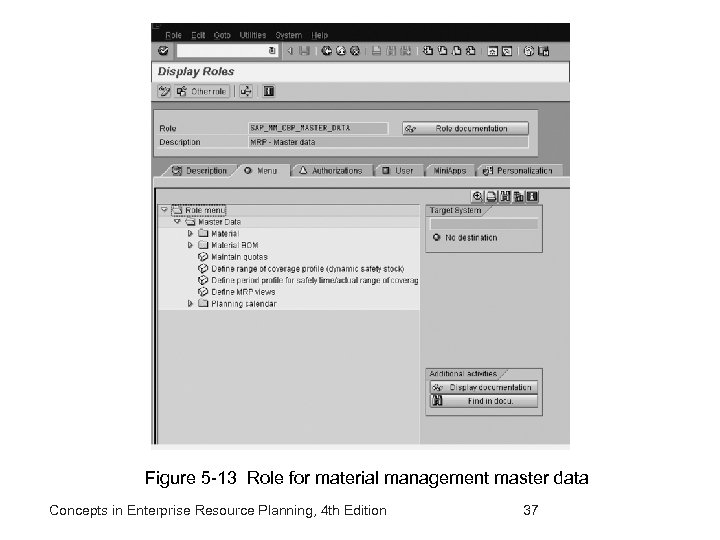 Figure 5 -13 Role for material management master data Concepts in Enterprise Resource Planning, 4 th Edition 37
 Tolerance Groups • Setting limits on the size of transaction an employee can process – In an SAP ERP system, this is done using tolerance groups • Tolerance groups – Preset limits on an employee’s ability to post transactions – Set limits on the dollar value for a single item in a document as well as the total value of document Concepts in Enterprise Resource Planning, 4 th Edition 38
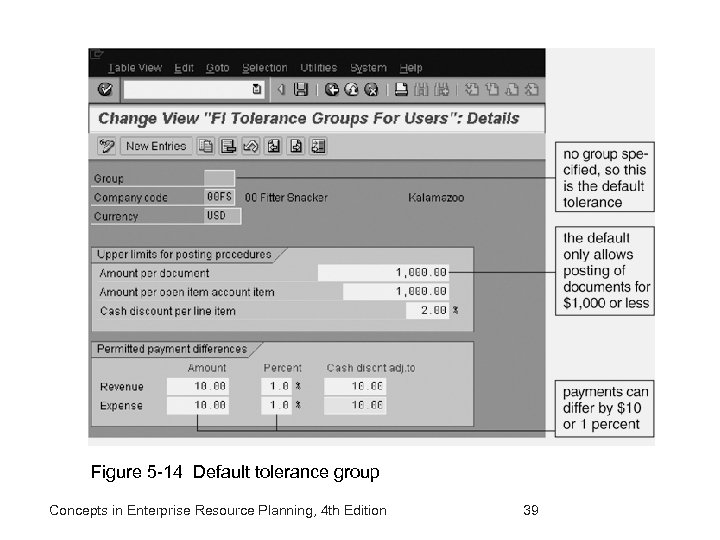 Figure 5 -14 Default tolerance group Concepts in Enterprise Resource Planning, 4 th Edition 39
 Financial Transparency • ERP systems provide the ability to drill down from a report to the source documents (transactions) that created it – Makes it easier for auditors to confirm the integrity of reports • With a properly configured and managed ERP system, there are direct links between the company’s financial statements and individual transactions that make up the statements, so – Fraud and abuse can be detected more easily Concepts in Enterprise Resource Planning, 4 th Edition 40
 Summary • Companies need accounting systems to record transactions and generate financial statements • Unintegrated information systems – Accounting data might not be current • Can cause problems for sales representatives trying to make operational decisions – Data can be inaccurate • Can affect decision making and therefore profitability Concepts in Enterprise Resource Planning, 4 th Edition 41
 Summary (cont’d. ) • Closing the books at the end of an accounting period can be difficult with an unintegrated IS, but is relatively easy with an integrated IS – Closing the books means zeroing out temporary accounts • Using an integrated IS and a common database to record accounting data has important inventory cost-accounting benefits – Can lead to more accurate product cost calculations – Can help managers determine which products are profitable and which are not Concepts in Enterprise Resource Planning, 4 th Edition 42
 Summary (cont’d. ) • Use of an integrated system and a common database to record accounting data has important management-reporting benefits – Built-in drill-down and query tools available • Sarbanes-Oxley Act, 2002 U. S. federal regulation – Written and passed in the wake of Enron collapse – Promoted management accountability by requiring extra financial approval and reporting – ERP systems can help companies meet the requirements of this legislation Concepts in Enterprise Resource Planning, 4 th Edition 43