


 Скачать презентацию Conception réalisation et mesure d efficacité d une campagne de
35dc90742b08ed7e16b4134d9bb2b66f.ppt
- Количество слайдов: 67
 Conception, réalisation et mesure d'efficacité d'une campagne de sensibilisation du public pour un meilleur usage du médicament : l'exemple de la campagne "antibiotiques" réalisée pendant l'hiver 2000 -2001. P. M. Tulkens Unité de Pharmacologie Cellulaire et Moléculaire, Université Catholique de Louvain, Bruxelles Commission de Coordination de la Politique Antibiotique, Ministère fédéral de la Santé Publique et de l'Environnement Séminaire des Sciences Pharmaceutiques, UCL-Bruxelles, 4 décembre 2001 Campagne 4 -12 -01 1
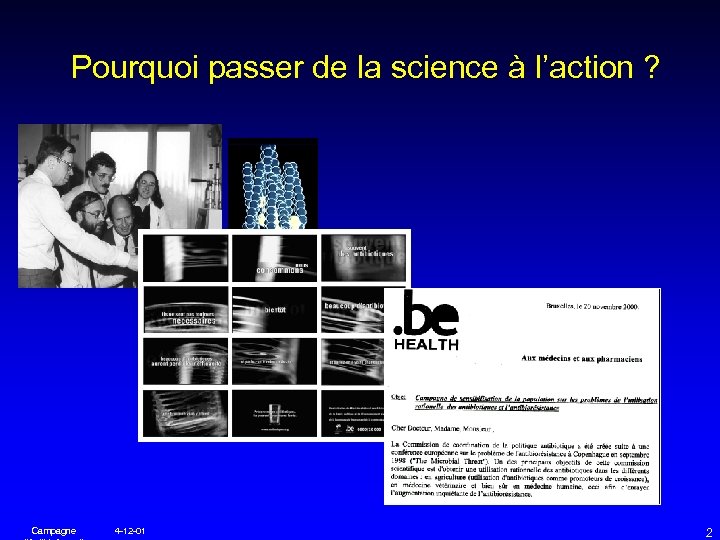 Pourquoi passer de la science à l’action ? Campagne 4 -12 -01 2
 Plan de l'exposé • Le problème : la résistance bactérienne – science – ampleur et signification clinique – relation avec la consommation des antibiotiques • Les actions entreprises – au niveau européen – au niveau belge • Coordination de la Politique Antibiotique – Sensibilisation du public » conception » réalisation » évaluation Campagne 4 -12 -01 3
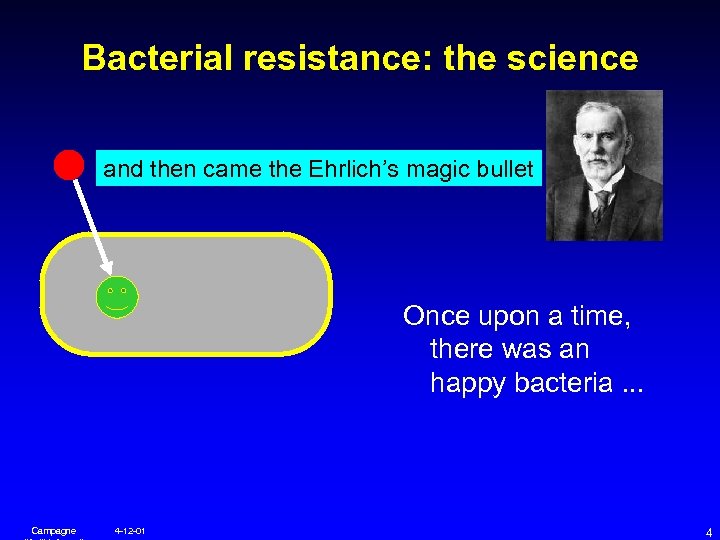 Bacterial resistance: the science and then came the Ehrlich’s magic bullet Once upon a time, there was an happy bacteria. . . Campagne 4 -12 -01 4
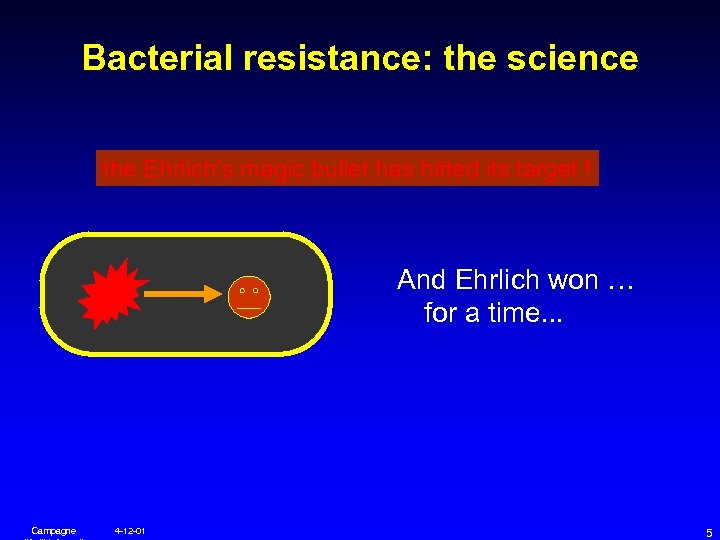 Bacterial resistance: the science the Ehrlich’s magic bullet has hitted its target ! And Ehrlich won … for a time. . . Campagne 4 -12 -01 5
 Bacterial resistance: the science But only for a time. . . Campagne 4 -12 -01 6
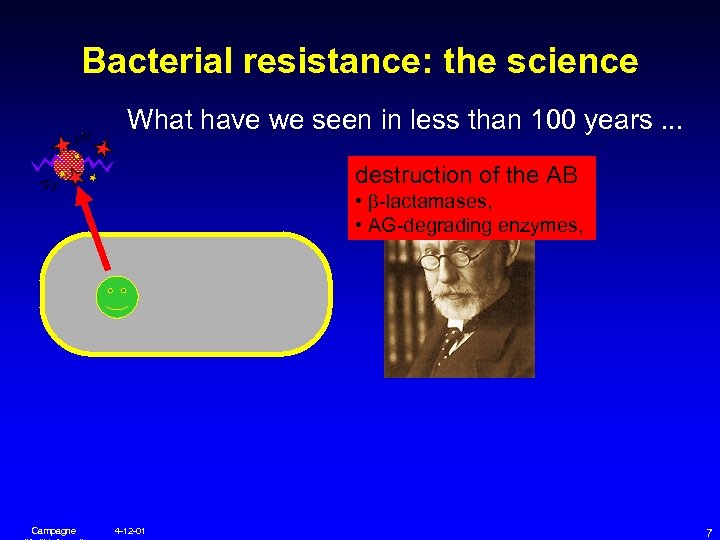 Bacterial resistance: the science What have we seen in less than 100 years. . . destruction of the AB • -lactamases, • AG-degrading enzymes, Campagne 4 -12 -01 7
 Bacterial resistance: the science What have we seen in less than 100 years. . . destruction of the AB • -lactamases, • AG-degrading enzymes, Campagne 4 -12 -01 8
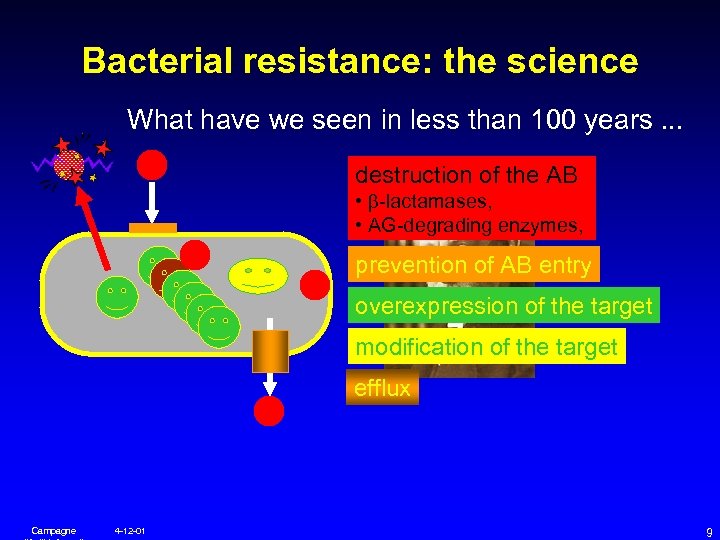 Bacterial resistance: the science What have we seen in less than 100 years. . . destruction of the AB • -lactamases, • AG-degrading enzymes, prevention of AB entry overexpression of the target modification of the target efflux Campagne 4 -12 -01 9
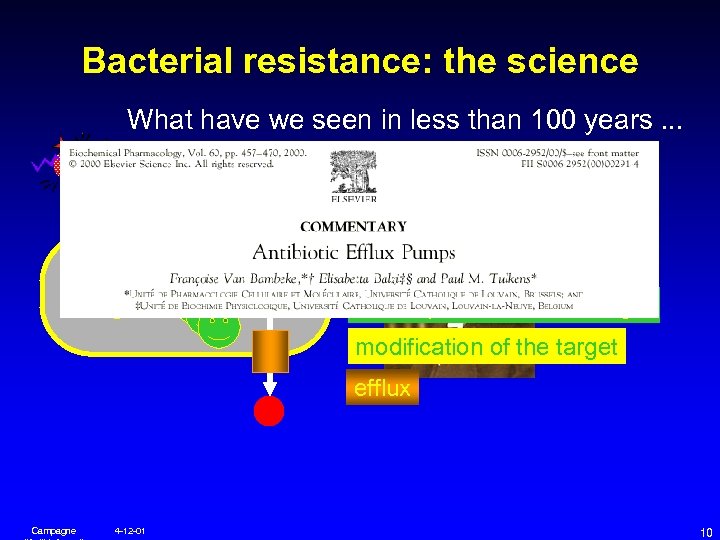 Bacterial resistance: the science What have we seen in less than 100 years. . . destruction of the AB • -lactamases, • AG-degrading enzymes, prevention of AB entry overexpression of the target modification of the target efflux Campagne 4 -12 -01 10
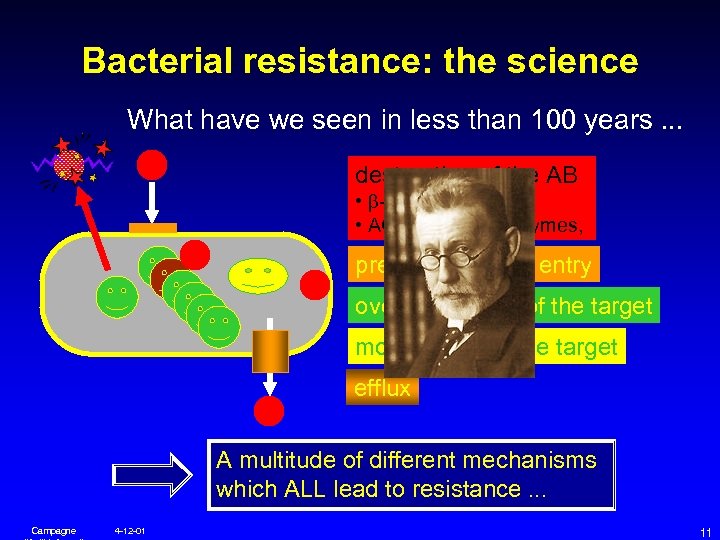 Bacterial resistance: the science What have we seen in less than 100 years. . . destruction of the AB • -lactamases, • AG-degrading enzymes, prevention of AB entry overexpression of the target modification of the target efflux A multitude of different mechanisms which ALL lead to resistance. . . Campagne 4 -12 -01 11
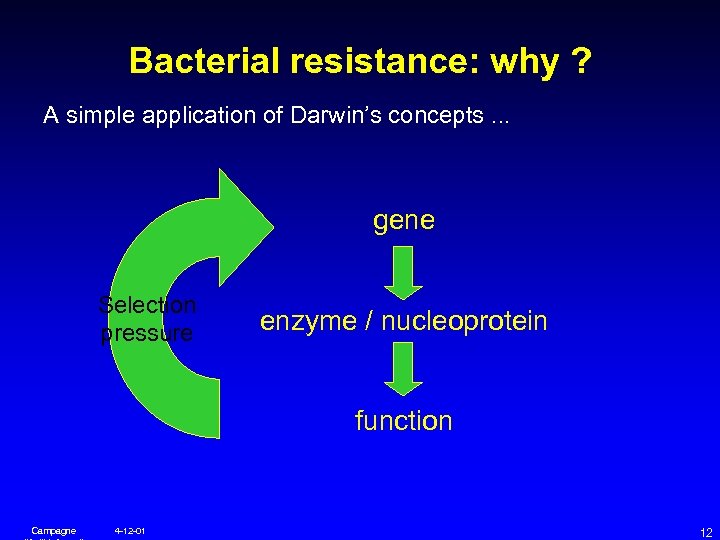 Bacterial resistance: why ? A simple application of Darwin’s concepts. . . gene Selection pressure enzyme / nucleoprotein function Campagne 4 -12 -01 12
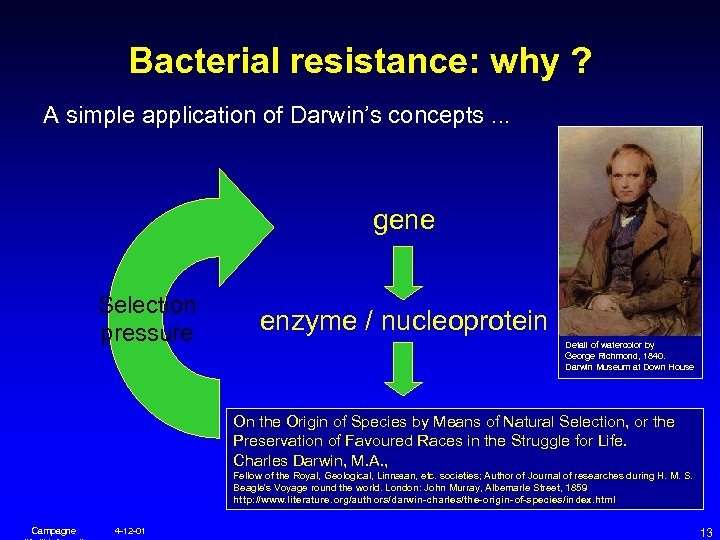 Bacterial resistance: why ? A simple application of Darwin’s concepts. . . gene Selection pressure enzyme / nucleoprotein Detail of watercolor by George Richmond, 1840. Darwin Museum at Down House function On the Origin of Species by Means of Natural Selection, or the Preservation of Favoured Races in the Struggle for Life. Charles Darwin, M. A. , Fellow of the Royal, Geological, Linnæan, etc. societies; Author of Journal of researches during H. M. S. Beagle's Voyage round the world. London: John Murray, Albemarle Street, 1859 http: //www. literature. org/authors/darwin-charles/the-origin-of-species/index. html Campagne 4 -12 -01 13
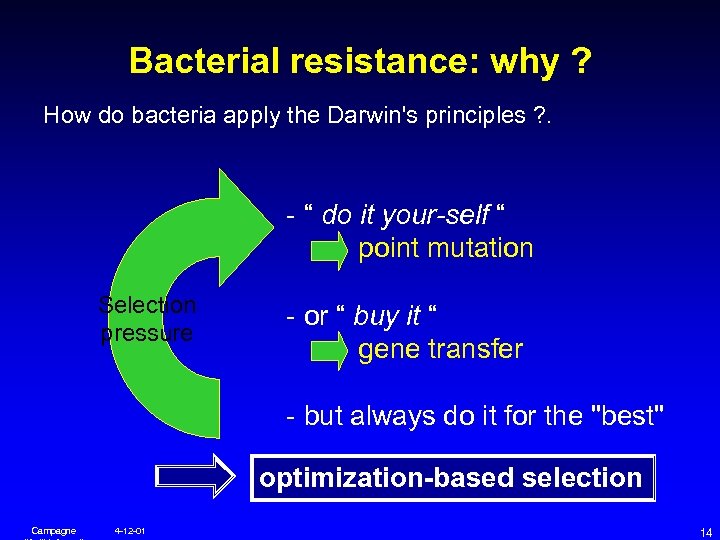 Bacterial resistance: why ? How do bacteria apply the Darwin's principles ? . - “ do it your-self “ point mutation Selection pressure - or “ buy it “ gene transfer - but always do it for the "best" optimization-based selection Campagne 4 -12 -01 14
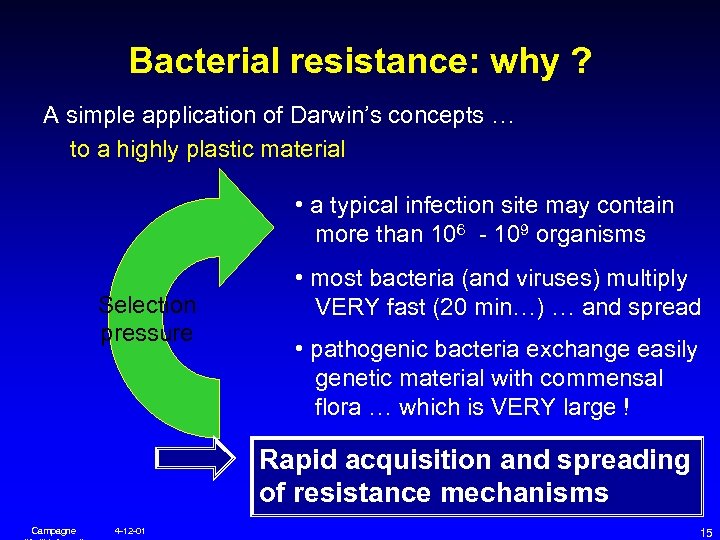 Bacterial resistance: why ? A simple application of Darwin’s concepts … to a highly plastic material • a typical infection site may contain more than 106 - 109 organisms Selection pressure • most bacteria (and viruses) multiply VERY fast (20 min…) … and spread • pathogenic bacteria exchange easily genetic material with commensal flora … which is VERY large ! Rapid acquisition and spreading of resistance mechanisms Campagne 4 -12 -01 15
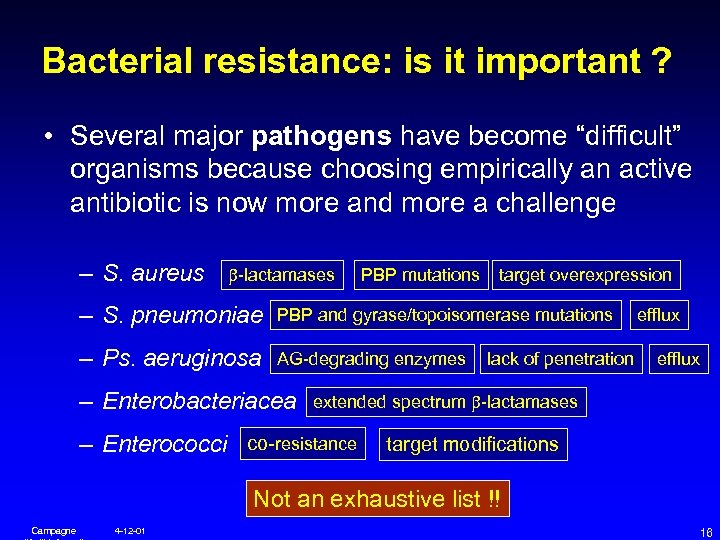 Bacterial resistance: is it important ? • Several major pathogens have become “difficult” organisms because choosing empirically an active antibiotic is now more and more a challenge – S. aureus -lactamases PBP mutations target overexpression – S. pneumoniae PBP and gyrase/topoisomerase mutations – Ps. aeruginosa AG-degrading enzymes – Enterobacteriacea lack of penetration efflux extended spectrum -lactamases – Enterococci co-resistance target modifications Not an exhaustive list !! Campagne 4 -12 -01 16
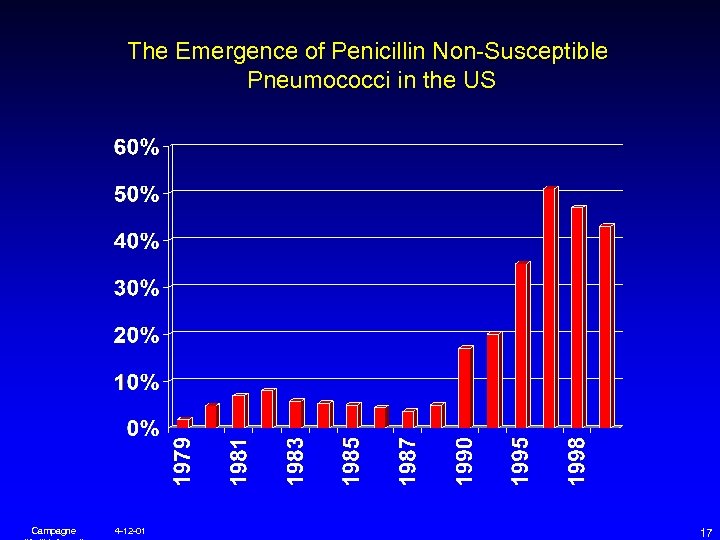 The Emergence of Penicillin Non-Susceptible Pneumococci in the US Campagne 4 -12 -01 17
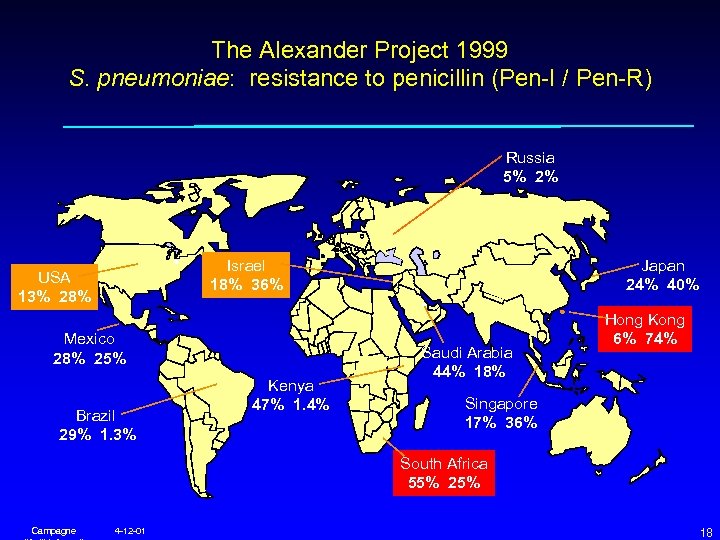 The Alexander Project 1999 S. pneumoniae: resistance to penicillin (Pen-I / Pen-R) Russia 5% 2% Israel 18% 36% USA 13% 28% Mexico 28% 25% Brazil 29% 1. 3% Kenya 47% 1. 4% Japan 24% 40% Saudi Arabia 44% 18% Hong Kong 6% 74% Singapore 17% 36% South Africa 55% 25% Campagne 4 -12 -01 18
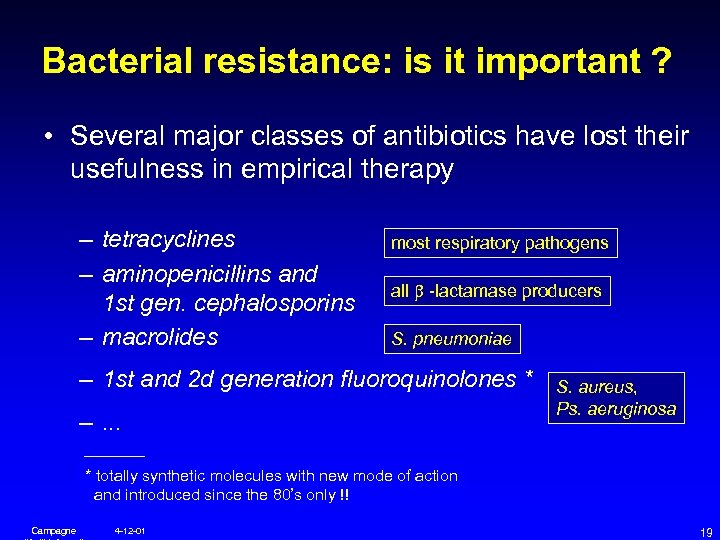 Bacterial resistance: is it important ? • Several major classes of antibiotics have lost their usefulness in empirical therapy – tetracyclines – aminopenicillins and 1 st gen. cephalosporins – macrolides most respiratory pathogens all -lactamase producers S. pneumoniae – 1 st and 2 d generation fluoroquinolones * –. . . S. aureus, Ps. aeruginosa * totally synthetic molecules with new mode of action and introduced since the 80’s only !! Campagne 4 -12 -01 19
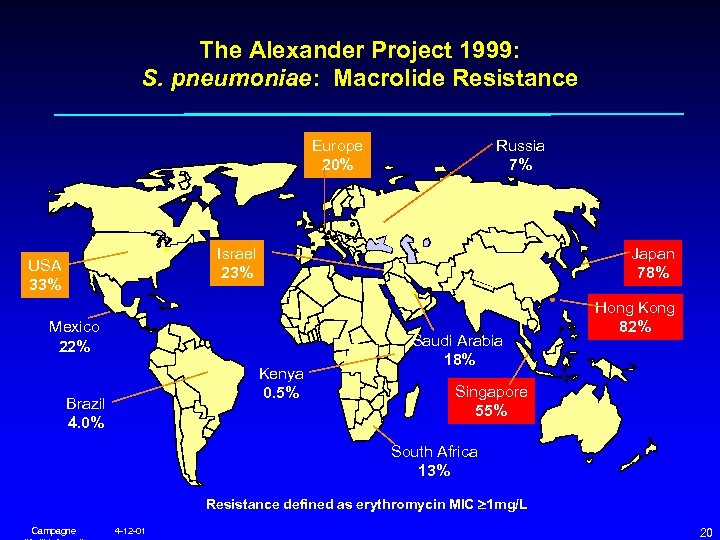 The Alexander Project 1999: S. pneumoniae: Macrolide Resistance Europe 20% Russia 7% Israel 23% USA 33% Japan 78% Mexico 22% Kenya 0. 5% Brazil 4. 0% Saudi Arabia 18% Hong Kong 82% Singapore 55% South Africa 13% Resistance defined as erythromycin MIC ³ 1 mg/L Campagne 4 -12 -01 20
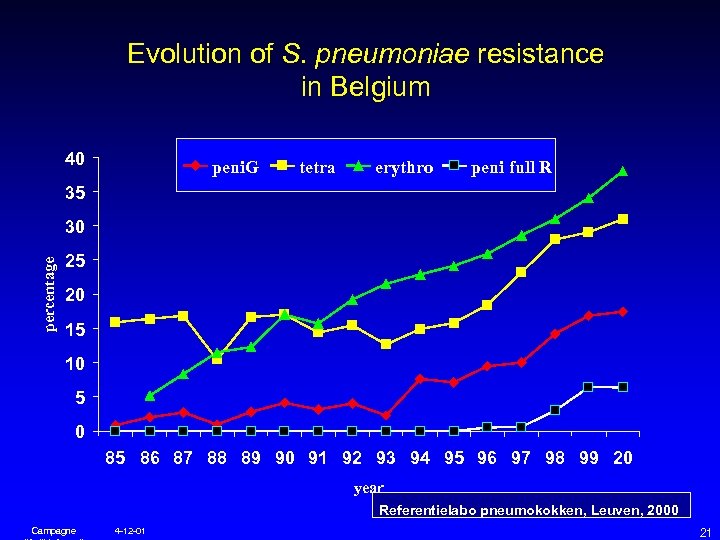 Evolution of S. pneumoniae resistance in Belgium 40 peni. G tetra erythro peni full R 35 percentage 30 25 20 15 10 5 0 85 86 87 88 89 90 91 92 93 94 95 96 97 98 99 20 year Referentielabo pneumokokken, Leuven, 2000 Campagne 4 -12 -01 21
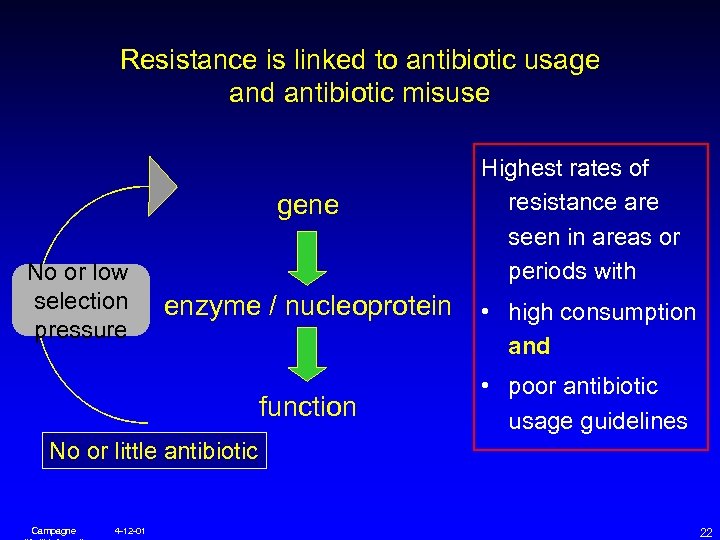 Resistance is linked to antibiotic usage and antibiotic misuse gene No or low selection pressure enzyme / nucleoprotein function Highest rates of resistance are seen in areas or periods with • high consumption and • poor antibiotic usage guidelines No or little antibiotic Campagne 4 -12 -01 22
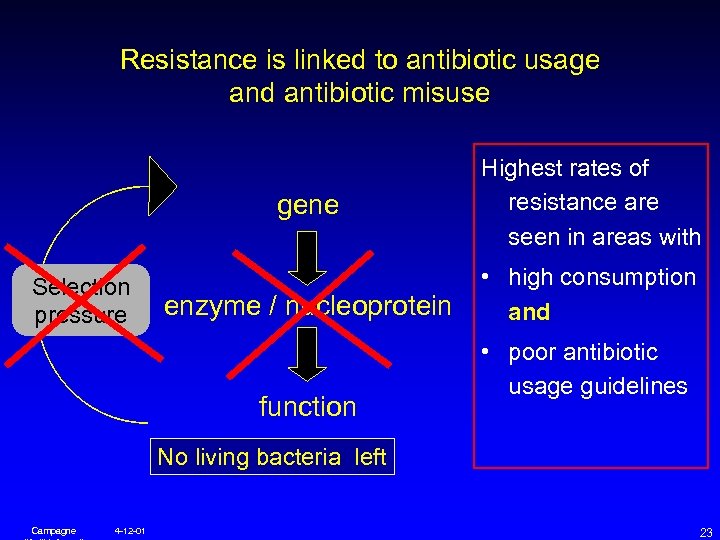 Resistance is linked to antibiotic usage and antibiotic misuse gene Selection pressure Highest rates of resistance are seen in areas with enzyme / nucleoprotein • high consumption and function • poor antibiotic usage guidelines No living bacteria left Campagne 4 -12 -01 23
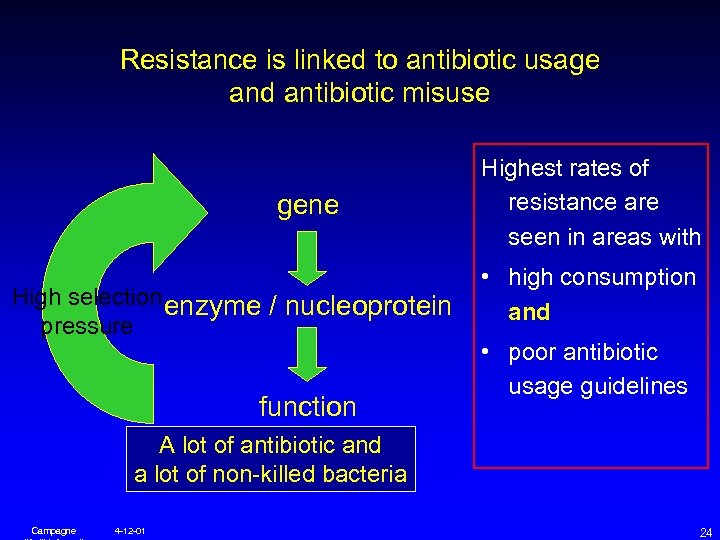 Resistance is linked to antibiotic usage and antibiotic misuse gene High selection enzyme / nucleoprotein pressure function Highest rates of resistance are seen in areas with • high consumption and • poor antibiotic usage guidelines A lot of antibiotic and a lot of non-killed bacteria Campagne 4 -12 -01 24
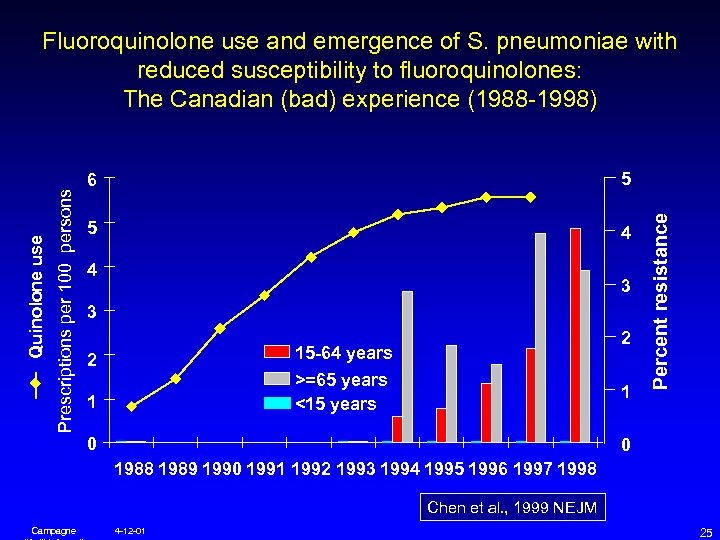 6 5 5 4 4 3 3 2 15 -64 years >=65 years <15 years 2 1 1 0 Percent resistance Prescriptions per 100 persons Quinolone use Fluoroquinolone use and emergence of S. pneumoniae with reduced susceptibility to fluoroquinolones: The Canadian (bad) experience (1988 -1998) 0 1988 1989 1990 1991 1992 1993 1994 1995 1996 1997 1998 Chen et al. , 1999 NEJM Campagne 4 -12 -01 25
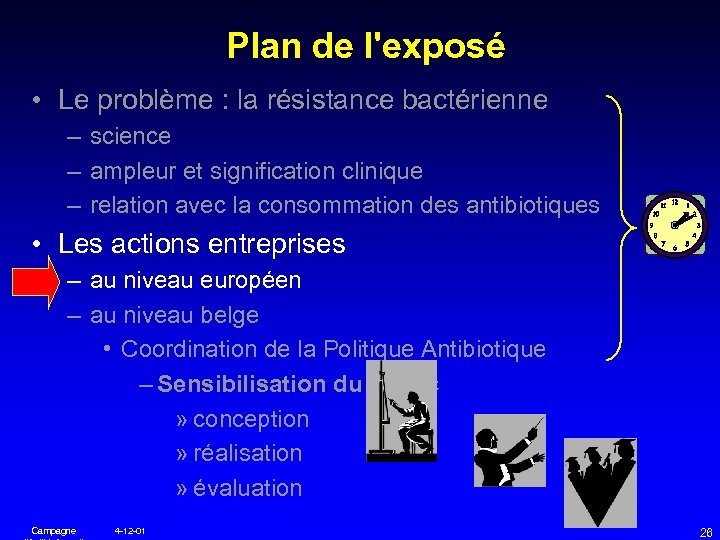 Plan de l'exposé • Le problème : la résistance bactérienne – science – ampleur et signification clinique – relation avec la consommation des antibiotiques • Les actions entreprises – au niveau européen – au niveau belge • Coordination de la Politique Antibiotique – Sensibilisation du public » conception » réalisation » évaluation Campagne 4 -12 -01 26
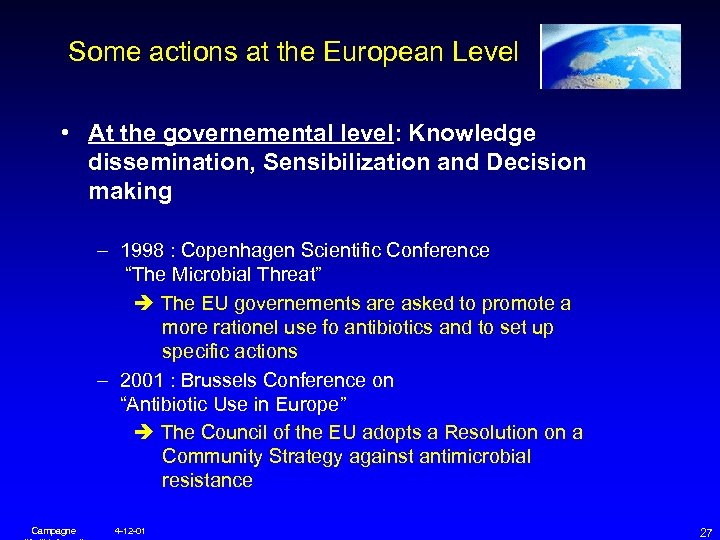 Some actions at the European Level • At the governemental level: Knowledge dissemination, Sensibilization and Decision making – 1998 : Copenhagen Scientific Conference “The Microbial Threat” è The EU governements are asked to promote a more rationel use fo antibiotics and to set up specific actions – 2001 : Brussels Conference on “Antibiotic Use in Europe” è The Council of the EU adopts a Resolution on a Community Strategy against antimicrobial resistance Campagne 4 -12 -01 27
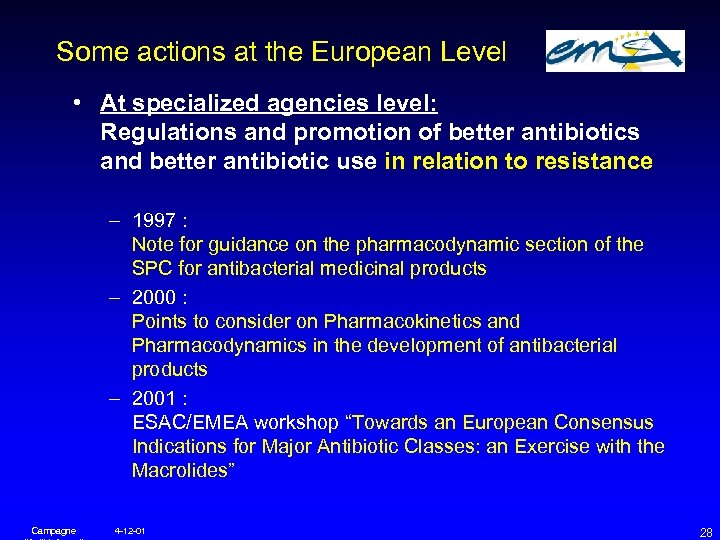 Some actions at the European Level • At specialized agencies level: Regulations and promotion of better antibiotics and better antibiotic use in relation to resistance – 1997 : Note for guidance on the pharmacodynamic section of the SPC for antibacterial medicinal products – 2000 : Points to consider on Pharmacokinetics and Pharmacodynamics in the development of antibacterial products – 2001 : ESAC/EMEA workshop “Towards an European Consensus Indications for Major Antibiotic Classes: an Exercise with the Macrolides” Campagne 4 -12 -01 28
 Plan de l'exposé • Le problème : la résistance bactérienne – science – ampleur et signification clinique – relation avec la consommation des antibiotiques • Les actions entreprises – au niveau européen – au niveau belge • Coordination de la Politique Antibiotique – Sensibilisation du public » conception » réalisation » évaluation Campagne 4 -12 -01 29
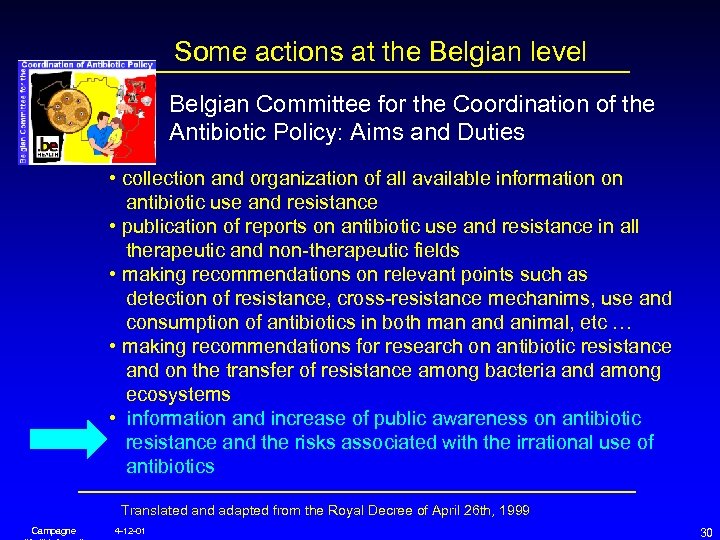 Some actions at the Belgian level Belgian Committee for the Coordination of the Antibiotic Policy: Aims and Duties • collection and organization of all available information on antibiotic use and resistance • publication of reports on antibiotic use and resistance in all therapeutic and non-therapeutic fields • making recommendations on relevant points such as detection of resistance, cross-resistance mechanims, use and consumption of antibiotics in both man and animal, etc … • making recommendations for research on antibiotic resistance and on the transfer of resistance among bacteria and among ecosystems • information and increase of public awareness on antibiotic resistance and the risks associated with the irrational use of antibiotics Translated and adapted from the Royal Decree of April 26 th, 1999 Campagne 4 -12 -01 30
 Plan de l'exposé • Le problème : la résistance bactérienne – science – ampleur et signification clinique – relation avec la consommation des antibiotiques • Les actions entreprises – au niveau européen – au niveau belge • Coordination de la Politique Antibiotique – Sensibilisation du public » conception » réalisation » évaluation Campagne 4 -12 -01 31
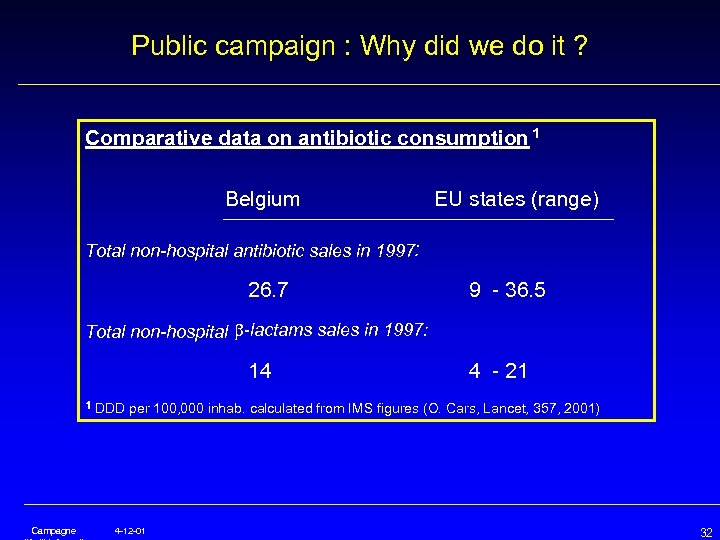 Public campaign : Why did we do it ? Comparative data on antibiotic consumption 1 Belgium EU states (range) Total non-hospital antibiotic sales in 1997: 26. 7 9 - 36. 5 Total non-hospital -lactams sales in 1997: 14 1 Campagne 4 - 21 DDD per 100, 000 inhab. calculated from IMS figures (O. Cars, Lancet, 357, 2001) 4 -12 -01 32
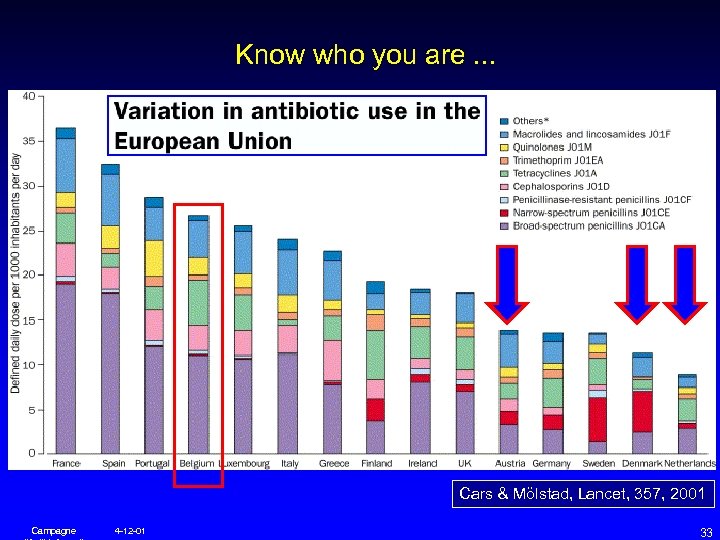 Know who you are. . . Cars & Mölstad, Lancet, 357, 2001 Campagne 4 -12 -01 33
 Why the public ? • Antibiotic sales in the community represent > 70 % of all antibiotic sales and is, therefore, an important component in the selection pressure • The largest use of these AB is towards minor respiratory tract infections which are often self-limiting and selfhealing and for which AB real usefulness is dubious – – pharyngitis bronchitis flu-like syndrome, … acute sinusitis vicious circle • Doctors believe they must prescribe, and pharmacist they must deliver antibiotics because of the demand of the patient Campagne 4 -12 -01 34
 Aims of the campaign • provide the public with a better understanding of the natural course of an infection, especially if minor and with a high rate of spontaneous resilience such as otitis media or uncomplicated bronchitis • explain which are the real benefits of antibiotic treatment, i. e. the cure of serious bacterial infections, as opposed to their inappropriate uses such as in minor infections of viral origin • underline the risks associated with the rapid emergence of resistance to antibiotics • foster a useful discussion of the patient with his/her doctor and his/her pharmacist on the need to use antibiotics appropriately. Campagne 4 -12 -01 35
 The Commission “Sensibilization” • • • Campagne Dr. Ludo VERBIST (microbiolologist, KU-Leuven) Dr. P. Demol (microbiologist, Ulg) Dr. P. Trefois (MD, “Question Santé” [non-profit]) Ph. Mouchet (Media Communication officer, “Question santé”) P. Geerts (Director “Omtrent Gezondheid” [non-profit]) Dr. M. De Meyere (General Practice, UG) Dr. P. Tulkens (pharmacology, UCL) R. Deschepper (anthropology, UG) Representatives of the Community Ministeries in charge of Public Health – Dr. D. Wildemeersch (Vlaamse Gemeenschap) – Dr. J. Morel (Communauté française) Dr. I. Bauraind et I. Vanden Bremt (Federal Ministry of Health) 4 -12 -01 36
 Public campaign : Budget and Support. . . Budget • 300, 000 Euros from Federal Funds to cover the main costs of the campaign. Additional support • the Flemish and French-speaking Communities (Vlaamse Gemeenschap & Communauté française de Belgique) * public Radio and TV broadcasts on public channels (free access to the French-speaking channels and direct support (approx. 50, 000 Euros) for broadcasts on the Flemishspeaking channels • Campagne the French-speaking Communitiy * collaboration of a non-profit organization specialized in developping Public Communications in healh-related topics (Question Santé). 4 -12 -01 37
 Pre-campaign study • N = 1, 000 persons, • specialized agency, • appropriate distribution concerning sex, ages, socio-economic status and geographical distribution. * Nov 2000 -March 2001; presented at the 11 th ECCMID, Istanbul, Turkey (poster no. 410) Campagne 4 -12 -01 38
 Pre-campaign study: main results * large misunderstanding or lack of information about the real conditions for usefulness of antibiotics in current infections * belief that antibiotics will allow a faster cure for even minor infections * great confidence of the public in MD’s and pharmacists * MD’s tend to overestimate the “patient’s pressure” for antibiotics * Nov 2000 -March 2001; presented at the 11 th ECCMID, Istanbul, Turkey (poster no. 410) Campagne 4 -12 -01 39
 Public campaign : pre-information of health professionals • ”Summary and position paper" underlining the general and medical significance of the resistance to antibiotics (“Folia Pharmacotherapeutica”; distributed free of charge to all registered MD's and Pharmacists). • Direct pre-information of MD’s representatives at the “ad-hoc” Working Party and through two pre-campaign meetings. • Package sent to all GP’s, Pediatricians, and “Respiratory Tract” specialists, and all public Pharmacies with – a letter in which the campaign and its aims were explained, and its significance in termes of Public Health underlined, and – 20 copies of the booklets and one poster for display in their waiting room or pharmacy sent to all GP's, pneumologists, ORL, pediatricians and pharmacists in the country Campagne 4 -12 -01 40
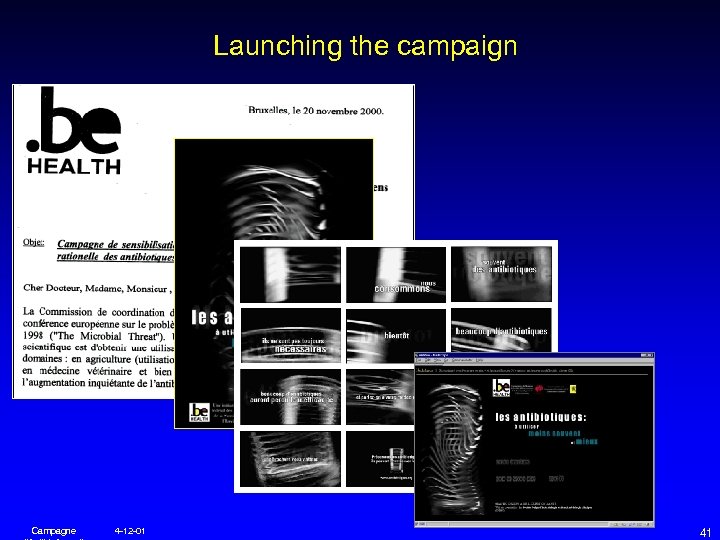 Launching the campaign Campagne 4 -12 -01 41
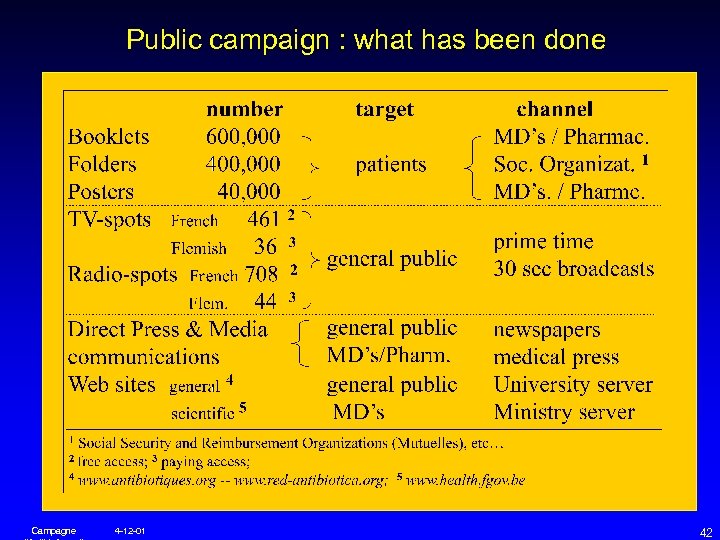 Public campaign : what has been done Campagne 4 -12 -01 42
 Plan de l'exposé • Le problème : la résistance bactérienne – science – ampleur et signification clinique – relation avec la consommation des antibiotiques • Les actions entreprises – au niveau européen – au niveau belge • Coordination de la Politique Antibiotique – Sensibilisation du public » conception » réalisation » évaluation Campagne 4 -12 -01 43
 Awareness of the public Method : • • face-to-face interviews n=1, 015 representative of population > 14 y. analysis by regions – Flanders (West-Fl. , East-Fl. , Kempen) – Brussels & Brabant (Fl. + Wall. ) – Wallonia • 1 month after end of the campaign Campagne 4 -12 -01 44
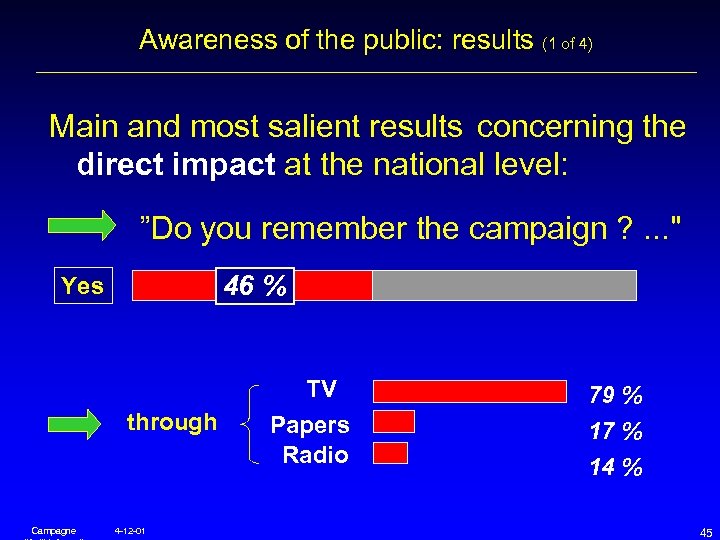 Awareness of the public: results (1 of 4) Main and most salient results concerning the direct impact at the national level: ”Do you remember the campaign ? . . . " 46 % Yes through Campagne 4 -12 -01 TV Papers Radio 79 % 17 % 14 % 45
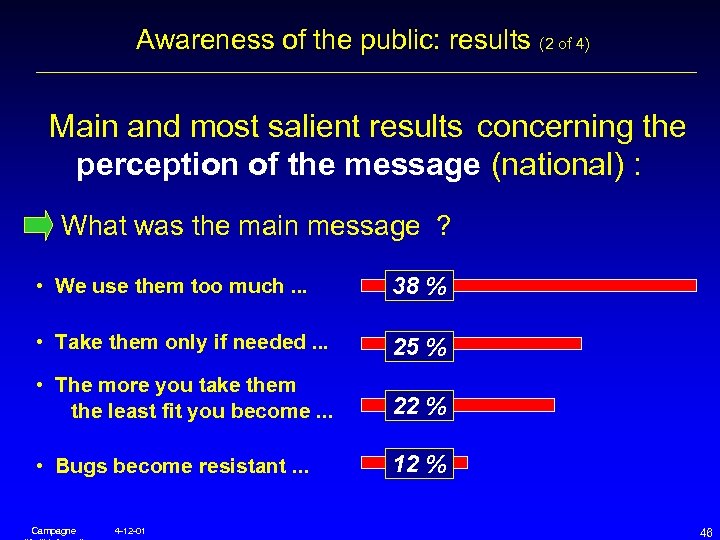 Awareness of the public: results (2 of 4) Main and most salient results concerning the perception of the message (national) : What was the main message ? • We use them too much. . . 38 % • Take them only if needed. . . 25 % • The more you take them the least fit you become. . . 22 % • Bugs become resistant. . . 12 % Campagne 4 -12 -01 46
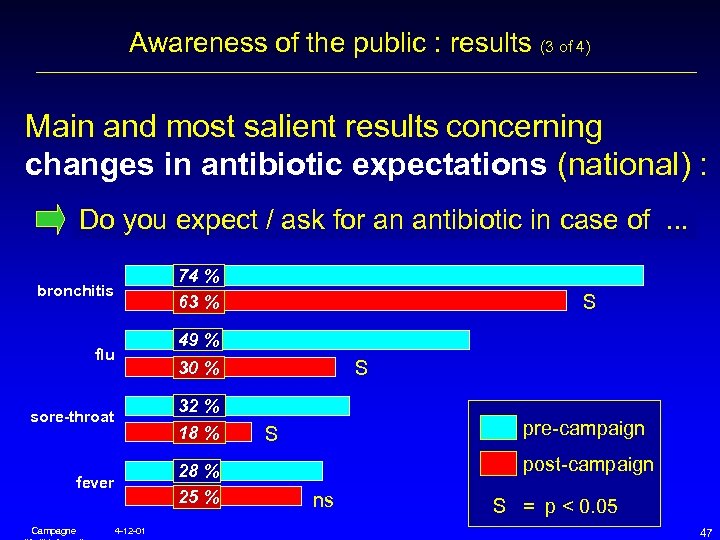 Awareness of the public : results (3 of 4) Main and most salient results concerning changes in antibiotic expectations (national) : Do you expect / ask for an antibiotic in case of. . . 74 % 63 % bronchitis 49 % flu S 30 % sore-throat 32 % 18 % fever 28 % 25 % Campagne S 4 -12 -01 pre-campaign S post-campaign ns S = p < 0. 05 47
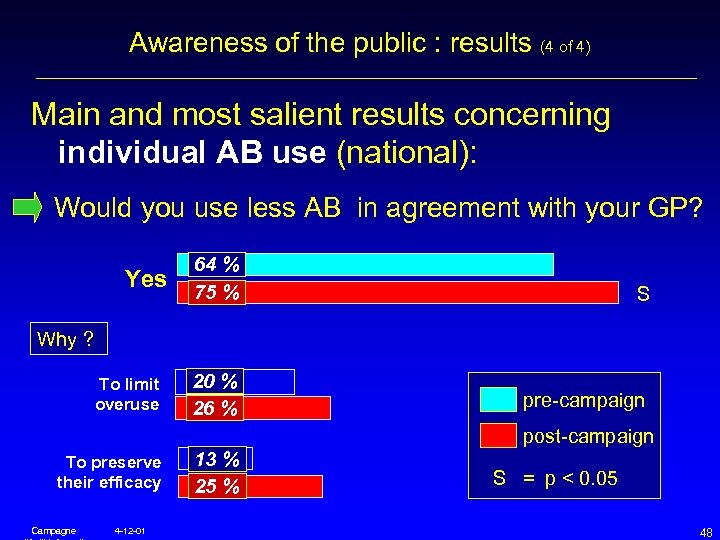 Awareness of the public : results (4 of 4) Main and most salient results concerning individual AB use (national): Would you use less AB in agreement with your GP? Yes 64 % 75 % S 20 % 26 % pre-campaign Why ? To limit overuse post-campaign To preserve their efficacy Campagne 4 -12 -01 13 % 25 % S = p < 0. 05 48
 Appreciation by the General Practitioners Method : • • Campagne telephone interviews n=400 representative of all 3 regions 3 months after end of the campaign 4 -12 -01 49
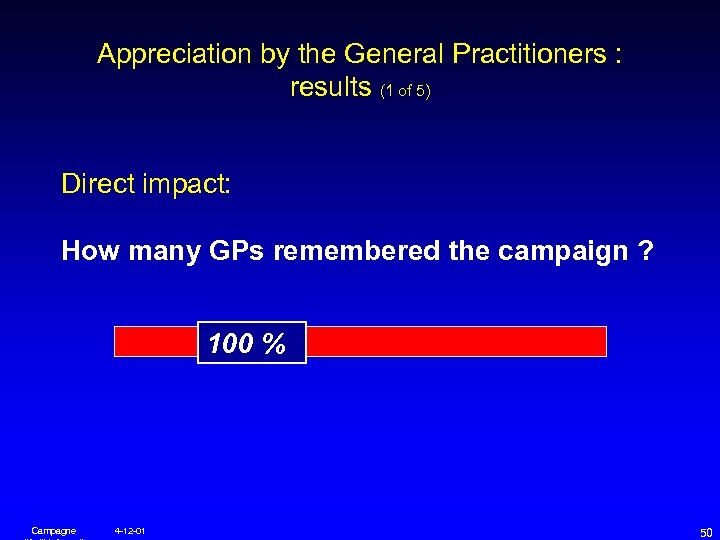 Appreciation by the General Practitioners : results (1 of 5) Direct impact: How many GPs remembered the campaign ? 100 % Campagne 4 -12 -01 50
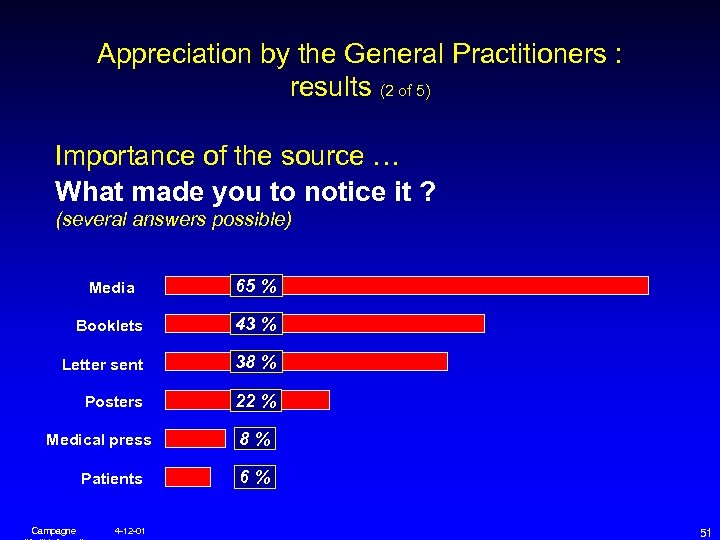 Appreciation by the General Practitioners : results (2 of 5) Importance of the source … What made you to notice it ? (several answers possible) Media 65 % Booklets 43 % Letter sent 38 % Posters 22 % Medical press Patients Campagne 4 -12 -01 8% 6% 51
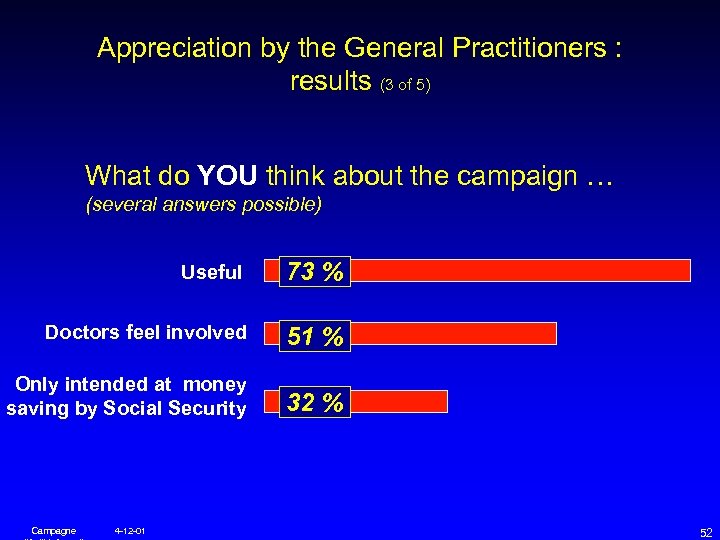 Appreciation by the General Practitioners : results (3 of 5) What do YOU think about the campaign … (several answers possible) Useful 73 % Doctors feel involved 51 % Only intended at money saving by Social Security 32 % Campagne 4 -12 -01 52
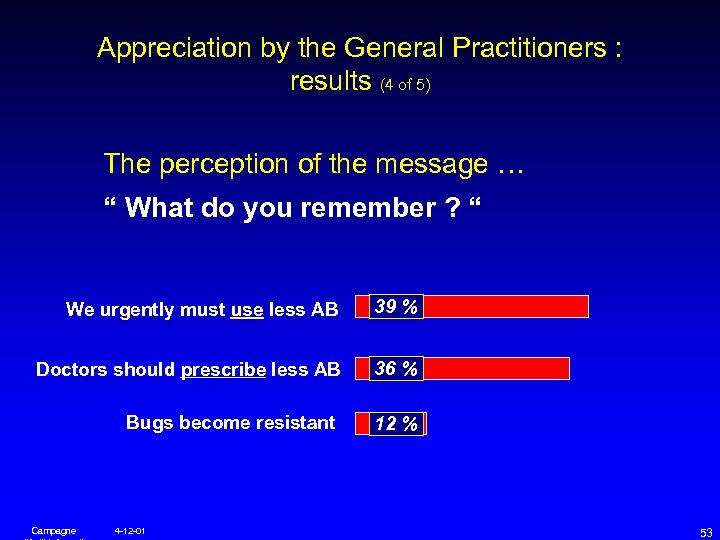 Appreciation by the General Practitioners : results (4 of 5) The perception of the message … “ What do you remember ? “ We urgently must use less AB 39 % Doctors should prescribe less AB 36 % Bugs become resistant Campagne 4 -12 -01 12 % 53
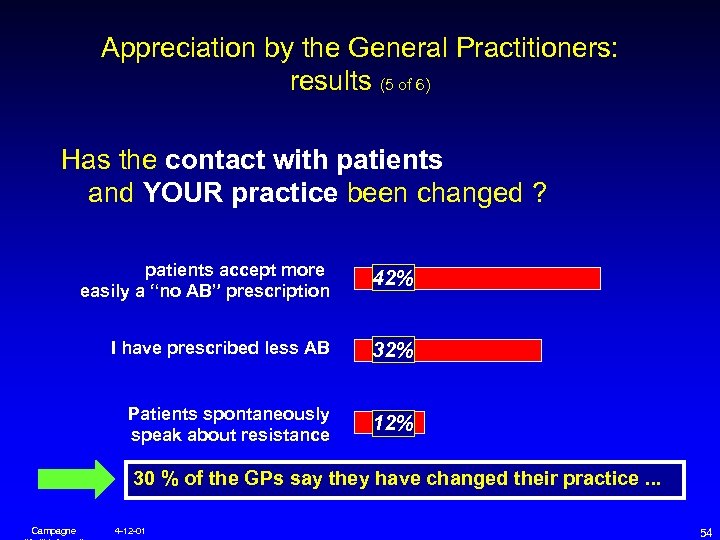 Appreciation by the General Practitioners: results (5 of 6) Has the contact with patients and YOUR practice been changed ? patients accept more easily a “no AB” prescription 42% I have prescribed less AB 32% Patients spontaneously speak about resistance 12% 30 % of the GPs say they have changed their practice. . . Campagne 4 -12 -01 54
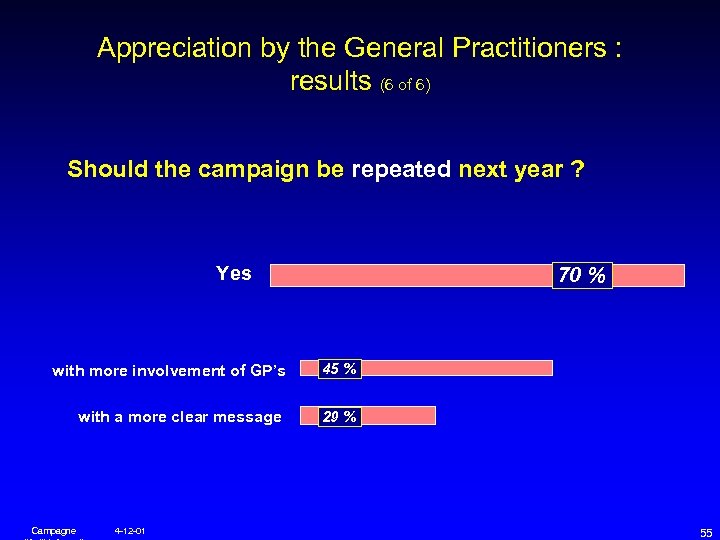 Appreciation by the General Practitioners : results (6 of 6) Should the campaign be repeated next year ? Yes 70 % with more involvement of GP’s 45 % with a more clear message 29 % Campagne 4 -12 -01 55
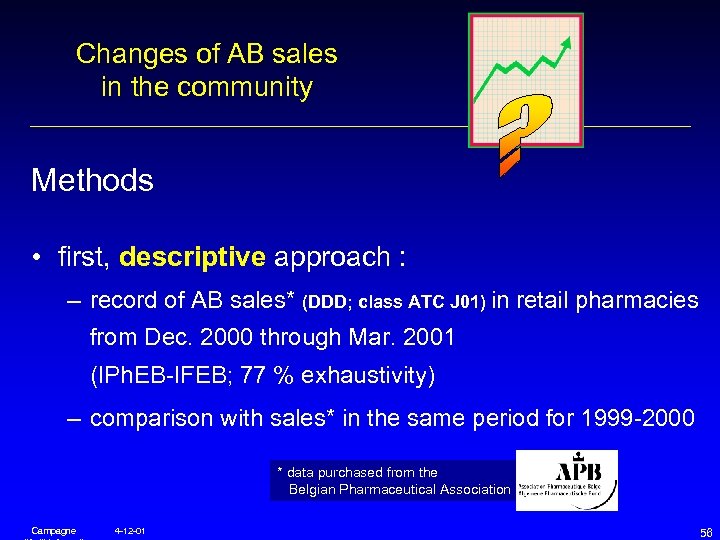 Changes of AB sales in the community Methods • first, descriptive approach : – record of AB sales* (DDD; class ATC J 01) in retail pharmacies from Dec. 2000 through Mar. 2001 (IPh. EB-IFEB; 77 % exhaustivity) – comparison with sales* in the same period for 1999 -2000 * data purchased from the Belgian Pharmaceutical Association Campagne 4 -12 -01 56
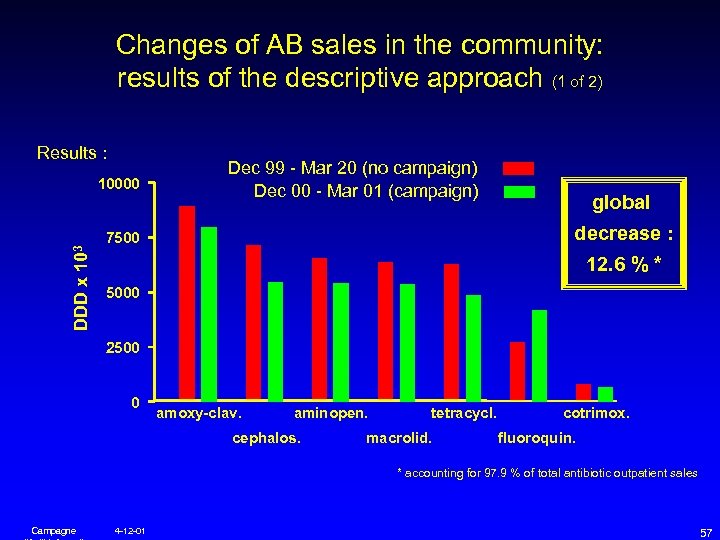 Changes of AB sales in the community: results of the descriptive approach (1 of 2) Results : DDD x 103 10000 Dec 99 - Mar 20 (no campaign) Dec 00 - Mar 01 (campaign) global decrease : 7500 12. 6 % * 5000 2500 0 amoxy-clav. aminopen. cephalos. tetracycl. macrolid. cotrimox. fluoroquin. * accounting for 97. 9 % of total antibiotic outpatient sales Campagne 4 -12 -01 57
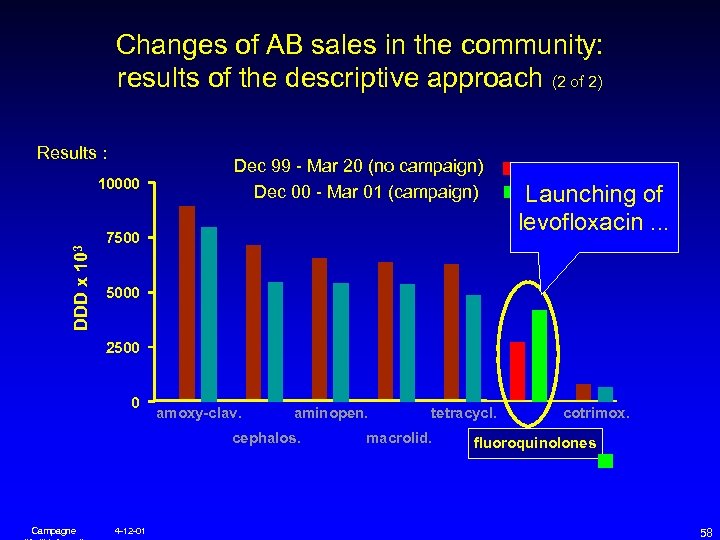 Changes of AB sales in the community: results of the descriptive approach (2 of 2) Results : DDD x 103 10000 Dec 99 - Mar 20 (no campaign) Dec 00 - Mar 01 (campaign) 7500 Launching of levofloxacin. . . 5000 2500 0 amoxy-clav. aminopen. cephalos. Campagne 4 -12 -01 tetracycl. macrolid. cotrimox. fluoroquinolones 58
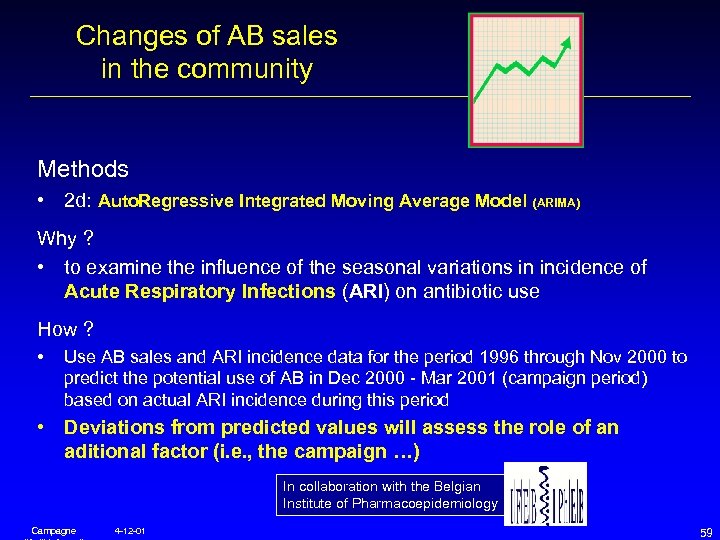 Changes of AB sales in the community Methods • 2 d: Auto. Regressive Integrated Moving Average Model (ARIMA) Why ? • to examine the influence of the seasonal variations in incidence of Acute Respiratory Infections (ARI) on antibiotic use How ? • Use AB sales and ARI incidence data for the period 1996 through Nov 2000 to predict the potential use of AB in Dec 2000 - Mar 2001 (campaign period) based on actual ARI incidence during this period • Deviations from predicted values will assess the role of an aditional factor (i. e. , the campaign …) In collaboration with the Belgian Institute of Pharmacoepidemiology Campagne 4 -12 -01 59
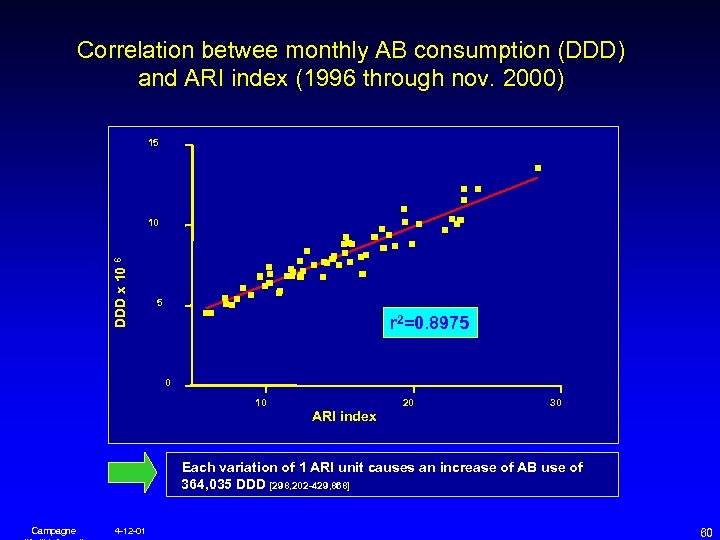 Correlation betwee monthly AB consumption (DDD) and ARI index (1996 through nov. 2000) 15 DDD x 10 6 10 5 r 2=0. 8975 0 10 20 30 ARI index Each variation of 1 ARI unit causes an increase of AB use of 364, 035 DDD [298, 202 -429, 868] Campagne 4 -12 -01 60
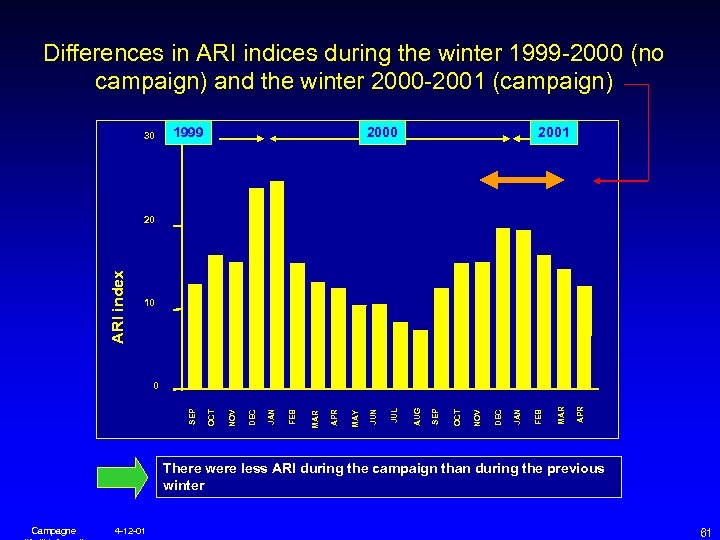 Differences in ARI indices during the winter 1999 -2000 (no campaign) and the winter 2000 -2001 (campaign) 30 1999 2000 2001 ARI index 20 10 APR MAR FEB JAN DEC NOV OCT SEP AUG JUL JUN MAY APR MAR FEB JAN DEC NOV OCT SEP 0 There were less ARI during the campaign than during the previous winter Campagne 4 -12 -01 61
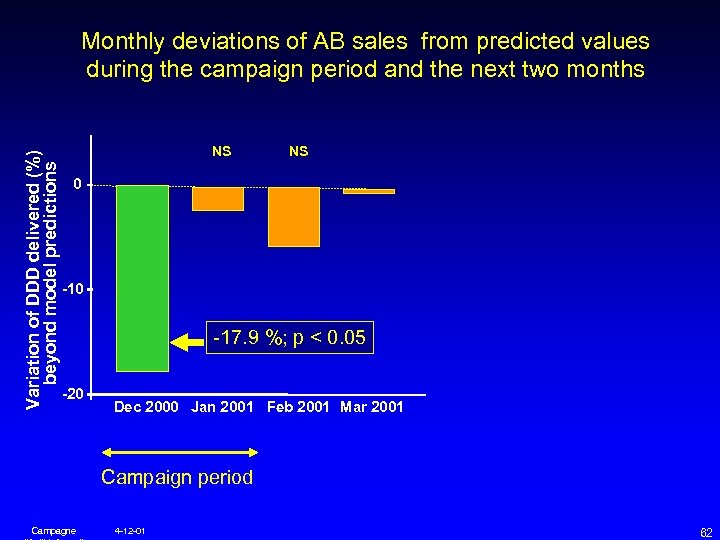 Variation of DDD delivered (%) beyond model predictions Monthly deviations of AB sales from predicted values during the campaign period and the next two months NS NS 0 -17. 9 %; p < 0. 05 -20 Dec 2000 Jan 2001 Feb 2001 Mar 2001 Campaign period Campagne 4 -12 -01 62
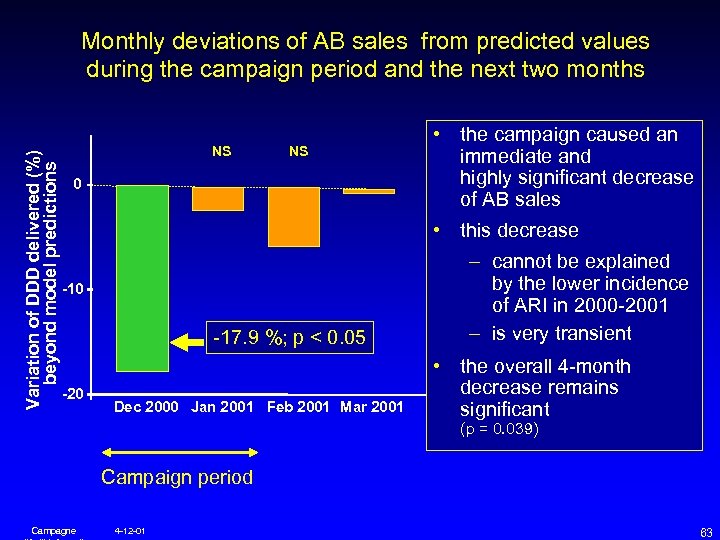 Variation of DDD delivered (%) beyond model predictions Monthly deviations of AB sales from predicted values during the campaign period and the next two months NS NS 0 • the campaign caused an immediate and highly significant decrease of AB sales • this decrease -10 -17. 9 %; p < 0. 05 -20 Dec 2000 Jan 2001 Feb 2001 Mar 2001 – cannot be explained by the lower incidence of ARI in 2000 -2001 – is very transient • the overall 4 -month decrease remains significant (p = 0. 039) Campaign period Campagne 4 -12 -01 63
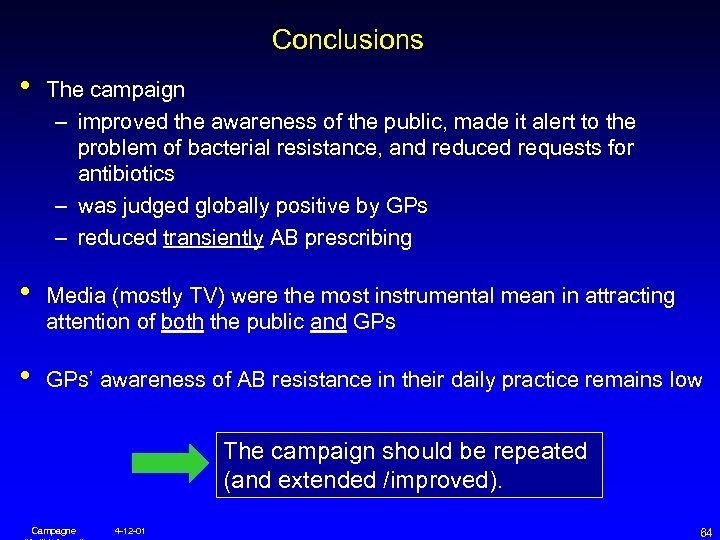 Conclusions • The campaign – improved the awareness of the public, made it alert to the problem of bacterial resistance, and reduced requests for antibiotics – was judged globally positive by GPs – reduced transiently AB prescribing • Media (mostly TV) were the most instrumental mean in attracting attention of both the public and GPs • GPs’ awareness of AB resistance in their daily practice remains low The campaign should be repeated (and extended /improved). Campagne 4 -12 -01 64
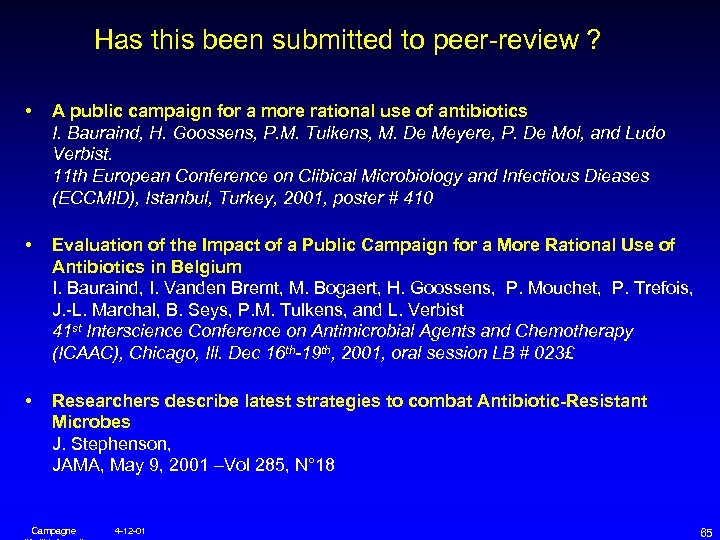 Has this been submitted to peer-review ? • A public campaign for a more rational use of antibiotics I. Bauraind, H. Goossens, P. M. Tulkens, M. De Meyere, P. De Mol, and Ludo Verbist. 11 th European Conference on Clibical Microbiology and Infectious Dieases (ECCMID), Istanbul, Turkey, 2001, poster # 410 • Evaluation of the Impact of a Public Campaign for a More Rational Use of Antibiotics in Belgium I. Bauraind, I. Vanden Bremt, M. Bogaert, H. Goossens, P. Mouchet, P. Trefois, J. -L. Marchal, B. Seys, P. M. Tulkens, and L. Verbist 41 st Interscience Conference on Antimicrobial Agents and Chemotherapy (ICAAC), Chicago, Ill. Dec 16 th-19 th, 2001, oral session LB # 023£ • Researchers describe latest strategies to combat Antibiotic-Resistant Microbes J. Stephenson, JAMA, May 9, 2001 –Vol 285, N° 18 Campagne 4 -12 -01 65
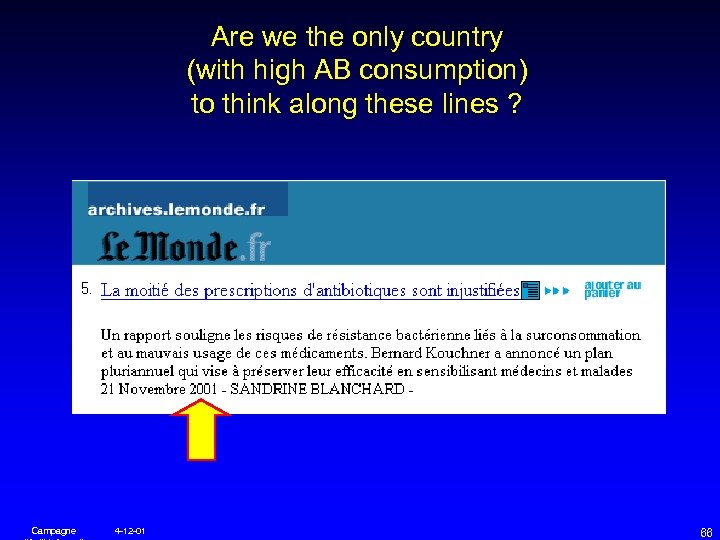 Are we the only country (with high AB consumption) to think along these lines ? Campagne 4 -12 -01 66
 Acknowledgments All the authors of the publications, and • Mr F. Vandenbroucke and Mrs M. Aelvoet (Federal Ministers of Social Affairs, Public Health and Environment) and their cabinet members • Mr C. Decoster, Chief Medical Officer, Federal Ministry of Health • The French-speaking Community of Belgium* • The Flemish-speaking Community of Belgium* • Scientific Institute of Public Health “Louis Pasteur” • Société Belge d’Infectiologie et de Microbiologie Clinique / Belgische Vereniging voor Infectiologie en Klinische Microbiologie • Université catholique de Louvain (for WEB facilities) * responsible for preventive medicine activities at the community level All campaign materials, this set of slides, and additional information is available for download at http: //www. antibiotiques. org/english or http: //www. red-antibiotica. org/english Campagne 4 -12 -01 67