

Concept of Family Law Family Law is a

 Скачать презентацию Concept of Family Law Family Law is a
34718-concept_of_family_law_i.ppt
- Количество слайдов: 11
Concept of Family Law Family Law is a body of rules which regulates: 1) conclusion of marriage; 2) termination of marriage 3) conditions of the invalidation of marriage; 4) civil rights and obligations of family members; 5) adoption of children; 6) order of civil registration. Sources of Family Law Constitution of RK Law of RK on Marriage and Family dated by December 17, 1998.
Constitutional Provisions Article 27 of the Constitution of RK The marriage and family, motherhood, paternity and the childhood are under the protection of the state. 2. The care of children and their education are the natural right and a duty of parents. 3. Full age able-bodied children are obliged to care of their invalid parents.
Conditions of the conclusion of marriage Mutual voluntary consent of marrying man and woman; Achievement of 18 years of age by them; Organs of civil registration can decrease the marrying age for no more than 2 years at presence of valid reasons. Marriage between persons who did not reach the age of 18 is authorized only with the consent of their parents, guardians or trustees.
The conclusion of marriage is not allowed between: Persons if one of them already consists in another registered marriage; Direct relatives on an ascending and descending line (parents and children, grandfather, grandmother and grandsons); Brothers and sisters having either common father or mother; Foster parents and adopted children; Persons if one of them is recognized as incapable by court because of mental disease or dementia.
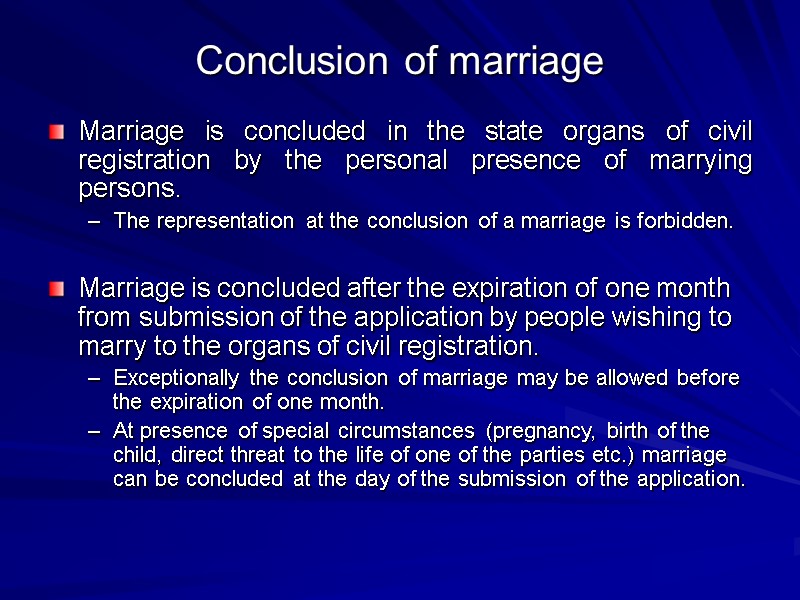
Conclusion of marriage Marriage is concluded in the state organs of civil registration by the personal presence of marrying persons. The representation at the conclusion of a marriage is forbidden. Marriage is concluded after the expiration of one month from submission of the application by people wishing to marry to the organs of civil registration. Exceptionally the conclusion of marriage may be allowed before the expiration of one month. At presence of special circumstances (pregnancy, birth of the child, direct threat to the life of one of the parties etc.) marriage can be concluded at the day of the submission of the application.
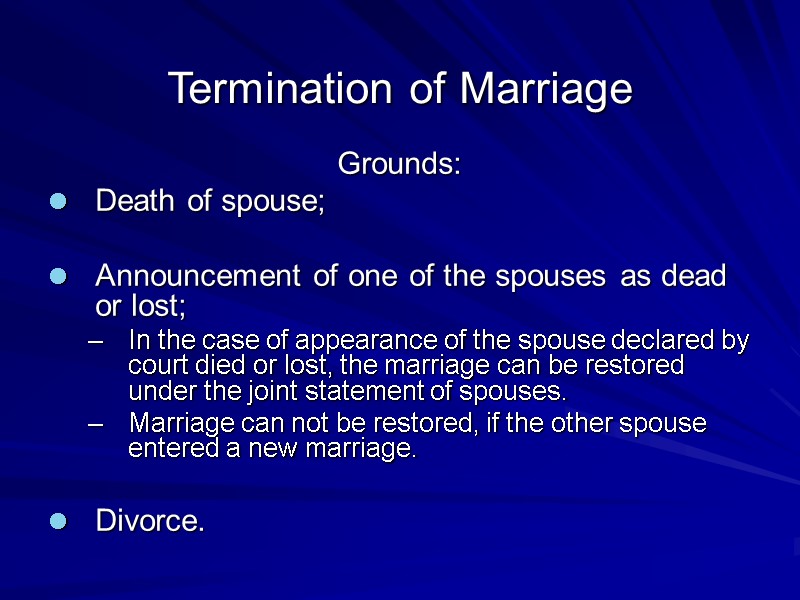
Termination of Marriage Grounds: Death of spouse; Announcement of one of the spouses as dead or lost; In the case of appearance of the spouse declared by court died or lost, the marriage can be restored under the joint statement of spouses. Marriage can not be restored, if the other spouse entered a new marriage. Divorce.
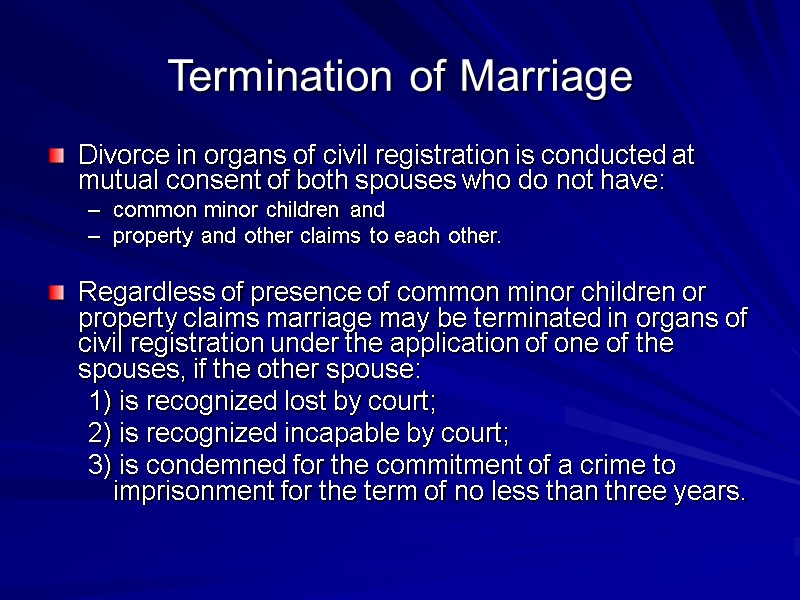
Termination of Marriage Divorce in organs of civil registration is conducted at mutual consent of both spouses who do not have: common minor children and property and other claims to each other. Regardless of presence of common minor children or property claims marriage may be terminated in organs of civil registration under the application of one of the spouses, if the other spouse: 1) is recognized lost by court; 2) is recognized incapable by court; 3) is condemned for the commitment of a crime to imprisonment for the term of no less than three years.
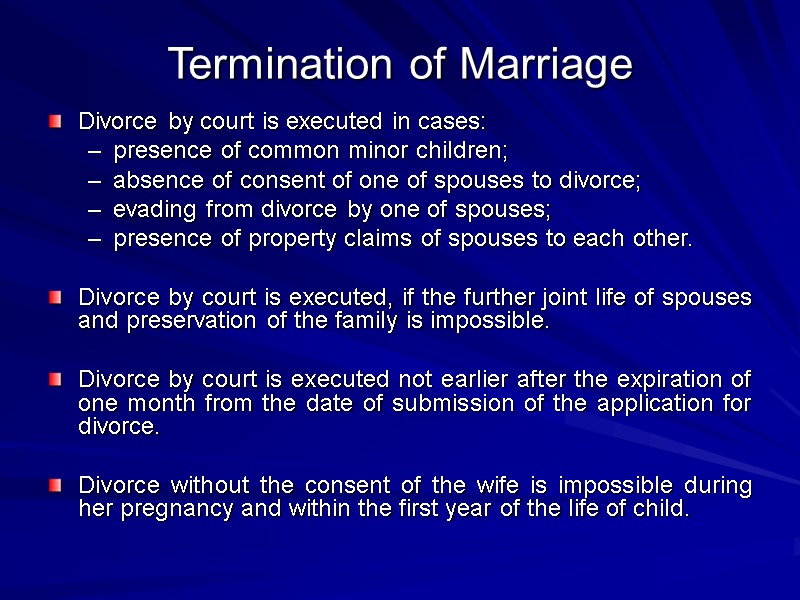
Termination of Marriage Divorce by court is executed in cases: presence of common minor children; absence of consent of one of spouses to divorce; evading from divorce by one of spouses; presence of property claims of spouses to each other. Divorce by court is executed, if the further joint life of spouses and preservation of the family is impossible. Divorce by court is executed not earlier after the expiration of one month from the date of submission of the application for divorce. Divorce without the consent of the wife is impossible during her pregnancy and within the first year of the life of child.
Invalidation of Marriage The marriage may be invalidated: if the conditions of its conclusion are infringed and in the case of the conclusion of a fictitious marriage. The marriage concluded on compulsion can be invalidated. The invalidation of marriage is concluded by court. If invalidated, the marriage is nullified from the date of its conclusion.
Personal Rights and Obligations of Spouses Spouses have equal rights and perform equal duties. Each of spouses is free to choose his (her) activity, profession or residence. Questions of motherhood, fatherhood and education of children and other questions of the family life are solved by spouses in common.
Personal Rights and Obligations of Spouses At the conclusion of marriage: spouses may choose a surname of one of them as their common surname or each of spouses may keep his (her) own surname, or each of spouses may attach a surname of the other spouse to his (her) surname. Attachment of surnames is not allowed, if the surname of even one of the spouses is already double. In the case of divorce spouses have the right to keep the common surname or to restore their pre-marriage surnames.