


 Скачать презентацию Con qué desayunas qué comes para el
25152f5273b4fb3a73462e77d1274d9e.ppt
- Количество слайдов: 23
 ¿Con qué desayunas? / ¿qué comes para el desayuno? • En/para el desayuno como – Yo como uvas, naranjas y bananas para el desayuno. – Desayuno con naranjas, bananas y uvas. • Desayuno con…. . – En el desayuno como huevos, arroz y bebo leche. • Yo como huevos, jamón y bebo té
 ¿Con qué almuerzas? / ¿qué comes para el almuerzo? • Yo almuerzo con…. • Para el almuerzo, como • En el almuerzo como un sándwich, una banana y unas fresas. • En el almuerzo, como un bocadillo, galleta y bebo agua. • Yo como un sándwich, una manzana y bebo agua para el almuerzo.
 ¿Con qué cenas? / ¿qué comes para la cena? • Yo como/ceno con • Ceno con… • Yo como. • Ceno con un sándwich, pollo y jamón • Ceno con bistec, arroz y bebo jugo de naranja • Para la cena como bistec y arroz, helado de vainilla y uvas.
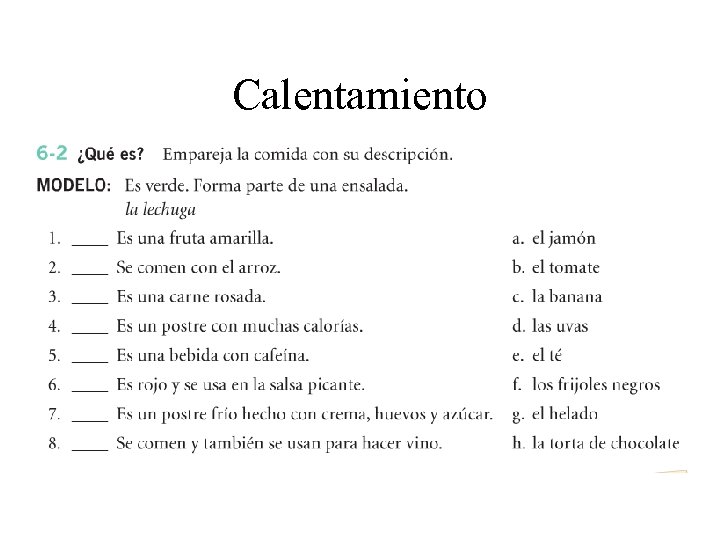 Calentamiento •
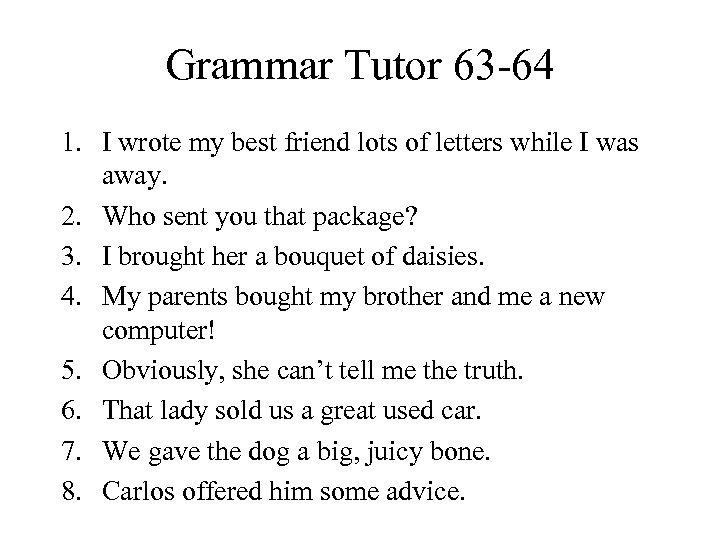 Grammar Tutor 63 -64 1. I wrote my best friend lots of letters while I was away. 2. Who sent you that package? 3. I brought her a bouquet of daisies. 4. My parents bought my brother and me a new computer! 5. Obviously, she can’t tell me the truth. 6. That lady sold us a great used car. 7. We gave the dog a big, juicy bone. 8. Carlos offered him some advice.
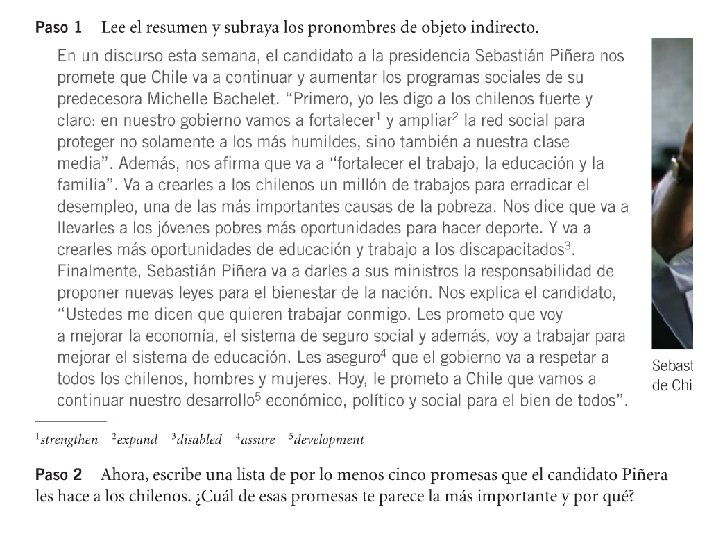
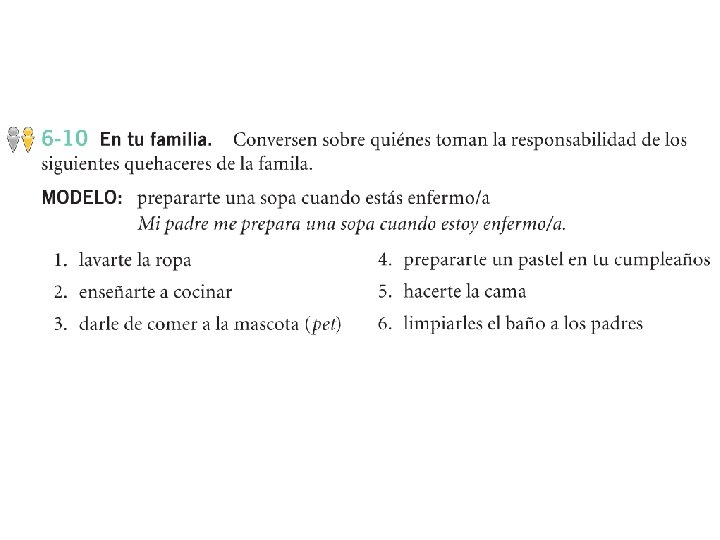
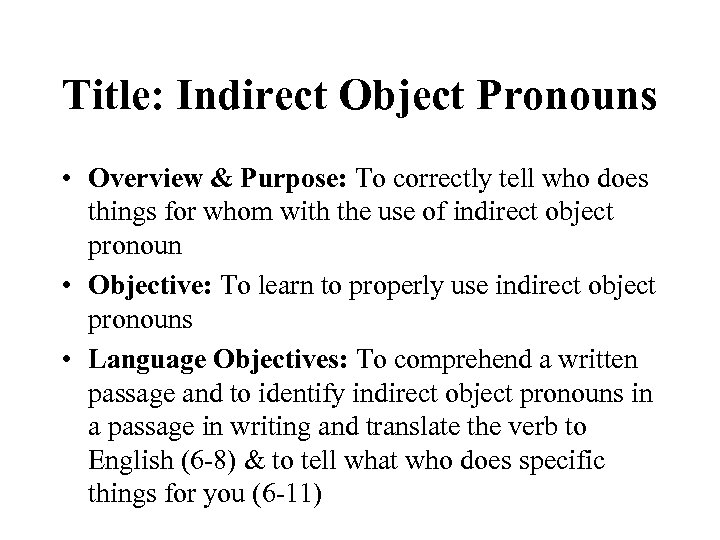 Title: Indirect Object Pronouns • Overview & Purpose: To correctly tell who does things for whom with the use of indirect object pronoun • Objective: To learn to properly use indirect object pronouns • Language Objectives: To comprehend a written passage and to identify indirect object pronouns in a passage in writing and translate the verb to English (6 -8) & to tell what who does specific things for you (6 -11)
 Indirect Objects and Indirect Object Pronouns (Los complementos indirectos y los pronombres de complemento indirecto) ¿Me puede mostrar los modelos más económicos?
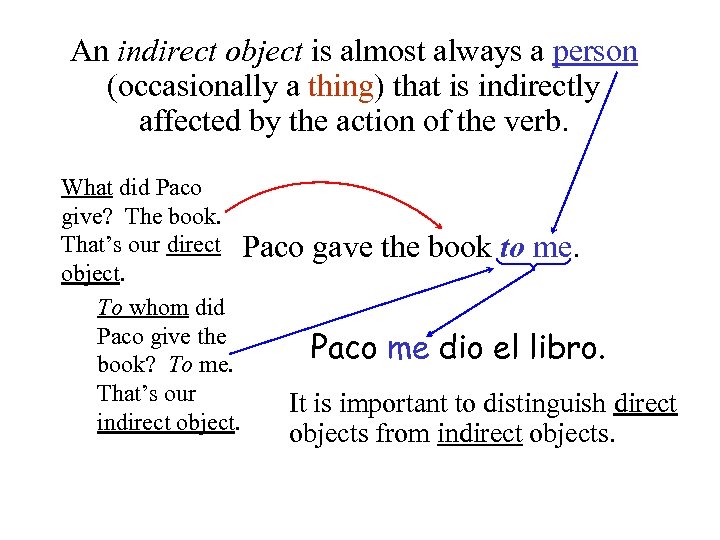 An indirect object is almost always a person (occasionally a thing) that is indirectly affected by the action of the verb. What did Paco give? The book. That’s our direct Paco gave the book to me. object. To whom did Paco give the Paco me dio el libro. book? To me. That’s our It is important to distinguish direct indirect objects from indirect objects.
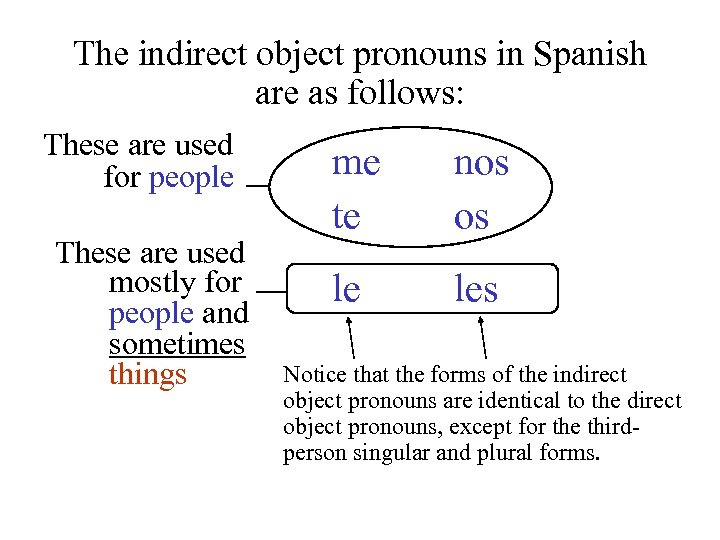 The indirect object pronouns in Spanish are as follows: These are used for people These are used mostly for people and sometimes things me te nos os le les Notice that the forms of the indirect object pronouns are identical to the direct object pronouns, except for the thirdperson singular and plural forms.
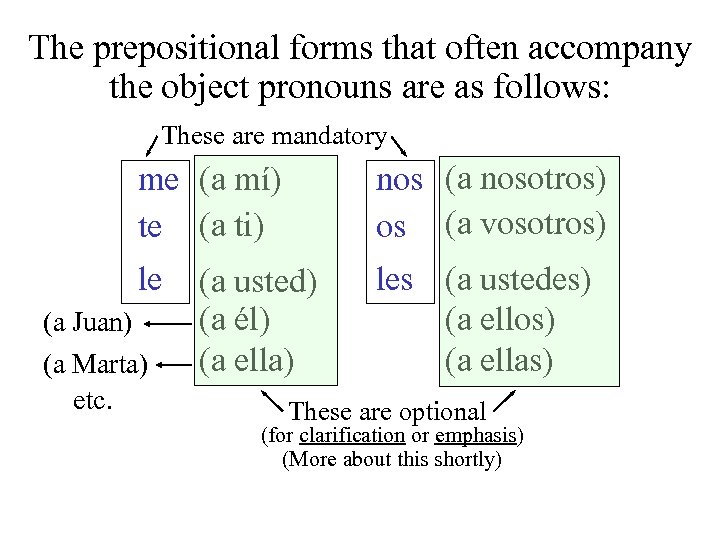 The prepositional forms that often accompany the object pronouns are as follows: These are mandatory me (a mí) te (a ti) nos (a nosotros) os (a vosotros) le les (a ustedes) (a ellos) (a ellas) (a Juan) (a Marta) etc. (a usted) (a él) (a ella) These are optional (for clarification or emphasis) (More about this shortly)
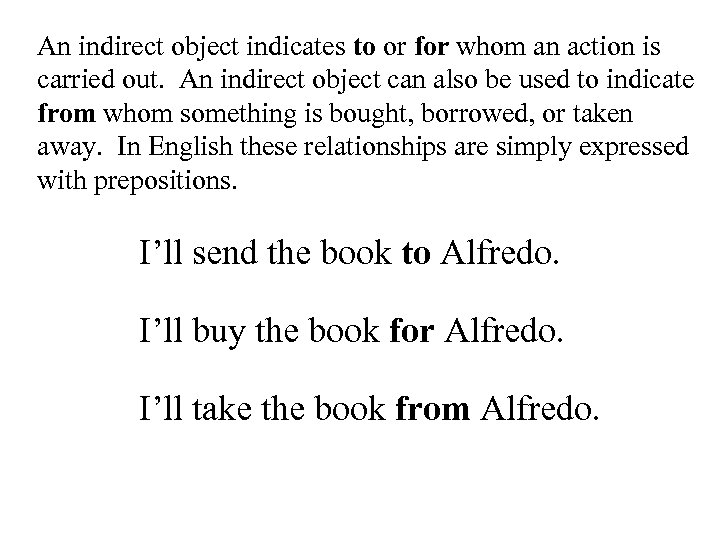 An indirect object indicates to or for whom an action is carried out. An indirect object can also be used to indicate from whom something is bought, borrowed, or taken away. In English these relationships are simply expressed with prepositions. I’ll send the book to Alfredo. I’ll buy the book for Alfredo. I’ll take the book from Alfredo.
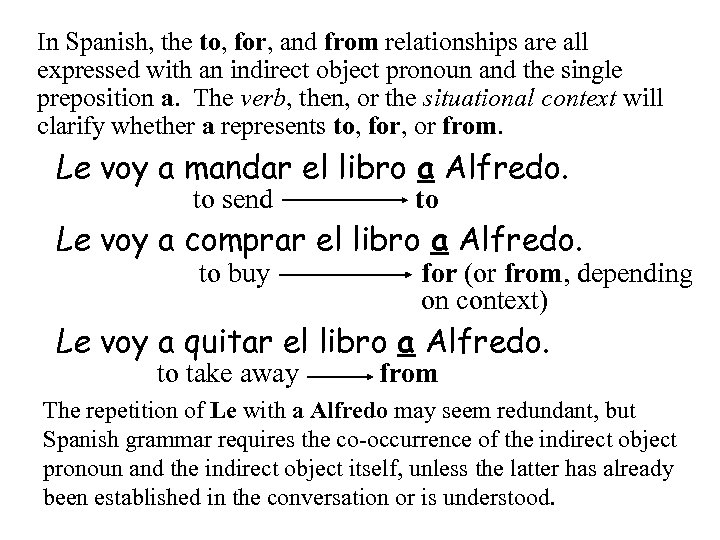 In Spanish, the to, for, and from relationships are all expressed with an indirect object pronoun and the single preposition a. The verb, then, or the situational context will clarify whether a represents to, for, or from. Le voy a mandar el libro a Alfredo. to send to Le voy a comprar el libro a Alfredo. to buy for (or from, depending on context) Le voy a quitar el libro a Alfredo. to take away from The repetition of Le with a Alfredo may seem redundant, but Spanish grammar requires the co-occurrence of the indirect object pronoun and the indirect object itself, unless the latter has already been established in the conversation or is understood.
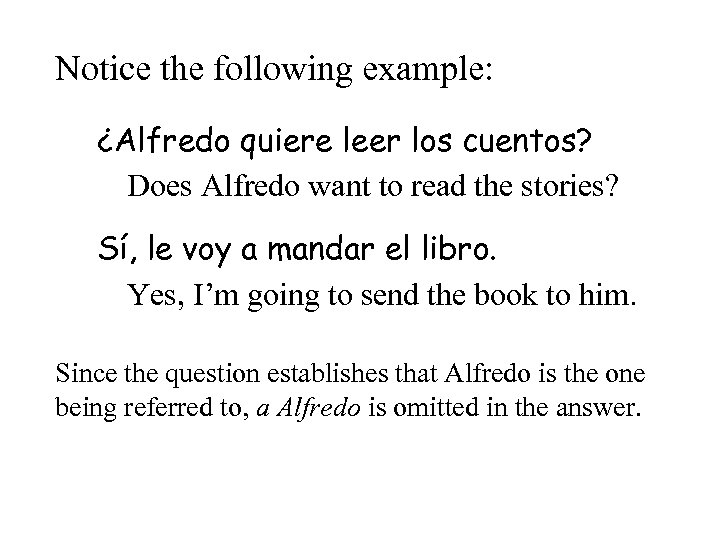 Notice the following example: ¿Alfredo quiere leer los cuentos? Does Alfredo want to read the stories? Sí, le voy a mandar el libro. Yes, I’m going to send the book to him. Since the question establishes that Alfredo is the one being referred to, a Alfredo is omitted in the answer.
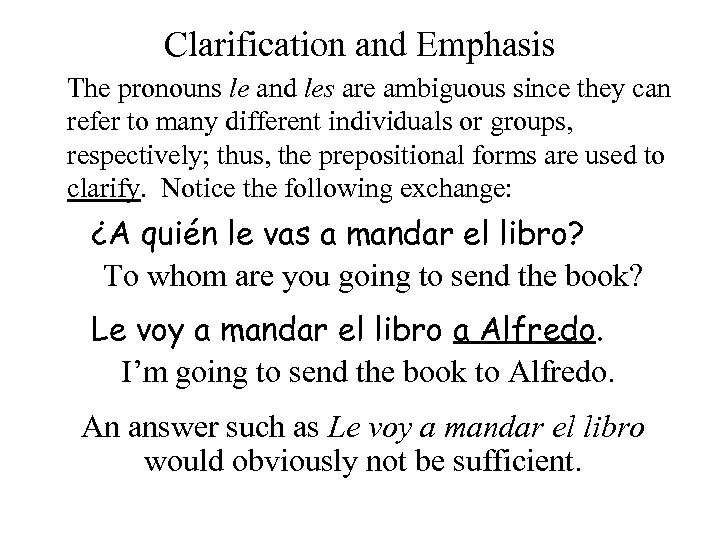 Clarification and Emphasis The pronouns le and les are ambiguous since they can refer to many different individuals or groups, respectively; thus, the prepositional forms are used to clarify. Notice the following exchange: ¿A quién le vas a mandar el libro? To whom are you going to send the book? Le voy a mandar el libro a Alfredo. I’m going to send the book to Alfredo. An answer such as Le voy a mandar el libro would obviously not be sufficient.
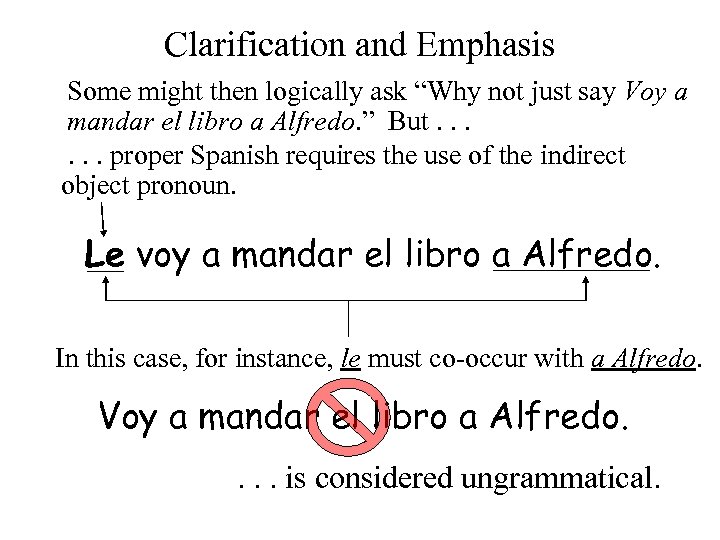 Clarification and Emphasis Some might then logically ask “Why not just say Voy a mandar el libro a Alfredo. ” But. . . proper Spanish requires the use of the indirect object pronoun. Le voy a mandar el libro a Alfredo. In this case, for instance, le must co-occur with a Alfredo. Voy a mandar el libro a Alfredo. . is considered ungrammatical.
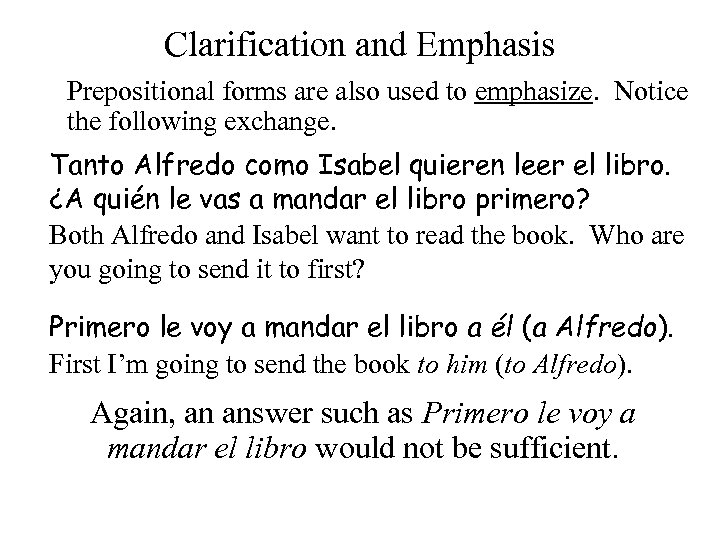 Clarification and Emphasis Prepositional forms are also used to emphasize. Notice the following exchange. Tanto Alfredo como Isabel quieren leer el libro. ¿A quién le vas a mandar el libro primero? Both Alfredo and Isabel want to read the book. Who are you going to send it to first? Primero le voy a mandar el libro a él (a Alfredo). First I’m going to send the book to him (to Alfredo). Again, an answer such as Primero le voy a mandar el libro would not be sufficient.
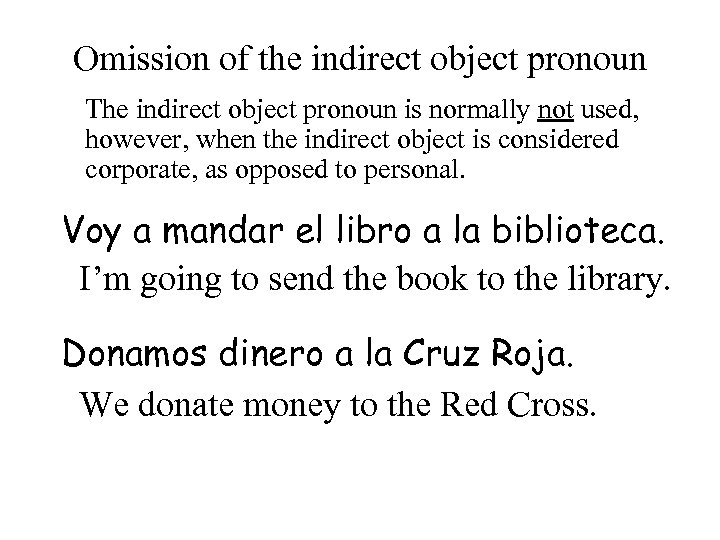 Omission of the indirect object pronoun The indirect object pronoun is normally not used, however, when the indirect object is considered corporate, as opposed to personal. Voy a mandar el libro a la biblioteca. I’m going to send the book to the library. Donamos dinero a la Cruz Roja. We donate money to the Red Cross.
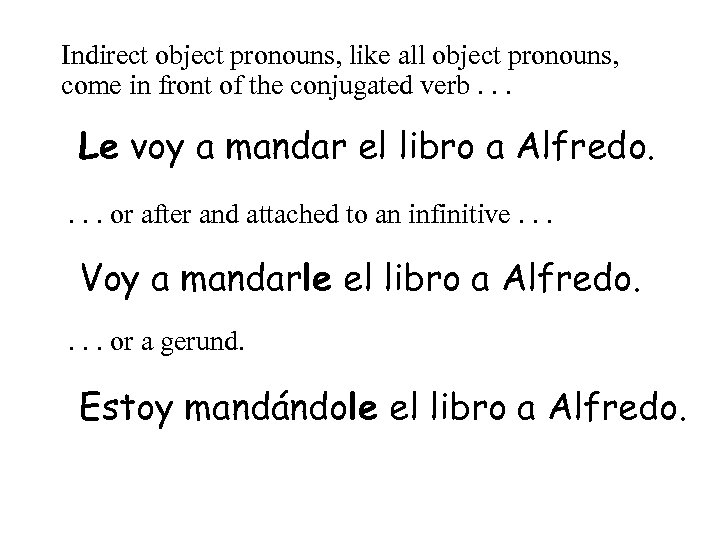 Indirect object pronouns, like all object pronouns, come in front of the conjugated verb. . . Le voy a mandar el libro a Alfredo. . or after and attached to an infinitive. . . Voy a mandarle el libro a Alfredo. . or a gerund. Estoy mandándole el libro a Alfredo.
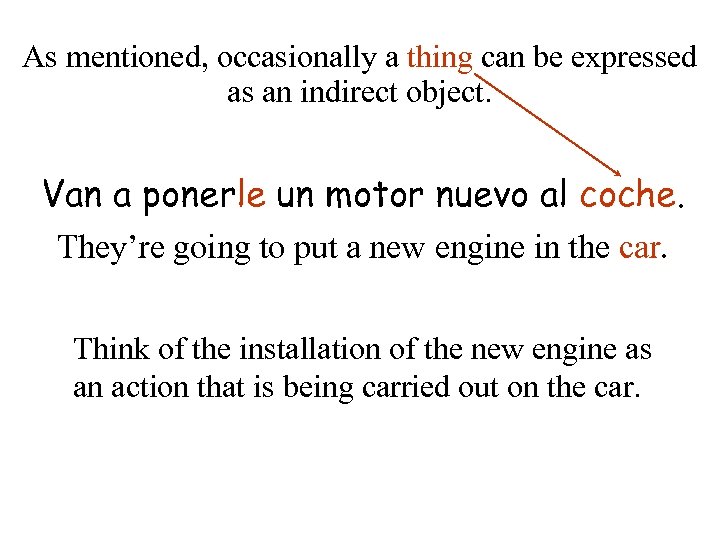 As mentioned, occasionally a thing can be expressed as an indirect object. Van a ponerle un motor nuevo al coche. They’re going to put a new engine in the car. Think of the installation of the new engine as an action that is being carried out on the car.
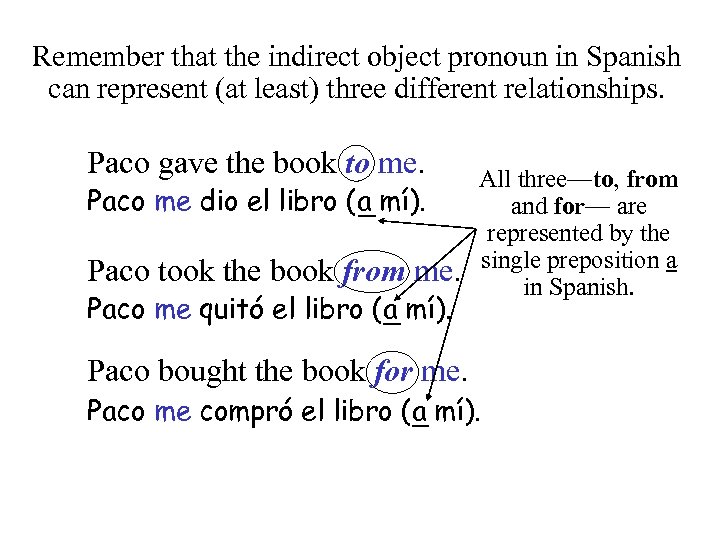 Remember that the indirect object pronoun in Spanish can represent (at least) three different relationships. Paco gave the book to me. Paco me dio el libro (a mí). Paco took the book from me. Paco me quitó el libro (a mí). All three—to, from and for— are represented by the single preposition a in Spanish. Paco bought the book for me. Paco me compró el libro (a mí).
 FIN
FIN