


 Скачать презентацию Computing Corporate Platforms What s in Common
6bc1d3e5448018cec525b65709f0e192.ppt
- Количество слайдов: 37
 Computing & Corporate Platforms: What’s in Common? © 2001 Diamond Exchange 4 December 2001 Gordon Bell, Microsoft Research gbell@microsoft. com
 Overview ¢Company platform needs to be like a computer platform, -an organism building on technology, providing more capability. ¢Every technology change e. g. Moore et al, is likely to be disruptive to some part of an organization ¢Platform is a framework for the organization to use and change… -it has to be architected, and maintained (aka evolved) ¢Under MBA doctrine*, every company will attempt to create unique (aka proprietary) platforms ¢What are some parallels from our understanding of computing platforms e. g. the need for an architect and architecture, and the relationship to other infrastructure that can be applied to company platforms? *What is you uniqueness? © 2001 " If you can't be elegant, at least be extravagant. " -Franco Moschino
 Outline ¢ ¢ ¢ Some terms Computing Platforms*: and their evolution Corporate Platform*: a parallel to computing platforms * “On. Star can be just like AOL” © 2001 Ralph Szgenda, GM’s CIO.
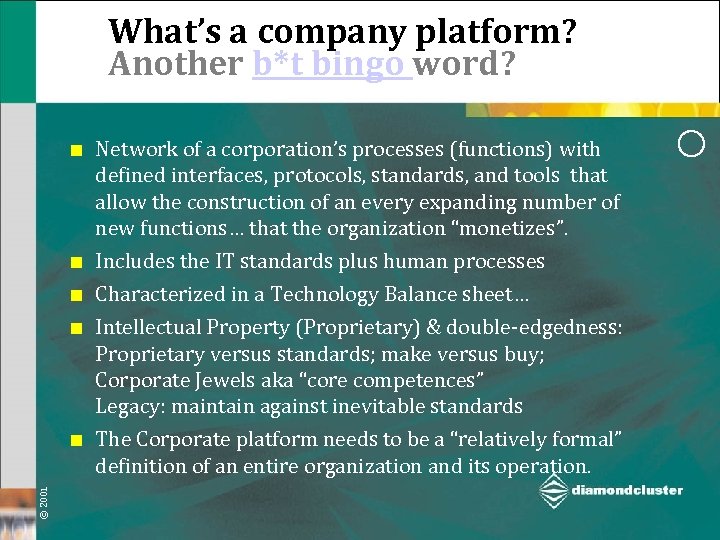 What’s a company platform? Another b*t bingo word? ¢ ¢ © 2001 ¢ Network of a corporation’s processes (functions) with defined interfaces, protocols, standards, and tools that allow the construction of an every expanding number of new functions… that the organization “monetizes”. Includes the IT standards plus human processes Characterized in a Technology Balance sheet… Intellectual Property (Proprietary) & double-edgedness: Proprietary versus standards; make versus buy; Corporate Jewels aka “core competences” Legacy: maintain against inevitable standards The Corporate platform needs to be a “relatively formal” definition of an entire organization and its operation.
 Platforms are enablers… ¢ ¢ © 2001 ¢ Machine platforms enable endless products –Bob Cats and Cuisinarts to Computers. Venture platform is a “machine” for building new biz’s Can corporate venture platforms enable endless businesses as per Mason and Rohner? How do you specify and do platforms? What is the core aka corporate platform?
 © 2001 Computing Platforms
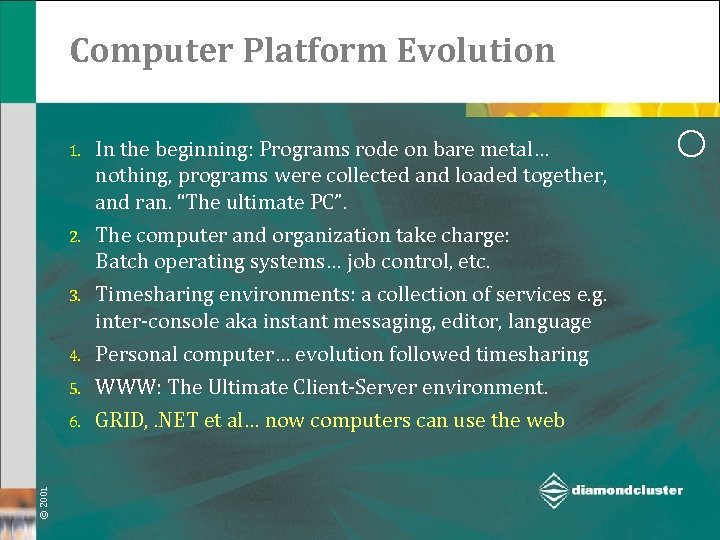 Computer Platform Evolution 5. In the beginning: Programs rode on bare metal… nothing, programs were collected and loaded together, and ran. “The ultimate PC”. The computer and organization take charge: Batch operating systems… job control, etc. Timesharing environments: a collection of services e. g. inter-console aka instant messaging, editor, language Personal computer… evolution followed timesharing WWW: The Ultimate Client-Server environment. 6. GRID, . NET et al… now computers can use the web 1. 2. 3. © 2001 4.
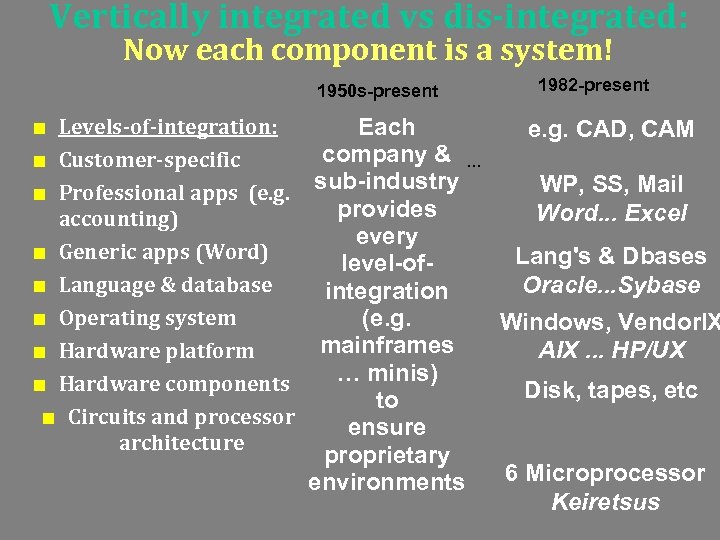 Vertically integrated vs dis-integrated: Now each component is a system! 1950 s-present Levels-of-integration: Customer-specific Professional apps (e. g. accounting) Generic apps (Word) Language & database Operating system Hardware platform 1982 -present Each e. g. CAD, CAM company &. . . ¢ sub-industry WP, SS, Mail ¢ provides Word. . . Excel every ¢ Lang's & Dbases level-of¢ Oracle. . . Sybase integration ¢ (e. g. Windows, Vendor. IX mainframes ¢ AIX. . . HP/UX … minis) ¢ Hardware components Disk, tapes, etc to ¢ Circuits and processor ensure architecture proprietary 6 Microprocessor environments Keiretsus ¢
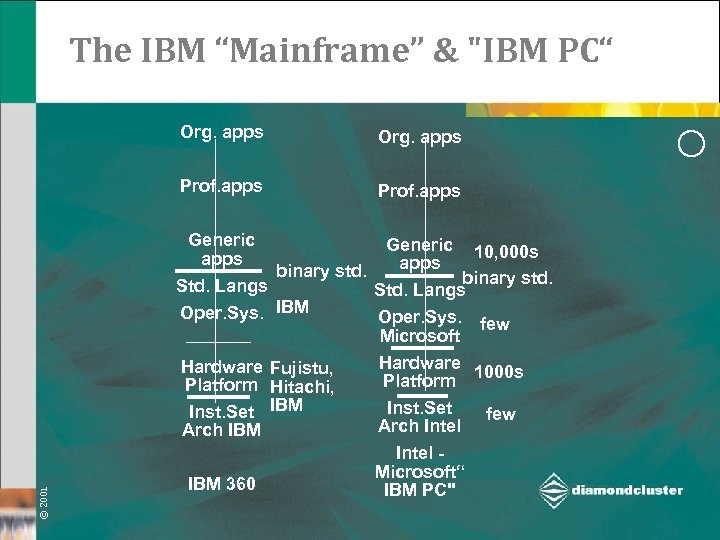 The IBM “Mainframe” & "IBM PC“ Org. apps Prof. apps © 2001 Org. apps Prof. apps Generic 10, 000 s apps binary std. Std. Langs Oper. Sys. IBM Oper. Sys. few Microsoft Hardware Fujistu, 1000 s Platform Hitachi, Inst. Set IBM few Arch Intel Arch IBM Intel Microsoft“ IBM 360 IBM PC"
 Standards, Portability, Interoperability, and Open-ness Standards are aimed at portability & interoperability, however user investment is data and the apps that interpret that data ¢ Portability is the ability to move apps, data, and people among “computer” system architectures. ¢ Interoperability is the ability for people and programs to exchange information in a meaningful way. ¢ An open system (IEEE P 1003. 0) is one that implements sufficient open specifications* for interfaces, services, and supporting formats to enable properly engineered applications software to: ¢ 1. be ported with minimal or no changes to a wide range of systems ¢ 2. interoperate with other apps on local & remote systems ¢ 3. interact with users in a style that facilitates user portability. ¢ *Open specs are public & maintained by an "open", consensus process to accommodate new technology (t) consistent with international standards. © 2001 ¢
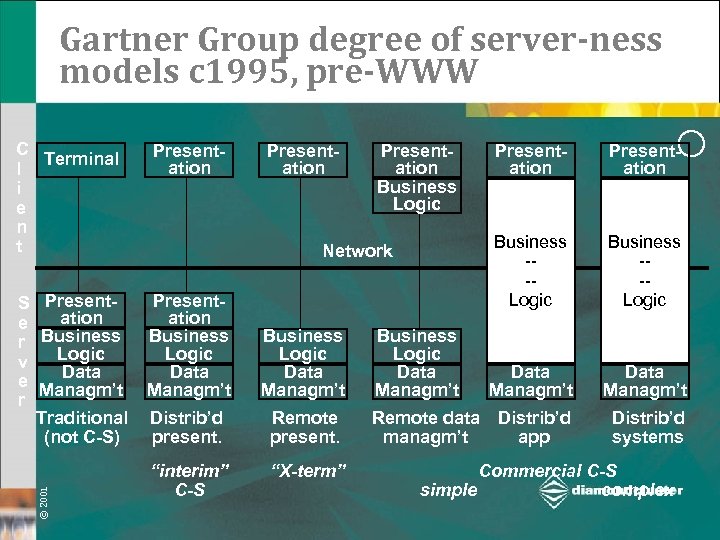 Gartner Group degree of server-ness models c 1995, pre-WWW Presentation S Presentation e r Business Logic v Data e Managm’t r Traditional (not C-S) Presentation Business Logic Data Managm’t Distrib’d present. Remote present. “interim” C-S “X-term” © 2001 C Terminal l i e n t Presentation Business Logic Presentation Business --Logic Data Managm’t Remote data Distrib’d managm’t app Distrib’d systems Network Business Logic Data Managm’t Commercial C-S simple complex
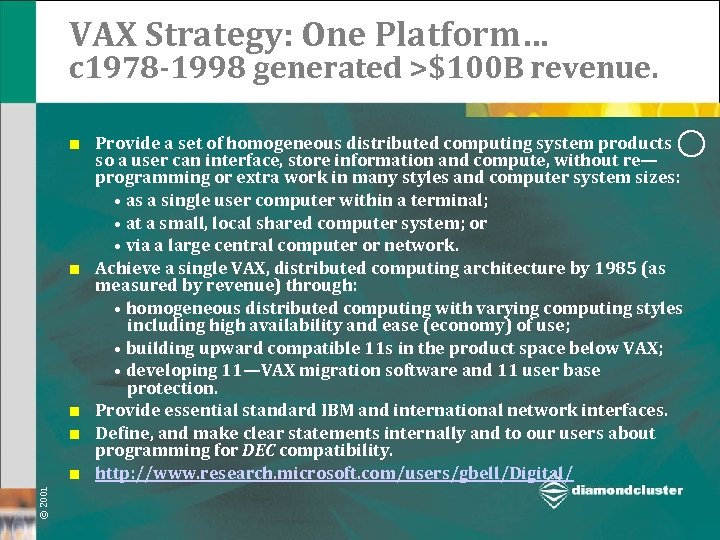 VAX Strategy: One Platform… c 1978 -1998 generated >$100 B revenue. ¢ ¢ © 2001 ¢ Provide a set of homogeneous distributed computing system products so a user can interface, store information and compute, without re— programming or extra work in many styles and computer system sizes: • as a single user computer within a terminal; • at a small, local shared computer system; or • via a large central computer or network. Achieve a single VAX, distributed computing architecture by 1985 (as measured by revenue) through: • homogeneous distributed computing with varying computing styles including high availability and ease (economy) of use; • building upward compatible 11 s in the product space below VAX; • developing 11—VAX migration software and 11 user base protection. Provide essential standard IBM and international network interfaces. Define, and make clear statements internally and to our users about programming for DEC compatibility. http: //www. research. microsoft. com/users/gbell/Digital/
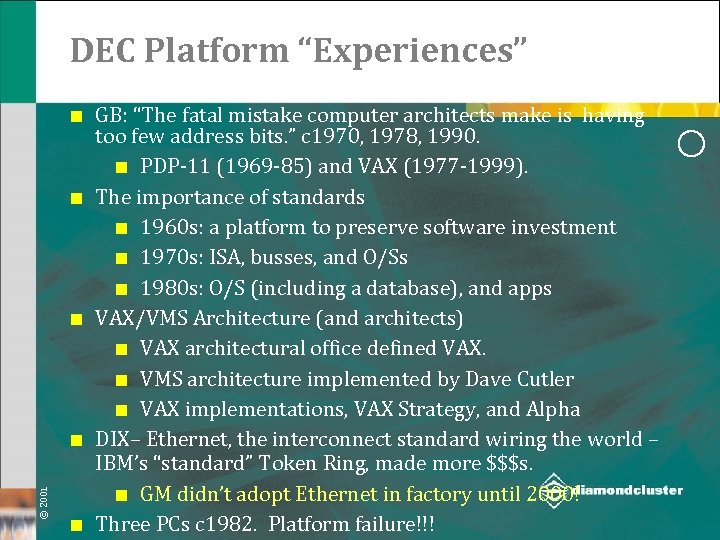 DEC Platform “Experiences” ¢ ¢ ¢ © 2001 ¢ ¢ GB: “The fatal mistake computer architects make is having too few address bits. ” c 1970, 1978, 1990. ¢ PDP-11 (1969 -85) and VAX (1977 -1999). The importance of standards ¢ 1960 s: a platform to preserve software investment ¢ 1970 s: ISA, busses, and O/Ss ¢ 1980 s: O/S (including a database), and apps VAX/VMS Architecture (and architects) ¢ VAX architectural office defined VAX. ¢ VMS architecture implemented by Dave Cutler ¢ VAX implementations, VAX Strategy, and Alpha DIX– Ethernet, the interconnect standard wiring the world – IBM’s “standard” Token Ring, made more $$$s. ¢ GM didn’t adopt Ethernet in factory until 2000! Three PCs c 1982. Platform failure!!!
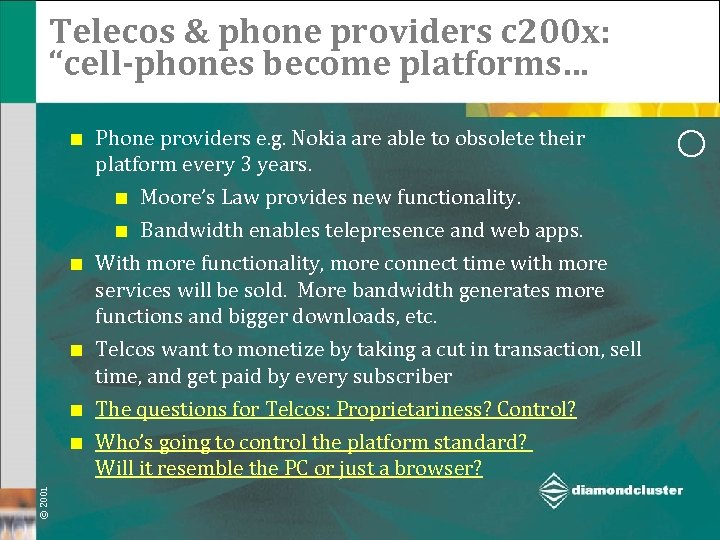 Telecos & phone providers c 200 x: “cell-phones become platforms… ¢ Phone providers e. g. Nokia are able to obsolete their platform every 3 years. ¢ ¢ Moore’s Law provides new functionality. Bandwidth enables telepresence and web apps. With more functionality, more connect time with more services will be sold. More bandwidth generates more functions and bigger downloads, etc. Telcos want to monetize by taking a cut in transaction, sell time, and get paid by every subscriber The questions for Telcos: Proprietariness? Control? ¢ © 2001 ¢ Who’s going to control the platform standard? Will it resemble the PC or just a browser?
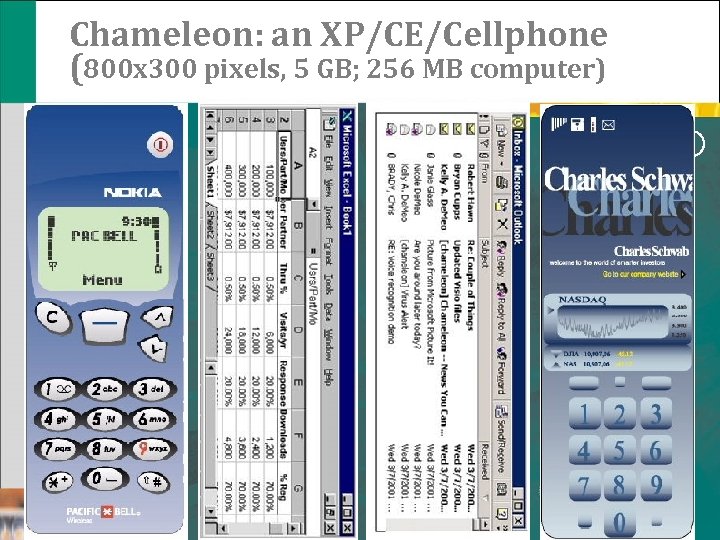 © 2001 Chameleon: an XP/CE/Cellphone (800 x 300 pixels, 5 GB; 256 MB computer)
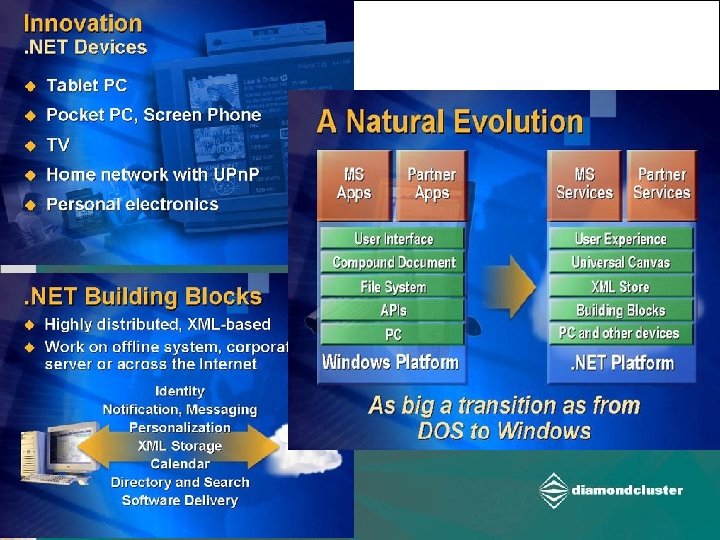 © 2001 . NET views
 © 2001 Corporate Platforms…
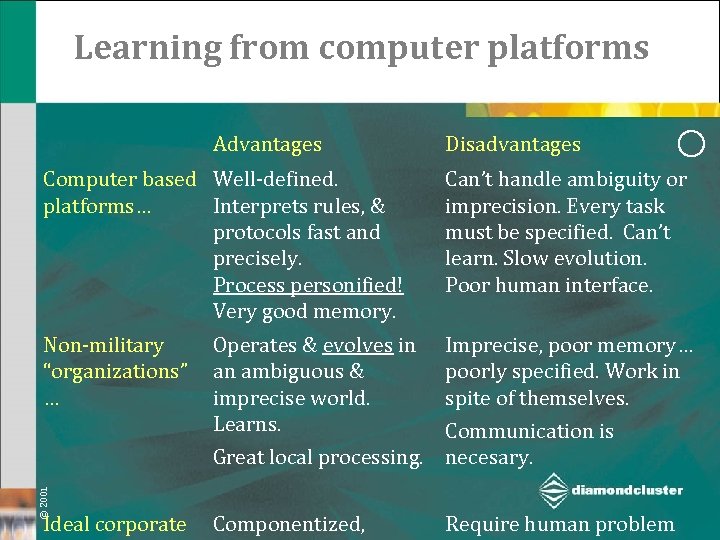 Learning from computer platforms Advantages Disadvantages Can’t handle ambiguity or imprecision. Every task must be specified. Can’t learn. Slow evolution. Poor human interface. Non-military “organizations” … Operates & evolves in an ambiguous & imprecise world. Learns. Great local processing. Imprecise, poor memory… poorly specified. Work in spite of themselves. Communication is necesary. Componentized, Require human problem © 2001 Computer based Well-defined. platforms… Interprets rules, & protocols fast and precisely. Process personified! Very good memory. Ideal corporate
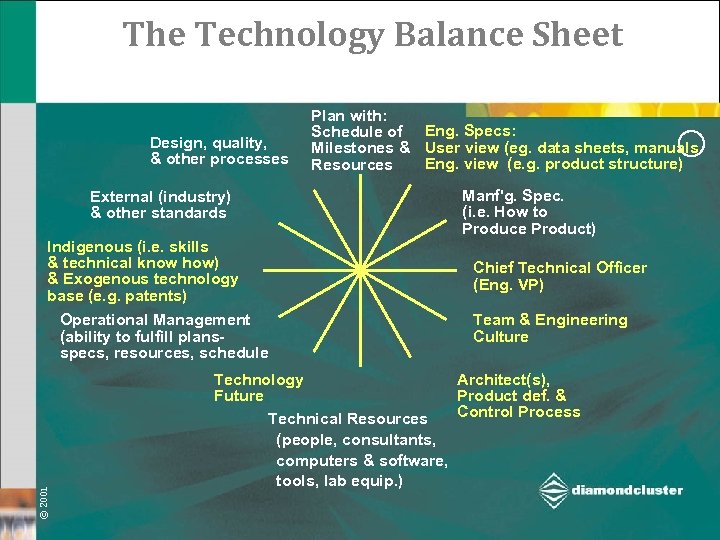 The Technology Balance Sheet Design, quality, & other processes External (industry) & other standards Indigenous (i. e. skills & technical know how) & Exogenous technology base (e. g. patents) © 2001 Operational Management (ability to fulfill plansspecs, resources, schedule Plan with: Schedule of Eng. Specs: Milestones & User view (eg. data sheets, manuals Eng. view (e. g. product structure) Resources Manf'g. Spec. (i. e. How to Produce Product) Chief Technical Officer (Eng. VP) Team & Engineering Culture Technology Architect(s), Future Product def. & Control Process Technical Resources (people, consultants, computers & software, tools, lab equip. )
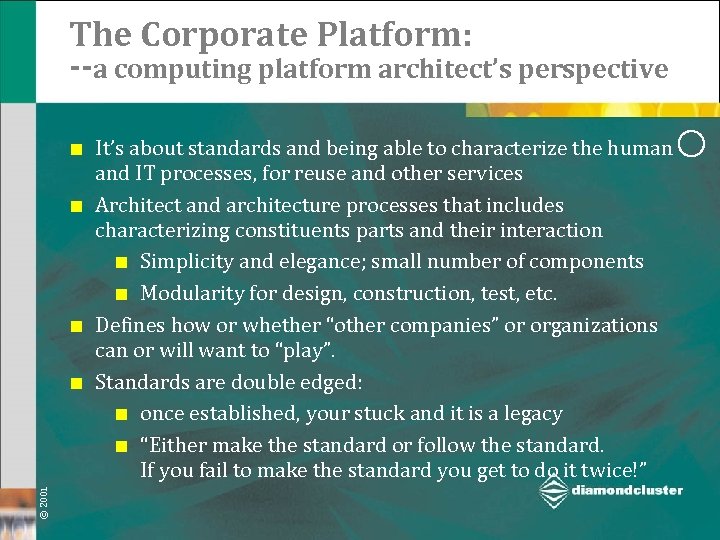 The Corporate Platform: --a computing platform architect’s perspective ¢ ¢ ¢ © 2001 ¢ It’s about standards and being able to characterize the human and IT processes, for reuse and other services Architect and architecture processes that includes characterizing constituents parts and their interaction ¢ Simplicity and elegance; small number of components ¢ Modularity for design, construction, test, etc. Defines how or whether “other companies” or organizations can or will want to “play”. Standards are double edged: ¢ once established, your stuck and it is a legacy ¢ “Either make the standard or follow the standard. If you fail to make the standard you get to do it twice!”
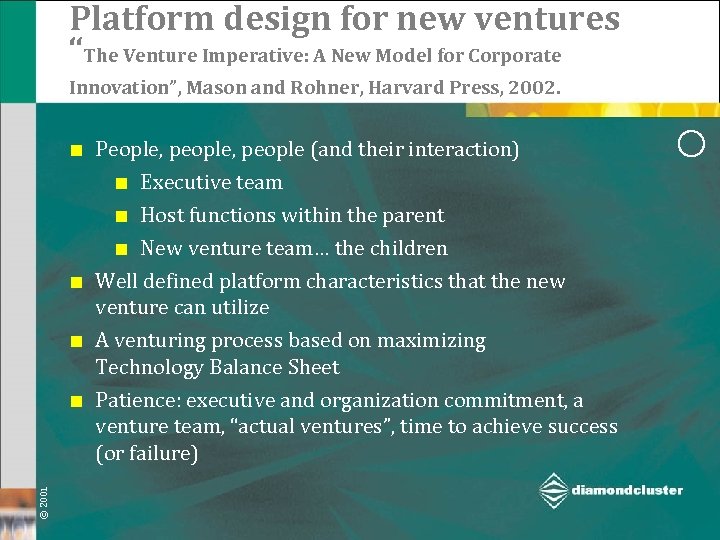 Platform design for new ventures “The Venture Imperative: A New Model for Corporate Innovation”, Mason and Rohner, Harvard Press, 2002. ¢ People, people (and their interaction) ¢ Executive team ¢ Host functions within the parent ¢ New venture team… the children ¢ Well defined platform characteristics that the new venture can utilize A venturing process based on maximizing Technology Balance Sheet ¢ © 2001 ¢ Patience: executive and organization commitment, a venture team, “actual ventures”, time to achieve success (or failure)
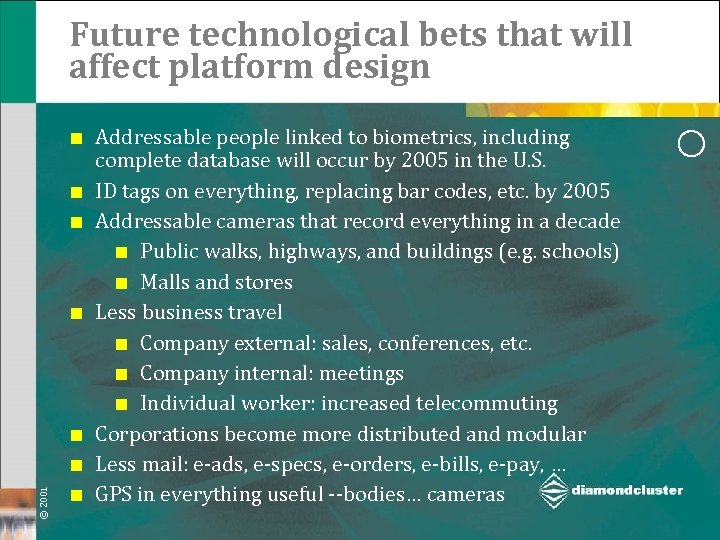 Future technological bets that will affect platform design ¢ ¢ ¢ © 2001 ¢ ¢ Addressable people linked to biometrics, including complete database will occur by 2005 in the U. S. ID tags on everything, replacing bar codes, etc. by 2005 Addressable cameras that record everything in a decade ¢ Public walks, highways, and buildings (e. g. schools) ¢ Malls and stores Less business travel ¢ Company external: sales, conferences, etc. ¢ Company internal: meetings ¢ Individual worker: increased telecommuting Corporations become more distributed and modular Less mail: e-ads, e-specs, e-orders, e-bills, e-pay, … GPS in everything useful --bodies… cameras
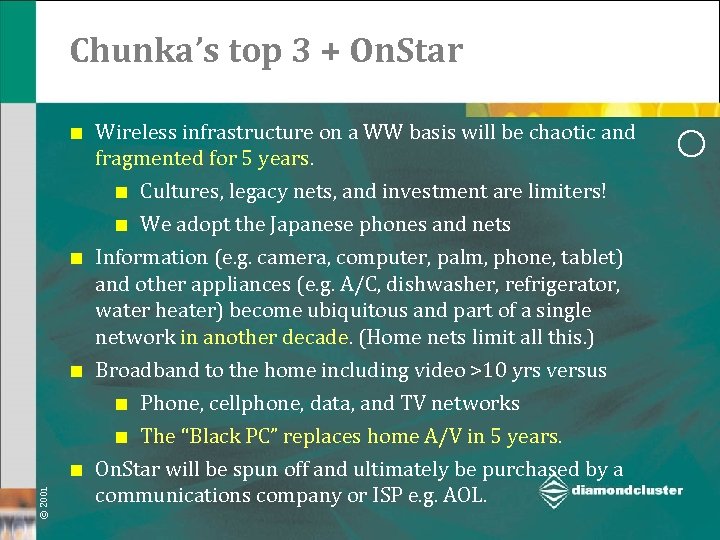 Chunka’s top 3 + On. Star ¢ Wireless infrastructure on a WW basis will be chaotic and fragmented for 5 years. ¢ ¢ Cultures, legacy nets, and investment are limiters! We adopt the Japanese phones and nets Information (e. g. camera, computer, palm, phone, tablet) and other appliances (e. g. A/C, dishwasher, refrigerator, water heater) become ubiquitous and part of a single network in another decade. (Home nets limit all this. ) Broadband to the home including video >10 yrs versus ¢ ¢ © 2001 ¢ Phone, cellphone, data, and TV networks The “Black PC” replaces home A/V in 5 years. On. Star will be spun off and ultimately be purchased by a communications company or ISP e. g. AOL.
 © 2001 The End
 © 2001 Backup
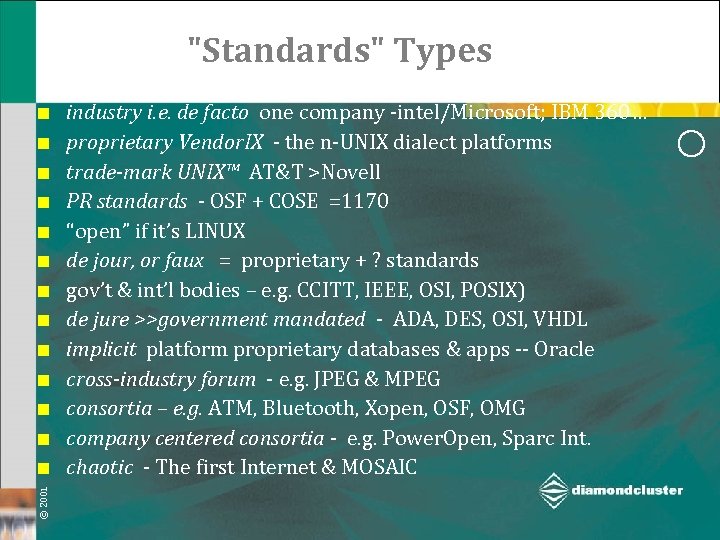 "Standards" Types ¢ ¢ ¢ © 2001 ¢ industry i. e. de facto one company -intel/Microsoft; IBM 360… proprietary Vendor. IX - the n-UNIX dialect platforms trade-mark UNIX™ AT&T >Novell PR standards - OSF + COSE =1170 “open” if it’s LINUX de jour, or faux = proprietary + ? standards gov’t & int’l bodies – e. g. CCITT, IEEE, OSI, POSIX) de jure >>government mandated - ADA, DES, OSI, VHDL implicit platform proprietary databases & apps -- Oracle cross-industry forum - e. g. JPEG & MPEG consortia – e. g. ATM, Bluetooth, Xopen, OSF, OMG company centered consortia - e. g. Power. Open, Sparc Int. chaotic - The first Internet & MOSAIC
 © 2001 Not to be used
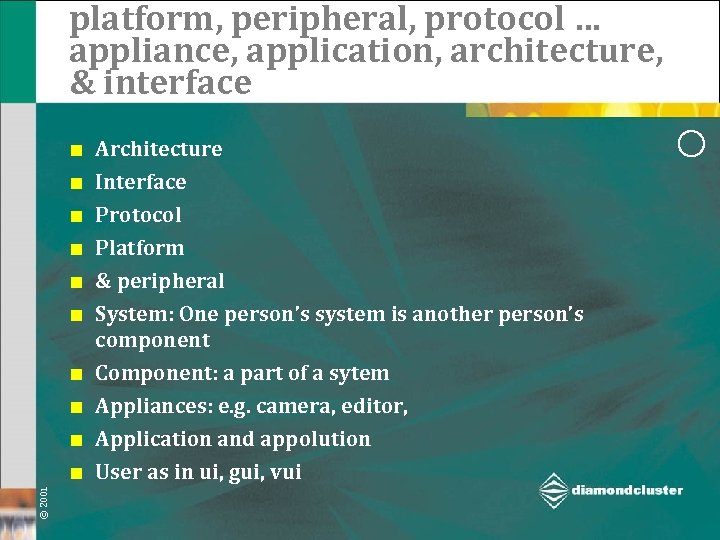 platform, peripheral, protocol … appliance, application, architecture, & interface ¢ ¢ Architecture Interface Protocol Platform ¢ & peripheral System: One person’s system is another person’s component Component: a part of a sytem ¢ Appliances: e. g. camera, editor, ¢ Application and appolution ¢ User as in ui, gui, vui ¢ © 2001 ¢
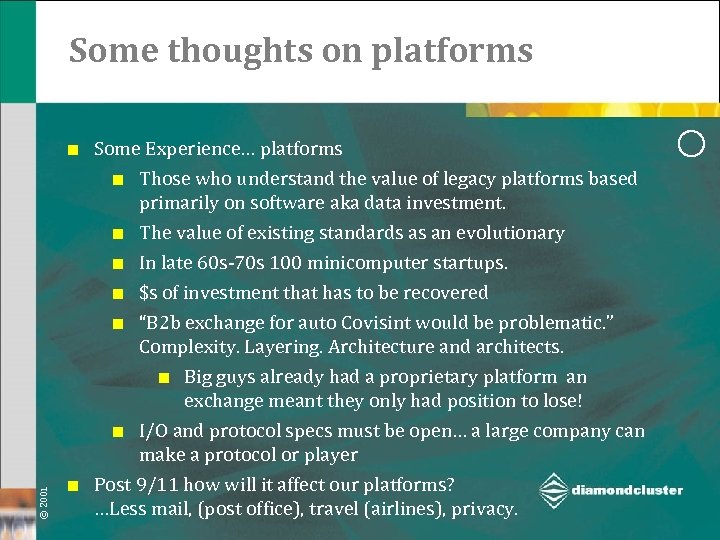 Some thoughts on platforms ¢ Some Experience… platforms ¢ ¢ In late 60 s-70 s 100 minicomputer startups. ¢ $s of investment that has to be recovered ¢ “B 2 b exchange for auto Covisint would be problematic. ” Complexity. Layering. Architecture and architects. ¢ Big guys already had a proprietary platform an exchange meant they only had position to lose! ¢ I/O and protocol specs must be open… a large company can make a protocol or player Post 9/11 how will it affect our platforms? …Less mail, (post office), travel (airlines), privacy. © 2001 ¢ ¢ Those who understand the value of legacy platforms based primarily on software aka data investment. The value of existing standards as an evolutionary
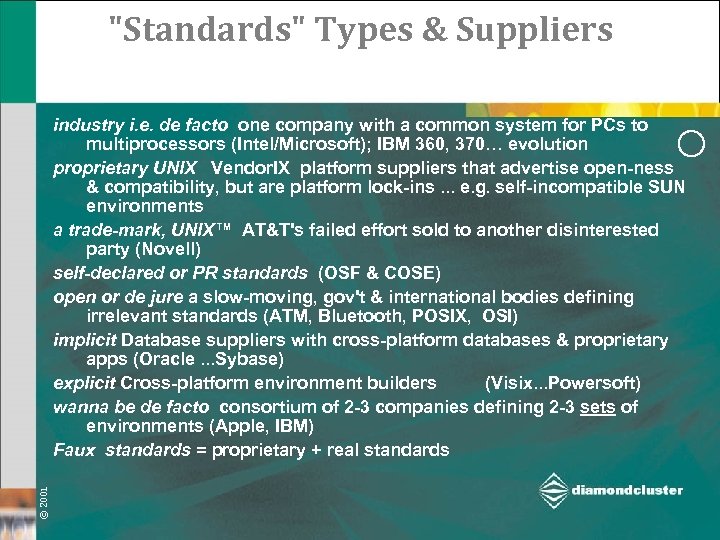 "Standards" Types & Suppliers © 2001 industry i. e. de facto one company with a common system for PCs to multiprocessors (Intel/Microsoft); IBM 360, 370… evolution proprietary UNIX Vendor. IX platform suppliers that advertise open-ness & compatibility, but are platform lock-ins. . . e. g. self-incompatible SUN environments a trade-mark, UNIX™ AT&T's failed effort sold to another disinterested party (Novell) self-declared or PR standards (OSF & COSE) open or de jure a slow-moving, gov't & international bodies defining irrelevant standards (ATM, Bluetooth, POSIX, OSI) implicit Database suppliers with cross-platform databases & proprietary apps (Oracle. . . Sybase) explicit Cross-platform environment builders (Visix. . . Powersoft) wanna be de facto consortium of 2 -3 companies defining 2 -3 sets of environments (Apple, IBM) Faux standards = proprietary + real standards
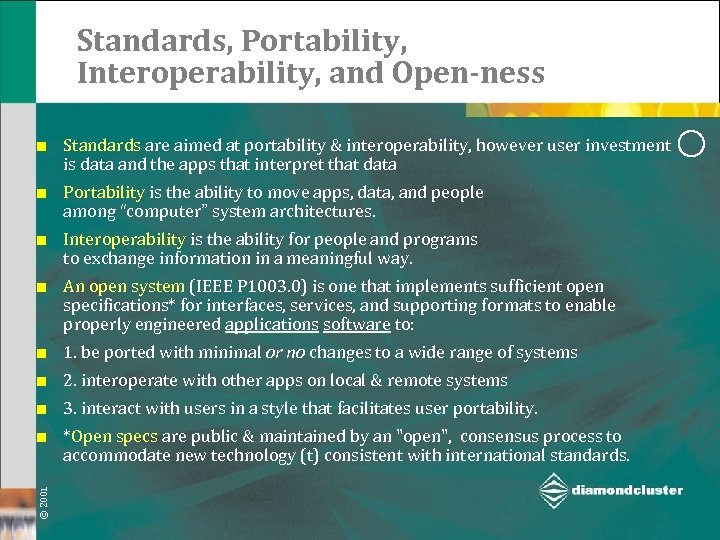
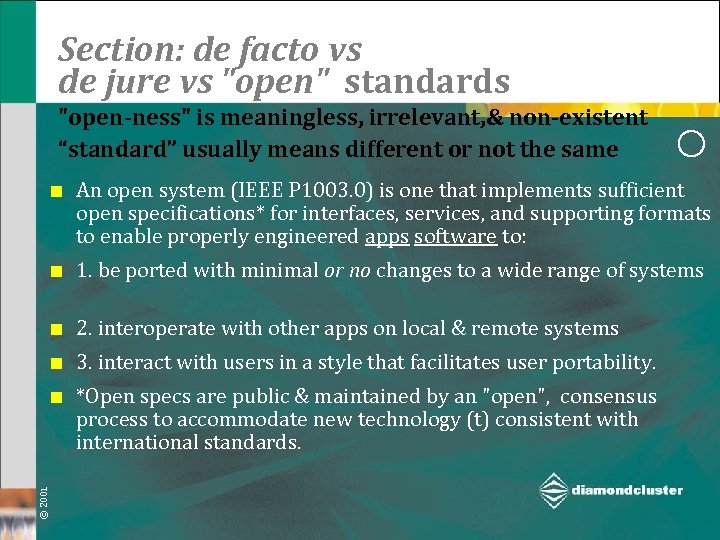 Section: de facto vs de jure vs "open" standards "open-ness" is meaningless, irrelevant, & non-existent “standard” usually means different or not the same An open system (IEEE P 1003. 0) is one that implements sufficient open specifications* for interfaces, services, and supporting formats to enable properly engineered apps software to: ¢ 1. be ported with minimal or no changes to a wide range of systems ¢ 2. interoperate with other apps on local & remote systems ¢ 3. interact with users in a style that facilitates user portability. ¢ *Open specs are public & maintained by an "open", consensus process to accommodate new technology (t) consistent with international standards. © 2001 ¢
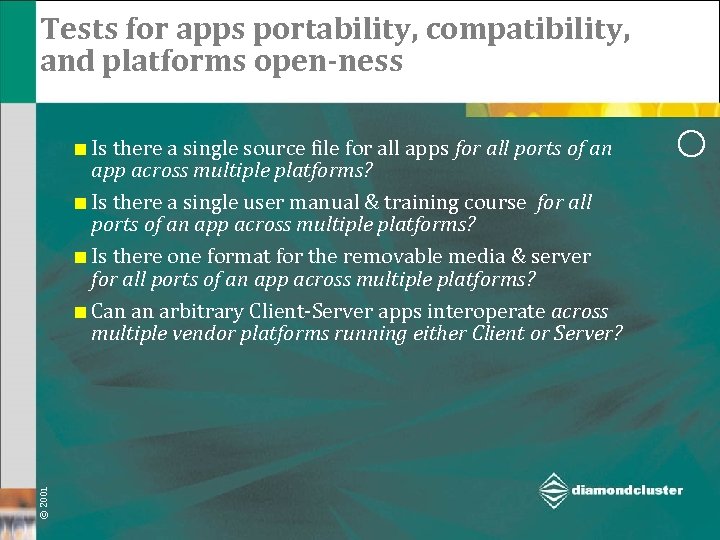 Tests for apps portability, compatibility, and platforms open-ness there a single source file for all apps for all ports of an app across multiple platforms? ¢ Is there a single user manual & training course for all ports of an app across multiple platforms? ¢ Is there one format for the removable media & server for all ports of an app across multiple platforms? ¢ Can an arbitrary Client-Server apps interoperate across multiple vendor platforms running either Client or Server? © 2001 ¢ Is
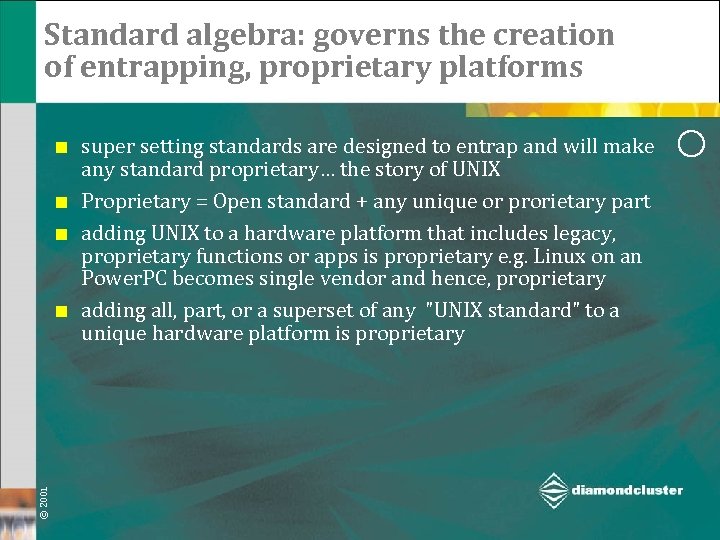 Standard algebra: governs the creation of entrapping, proprietary platforms ¢ ¢ ¢ © 2001 ¢ super setting standards are designed to entrap and will make any standard proprietary… the story of UNIX Proprietary = Open standard + any unique or prorietary part adding UNIX to a hardware platform that includes legacy, proprietary functions or apps is proprietary e. g. Linux on an Power. PC becomes single vendor and hence, proprietary adding all, part, or a superset of any "UNIX standard" to a unique hardware platform is proprietary
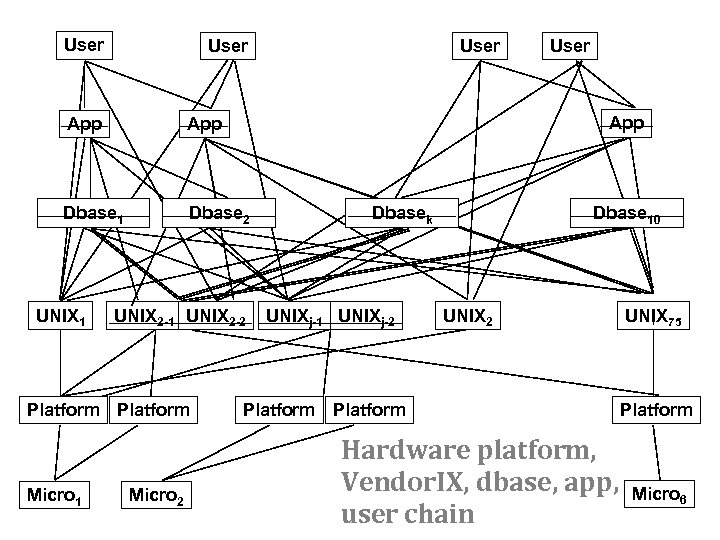 User App App Dbase 1 Dbase 2 UNIX 1 UNIX 2 -2 Platform Micro 1 Micro 2 User Dbasek UNIXj-1 UNIXj-2 Dbase 10 UNIX 2 Platform Hardware platform, Vendor. IX, dbase, app, user chain UNIX 75 Platform Micro 6
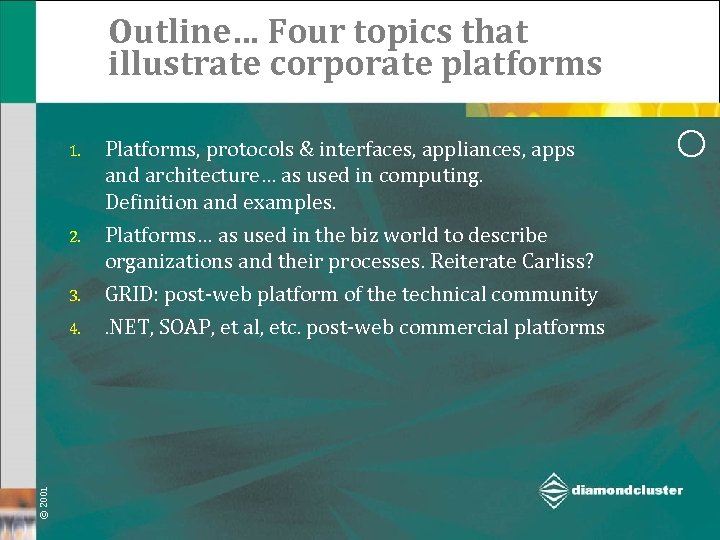 Outline… Four topics that illustrate corporate platforms 1. 2. 3. © 2001 4. Platforms, protocols & interfaces, appliances, apps and architecture… as used in computing. Definition and examples. Platforms… as used in the biz world to describe organizations and their processes. Reiterate Carliss? GRID: post-web platform of the technical community. NET, SOAP, et al, etc. post-web commercial platforms
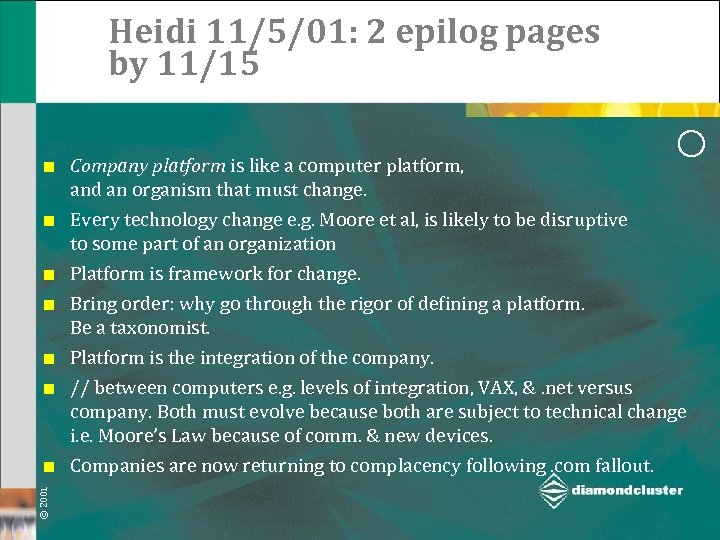 Heidi 11/5/01: 2 epilog pages by 11/15 ¢ ¢ ¢ © 2001 ¢ Company platform is like a computer platform, and an organism that must change. Every technology change e. g. Moore et al, is likely to be disruptive to some part of an organization Platform is framework for change. Bring order: why go through the rigor of defining a platform. Be a taxonomist. Platform is the integration of the company. // between computers e. g. levels of integration, VAX, &. net versus company. Both must evolve because both are subject to technical change i. e. Moore’s Law because of comm. & new devices. Companies are now returning to complacency following. com fallout.
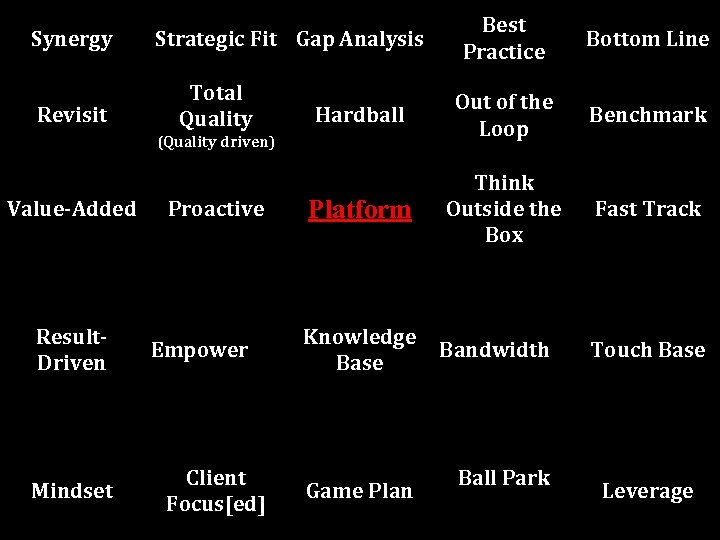 Synergy Revisit Best Practice Bottom Line Hardball Out of the Loop Benchmark Platform Think Outside the Box Fast Track Strategic Fit Gap Analysis Total Quality (Quality driven) Value-Added Result. Driven Mindset Proactive Empower Client Focus[ed] Knowledge Base Game Plan Bandwidth Ball Park Touch Base Leverage