


 Скачать презентацию Computers in Teaching and Learning in Higher Education
a1433959e3c9984c999e5a1cb8babeb1.ppt
- Количество слайдов: 23
 Computers in Teaching and Learning in Higher Education Dave Moursund University of Oregon April 27, 2007
 Information, Knowledge, Wisdom, Foresight “Before you become too entranced with gorgeous gadgets and mesmerizing video displays, let me remind you that information is not knowledge, knowledge is not wisdom, and wisdom is not foresight. Each grows out of the other, and we need them all. ” (Arthur C. Clark) UO Symposium 4/27/07 2
 Content, Pedagogy, Assessment Teaching involves all three: content, pedagogy (instruction) and assessment IT affects all three, in each academic discipline. Watch for the difference emphasis areas as the various panelists do their presentations. UO Symposium 4/27/07 3
 Goals of Symposium Explore current and future roles of Information Technology in the Scholarship and Science of Teaching and Learning. Showcase some UO people who are making effective instructional use of IT. Work toward improving education for students at the UO. UO Symposium 4/27/07 4
 Free Books, Teaching Materials, Entire Courses Creative Commons licensing Lots of people and organizations contribute free “stuff” Includes free courses and other academically useful materials such as Wikipedia UO Symposium 4/27/07 5
 Academic Goals of Education Acquisition & retention of basics and higher level knowledge and skills. Understanding of the Content being taught. Ability to use the Content to be Ø Literate, responsible, creative, productive adult Ø Self-reliant Ø Lifelong learner Ø A person who copes well with technological, social, and other types of changes UO Symposium 4/27/07 6
 Tools and Teams Shovel, hoe, plow—tools to aid physical performance Reading, writing, arithmetic, IT—tools to aid cognitive performance People and their tools forming a team to solve problems and accomplish tasks. UO Symposium 4/27/07 7
 A Team of People and Tools UO Symposium 4/27/07 8
 BIG Idea #1: Enhancing Performance 1. Enhancing physical and cognitive performance of people: education, training, coaching, diet, drugs 2. Enhancing physical and cognitive (artificially intelligent) performance of machines 3. People and machines have overlapping but different capabilities & limitations UO Symposium 4/27/07 9
 BIG Idea # 2: Expertise Each discipline has its own defining characteristics for expertise (novice up to world class) Some tools cut across many disciplines ØReading, writing, arithmetic (math) ØLibrary Some tools are relatively specific to particular disciplines UO Symposium 4/27/07 10
 Achieving a High Level of Expertise Takes Appropriate natural ability 10, 000 or more hours 10 or more years Good teaching, training, coaching Student being motivated, committed UO Symposium 4/27/07 11
 Artificial Intelligence Within certain narrow areas, computer systems surpass humans The number of such areas is growing Both faculty an students need to have knowledge of how this affects what constitutes a good, modern education UO Symposium 4/27/07 12
 Big Idea #3: Expertise of a Teacher UO Symposium 4/27/07 13
 A Teacher Needs: General knowledge and skills Discipline-specific content knowledge and skills General pedagogical knowledge and skills Discipline-specific pedagogical knowledge and skills. (This is called pedagogical content knowledge, or PCK. ) UO Symposium 4/27/07 14
 Changes Challenging Teachers: General Knowledge and Skills The world and students are changing ØThomas Friedman’s book “The World is Flat” captures some of the ideas ØWatch students walk across campus and you will see some of the ideas ØInformation and knowledge explosion ØBig problems—such as sustainability UO Symposium 4/27/07 15
 Changes Challenging Teachers: Discipline-specific Content Information and communication technology adds a new dimension to each academic discipline Ø A strong parallel with reading, writing, and arithmetic Ø Strong parallel with automation of physical and mental tools Ø Calculator as an example UO Symposium 4/27/07 16
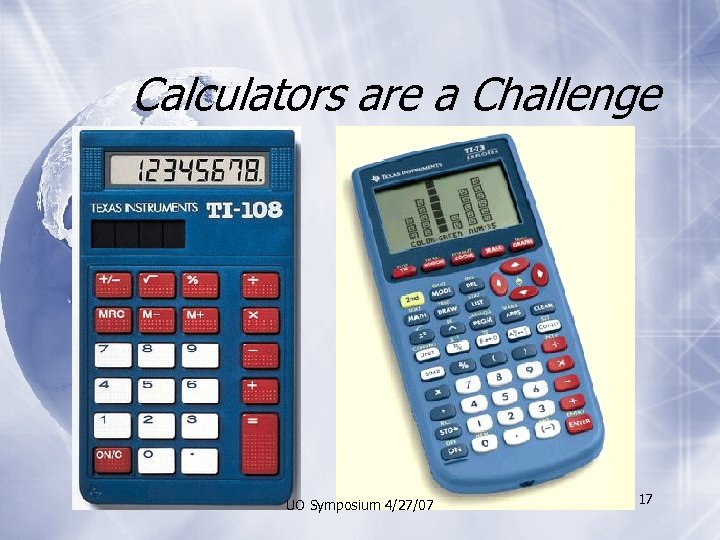 Calculators are a Challenge UO Symposium 4/27/07 17
 Changes Challenging Teachers: General Pedagogical Knowledge Instruction delivery systems Course management systems Email Students reading and writing hypermedia Learning theory: Ø constructivism and situated learning Ø teaching for transfer of learning Brain science UO Symposium 4/27/07 18
 Changes Challenging Teachers: Pedagogical Content Knowledge Teaching discipline-specific: ØInformation storage and retrieval ØReading and writing ØTools ØProblem solving and other higher-order knowledge and skills UO Symposium 4/27/07 19
 BIG Idea #4: Authentic Content and Assessment Teach content that is aligned with (authentic to) expected student performance Assess in a manner that is aligned with the performance-oriented expertise that one is expecting students to be gaining Hands-on computers during tests and other assessment? ? ? UO Symposium 4/27/07 20
 BIG Idea #5: Student IT Prerequisites Higher education faculty assume that students enter college knowing a great deal about educational uses of computers. Ø For the most part, student knowledge is superficial and not up to the types of standards one might want to set. Ø The Pre K-12 standards developed by the International Society for Technology in Education have been widely adopted, but fidelity and quality of implementation has been poor. UO Symposium 4/27/07 21
 Closure IT is a major challenge to an educational system’s ØTeachers and assessment of teachers ØStudents and assessment of students ØInfrastructure; promotion, tenure and retention systems; and hiring practices. UO Symposium 4/27/07 22
 Addresses http: //uoregon. edu/~ moursund/dave/index. htm moursund@uoregon. edu UO Symposium 4/27/07 23