


 Скачать презентацию Computers Are Your Future 2005 Prentice-Hall Inc
69205bb2ff15eab217e6ef555a4bd8ec.ppt
- Количество слайдов: 28
 Computers Are Your Future © 2005 Prentice-Hall, Inc. Slide
 Computers Are Your Future Chapter 10 Databases and Information Systems © 2005 Prentice-Hall, Inc 2
 Computers Are Your Future Chapter 10 What You Will Learn About ü The potential uses of a database program ü The basic components of a database ü The basic qualities of a good database ü The differences between file management and relational database programs © 2005 Prentice-Hall, Inc 3
 Computers Are Your Future Chapter 10 What You Will Learn About ü The basic characteristics of a computerized information system ü The characteristics of valuable information ü The types of computerized information systems ü The retail sector and computer databases © 2005 Prentice-Hall, Inc 4
 Computers Are Your Future Chapter 10 Database Concepts ü Data is any unorganized text, graphics, sounds, or videos. ü A database is a collection of data. ü Database programs enable people to add, sort, group, summarize, and print data. ü Information is data that has been processed in a meaningful and useful way. © 2005 Prentice-Hall, Inc 5
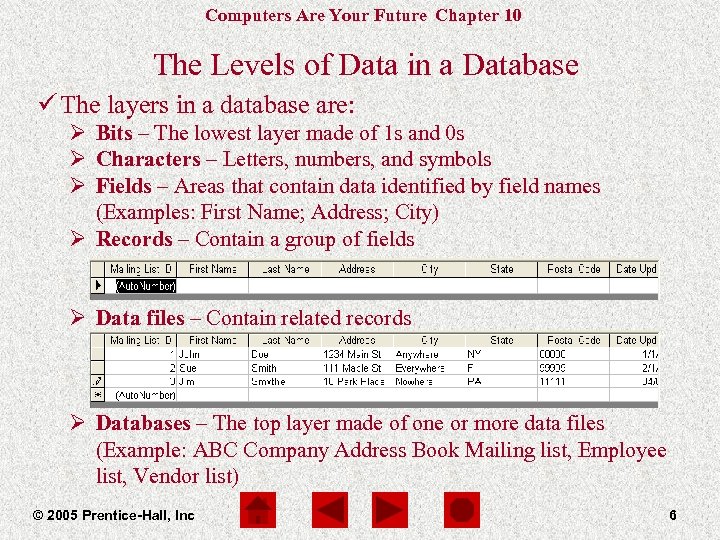 Computers Are Your Future Chapter 10 The Levels of Data in a Database ü The layers in a database are: Ø Bits – The lowest layer made of 1 s and 0 s Ø Characters – Letters, numbers, and symbols Ø Fields – Areas that contain data identified by field names (Examples: First Name; Address; City) Ø Records – Contain a group of fields Ø Data files – Contain related records Ø Databases – The top layer made of one or more data files (Example: ABC Company Address Book Mailing list, Employee list, Vendor list) © 2005 Prentice-Hall, Inc 6
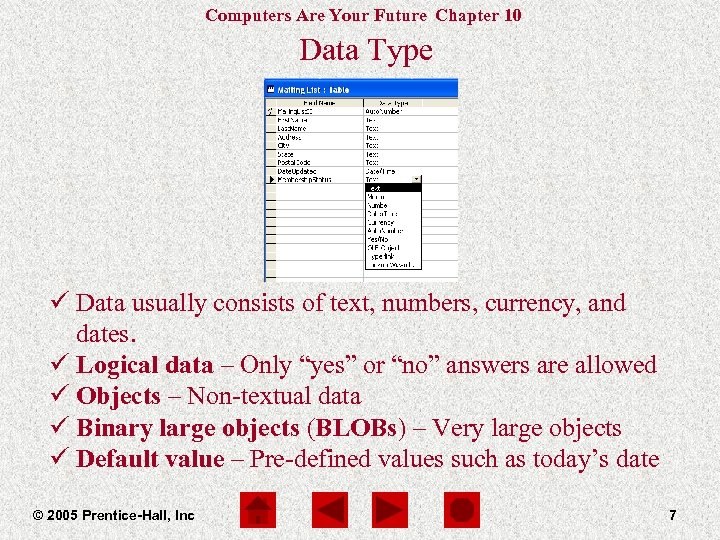 Computers Are Your Future Chapter 10 Data Type ü Data usually consists of text, numbers, currency, and dates. ü Logical data – Only “yes” or “no” answers are allowed ü Objects – Non-textual data ü Binary large objects (BLOBs) – Very large objects ü Default value – Pre-defined values such as today’s date © 2005 Prentice-Hall, Inc 7
 Computers Are Your Future Chapter 10 Types of Database Programs ü File Management Programs: Ø Create flat files containing one file or table Ø Files can not be linked to other files Ø Are easy to use and customize Ø Are not as complex as database management systems ü Database Management Systems (DBMS): Ø Contain multiple files or tables Ø Are programs that enable data to be stored, modified, and extracted from a database Ø Are more difficult to learn than file management systems © 2005 Prentice-Hall, Inc 8
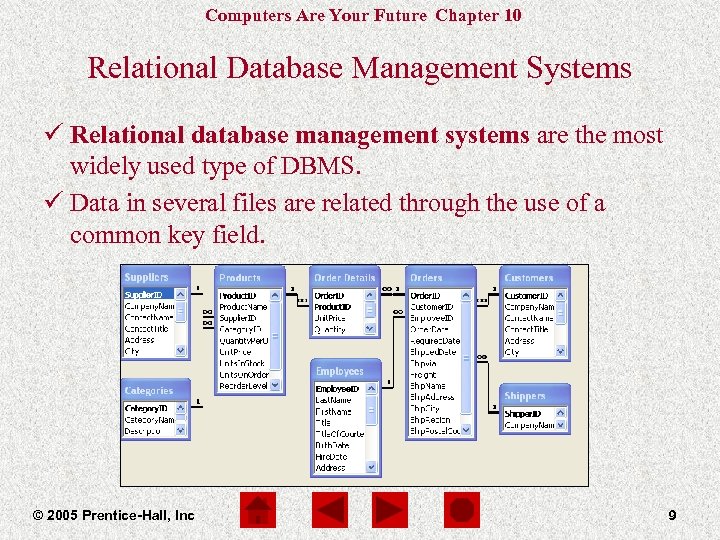 Computers Are Your Future Chapter 10 Relational Database Management Systems ü Relational database management systems are the most widely used type of DBMS. ü Data in several files are related through the use of a common key field. © 2005 Prentice-Hall, Inc 9
 Computers Are Your Future Chapter 10 Data Warehousing and Data Mining ü Data Warehousing: Ø Supplements DBMSs by bringing together all data into one huge database Ø Organizes management’s decision-making process Ø Uses a technique called drill-down to view performance data of the entire company ü Data marts support one division of an organization rather than an entire firm. ü Data Mining: Ø Is a data exploration technique Ø Is used to find unknown patterns of data © 2005 Prentice-Hall, Inc 10
 Computers Are Your Future Chapter 10 Client/Server Database Systems ü Data server – Professionally administered program that runs on a local area network (LAN). It responds to requests for data. ü Client – A user-friendly program that accesses the server. Users can add data, maintain records, perform queries, and generate reports. ØClients request data using a query language called Structured Query Language (SQL). © 2005 Prentice-Hall, Inc 11
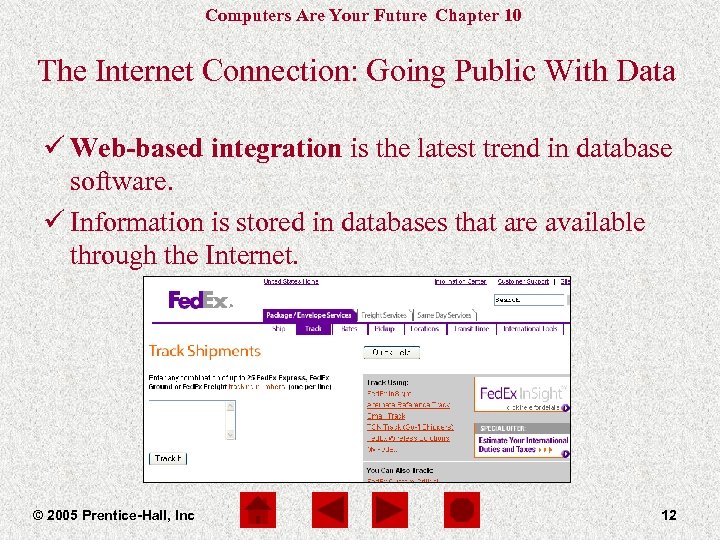 Computers Are Your Future Chapter 10 The Internet Connection: Going Public With Data ü Web-based integration is the latest trend in database software. ü Information is stored in databases that are available through the Internet. © 2005 Prentice-Hall, Inc 12
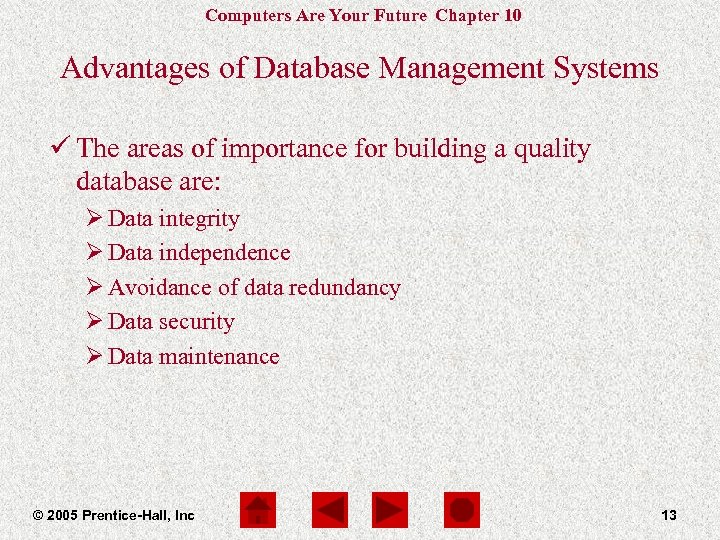 Computers Are Your Future Chapter 10 Advantages of Database Management Systems ü The areas of importance for building a quality database are: § Data integrity security isdatahow Data independence validity of the §§§Data is the refers to refers Data maintenance Avoidance of the Ø Data integrity data. is stored soprocedures be to data unavailability can forused to the that it of data to redundancy refers § Data different typesthe application it. with validation whoof repetition of people defines acceptable adding, updating, and avoiding would misuse Ø Data independence input § Data is also protected from programs. data. records. deleting Ø Avoidance of data redundancy ranges for each field. § Types of loss due to equipment data validation are: Ø Data security v Alphabetic check failure. v Numeric check Ø Data maintenance v Range check v Consistency check v Completeness check © 2005 Prentice-Hall, Inc 13
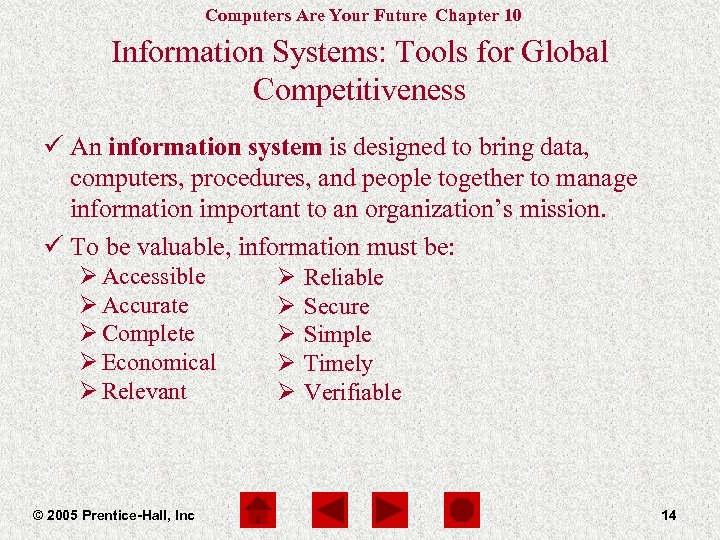 Computers Are Your Future Chapter 10 Information Systems: Tools for Global Competitiveness ü An information system is designed to bring data, computers, procedures, and people together to manage information important to an organization’s mission. ü To be valuable, information must be: Ø Accessible Ø Accurate Ø Complete Ø Economical Ø Relevant © 2005 Prentice-Hall, Inc Ø Ø Ø Reliable Secure Simple Timely Verifiable 14
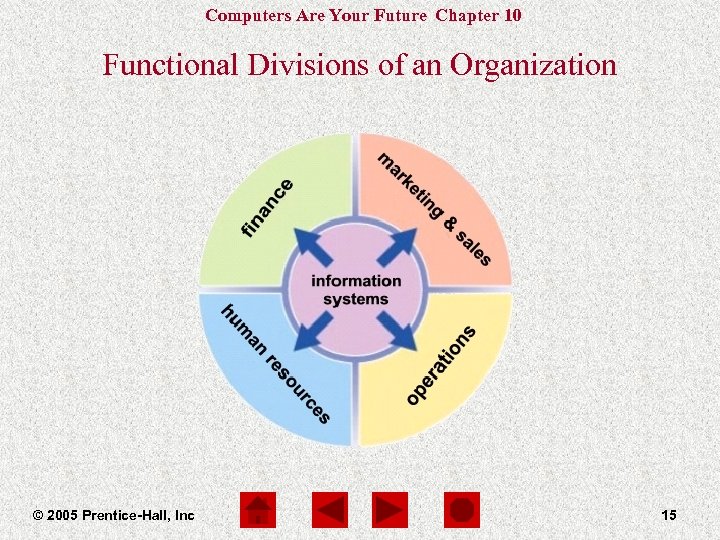 Computers Are Your Future Chapter 10 Functional Divisions of an Organization © 2005 Prentice-Hall, Inc 15
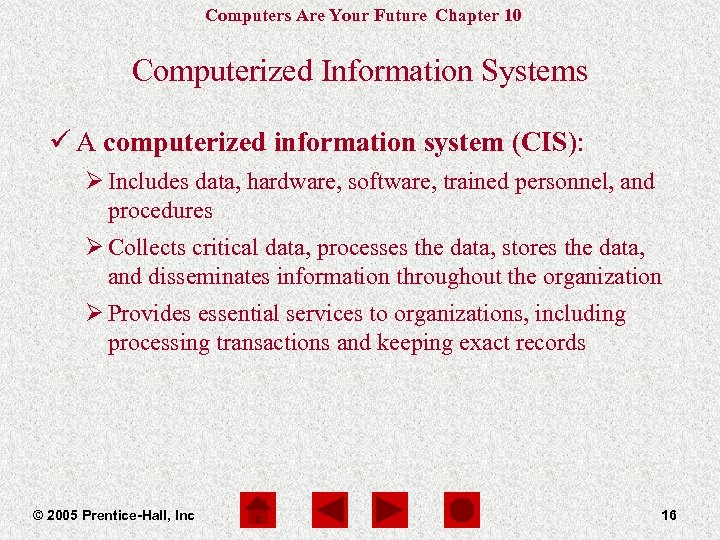 Computers Are Your Future Chapter 10 Computerized Information Systems ü A computerized information system (CIS): Ø Includes data, hardware, software, trained personnel, and procedures Ø Collects critical data, processes the data, stores the data, and disseminates information throughout the organization Ø Provides essential services to organizations, including processing transactions and keeping exact records © 2005 Prentice-Hall, Inc 16
 Computers Are Your Future Chapter 10 Techniques of Information Reduction ü Controlling information is important to keep people from being overwhelmed by it. ü Control methods in an information system include: Ø Routing information Ø Summarizing information Ø Enabling selectivity Ø Eliminating unnecessary information © 2005 Prentice-Hall, Inc 17
 Computers Are Your Future Chapter 10 Transaction Processing Systems (TPSs) ü TPSs handle an organization’s accounting needs. ü Early TPSs used batch processing systems. ü Online processing consists of entering transaction data and viewing the results immediately. ü TPSs enable managers to make operational decisions. ü TPSs can produce summary and exception reports. © 2005 Prentice-Hall, Inc 18
 Computers Are Your Future Chapter 10 Management Information Systems (MISs) ü MISs are computer-based systems that support the information needs of different levels of management. ü MISs help management make informed tactical decisions. ü MISs work with transaction processing systems. ü MISs inform managers if their goals are being met. ü Drawbacks of MISs: Ø Reports may contain unwanted information Ø Information may not be available when needed Ø Reams of printouts © 2005 Prentice-Hall, Inc 19
 Computers Are Your Future Chapter 10 Decision Support Systems (DSSs) ü DSSs enable managers to ask questions that can’t be answered by MIS reports. ü Online Analytical Processing (OLAP) enables managers to import up-to-the-minute reports from transaction databases. © 2005 Prentice-Hall, Inc 20
 Computers Are Your Future Chapter 10 Executive Information Systems (EISs) ü EISs are also known as executive support systems (ESSs). ü EISs support strategic decisions made by top level management that will affect the entire company. ü EISs filter critical information so that trends are apparent. © 2005 Prentice-Hall, Inc 21
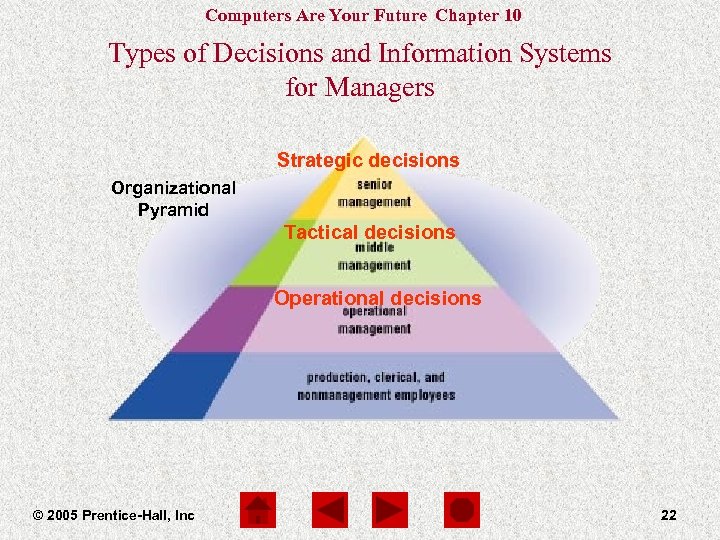 Computers Are Your Future Chapter 10 Types of Decisions and Information Systems for Managers Strategic decisions Organizational Pyramid Tactical decisions Operational decisions © 2005 Prentice-Hall, Inc 22
 Computers Are Your Future Chapter 10 Knowledge Management Systems ü Knowledge management systems are used to capture knowledge created by employees and make it available when needed. © 2005 Prentice-Hall, Inc 23
 Computers Are Your Future Chapter 10 Expert Systems ü Expert systems are systems that deal with expert knowledge in a particular area. ü Expert systems: Ø Help in making decisions Ø Use artificial intelligence principles Ø Provide technical support for customers © 2005 Prentice-Hall, Inc 24
 Computers Are Your Future Chapter 10 Computers and Databases in the Retail Sector ü Computers and databases are used for the checkout process and strategic purposes. ü At the checkout counter: ØPoint of sale terminals are replacing the cash register. ØOptical scanners read the universal product code (UPC) label that identifies items, their costs, and any sale prices. ØCredit card authorization terminals are used to process credit card transactions by placing a call to a call center which provides authorization numbers. © 2005 Prentice-Hall, Inc 25
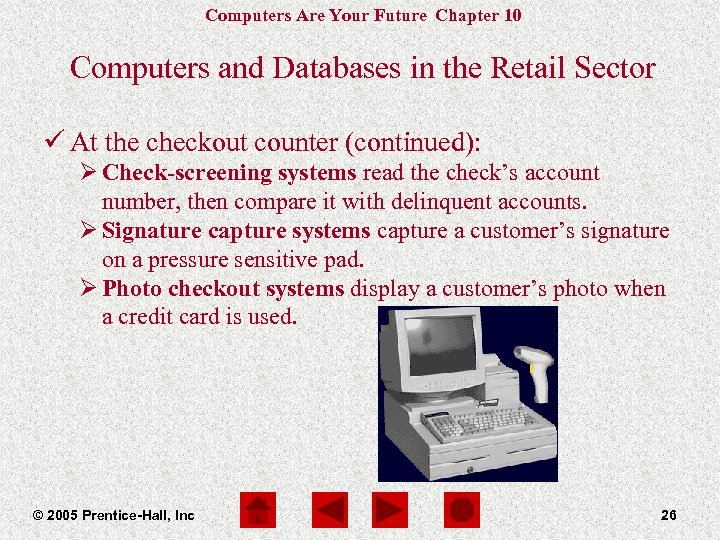 Computers Are Your Future Chapter 10 Computers and Databases in the Retail Sector ü At the checkout counter (continued): Ø Check-screening systems read the check’s account number, then compare it with delinquent accounts. Ø Signature capture systems capture a customer’s signature on a pressure sensitive pad. Ø Photo checkout systems display a customer’s photo when a credit card is used. © 2005 Prentice-Hall, Inc 26
 Computers Are Your Future Chapter 10 Summary • • • Database software transforms data into information. Information is data that is organized to be meaningful and useful. A database file is made of: Characters Fields Records File management programs work with one database file. DBMSs can work with two or more database files at a time. A good database system contains: Data integrity Data independence Data redundancy avoidance measures Data security Data maintenance procedures © 2005 Prentice-Hall, Inc 27
 Computers Are Your Future Chapter 10 Summary continued • A computer information system provides essential services to an organization. • Information systems include: Transaction processing systems (TPS) Management information systems (MIS) Decision support systems (DSS) Executive information systems (EIS) Knowledge management systems (KMS) Expert systems (ES) • Computers and databases provide an indispensable resource for the retail sector. © 2005 Prentice-Hall, Inc 28