


 Скачать презентацию Computers and the Law Legal Environment Randy Canis
6e5f548a7e54c7508e5ca7e788356ccb.ppt
- Количество слайдов: 116
 Computers and the Law Legal Environment Randy Canis CLASS 5 Trademarks and Trade Dress; Database Protection 1
 Trademarks and Trade Dress • What is a trademark? • What is trade dress? • How are trademarks and trade dress applied to technology? 2
 Practice of Trademark Law • Your boss tells you that your company plans to adopt a mark for its product. What should you advise your boss to do before announcing the mark and/or launching the product? 3
 Preliminary Questions to Address • Are we adopting a mark or a trade name? • What type of mark will be used for the product/service? • What type of device will be used for the trademark? 4
 What is a Trademark? • A trademark is any word, name, symbol, or device, or any combination thereof used to identify and distinguish his or her goods from those manufactured or sold by others and to indicate the source of the goods. • See 15 U. S. C. § 1127 5
 What is the Purpose of a Trademark? a) trademarks reduce consumer search costs and contribute to transactional efficiency in the marketplace; b) trademarks make companies accountable for their products; c) trademarks provide an incentive to produce high-quality products; d) trademarks promote competition by allowing consumers to differentiate among products on the basis of source; e) trademarks protect the investment and goodwill of the trademark owner; f) trademarks promote fair dealing and commercial honesty in the marketing and sale of products; and g) in the case of prestigious trademarks, they can be used to reflect the wealth, status and taste of the purchaser. From PLI Understanding Trademark Law 2009 (materials by Jeffery A. Handelman) 6
 Other Types of Marks • Service mark – “to identify and distinguish the services of one person … from the services of others and to indicate the source of the services” • Certification Mark – “to certify regional or other origin, material, mode of manufacture, quality, accuracy, or other characteristics of such person's goods or services or that the work or labor on the goods or services was performed by members of a union or other organization. ” • Collective Mark - indicates membership in a union, an association, or other organization. 7
 Origins of Trademark Law • Common Law – Deceit – “A fraudulent and deceptive misrepresentation, artifice, or device, used by one or more persons to device and trick another, who is ignorant of the true facts, to the prejudice and damage of the party imposed on. ” • Unfair Competition – Passing Off – when P can prove that D had used P’s mark to deceive consumers into thinking that P was the source of D’s goods. 8
 Trade Names Distinguished • A trade name (or commercial name) is any name used by a person to identify his or her business or vocation. • Contrasting examples: – Microsoft v. Microsoft Corporation – Yahoo v. Yahoo! Inc. – Adobe v. Adobe Systems Incorporated 9
 Devices for Trademarks • Words – MICROSOFT for computer software • Symbol – Nike SWOOSH • Device – Mc. Donalds GOLDEN ARCHES, Levis Pocket • Sound – Michael Buffer LET’S GET READY TO RUMBLE, NBC THREE CHIMES 10
 Additional Questions • Where geographically will the mark be used? • When will use of the mark commence? • Should federal registration be sought? 11
 State and Common Law Trademarks • State Trademarks – – – • For intrastate sale of goods and services Usually less expensive than federal registration On a state by state basis Common Law Trademarks – Requirements i. Adoption ii. Affixation iii. Use 12
 Symbols • • ® - Federally registered Circle T - State registered TM - trademark at common law SM – service mark at common law 13
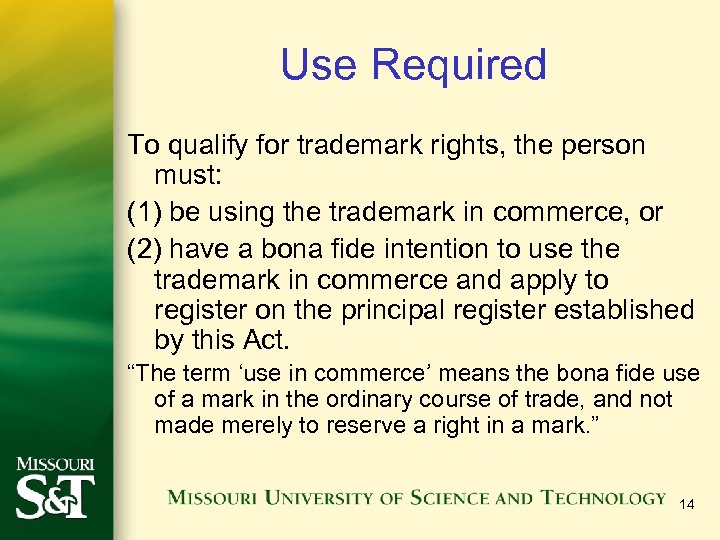 Use Required To qualify for trademark rights, the person must: (1) be using the trademark in commerce, or (2) have a bona fide intention to use the trademark in commerce and apply to register on the principal register established by this Act. “The term ‘use in commerce’ means the bona fide use of a mark in the ordinary course of trade, and not made merely to reserve a right in a mark. ” 14
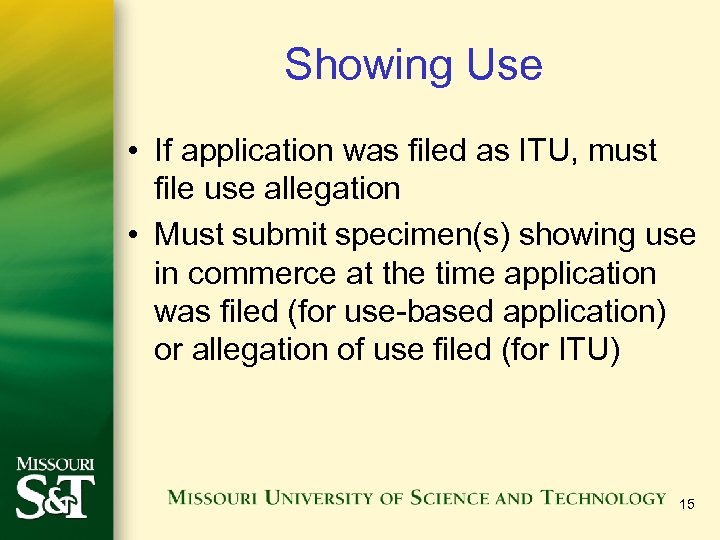 Showing Use • If application was filed as ITU, must file use allegation • Must submit specimen(s) showing use in commerce at the time application was filed (for use-based application) or allegation of use filed (for ITU) 15
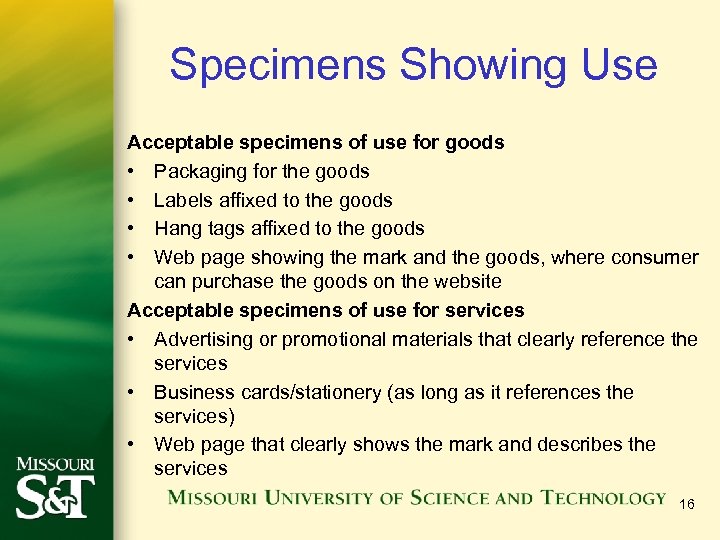 Specimens Showing Use Acceptable specimens of use for goods • Packaging for the goods • Labels affixed to the goods • Hang tags affixed to the goods • Web page showing the mark and the goods, where consumer can purchase the goods on the website Acceptable specimens of use for services • Advertising or promotional materials that clearly reference the services • Business cards/stationery (as long as it references the services) • Web page that clearly shows the mark and describes the services 16
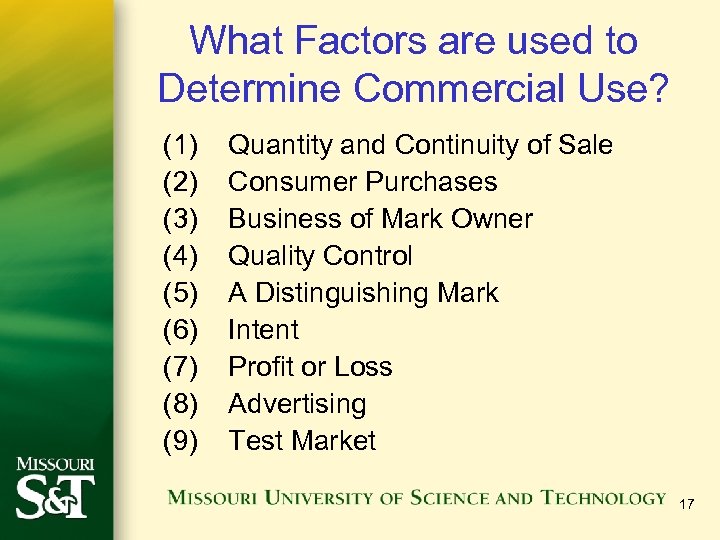 What Factors are used to Determine Commercial Use? (1) Quantity and Continuity of Sale (2) Consumer Purchases (3) Business of Mark Owner (4) Quality Control (5) A Distinguishing Mark (6) Intent (7) Profit or Loss (8) Advertising (9) Test Market 17
 Types of Searches • Knock-out – exact mark • Preliminary – identical and confusingly similar federal and state trademarks • Comprehensive – preliminary plus common law and the Internet 18
 Be v. Be • • “bebe stores, inc. (Nasdaq: BEBE) announced that a federal appeals court panel this week rejected May Department Stores Company's appeal to lift a preliminary injunction that would bar it from using the name "be" on a clothing line for young women. In the published ruling, the panel said it had found that bebe had presented enough evidence during the preliminary hearing to support its claim that the St. Louis retailer was attempting to confuse customers and compete unfairly. Since the panel found no error on the part of the lower court's ruling, it affirmed the injunction. ” Source: http: //www. allbusiness. com/legal/trial-procedure-appellatedecisions/5974796 -1. html#ixzz 1 l. Wh 2 C 8 W 0 Also see https: //ecf. moed. uscourts. gov/documents/opinions/BEBE_STORES _INC_V_THE_MAY_DEPARTMENT_STORES_INTERNATIONAL_I NC_DBA_MAY_DEPARTMENT_STORES_COMPANY-CDP 54. PDF 19
 Federal Trademark Registration Steps • Search (and opinion) • Application (use-based or intent-touse) • Prosecution • Registration 20
 Additional Questions • Is the mark a surname? • Is the mark prohibited? 21
 Surnames • Ordinarily, a person can use his/her own surname as a mark. • However, a person cannot use his/her own surname if a prior comer's surname is in the same product area and if the purpose is to drain off good will. • The second comer can use the same or similar surname if he/she wishes to use or develop his/her own expertise and good will. • In so doing, he/she must avoid confusing by disclaiming a connection with the prior comer's business, or distinguishing his/her mark. • A surname mark can be registered only after it acquires secondary meaning. 22
 Prohibited Trademarks Marks that consist or comprise of the following are prohibited: – immoral, deceptive, or scandalous matter; – matter which may disparage or falsely suggest a connection with persons, living or dead, institutions, beliefs, or national symbols, or bring them into contempt, or disrepute; – a geographical indication which, when used on or in connection with wines or spirits, identifies a place other than the origin of the goods … – flag or coat of arms or other insignia of the United States, or of any State or municipality, or of any foreign nation, or any simulation thereof. – a name, portrait, or signature identifying a particular living individual except by his written consent, or the name, signature, or portrait of a deceased President of the United States during the life of his widow, if any, except by the written consent of the widow. See 15 U. S. C. § 1052 23
 Trademark Strength • How strong will the selected mark be? 24
 Protection is based on Strength of Mark • The protection afforded a trademark depends on the strength or weakness of a mark. The stronger a trademark, the greater the protection afforded. … • The strength of the mark analysis focuses on the "distinctiveness of the mark, or more precisely, its tendency to identify the goods sold under the mark as emanating from a particular, although possibly anonymous, source. " … • A mark's strength is measured by two factors: "(1) the degree to which it is inherently distinctive; and (2) the degree to which it is distinctive in the marketplace. " Id. • See Blockbuster Entertainment Group, Div. of Viacom, Inc. v. Laylco, Inc. , 869 F. Supp. 505, 509 (E. D. Mich. 1994) 25
 Distinctiveness • • • Classifications of trademarks are based upon the inherent distinctiveness of the mark Classifications include 1) generic; 2) descriptive; 3) suggestive; and 4) arbitrary or fanciful. Fanciful or arbitrary marks are eligible for protection without proof of secondary meaning and with ease of establishing infringement. 26
 Generic Marks • A generic mark is generally a common description of goods or for a class of goods • A generic mark is ineligible for trademark protection. • Examples – Milk for a particular drink that comes from a cow – Chocolate for a particular kind of dessert – Newspaper for a particular type of reading material 27
 What Does It Mean for a Trademark to Be Generic? • • • The defendants' mark registration specifies that the "Rams" name is to be used for "entertainment services--namely, professional football exhibitions. " Thus, the product denoted by the "Rams" registration is a professional football team, and the record is devoid of any evidence demonstrating that any other professional football team is known as the "Rams, " with the exception of the now extinct "Los Angeles Rams" franchise. The plaintiff has also failed to adduce any evidence that the "Rams" mark has become a common term for professional football teams generally. See Henri's Food Prods. Co. v. Tasty Snacks, Inc. , 817 F. 2 d 1303, 1305 (7 th Cir. 1987). Contrary to the plaintiff's claim, use of the "Rams" mark by one, or even several, college athletic teams does not establish a genuine issue as to the mark having become generic as it is defined by the statute because none of the collegiate parties using the mark produces the same product: a professional football team. Furthermore, the record fails to demonstrate that "Rams" is the common linguistic term for a professional football team. See Gimix, 699 F. 2 d at 905. See Johnny Blastoff, Inc. v. Los Angeles Rams Football Co. , 188 F. 3 d 427, 438 (7 th Cir. 1999) 28
 Generic Nature of Marks • “When defendants obtained their trademark, they did no CDROM business. The term ‘CDs’ (not ‘CDS’) is generic, and a holder of a trademark must be denied protection if the mark becomes generic and is an expression that does not relate exclusively to a trademark owner's property. … • “The court concludes that defendants cannot now expand their trademark rights to generic descriptions existing in our everyday language. Whereas "CDS" are initials of defendants' companies, defendants' registration of the trademark in 1988 described a business pertaining to "desktop publishing and printing. " Defendants now seek to expand the scope of this mark's protection to preclude the use of "CDs" in reference to compact disc products and services, and this renders the mark invalid as being generic. Accordingly, plaintiff's motion for summary judgment is granted. ” • CD Solutions v. Tooker, 15 F. Supp. 2 d 986 (D. C. OR 1998) 29
 Descriptive Marks • A descriptive mark describes a product's features, qualities, or ingredients in ordinary language, • A descriptive mark may be protected only if secondary meaning is established. • Examples – – – Sudsy for soap Big chips for cookies Featherlite for gloves American Airlines for airplane travel services Quick Key for a keyboard 30
 Suggestive Marks • A suggestive mark employs terms which do not describe but merely suggest the features of the product, requiring the purchaser to use imagination, thought, and perception to reach a conclusion as to the nature of the goods. • Examples – Coppertone for suntan lotion – Blockbuster for movie rental services – Sandals for resort services 31
 Fanciful Marks • "Fanciful marks consist of coined words that have been invented or selected for the sole purpose of functioning as a trademark. ” King of the Mt. Sports, Inc. v. Chrysler Corp. , 185 F. 3 d 1084, 1093 (10 th Cir. 1999) 32
 Arbitrary Marks • “Arbitrary marks comprise those words, symbols, pictures, etc. , that are in common linguistic use but which, when used with the goods or services in issue, neither suggest nor describe any ingredient, quality or characteristic of those goods or services. ” King of the Mt. Sports, Inc. v. Chrysler Corp. , 185 F. 3 d 1084, 1093 (10 th Cir. 1999) 33
 Secondary Meaning • A mark also may be considered strong if it has acquired a strong secondary meaning. • "To establish secondary meaning, a manufacturer must show that, in the minds of the public, the primary significance of a product feature or term is to identify the source of the product rather than the product itself. " Inwood Laboratories, Inc. v. Ives Laboratories, Inc. , 456 U. S. 844, 851, 102 S. Ct. 2182, 2187, 72 L. Ed. 2 d 606 (1982). 34
 Secondary Meaning Factors • The common factors tending to show secondary meaning are (1) advertising expenditures; (2) consumer studies linking the name to a source; (3) sales success; (4) unsolicited media coverage; (5) attempts to plagiarize the mark; and (6) the length and exclusivity of the mark's use. … • See Blockbuster Entertainment Group, Div. of Viacom, Inc. v. Laylco, Inc. , 869 F. Supp. 505, 510 (E. D. Mich. 1994) • See also http: //www. bitlaw. com/source/tmep/1212_0 6. html 35
 Who has Protectable Rights in a Trademark? • • • The determination of whether a party has established protectable rights in a trademark is made on a case by case basis, considering the totality of the circumstances. See New West Corp. v. NYM Co. of Cal. , Inc. , 595 F. 2 d 1194, 1200 (9 th Cir. 1979). A party may acquire a protectable right in a trademark only through use of the mark in connection with its product. See Zaz Designs v. L'Oreal, S. A. , 979 F. 2 d 499, 503 (7 th Cir. 1992). The party seeking to establish appropriation of a trademark must show first, adoption, and second, "use in a way sufficiently public to identify or distinguish the marked goods in an appropriate segment of the public mind as those of [the adopter of the mark]. " New West, 595 F. 2 d at 1200. The party who first appropriates the mark through use, and for whom the mark serves as a designation of source, acquires superior rights to it. See Zaz, 979 F. 2 d at 503 -04. Evidence of actual sales is not necessary to establish ownership. See New West, 595 F. 2 d at 1200. See Johnny Blastoff, Inc. v. Los Angeles Rams Football Co. , 188 F. 3 d 427, 433 (7 th Cir. 1999) 36
 Who has Protectable Rights in a Trademark? • • Furthermore, current case law in the area of franchise relocation and expansion has created a strong presumption of franchise owner priority in their marks. In Indianapolis Colts, Inc. v. Metropolitan Baltimore Football Club Ltd. , 34 F. 3 d 410, 413 (7 th Cir. 1994), this Court held that the "Indianapolis Colts" mark may be viewed simply as "Colts, " independent of urban affiliation. While courts consistently define "use" as the public sale of a product, in some circumstances parties have been found to possess rights in an alteration of an existing mark that was used solely by third parties to designate its product. See Coca-Cola Co. v. Busch, 44 F. Supp. 405, 409 -10 (D. Pa. 1942) ("Coke" protectable trademark for "Coca. Cola"). In addition, advertising and promotion surrounding the development of sports facilities have been found to establish rights in the mark. See Maryland Stadium Authority v. Becker, 806 F. Supp. 1236 (D. Md. 1992). See Johnny Blastoff, Inc. v. Los Angeles Rams Football Co. , 188 F. 3 d 427, 433 (7 th Cir. 1999) 37
 Benefits of Trademark Protection • A certificate of registration on the principal register provides – prima facie evidence of the validity of the registered mark and of the registration of the mark, – prima facie evidence of the registrant’s ownership of the mark, and – prima facie evidence of the registrant’s exclusive right to use the registered mark in commerce on or in connection with the goods or services specified in the certificate. • 15 U. S. C. 1057(b) 38
 Loss of Rights • How can I lose the rights associated with my trademark? 39
 Abandonment • Under the Lanham Act, a mark will be deemed abandoned when its use is discontinued with an intent not to resume use. 15 U. S. C. § 1127. When not explicitly stated, the intent not to resume use can be inferred from the circumstances of the case. Specifically, three consecutive years of nonuse serves as prima facie evidence of abandonment. 15 U. S. C. § 1127. The statutory language clarifies that "'use' of a mark means the bona fide use of such mark made in the ordinary course of trade, and not made merely to reserve a right in a mark. " … • Cent. Mfg. Co. v. Brett, 2005 U. S. Dist. LEXIS 23379 (N. D. IL 2005) 40
 How Do You Avoid Losing Your Trademark? • Employ usage "X brand [generic term]" on product and in advertising – Sony’s Walkman AM/FM portable radio/tape player • Capitalize trademark • Use trademark as adjective, never as noun • Use trademark notice marks (circled T or circled R) • Use same trademark on related products • Police improper usage in advertising and by outsiders • Establish an education program (through advertising) – Coca-Cola police! 41
 Incontestability • Can my mark become strong enough as to withstand some challenges? 42
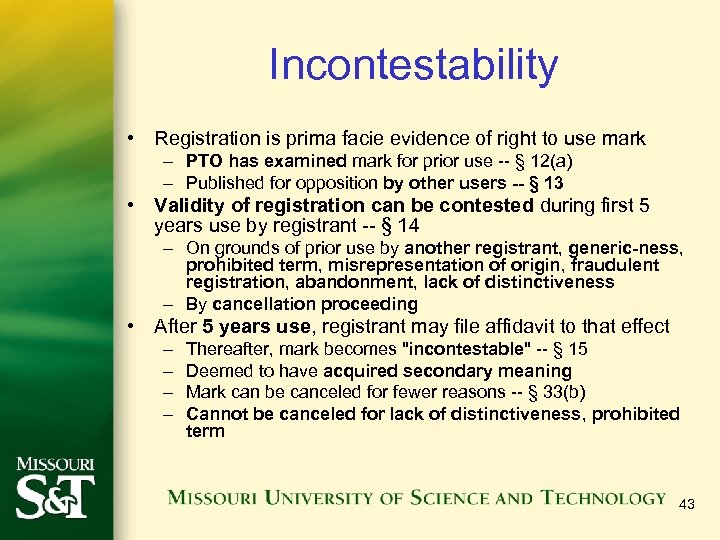 Incontestability • Registration is prima facie evidence of right to use mark – PTO has examined mark for prior use -- § 12(a) – Published for opposition by other users -- § 13 • Validity of registration can be contested during first 5 years use by registrant -- § 14 – On grounds of prior use by another registrant, generic-ness, prohibited term, misrepresentation of origin, fraudulent registration, abandonment, lack of distinctiveness – By cancellation proceeding • After 5 years use, registrant may file affidavit to that effect – – Thereafter, mark becomes "incontestable" -- § 15 Deemed to have acquired secondary meaning Mark can be canceled for fewer reasons -- § 33(b) Cannot be canceled for lack of distinctiveness, prohibited term 43
 What is the Value of Having a Mark Incontestable? • "[O]nce a mark has been registered for five years, the mark must be considered strong and worthy of full protection. " Wynn Oil I, 839 F. 2 d at 1187; 15 U. S. C. s 1065. Here, Blockbuster's trade marks "Blockbuster" and "Blockbuster Video, " have been registered since 1986, more than five years prior to the commencement of this action. Therefore, those marks are incontestible and Defendant cannot argue that the marks are merely descriptive and worthy of little protection. Park 'N Fly, Inc. v. Dollar Park and Fly, Inc. , 469 U. S. 189, 105 S. Ct. 658, 83 L. Ed. 2 d 582 (1985). • See Blockbuster Entertainment Group, Div. of Viacom, Inc. v. Laylco, Inc. , 869 F. Supp. 505, 509 (E. D. Mich. 1994) 44
 Rights of Others • What if someone is using the same or similar mark in a different geographic area? • How related must another’s products and/or services be to mine before it causes a problem? 45
 Concurrent Use • Concurrent use is when users have the same or similar marks on same or similar goods in separate geographic areas. • Each concurrent user is entitled to protection in its own separate market areas. • The senior user is entitled to protection in overlapping market areas. • But federal registration gives nationwide protection (subject to grandfathered pre-registration rights) including constructive notice of nationwide rights. 46
 Concurrent Use Causing Confusion? • When considering the area and manner of concurrent use factor, we have to assess whether "there is a relationship in use, promotion, distribution, or sales between the goods or services of the parties. " Forum Corp. of North America v. Forum, Ltd. , 903 F. 2 d 434, 442 (7 th Cir. 1990). • In determining whether the area and manner of concurrent use as between two marks is likely to cause confusion, the magistrate noted that several factors can be important: 1) the relative geographical distribution areas, see Rust Environment & Infrastructure, Inc. v. Teunissen, 131 F. 3 d 1210, 1217 (7 th Cir. 1997); 2) whethere exists evidence of direct competition between the products, see Smith Fiberglass Prods. , Inc. v. Ameron, Inc. , 7 F. 3 d 1327, 1330 (7 th Cir. 1993); 3) whether the products are sold to consumers in the same type of store, see Vitarroz Corp. v. Borden, Inc. , 644 F. 2 d 960, 967 (2 nd Cir. 1981); 4) whether the products are sold in the similar section of a particular store, see id. ; and 5) whether the product is sold through the same marketing channels, see Nike, Inc. v. "Just Did It" Enters. , 6 F. 3 d 1225, 1230 (7 th Cir. 1993). • See Ty, Inc. v. Jones Group, Inc. , 237 F. 3 d 891, 900 (7 th. Cir. 2000) 47
 Related Products – Trademarks • “The trademark registrant/user is entitled to the exclusive use of mark (i) for related products in areas where related products overlap, (ii) to avoid product origin confusion, (iii) to avoid dilution of senior mark's goodwill, and (iv) to permit natural expansion into related product lines. “In assessing whether products are similar, the question is "whether the products are the kind the public attributes to a single source. " … • See Ty, Inc. v. Jones Group, Inc. , 237 F. 3 d 891 (7 th. Cir. 2000) 48
 Related Products - Likelihood of Confusion • "To the extent goods (or trade names) serve the same purpose, fall within the same general class, or are used together, the use of similar designations is more likely to cause confusion. " … In this case, Blockbuster and Video Busters are in direct competition with each other in renting video cassettes to customers in metropolitan Detroit. Therefore, this factor weighs heavily toward a finding of confusion. • See Blockbuster Entertainment Group, Div. of Viacom, Inc. v. Laylco, Inc. , 869 F. Supp. 505, 511 (E. D. Mich. 1994) 49
 Trademark Infringement 50
![Scope of Protection • “[T]he rights of the owner of a registered trademark are](https://present5.com/presentation/6e5f548a7e54c7508e5ca7e788356ccb/image-51.jpg "Scope of Protection • “[T]he rights of the owner of a registered trademark are") Scope of Protection • “[T]he rights of the owner of a registered trademark are not limited to protection with respect to the specific goods stated on the certificate. . . but extend to any goods related in the minds of consumers in the sense that a single producer is likely to put out both goods. " … • Synergistic Int'l, LLC v. Korman, 2005 U. S. Dist. LEXIS 31370 (E. D. VA 2005) 51
Scope of Protection • “[T]he rights of the owner of a registered trademark are not limited to protection with respect to the specific goods stated on the certificate. . . but extend to any goods related in the minds of consumers in the sense that a single producer is likely to put out both goods. " … • Synergistic Int'l, LLC v. Korman, 2005 U. S. Dist. LEXIS 31370 (E. D. VA 2005) 51
 Infringement • In a trademark infringement action, "the plaintiff must demonstrate: (1) the validity of its trademark; and (2) the infringement of that mark. " … • Cent. Mfg. Co. v. Brett, 2005 U. S. Dist. LEXIS 23379 (N. D. IL 2005) 52
 Infringement under the Lanham Act • To show infringement, Plaintiffs must show that they (1) registered a trademark; (2) which Defendants used in commerce without Plaintiffs' consent; and (3) which created a likelihood of confusion as a result. • S Indus. , Inc. v. GMI Holdings, Inc. , 1998 U. S. Dist. LEXIS 1780, 1998 WL 67627, *3 (N. D. Ill. Jan. 30, 1998). 53
 Causing Confusion • “The Lanham Act prohibits the use of a mark in connection with goods or services in a manner that is likely to cause confusion as to the source or sponsorship of the goods or services. 15 U. S. C. § 1125(a)(1). ” … • “[T]he 'core element' of trademark infringement law is 'whether an alleged trademark infringer's use of a mark creates a likelihood that the consuming public will be confused as to who makes what product. '" Brother Records, Inc. v. Jardine, 318 F. 3 d 900, 908 (9 th Cir. 2003) (quoting Thane Int'l, Inc. v. Trek Bicycle Corp, 305 F. 3 d 894, 901 (9 th Cir. 2002)). • Davis v. Walt Disney Co. , 2005 U. S. App. LEXIS 26461 (8 th Cir. 2005) 54
 What are the Factors for Trademark Infringement? • In analyzing whether Defendants have infringed a trademark such as "Blockbuster Video, " the Sixth Circuit looks to eight factors under the Lanham Act: (1) the strength of the plaintiff's mark; (2) the relatedness of the goods; (3) the similarity of the marks; (4) evidence of actual confusion; (5) marketing channels used; (6) the likely degree of purchaser care; (7) the defendants' intent on selecting the its mark; and (8) the likelihood of expansion of the product lines. Frisch's Restaurants, Inc. v. Elby's Big Boy of Steubenville, Inc. , 670 F. 2 d 642 (6 th Cir. ), cert. denied, 459 U. S. 916, 103 S. Ct. 231, 74 L. Ed. 2 d 182 (1982). • See Blockbuster Entertainment Group, Div. of Viacom, Inc. v. Laylco, Inc. , 869 F. Supp. 505, 509 (E. D. Mich. 1994) 55
 What is the Principal of Likelihood of Confusion? • "The general concept underlying the likelihood of confusion [test] is that the public believe that the mark's owner sponsored or otherwise approved the use of the trademark. " … Therefore, the court must examine the eight factors identified in Elby's Big Boy. • See Blockbuster Entertainment Group, Div. of Viacom, Inc. v. Laylco, Inc. , 869 F. Supp. 505, 509 (E. D. Mich. 1994) 56
 Factors for Likelihood of Confusion • • • In Squirt. Co v. Seven-Up Co. , 628 F. 2 d 1086, 1091 (8 th Cir. 1990), we articulated the factors to be considered in evaluating a likelihood of confusion. These can be enumerated as: 1) the strength of the plaintiff's mark; 2) the similarity between the plaintiff's and defendant's marks; 3) the degree to which the allegedly infringing product competes with the plaintiff's goods; 4) the alleged infringer's intent to confuse the public; 5) the degree of care reasonably expected of potential customers, and 6) evidence of actual confusion. "We use [these factors] as a guide to determine whether a reasonable jury could find a likelihood of confusion. Factual disputes regarding a single factor are insufficient to support the reversal of summary judgment unless they tilt the entire balance in favor of such a finding. " Duluth News-Tribune v. Mesabi Publ'g Co. , 84 F. 3 d 1093, 1096 (8 th Cir. 1996). Davis v. Walt Disney Co. , 2005 U. S. App. LEXIS 26461 (8 th Cir. 2005) 57
 Must All of the Trademark Infringement Factors Be Present? • These factors "are simply a guide to help determine whether confusion would be likely to result from simultaneous use of. . . two contested marks. They imply no mathematical precision, and a plaintiff need not show that all, or even most, of the factors listed are present in any particular case to be successful. " Wynn Oil Co. v. Thomas ("Wynn Oil I"), 839 F. 2 d 1183, 1186 (6 th Cir. 1988). • See Blockbuster Entertainment Group, Div. of Viacom, Inc. v. Laylco, Inc. , 869 F. Supp. 505, 509 (E. D. Mich. 1994) 58
 Similarity of the Marks • The single most important factor in determining likelihood of confusion is mark similarity. " … Marks "are confusingly similar if ordinary consumers would likely conclude that [the two products] share a common source, affiliation, connection or sponsorship. " …The proper test is "not side-by-side comparison" but "whether the labels create the 'same overall impression' when viewed separately. " … Courts should "compare the appearance, sound, and meaning of the marks" in assessing their similarity. … • M. D. On-Line, Inc. v. Web. MD Corp. , 2005 U. S. Dist. LEXIS 23563 (D. C. NJ 2005) 59
 Sight, Sound and Meaning • “The court examines the degree of similarity between the marks on three levels: sight, sound, and meaning. King of the Mountain Sports, 185 F. 3 d at 1090. These factors must be evaluated "in the context of the marks as a whole as they are encountered by consumers in the marketplace. " Id. at 1090 (quotation omitted). The court does not engage in a side-by-side comparison of the two marks, but rather must determine whether the allegedly infringing mark is confusing to the public when singly presented. Id. Similarities of the marks are given more weight than differences. Id. ” • Big Dog Motorcycles, L. L. C. v. Big Dog Holdings, Inc. , 2005 U. S. Dist. LEXIS 31059 (D. C. KS 2005) 60
 What Remedies are Available for Trademark Infringement? • • Injunction against future infringement Net profits, damages, court costs No punitive damages or attorney’s fees Burden on defendant to prove production expenses Destruction of infringing articles Cancellation of registration of infringing mark Import ban against infringing articles 61
 Injunctive Relief • “Pursuant to 15 U. S. C. § 1116, a court may grant injunctive relief to prevent a violation of 15 U. S. C. § 1114 or § 1125. Because an injunction prevents future confusion, by enjoining the infringer from use of the similar mark, ‘an injunction is the preferred remedy’ in cases where likelihood of confusion has been found. ” … • Synergistic Int'l, LLC v. Korman, 2005 U. S. Dist. LEXIS 31370 (E. D. VA 2005) 62
 Dilution • “Dilution is defined as the lessening of the capacity of a famous mark to identify and distinguish goods or services. In order to prevail on a claim under the Federal Trademark Dilution Act ("FTDA"), the plaintiff must prove that: (1) the mark is famous and distinctive; (2) the infringer adopted the mark after the mark had become famous and distinctive; and (3) the infringer caused dilution of the mark. ” Kinetic Concepts, Inc. v. Bluesky Med. Group, Inc. , 2005 U. S. Dist. LEXIS 32353 (W. D. TX 2005) 63
 How May Third Parties Use Trademarks? • Proper identification of goods or services to which mark is associated • Comparison advertisements allowed, or • Noncommercial parody or satire is allowed – Absent disparagement of product or service quality, and – Absent likelihood of confusion • Repair, reconstruction, repackaging, secondhand sales allowed – Provided there is no change in product or service quality 64
 Nominative Fair Use • "Nominative" fair use is said to occur "when the alleged infringer uses the [trademark holder's] product, even if the alleged infringer's ultimate goal is to describe his own product. Nominative fair use also occurs if the only practical way to refer to something is to use the trademarked term. " … By contrast, "classic" fair use occurs where the defendant uses the plaintiff's mark to describe the defendant's own product. … • Century 21 Real Estate Corp. v. Lendingtree, Inc. , 425 F. 3 d 211 (3 rd Cir. 2005) 65
 Tiffany v. e. Bay • Case Background • S. D. NY - Finding in favor of e. Bay – e. Bay did not commit trademark infringement, trademark dilution, or false advertising • Case Forward • Supreme Court denied cert 66
 Tiffany v. e. Bay • e. Bay – Platform/marketplace for selling goods – Sometimes used for fraud • Tiffany – High-end quality and style of jewelry • Basis of lawsuit – e. Bay marketplace was used to sell counterfeit Tiffany goods 67
 Tiffany v. e. Bay • How does e. Bay make its money? • How does Tiffany sell its goods? • What control does Tiffany have over the secondary market for its goods? 68
 Tiffany v. e. Bay • How did Tiffany learn of the extent that counterfeit goods were being sold on e. Bay? • How does e. Bay protect its buyers? • How does e. Bay monitor for counterfeit merchandise? 69
 Tiffany v. e. Bay • What is the Verified Rights Owner ('Ve. RO') Program and how does it work? • What else did e. Bay do to support lawful purchasing? • How did e. Bay advertise using Tiffany? 70
 Tiffany v. e. Bay • Causes of action – Direct trademark infringement – Contributory trademark infringement – Trademark dilution – False advertising 71
![Tiffany v. e. Bay • Direct trademark infringement – “[T]he owner of a mark](https://present5.com/presentation/6e5f548a7e54c7508e5ca7e788356ccb/image-72.jpg "Tiffany v. e. Bay • Direct trademark infringement – “[T]he owner of a mark") Tiffany v. e. Bay • Direct trademark infringement – “[T]he owner of a mark registered with the Patent and Trademark Office can bring a civil action against a person alleged to have used the mark without the owner's consent. ” – Test • Whether the mark is entitled to protection • Likelihood of confusion 72
Tiffany v. e. Bay • Direct trademark infringement – “[T]he owner of a mark registered with the Patent and Trademark Office can bring a civil action against a person alleged to have used the mark without the owner's consent. ” – Test • Whether the mark is entitled to protection • Likelihood of confusion 72
 Tiffany v. e. Bay • e. Bay Accused behavior – Using the mark on the e. Bay website – Purchase of sponsored links – Jointly and severally liable with counterfeiters 73
 Tiffany v. e. Bay • Nominative fair use • Permits "[a] defendant [to] use a plaintiff's trademark to identify the plaintiff's goods so long as there is no likelihood of confusion about the source of [the] defendant's product or the mark-holder's sponsorship or affiliation. " 74
 Tiffany v. e. Bay • Nominative Fair Use • To fall within the protection, … : "First, the product or service in question must be one not readily identifiable without use of the trademark; second, only so much of the mark or marks may be used as is reasonably necessary to identify the product or service; and third, the user must do nothing that would, in conjunction with the mark, suggest sponsorship or endorsement by the trademark holder. " 75
 Tiffany v. e. Bay • “We have recognized that a defendant may lawfully use a plaintiff's trademark where doing so is necessary to describe the plaintiff's product and does not imply a false affiliation or endorsement by the plaintiff of the defendant. ” • What did the court find with respect to e. Bay’s use of Tiffany mark? 76
 Tiffany v. e. Bay • Contributory Trademark Infringement • Inwood Supreme Court case – "if a manufacturer or distributor intentionally induces another to infringe a trademark, or if it continues to supply its product to one whom it knows or has reason to know is engaging in trademark infringement, the manufacturer or distributor is contributorially responsible for any harm done as a result of the deceit. “ • 9 th Cir. – contributory trademark infringement applies to a service provider if he or she exercises sufficient control over the infringing conduct. 77
![Tiffany v. e. Bay • “[For] service providers, there are two ways in which](https://present5.com/presentation/6e5f548a7e54c7508e5ca7e788356ccb/image-78.jpg "Tiffany v. e. Bay • “[For] service providers, there are two ways in which") Tiffany v. e. Bay • “[For] service providers, there are two ways in which a defendant may become contributorially liable for the infringing conduct of another: first, if the service provider ‘intentionally induces another to infringe a trademark, ’ and second, if the service provider ‘continues to supply its [service] to one whom it knows or has reason to know is engaging in trademark infringement. ’” 78
Tiffany v. e. Bay • “[For] service providers, there are two ways in which a defendant may become contributorially liable for the infringing conduct of another: first, if the service provider ‘intentionally induces another to infringe a trademark, ’ and second, if the service provider ‘continues to supply its [service] to one whom it knows or has reason to know is engaging in trademark infringement. ’” 78
 Tiffany v. e. Bay • What is the basis of Tiffany’s argument? – “e. Bay continued to supply its services to the sellers of counterfeit Tiffany goods while knowing or having reason to know that such sellers were infringing Tiffany's mark. ” • Why was this argument rejected at D. C. ? 79
 Tiffany v. e. Bay • What is the generalized knowledge of infringement and how does it apply to the test? • “For contributory trademark infringement liability to lie, a service provider must have more than a general knowledge or reason to know that its service is being used to sell counterfeit goods. Some contemporary knowledge of which particular listings are infringing or will infringe in the future is necessary. ” 80
 Tiffany v. e. Bay • Willful blindness – Not in this case – Market pressures – “[W]e agree with the district court that if e. Bay had reason to suspect that counterfeit Tiffany goods were being sold through its website, and intentionally shielded itself from discovering the offending listings or the identity of the sellers behind them, e. Bay might very well have been charged with knowledge of those sales sufficient to satisfy Inwood's "knows or has reason to know" prong. 81
 Tiffany v. e. Bay • Trademark Dilution • “Federal law allows the owner of a ‘famous mark’ to enjoin a person from using ‘a mark or trade name in commerce that is likely to cause dilution by blurring or dilution by tarnishment of the famous mark. ’ 15 U. S. C. § 1125(c)(1). ” 82
 Tiffany v. e. Bay • Dilution by blurring 1) "[t]he degree of similarity between the mark or trade name and the famous mark"; 2) "[t]he degree of inherent or acquired distinctiveness of the famous mark"; 3) "[t]he extent to which the owner of the famous mark is engaging in substantially exclusive use of the mark"; 4) "[t]he degree of recognition of the famous mark"; 5) "[w]hether the user of the mark or trade name intended to create an association with the famous mark"; and 6) "[a]ny actual association between the mark or trade name and the famous mark. " 83
 Tiffany v. e. Bay • Dilution by tarnishment – an "association arising from the similarity between a mark or trade name and a famous mark that harms the reputation of the famous mark. “ – "generally arises when the plaintiff's trademark is linked to products of shoddy quality, or is portrayed in an unwholesome or unsavory context likely to evoke unflattering thoughts about the owner's product. " 84
 Tiffany v. e. Bay • Dilution by Blurring – No second mark or product at issue 85
 Tiffany v. e. Bay • False Advertising • Theories 1. A challenged advertisement is literally false, i. e. , false on its face 2. The challenged advertisement, while not literally false, is nevertheless likely to mislead or confuse consumers. 86
 Tiffany v. e. Bay • If literally false – "the court may enjoin the use of the claim without reference to the advertisement's impact on the buying public. “ • When not literally false – a plaintiff "must demonstrate, by extrinsic evidence, that the challenged commercials tend to mislead or confuse consumers, " and must "demonstrate that a statistically significant part of the commercial audience holds the false belief allegedly communicated by the challenged advertisement. " 87
 Tiffany v. e. Bay • What did the court find with false advertising? – “We agree with the district court that e. Bay's advertisements were not literally false inasmuch as genuine Tiffany merchandise was offered for sale through e. Bay's website. But we are unable to affirm on the record before us the district court's further conclusion that e. Bay's advertisements were not "likely to mislead or confuse consumers. " 88
 Tiffany v. e. Bay • “An online advertiser such as e. Bay need not cease its advertisements for a kind of goods only because it knows that not all of those goods are authentic. A disclaimer might suffice. But the law prohibits an advertisement that implies that all of the goods offered on a defendant's website are genuine when in fact, as here, a sizeable proportion of them are not. ” 89
 Tiffany v. e. Bay • We affirm the judgment with respect to Tiffany‘s claims of trademark infringement and dilution, but remand for further proceedings with respect to Tiffany's claim of false advertising. 90
 Bringing Declaratory Judgment • When is there an actual controversy for a mark owner’s enforcement actions? 1) Alleged infringer plaintiff must have a “real and reasonable apprehension of litigation; ” and 2) the plaintiff must have “engaged in a course of conduct which brought it into actual conflict” with the trademark owner defendant. • Risk with sending a cease and desist letter 91
 Naked Licensing • Trademark owners must maintain adequate quality control over the use of its trademarks or all trademark rights can be lost 92
 Trademarks • Hot areas and cases – Ambush Marketing – Fictional Products – First Amendment v. Trademark Use in Video Games 93
 Trade Names and Trade Dress 94
 Trade Names • Trademarks (i. e. , symbols used to identify and distinguish goods or services) and trade names (i. e. , symbols used to distinguish companies, partnerships and businesses) are technically distinct; the major legal distinction between the two is that "trade names cannot be registered and are therefore not protected under 15 U. S. C. 1114. “ First Franklin Fin. Corp. v. Franklin First Fin. , LTD, 356 F. Supp. 2 d 1048 (N. D. CA 2005) 95
 Trade Dress • “The total appearance and image of a product, including features such as size, texture, shape, color or color combinations, graphics, and even particular advertising and marketing techniques used to promote its sales … Duplication of the trade dress of another’s goods is actionable as passing off at common law and under the Trademark Act. 15 USC § 1125(a). Commercial prints and labels constituting key elements of trade dress may be protectible under the copyright laws as well. ” • Levin, Trade Dress Protection § 2: 1 citing Black’s Law Dictionary 96
 Trade Dress Infringement • To prove infringement of unregistered trade dress under § 43(a) of the Lanham Act, the plaintiff must show that: "(1) the allegedly infringing feature is non-functional, (2) the feature is inherently distinctive or has acquired secondary meaning, and (3) consumers are likely to confuse the source of the plaintiff's product with that of the defendant's product. “ • Webloyalty. com, Inc. v. Consumer Innovations, LLC, 388 F. Supp. 2 d 435, 445 (D. C. DE 2005) 97
 USPTO • Administers federal trademark registration – http: //www. uspto. gov/main/trademarks. ht m • Trademark Manual of Examination Procedures (TMEP) - 3 rd Edition – http: //www. uspto. gov/web/offices/tac/tme p/ 98
 Database Protection 99
 Database Protection • Can you protect a database under copyright law? – Copyright protection depends on how the preexisting materials or data are selected, coordinated, or arranged 100
 Compilations • “A ‘compilation’ is a work formed by the collection and assembling of preexisting materials or of data that are selected, coordinated, or arranged in such a way that the resulting work as a whole constitutes an original work of authorship. The term ‘compilation’ includes collective works. ” 101
 Feist Publications, Inc. v. Rural Telephone Service Co. Parties • Rural – “Pursuant to state regulation, Rural publishes a typical telephone directory, consisting of white pages and yellow pages. It obtains data for the directory from subscribers, who must provide their names and addresses to obtain telephone service. ” • Feist – “…Feist Publications, Inc. , is a publishing company that specializes in area-wide telephone directories covering a much larger geographic range than directories such as Rural's. ” • Who were the amici curiae and why is that important? 102
 Feist Publications, Inc. v. Rural Telephone Service Co • “Feist is not a telephone company, let alone with monopoly status, and therefore lacks independent access to any subscriber information. To obtain white pages listings for its area-wide directory, Feist approached each of the 11 telephone companies operating in northwest Kansas and offered to pay for the right to use its white pages listings. ” 103
 Feist Publications, Inc. v. Rural Telephone Service Co. • “When Rural refused to license its white pages listings to Feist for a directory covering 11 different telephone service areas, Feist extracted the listings it needed from Rural's directory without Rural's consent. Although Feist altered many of Rural's listings, several were identical to listings in Rural's white pages. ” • Why did Rural refusal to license to Feist? 104
 Feist Publications, Inc. v. Rural Telephone Service Co. What position did the parties take? • Rural – Wholesale use of the information from the telephone directory is copyright infringement. – Feist must compile its own directory. How? • Feist – The information in the telephone directory is not subject to copyright protection. 105
 Feist Publications, Inc. v. Rural Telephone Service Co. Facts v. Compilation • “This case concerns the interaction of two wellestablished propositions. The first is that facts are not copyrightable; the other, that compilations of facts generally are. Each of these propositions possesses an impeccable pedigree. That there can be no valid copyright in facts is universally understood. The most fundamental axiom of copyright law is that ‘no author may copyright his ideas or the facts he narrates. ’ … [I]t is beyond dispute that compilations of facts are within the subject matter of copyright. Compilations were expressly mentioned in the Copyright Act of 1909, and again in the Copyright Act of 1976. ” 106
 Feist Publications, Inc. v. Rural Telephone Service Co. Originality • “The key to resolving the tension lies in understanding why facts are not copyrightable. The sine qua non of copyright is originality. To qualify for copyright protection, a work must be original to the author. … Original, as the term is used in copyright, means only that the work was independently created by the author (as opposed to copied from other works), and that it possesses at least some minimal degree of creativity. 107
 Feist Publications, Inc. v. Rural Telephone Service Co. Creation v. Discovery • “The distinction is one between creation and discovery: The first person to find and report a particular fact has not created the fact; he or she has merely discovered its existence. The same is true of all facts -- scientific, historical, biographical, and news of the day. ‘They may not be copyrighted and are part of the public domain available to every person. ’” 108
 Feist Publications, Inc. v. Rural Telephone Service Co. Factual Compilations • “Factual compilations … may possess the requisite originality. The compilation author typically chooses which facts to include, in what order to place them, and how to arrange the collected data so that they may be used effectively by readers. These choices as to selection and arrangement, so long as they are made independently by the compiler and entail a minimal degree of creativity, are sufficiently original that Congress may protect such compilations through the copyright laws. … Thus, even a directory that contains absolutely no protectible written expression, only facts, meets the constitutional minimum for copyright protection if it features an original selection or arrangement. ” 109
 Feist Publications, Inc. v. Rural Telephone Service Co. What is the scope of copyright protection on a compilation? • “Originality remains the sine qua non of copyright; accordingly, copyright protection may extend only to those components of a work that are original to the author. … Thus, if the compilation author clothes facts with an original collocation of words, he or she may be able to claim a copyright in this written expression. Others may copy the underlying facts from the publication, but not the precise words used to present them. … Where the compilation author adds no written expression but rather lets the facts speak for themselves, the expressive element is more elusive. The only conceivable expression is the manner in which the compiler has selected and arranged the facts. Thus, if the selection and arrangement are original, these elements of the work are eligible for copyright protection. … No matter how original the format, however, the facts themselves do not become original through association. ” 110
![Feist Publications, Inc. v. Rural Telephone Service Co. • “[T]he copyright in a factual](https://present5.com/presentation/6e5f548a7e54c7508e5ca7e788356ccb/image-111.jpg "Feist Publications, Inc. v. Rural Telephone Service Co. • “[T]he copyright in a factual") Feist Publications, Inc. v. Rural Telephone Service Co. • “[T]he copyright in a factual compilation is thin. Notwithstanding a valid copyright, a subsequent compiler remains free to use the facts contained in another's publication to aid in preparing a competing work, so long as the competing work does not feature the same selection and arrangement. ” 111
Feist Publications, Inc. v. Rural Telephone Service Co. • “[T]he copyright in a factual compilation is thin. Notwithstanding a valid copyright, a subsequent compiler remains free to use the facts contained in another's publication to aid in preparing a competing work, so long as the competing work does not feature the same selection and arrangement. ” 111
 Feist Publications, Inc. v. Rural Telephone Service Co. Isn’t it unfair? • “It may seem unfair that much of the fruit of the compiler's labor may be used by others without compensation. … As applied to a factual compilation, assuming the absence of original written expression, only the compiler's selection and arrangement may be protected; the raw facts may be copied at will. This result is neither unfair nor unfortunate. It is the means by which copyright advances the progress of science and art. ” 112
 Feist Publications, Inc. v. Rural Telephone Service Co. “Sweat of the Brow” theory • “Courts developed a new theory to justify the protection of factual compilations. Known alternatively as ‘sweat of the brow’ or ‘industrious collection, ’ the underlying notion was that copyright was a reward for the hard work that went into compiling facts. … • "The right to copyright a book upon which one has expended labor in its preparation does not depend upon whether the materials which he has collected consist or not of matters which are publici juris, or whether such materials show literary skill or originality, either in thought or in language, or anything more than industrious collection. The man who goes through the streets of a town and puts down the names of each of the inhabitants, with their occupations and their street number, acquires material of which he is the author. ” • Why does the court reject the “sweat of the brow” theory? 113
 Feist Publications, Inc. v. Rural Telephone Service Co. Statutory Definition of Compilation • “The purpose of the statutory definition is to emphasize that collections of facts are not copyrightable per se. It conveys this message through its tripartite structure, as emphasized above by the italics. The statute identifies three distinct elements and requires each to be met for a work to qualify as a copyrightable compilation: (1) the collection and assembly of pre-existing material, facts, or data; (2) the selection, coordination, or arrangement of those materials; and (3) the creation, by virtue of the particular selection, coordination, or arrangement, of an ‘original’ work of authorship. ” 114
 Databases • So, databases of strictly factual information are not copyrightable. • 108 th Congress (2003 -4) H. R. 3261 – “Database and Collections of Information Misappropriation Act” – Did not pass… 115
 Program Completed All course materials - Copyright 2000 -14 Randy L. Canis, Esq. 116