 Скачать презентацию Computer Security Primer CSE 291 Fall 2005 October
88a59db48270eb7ea9c40a2fc5a377d3.ppt
- Количество слайдов: 68



Computer Security Primer CSE 291 Fall 2005 October 5, 2005 Geoffrey M. Voelker
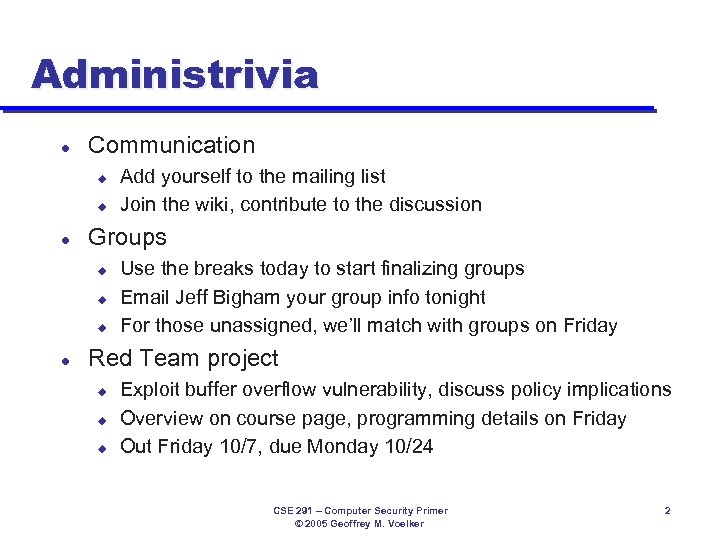
Administrivia l Communication u u l Groups u u u l Add yourself to the mailing list Join the wiki, contribute to the discussion Use the breaks today to start finalizing groups Email Jeff Bigham your group info tonight For those unassigned, we’ll match with groups on Friday Red Team project u u u Exploit buffer overflow vulnerability, discuss policy implications Overview on course page, programming details on Friday Out Friday 10/7, due Monday 10/24 CSE 291 – Computer Security Primer © 2005 Geoffrey M. Voelker 2
Today l Two goals u u l Your opportunity to ask computer security questions u u l Overview of computer security topics Provide context for remaining cybersecurity talks I’ve always wondered what X is… Who knows, maybe I can answer it Standard disclaimer u u I’m not a computer security expert, but I play one on Conf. XP Channeling Steve Zdancewic, Dan Boneh, Butler Lampson, and John Mitchell via Stefan’s CSE 127 slides CSE 291 – Computer Security Primer © 2005 Geoffrey M. Voelker 3
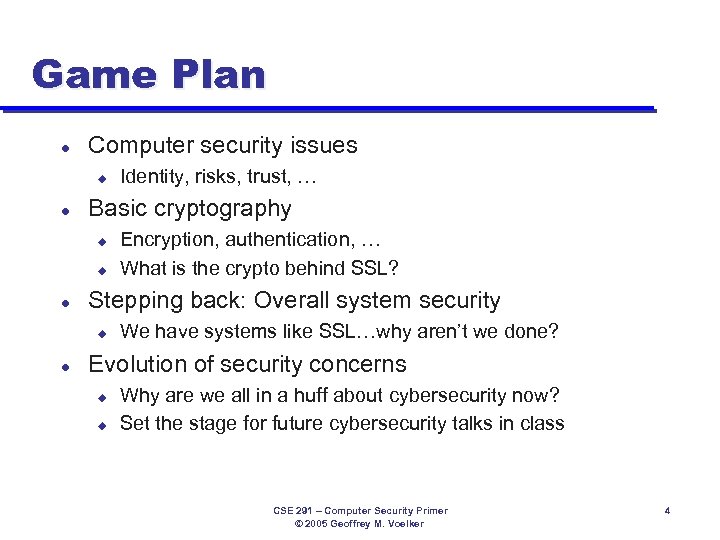
Game Plan l Computer security issues u l Basic cryptography u u l Encryption, authentication, … What is the crypto behind SSL? Stepping back: Overall system security u l Identity, risks, trust, … We have systems like SSL…why aren’t we done? Evolution of security concerns u u Why are we all in a huff about cybersecurity now? Set the stage for future cybersecurity talks in class CSE 291 – Computer Security Primer © 2005 Geoffrey M. Voelker 4
Computer Security l l Definition: The reasoning, mechanisms, policies, and procedures used to deal with someone else doing something that you don’t want them to do There a handful of key issues here (paraphrasing Butler Lampson) u u u Identity Policy Risks/Threats Deterrence/Policy Locks CSE 291 – Computer Security Primer © 2005 Geoffrey M. Voelker 5
Identity l What is it? u l One def: The distinct personality of an individual regarded as a persisting entity; individuality (courtesy Black Unicorn) Why valuable? u u Unique identifier – distinguishing mark (courtesy A. S. L. von Bernhardi) Needed to establish an assertion about reputation CSE 291 – Computer Security Primer © 2005 Geoffrey M. Voelker 6
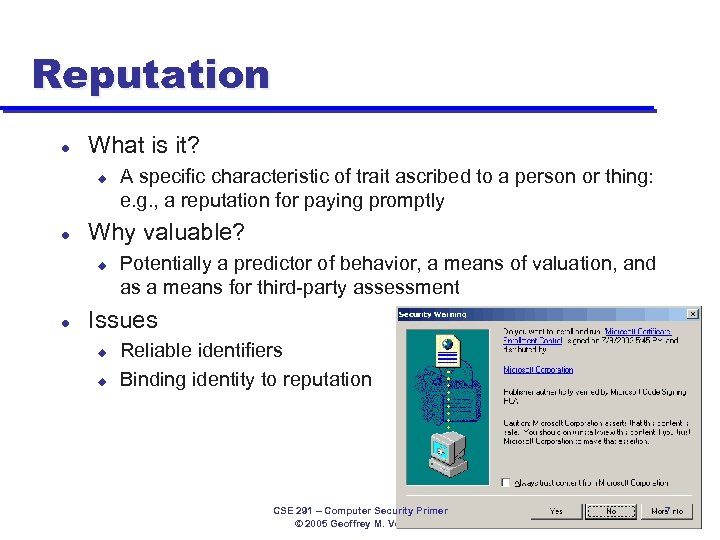
Reputation l What is it? u l Why valuable? u l A specific characteristic of trait ascribed to a person or thing: e. g. , a reputation for paying promptly Potentially a predictor of behavior, a means of valuation, and as a means for third-party assessment Issues u u Reliable identifiers Binding identity to reputation CSE 291 – Computer Security Primer © 2005 Geoffrey M. Voelker 7
Due Diligence and Trust l Due Diligence u u l Work to acquire multiple independent pieces of evidence establishing identity/reputation linkage; particularly via direct experience Problem: Expensive Trust u u u Reliance on something in the future; hope Allows cheap form of due-diligence: third-party attestation Economics of third-party attestation? Cost vs limited liability What is a third-party qualified to attest to? Thompson: “Trusting Trust” “Trust” vs. “Trustworthy” (Bruce Schneier) CSE 291 – Computer Security Primer © 2005 Geoffrey M. Voelker 8
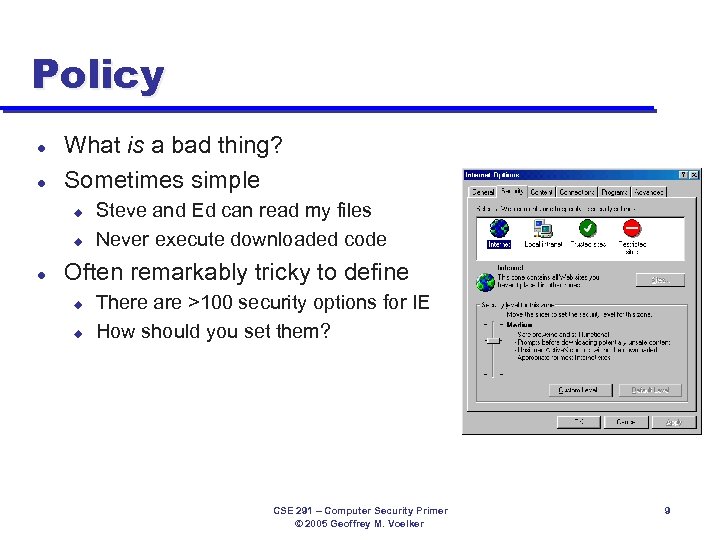
Policy l l What is a bad thing? Sometimes simple u u l Steve and Ed can read my files Never execute downloaded code Often remarkably tricky to define u u There are >100 security options for IE How should you set them? CSE 291 – Computer Security Primer © 2005 Geoffrey M. Voelker 9
Risks and Threats l Risk u u l Threats u u u l What is the cost if the bad thing happens? What is the likelihood of the bad thing happening? What is the cost of preventing the bad thing? Example: Visa/Mastercard fraud Who is targeting the risk? What are their capabilities? What are their motivations? These tend to be well understood/formalized in some communities (e. g. , finance sector) and less in others (e. g. , computer science) CSE 291 – Computer Security Primer © 2005 Geoffrey M. Voelker 10
Deterrence l There is some non-zero expectation that there is a future cost to doing a bad thing u l Need meaningful forensic capabilities u u u l going to jail, having a missile hit your house, having your assets siezed, etc. Audit actions, assign identity to evidence, etc Non-reputation Must be cost effective Again channeling Butler: “lots of good locks on the Internet, few police” u We’ll come back to this at the end CSE 291 – Computer Security Primer © 2005 Geoffrey M. Voelker 11
Locks l Mechanisms used to protect resources against threats u u l This is most of academic and industrial computer security Anderson: Necessary, but not sufficient Several classes of locks u u u Cryptographic Software security Protocol security CSE 291 – Computer Security Primer © 2005 Geoffrey M. Voelker 12
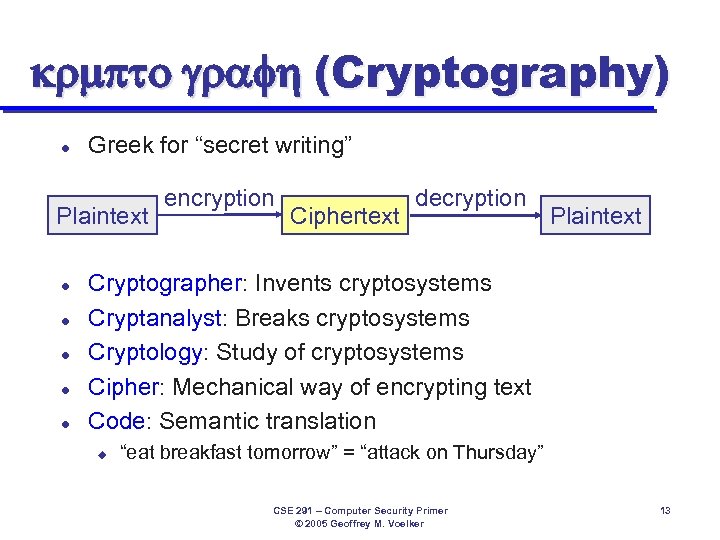
krmpto graf (Cryptography) l Greek for “secret writing” Plaintext l l l encryption Ciphertext decryption Plaintext Cryptographer: Invents cryptosystems Cryptanalyst: Breaks cryptosystems Cryptology: Study of cryptosystems Cipher: Mechanical way of encrypting text Code: Semantic translation u “eat breakfast tomorrow” = “attack on Thursday” CSE 291 – Computer Security Primer © 2005 Geoffrey M. Voelker 13
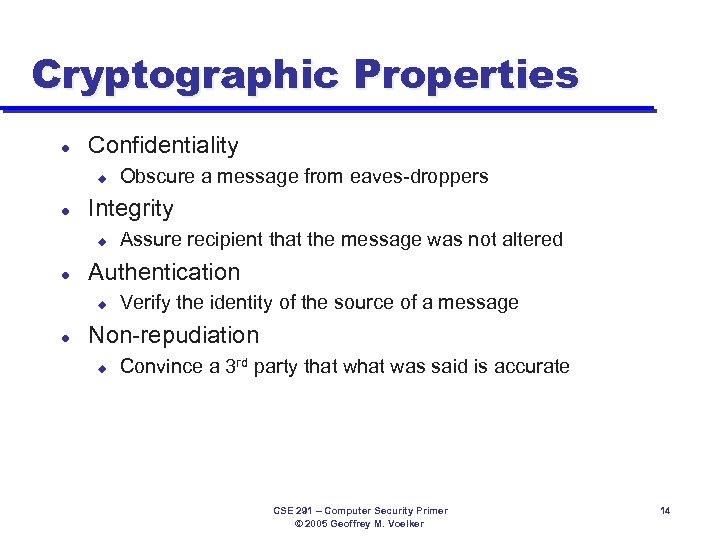
Cryptographic Properties l Confidentiality u l Integrity u l Assure recipient that the message was not altered Authentication u l Obscure a message from eaves-droppers Verify the identity of the source of a message Non-repudiation u Convince a 3 rd party that was said is accurate CSE 291 – Computer Security Primer © 2005 Geoffrey M. Voelker 14
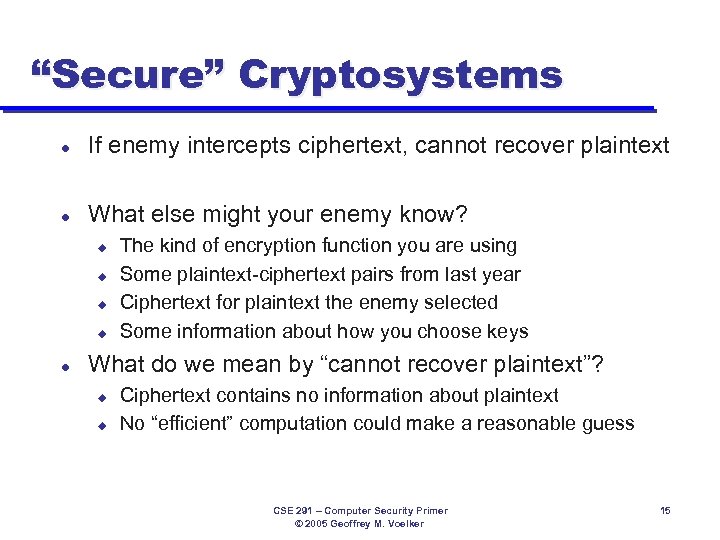
“Secure” Cryptosystems l If enemy intercepts ciphertext, cannot recover plaintext l What else might your enemy know? u u l The kind of encryption function you are using Some plaintext-ciphertext pairs from last year Ciphertext for plaintext the enemy selected Some information about how you choose keys What do we mean by “cannot recover plaintext”? u u Ciphertext contains no information about plaintext No “efficient” computation could make a reasonable guess CSE 291 – Computer Security Primer © 2005 Geoffrey M. Voelker 15
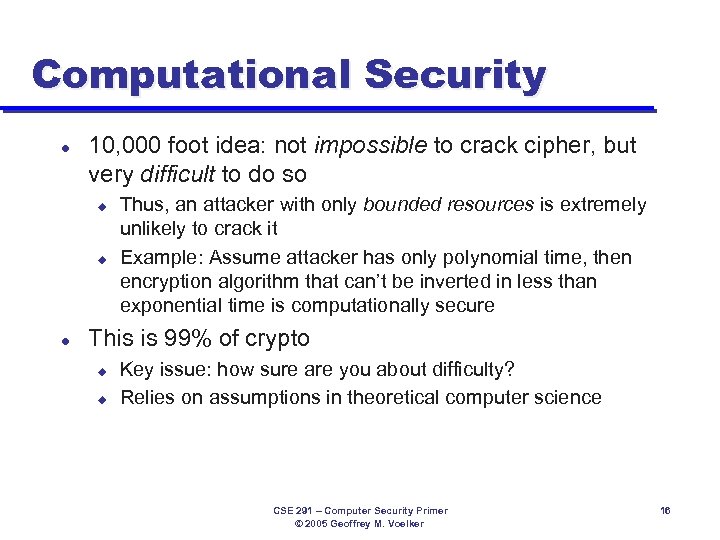
Computational Security l 10, 000 foot idea: not impossible to crack cipher, but very difficult to do so u u l Thus, an attacker with only bounded resources is extremely unlikely to crack it Example: Assume attacker has only polynomial time, then encryption algorithm that can’t be inverted in less than exponential time is computationally secure This is 99% of crypto u u Key issue: how sure are you about difficulty? Relies on assumptions in theoretical computer science CSE 291 – Computer Security Primer © 2005 Geoffrey M. Voelker 16
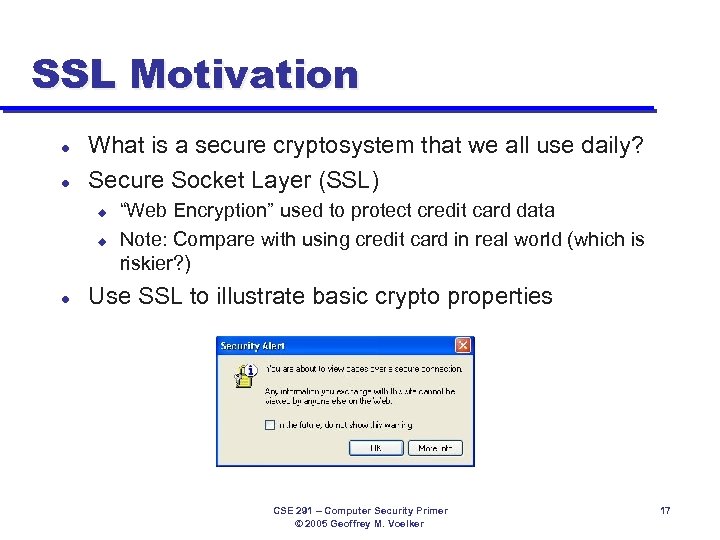
SSL Motivation l l What is a secure cryptosystem that we all use daily? Secure Socket Layer (SSL) u u l “Web Encryption” used to protect credit card data Note: Compare with using credit card in real world (which is riskier? ) Use SSL to illustrate basic crypto properties CSE 291 – Computer Security Primer © 2005 Geoffrey M. Voelker 17
Shared Key Cryptography l First step: Confidentiality (protect credit card) u l l Shared key & public key cryptography Sender & receiver use the same key Key must remain private (i. e. , secret) Also called symmetric or secret key cryptography Examples u DES, Triple-DES, Blowfish, Twofish, AES, Rijndael, … CSE 291 – Computer Security Primer © 2005 Geoffrey M. Voelker 18
Shared Key Notation l l l Encryption algorithm E : key x plain cipher Notation: K{msg} = E(K, msg) Decryption algorithm D : key x cipher plain D inverts E D(K, E(K, msg)) = msg Use capital “K” for shared (secret) keys Sometimes E is the same algorithm as D CSE 291 – Computer Security Primer © 2005 Geoffrey M. Voelker 19
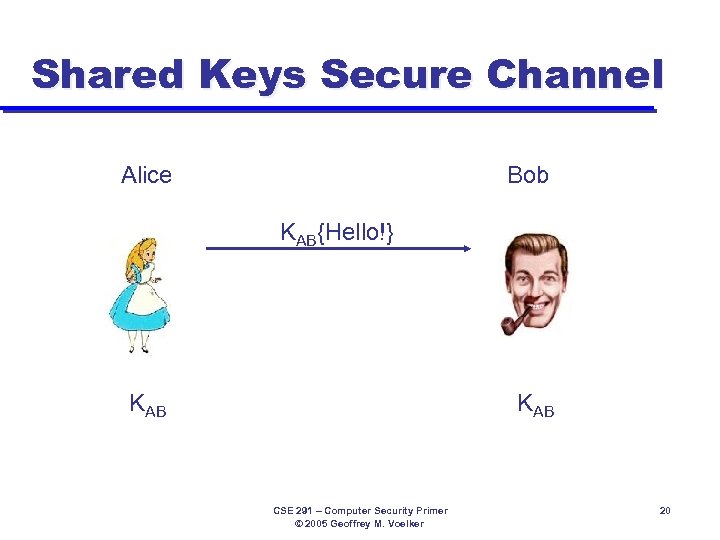
Shared Keys Secure Channel Alice Bob KAB{Hello!} KAB CSE 291 – Computer Security Primer © 2005 Geoffrey M. Voelker 20
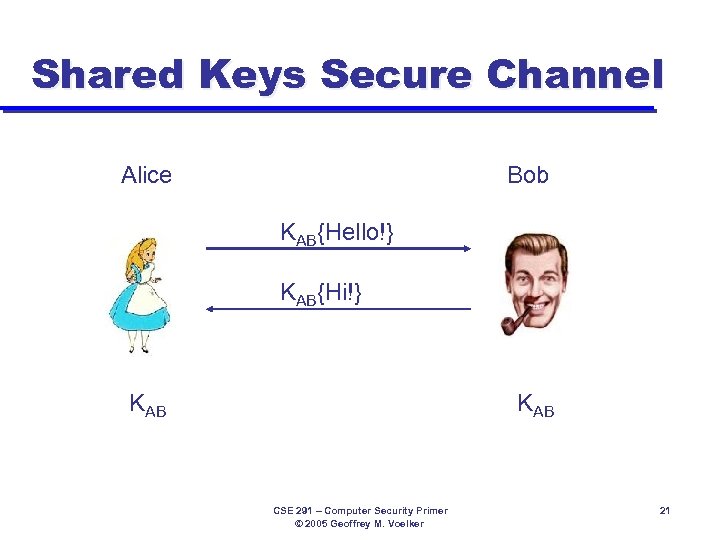
Shared Keys Secure Channel Alice Bob KAB{Hello!} KAB{Hi!} KAB CSE 291 – Computer Security Primer © 2005 Geoffrey M. Voelker 21
Shared Key Issues l Compromised key means interceptors can decrypt any ciphertext they have acquired u l Distribution of keys is problematic u u u l l Change keys frequently to limit damage Keys must be transmitted securely Use couriers? Distribute in pieces over separate channels? Number of keys is O(n 2) where n is # of participants We don’t have many “proofs” of computational security for shared key systems CSE 291 – Computer Security Primer © 2005 Geoffrey M. Voelker 22
Public Key Cryptography l l l Sender encrypts using a public key Receiver decrypts using a private key Only the private key must be kept secret u l l Public key can be distributed at will (still tricky, though) Also called asymmetric cryptography Best known example: RSA u Ron Rivest, Adi Shamir, Leonard Adleman » Proposed in 1979 » They won the 2002 Turing award for this work u Has withstood years of cryptanalysis » Not a guarantee of security… » But perhaps a strong vote of confidence CSE 291 – Computer Security Primer © 2005 Geoffrey M. Voelker 23
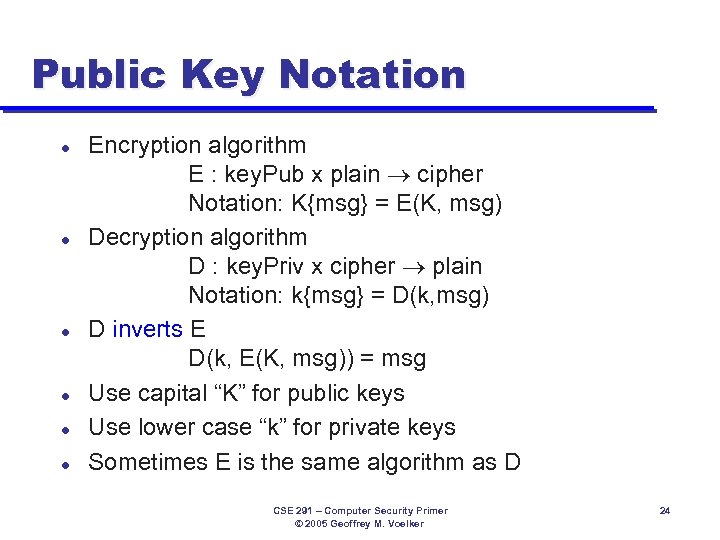
Public Key Notation l l l Encryption algorithm E : key. Pub x plain cipher Notation: K{msg} = E(K, msg) Decryption algorithm D : key. Priv x cipher plain Notation: k{msg} = D(k, msg) D inverts E D(k, E(K, msg)) = msg Use capital “K” for public keys Use lower case “k” for private keys Sometimes E is the same algorithm as D CSE 291 – Computer Security Primer © 2005 Geoffrey M. Voelker 24
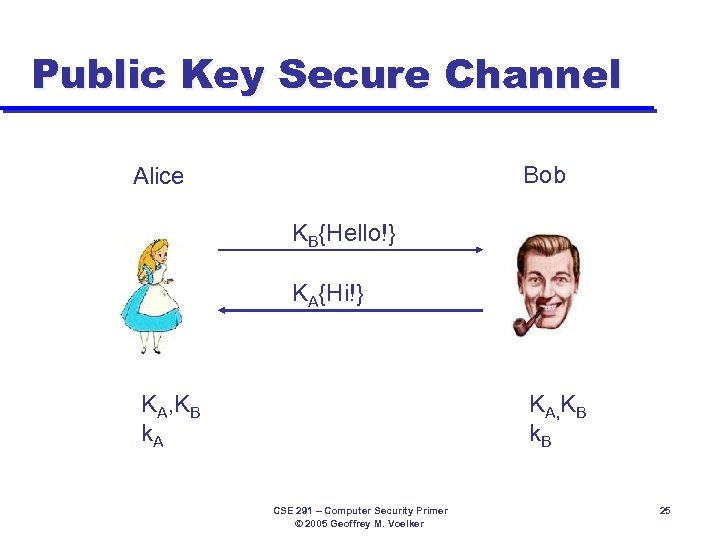
Public Key Secure Channel Bob Alice KB{Hello!} KA{Hi!} KA, KB k. A KA, KB k. B CSE 291 – Computer Security Primer © 2005 Geoffrey M. Voelker 25
Public Key Crypto Pros/Cons l More computationally expensive than shared key crypto u u u l More formal justification of difficulty u l Algorithms are harder to implement Require more complex machinery RSA 1000 x slower than DES (hardware implementations) Hardness related to complexity-theoretic results A principal needs one private key and one public key u Number of total keys for pair-wise communication is O(n) CSE 291 – Computer Security Primer © 2005 Geoffrey M. Voelker 26
Diffie-Hellman Key Exchange l l Shared key systems are fast, but require pairwise secret key exchange Public key systems are slow, but allow easier distribution of keys Diffie-Hellman: Hybrid system Idea: Use public key system to distribute shared key CSE 291 – Computer Security Primer © 2005 Geoffrey M. Voelker 27
Crypto Summary l We now have Confidentiality u u u l Shared keys, public keys for encryption, decryption Combine them for ease-of-use, efficiency No one can eavesdrop and obtain credit card info Integrity property next u u How does Alice know that what she received is what Bob sent? How does Amazon know that no one corrupted credit card info in transit? CSE 291 – Computer Security Primer © 2005 Geoffrey M. Voelker 28
Message Authentication l Issue: An attacker can reorder blocks in RSA u l l You want some “evidence” that a message hasn’t been changed You’d prefer if the evidence wasn’t too expensive u l l Decryption succeeds, but result is not what was encrypted To create, verify, or transmit It should be hard to forge the evidence The evidence should be unique CSE 291 – Computer Security Primer © 2005 Geoffrey M. Voelker 29
Cryptographic Hashes l Map variable length string into fixed length digest u l Hash functions h for cryptographic use fall in one or both of the following classes u u l Sometimes called a Message Digest Collision Resistant Hash Function (unique): It should be computationally infeasible to find two distinct inputs that hash to a common value (i. e. , h(x) = h(y) ) One Way Hash Function (unforgeable): Given a specific hash value y, it should be computationally infeasible to find an input x such that h(x)=y Examples u u Secure Hash Algorithm (SHA) Message Digest (MD 4, MD 5) CSE 291 – Computer Security Primer © 2005 Geoffrey M. Voelker 30
Cryptographic Hash Uses l Modification Detection Codes (MDC) u u l Compute and store hash (securely) of some data Check later by recomputing hash and comparing Has this file been tampered with? Has this message stream been altered? Message Authentication Code (MAC) u u Cryptographically keyed hash function Send (msg, hash(msg, key)) Attacker who doesn’t know the key can’t modify msg (or the hash) Receiver who knows key can verify origin of message CSE 291 – Computer Security Primer © 2005 Geoffrey M. Voelker 31
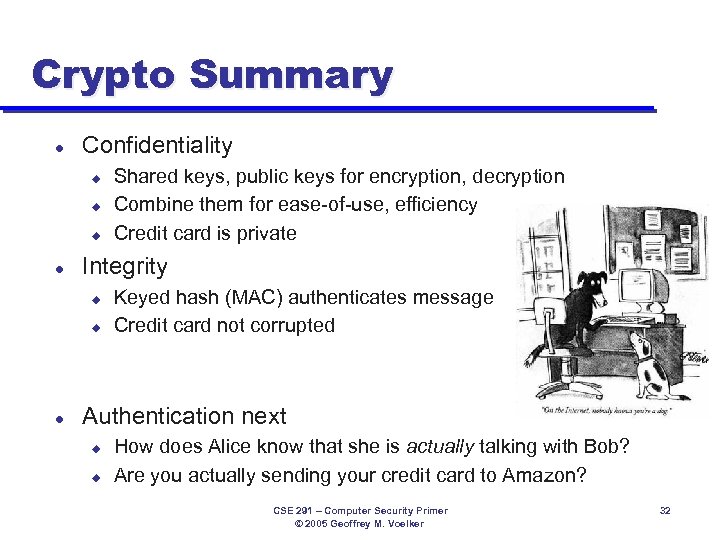
Crypto Summary l Confidentiality u u u l Integrity u u l Shared keys, public keys for encryption, decryption Combine them for ease-of-use, efficiency Credit card is private Keyed hash (MAC) authenticates message Credit card not corrupted Authentication next u u How does Alice know that she is actually talking with Bob? Are you actually sending your credit card to Amazon? CSE 291 – Computer Security Primer © 2005 Geoffrey M. Voelker 32
Signatures l l Consider a paper check used to transfer money from one person to another Signature confirms authenticity u l In case of alleged forgery u l 3 rd party can verify authenticity (maybe? ) Checks are cancelled u l Only legitimate signer can produce signature (true? ) So they can’t be reused Checks are not alterable u Or alterations are easily detected CSE 291 – Computer Security Primer © 2005 Geoffrey M. Voelker 33
Digital Signatures l l Only one principal can make, others can easily recognize Unforgeable u l Authentic u l If R receives the pair (M, S{P, M}) purportedly from P, R can check that the signature really is from P Not alterable u l If P signs a message M with signature S{P, M} it is impossible for any other principal to produce the pair (M, S{P, M}) After being transmitted, (M, S{P, M}) cannot be changed by P, R, or an interceptor Not reusable u Duplicate messages will be detected by the recipient CSE 291 – Computer Security Primer © 2005 Geoffrey M. Voelker 34
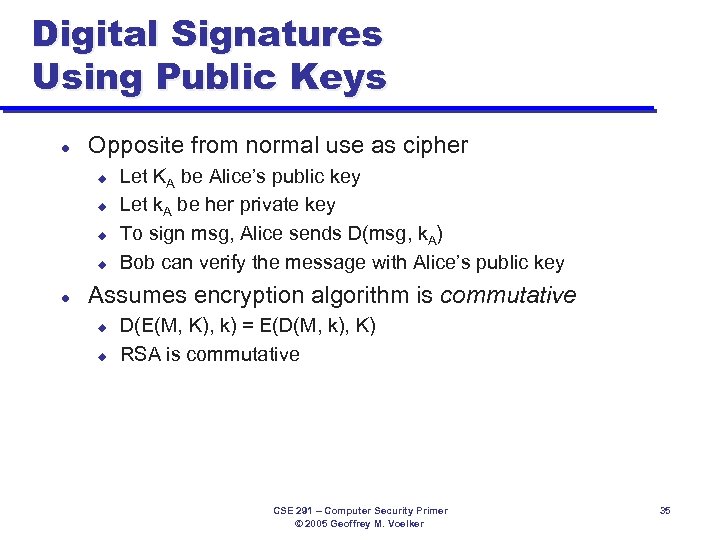
Digital Signatures Using Public Keys l Opposite from normal use as cipher u u l Let KA be Alice’s public key Let k. A be her private key To sign msg, Alice sends D(msg, k. A) Bob can verify the message with Alice’s public key Assumes encryption algorithm is commutative u u D(E(M, K), k) = E(D(M, k), K) RSA is commutative CSE 291 – Computer Security Primer © 2005 Geoffrey M. Voelker 35
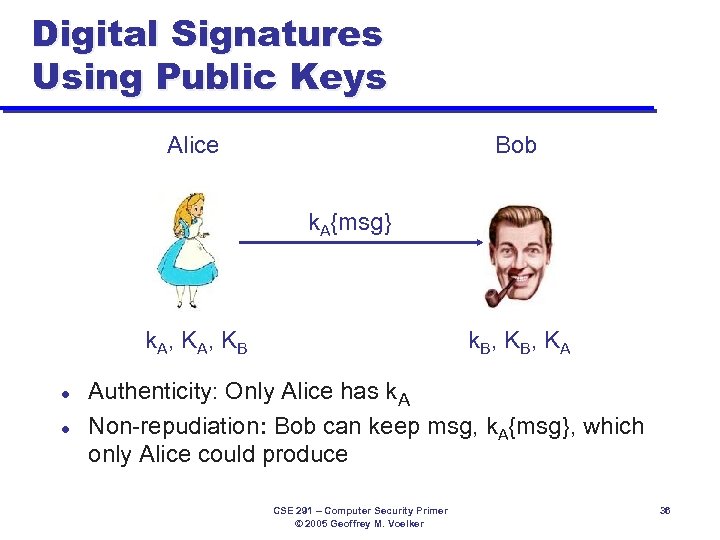
Digital Signatures Using Public Keys Alice Bob k. A{msg} k. A, KB l l k. B, KA Authenticity: Only Alice has k. A Non-repudiation: Bob can keep msg, k. A{msg}, which only Alice could produce CSE 291 – Computer Security Primer © 2005 Geoffrey M. Voelker 36
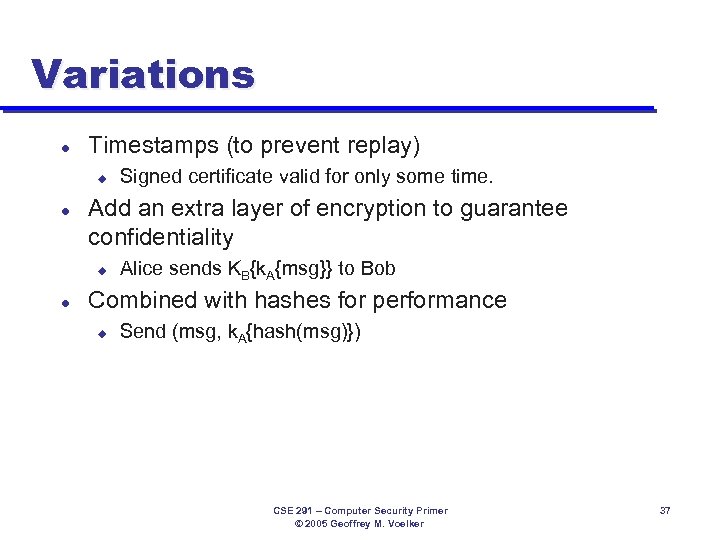
Variations l Timestamps (to prevent replay) u l Add an extra layer of encryption to guarantee confidentiality u l Signed certificate valid for only some time. Alice sends KB{k. A{msg}} to Bob Combined with hashes for performance u Send (msg, k. A{hash(msg)}) CSE 291 – Computer Security Primer © 2005 Geoffrey M. Voelker 37
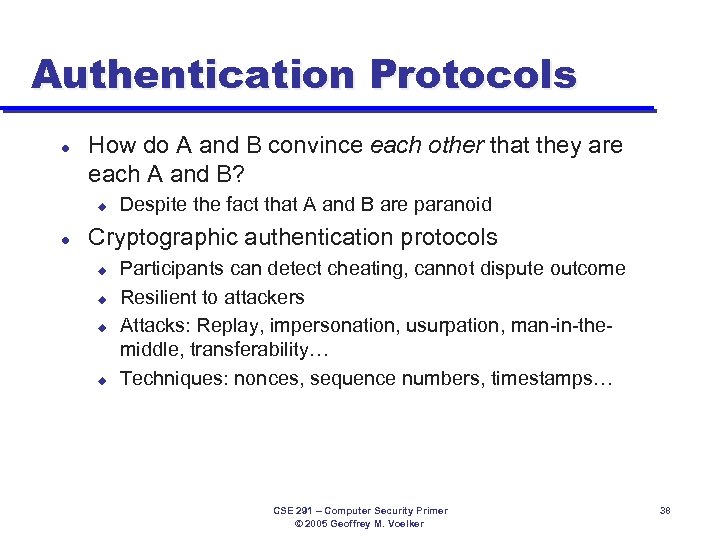
Authentication Protocols l How do A and B convince each other that they are each A and B? u l Despite the fact that A and B are paranoid Cryptographic authentication protocols u u Participants can detect cheating, cannot dispute outcome Resilient to attackers Attacks: Replay, impersonation, usurpation, man-in-themiddle, transferability… Techniques: nonces, sequence numbers, timestamps… CSE 291 – Computer Security Primer © 2005 Geoffrey M. Voelker 38
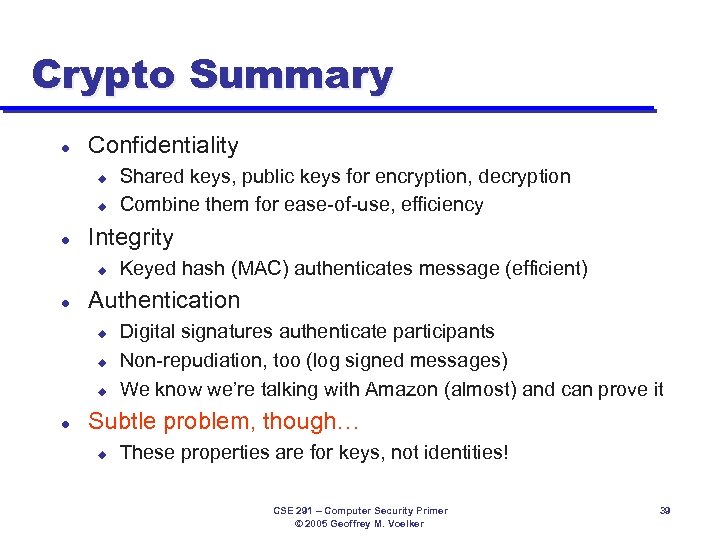
Crypto Summary l Confidentiality u u l Integrity u l Keyed hash (MAC) authenticates message (efficient) Authentication u u u l Shared keys, public keys for encryption, decryption Combine them for ease-of-use, efficiency Digital signatures authenticate participants Non-repudiation, too (log signed messages) We know we’re talking with Amazon (almost) and can prove it Subtle problem, though… u These properties are for keys, not identities! CSE 291 – Computer Security Primer © 2005 Geoffrey M. Voelker 39
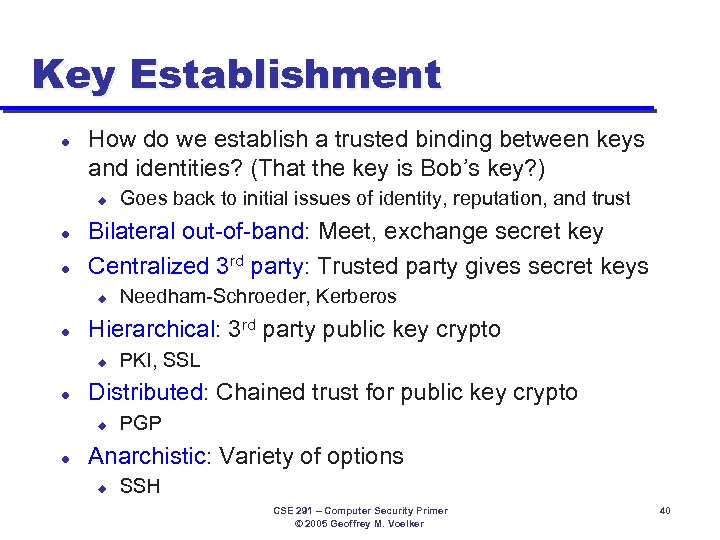
Key Establishment l How do we establish a trusted binding between keys and identities? (That the key is Bob’s key? ) u l l Bilateral out-of-band: Meet, exchange secret key Centralized 3 rd party: Trusted party gives secret keys u l PKI, SSL Distributed: Chained trust for public key crypto u l Needham-Schroeder, Kerberos Hierarchical: 3 rd party public key crypto u l Goes back to initial issues of identity, reputation, and trust PGP Anarchistic: Variety of options u SSH CSE 291 – Computer Security Primer © 2005 Geoffrey M. Voelker 40
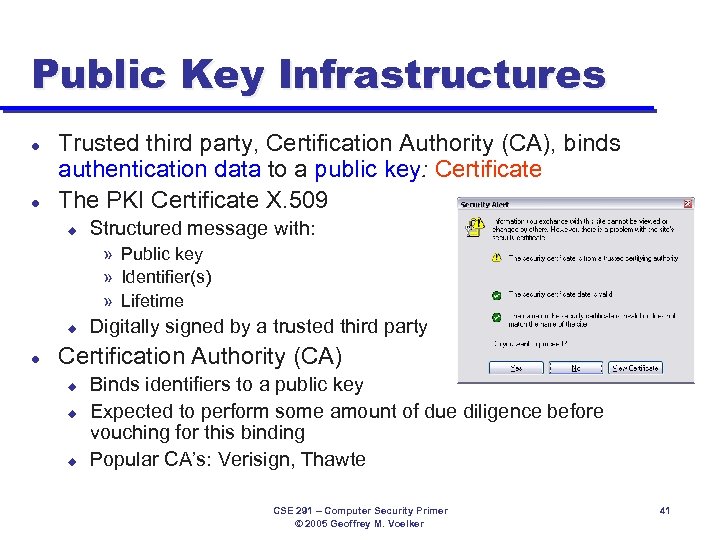
Public Key Infrastructures l l Trusted third party, Certification Authority (CA), binds authentication data to a public key: Certificate The PKI Certificate X. 509 u Structured message with: » Public key » Identifier(s) » Lifetime u l Digitally signed by a trusted third party Certification Authority (CA) u u u Binds identifiers to a public key Expected to perform some amount of due diligence before vouching for this binding Popular CA’s: Verisign, Thawte CSE 291 – Computer Security Primer © 2005 Geoffrey M. Voelker 41
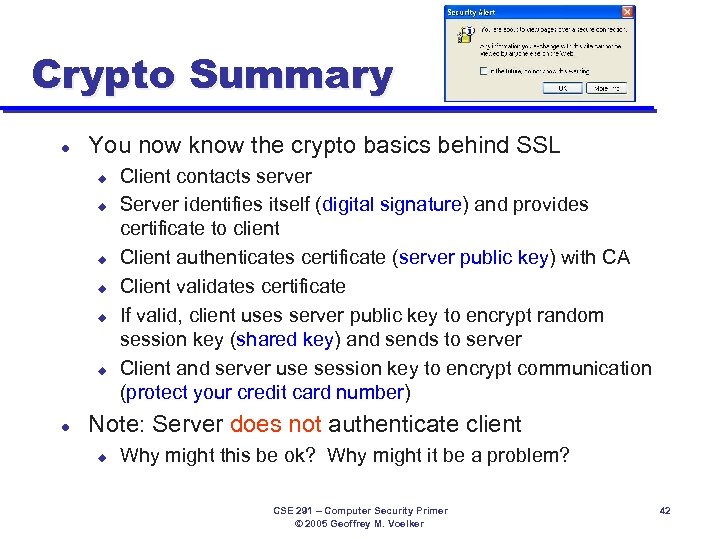
Crypto Summary l You now know the crypto basics behind SSL u u u l Client contacts server Server identifies itself (digital signature) and provides certificate to client Client authenticates certificate (server public key) with CA Client validates certificate If valid, client uses server public key to encrypt random session key (shared key) and sends to server Client and server use session key to encrypt communication (protect your credit card number) Note: Server does not authenticate client u Why might this be ok? Why might it be a problem? CSE 291 – Computer Security Primer © 2005 Geoffrey M. Voelker 42
Overall System Security l l We have successful cryptosystems like SSL, so what’s the problem? Clearly, appropriate use of cryptography is essential u l Even that is hard to get right (frequently problems are with implementations) …but even if cryptography is used appropriately, there are still plenty of possible vulnerabilities u 85% of CERT vulnerabilities could not be prevented with cryptography CSE 291 – Computer Security Primer © 2005 Geoffrey M. Voelker 43
When Is a System Secure? l Claim: Perfect security does not exist u u u Security vulnerabilities are the result of violating an assumption about the software (or, more generally, the entire system) Corollary: As long as you make assumptions, you’re vulnerable. And: You always need to make assumptions! (or else your software is useless and slow) CSE 291 – Computer Security Primer © 2005 Geoffrey M. Voelker 44
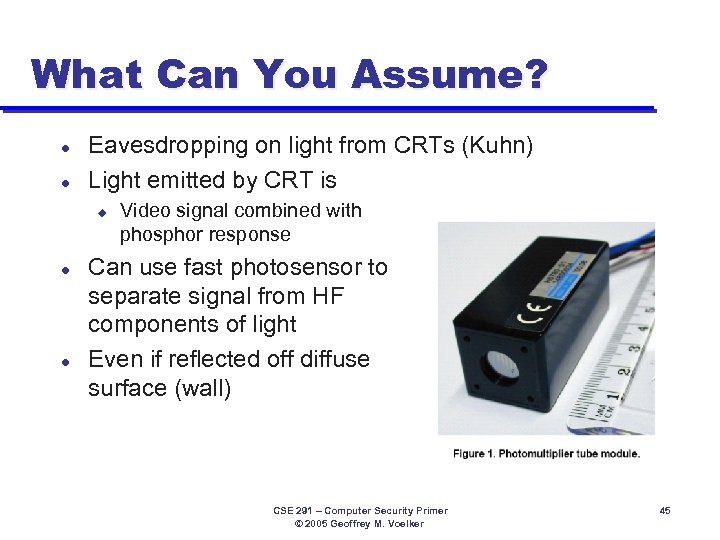
What Can You Assume? l l Eavesdropping on light from CRTs (Kuhn) Light emitted by CRT is u l l Video signal combined with phosphor response Can use fast photosensor to separate signal from HF components of light Even if reflected off diffuse surface (wall) CSE 291 – Computer Security Primer © 2005 Geoffrey M. Voelker 45
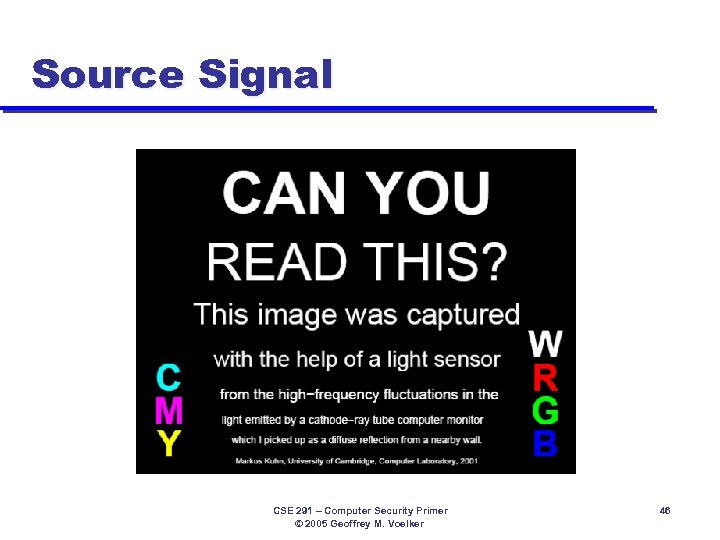
Source Signal CSE 291 – Computer Security Primer © 2005 Geoffrey M. Voelker 46
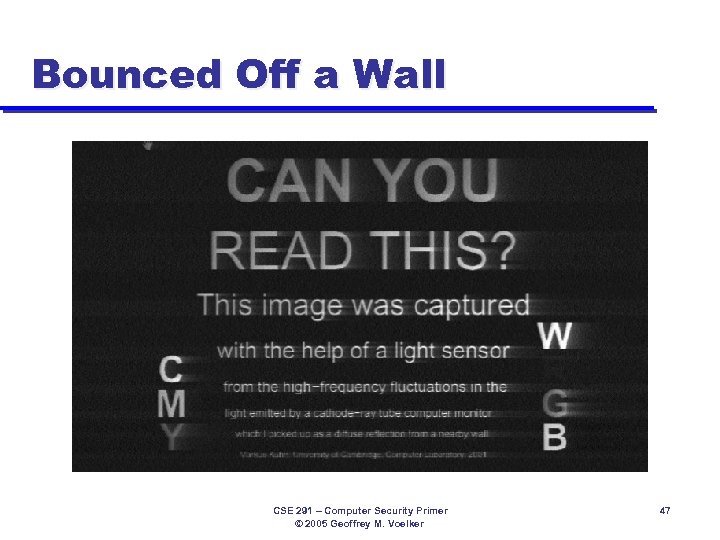
Bounced Off a Wall CSE 291 – Computer Security Primer © 2005 Geoffrey M. Voelker 47
Practical Security l Anderson: “Designers focused on what could possibly go wrong, rather than on what was likely to” u u l Not all threats are equal: What are the attacks being used? Need data (tough, no one wants to admit it) 2001: First published report of Denial-of-Service activity 2001–today: Worms (hard to deny their existence…) Lampson: “The best is the enemy of the good” u Doing nothing until a perfect solution found is a bad idea » Especially since nothing is perfect…back to risk assessment u u u “I can think of a way to break your system” IDS, worm defense, buffer overflow defense all have flaws But we still want them CSE 291 – Computer Security Primer © 2005 Geoffrey M. Voelker 48
Kinds of Attacks l Direct attacks u Attacks against the cryptosystem » e. g. , timing attacks on SSL (Brumley and Boneh) u l Typically requires high expertise Indirect attacks u u u Attacks on assumptions (light bouncing off walls) Attacking interface to system, identity Anderson: “most security failures are due to implementation and management errors” » Management of keys, usability of system » Buffer overflow, format string attacks u May not require much expertise CSE 291 – Computer Security Primer © 2005 Geoffrey M. Voelker 49
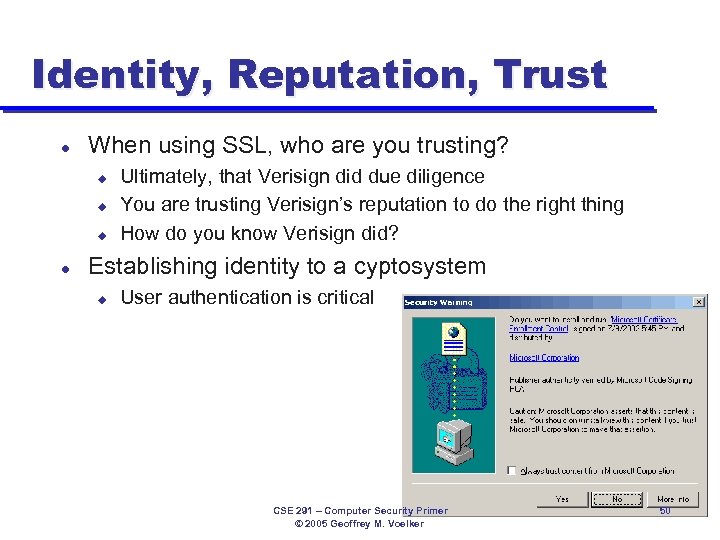
Identity, Reputation, Trust l When using SSL, who are you trusting? u u u l Ultimately, that Verisign did due diligence You are trusting Verisign’s reputation to do the right thing How do you know Verisign did? Establishing identity to a cyptosystem u User authentication is critical CSE 291 – Computer Security Primer © 2005 Geoffrey M. Voelker 50
Authenticating Humans l Need to securely authenticate people into systems u l l Authentication is based on one or more of the following: Something you know u l Password Something you have u l If you get the keys, cryptosystem doesn’t know differently Driver’s license Something inherent about you u Biometrics (fingerprint, retinal, voice, face), location CSE 291 – Computer Security Primer © 2005 Geoffrey M. Voelker 51
Text Passwords l l Shared code/phrase Client sends to authenticate Simple, right? How do you… u u u l Establish them to begin with? Stop them from leaking? Stop them from being guessed? Brute force attacks can frequently break passwords CSE 291 – Computer Security Primer © 2005 Geoffrey M. Voelker 52
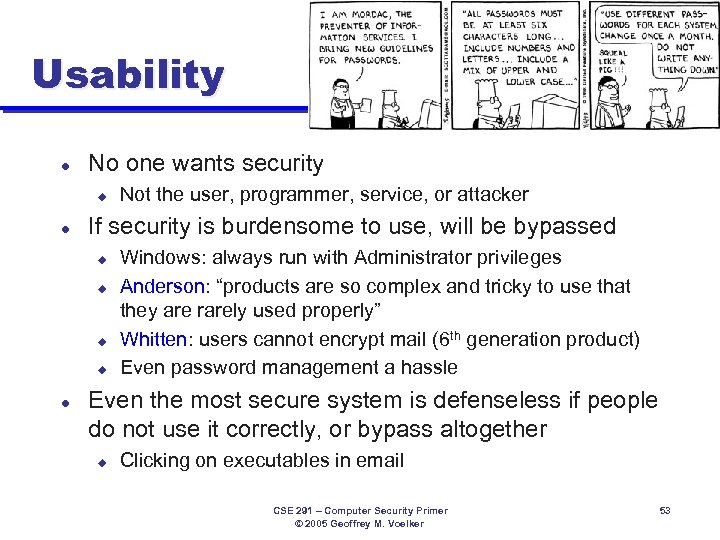
Usability l No one wants security u l If security is burdensome to use, will be bypassed u u l Not the user, programmer, service, or attacker Windows: always run with Administrator privileges Anderson: “products are so complex and tricky to use that they are rarely used properly” Whitten: users cannot encrypt mail (6 th generation product) Even password management a hassle Even the most secure system is defenseless if people do not use it correctly, or bypass altogether u Clicking on executables in email CSE 291 – Computer Security Primer © 2005 Geoffrey M. Voelker 53
Implementation Attacks l Most common implementation attack is buffer overflow u l l l Assumption (by programmer) that the data will fit in a limited-size buffer This leads to a vulnerability: Supply data that is too big for the buffer (thereby violating the assumptions) This vulnerability can be exploited to subvert the entire programming model u l 50% of all CERT incidents related to these i. e. , execute arbitrary code You will do precisely this in the Red Team project CSE 291 – Computer Security Primer © 2005 Geoffrey M. Voelker 54
Why Cyber. Security Now? l Ever since the first computer we have had security u Why are we all in an uproar now? CSE 291 – Computer Security Primer © 2005 Geoffrey M. Voelker 55
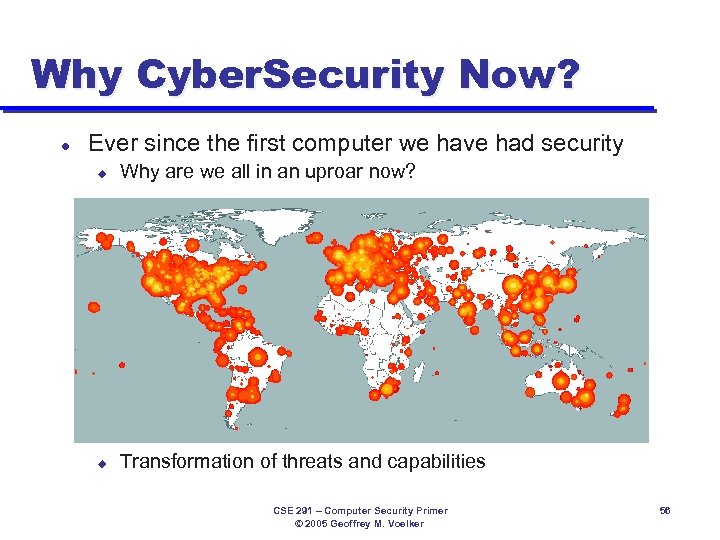
Why Cyber. Security Now? l Ever since the first computer we have had security u Why are we all in an uproar now? u Transformation of threats and capabilities CSE 291 – Computer Security Primer © 2005 Geoffrey M. Voelker 56
Problem: Internet Succeeded l Large, homogeneous software base u u l Software vulnerabilities u l 300 million Internet hosts (7/04) 80% run same OS family (Windows) Software is complex and it has bugs (weekly security updates) High-performance network (unrestricted connectivity) u u Low latency: 16 ms to UCB, 28 ms to UW, 80 ms to MIT High bandwidth: UCSD has a multi-gigabit Internet connection » DSL and cable increasingly replacing dialup l Incentives u u Bragging, delinquency, anger, profit, terror No deterrence: easy to do, difficult to get caught CSE 291 – Computer Security Primer © 2005 Geoffrey M. Voelker 57
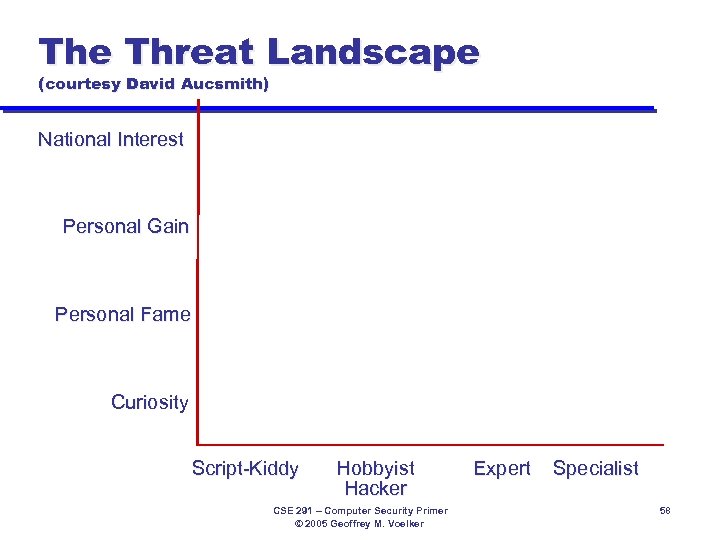
The Threat Landscape (courtesy David Aucsmith) National Interest Personal Gain Personal Fame Curiosity Vandal Script-Kiddy Hobbyist Hacker CSE 291 – Computer Security Primer © 2005 Geoffrey M. Voelker Expert Specialist 58
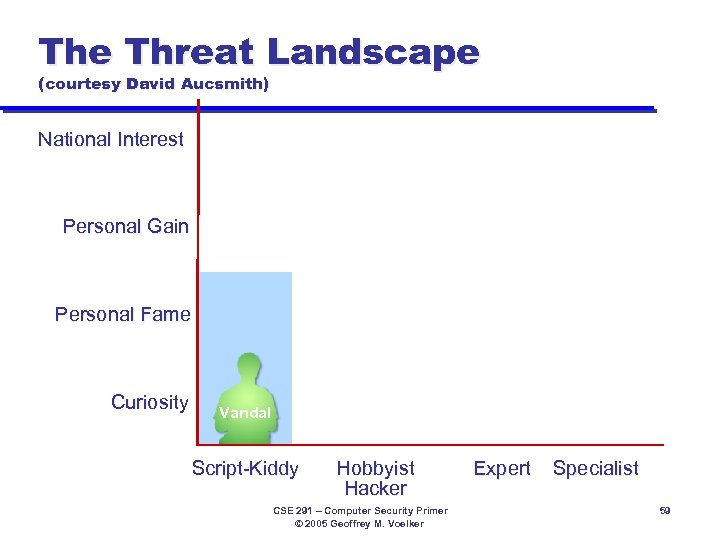
The Threat Landscape (courtesy David Aucsmith) National Interest Spy Personal Gain Trespasser Personal Fame Curiosity Vandal Author Script-Kiddy Hobbyist Hacker CSE 291 – Computer Security Primer © 2005 Geoffrey M. Voelker Expert Specialist 59
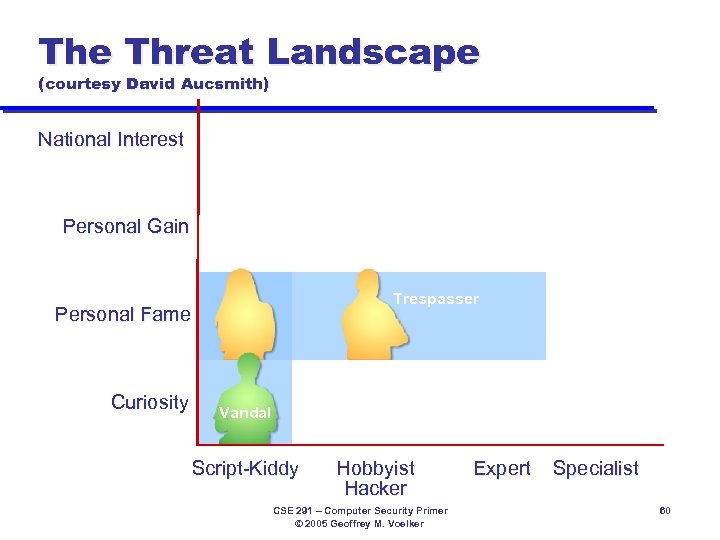
The Threat Landscape (courtesy David Aucsmith) National Interest Spy Personal Gain Trespasser Personal Fame Curiosity Vandal Author Script-Kiddy Hobbyist Hacker CSE 291 – Computer Security Primer © 2005 Geoffrey M. Voelker Expert Specialist 60
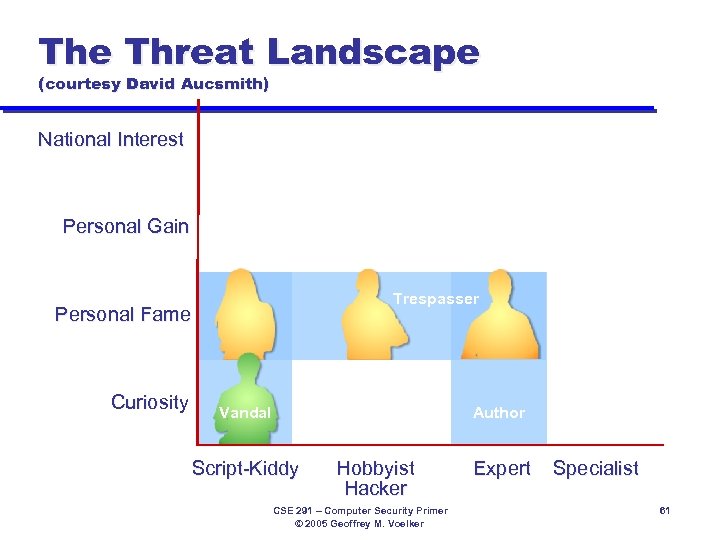
The Threat Landscape (courtesy David Aucsmith) National Interest Personal Gain Thief Trespasser Personal Fame Curiosity Vandal Author Script-Kiddy Hobbyist Hacker CSE 291 – Computer Security Primer © 2005 Geoffrey M. Voelker Expert Specialist 61
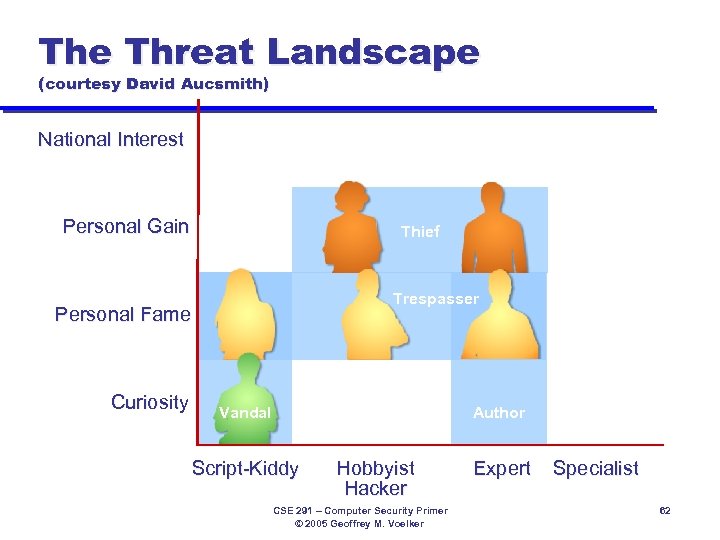
The Threat Landscape (courtesy David Aucsmith) National Interest Spy Personal Gain Thief Trespasser Personal Fame Curiosity Vandal Author Script-Kiddy Hobbyist Hacker CSE 291 – Computer Security Primer © 2005 Geoffrey M. Voelker Expert Specialist 62
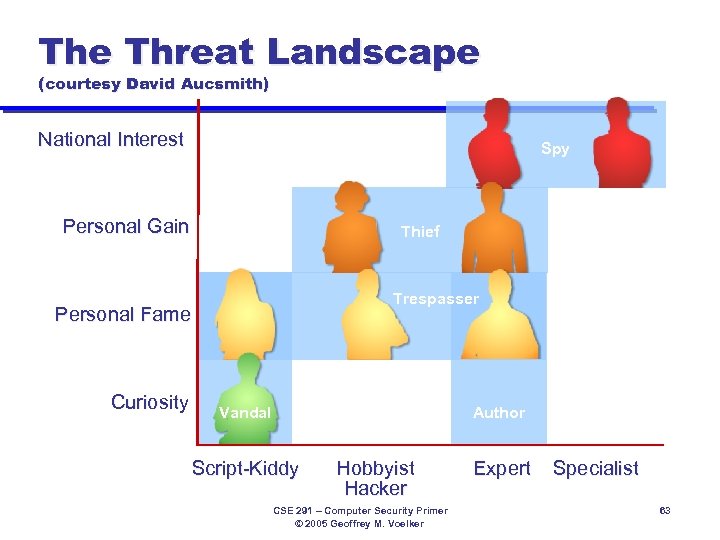
The Threat Landscape (courtesy David Aucsmith) National Interest Spy Personal Gain Thief Trespasser Personal Fame Curiosity Vandal Author Script-Kiddy Hobbyist Hacker CSE 291 – Computer Security Primer © 2005 Geoffrey M. Voelker Expert Specialist 63
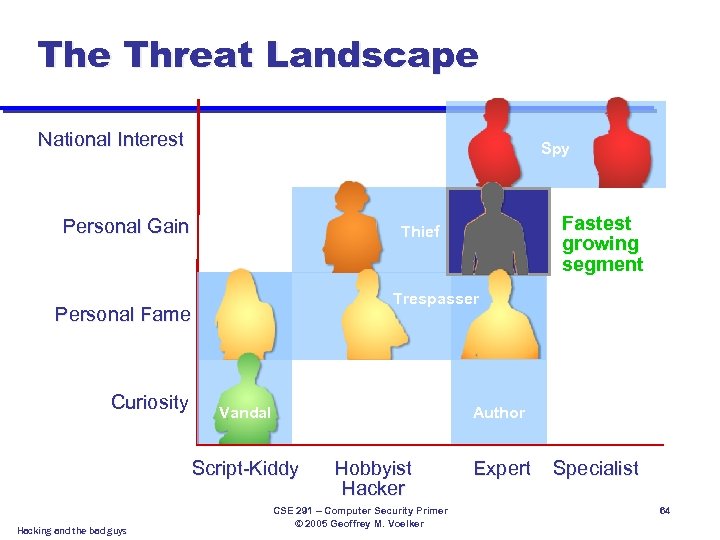
The Threat Landscape National Interest Spy Personal Gain Trespasser Personal Fame Curiosity Vandal Author Script-Kiddy Hacking and the bad guys Fastest growing segment Thief Hobbyist Hacker CSE 291 – Computer Security Primer © 2005 Geoffrey M. Voelker Expert Specialist 64
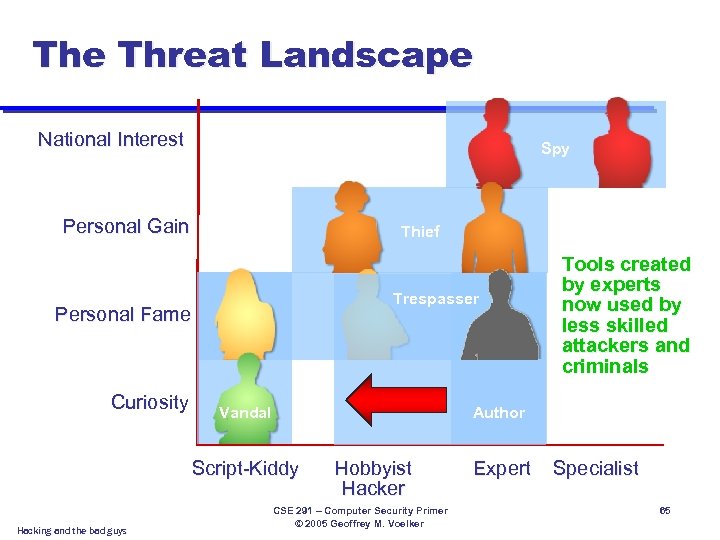
The Threat Landscape National Interest Spy Personal Gain Thief Trespasser Personal Fame Curiosity Vandal Author Script-Kiddy Hacking and the bad guys Tools created by experts now used by less skilled attackers and criminals Hobbyist Hacker CSE 291 – Computer Security Primer © 2005 Geoffrey M. Voelker Expert Specialist 65
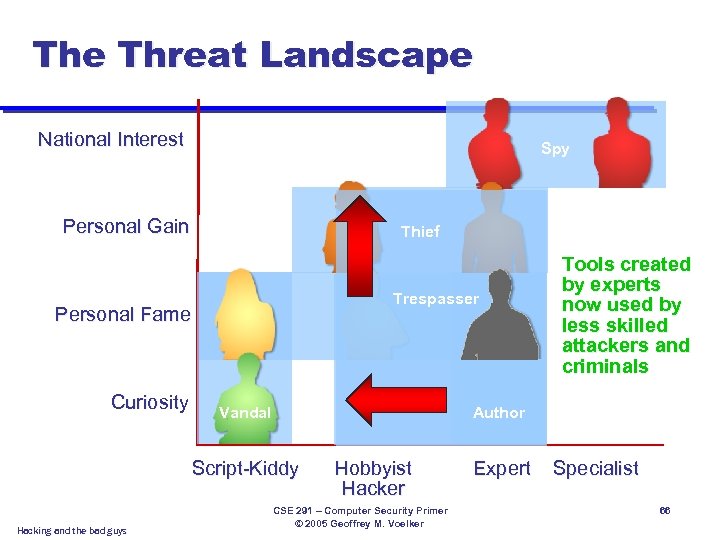
The Threat Landscape National Interest Spy Personal Gain Thief Trespasser Personal Fame Curiosity Vandal Author Script-Kiddy Hacking and the bad guys Tools created by experts now used by less skilled attackers and criminals Hobbyist Hacker CSE 291 – Computer Security Primer © 2005 Geoffrey M. Voelker Expert Specialist 66
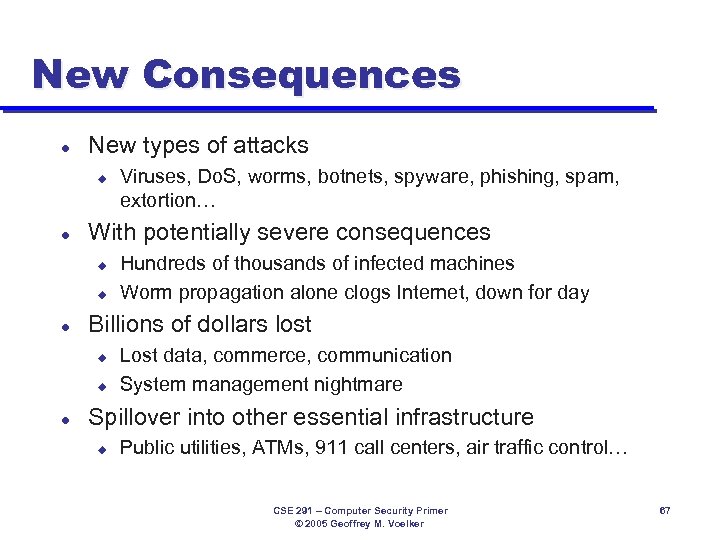
New Consequences l New types of attacks u l With potentially severe consequences u u l Hundreds of thousands of infected machines Worm propagation alone clogs Internet, down for day Billions of dollars lost u u l Viruses, Do. S, worms, botnets, spyware, phishing, spam, extortion… Lost data, commerce, communication System management nightmare Spillover into other essential infrastructure u Public utilities, ATMs, 911 call centers, air traffic control… CSE 291 – Computer Security Primer © 2005 Geoffrey M. Voelker 67
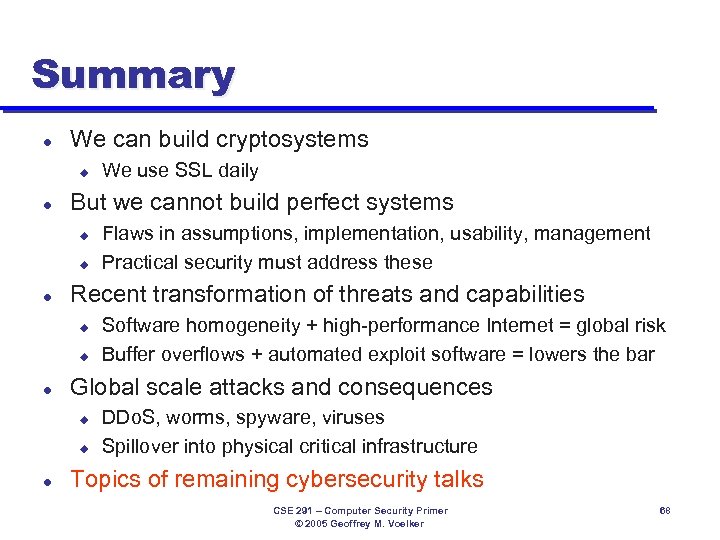
Summary l We can build cryptosystems u l But we cannot build perfect systems u u l u Software homogeneity + high-performance Internet = global risk Buffer overflows + automated exploit software = lowers the bar Global scale attacks and consequences u u l Flaws in assumptions, implementation, usability, management Practical security must address these Recent transformation of threats and capabilities u l We use SSL daily DDo. S, worms, spyware, viruses Spillover into physical critical infrastructure Topics of remaining cybersecurity talks CSE 291 – Computer Security Primer © 2005 Geoffrey M. Voelker 68
Скачать презентацию Computer Security Primer CSE 291 Fall 2005 October
88a59db48270eb7ea9c40a2fc5a377d3.ppt