


 Скачать презентацию Computer Security CS 426 Lecture 23 Trusted Operating
63b7d33e6e847d686603e92ba57ee067.ppt
- Количество слайдов: 45
 Computer Security CS 426 Lecture 23 Trusted Operating Systems and Assurance CS 426 Fall 2010/Lecture 23 1
 Topics for this lecture • • • Trusted vs. trustworthy TCB Security features of a “Trusted OS” TCSEC Common criteria CS 426 Fall 2010/Lecture 23 2
 Trusted vs. Trustworthy • A component of a system is trusted means that – the security of the system depends on it – failure of component can break the security policy – determined by its role in the system • A component is trustworthy means that – the component deserves to be trusted – e. g. , it is implemented correctly – determined by intrinsic properties of the component Trusted Operating System is actually a misnomer CS 426 Fall 2010/Lecture 23 3
 Terminology: Trusted Computing Base • The set of all hardware, software and procedural components that enforce the security policy. – in order to break security, an attacker must subvert one or more of them. • What consists of the conceptual Trusted Computing Based in a Unix/Linux system? – hardware, kernel, system binaries, system configuration files, etc. CS 426 Fall 2010/Lecture 23 4
 Terminology: Trusted Computing • Technology developed by Trusted Computing Group – AMD, HP, IBM, Intel, Microsoft – Goal is to ensure that the computer will consistently behave in specific ways, and those behaviors will be enforced by hardware and software. – Use cryptography to help enforce a selected behavior • Controversial – Provide features that can be used to secure hardware against the owner CS 426 Fall 2010/Lecture 23 5
 Two Key Features of TC • Sealed Storage: Stored data can only be opened by certain software/hardware combination – Can be used for DRM • Remote Attestation: remote certification that only authorized code is running on a system • Concerns: Loss of control by end users, privacy CS 426 Fall 2010/Lecture 23 6
 Terminology: Trusted Platform Module • Trusted Platform Module – a specification by TCP or implementation of the specification – a hardware module (integrated circuit) that provides • secure generation of cryptographic keys, • storage of keys that cannot be retrieved • a Hardware Random Number Generator. • remote attestation, etc CS 426 Fall 2010/Lecture 23 7
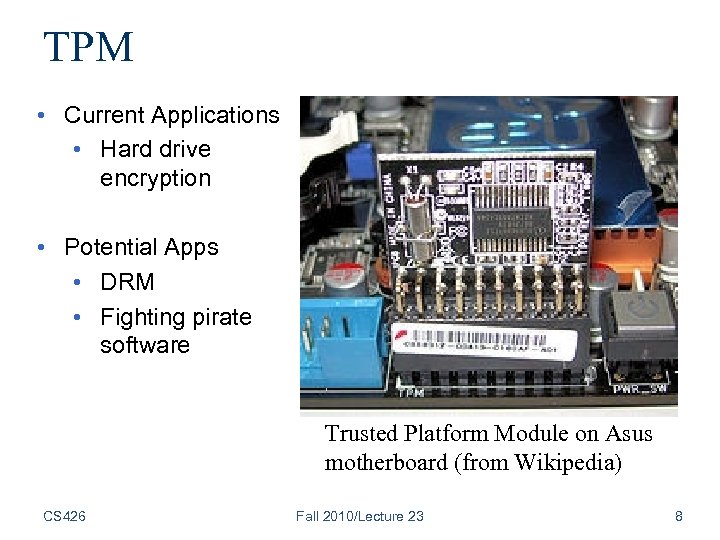 TPM • Current Applications • Hard drive encryption • Potential Apps • DRM • Fighting pirate software Trusted Platform Module on Asus motherboard (from Wikipedia) CS 426 Fall 2010/Lecture 23 8
 What makes a “Trusted OS” • Trusted OS = Additional Security Features + Higher level of assurance • Examples: Trusted. BSD, Trusted Solaris • Extra security features (compared to ordinary OS) – Often including support for Multi-level Security • More secure implementation & deployment – Apply secure design and coding principles – Assurance and certification • Code audit or formal verification – Maintenance procedures • Apply patches, etc. CS 426 Fall 2010/Lecture 23 9
 Sample Features of “Trusted OS” • Mandatory access control – Often for confidentiality • Object reuse protection – Write over old data when file space is allocated • Complete mediation – Prevent any access that circumvents monitor • Auditing – Log security-related events and check logs CS 426 Fall 2010/Lecture 23 10
 Assurance • Trusted OS = Additional Security Features + Higher level of assurance • Assurance: “estimate of the likelihood that a system will not fail in some particular way” • Based on factors such as – – CS 426 Software architecture Development process Who developed it Technical assessment Fall 2010/Lecture 23 11
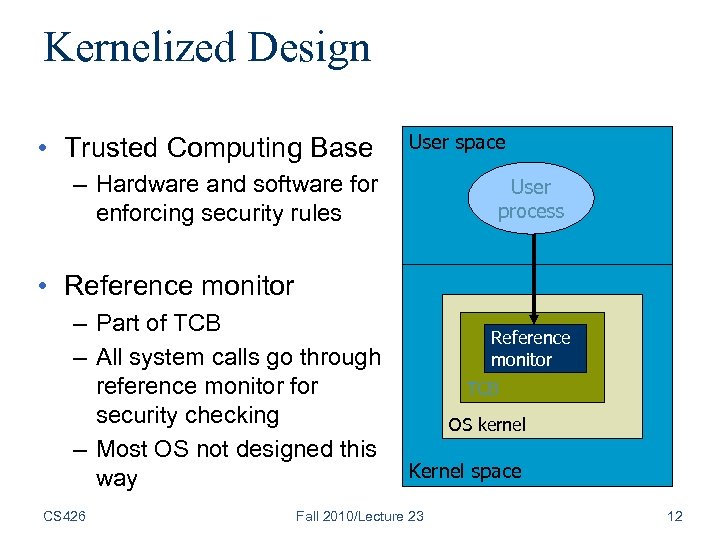 Kernelized Design • Trusted Computing Base User space – Hardware and software for enforcing security rules User process • Reference monitor – Part of TCB Reference – All system calls go through monitor reference monitor for TCB security checking OS kernel – Most OS not designed this Kernel space way CS 426 Fall 2010/Lecture 23 12
 Reference Monitor Revisited • Three required properties for reference monitors in “trusted systems” – tamper-proof – non-bypassable (complete mediation) – small enough to be analyzable CS 426 Fall 2010/Lecture 23 13
 Assurance methods • Testing – Can demonstrate existence of flaw, not absence • Formal Specification and Verification – Time-consuming, painstaking process • “Validation” – Requirements checking, design and code reviews , module and system testing • Configuration Management and Trusted System Distribution – Improve assurnace in the development/deployment cycle CS 426 Fall 2010/Lecture 23 14
 Assurance Criteria • Criteria are specified to enable evaluation • Originally motivated by military applications, but now is much wider • Examples – Orange Book (Trusted Computer System Evaluation Criteria) – Common Criteria CS 426 Fall 2010/Lecture 23 15
 TCSEC: 1983– 1999 • Trusted Computer System Evaluation Criteria – Also known as the Orange Book – Series that expanded on Orange Book in specific areas was called Rainbow Series – Developed by National Computer Security Center, US Dept. of Defense • Heavily influenced by Bell-La. Padula model and reference monitor concept • Emphasizes confidentiality CS 426 Fall 2010/Lecture 23 16
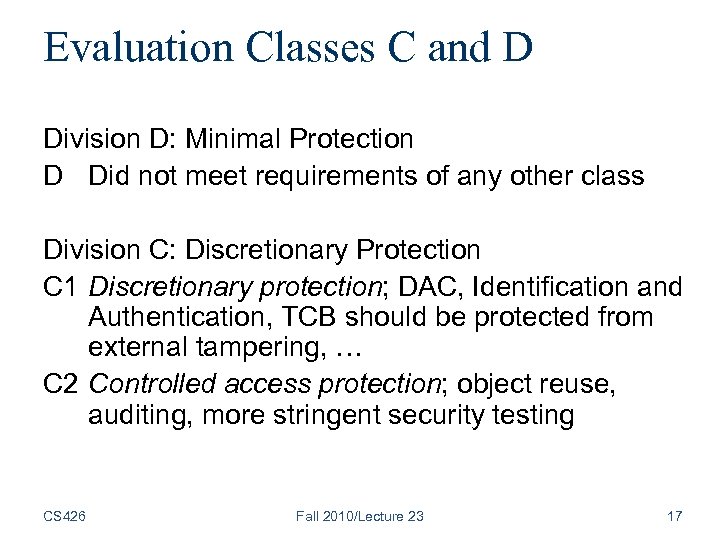 Evaluation Classes C and D Division D: Minimal Protection D Did not meet requirements of any other class Division C: Discretionary Protection C 1 Discretionary protection; DAC, Identification and Authentication, TCB should be protected from external tampering, … C 2 Controlled access protection; object reuse, auditing, more stringent security testing CS 426 Fall 2010/Lecture 23 17
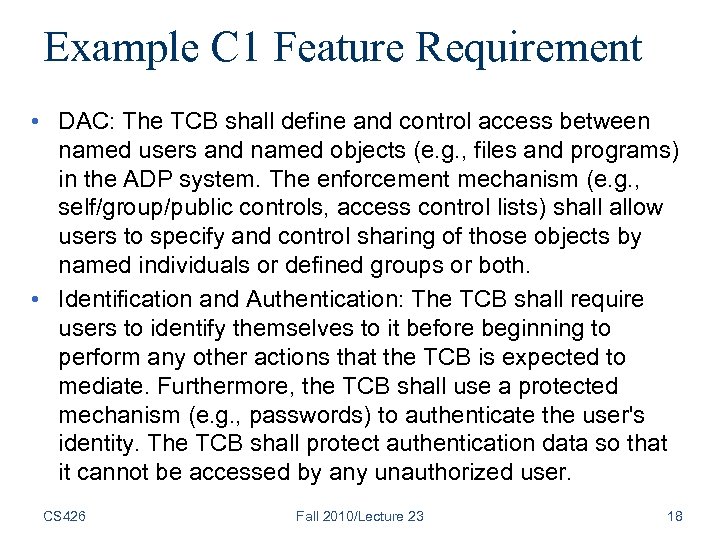 Example C 1 Feature Requirement • DAC: The TCB shall define and control access between named users and named objects (e. g. , files and programs) in the ADP system. The enforcement mechanism (e. g. , self/group/public controls, access control lists) shall allow users to specify and control sharing of those objects by named individuals or defined groups or both. • Identification and Authentication: The TCB shall require users to identify themselves to it before beginning to perform any other actions that the TCB is expected to mediate. Furthermore, the TCB shall use a protected mechanism (e. g. , passwords) to authenticate the user's identity. The TCB shall protect authentication data so that it cannot be accessed by any unauthorized user. CS 426 Fall 2010/Lecture 23 18
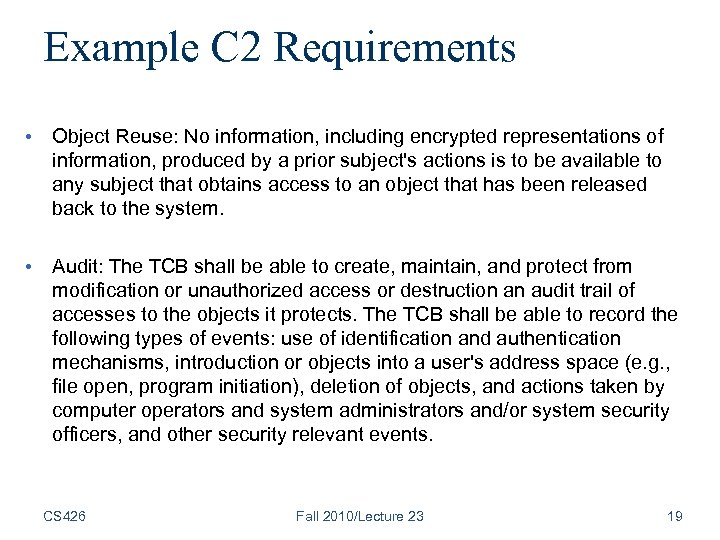 Example C 2 Requirements • Object Reuse: No information, including encrypted representations of information, produced by a prior subject's actions is to be available to any subject that obtains access to an object that has been released back to the system. • Audit: The TCB shall be able to create, maintain, and protect from modification or unauthorized access or destruction an audit trail of accesses to the objects it protects. The TCB shall be able to record the following types of events: use of identification and authentication mechanisms, introduction or objects into a user's address space (e. g. , file open, program initiation), deletion of objects, and actions taken by computer operators and system administrators and/or system security officers, and other security relevant events. CS 426 Fall 2010/Lecture 23 19
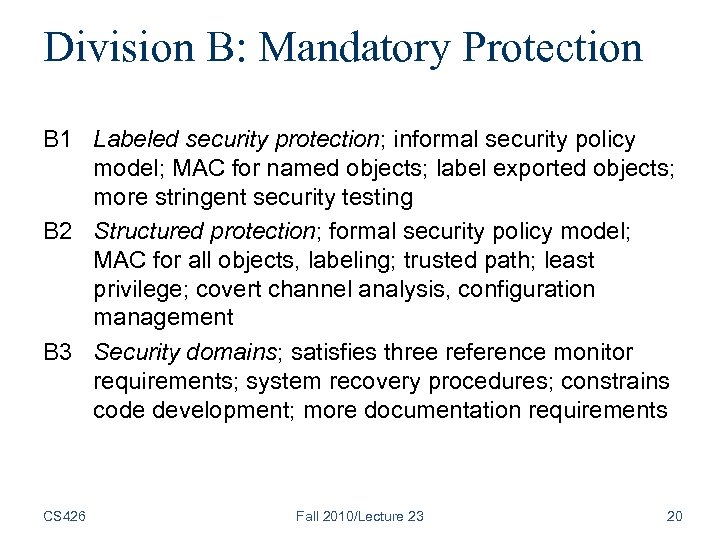 Division B: Mandatory Protection B 1 Labeled security protection; informal security policy model; MAC for named objects; label exported objects; more stringent security testing B 2 Structured protection; formal security policy model; MAC for all objects, labeling; trusted path; least privilege; covert channel analysis, configuration management B 3 Security domains; satisfies three reference monitor requirements; system recovery procedures; constrains code development; more documentation requirements CS 426 Fall 2010/Lecture 23 20
 Example B 1 Requirements • Labels: Sensitivity labels associated with each subject and storage object under its control (e. g. , process, file, segment, device) shall be maintained by the TCB. These labels shall be used as the basis for mandatory access control decisions. • Design Specification and Verification: An informal or formal model of the security policy supported by the TCB shall be maintained over the life cycle of the ADP system and demonstrated to be consistent with its axioms. CS 426 Fall 2010/Lecture 23 21
 Example B 2 Requirement • Trusted Path: The TCB shall support a trusted communication path between itself and user for initial login and authentication. Communications via this path shall be initiated exclusively by a user • Covert Channel Analysis: The system developer shall conduct a thorough search for covert storage channels and make a determination (either by actual measurement or by engineering estimation) of the maximum bandwidth of each identified channel. CS 426 Fall 2010/Lecture 23 22
 Example B 3 Requirements • The class (B 3) TCB must satisfy the reference monitor requirements that it mediate all accesses of subjects to objects, be tamperproof, and be small enough to be subjected to analysis and tests. • Trusted Recovery: Procedures and/or mechanisms shall be provided to assure that, after an ADP system failure or other discontinuity, recovery without a protection compromise is obtained. CS 426 Fall 2010/Lecture 23 23
 Division A: Verification Protection A 1 Verified design; functionally equivalent to B 3, by require the use of formal methods for assurance; trusted distribution; code, formal top-level specification (FTLS) correspondence CS 426 Fall 2010/Lecture 23 24
 Requirement for Verified Design in A 1 • A formal model of the security policy must be clearly identified and documented, including a mathematical proof that the model is consistent and is sufficient to support the security policy. • An formal top-level specification (FTLS) must be produced. • The FTLS of the TCB must be shown to be consistent with the model by formal techniques where possible (i. e. , where verification tools exist) and informal ones otherwise. • The TCB implementation (i. e. , in hardware, firmware, and software) must be informally shown to be consistent with the FTLS. • Formal analysis techniques must be used to identify and analyze covert channels. Informal techniques may be used to identify covert timing channels. CS 426 Fall 2010/Lecture 23 25
 Limitations • Written for operating systems – NCSC introduced “interpretations” for other things such as networks (Trusted Network Interpretation, the Red Book), databases (Trusted Database Interpretation, the Purple or Lavender Book) • Focuses on BLP – Most commercial firms do not need MAC • Does not address data integrity or availability – Critical to commercial firms • Combine functionality and assurance in a single linear scale CS 426 Fall 2010/Lecture 23 26
 Contributions • Heightened awareness in commercial sector to computer security needs • Led to wave of new approaches to evaluation – As commercial firms could not use it for their products, some commercial firms began offering certifications • Basis for several other schemes, such as Federal Criteria, Common Criteria CS 426 Fall 2010/Lecture 23 27
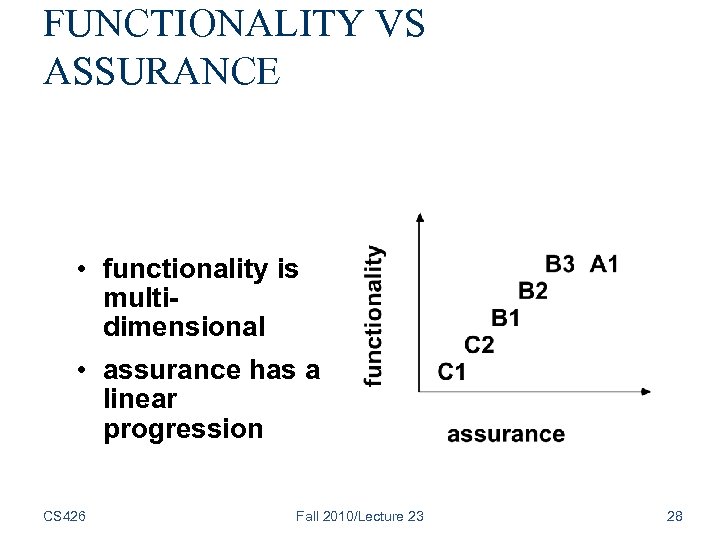 FUNCTIONALITY VS ASSURANCE • functionality is multidimensional • assurance has a linear progression CS 426 Fall 2010/Lecture 23 28
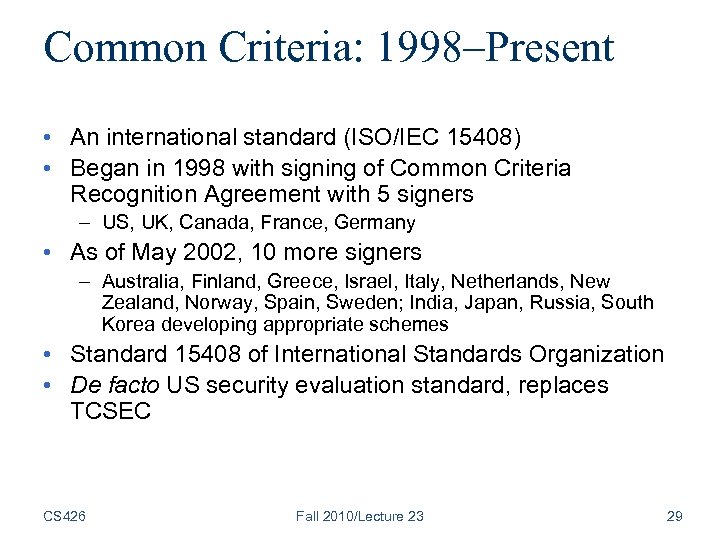 Common Criteria: 1998–Present • An international standard (ISO/IEC 15408) • Began in 1998 with signing of Common Criteria Recognition Agreement with 5 signers – US, UK, Canada, France, Germany • As of May 2002, 10 more signers – Australia, Finland, Greece, Israel, Italy, Netherlands, New Zealand, Norway, Spain, Sweden; India, Japan, Russia, South Korea developing appropriate schemes • Standard 15408 of International Standards Organization • De facto US security evaluation standard, replaces TCSEC CS 426 Fall 2010/Lecture 23 29
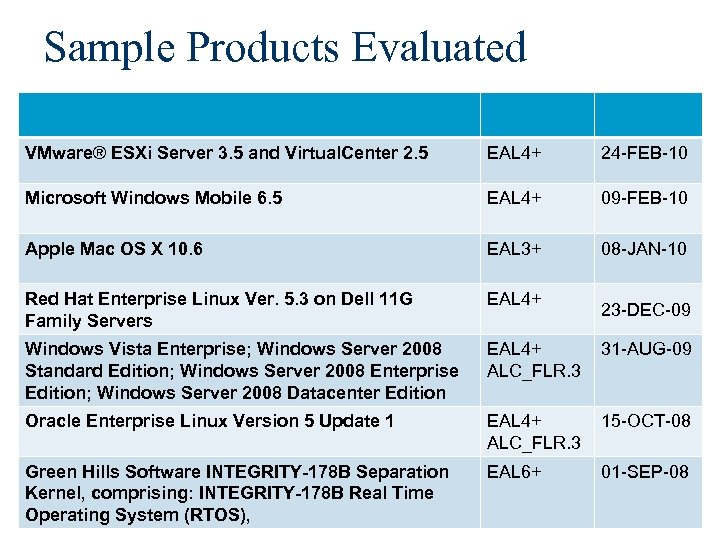 Sample Products Evaluated VMware® ESXi Server 3. 5 and Virtual. Center 2. 5 EAL 4+ 24 -FEB-10 Microsoft Windows Mobile 6. 5 EAL 4+ 09 -FEB-10 Apple Mac OS X 10. 6 EAL 3+ 08 -JAN-10 Red Hat Enterprise Linux Ver. 5. 3 on Dell 11 G Family Servers EAL 4+ Windows Vista Enterprise; Windows Server 2008 Standard Edition; Windows Server 2008 Enterprise Edition; Windows Server 2008 Datacenter Edition EAL 4+ ALC_FLR. 3 31 -AUG-09 Oracle Enterprise Linux Version 5 Update 1 EAL 4+ ALC_FLR. 3 15 -OCT-08 Green Hills Software INTEGRITY-178 B Separation Kernel, comprising: INTEGRITY-178 B Real Time Operating System (RTOS), CS 426 Fall 2010/Lecture 23 EAL 6+ 01 -SEP-08 23 -DEC-09 30
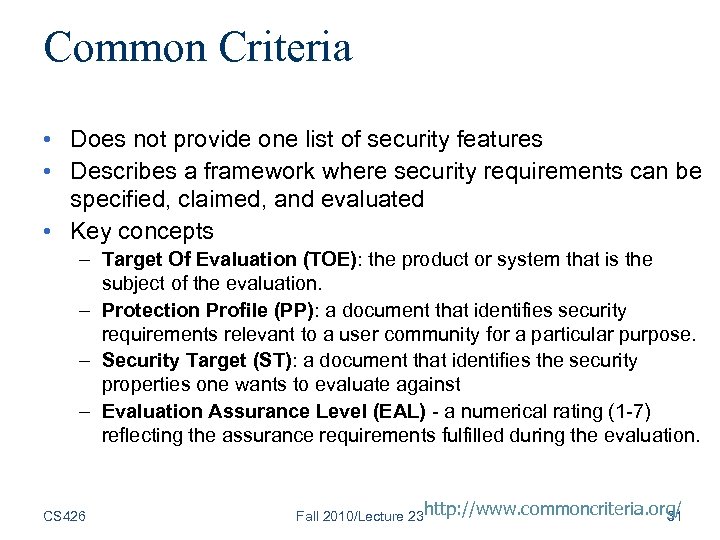 Common Criteria • Does not provide one list of security features • Describes a framework where security requirements can be specified, claimed, and evaluated • Key concepts – Target Of Evaluation (TOE): the product or system that is the subject of the evaluation. – Protection Profile (PP): a document that identifies security requirements relevant to a user community for a particular purpose. – Security Target (ST): a document that identifies the security properties one wants to evaluate against – Evaluation Assurance Level (EAL) - a numerical rating (1 -7) reflecting the assurance requirements fulfilled during the evaluation. CS 426 Fall 2010/Lecture 23 http: //www. commoncriteria. org/ 31
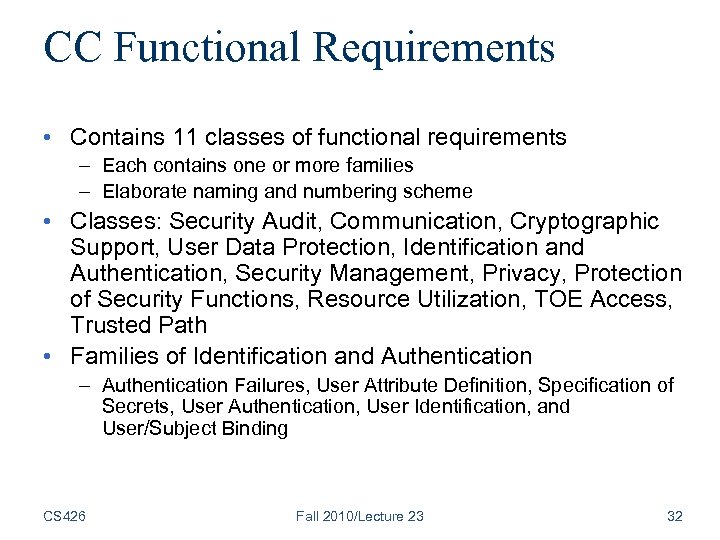 CC Functional Requirements • Contains 11 classes of functional requirements – Each contains one or more families – Elaborate naming and numbering scheme • Classes: Security Audit, Communication, Cryptographic Support, User Data Protection, Identification and Authentication, Security Management, Privacy, Protection of Security Functions, Resource Utilization, TOE Access, Trusted Path • Families of Identification and Authentication – Authentication Failures, User Attribute Definition, Specification of Secrets, User Authentication, User Identification, and User/Subject Binding CS 426 Fall 2010/Lecture 23 32
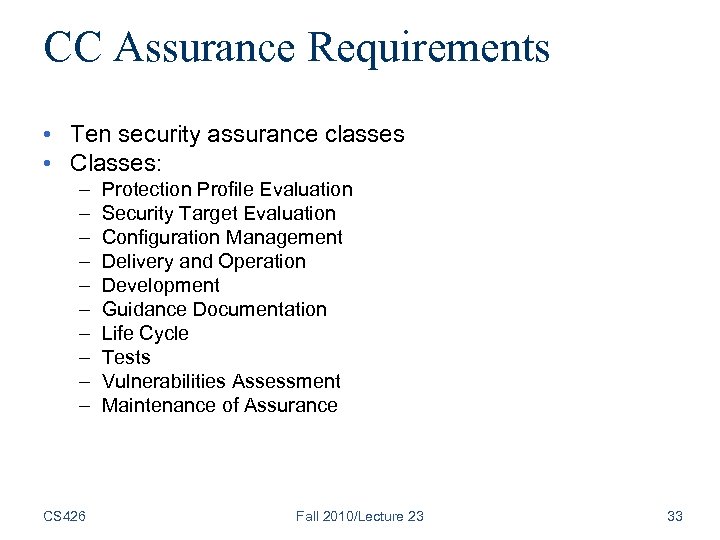 CC Assurance Requirements • Ten security assurance classes • Classes: – – – – – CS 426 Protection Profile Evaluation Security Target Evaluation Configuration Management Delivery and Operation Development Guidance Documentation Life Cycle Tests Vulnerabilities Assessment Maintenance of Assurance Fall 2010/Lecture 23 33
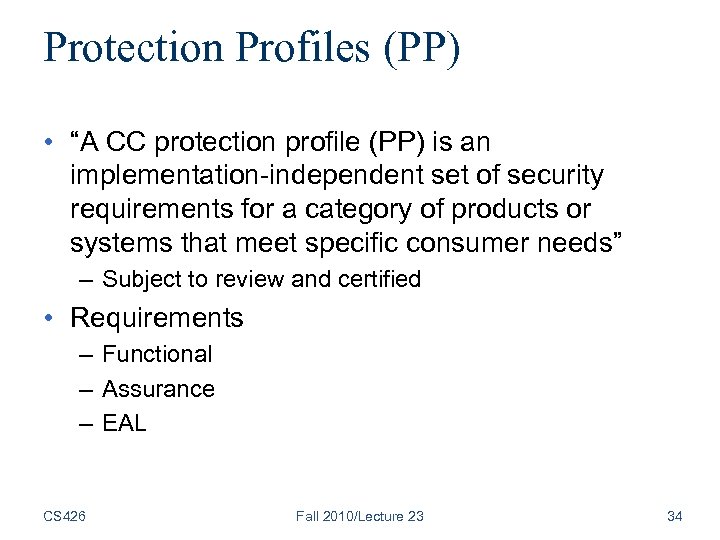 Protection Profiles (PP) • “A CC protection profile (PP) is an implementation-independent set of security requirements for a category of products or systems that meet specific consumer needs” – Subject to review and certified • Requirements – Functional – Assurance – EAL CS 426 Fall 2010/Lecture 23 34
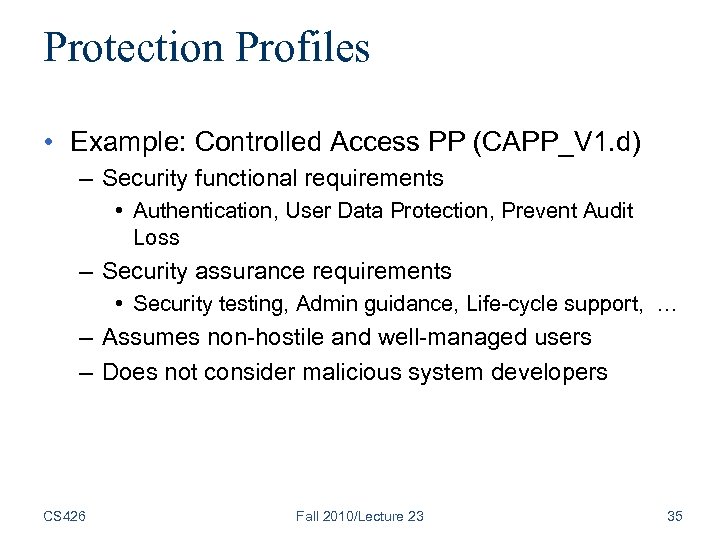 Protection Profiles • Example: Controlled Access PP (CAPP_V 1. d) – Security functional requirements • Authentication, User Data Protection, Prevent Audit Loss – Security assurance requirements • Security testing, Admin guidance, Life-cycle support, … – Assumes non-hostile and well-managed users – Does not consider malicious system developers CS 426 Fall 2010/Lecture 23 35
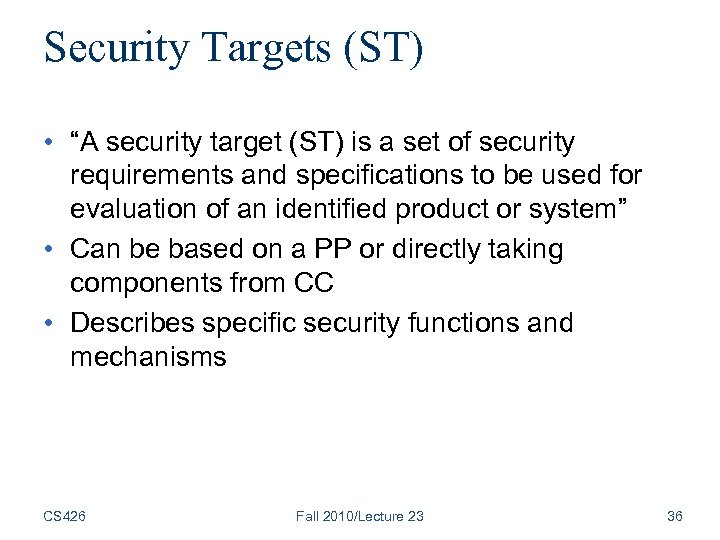 Security Targets (ST) • “A security target (ST) is a set of security requirements and specifications to be used for evaluation of an identified product or system” • Can be based on a PP or directly taking components from CC • Describes specific security functions and mechanisms CS 426 Fall 2010/Lecture 23 36
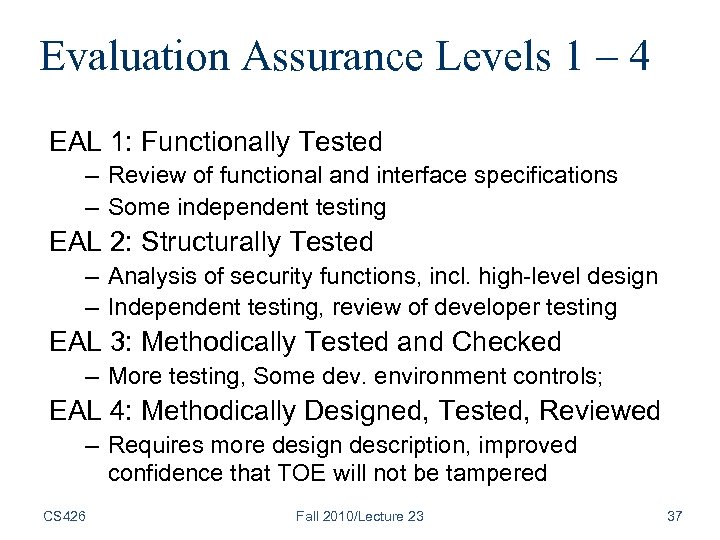 Evaluation Assurance Levels 1 – 4 EAL 1: Functionally Tested – Review of functional and interface specifications – Some independent testing EAL 2: Structurally Tested – Analysis of security functions, incl. high-level design – Independent testing, review of developer testing EAL 3: Methodically Tested and Checked – More testing, Some dev. environment controls; EAL 4: Methodically Designed, Tested, Reviewed – Requires more design description, improved confidence that TOE will not be tampered CS 426 Fall 2010/Lecture 23 37
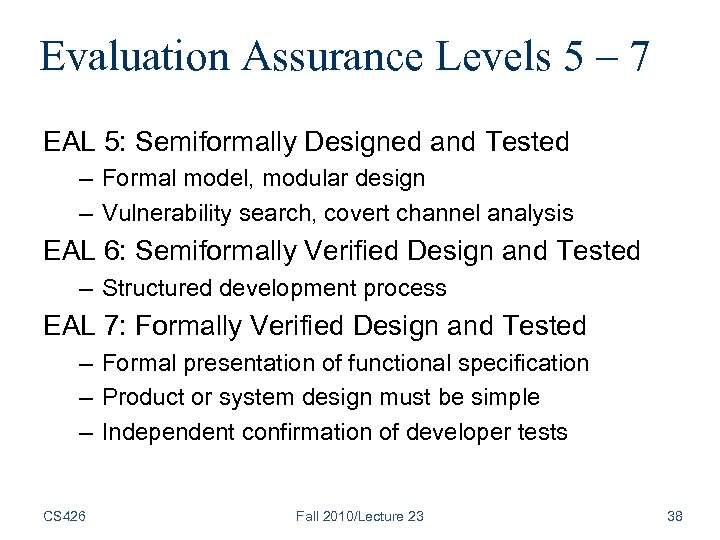 Evaluation Assurance Levels 5 – 7 EAL 5: Semiformally Designed and Tested – Formal model, modular design – Vulnerability search, covert channel analysis EAL 6: Semiformally Verified Design and Tested – Structured development process EAL 7: Formally Verified Design and Tested – Formal presentation of functional specification – Product or system design must be simple – Independent confirmation of developer tests CS 426 Fall 2010/Lecture 23 38
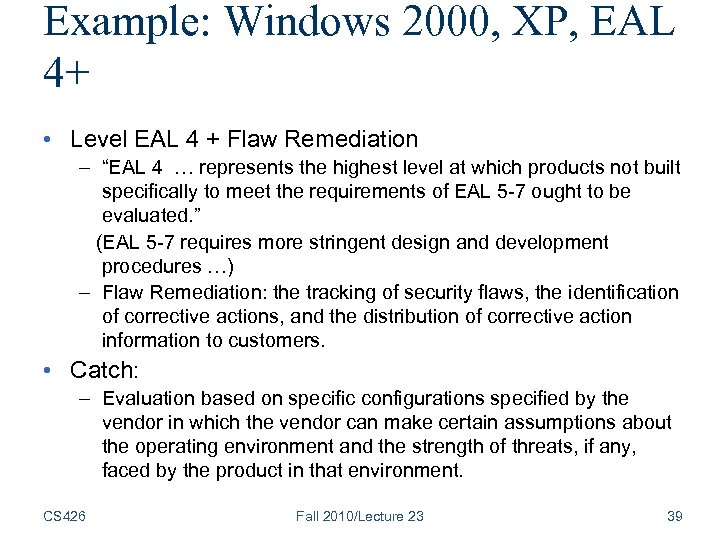 Example: Windows 2000, XP, EAL 4+ • Level EAL 4 + Flaw Remediation – “EAL 4 … represents the highest level at which products not built specifically to meet the requirements of EAL 5 -7 ought to be evaluated. ” (EAL 5 -7 requires more stringent design and development procedures …) – Flaw Remediation: the tracking of security flaws, the identification of corrective actions, and the distribution of corrective action information to customers. • Catch: – Evaluation based on specific configurations specified by the vendor in which the vendor can make certain assumptions about the operating environment and the strength of threats, if any, faced by the product in that environment. CS 426 Fall 2010/Lecture 23 39
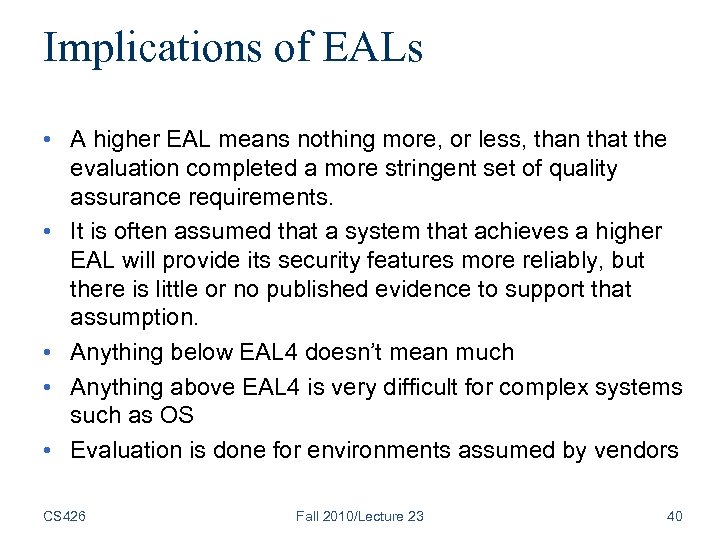 Implications of EALs • A higher EAL means nothing more, or less, than that the evaluation completed a more stringent set of quality assurance requirements. • It is often assumed that a system that achieves a higher EAL will provide its security features more reliably, but there is little or no published evidence to support that assumption. • Anything below EAL 4 doesn’t mean much • Anything above EAL 4 is very difficult for complex systems such as OS • Evaluation is done for environments assumed by vendors CS 426 Fall 2010/Lecture 23 40
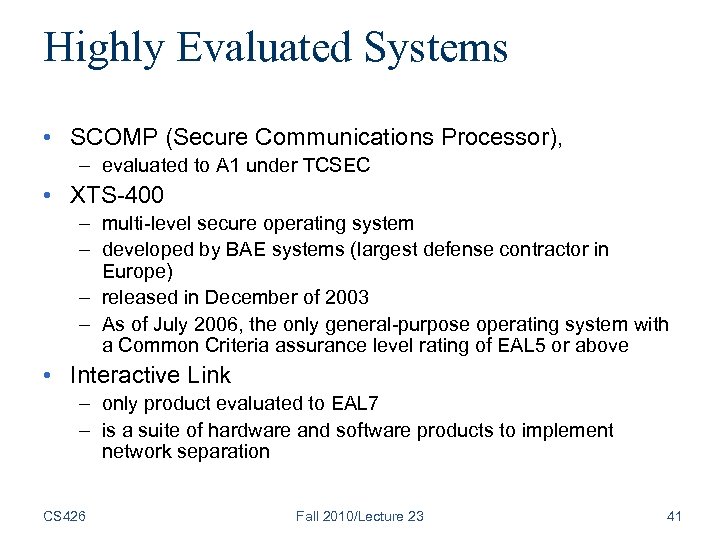 Highly Evaluated Systems • SCOMP (Secure Communications Processor), – evaluated to A 1 under TCSEC • XTS-400 – multi-level secure operating system – developed by BAE systems (largest defense contractor in Europe) – released in December of 2003 – As of July 2006, the only general-purpose operating system with a Common Criteria assurance level rating of EAL 5 or above • Interactive Link – only product evaluated to EAL 7 – is a suite of hardware and software products to implement network separation CS 426 Fall 2010/Lecture 23 41
 Criticism of CC: • Evaluation is a costly process (often measured in hundreds of thousands of US dollars) -- and the vendor's return on that investment is not necessarily a more secure product • Evaluation focuses primarily on assessing the evaluation documentation, not the product itself • The effort and time to prepare evaluation-related documentation is so cumbersome that by the time the work is completed, the product in evaluation is generally obsolete • Industry input, including that from organizations such as the Common Criteria Vendor's Forum, generally has little impact on the process as a whole CS 426 Fall 2010/Lecture 23 42
 Readings • Wikipedia topics: – trusted computing, trust computing group, trusted platform module (TPM) – trusted computing base, reference monitor – TCSEC, Common Criteria, Evaluation Assurance Level CS 426 Fall 2010/Lecture 23 43
 Readings for This Lecture • Wikipedia – – – CS 426 trusted computing base TCSEC Common Criteria, Evaluation Assurance Level Fall 2010/Lecture 23 44
 Coming Attractions … • Integrity Protection CS 426 Fall 2010/Lecture 23 45