 Скачать презентацию Computer Security CS 426 Lecture 11 Software Vulnerabilities
4a97e7e7ece044526e44b7c7084e11cb.ppt
- Количество слайдов: 40



Computer Security CS 426 Lecture 11 Software Vulnerabilities: Input Validation Issues & Buffer Overflows CS 426 Fall 2010/Lecture 11 1
Steps in a standard break-in (Getting in) • Get your foot in the door – – Steal a password file and run dictionary attack Try to guess a password online Sniff passwords off the network, social engineering Use input vulnerability in network-facing programs (e. g. , web server, ftp server, mail server, browser, etc. ) • Use partial access to gain root (admin) access – Break some mechanism on the system – Often involve exploiting vulnerabilities in some local programs CS 426 Fall 2010/Lecture 11 2
Steps in a standard break-in (After Getting in) • Set up some way to return – Install login program or web server with back door • Cover your tracks – Disable intrusion detection, virus protection, – Install rootkits, • Perform desired attacks – break into other machines – taking over the machine – Steal useful information (e. g. , credit card numbers) CS 426 Fall 2010/Lecture 11 3
Common Software Vulnerabilities • • • Input validation Buffer overflows Format string problems Integer overflows Race conditions… CS 426 Fall 2010/Lecture 11 4
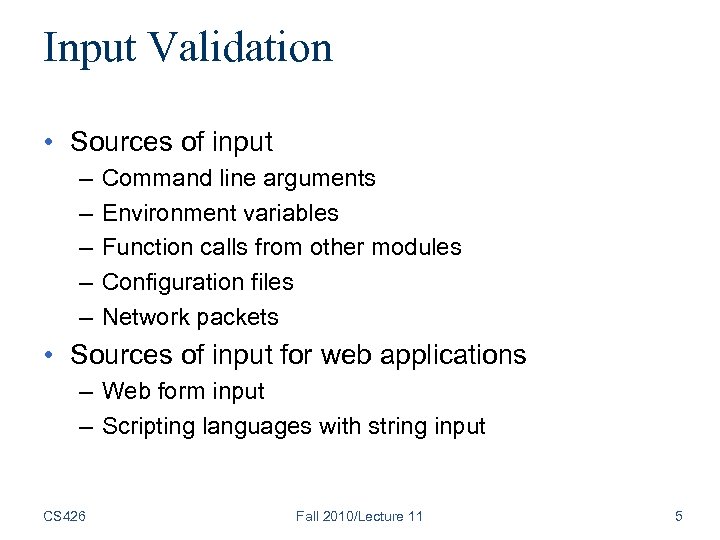
Input Validation • Sources of input – – – Command line arguments Environment variables Function calls from other modules Configuration files Network packets • Sources of input for web applications – Web form input – Scripting languages with string input CS 426 Fall 2010/Lecture 11 5
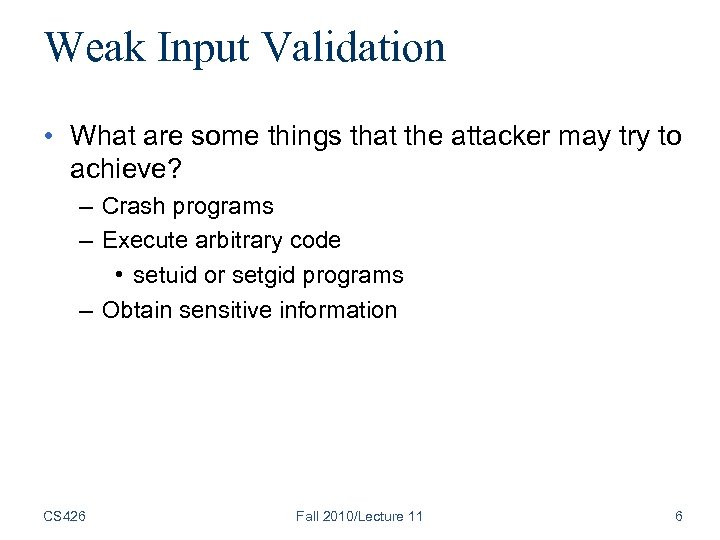
Weak Input Validation • What are some things that the attacker may try to achieve? – Crash programs – Execute arbitrary code • setuid or setgid programs – Obtain sensitive information CS 426 Fall 2010/Lecture 11 6
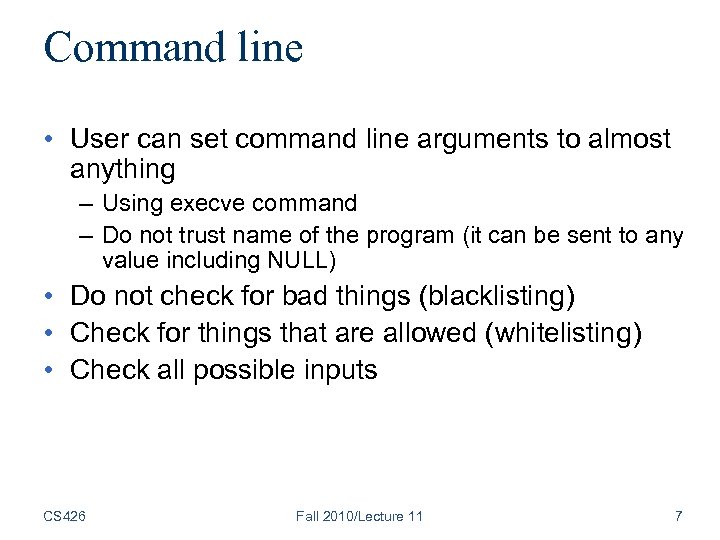
Command line • User can set command line arguments to almost anything – Using execve command – Do not trust name of the program (it can be sent to any value including NULL) • Do not check for bad things (blacklisting) • Check for things that are allowed (whitelisting) • Check all possible inputs CS 426 Fall 2010/Lecture 11 7
![Simple example void main(int argc, char ** argv) { char buf[1024]; sprintf(buf, ”cat %s”,](https://present5.com/presentation/4a97e7e7ece044526e44b7c7084e11cb/image-8.jpg "Simple example void main(int argc, char ** argv) { char buf[1024]; sprintf(buf, ”cat %s”,")
Simple example void main(int argc, char ** argv) { char buf[1024]; sprintf(buf, ”cat %s”, argv[1]); system (“buf”); } Can easily add things to the command by adding ; CS 426 Fall 2010/Lecture 11 8
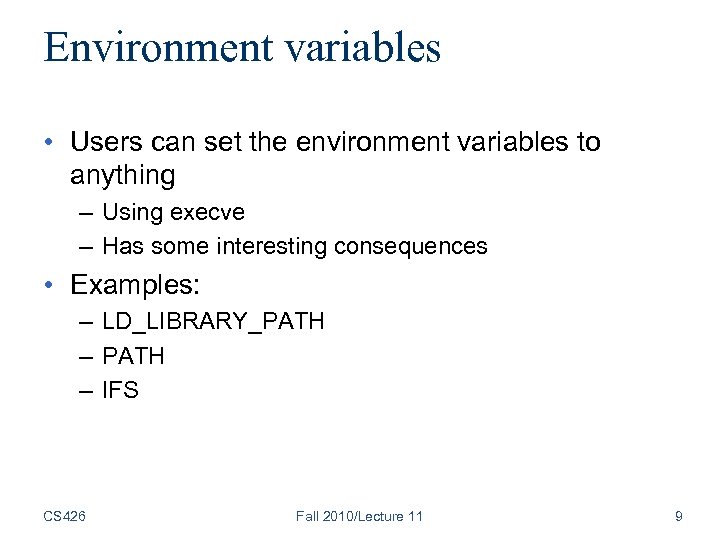
Environment variables • Users can set the environment variables to anything – Using execve – Has some interesting consequences • Examples: – LD_LIBRARY_PATH – IFS CS 426 Fall 2010/Lecture 11 9
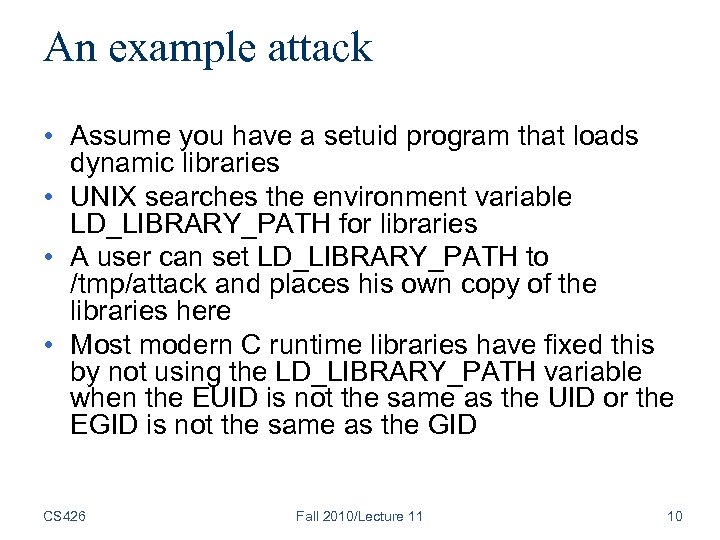
An example attack • Assume you have a setuid program that loads dynamic libraries • UNIX searches the environment variable LD_LIBRARY_PATH for libraries • A user can set LD_LIBRARY_PATH to /tmp/attack and places his own copy of the libraries here • Most modern C runtime libraries have fixed this by not using the LD_LIBRARY_PATH variable when the EUID is not the same as the UID or the EGID is not the same as the GID CS 426 Fall 2010/Lecture 11 10
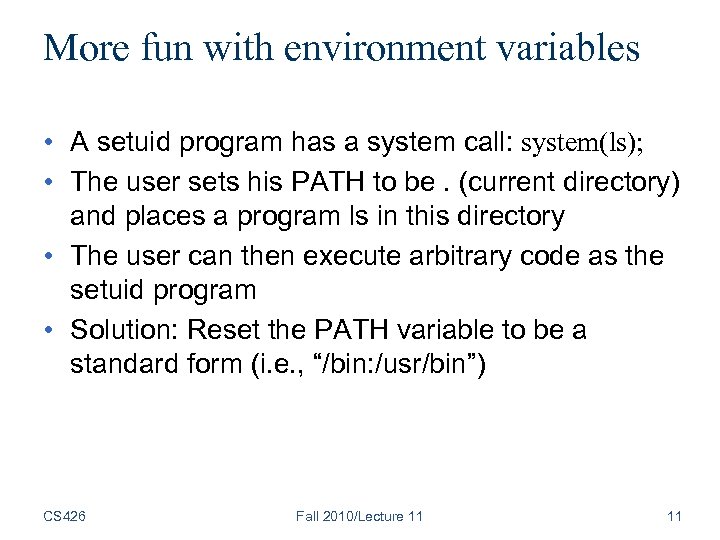
More fun with environment variables • A setuid program has a system call: system(ls); • The user sets his PATH to be. (current directory) and places a program ls in this directory • The user can then execute arbitrary code as the setuid program • Solution: Reset the PATH variable to be a standard form (i. e. , “/bin: /usr/bin”) CS 426 Fall 2010/Lecture 11 11
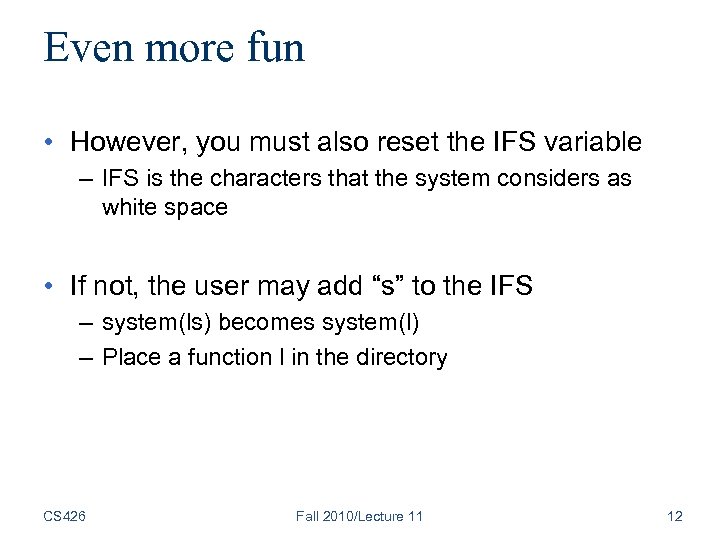
Even more fun • However, you must also reset the IFS variable – IFS is the characters that the system considers as white space • If not, the user may add “s” to the IFS – system(ls) becomes system(l) – Place a function l in the directory CS 426 Fall 2010/Lecture 11 12
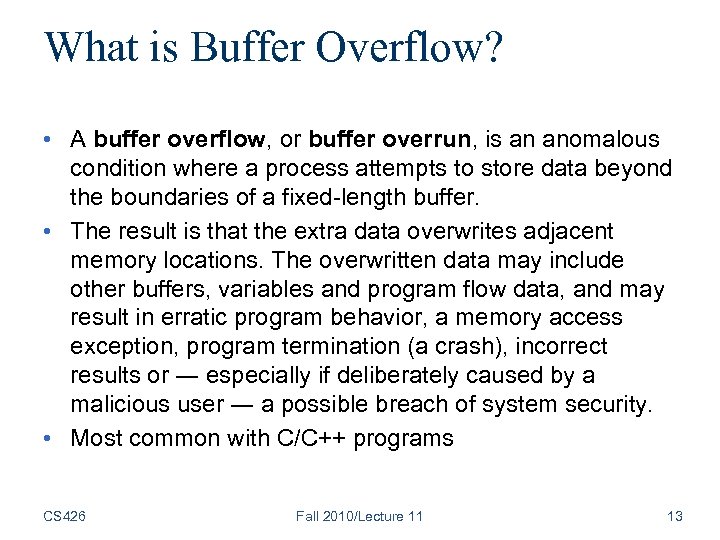
What is Buffer Overflow? • A buffer overflow, or buffer overrun, is an anomalous condition where a process attempts to store data beyond the boundaries of a fixed-length buffer. • The result is that the extra data overwrites adjacent memory locations. The overwritten data may include other buffers, variables and program flow data, and may result in erratic program behavior, a memory access exception, program termination (a crash), incorrect results or ― especially if deliberately caused by a malicious user ― a possible breach of system security. • Most common with C/C++ programs CS 426 Fall 2010/Lecture 11 13
History • Used in 1988’s Morris Internet Worm • Alphe One’s “Smashing The Stack For Fun And Profit” in Phrack Issue 49 in 1996 popularizes stack buffer overflows • Still extremely common today CS 426 Fall 2010/Lecture 11 14
What is needed to understand Buffer Overflow • • Understanding C functions and the stack. Some familiarity with machine code. Know how systems calls are made. The exec() system call. • Attacker needs to know which CPU and OS are running on the target machine. – Our examples are for x 86 running Linux. – Details vary slightly between CPU’s and OS: • Stack growth direction. • big endian vs. little endian. CS 426 Fall 2010/Lecture 11 15

Buffer Overflow • Stack overflow – Shell code – Return-to-libc • Overflow sets ret-addr to address of libc function – Off-by-one – Overflow function pointers & longjmp buffers • Heap overflow CS 426 Fall 2010/Lecture 11 16
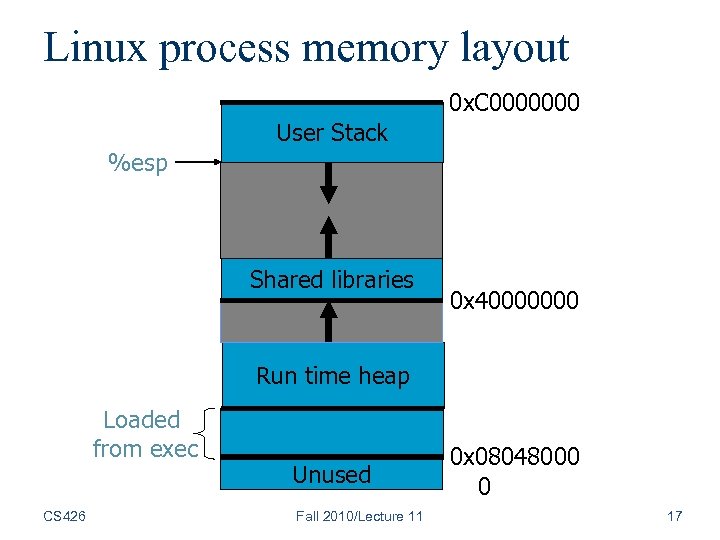
Linux process memory layout 0 x. C 0000000 User Stack %esp Shared libraries 0 x 40000000 Run time heap Loaded from exec CS 426 Unused Fall 2010/Lecture 11 0 x 08048000 0 17
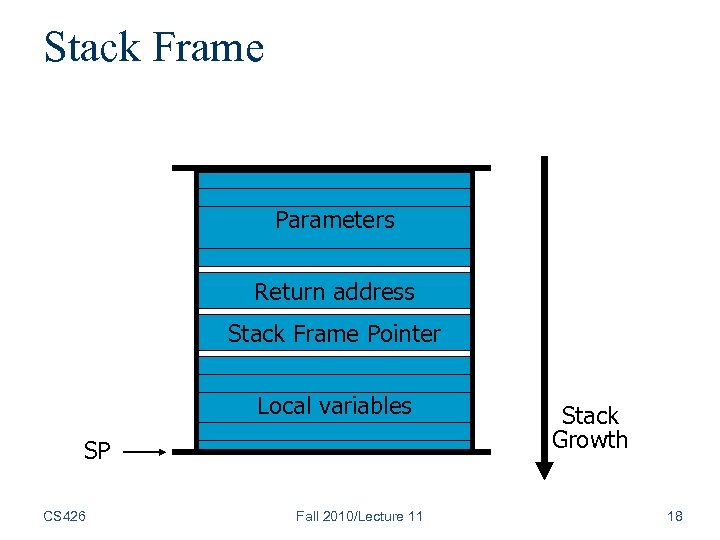
Stack Frame Parameters Return address Stack Frame Pointer Local variables SP CS 426 Fall 2010/Lecture 11 Stack Growth 18
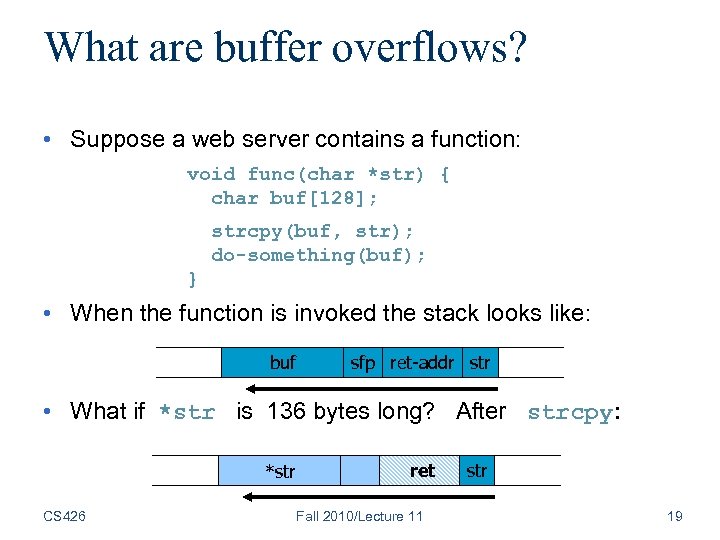
What are buffer overflows? • Suppose a web server contains a function: void func(char *str) { char buf[128]; strcpy(buf, str); do-something(buf); } • When the function is invoked the stack looks like: buf sfp ret-addr str • What if *str is 136 bytes long? After strcpy: *str CS 426 ret Fall 2010/Lecture 11 str 19
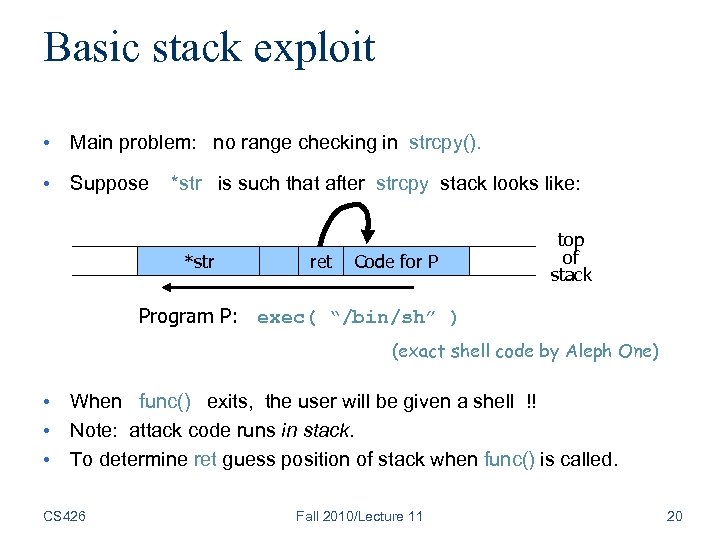
Basic stack exploit • Main problem: no range checking in strcpy(). • Suppose *str is such that after strcpy stack looks like: *str ret Code for P top of stack Program P: exec( “/bin/sh” ) (exact shell code by Aleph One) • When func() exits, the user will be given a shell !! • Note: attack code runs in stack. • To determine ret guess position of stack when func() is called. CS 426 Fall 2010/Lecture 11 20
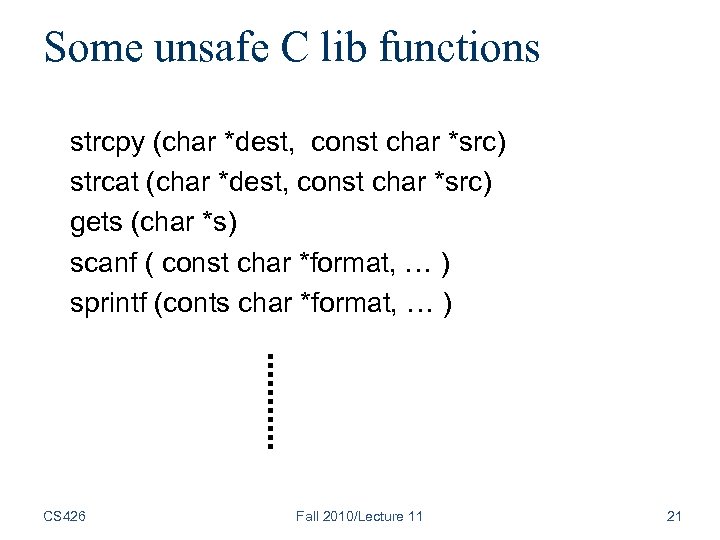
Some unsafe C lib functions strcpy (char *dest, const char *src) strcat (char *dest, const char *src) gets (char *s) scanf ( const char *format, … ) sprintf (conts char *format, … ) CS 426 Fall 2010/Lecture 11 21
Exploiting buffer overflows • Suppose web server calls func() with given URL. • Attacker can create a 200 byte URL to obtain shell on web server. • Some complications for stack overflows: – Program P should not contain the ‘’ character. – Overflow should not crash program before func() exits. CS 426 Fall 2010/Lecture 11 22

Other control hijacking opportunities • Stack smashing attack: – Override return address in stack activation record by overflowing a local buffer variable. • Function pointers: (used in attack on PHP 4. 0. 2) buf[128] Func. Ptr Heap or stack – Overflowing buf will override function pointer. • Longjmp buffers: longjmp(pos) (used in attack on Perl 5. 003) – Overflowing buf next to pos overrides value of pos. CS 426 Fall 2010/Lecture 11 23
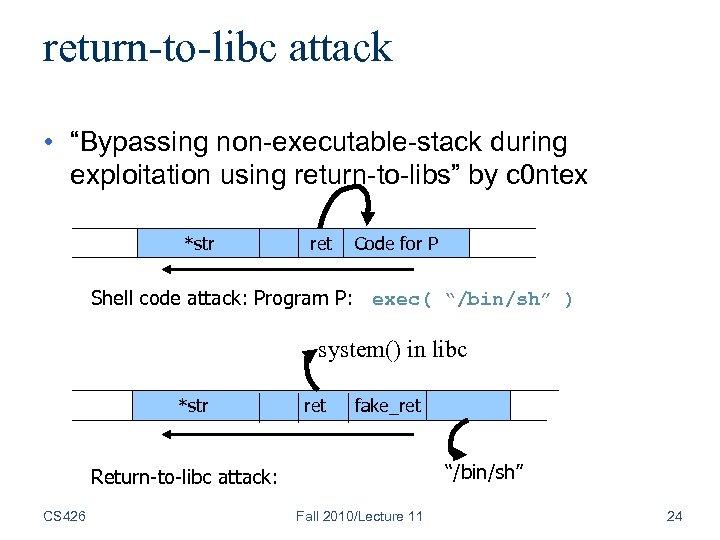
return-to-libc attack • “Bypassing non-executable-stack during exploitation using return-to-libs” by c 0 ntex *str ret Code for P Shell code attack: Program P: exec( “/bin/sh” ) system() in libc *str ret fake_ret “/bin/sh” Return-to-libc attack: CS 426 Fall 2010/Lecture 11 24
![Off by one buffer overflow • Sample code func f(char *input) { char buf[LEN];](https://present5.com/presentation/4a97e7e7ece044526e44b7c7084e11cb/image-25.jpg "Off by one buffer overflow • Sample code func f(char *input) { char buf[LEN];")
Off by one buffer overflow • Sample code func f(char *input) { char buf[LEN]; if (strlen(input) <= LEN) { strcpy(buf, input) } } CS 426 Fall 2010/Lecture 11 25
Heap Overflow • Heap overflow is a general term that refers to overflow in data sections other than the stack – buffers that are dynamically allocated, e. g. , by malloc – statically initialized variables (data section) – uninitialized buffers (bss section) • Heap overflow may overwrite other date allocated on heap • By exploiting the behavior of memory management routines, may overwrite an arbitrary memory location with a small amount of data. – E. g. , Simple. Heap_free() does • hdr->next->prev : = hdr->next->prev; CS 426 Fall 2010/Lecture 11 26
Finding buffer overflows • Hackers find buffer overflows as follows: – Run web server on local machine. – Fuzzing: Issue requests with long tags. All long tags end with “$$$$$”. – If web server crashes, search core dump for “$$$$$” to find overflow location. • Some automated tools exist. (). • Then use disassemblers and debuggers (e. . g IDA-Pro) to construct exploit. CS 426 Fall 2010/Lecture 11 27
Preventing Buffer Overflow Attacks • • • Use type safe languages (Java, ML). Use safe library functions Static source code analysis. Non-executable stack Run time checking: Stack. Guard, Libsafe, Safe. C, (Purify). • Address space layout randomization. • Detection deviation of program behavior • Access control to control aftermath of attacks… (covered later in course) CS 426 Fall 2010/Lecture 11 28

Static source code analysis Statically check source code to detect buffer overflows. – Several consulting companies. • Main idea: automate the code review process. • Several tools exist: – Coverity (Engler et al. ): Test trust inconsistency. – Microsoft program analysis group: • PREfix: looks for fixed set of bugs (e. g. null ptr ref) • PREfast: local analysis to find idioms for prog errors. • Berkeley: Wagner, et al. Test constraint violations. • Find lots of bugs, but not all. – CS 426 Fall 2010/Lecture 11 29
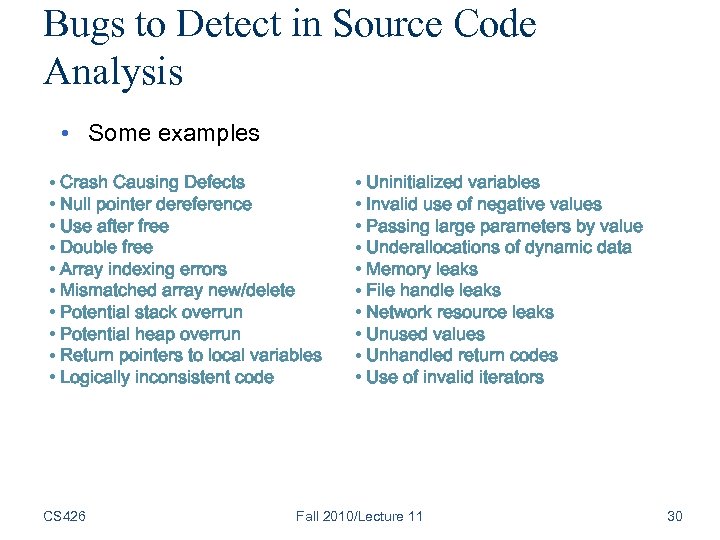
Bugs to Detect in Source Code Analysis • Some examples • Crash Causing Defects • Null pointer dereference • Use after free • Double free • Array indexing errors • Mismatched array new/delete • Potential stack overrun • Potential heap overrun • Return pointers to local variables • Logically inconsistent code CS 426 • Uninitialized variables • Invalid use of negative values • Passing large parameters by value • Underallocations of dynamic data • Memory leaks • File handle leaks • Network resource leaks • Unused values • Unhandled return codes • Use of invalid iterators Fall 2010/Lecture 11 30
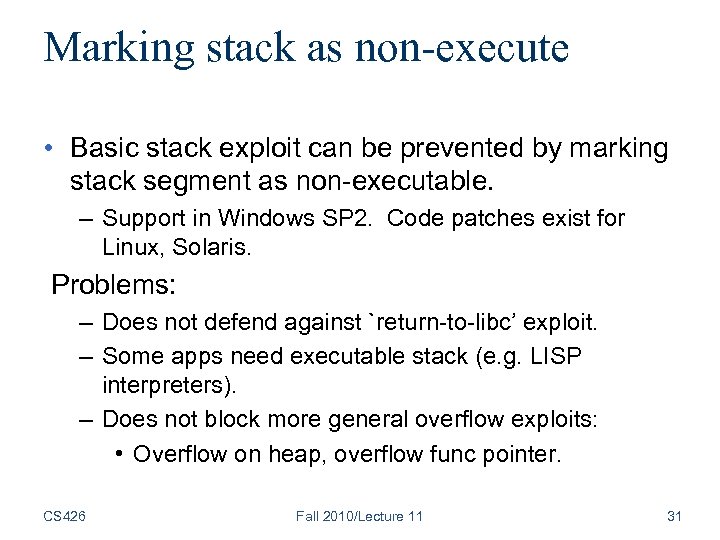
Marking stack as non-execute • Basic stack exploit can be prevented by marking stack segment as non-executable. – Support in Windows SP 2. Code patches exist for Linux, Solaris. Problems: – Does not defend against `return-to-libc’ exploit. – Some apps need executable stack (e. g. LISP interpreters). – Does not block more general overflow exploits: • Overflow on heap, overflow func pointer. CS 426 Fall 2010/Lecture 11 31
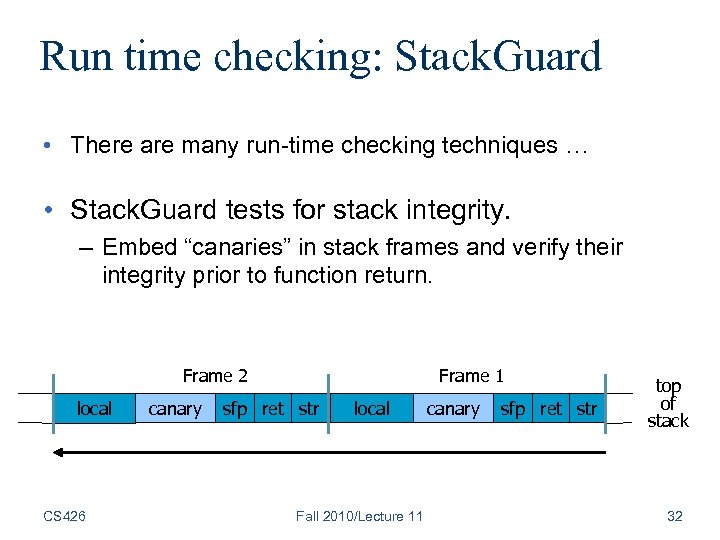
Run time checking: Stack. Guard • There are many run-time checking techniques … • Stack. Guard tests for stack integrity. – Embed “canaries” in stack frames and verify their integrity prior to function return. Frame 2 local CS 426 canary Frame 1 sfp ret str local Fall 2010/Lecture 11 canary sfp ret str top of stack 32
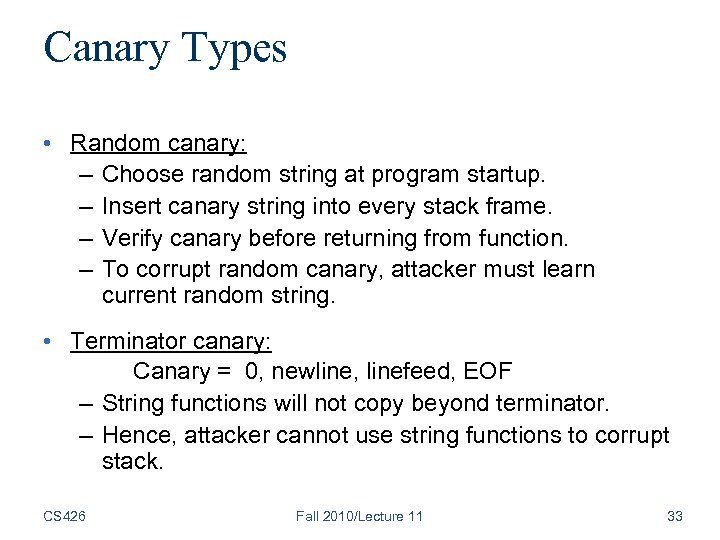
Canary Types • Random canary: – Choose random string at program startup. – Insert canary string into every stack frame. – Verify canary before returning from function. – To corrupt random canary, attacker must learn current random string. • Terminator canary: Canary = 0, newline, linefeed, EOF – String functions will not copy beyond terminator. – Hence, attacker cannot use string functions to corrupt stack. CS 426 Fall 2010/Lecture 11 33
Stack. Guard (Cont. ) • Stack. Guard implemented as a GCC patch. – Program must be recompiled. – Minimal performance effects: 8% for Apache. • Newer version: Point. Guard. – Protects function pointers and setjmp buffers by placing canaries next to them. – More noticeable performance effects. • Note: Canaries don’t offer fullproof protection. – Some stack smashing attacks can leave canaries untouched. CS 426 Fall 2010/Lecture 11 34
Randomization: Motivations. • Buffer overflow and return-to-libc exploits need to know the (virtual) address to which pass control – Address of attack code in the buffer – Address of a standard kernel library routine • Same address is used on many machines – Slammer infected 75, 000 MS-SQL servers using same code on every machine • Idea: introduce artificial diversity – Make stack addresses, addresses of library routines, etc. unpredictable and different from machine to machine CS 426 Fall 2010/Lecture 11 35
Address Space Layout Randomization • Arranging the positions of key data areas randomly in a process' address space. – e. g. , the base of the executable and position of libraries (libc), heap, and stack, – Effects: for return to libc, needs to know address of the key functions. – Attacks: • Repetitively guess randomized address • Spraying injected attack code • Vista has this enabled, software packages available for Linux and other UNIX variants CS 426 Fall 2010/Lecture 11 36
Instruction Set Randomization • Instruction Set Randomization (ISR) – Each program has a different and secret instruction set – Use translator to randomize instructions at load-time – Attacker cannot execute its own code. • What constitutes instruction set depends on the environment. – for binary code, it is CPU instruction – for interpreted program, it depends on the interpreter CS 426 Fall 2010/Lecture 11 37
Instruction Set Randomization • An implementation for x 86 using the Bochs emulator – network intensive applications doesn’t have too much performance overhead – CPU intensive applications have one to two orders of slow-down • Not yet used in practice CS 426 Fall 2010/Lecture 11 38
Readings for This Lecture • Wikipedia • • CS 426 Privilege escalation Buffer overflow Stack buffer overflow Buffer overflow protection Fall 2010/Lecture 11 39
Coming Attractions … • Other Software vulnerabilities CS 426 Fall 2010/Lecture 11 40
Скачать презентацию Computer Security CS 426 Lecture 11 Software Vulnerabilities
4a97e7e7ece044526e44b7c7084e11cb.ppt