


 Скачать презентацию Computer Science and Healthcare Synergy Howard Wactlar III
02c29faafc5e55183e8b4859278e735f.ppt
- Количество слайдов: 21
 Computer Science and Healthcare Synergy Howard Wactlar III PI Meeting, April 2010 Carnegie Mellon University Pittsburgh, USA
 Lessons (being) Learned Collaborating with Medical Practitioners Copyright © 2010
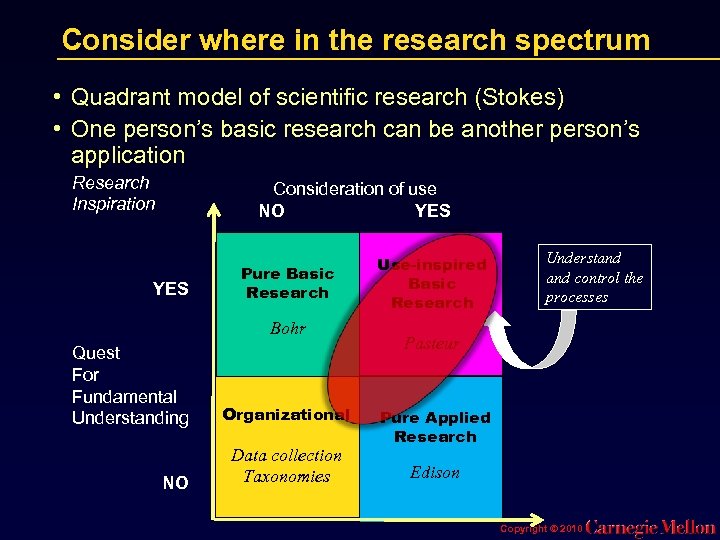 Consider where in the research spectrum • Quadrant model of scientific research (Stokes) • One person’s basic research can be another person’s application Research Inspiration Consideration of use NO YES Pure Basic Research Bohr Quest For Fundamental Understanding NO Organizational Data collection Taxonomies Use-inspired Basic Research Understand control the processes Pasteur Pure Applied Research Edison Copyright © 2010
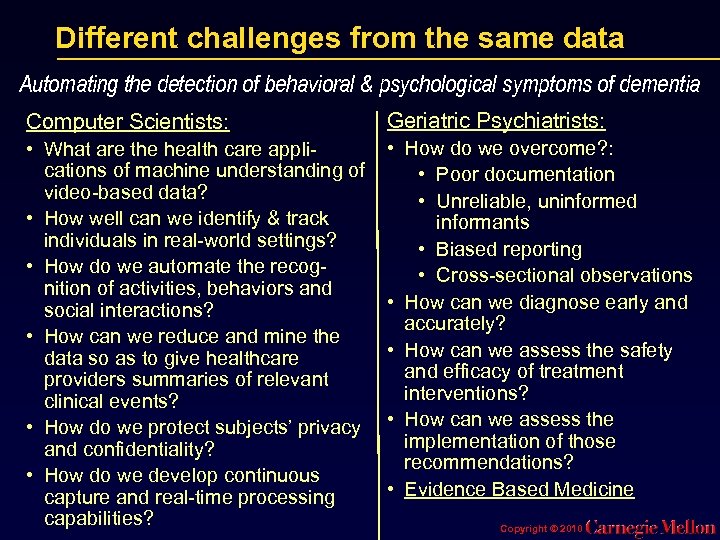 Different challenges from the same data Automating the detection of behavioral & psychological symptoms of dementia Computer Scientists: Geriatric Psychiatrists: • What are the health care applications of machine understanding of video-based data? • How well can we identify & track individuals in real-world settings? • How do we automate the recognition of activities, behaviors and social interactions? • How can we reduce and mine the data so as to give healthcare providers summaries of relevant clinical events? • How do we protect subjects’ privacy and confidentiality? • How do we develop continuous capture and real-time processing capabilities? • How do we overcome? : • Poor documentation • Unreliable, uninformed informants • Biased reporting • Cross-sectional observations • How can we diagnose early and accurately? • How can we assess the safety and efficacy of treatment interventions? • How can we assess the implementation of those recommendations? • Evidence Based Medicine Copyright © 2010
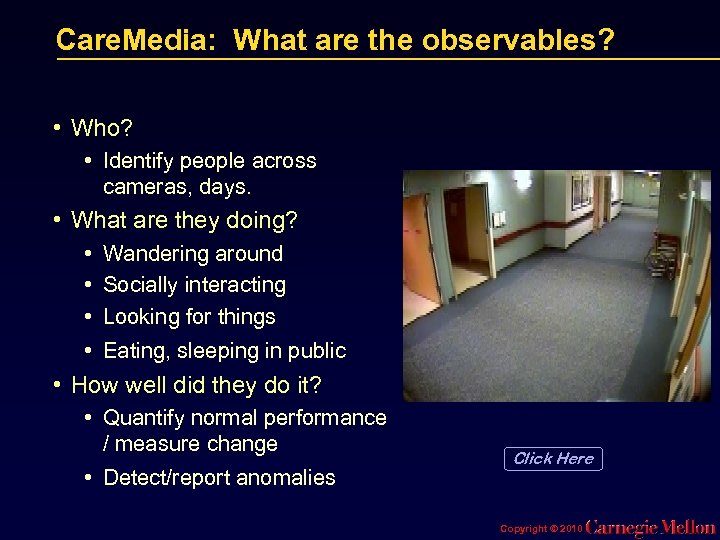 Care. Media: What are the observables? • Who? • Identify people across cameras, days. • What are they doing? • Wandering around • Socially interacting • Looking for things • Eating, sleeping in public • How well did they do it? • Quantify normal performance / measure change • Detect/report anomalies Click Here Copyright © 2010
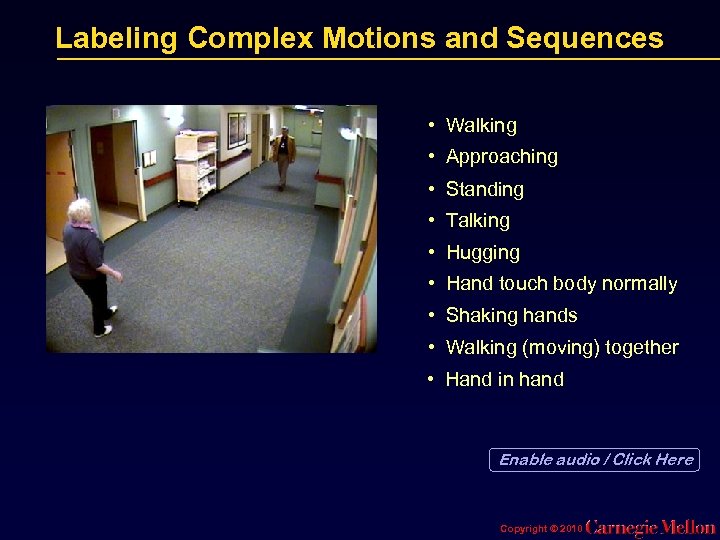 Labeling Complex Motions and Sequences • Walking • Approaching • Standing • Talking • Hugging • Hand touch body normally • Shaking hands • Walking (moving) together • Hand in hand Enable audio / Click Here Copyright © 2010
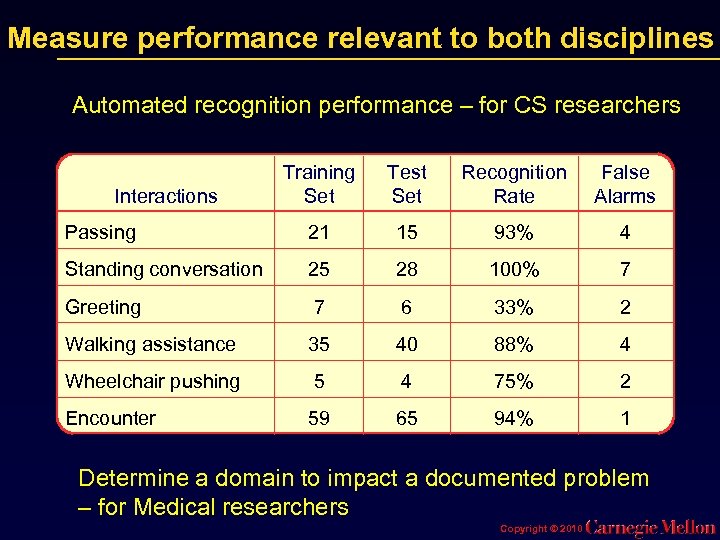 Measure performance relevant to both disciplines Automated recognition performance – for CS researchers Training Set Test Set Recognition Rate False Alarms Passing 21 15 93% 4 Standing conversation 25 28 100% 7 Greeting 7 6 33% 2 Walking assistance 35 40 88% 4 Wheelchair pushing 5 4 75% 2 Encounter 59 65 94% 1 Interactions Determine a domain to impact a documented problem – for Medical researchers Copyright © 2010
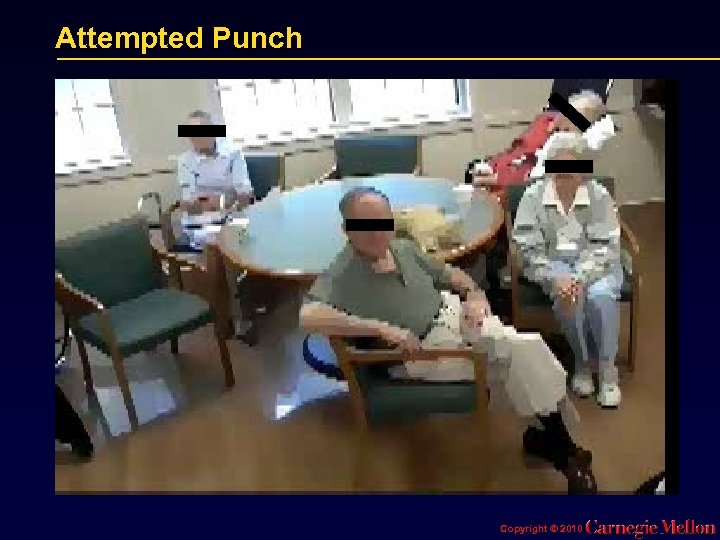
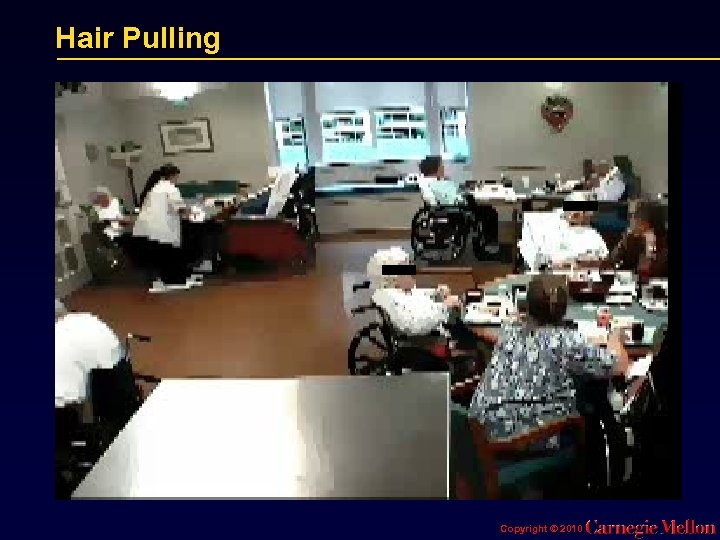
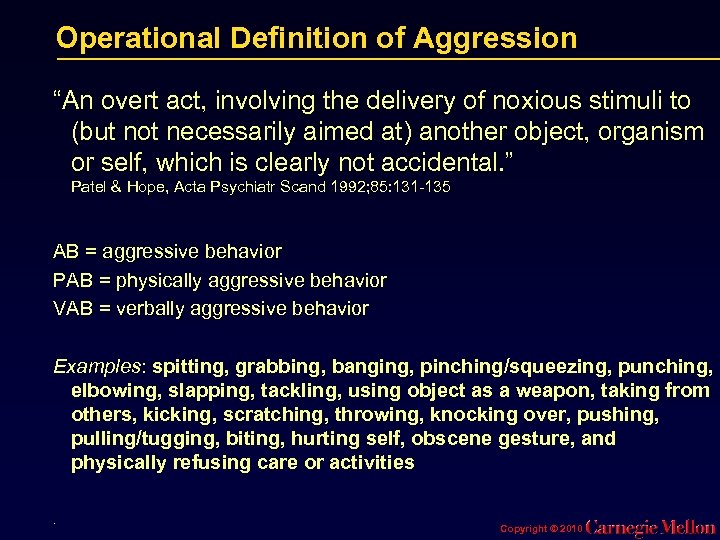 Operational Definition of Aggression “An overt act, involving the delivery of noxious stimuli to (but not necessarily aimed at) another object, organism or self, which is clearly not accidental. ” Patel & Hope, Acta Psychiatr Scand 1992; 85: 131 -135 AB = aggressive behavior PAB = physically aggressive behavior VAB = verbally aggressive behavior Examples: spitting, grabbing, banging, pinching/squeezing, punching, elbowing, slapping, tackling, using object as a weapon, taking from others, kicking, scratching, throwing, knocking over, pushing, pulling/tugging, biting, hurting self, obscene gesture, and physically refusing care or activities. Copyright © 2010
 Attempted Punch Copyright © 2010
 Hair Pulling Copyright © 2010
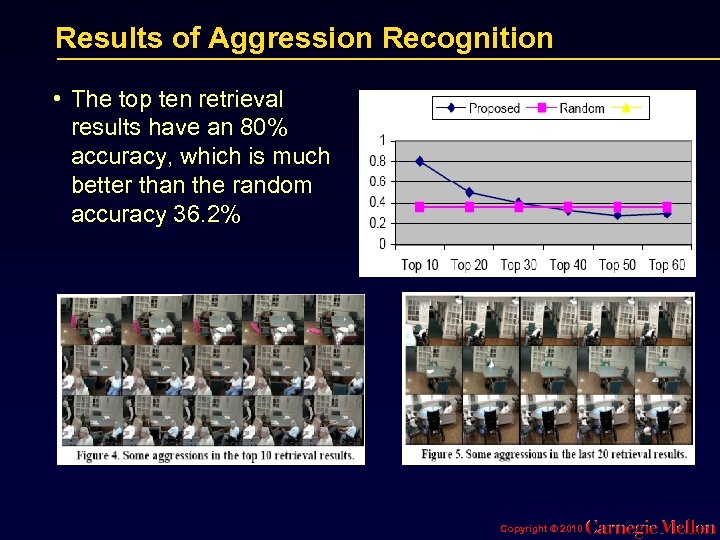 Results of Aggression Recognition • The top ten retrieval results have an 80% accuracy, which is much better than the random accuracy 36. 2% Copyright © 2010
 The Healthcare Crisis Copyright © 2010
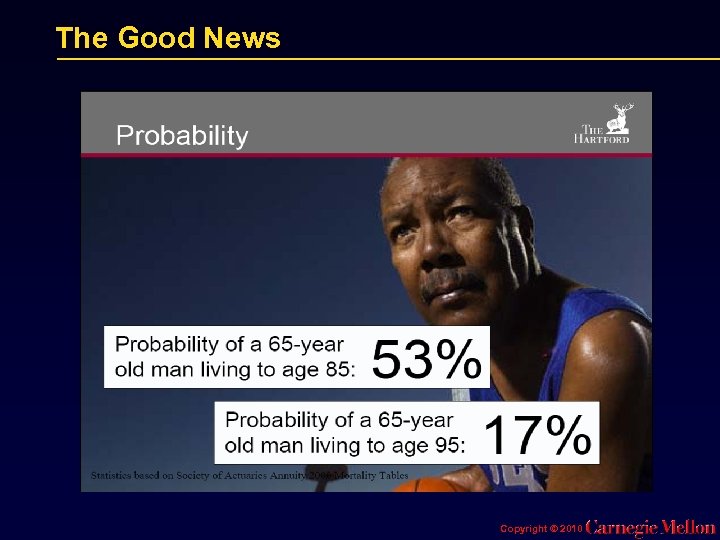 The Good News Copyright © 2010
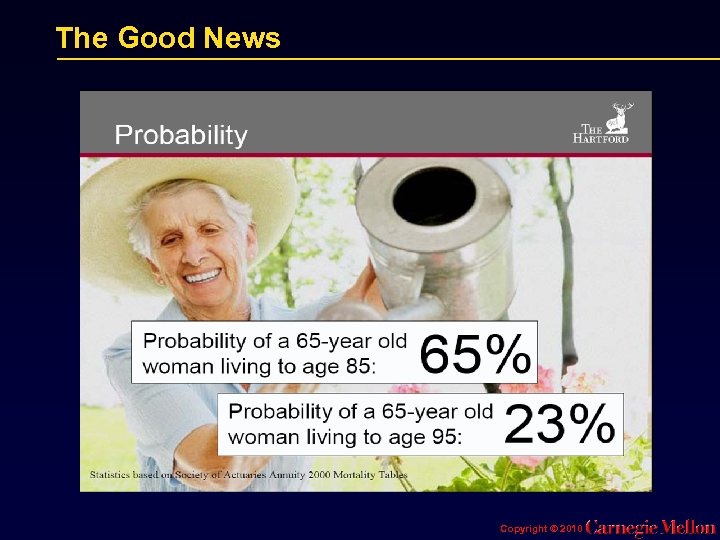 The Good News Copyright © 2010
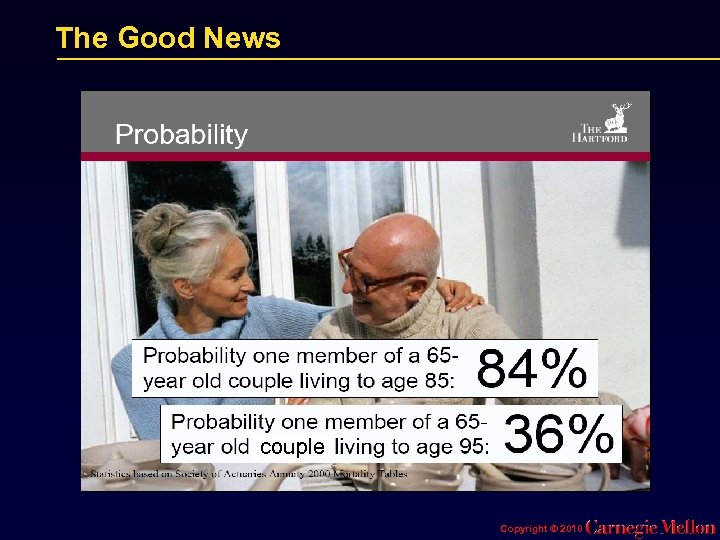 The Good News couple Copyright © 2010
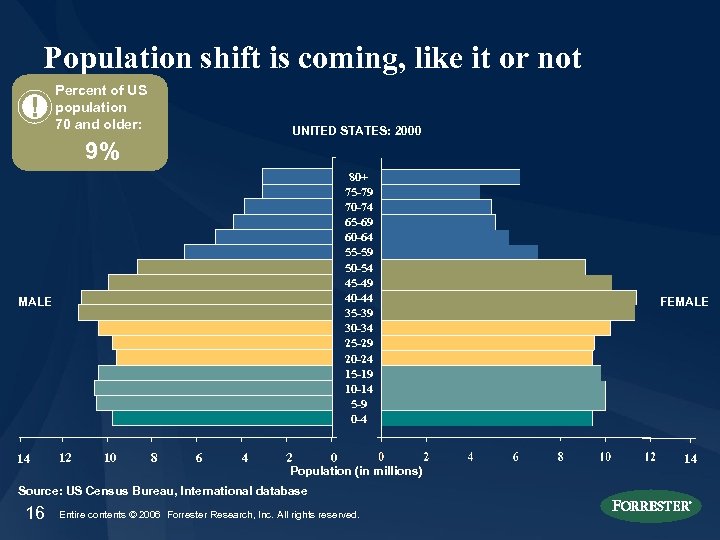 Population shift is coming, like it or not ! Percent of US population 70 and older: UNITED STATES: 2000 9% 80+ 75 -79 70 -74 65 -69 60 -64 55 -59 50 -54 45 -49 40 -44 35 -39 30 -34 25 -29 20 -24 15 -19 10 -14 5 -9 0 -4 MALE 14 12 10 8 6 4 2 0 Population (in millions) Source: US Census Bureau, International database 16 Entire contents © 2006 Forrester Research, Inc. All rights reserved. FEMALE 14
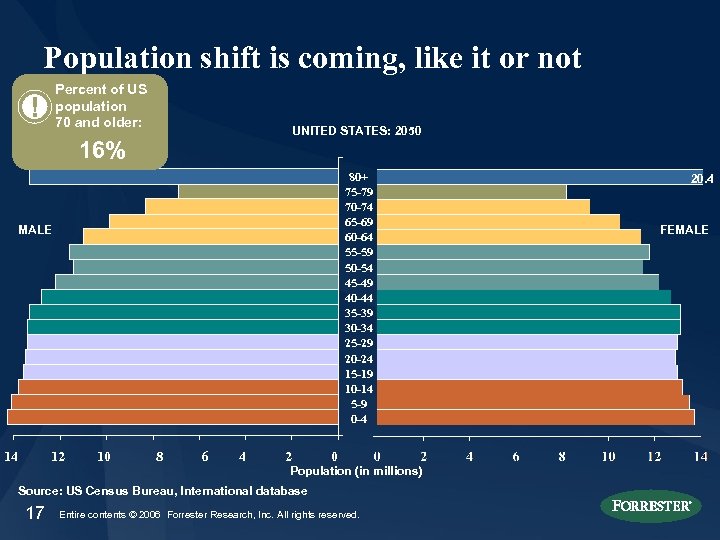 Population shift is coming, like it or not Percent of US population 70 and older: ! UNITED STATES: 2050 16% 80+ 75 -79 70 -74 65 -69 60 -64 55 -59 50 -54 45 -49 40 -44 35 -39 30 -34 25 -29 20 -24 15 -19 10 -14 5 -9 0 -4 MALE 14 12 10 8 6 4 2 0 Population (in millions) Source: US Census Bureau, International database 17 Entire contents © 2006 Forrester Research, Inc. All rights reserved. 20. 4 FEMALE
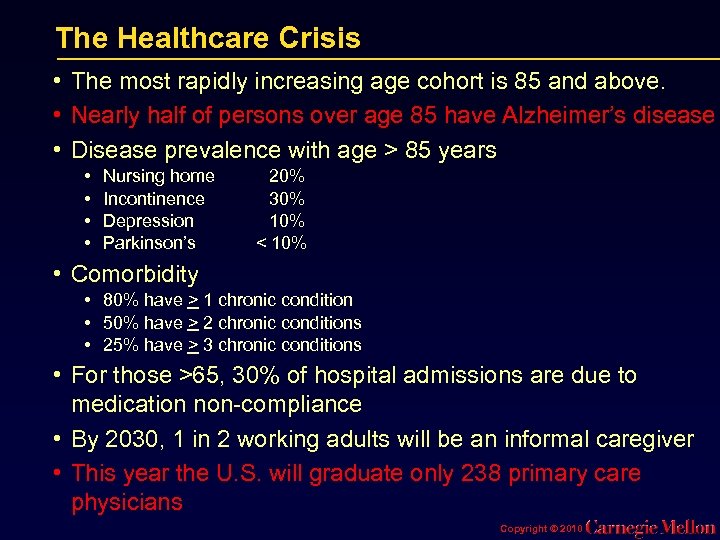 The Healthcare Crisis • The most rapidly increasing age cohort is 85 and above. • Nearly half of persons over age 85 have Alzheimer’s disease • Disease prevalence with age > 85 years • • Nursing home 20% Incontinence 30% Depression 10% Parkinson’s < 10% • Comorbidity • 80% have > 1 chronic condition • 50% have > 2 chronic conditions • 25% have > 3 chronic conditions • For those >65, 30% of hospital admissions are due to medication non-compliance • By 2030, 1 in 2 working adults will be an informal caregiver • This year the U. S. will graduate only 238 primary care physicians Copyright © 2010
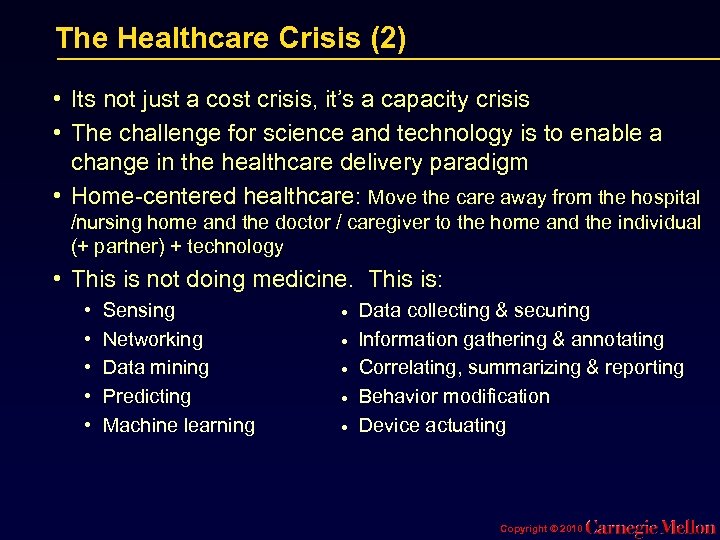 The Healthcare Crisis (2) • Its not just a cost crisis, it’s a capacity crisis • The challenge for science and technology is to enable a change in the healthcare delivery paradigm • Home-centered healthcare: Move the care away from the hospital /nursing home and the doctor / caregiver to the home and the individual (+ partner) + technology • This is not doing medicine. This is: • • • Sensing Networking Data mining Predicting Machine learning Data collecting & securing Information gathering & annotating Correlating, summarizing & reporting Behavior modification Device actuating Copyright © 2010
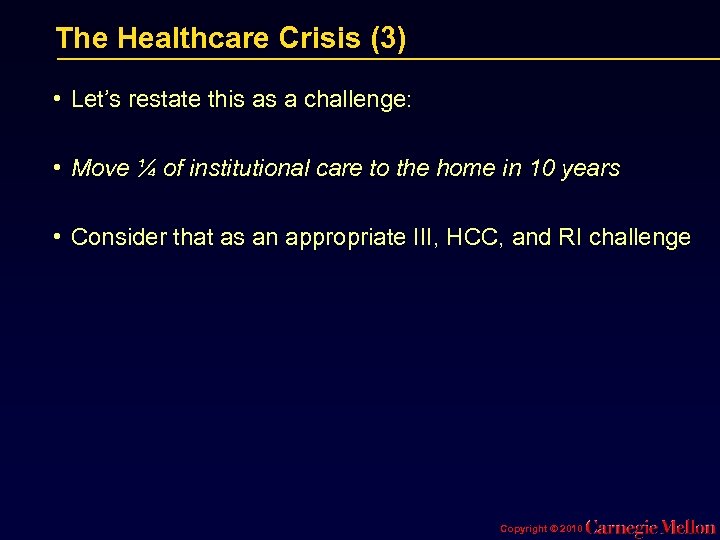 The Healthcare Crisis (3) • Let’s restate this as a challenge: • Move ¼ of institutional care to the home in 10 years • Consider that as an appropriate III, HCC, and RI challenge Copyright © 2010
 Thank You Questions ? Howard Wactlar III PI Meeting, April 2010 Carnegie Mellon University Pittsburgh, USA