


 Скачать презентацию Computer Organization Unit III Input output Organization Department of
6c11e5c869922c511abd90bc94e88e51.ppt
- Количество слайдов: 95
 Computer Organization Unit III: Input/output Organization Department of CSE, SSE Mukka www. bookspar. com | Website for students | VTU NOTES
 Accessing I/O Devices A simple arrangement to connect I/O devices to a computer it to use a single bus arrangement Bus consists of 3 sets of lines to carry address, data and control signals. Each I/O device is assigned a unique set of addresses The bus enables all the devices connected to it to exchange information When processor places address on the bus, the device that recognises this address responds to the commands issued on the control lines. When I/O devices and memory share the same address space, the arrangement is called as memory-mapped I/O www. bookspar. com | Website for students | VTU NOTES
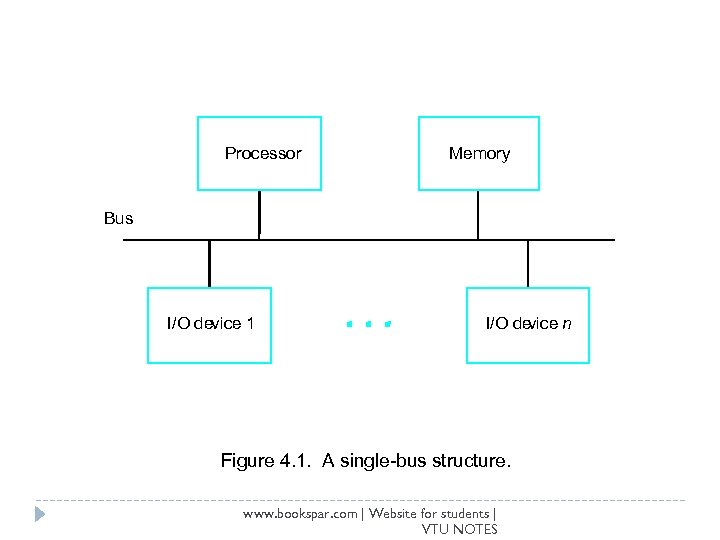 Processor Memory Bus I/O device 1 I/O de vice n Figure 4. 1. A single-bus structure. www. bookspar. com | Website for students | VTU NOTES
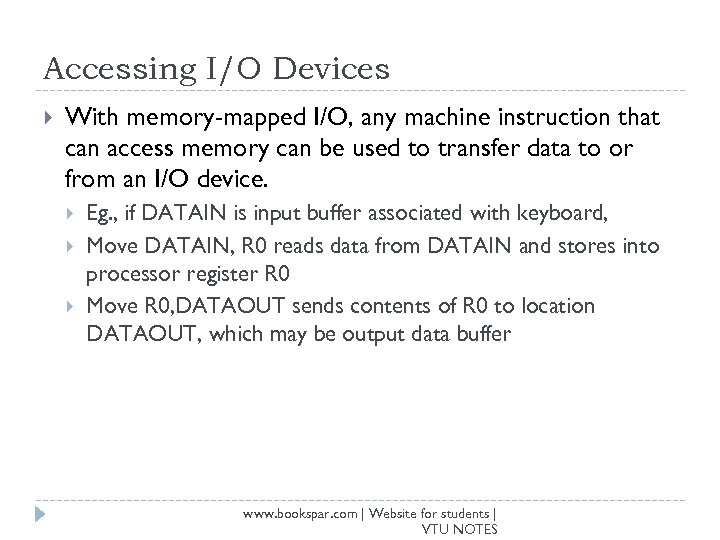 Accessing I/O Devices With memory-mapped I/O, any machine instruction that can access memory can be used to transfer data to or from an I/O device. Eg. , if DATAIN is input buffer associated with keyboard, Move DATAIN, R 0 reads data from DATAIN and stores into processor register R 0 Move R 0, DATAOUT sends contents of R 0 to location DATAOUT, which may be output data buffer www. bookspar. com | Website for students | VTU NOTES
 Contd… When I/O devices and memory share different address space, the arrangement is called as I/O-mapped I/O. E. g. , Processors like Intel Family, have separate In and Out instructions to perform I/O transfers One advantage of a separate I/O address space is I/O devices deal with a fewer address lines. I/O address lines need not be separate from memory address lines even if there are separate instructions for I/O In such cases a special signal on the bus indicates that it is an I/O operation. Memory ignores the requested transfer. The I/O devices examine the low-order bits of the address bus to determine whether they should respond. www. bookspar. com | Website for students | VTU NOTES
 Hardware devices required to connect an I/O device to the bus www. bookspar. com | Website for students | VTU NOTES
 I/O interface Address decoder – enables the device to recognize its address when this address appears on address lines The data register holds the data being transferred to/from the processor The status register contains information relevant to the operation of the I/O device Both the data and status registers are connected to the data bus and assigned unique addresses The address decoder, the data and the status registers, and the control circuitry required to coordinate I/O transfers constitute the device’s interface circuit www. bookspar. com | Website for students | VTU NOTES
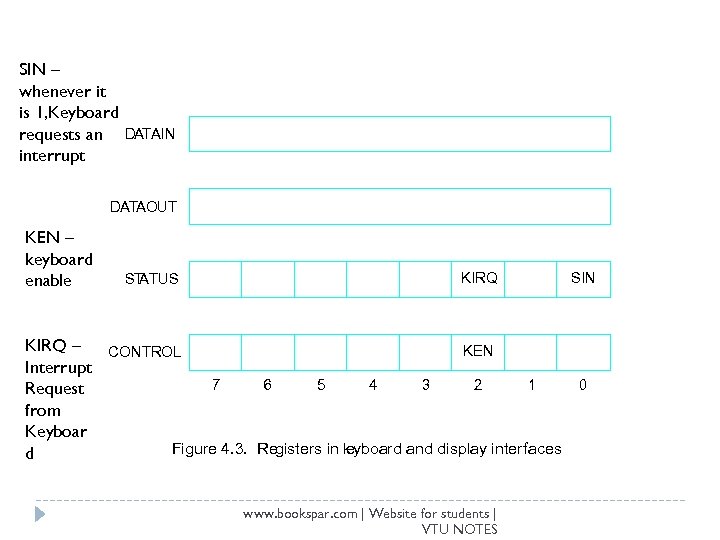
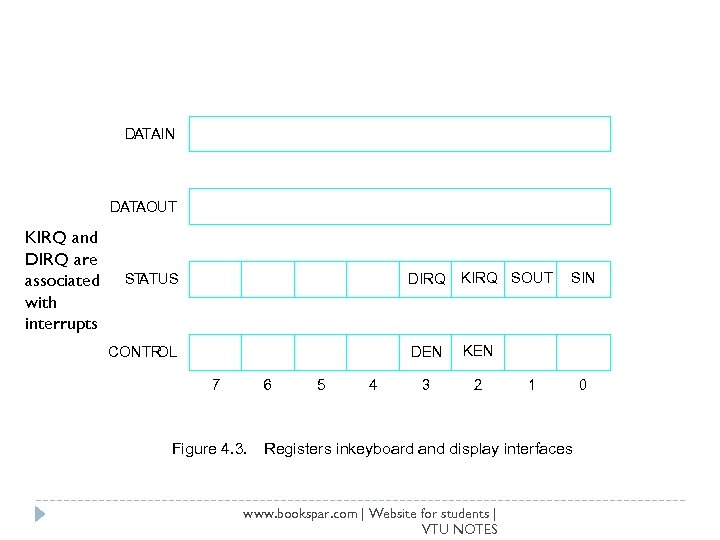 DATAIN DATAOUT KIRQ and DIRQ are associated with interrupts ST ATUS DIRQ KIRQ SOUT CONTR OL DEN KEN 3 2 7 6 Figure 4. 3. 5 4 SIN 1 Registers inkeyboard and display interfaces www. bookspar. com | Website for students | VTU NOTES 0
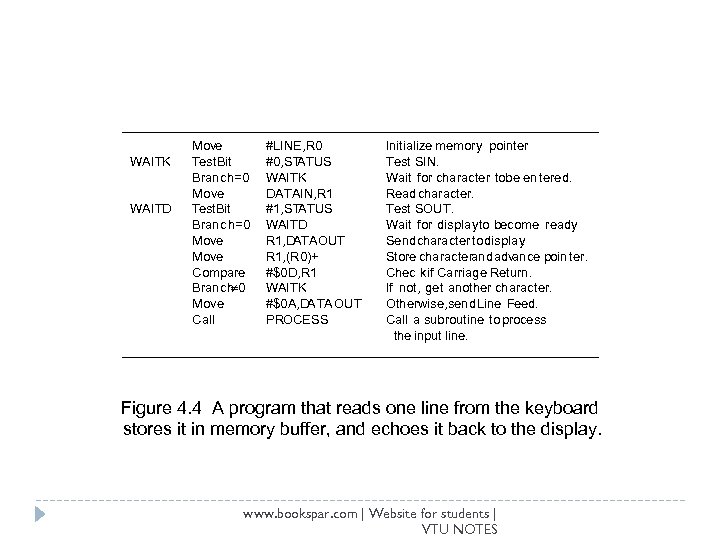 WAITK WAITD Move Test. Bit Branc h=0 Move Compare Branc h 0 Move Call #LINE, R 0 #0, ST ATUS WAITK DATAIN, R 1 #1, ST ATUS WAITD R 1, DATAOUT R 1, (R 0)+ #$0 D, R 1 WAITK #$0 A, DATA OUT PROCESS Initialize memory pointer Test SIN. Wait for character tobe en tered. Readcharacter. Test SOUT. Wait for displa yto become ready. Sendcharacter todispla y. Store characterandadv ance poin ter. Chec k if Carriage Return. If not, get another character. Otherwise, send. Line Feed. Call a subroutine to process the input line. Figure 4. 4 A program that reads one line from the keyboard stores it in memory buffer, and echoes it back to the display. www. bookspar. com | Website for students | VTU NOTES
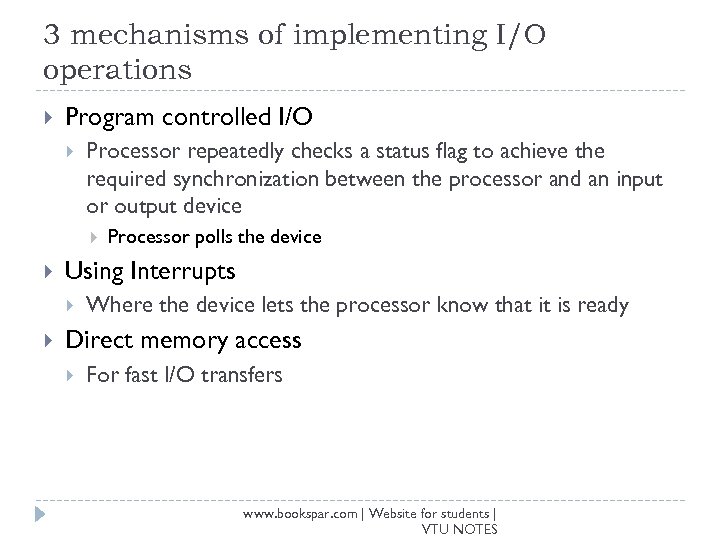 3 mechanisms of implementing I/O operations Program controlled I/O Processor repeatedly checks a status flag to achieve the required synchronization between the processor and an input or output device Using Interrupts Processor polls the device Where the device lets the processor know that it is ready Direct memory access For fast I/O transfers www. bookspar. com | Website for students | VTU NOTES
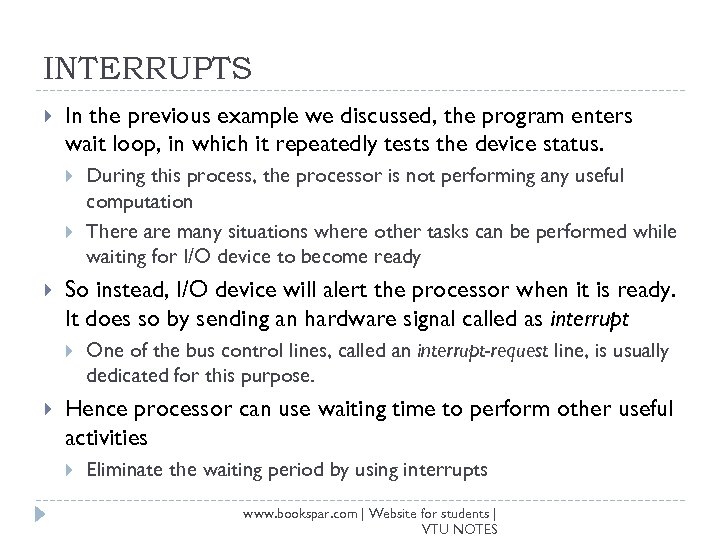 INTERRUPTS In the previous example we discussed, the program enters wait loop, in which it repeatedly tests the device status. So instead, I/O device will alert the processor when it is ready. It does so by sending an hardware signal called as interrupt During this process, the processor is not performing any useful computation There are many situations where other tasks can be performed while waiting for I/O device to become ready One of the bus control lines, called an interrupt-request line, is usually dedicated for this purpose. Hence processor can use waiting time to perform other useful activities Eliminate the waiting period by using interrupts www. bookspar. com | Website for students | VTU NOTES
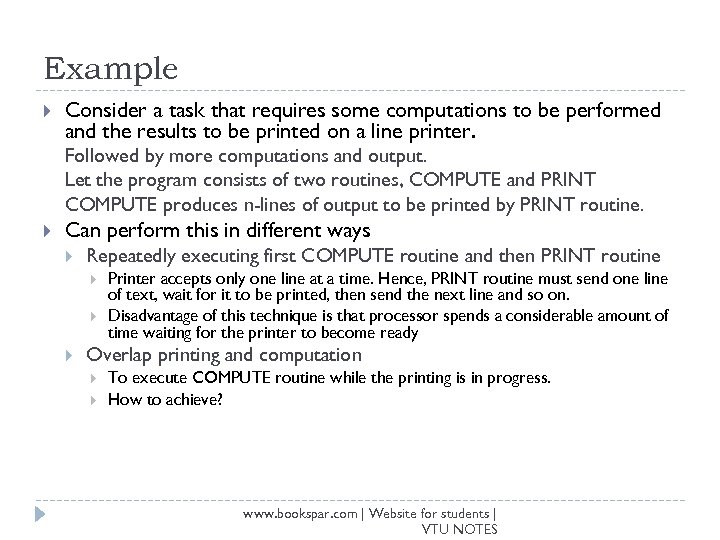 Example Consider a task that requires some computations to be performed and the results to be printed on a line printer. Followed by more computations and output. Let the program consists of two routines, COMPUTE and PRINT COMPUTE produces n-lines of output to be printed by PRINT routine. Can perform this in different ways Repeatedly executing first COMPUTE routine and then PRINT routine Printer accepts only one line at a time. Hence, PRINT routine must send one line of text, wait for it to be printed, then send the next line and so on. Disadvantage of this technique is that processor spends a considerable amount of time waiting for the printer to become ready Overlap printing and computation To execute COMPUTE routine while the printing is in progress. How to achieve? www. bookspar. com | Website for students | VTU NOTES
 COMPUTE routine is executed to produce n lines of output. PRINT routine executed to send the first line of text to the printer. Instead of waiting for this line to be printed, PRINT routine is temporarily suspended and execution of COMPUTE routine continued. Whenever the printer becomes ready, it alerts the processor by sending interrupt-request signal. The processor interrupts the execution of COMPUTE routine and transfers control to PRINT routine and the process is repeated If COMPUTE routine takes a longer time to generate n lines than the time required by PRINT routine to print them, the processor will be performing useful computations all the time. www. bookspar. com | Website for students | VTU NOTES
 www. bookspar. com | Website for students | VTU NOTES
 Interrupts contd. . The routine executed in response to an interrupt request is called the interrupt-service routine. In prev example, it was PRINT routine Interrupts bears considerable resemblance with subroutine calls Assume that an interrupt request arrives when the processor is processing ith instruction of COMPUTE routine. Processor first completes execution of ith instruction and loads the PC address with the address of the first instruction of the interrupt service routine After execution of the interrupt service routine, the processor has to come back to instruction i+1. So when an interrupt occurs, the current contents of PC must be kept in a temporary storage location A return from interrupt instruction will reload the PC with the contents of this temporary storage location, causing execution to resume at instruction i+1 in many processors return address is saved in processor stack. www. bookspar. com | Website for students | VTU NOTES
 Contd. . The processor must let the device know that its interrupt request has been acknowledged. So that it removes its interrupt request signal This can be accomplished by a special control signal on control bus called as interrupt-acknowledge signal. An alternative to accomplish this is to have transfer of data between processor and I/O device interface The execution of an instruction in the interrupt service routine that accesses a status or data register in the device interface implicitly informs the device that its interrupt request has been recognized. www. bookspar. com | Website for students | VTU NOTES
 Difference between an interrupt service routine and Subroutine A subroutine performs a function required by the program from which it is called. An interrupt service routine may not have anything in common with the program being executed at the time interrupt request is received. Often it belongs to 2 different users. Therefore before starting execution of ISR ( Interrupt service routine), any information that may be altered during the execution of interrupt must be saved. This information must be restored before execution of interrupted program is resumed. This information typically includes the condition code flags and the contents of any registers used by both the interrupted program and the interrupt-service routine. www. bookspar. com | Website for students | VTU NOTES
 Interrupt latency The task of saving and restoring information is done automatically by processor or by program instructions Most modern processors save only the minimum amount of information needed to maintain the integrity of program execution Because the process of saving and restoring registers involves memory transfers that increase total execution time ( execution overhead ) Saving registers increases the delay between the time interrupt request is received and the start of execution of interrupt-service routine. This delay is called as interrupt latency In some applications, longer interrupt latency is unacceptable. Hence keep the amount of information, saved automatically by the processor when an interrupt request is accepted, to a minimum. Typically processor saves only the PC and the processor status register Any additional info to be saved must be saved by the program instructions at the beginning of the interrupt-service routine and restored at the end of the routine www. bookspar. com | Website for students | VTU NOTES
 Registers retrieval Some processor with small no of registers saves automatically all processor registers automatically at the time an interrupt request is accepted Some computers provide 2 types of instructions One saves all processor registers Other does not ( may save only part ) Another approach is to provide duplicate set of processor registers Another set of registers used by interrupt service routine, hence no need to save and restore processor registers www. bookspar. com | Website for students | VTU NOTES
 Usage of interrupts Interrupts is used not only for I/O transfers It allows transfer of control from one program to another due to an event external to the computer Concept of interrupts is used in OS Also in many control applications where processing of certain routines must be accurately timed relative to external events. Called as real-time processing www. bookspar. com | Website for students | VTU NOTES
 Interrupt hardware An I/O device requests an interrupt by activating a bus line called interrupt-request. Following diagram shows how a single interrupt-request line may be used to serve n devices. All devices connected to the line via switches to the ground. To request an interrupt, a device closes its associated switch. When a device requests an interrupt by closing its switch, the voltage on the line drops to 0, causing the interrupt-request signal, INTR, received by the processor to go to 1. Value of INTR is the logical OR of the requests from individual devices INTR = INTR 1 + … + INTRn www. bookspar. com | Website for students | VTU NOTES
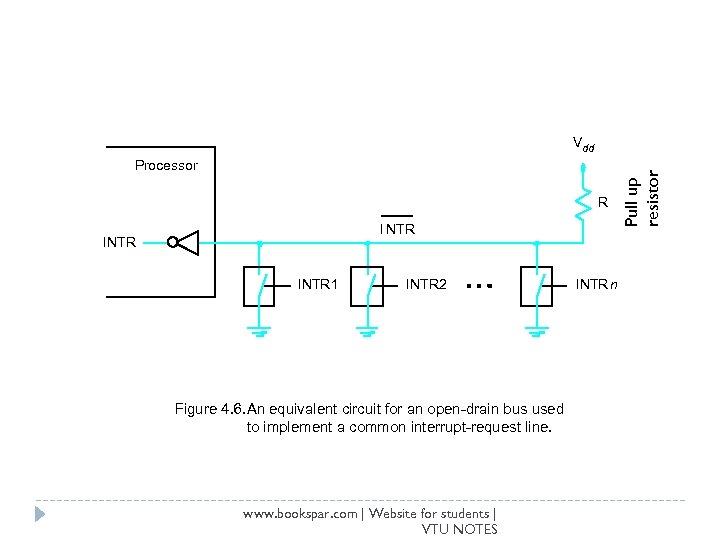 Processor R I NTR INTR 1 INTR 2 Figure 4. 6. An equivalent circuit for an open-drain bus used to implement a common interrupt-request line. www. bookspar. com | Website for students | VTU NOTES INTR n Pull up resistor Vdd
 Enabling and disabling interrupts Interruption of the program execution due to arrival of interrupts must be carefully controlled So in all computers there will be facility to enable and disable interrupts as desired There are many situations where in processor should ignore interrupt requests. For eg. , in the compute-print program, an interrupt request from the printer should be accepted only if there are output lines to be printed Simplest way is to provide machine instructions like Interrupt-enable and Interrupt-disable www. bookspar. com | Website for students | VTU NOTES
 Enabling and disabling interrupts Consider a case of single interrupt request signal from a device. . When the device activates interrupt-request signal, it keeps it activated until it learns that the processor has accepted its request This active request signal should not cause successive interruptions, causing the system to enter into infinite loop from which it cannot recover. www. bookspar. com | Website for students | VTU NOTES
 3 mechanisms for stopping infinite loop The processor hardware ignores the interrupt-request line until execution of the first instruction of the interrupt-service routine has been completed Processor automatically disables interrupts before starting execution of interrupt-service routine Usually this first instruction will be interrupt-disable instruction Last instruction before return-from-interrupt instruction will be interrupt-enable instruction After saving contents of PC and Processor status(PS) register on the stack, processor performs equivalent of interrupt-disable instruction One bit in PS-register will be interrupt-enable bit. An interrupt received while this bit is 1 will accept else rejected When return-from-interrupt instruction is executed, the contents of the PS are restored from the stack, setting Interrupt-enable bit back to 1. Processor has a special interrupt-request line for which the interrupthandling circuit responds only to the leading edge of the signal. Such a line is called edge-triggered www. bookspar. com | Website for students | VTU NOTES
 Typical scenario The device raises an interrupt request The processor interrupts the program currently being executed Interrupts are disabled by changing the control bits in the PS ( except in the case of edge triggered interrupts ) The device is informed that its request has been recognized, and in response, it deactivates the interruptrequest signal The requested action is performed by interrupt-service routine Interrupts are enabled and execution of the interrupted program is resumed www. bookspar. com | Website for students | VTU NOTES
 Handling multiple devices A number of devices capable of initiating interrupts are connected to the processor. Since these devices are operationally independent, there is no particular order in which they generate interrupts For eg. , device X may request an interrupt when an interrupt caused by device Y is being serviced Also, several devices may request interrupts at exactly the same time www. bookspar. com | Website for students | VTU NOTES
 Handling multiple devices A number of questions to be answered How can the processor recognize the device requesting interrupt? Given that different devices are likely to require differentservice routines, how can the processor obtain the starting address of the appropriate routine in each case? Should a device be allowed to interrupt the processor while another interrupt is being serviced? How should two or more simultaneous interrupt requests be handled? www. bookspar. com | Website for students | VTU NOTES
 Handling multiple devices When a interrupt request is received over the common interrupt-request line, additional information is needed to identify the particular device that activated the line. If two devices request interrupt at same time, it must be possible to break tie and select one of the two requests for service. the information whether a device is requesting an interrupt is available in its status register. The device sets one of the bits in status register called IRQ to 1. For e. g. , bits KIRQ and DIRQ are interrupt request bits for keyboard and display respectively www. bookspar. com | Website for students | VTU NOTES
 Handling multiple devices Simplest way to identify the interrupting device is to poll all the I/O devices connected to the bus The first device encountered with its IRQ bit set is the device that should be serviced Polling is easy to implement. Its main disadvantage is time spent in interrogating the IRQ bits of all the devices that may not be requesting any service An alternative is vectored interrupts www. bookspar. com | Website for students | VTU NOTES
 Usage of vectored interrupts To reduce the time involved in polling process, a device requesting interrupt will identify itself directly to the processor By sending a special code over the bus, which may represent the starting address of the interrupt-service routine for that device. The code length is typically between 4 -8 bits Processor can immediately start executing the routine www. bookspar. com | Website for students | VTU NOTES
 Usage of vectored interrupts This arrangement implies that the interrupt-service routine for a given device must always start at the same location. The programmer can gain flexibility by storing in this location an instruction that causes a branch to the appropriate routine So in many computers, the location pointed to by the interrupted device is used to store the starting address of the interrupt-service routine The processor reads this address called as the interrupt vector and loads it into the PC Interrupt vector may also include a new value for the processor status register www. bookspar. com | Website for students | VTU NOTES
 Usage of vectored interrupts I/O devices in most computers, send the interrupt-vector code over the data bus, using the bus control signals to ensure that devices do not interfere with each other. When a device sends an interrupt request, processor may not be ready to receive interrupt-vector code It must first complete the execution of the current instruction, which may require the use of the bus Further delays caused, if interrupts happen to be disabled at the time request is raised. Interrupting device waits to put data on the bus only when the processor is ready to receive it. When the processor is ready, it activates the interrupt-acknowledge line, INTA. The I/O device responds by sending its interrupt-vector code and turning off the INTR signal www. bookspar. com | Website for students | VTU NOTES
 Interrupt nesting Often when there are several devices involved, execution of a given interrupt-service routine, once started will always continues to completion before the processor accepts an interrupt request from a second device. For some devices, a long delay in responding to an interrupt request may lead to erroneous operation The delay caused in accepting the request of another device is acceptable to most simple systems Eg. , a computer that keeps track of time of the day using a real-time clock To accept an interrupt request during the execution of an interruptservice routine for another device, I/O devices should be organized in a priority structure. An interrupt request from a high-priority device should be accepted while the processor is servicing another request from a lowerpriority device www. bookspar. com | Website for students | VTU NOTES
 Interrupt nesting A multiple-level priority organization means during execution of an interrupt-service routine, interrupt requests from some devices are accepted but not from others, depending upon the device’s priority. Assign a priority level to the processor that can be changed under program control The priority level of the processor is the priority of the program that is currently being executed The processor accepts interrupts only from those devices that have priorities higher than its own www. bookspar. com | Website for students | VTU NOTES
 Interrupt nesting The processor’s priority is usually encoded in a few bits of the processor status word. It can be changed by program instructions that write into the PS. These instructions are privileged instructions, which can be executed only while the processor is running in supervisor mode The processor is in supervisor mode only when executing OS routines It switches to user mode before beginning to execute application programs An attempt to execute a privileged instruction while in the user mode causes a special type of interrupt called the privilege exception www. bookspar. com | Website for students | VTU NOTES
 Figure 4. 7. Implementation of interrupt priority using individual interrupt-request and acknowledge lines. www. bookspar. com | Website for students | VTU NOTES
 How to handle simultaneous requests from multiple devices? The processor must have some means of deciding which request to service first In prev figure we implemented a priority scheme where different devices have different interrupt request lines If several devices share a single interrupt request line, we need a different mechanism One simplest mechanism is polling the devices’ status registers Priority is determined by the order in which the devices are polled Only one device should send interrupt vector code www. bookspar. com | Website for students | VTU NOTES
 How to assure that only one device sends interrupt vector code? Common mechanism used is daisy chain model INTR line is common to all devices INTA is connected in a daisy chain fashion INTA signal propagates serially through the devices When several devices raise an interrupt request, and INTR line is activated, the processor responds by setting the INTA line to 1. Device 1 passes signal to Device 2 only if it does not require any service So, in daisy chain model, the device that is electrically closest to the system has the highest priority www. bookspar. com | Website for students | VTU NOTES
 Simultaneous requests using a combination of both In interrupt priority scheme using individual INTR and INTA lines, it allows the processor to accept interrupt requests from some devices but not from others, depending upon their priorities. In daisy chain model, the main advantage is that it requires fewer lines. A combination of daisy chain and multiple priority scheme is followed in many computers www. bookspar. com | Website for students | VTU NOTES
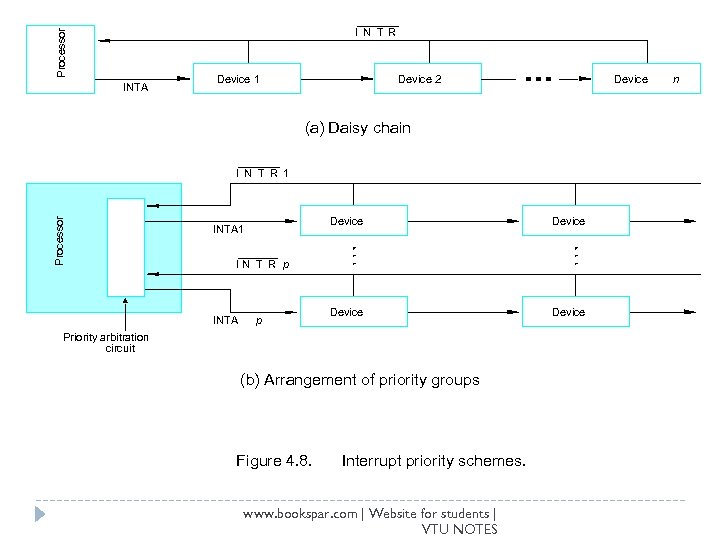 Processor I N T R INTA Device 1 Device 2 Device (a) Daisy chain Processor I N T R 1 Device INTA 1 Device IN T R p INTA p Priority arbitration circuit (b) Arrangement of priority groups Figure 4. 8. Interrupt priority schemes. www. bookspar. com | Website for students | VTU NOTES n
 Controlling device requests Till now we assumed that an I/O device interface generates an interrupt request whenever it is ready for I/O transfer. For eg. , whenever the SIN flag is 1 We need to take care that only those I/O devices that are being used by a given program generate interrupt request Idle devices must not be allowed to generate interrupt-requests Hence need a mechanism in the interface circuits of devices to control whether the device is allowed to generate an interrupt request. Control is usually provided by interrupt enable bit ( KEN for eg. , for Keyboard ) Then interface circuit of a device generates interrupt request whenever the corresponding status flag ( SIN for keyboard ) is set. Interface circuit sets bit KIRQ to indicate that the keyboard is requesting an interrupt www. bookspar. com | Website for students | VTU NOTES
 SIN – whenever it is 1, Keyboard requests an DATAIN interrupt DATAOUT KEN – keyboard enable ST ATUS KIRQ SIN KIRQ – KEN CONTROL Interrupt 7 6 5 4 3 2 1 0 Request from Keyboar Figure 4. 3. Registers in k eyboard and display interfaces d www. bookspar. com | Website for students | VTU NOTES
 Controlling device requests – 2 mechanisms At the device end, an interrupt-enable bit in a control register determines whether the device is allowed to generate an interrupt request. At the processor end, either an interrupt enable bit in the PS register or a priority structure determines whether a given interrupt request will be accepted www. bookspar. com | Website for students | VTU NOTES
 Exceptions The term exception is used to refer to any event that causes an interruption. I/O interrupts are one example of an exception Some other kinds of exceptions are Exceptions to recover from errors Exceptions for debugging Privilege exception www. bookspar. com | Website for students | VTU NOTES
 Exceptions – recovery from errors For eg. , many computers include an error-checking code in the main memory, which allows detection of errors in the stored data. If an error occurs, the control hardware detects it and informs the processor by raising an interrupt Processor interrupts a program if it detects an error or an unusual condition while executing instructions For eg. , the OP-code field of an instruction may not corrrespond to any legal instruction, or an arithmetic instruction may attempt a division by zero. Processor suspends the current program being executed and starts an exception-service routine. This routine takes appropriate action to recover from error Or informs the user about it. The processor most probably may not complete the execution of current instruction and begins exception processing immediately www. bookspar. com | Website for students | VTU NOTES
 Exceptions-debugging Helps programmer to find errors in the program Debugger software usually provides two important facilities - trace and breakpoint In trace mode, an exception occurs after execution of every instruction of the debugged program, using the debugging program as the exception -service routine. The debugging program enables the user to examine the contents of registers, memory locations etc The trace exception is disabled during the execution of debugging program Breakpoints provide a similar facility, except that the program being debugged is interrupted only at specific points selected by the user. An instruction called trap or software interrupt is provided for this purpose The debugging program saves instruction i+1 and replaces it with a software interrupt instruction When program execution reaches that point, program is interrupted and debugging routine is activated When user is ready, debugging routine restores saved instruction and executes a return-from-interrupt instruction www. bookspar. com | Website for students | VTU NOTES
 Exceptions-privilege exception To protect the OS of a system from being corrupted by user programs, certain instructions can be executed only while the processor is in the supervisor mode These instructions are called privileged instructions Eg. , when a processor is running in the user mode, it will not execute an instruction that changes the priority level of the processor or that enables a user program to access areas in the computer memory that have been allocated to other users. An attempt to execute such an instruction will produce a privilege exception, Causes the processor to switch to the supervisor mode Begin executing an appropriate routine in OS. www. bookspar. com | Website for students | VTU NOTES
 Direct memory access - Introduction In previous sections, Data are transferred by executing instructions such as Move An instruction to transfer input or output data is executed only after the processor determines that the I/O device is ready. To do this, the processor either polls a status flag in the device interface or waits for the device to send an interrupt request. In either case, considerable overhead is incurred, because DATAIN, R 0 several program instructions must be executed for each data word transferred. In addition to polling the status register of the device, instructions are needed for incrementing the memory address and keeping track of the word count. When interrupts are used, there is the additional overhead associated with saving and restoring the program counter and other state information www. bookspar. com | Website for students | VTU NOTES
 Direct Memory access To transfer large blocks of data at high speed, an alternative approach is used. A special control unit may be provided to allow transfer of a block of data directly between an external device and the main memory, without continuous intervention by the processor. This approach is called direct memory access, or DMA. www. bookspar. com | Website for students | VTU NOTES
 DMA Controller DMA transfers are performed by a control circuit that is part of the I/O device interface. This circuit is called as a DMA controller. The DMA controller performs the functions that would normally be carried out by the processor when accessing the main memory. For each word transferred, it provides the memory address and all the bus signals that control data transfer. Since it has to transfer blocks of data, the DMA controller must increment the memory address for successive words and keep track of the number of transfers. www. bookspar. com | Website for students | VTU NOTES
 IS DMA Controller completely independent of processor? Although a DMA controller can transfer data without intervention by the processor, its operation must be under the control of a program executed by the processor. To initiate the transfer of a block of words, the processor sends the starting address, the number of words in the block, and the direction of the transfer. On receiving this information, the DMA controller proceeds to perform the requested operation. When the entire block has been transferred, the controller informs the processor by raising an interrupt signal. www. bookspar. com | Website for students | VTU NOTES
 Role of OS in DMA operations I/O operations are always performed by the operating system of the computer in response to a request from an application program. The OS is also responsible for suspending the execution of one program and starting another. Thus, for an I/O operation involving DMA, the OS puts the program that requested the transfer in the Blocked state, initiates the DMA operation, and starts the execution of another program. When the transfer is completed, the DMA controller informs the processor by sending an interrupt request. In response, the OS puts the suspended program in the Runnable state so that it can be selected by the scheduler to continue execution. www. bookspar. com | Website for students | VTU NOTES
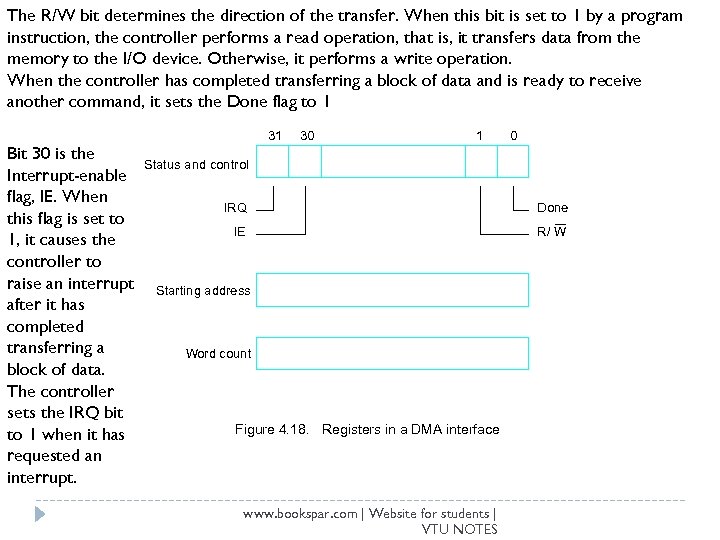 The R/W bit determines the direction of the transfer. When this bit is set to 1 by a program instruction, the controller performs a read operation, that is, it transfers data from the memory to the I/O device. Otherwise, it performs a write operation. When the controller has completed transferring a block of data and is ready to receive another command, it sets the Done flag to 1 Bit 30 is the Interrupt-enable flag, IE. When this flag is set to 1, it causes the controller to raise an interrupt after it has completed transferring a block of data. The controller sets the IRQ bit to 1 when it has requested an interrupt. 31 30 1 0 Status and control IRQ Done IE R/ W Starting address Word count Figure 4. 18. Registers in a DMA interface www. bookspar. com | Website for students | VTU NOTES
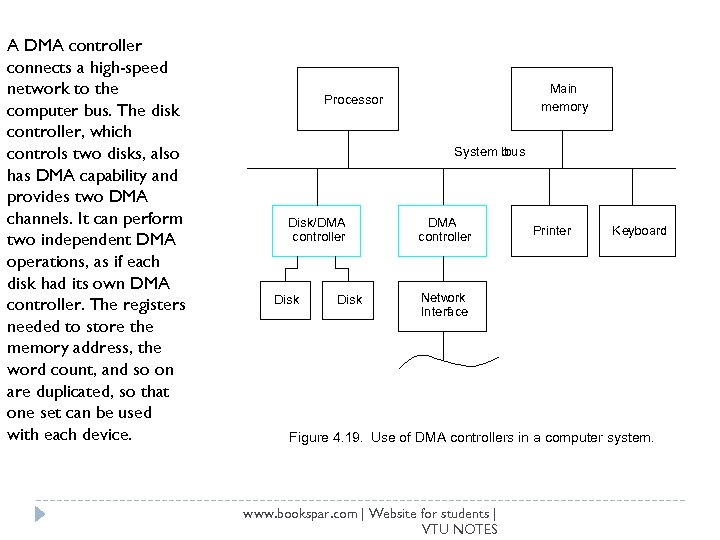 A DMA controller connects a high-speed network to the computer bus. The disk controller, which controls two disks, also has DMA capability and provides two DMA channels. It can perform two independent DMA operations, as if each disk had its own DMA controller. The registers needed to store the memory address, the word count, and so on are duplicated, so that one set can be used with each device. Main memory Processor System b bus Disk/DMA controller Disk DMA controller Printer Keyboard Netw ork Interf ce a Figure 4. 19. Use of DMA controllers in a computer system. www. bookspar. com | Website for students | VTU NOTES
 Details of DMA transfer To start a DMA transfer of a block of data from the main memory to one of the disks, a program writes the address and word count information into the registers of the corresponding channel of the disk controller. It also provides the disk controller with information to identify the data for future retrieval. The DMA controller proceeds independently to implement the specified operation. When the DMA transfer is completed, this fact is recorded in the status and control register of the DMA channel by setting the Done bit. If the IE bit is set, the controller sends an interrupt request to the processor and sets the IRQ bit. The status register can also be used to record other information, such as whether the transfer took place correctly or errors occurred. www. bookspar. com | Website for students | VTU NOTES
 Memory accesses by processor v/s DMA Memory accesses by the processor and the DMA controller are interwoven. Requests by DMA devices for using the bus are always given higher priority than processor requests. Among different DMA devices, top priority is given to highspeed peripherals such as a disk, a high-speed network interface, or a graphics display device. Since the processor originates most memory access cycles, the DMA controller can be said to “steal” memory cycles from the processor. Hence, the interweaving technique is usually called cycle stealing. Alternatively, the DMA controller may be given exclusive access to the main memory to transfer a block of data without interruption. This is known as block or burst mode. www. bookspar. com | Website for students | VTU NOTES
 How to overcome difference in speeds of different devices Most DMA controllers incorporate a data storage buffer. for example, the DMA controller in a network interface, reads a block of data from the main memory and stores it into its input buffer. This transfer takes place using burst mode at a speed appropriate to the memory and the computer bus. Then, the data in the buffer are transmitted over the network at the speed of the network. www. bookspar. com | Website for students | VTU NOTES
 Bus Arbitration A conflict may arise if both the processor and a DMA controller or two DMA controllers try to use the bus at the same time to access the main memory. To resolve these conflicts, an arbitration procedure is implemented on the bus to coordinate the activities of all devices requesting memory transfers. www. bookspar. com | Website for students | VTU NOTES
 Bus Arbitration The device that is allowed to initiate data transfers on the bus at any given time is called the bus master. When the current master relinquishes control of the bus, another device can acquire this status. Bus arbitration is the process by which the next device to become the bus master is selected and bus mastership is transferred to it. The selection of the bus master must take into account the needs of various devices by establishing a priority system for gaining access to the bus. www. bookspar. com | Website for students | VTU NOTES
 Two approaches to bus arbitration: centralized and distributed In centralized arbitration, a single bus arbiter performs the required arbitration. In distributed arbitration, all devices participate in the selection of the next bus master. www. bookspar. com | Website for students | VTU NOTES
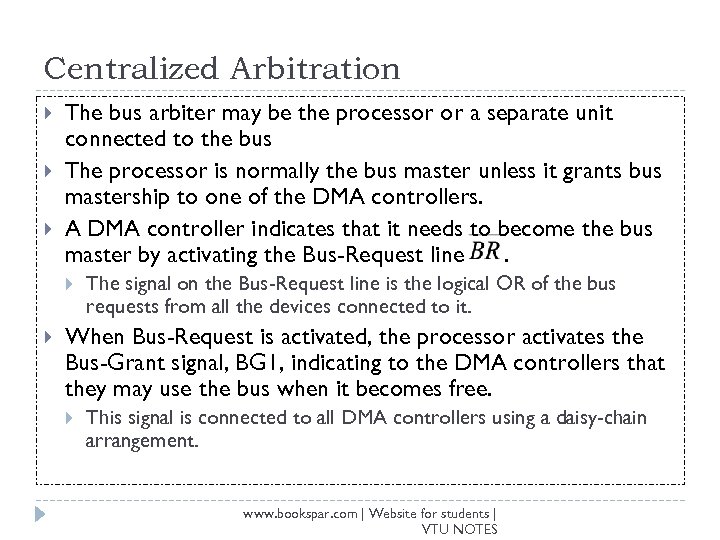 Centralized Arbitration The bus arbiter may be the processor or a separate unit connected to the bus The processor is normally the bus master unless it grants bus mastership to one of the DMA controllers. A DMA controller indicates that it needs to become the bus master by activating the Bus-Request line. The signal on the Bus-Request line is the logical OR of the bus requests from all the devices connected to it. When Bus-Request is activated, the processor activates the Bus-Grant signal, BG 1, indicating to the DMA controllers that they may use the bus when it becomes free. This signal is connected to all DMA controllers using a daisy-chain arrangement. www. bookspar. com | Website for students | VTU NOTES
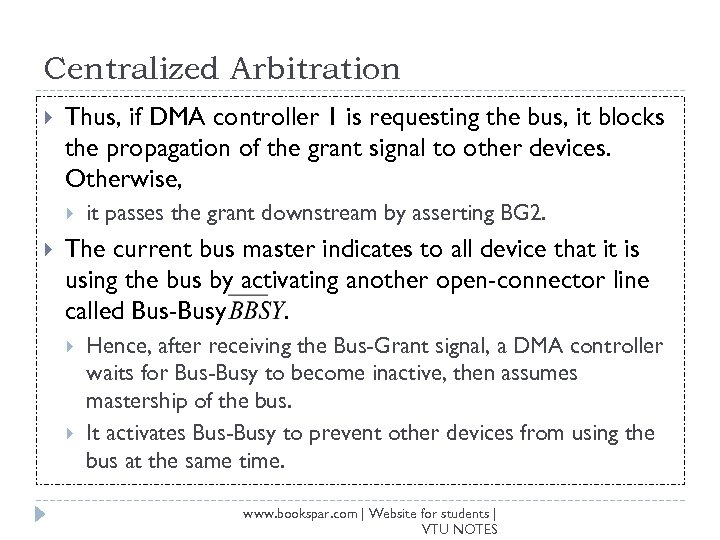 Centralized Arbitration Thus, if DMA controller 1 is requesting the bus, it blocks the propagation of the grant signal to other devices. Otherwise, it passes the grant downstream by asserting BG 2. The current bus master indicates to all device that it is using the bus by activating another open-connector line called Bus-Busy. Hence, after receiving the Bus-Grant signal, a DMA controller waits for Bus-Busy to become inactive, then assumes mastership of the bus. It activates Bus-Busy to prevent other devices from using the bus at the same time. www. bookspar. com | Website for students | VTU NOTES
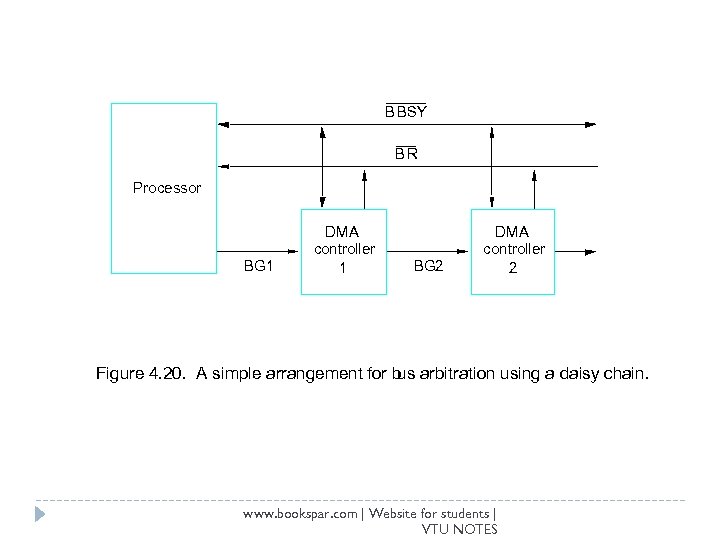 B BSY BR Processor BG 1 DMA controller 1 BG 2 DMA controller 2 Figure 4. 20. A simple arrangement for b arbitration using a daisy chain. us www. bookspar. com | Website for students | VTU NOTES
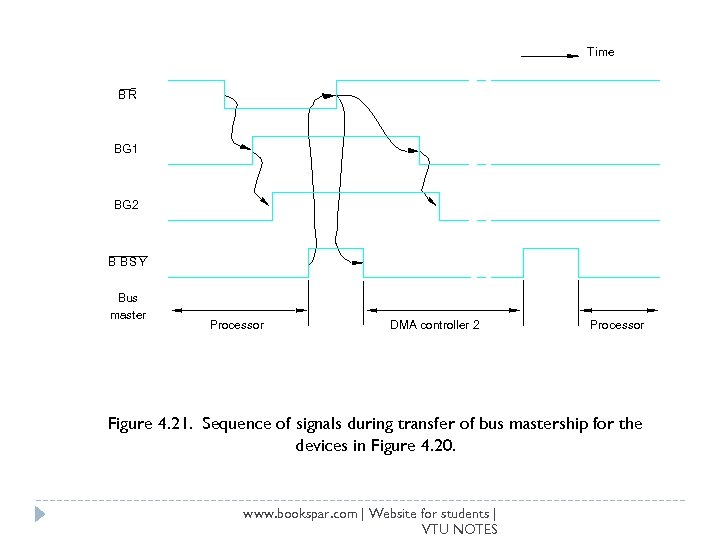 Time BR BG 1 BG 2 B BSY Bus master Processor DMA controller 2 Processor Figure 4. 21. Sequence of signals during transfer of bus mastership for the devices in Figure 4. 20. www. bookspar. com | Website for students | VTU NOTES
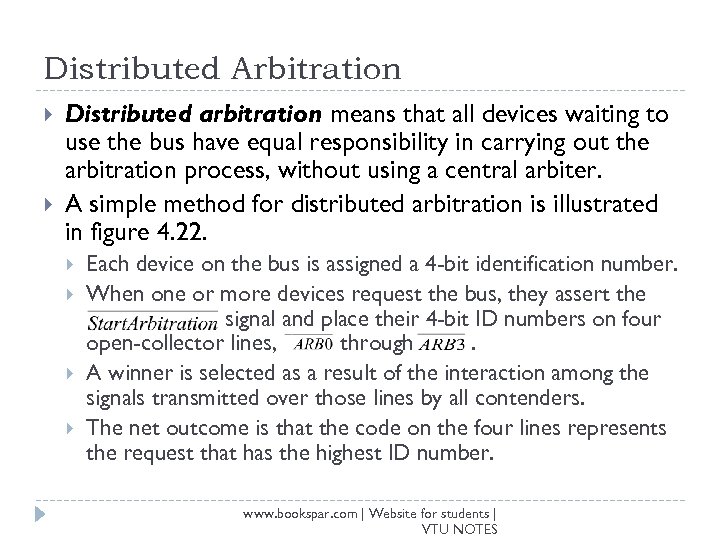 Distributed Arbitration Distributed arbitration means that all devices waiting to use the bus have equal responsibility in carrying out the arbitration process, without using a central arbiter. A simple method for distributed arbitration is illustrated in figure 4. 22. Each device on the bus is assigned a 4 -bit identification number. When one or more devices request the bus, they assert the signal and place their 4 -bit ID numbers on four open-collector lines, through. A winner is selected as a result of the interaction among the signals transmitted over those lines by all contenders. The net outcome is that the code on the four lines represents the request that has the highest ID number. www. bookspar. com | Website for students | VTU NOTES
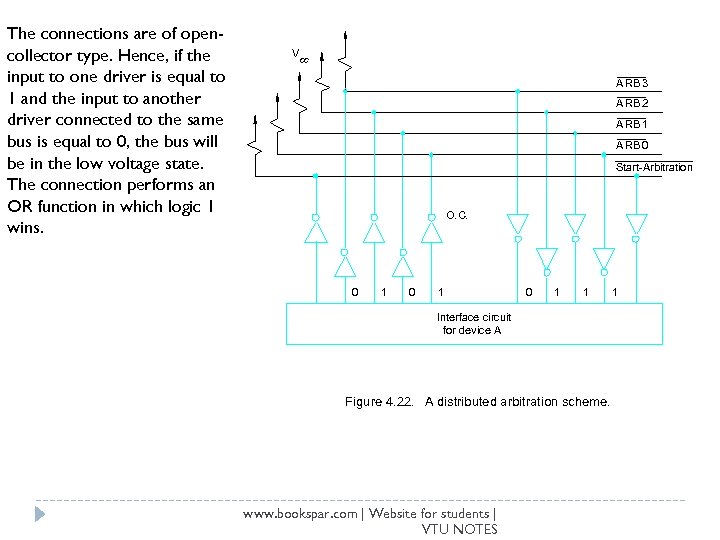 The connections are of opencollector type. Hence, if the input to one driver is equal to 1 and the input to another driver connected to the same bus is equal to 0, the bus will be in the low voltage state. The connection performs an OR function in which logic 1 wins. V cc A RB 3 A RB 2 A RB 1 A RB 0 Start-Arbitration O. C. 0 1 0 1 1 Interface circuit for device A Figure 4. 22. A distributed arbitration scheme. www. bookspar. com | Website for students | VTU NOTES 1
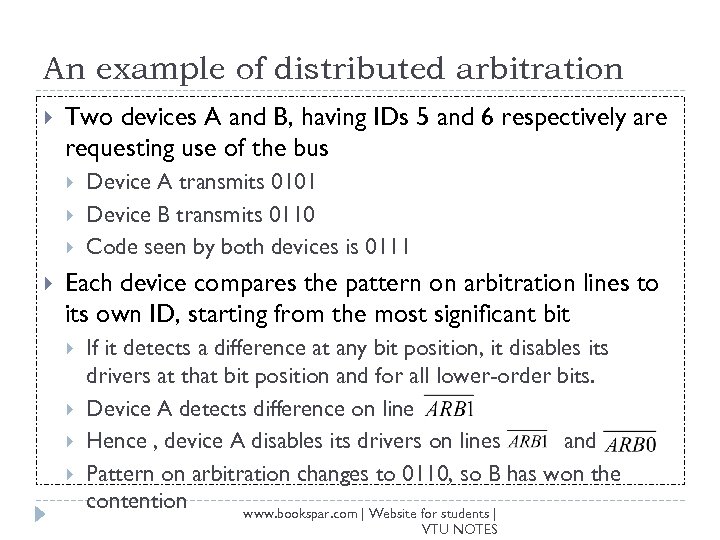 An example of distributed arbitration Two devices A and B, having IDs 5 and 6 respectively are requesting use of the bus Device A transmits 0101 Device B transmits 0110 Code seen by both devices is 0111 Each device compares the pattern on arbitration lines to its own ID, starting from the most significant bit If it detects a difference at any bit position, it disables its drivers at that bit position and for all lower-order bits. Device A detects difference on line Hence , device A disables its drivers on lines and Pattern on arbitration changes to 0110, so B has won the contention www. bookspar. com | Website for students | VTU NOTES
 BUSES The processor, main memory, and I/O devices can be interconnected by means of a common bus whose primary function is to provide a communication path for the transfer of data. The bus includes the lines needed to support interrupts and arbitration. A bus protocol is the set of rules that govern the behavior of various devices connected to the bus as to when to place information on the bus, assert control signals, and so on. www. bookspar. com | Website for students | VTU NOTES
 3 types of buses Address bus Data bus Control bus Specify whether a read or a write operation is to be performed. Usually , a single line is used When several operand sizes are possible, such as byte, word, or long word, the required size of data is indicated Bus control signals also carry timing information Specify times at which the processor and the I/O devices may place data on the bus or receive data from the bus www. bookspar. com | Website for students | VTU NOTES
 Synchronous and Asynchronous schemes Variety of schemes devised for the timing of data transfers Broadly classified as synchronous and asynchronous In any data transfer there will be Master device which initiates data transfer Usually Processor or other devices with DMA capability Also called as initiator Slave or target device the device addressed by the master www. bookspar. com | Website for students | VTU NOTES
 Synchronous Bus In a synchronous bus, all devices derive timing information from a common clock line. Equally spaced pulses on this line define equal time intervals. In the simplest form of a synchronous bus, each of these intervals constitutes a bus cycle during which one data transfer can take place. www. bookspar. com | Website for students | VTU NOTES
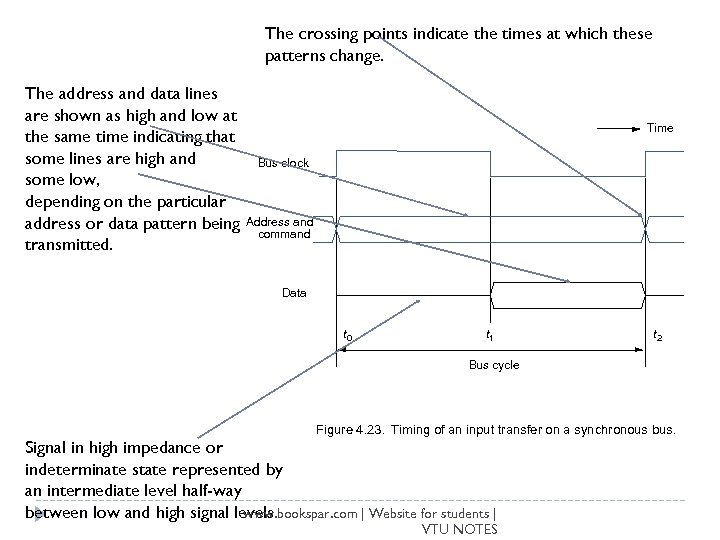 The crossing points indicate the times at which these patterns change. The address and data lines are shown as high and low at the same time indicating that some lines are high and some low, depending on the particular address or data pattern being transmitted. Time Bus clock Address and command Data t 0 t 1 t 2 Bus cycle Figure 4. 23. Timing of an input transfer on a synchronous bus. Signal in high impedance or indeterminate state represented by an intermediate level half-way www. bookspar. com | Website for students | between low and high signal levels VTU NOTES
 Sequence of events during an input operation in synchronous bus At time t 0, the master places the device address on the address lines and sends an appropriate command on the control lines. Information travels over the bus The command will indicate an input operation specify the length of the operand to be read, if necessary. speed determined by its physical and electrical characteristics. The clock pulse width, t 1 – t 0, must be longer than the maximum propagation delay between two devices. To allow all devices to decode the address and control signals so that the addressed device (the slave) can respond at time t 1. www. bookspar. com | Website for students | VTU NOTES
 Contd… It is important that slaves take no action or place any data on the bus before t 1. The information on the bus is unreliable during the period t 0 to t 1 because signals are changing state. The addressed slave places the requested input data on the data lines at time t 1. www. bookspar. com | Website for students | VTU NOTES
 Contd… At the end of the clock cycle, at time t 2, the master strobes the data on the data lines into its input buffer. For data to be loaded correctly into any storage device, “strobe” - to capture the values of the data at a given instant and store them into a buffer. the data must be available at the input of that device for a period greater than the setup time of the device. t 2 - t 1 > (maximum propagation time on the bus + the setup time of the input buffer register of the master) NOTE : A similar procedure is followed for output operation www. bookspar. com | Website for students | VTU NOTES
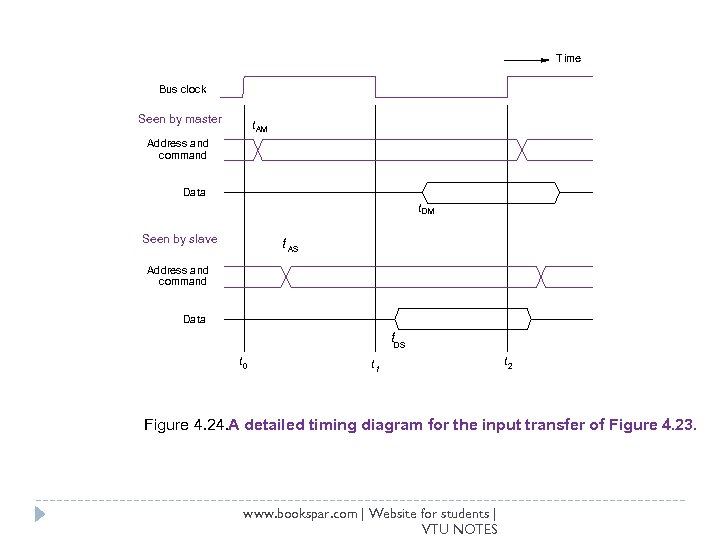 T ime Bus clock Seen by master t AM Address and command Data t DM Seen by slave t AS Address and command Data t. DS t 0 t 1 t 2 Figure 4. 24. A detailed timing diagram for the input transfer of Figure 4. 23. www. bookspar. com | Website for students | VTU NOTES
 Synchronous Bus Contd. . Previous diagram shows the detailed timing diagram for the same input operation The master sends the address and command signals on the rising edge at the beginning of clock period 1 (t 0). These signals do not appear on the bus until t. AM, largely due to the delay in the bus driver circuit. At t. AS, the signals reach the slave. The slave decodes the address and at t 1 sends the requested data. Data signals do not appear on the bus until t. DS. They travel toward the master and arrive at t. DM. www. bookspar. com | Website for students | VTU NOTES
 Synchronous Bus Contd. . At t 2, the master loads the data into its input buffer. The period t 2 -t. DM is the setup time for the master’s input buffer. The data must continue to be valid after t 2 for a period equal to the hold time of that buffer. www. bookspar. com | Website for students | VTU NOTES
 Limitations of single cycle transfer A transfer has to be completed within one clock cycle, The clock period, t 2 -t 0, must be chosen to accommodate the longest delays on the bus and the slowest device interface. This forces all devices to operate at the speed of the slowest device. www. bookspar. com | Website for students | VTU NOTES
 Limitations of single cycle transfer The processor has no way of determining whether the addressed device has actually responded. It assumes that, at t 2, the output data have been received by the I/O device or the input data are available on the data lines. If, because of a malfunction, the device does not respond, the error will not be detected. www. bookspar. com | Website for students | VTU NOTES
 How to overcome these limitations? Most buses incorporate control signals that represent a response from the device. These signals inform the master that the slave has recognized its address and that it is ready to participate in a data-transfer operation. They also make it possible to adjust the duration of the datatransfer period to suit the needs of the participating devices. To simplify the process, a high-frequency clock signal is used A complete data transfer cycle spans several clock cycles. The number of clock cycles can vary from one device to another. www. bookspar. com | Website for students | VTU NOTES
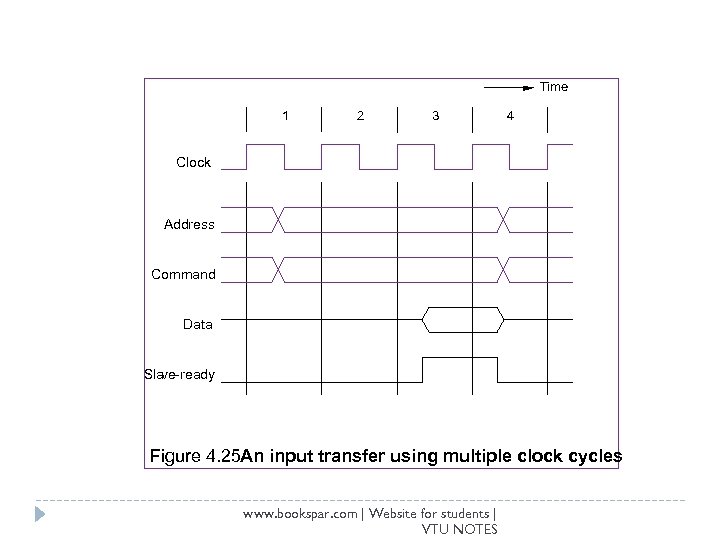 Time 1 2 3 4 Clock Address Command Data Sla ve-ready Figure 4. 25 An input transfer using multiple clock cycles. www. bookspar. com | Website for students | VTU NOTES
 Multiple-Cycle Transfers In figure 4. 25, during clock cycle 1, The master sends address and command information on the bus, requesting a read operation. The slave receives this information and decodes it. At the beginning of clock cycle 2, Slave makes a decision to respond and begins to access the requested data. Some delay is involved in getting the data. The data become ready and are placed on the bus in clock cycle 3. At the same time, the slave asserts a control signal called Slave-ready. www. bookspar. com | Website for students | VTU NOTES
 Multiple-Cycle Transfers The Slave-ready signal is an acknowledgment from the slave to the master, confirming that valid data have been sent. It allows the duration of a bus transfer to change from one device to another. If the addressed device does not respond at all, the master waits for some predefined maximum number of clock cycles, then aborts the operation. May be result of an incorrect address or a device malfunction. www. bookspar. com | Website for students | VTU NOTES
 ASYNCHRONOUS BUS: An alternative scheme for controlling data transfers on the bus The common clock is replaced by two timing control lines, Master-ready and Slave-ready. Based on the use of a handshake between the master and the salve. The concept of a handshake is a generalization of the idea of the Slave-ready signal. The first is asserted by the master to indicate that it is ready for a transaction the second is a response from the slave. www. bookspar. com | Website for students | VTU NOTES
 ASYNCHRONOUS BUS – Handshake Protocol The master places the address and command information on the bus. This causes all devices on the bus to decode the address. The selected slave performs the required operation(read or write ) It indicates to all devices that it has done so by activating the Master-ready line. It informs the processor it has done so by activating the Slaveready line. The master waits for Slave-ready to become asserted before it removes its signals from the bus. In the case of a read operation, it also strobes the data into its input buffer. www. bookspar. com | Website for students | VTU NOTES
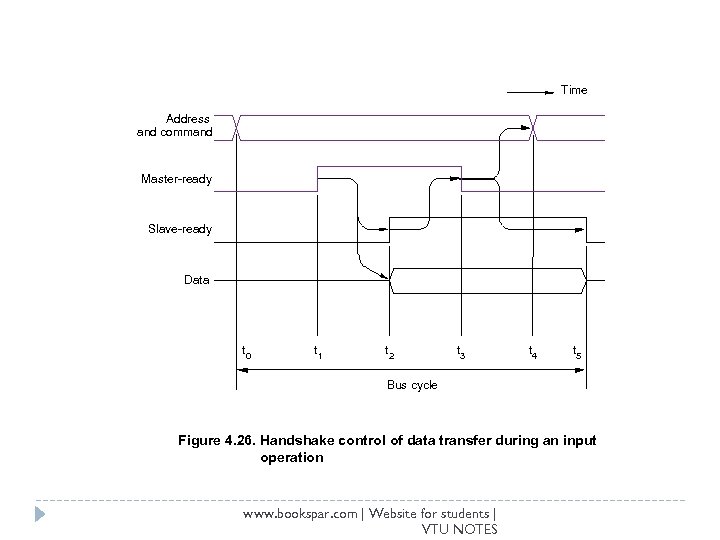 Time Address and command Master-ready Slave-ready Data t 0 t 1 t 2 t 3 t 4 t 5 Bus cycle Figure 4. 26. Handshake control of data transfer during an input operation www. bookspar. com | Website for students | VTU NOTES
 Sequence of events - Handshake control of data transfer during an output operation t 0 – The master places the address and command information on the bus, and all devices on the bus begin to decode this information. t 1 – The master sets the Master-ready line to 1 to inform the I/O devices that the address and command information is ready. The delay t 1 -t 0 is intended to allow for any skew that may occur on the bus. Skew occurs when two signals simultaneously transmitted from one source arrive at the destination at different times. This happens because different lines of the bus may have different propagation speeds. To guarantee that the Master-ready signal does not arrive at any device ahead of the address and command information, the delay t 1 -t 0 should be larger than the maximum possible bus skew. www. bookspar. com | Website for students | VTU NOTES
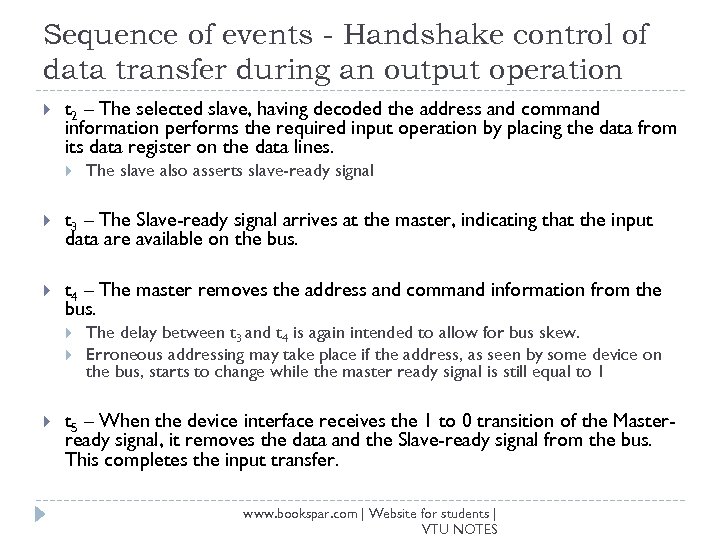 Sequence of events - Handshake control of data transfer during an output operation t 2 – The selected slave, having decoded the address and command information performs the required input operation by placing the data from its data register on the data lines. The slave also asserts slave-ready signal t 3 – The Slave-ready signal arrives at the master, indicating that the input data are available on the bus. t 4 – The master removes the address and command information from the bus. The delay between t 3 and t 4 is again intended to allow for bus skew. Erroneous addressing may take place if the address, as seen by some device on the bus, starts to change while the master ready signal is still equal to 1 t 5 – When the device interface receives the 1 to 0 transition of the Masterready signal, it removes the data and the Slave-ready signal from the bus. This completes the input transfer. www. bookspar. com | Website for students | VTU NOTES
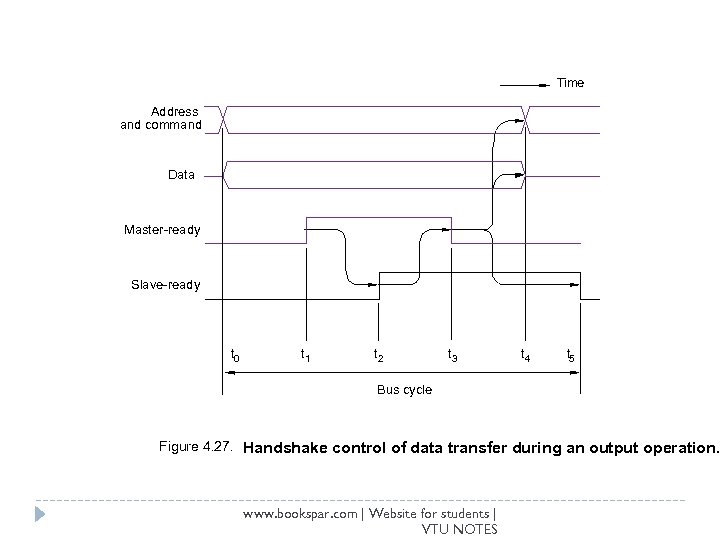 Time Address and command Data Master-ready Slave-ready t 0 t 1 t 2 t 3 t 4 t 5 Bus cycle Figure 4. 27. Handshake control of data transfer during an output operation. www. bookspar. com | Website for students | VTU NOTES
 Handshake control of data transfer during an output operation The timing for an output operation is essentially same as input operation The master places the data on data lines at the same time that it transmits the address and command information The selected slave strobes the data into its output buffer when it receives the Master-ready signal. It indicates the completion by setting slave-ready signal to 1 www. bookspar. com | Website for students | VTU NOTES
 Full Handshake The handshake signals what we saw in previous two examples of input and output operations are fully interlocked A change in one signal is followed by a change in the other signal This scheme is known as full handshake It provides the highest degree of flexibility and reliability www. bookspar. com | Website for students | VTU NOTES
 Synchronous or Asynchronous ? The choice of a particular design involves trade-offs among factors such as : Simplicity of the device interface Ability to accommodate device interfaces that introduce different amounts of delay Total time required for a bus transfer Ability to detect errors resulting from addressing a nonexistent device or from an interface malfunction www. bookspar. com | Website for students | VTU NOTES
 Synchronous or Asynchronous ? Advantages of asynchronous bus For synchronous bus, Handshake process eliminates the need of synchronization of the sender and receiver clocks, simplifying timing design Delays are accommodated When the delays change, the timing of data transfer adjusts automatically based on the new conditions Clock circuitry must be designed carefully to ensure proper synchronization Delays must be kept within strict bounds In synchronous bus, we an achieve faster data transfer rates. To accommodate a slow device, additional clock cycles can be used www. bookspar. com | Website for students | VTU NOTES