


 Скачать презентацию Computer Networks with Internet Technology William Stallings Chapter
c9b63f7a2e17d9df032560849577aaac.ppt
- Количество слайдов: 95
 Computer Networks with Internet Technology William Stallings Chapter 16 Network Security
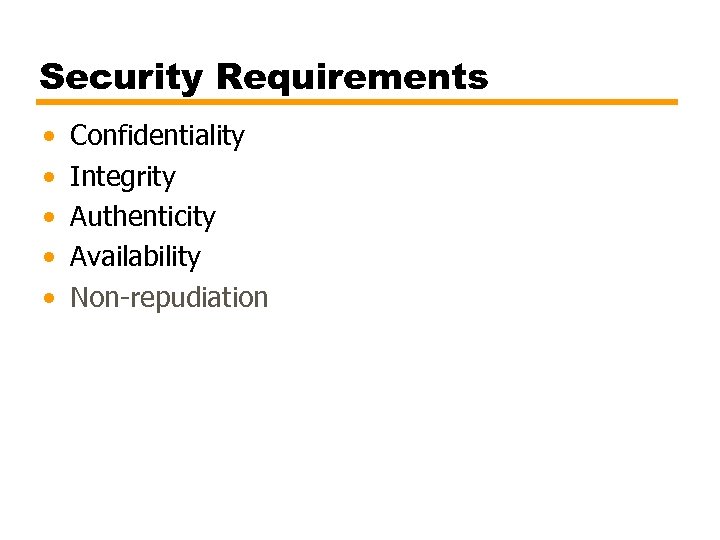 Security Requirements • • • Confidentiality Integrity Authenticity Availability Non-repudiation
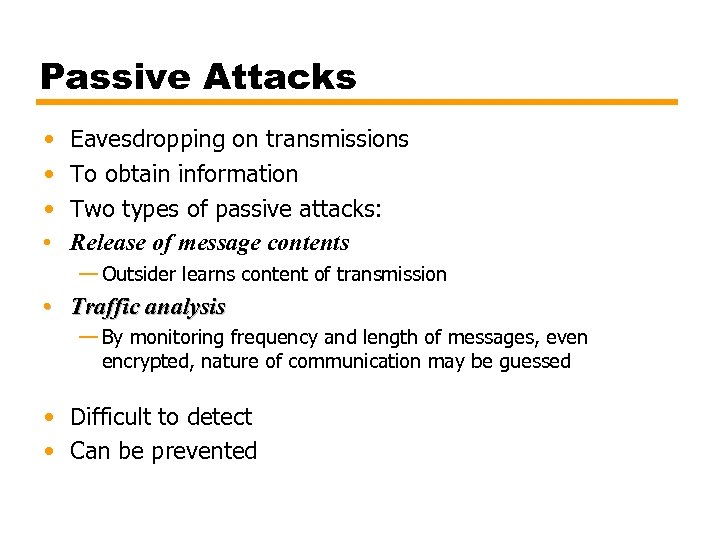 Passive Attacks • • Eavesdropping on transmissions To obtain information Two types of passive attacks: Release of message contents — Outsider learns content of transmission • Traffic analysis — By monitoring frequency and length of messages, even encrypted, nature of communication may be guessed • Difficult to detect • Can be prevented
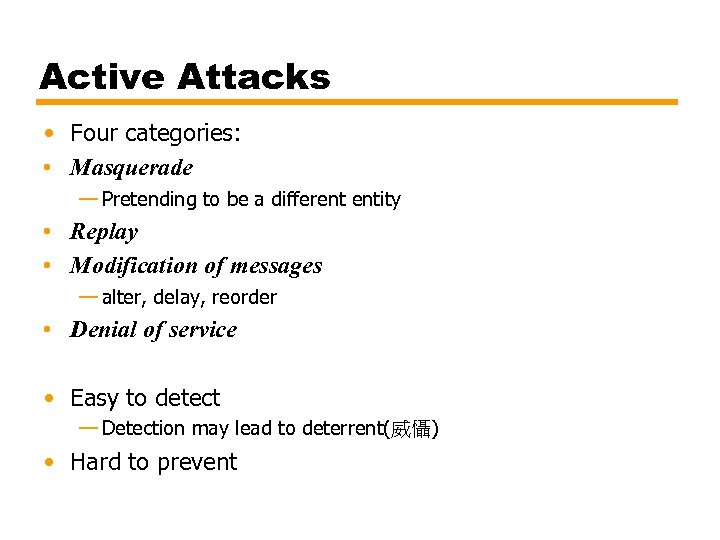 Active Attacks • Four categories: • Masquerade — Pretending to be a different entity • Replay • Modification of messages — alter, delay, reorder • Denial of service • Easy to detect — Detection may lead to deterrent(威懾) • Hard to prevent
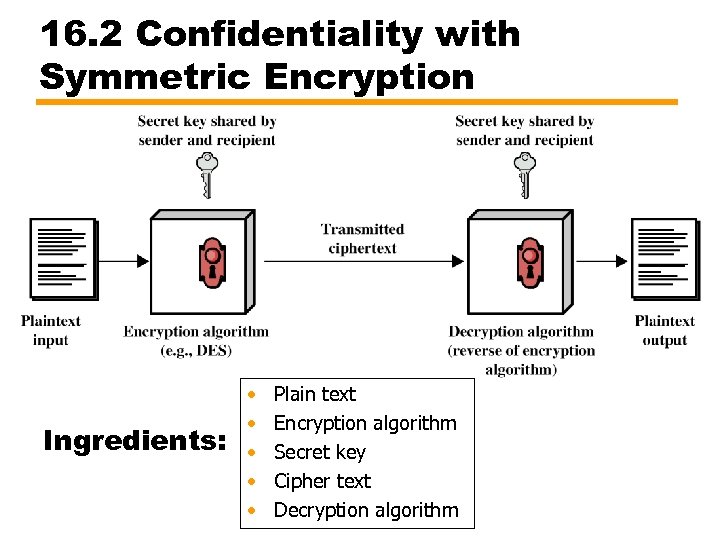 16. 2 Confidentiality with Symmetric Encryption Ingredients: • • • Plain text Encryption algorithm Secret key Cipher text Decryption algorithm
 Requirements for Secure Use of Symmetric Encryption • Strong encryption algorithm —Even if known, should not be able to decrypt or work out key —Even if a number of cipher texts are available together with plain texts of them • Sender and receiver must obtain secret key securely —Once key is known, all communication using this key is readable
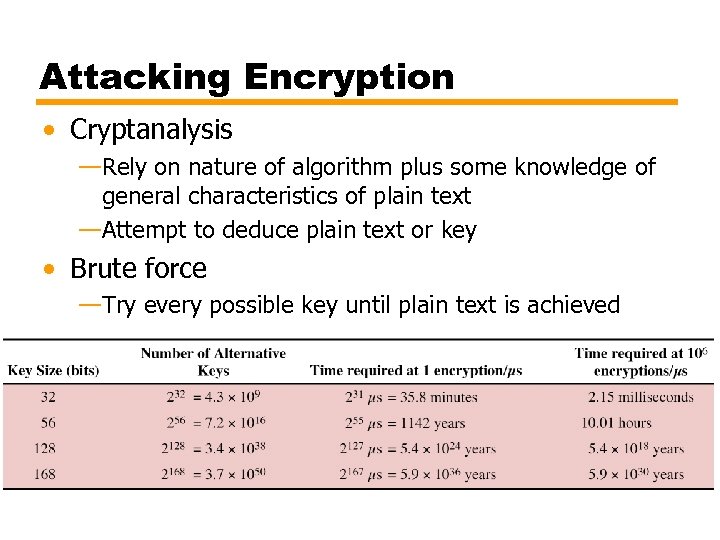 Attacking Encryption • Cryptanalysis —Rely on nature of algorithm plus some knowledge of general characteristics of plain text —Attempt to deduce plain text or key • Brute force —Try every possible key until plain text is achieved
 Encryption Algorithms • Block Cipher —Process plain text in fixed block sizes producing block of cipher text of equal size —Data encryption standard (DES) —Triple DES (3 DES, TDES) —Advanced Encryption Standard (AES)
 DES - Data Encryption Standard • • US standard 64 bit plain text blocks 56 bit key Broken in 1998 by Electronic Frontier Foundation —Special purpose machine —Less than three days —DES now worthless
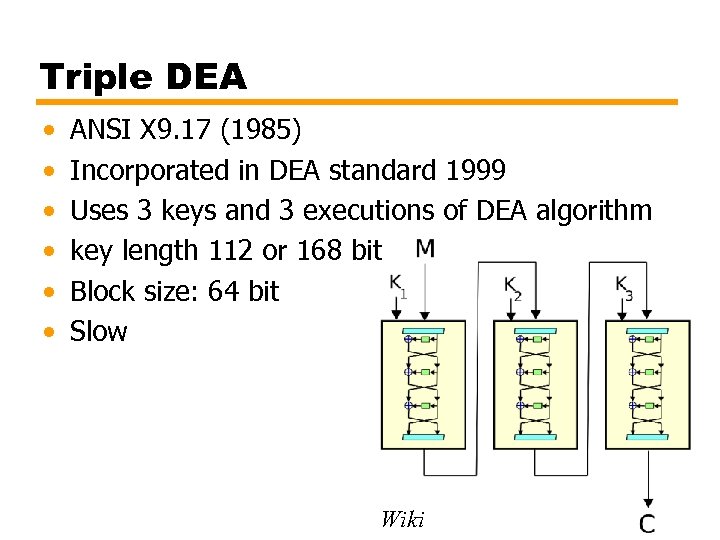 Triple DEA • • • ANSI X 9. 17 (1985) Incorporated in DEA standard 1999 Uses 3 keys and 3 executions of DEA algorithm key length 112 or 168 bit Block size: 64 bit Slow Wiki
 Advanced Encryption Standard • National Institute of Standards and Technology (NIST) in 1997 issued call for Advanced Encryption Standard (AES) —Rijndael (Rijmen & Daemen) —Security strength equal to or better than 3 DES —Improved efficiency —Symmetric block cipher, Block length 128 bits —Key lengths 128, 192, and 256 bits —Evaluation include security, computational efficiency, memory requirements, hardware and software suitability, and flexibility — 2001, AES issued as federal information processing standard (FIPS 197)
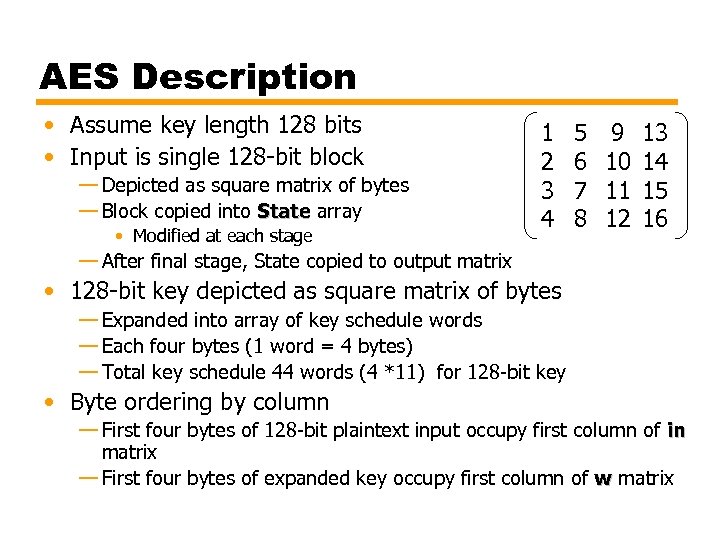 AES Description • Assume key length 128 bits • Input is single 128 -bit block — Depicted as square matrix of bytes — Block copied into State array State • Modified at each stage 1 2 3 4 5 6 7 8 9 10 11 12 13 14 15 16 — After final stage, State copied to output matrix • 128 -bit key depicted as square matrix of bytes — Expanded into array of key schedule words — Each four bytes (1 word = 4 bytes) — Total key schedule 44 words (4 *11) for 128 -bit key • Byte ordering by column — First four bytes of 128 -bit plaintext input occupy first column of in in matrix — First four bytes of expanded key occupy first column of w matrix
![w[0, 3] w[4, 7]](https://present5.com/presentation/c9b63f7a2e17d9df032560849577aaac/image-13.jpg "w[0, 3] w[4, 7]") w[0, 3] w[4, 7]
w[0, 3] w[4, 7]
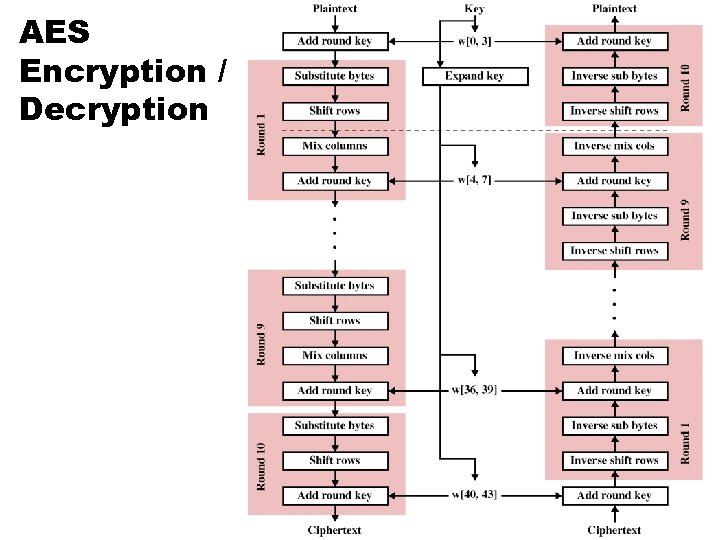 AES Encryption / Decryption
![AES Comments (1) • Key expanded into array of forty-four 32 -bit words, w[i]](https://present5.com/presentation/c9b63f7a2e17d9df032560849577aaac/image-15.jpg "AES Comments (1) • Key expanded into array of forty-four 32 -bit words, w[i]") AES Comments (1) • Key expanded into array of forty-four 32 -bit words, w[i] — Four distinct words (128 bits) serve as round key for each round • Four different stages (One permutation and three substitution) —Substitute bytes uses S-box table to perform byte-by -byte substitution of block —Shift rows is permutation that performed row by row —Mix columns is substitution that alters each byte in column as function of all of bytes in column —Add round key is bitwise XOR of current block with portion of expanded key
AES Comments (1) • Key expanded into array of forty-four 32 -bit words, w[i] — Four distinct words (128 bits) serve as round key for each round • Four different stages (One permutation and three substitution) —Substitute bytes uses S-box table to perform byte-by -byte substitution of block —Shift rows is permutation that performed row by row —Mix columns is substitution that alters each byte in column as function of all of bytes in column —Add round key is bitwise XOR of current block with portion of expanded key
 AES Comments (2) • Simple structure —For both encryption and decryption, cipher begins with Add Round Key stage —Followed by nine rounds, • Each includes all four stages —Followed by tenth round of three stages http: //ycchen. im. ncnu. edu. tw/net 2011/aes. swf
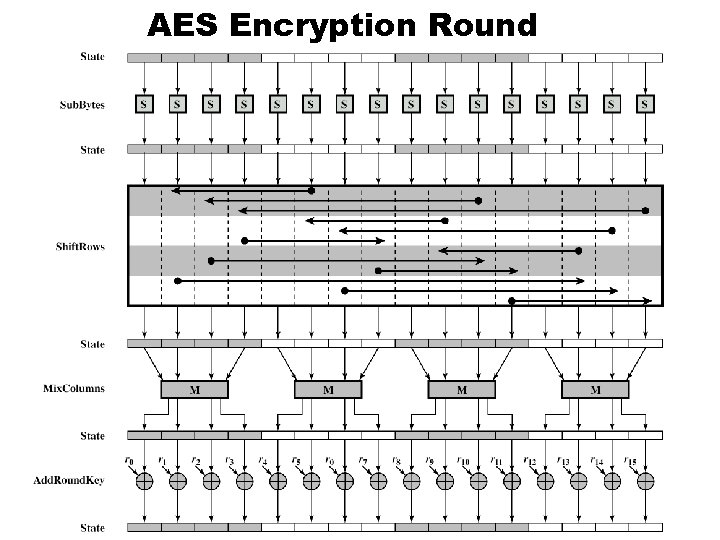 AES Encryption Round
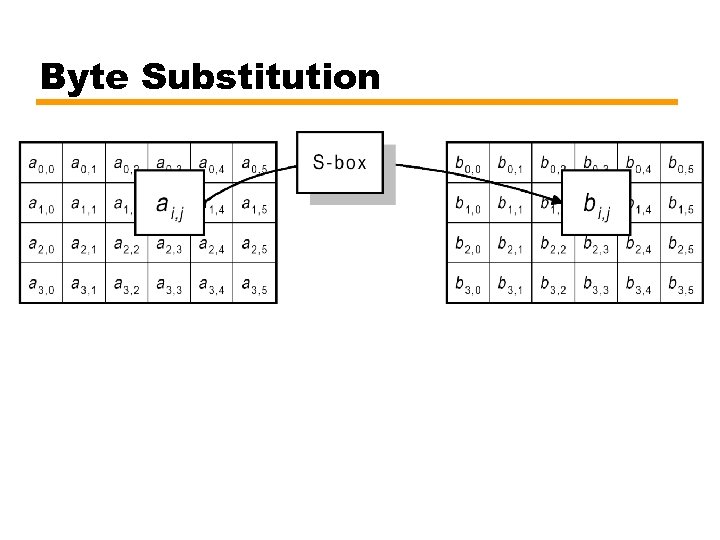 Byte Substitution
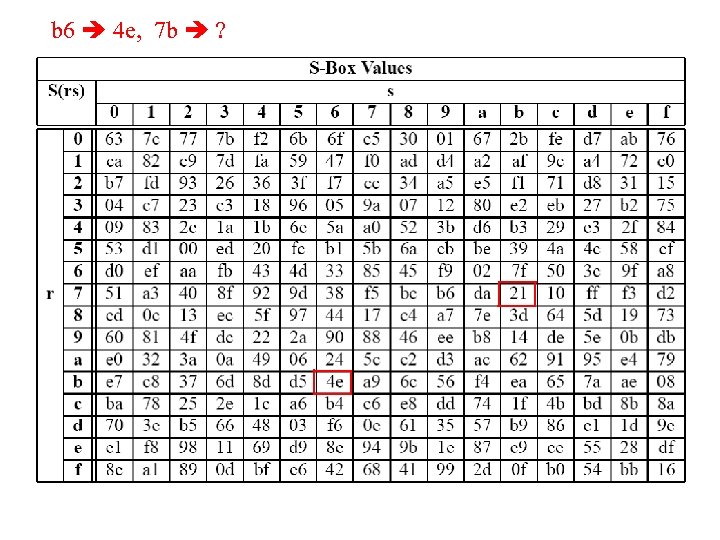 b 6 4 e, 7 b ?
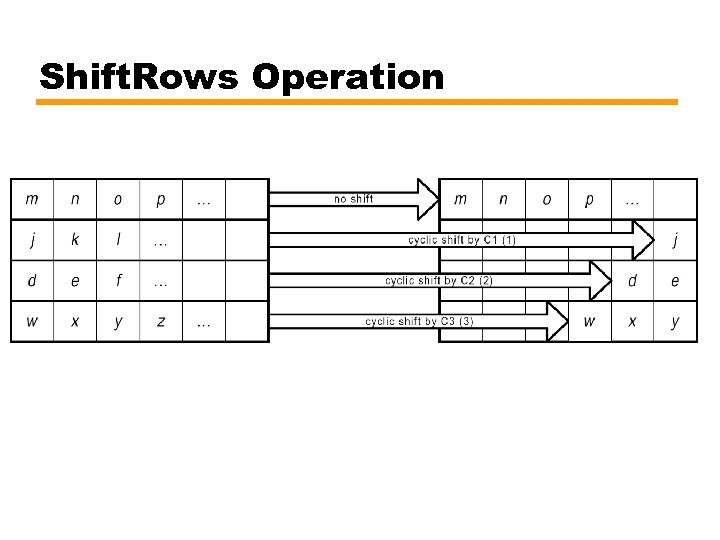 Shift. Rows Operation
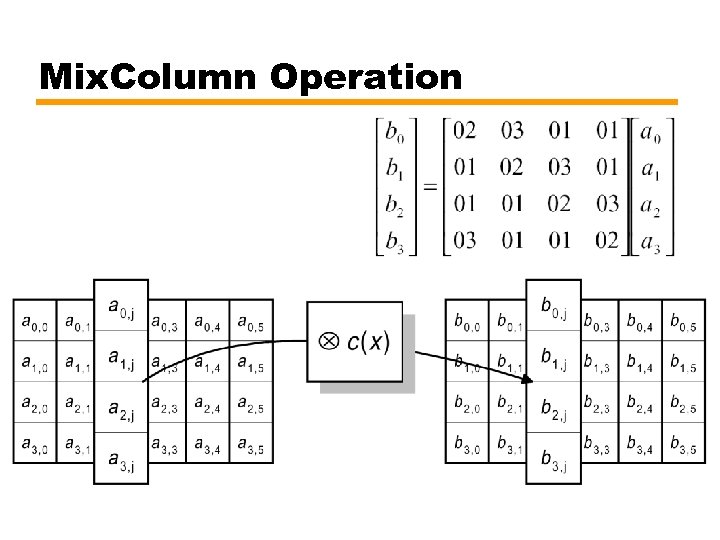 Mix. Column Operation
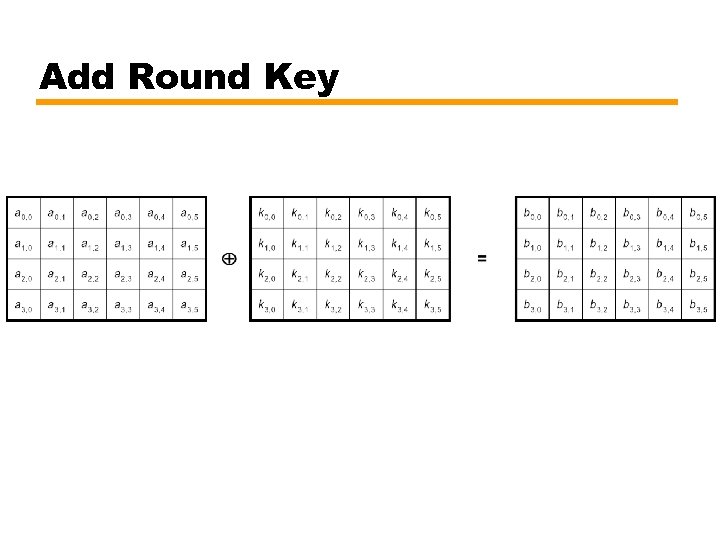 Add Round Key
 AES Comments (3) • Only Add Round Key stage uses key — Begin and ends with Add Round Key stage — Any other stage at beginning or end, reversible without key • Adds no security • Add Round Key stage by itself not formidable — Other three stages scramble bits — By themselves provide no security because no key • Each stage easily reversible • Decryption uses expanded key in reverse order — Not identical to encryption algorithm • Easy to verify that decryption does recover plaintext • Final round of encryption and decryption consists of only three stages — To make the cipher reversible
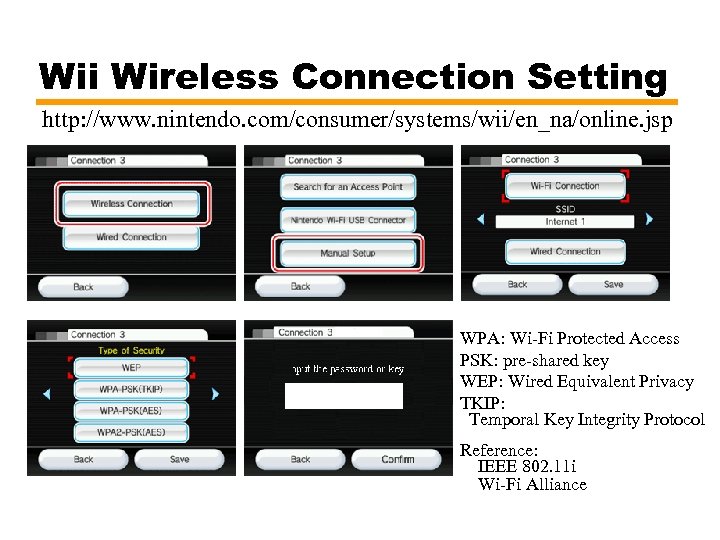 Wii Wireless Connection Setting http: //www. nintendo. com/consumer/systems/wii/en_na/online. jsp WPA: Wi-Fi Protected Access PSK: pre-shared key WEP: Wired Equivalent Privacy TKIP: Temporal Key Integrity Protocol Reference: IEEE 802. 11 i Wi-Fi Alliance
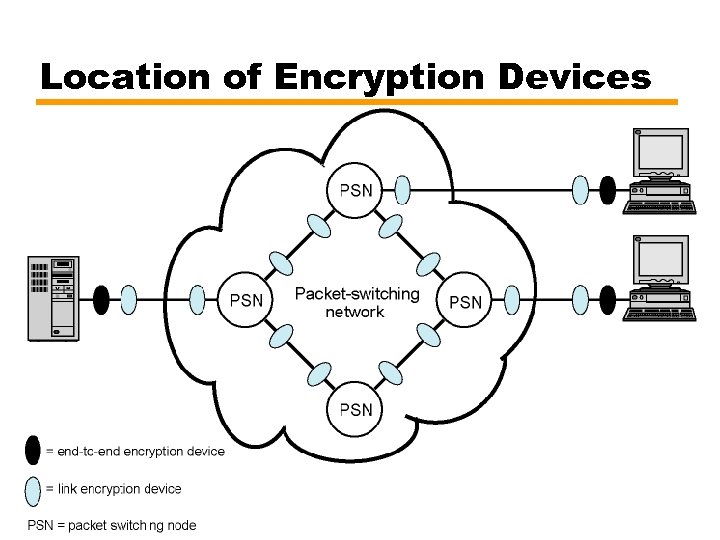 Location of Encryption Devices
 Link Encryption • • • Each communication link equipped at both ends All traffic secure High level of security Requires lots of encryption devices Message must be decrypted at each switch to read address (virtual circuit number) • Security vulnerable at switches —Particularly on public switched network
 End to End Encryption • Encryption done at ends of system • Data in encrypted form crosses network unaltered • Destination shares key with source to decrypt • Host can only encrypt user data —Otherwise switching nodes could not read header or route packet • Traffic pattern not secure • Use both link and end to end
 Key Distribution • Key selected by A and delivered to B • Third party selects key and delivers to A and B • Use old key to encrypt and transmit new key from A to B • Use old key to transmit new key from third party to A and B (next slide)
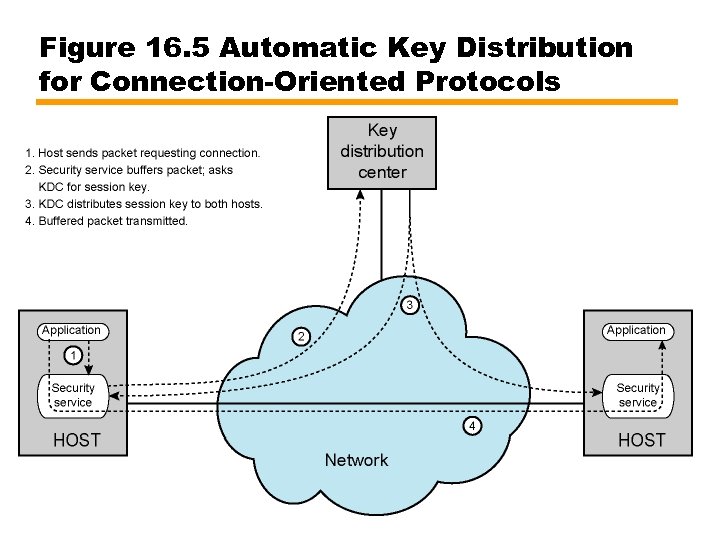 Figure 16. 5 Automatic Key Distribution for Connection-Oriented Protocols
 Automatic Key Distribution Two kinds of keys: • Session Key — Used for duration of one logical connection — Destroyed at end of session — Used for user data • Permanent key — Used for distribution of keys • Key distribution center — Determines which systems may communicate — Provides one session key for that connection • Security service module (SSM) — Performs end to end encryption — Obtains keys for host
 Traffic Padding • To reduce the opportunity of traffic analysis • Produce cipher text continuously • If no plain text to encode, send random data • Make traffic analysis impossible
 16. 3 Message Authentication and Hash Functions • Protection against active attacks —Falsification of data and transactions • Message is authentic if it is genuine and comes from the alleged source • Authentication allows receiver to verify that message is authentic —Message has not altered —Message is from authentic source —Message timeline
 Authentication Using Encryption • Assumes sender and receiver are only entities that know key • Message includes: —error detection code —sequence number —time stamp
 Authentication Without Encryption • Authentication tag generated and appended to each message • Message not encrypted • Useful for: —Messages broadcast to multiple destinations • Have one destination responsible for authentication —One side heavily loaded • Encryption adds to workload • Can authenticate random messages —Programs authenticated without encryption can be executed without decoding
 Message Authentication Code • Generate authentication code based on shared key and message • Common key shared between A and B (KAB) • MACM = F(KAB, M ) • If only sender and receiver know key and code matches: —Receiver assured message has not altered —Receiver assured message is from alleged sender —If message has sequence number, receiver assured of proper sequence
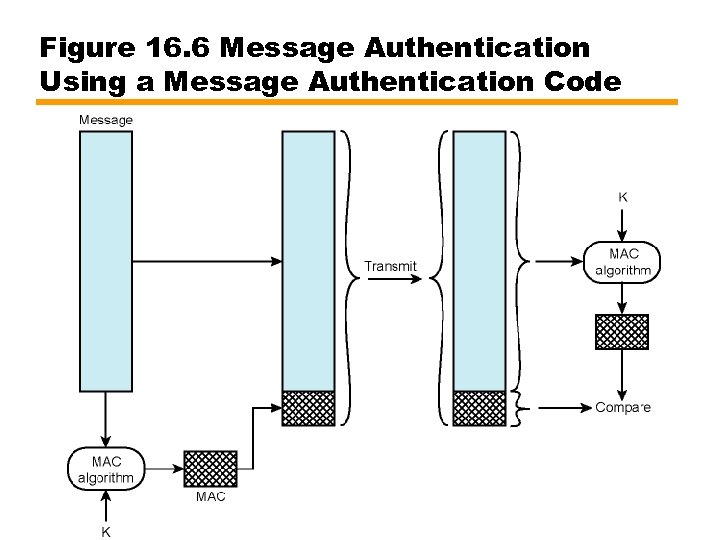 Figure 16. 6 Message Authentication Using a Message Authentication Code
 One Way Hash Function • Accepts variable size message M and produces fixed size message digest H(M ). • Advantages of authentication without encryption —Encryption is slow —Encryption hardware expensive —Encryption hardware optimized to large data —Algorithms covered by patents —Algorithms subject to export controls (from USA)
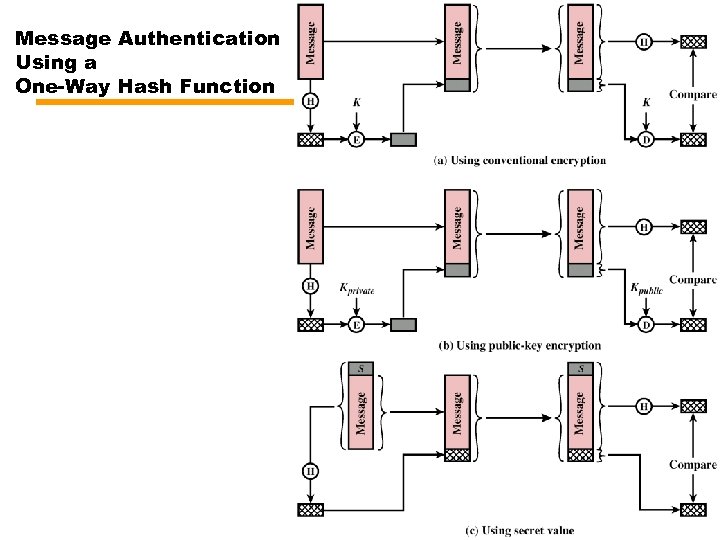 Message Authentication Using a One-Way Hash Function
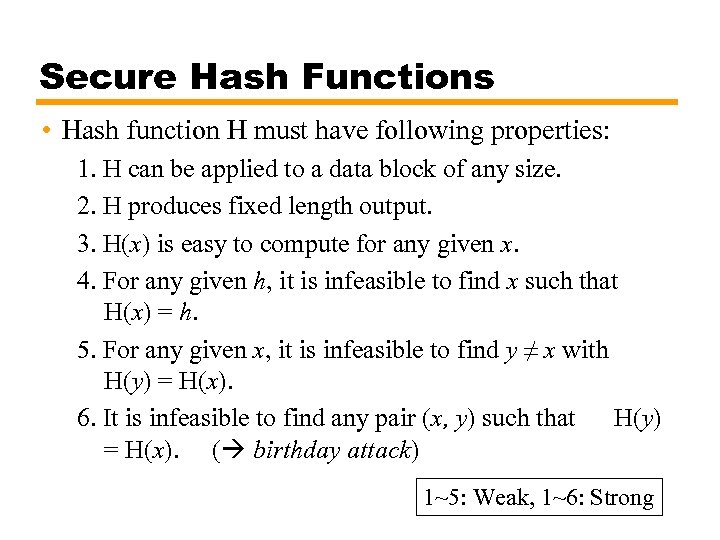 Secure Hash Functions • Hash function H must have following properties: 1. H can be applied to a data block of any size. 2. H produces fixed length output. 3. H(x) is easy to compute for any given x. 4. For any given h, it is infeasible to find x such that H(x) = h. 5. For any given x, it is infeasible to find y ≠ x with H(y) = H(x). 6. It is infeasible to find any pair (x, y) such that H(y) = H(x). ( birthday attack) 1~5: Weak, 1~6: Strong
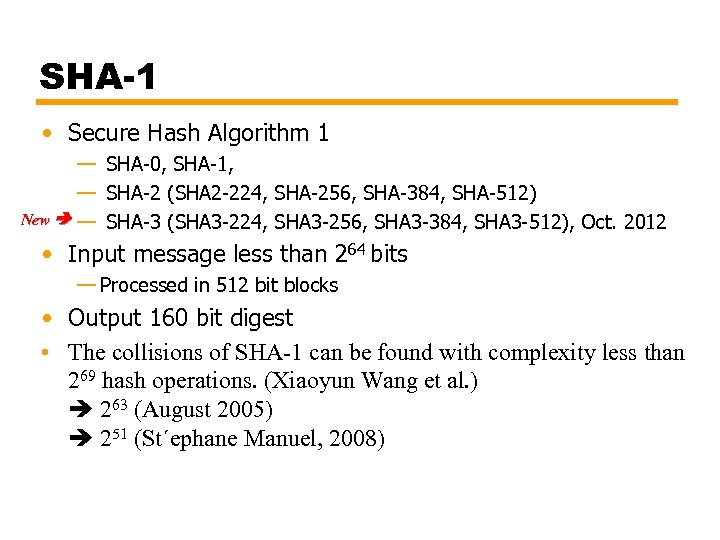 SHA-1 • Secure Hash Algorithm 1 — SHA-0, SHA-1, — SHA-2 (SHA 2 -224, SHA-256, SHA-384, SHA-512) New — SHA-3 (SHA 3 -224, SHA 3 -256, SHA 3 -384, SHA 3 -512), Oct. 2012 • Input message less than 264 bits — Processed in 512 bit blocks • Output 160 bit digest • The collisions of SHA-1 can be found with complexity less than 269 hash operations. (Xiaoyun Wang et al. ) 263 (August 2005) 251 (St´ephane Manuel, 2008)
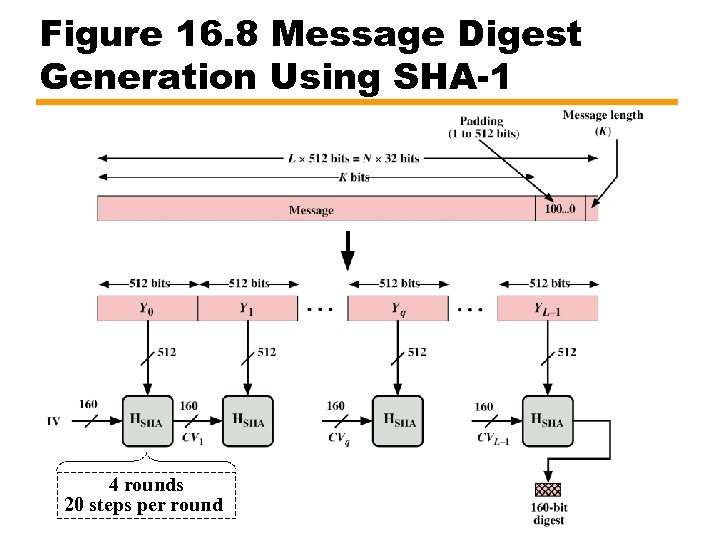 Figure 16. 8 Message Digest Generation Using SHA-1 4 rounds 20 steps per round
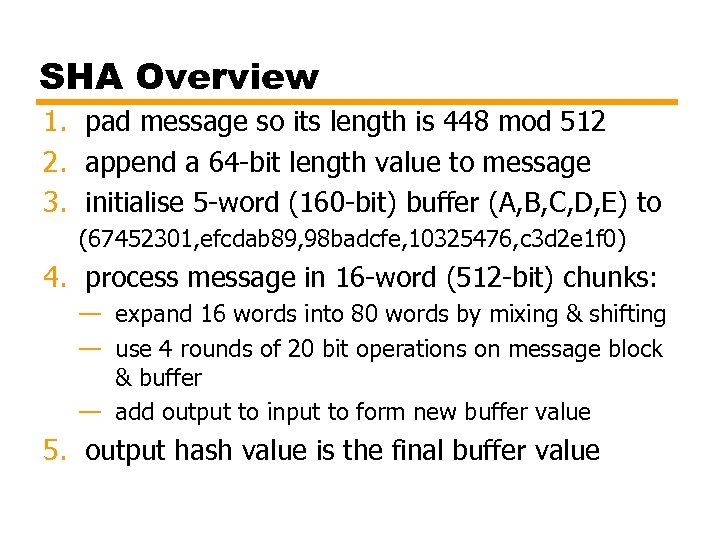 SHA Overview 1. pad message so its length is 448 mod 512 2. append a 64 -bit length value to message 3. initialise 5 -word (160 -bit) buffer (A, B, C, D, E) to (67452301, efcdab 89, 98 badcfe, 10325476, c 3 d 2 e 1 f 0) 4. process message in 16 -word (512 -bit) chunks: — expand 16 words into 80 words by mixing & shifting — use 4 rounds of 20 bit operations on message block & buffer — add output to input to form new buffer value 5. output hash value is the final buffer value
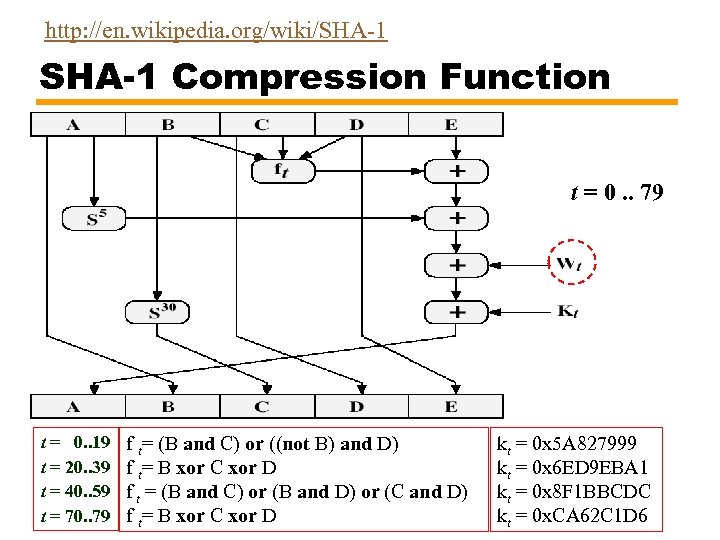 http: //en. wikipedia. org/wiki/SHA-1 Compression Function t = 0. . 79 t = 0. . 19 t = 20. . 39 t = 40. . 59 t = 70. . 79 f t= (B and C) or ((not B) and D) f t= B xor C xor D f t = (B and C) or (B and D) or (C and D) f t= B xor C xor D kt = 0 x 5 A 827999 kt = 0 x 6 ED 9 EBA 1 kt = 0 x 8 F 1 BBCDC kt = 0 x. CA 62 C 1 D 6
 SHA-3 • In 2005, cryptanalysts found attacks on SHA-1. • In 2012, NIST selected an additional algorithm, Keccak, for standardization under SHA-3. • The SHA-3 standard was released by NIST on August 5, 2015. • https: //en. wikipedia. org/wiki/SHA-3
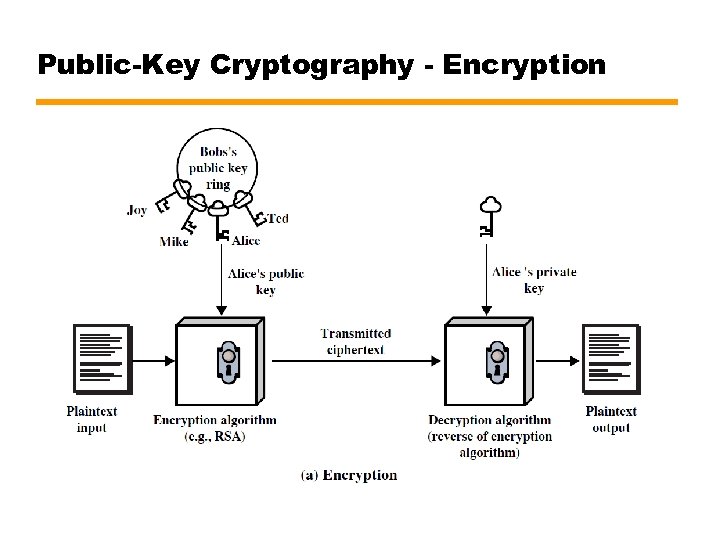 Public-Key Cryptography - Encryption
 Public Key Encryption • Based on mathematical algorithms • Asymmetric —Use two separate keys • Ingredients —Plain text —Encryption algorithm —Public and private key —Cipher text —Decryption algorithm
 Public Key Encryption Operation • One key made public —Used for encryption • Other kept private —Used for decryption • Infeasible to determine decryption key given encryption key and algorithm • Either key can be used for encryption, the other for decryption
 Steps • User generates pair of keys • User places one key in public domain • To send a message to user, encrypt using public key • User decrypts using private key
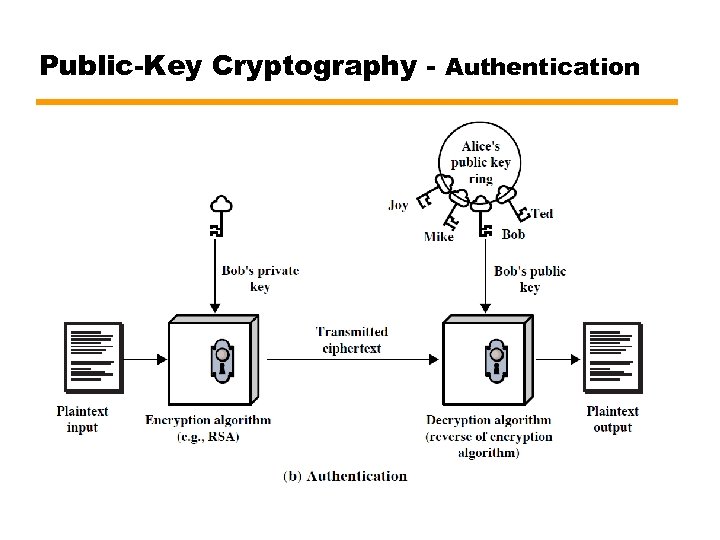 Public-Key Cryptography - Authentication
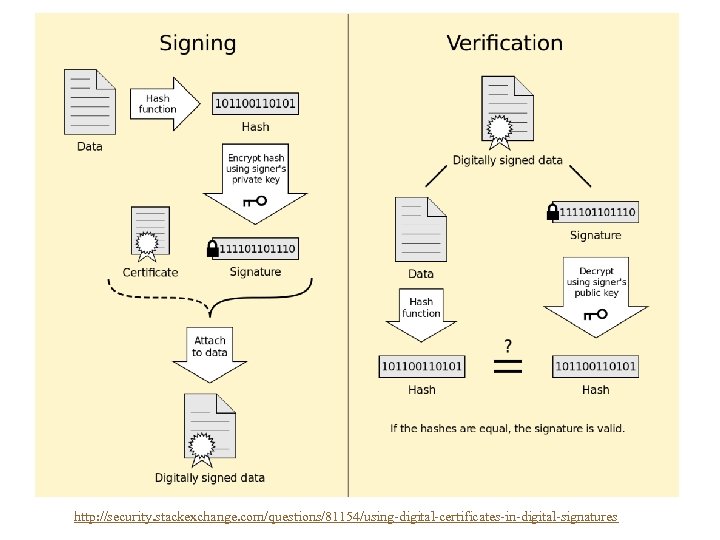
 Digital Signature • Sender encrypts message with their private key • Receiver can decrypt using senders public key • This authenticates sender, who is only person who has the matching key • Does not give privacy of data —Decrypt key is public
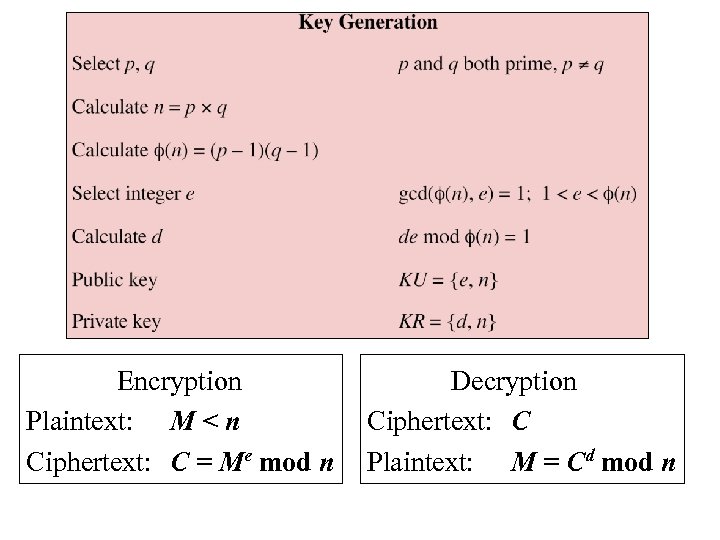
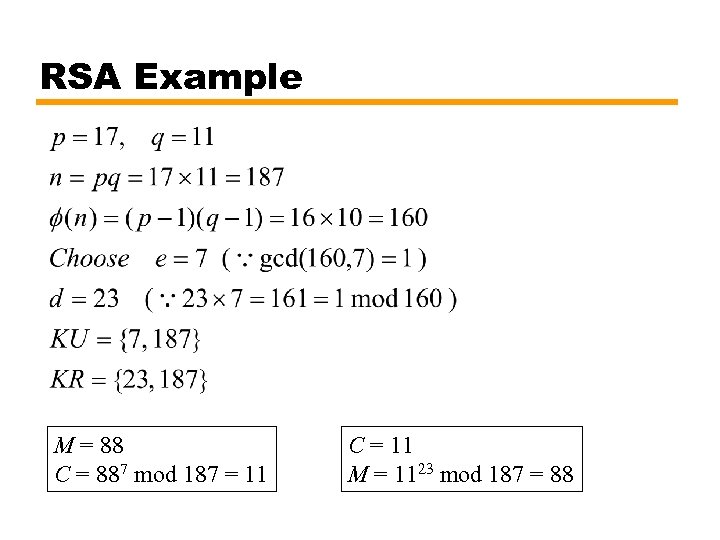
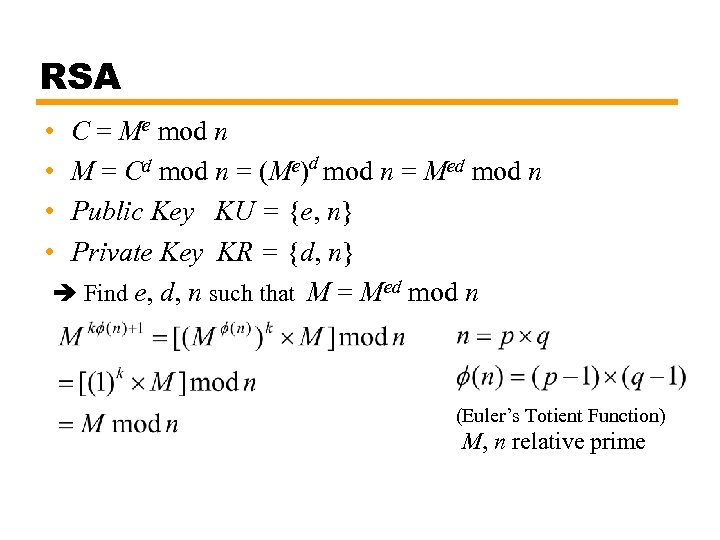 RSA • • C = Me mod n M = Cd mod n = (Me)d mod n = Med mod n Public Key KU = {e, n} Private Key KR = {d, n} Find e, d, n such that M = Med mod n (Euler’s Totient Function) M, n relative prime
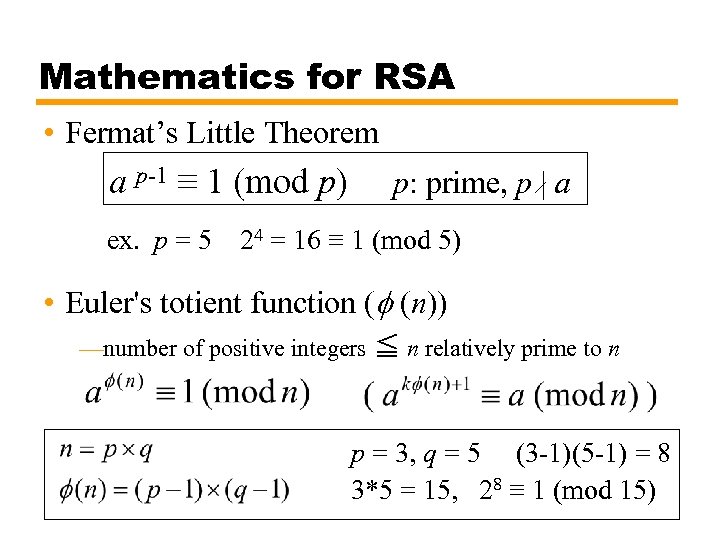 Mathematics for RSA • Fermat’s Little Theorem a p-1 ≡ 1 (mod p) ex. p = 5 p: prime, p | a 24 = 16 ≡ 1 (mod 5) • Euler's totient function ( (n)) —number of positive integers ≦ n relatively prime to n p = 3, q = 5 (3 -1)(5 -1) = 8 3*5 = 15, 28 ≡ 1 (mod 15)
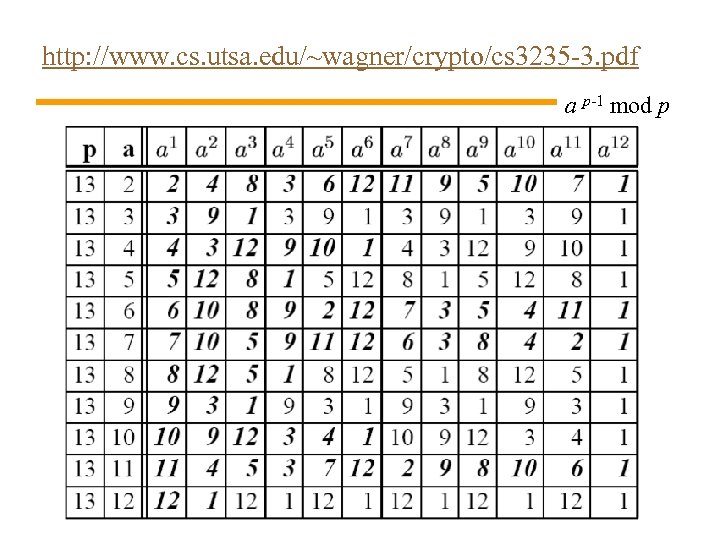 http: //www. cs. utsa. edu/~wagner/crypto/cs 3235 -3. pdf a p-1 mod p
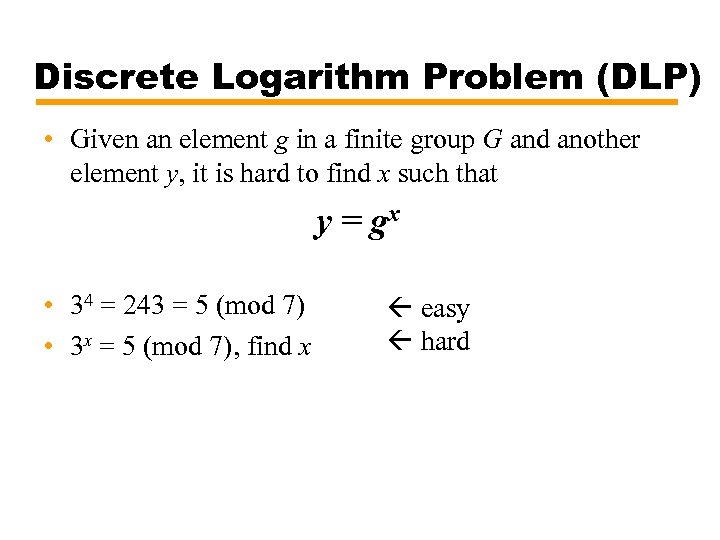 Discrete Logarithm Problem (DLP) • Given an element g in a finite group G and another element y, it is hard to find x such that y = gx • 34 = 243 = 5 (mod 7) • 3 x = 5 (mod 7), find x easy hard
 Encryption Plaintext: M < n Ciphertext: C = Me mod n Decryption Ciphertext: C Plaintext: M = Cd mod n
 RSA Example M = 88 C = 887 mod 187 = 11 C = 11 M = 1123 mod 187 = 88
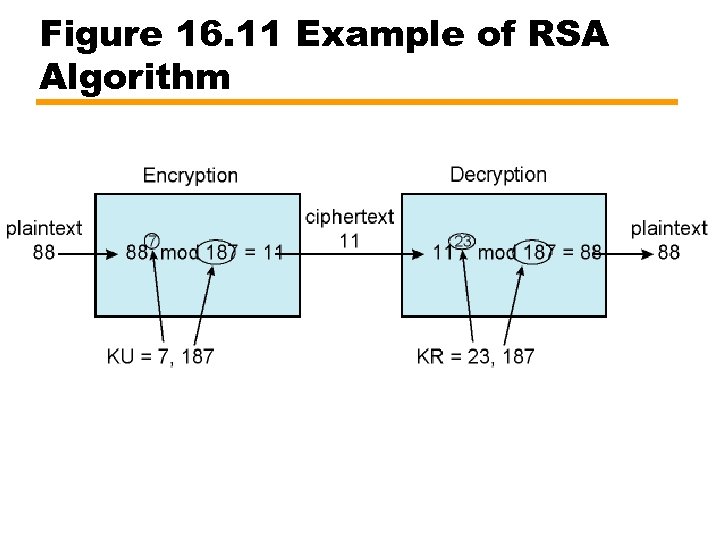 Figure 16. 11 Example of RSA Algorithm
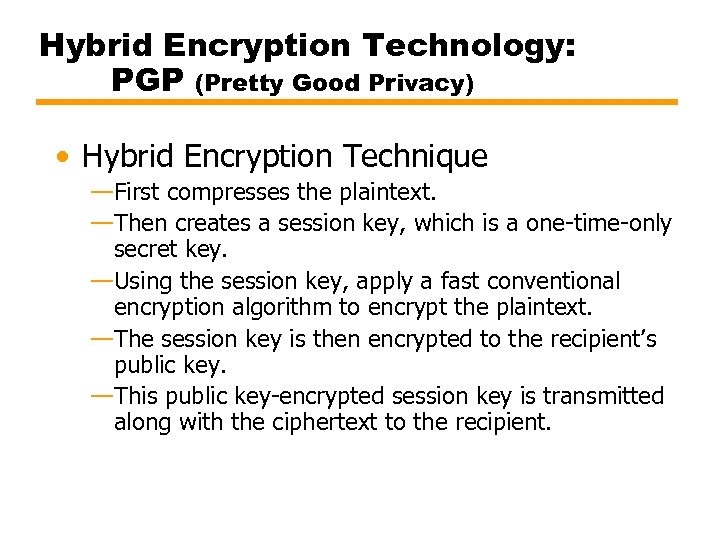 Hybrid Encryption Technology: PGP (Pretty Good Privacy) • Hybrid Encryption Technique —First compresses the plaintext. —Then creates a session key, which is a one-time-only secret key. —Using the session key, apply a fast conventional encryption algorithm to encrypt the plaintext. —The session key is then encrypted to the recipient’s public key. —This public key-encrypted session key is transmitted along with the ciphertext to the recipient.
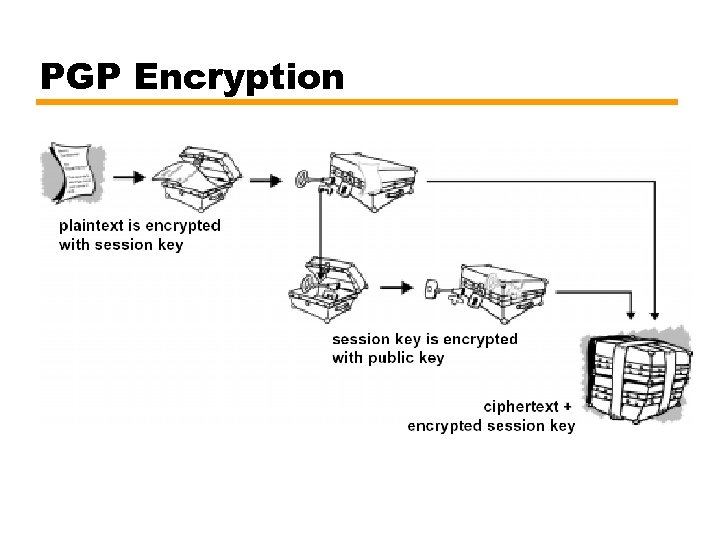 PGP Encryption
 PGP Decryption • The recipient uses its private key to recover the temporary session key • Use the session key to decrypt the conventionally-encrypted ciphertext.
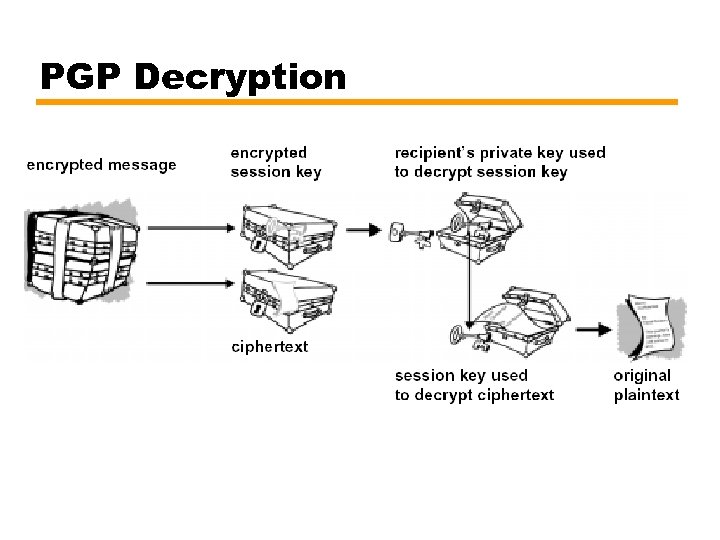 PGP Decryption
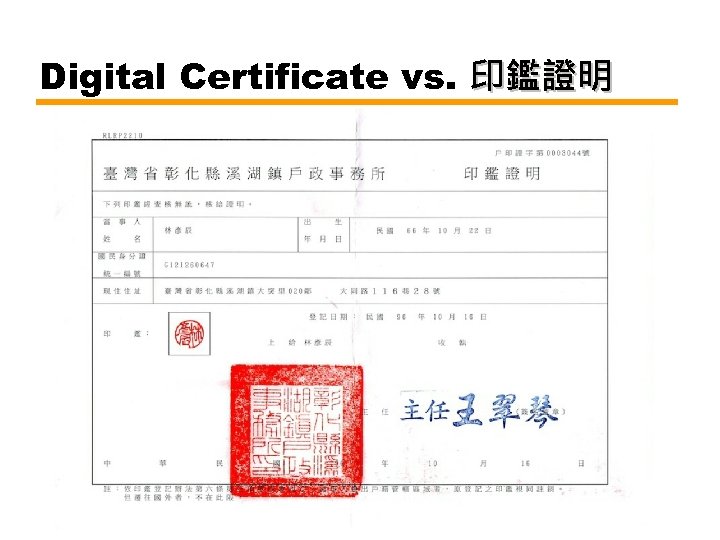
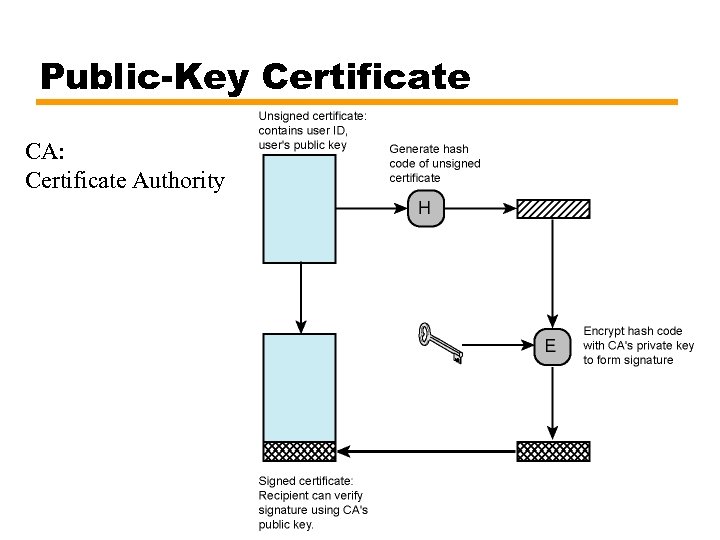 Public-Key Certificate CA: Certificate Authority
 Digital Certificate vs. 印鑑證明
 http: //security. stackexchange. com/questions/81154/using-digital-certificates-in-digital-signatures
 Diffie-Hellman Key Exchange • Two parties with no prior knowledge of each other can jointly establish a shared secret key over an insecure communications channel. • p: prime number, g: primitive root of p Bob Choose a Alice Choose b A= ga (mod p) B = gb (mod p) K = Ba (mod p) = gab (mod p) A B K = Ab (mod p) = gab (mod p)
 Secure Sockets Layer (SSL) Transport Layer Security (TLS) • Security services • Transport Layer Security defined in RFC 2246 • SSL general-purpose service —Set of protocols that rely on TCP • Two implementation options —Part of underlying protocol suite • Transparent to applications —Embedded in specific packages • E. g. Netscape and Microsoft Explorer and most Web servers • Minor differences between SSLv 3 and TLS
 SSL Architecture • SSL uses TCP to provide reliable end-to-end secure service • SSL two layers of protocols • Record Protocol provides basic security services to various higher-layer protocols —In particular, HTTP can operate on top of SSL • Three higher-layer protocols —Handshake Protocol —Change Cipher Spec Protocol —Alert Protocol —Used in management of SSL exchanges (see later)
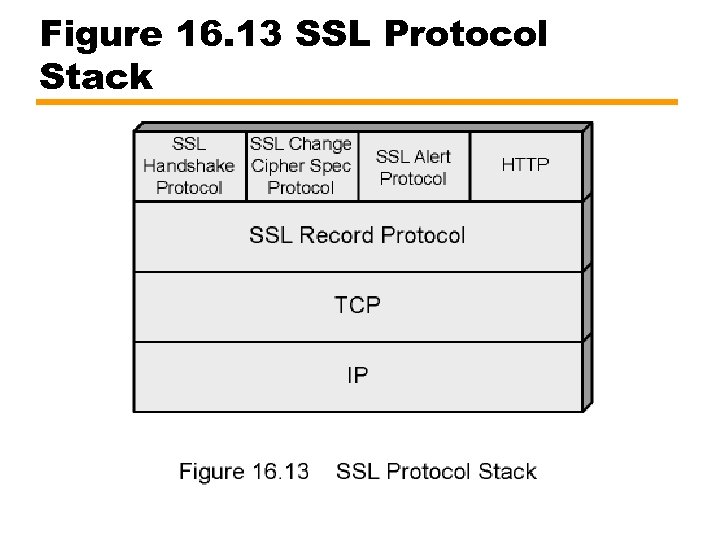 Figure 16. 13 SSL Protocol Stack
 SSL Connection and Session • Connection — Transport that provides suitable type of service — Peer-to-peer — Transient — Every connection associated with one session • Session — Association between client and server — Created by Handshake Protocol — Define set of cryptographic security parameters — Used to avoid negotiation of new security parameters for each connection • Maybe multiple secure connections between parties • May be multiple simultaneous sessions between parties — Not used in practice
 SSL Record Protocol • Confidentiality — Handshake Protocol defines shared secret key — Used for symmetric encryption • Message Integrity — Handshake Protocol defines shared secret key — Used to form message authentication code (MAC) • Each upper-layer message fragmented — 214 bytes (16384 bytes) or less • Compression optionally applied • Compute message authentication code • Compressed message plus MAC encrypted using symmetric encryption • Prepend header: Content Type, Version, Compressed Length
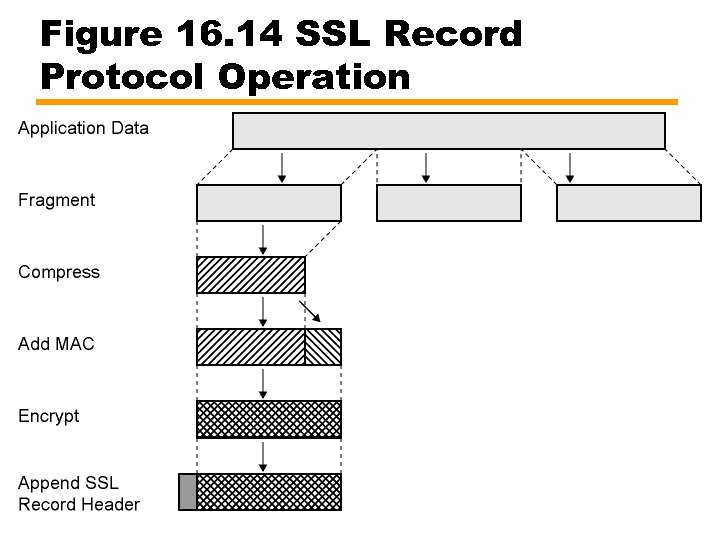 Figure 16. 14 SSL Record Protocol Operation
 Record Protocol Header • Content Type (8 bits) — change_cipher_spec, alert, handshake, and application_data — No distinction between applications (e. g. , HTTP) • Content of application data opaque to SSL • Major Version (8 bits) – SSL v 3 is 3 • Minor Version (8 bits) - SSLv 3 value is 0 • Compressed Length (16 bits) — Maximum 214 + 2048 • Record Protocol then transmits unit in TCP segment • Received data are decrypted, verified, decompressed, and reassembled and then delivered
 Change Cipher Spec Protocol • Uses Record Protocol • Single message —Single byte value 1 Simplest! • Cause pending state to be copied into current state —Updates cipher suite to be used on this connection
 Alert Protocol • Convey SSL-related alerts to peer entity • Alert messages compressed and encrypted • Two bytes —First byte warning(1) or fatal(2) • If fatal, SSL immediately terminates connection • Other connections on session may continue • No new connections on session —Second byte indicates specific alert —E. g. fatal alert is an incorrect MAC —E. g. nonfatal alert is close_notify message
 Handshake Protocol • Authenticate • Negotiate encryption and MAC algorithm and cryptographic keys • Used before any application data sent • Four phases
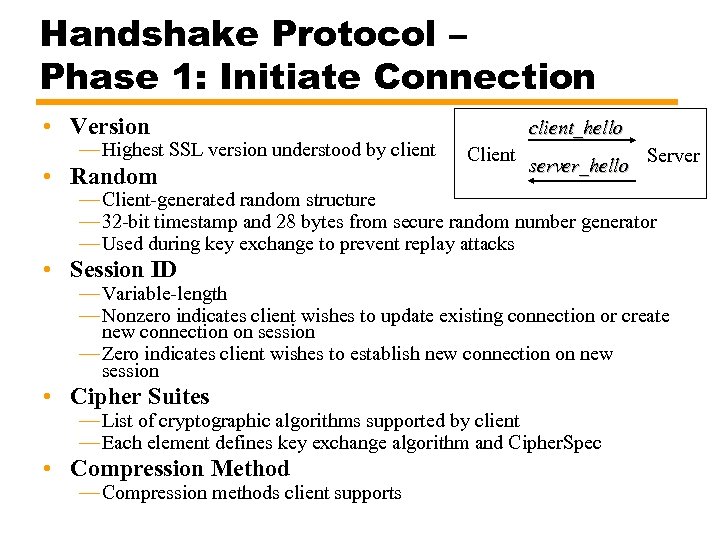 Handshake Protocol – Phase 1: Initiate Connection • Version — Highest SSL version understood by client • Random client_hello Client server_hello Server — Client-generated random structure — 32 -bit timestamp and 28 bytes from secure random number generator — Used during key exchange to prevent replay attacks • Session ID — Variable-length — Nonzero indicates client wishes to update existing connection or create new connection on session — Zero indicates client wishes to establish new connection on new session • Cipher Suites — List of cryptographic algorithms supported by client — Each element defines key exchange algorithm and Cipher. Spec • Compression Method — Compression methods client supports
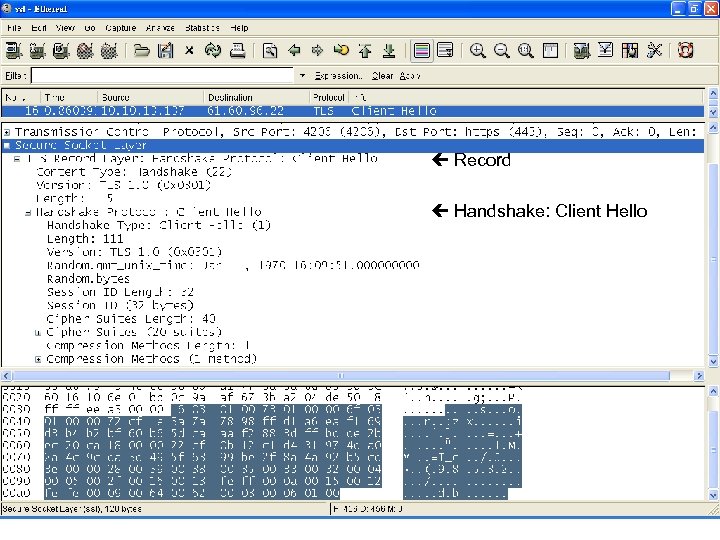 Record Handshake: Client Hello
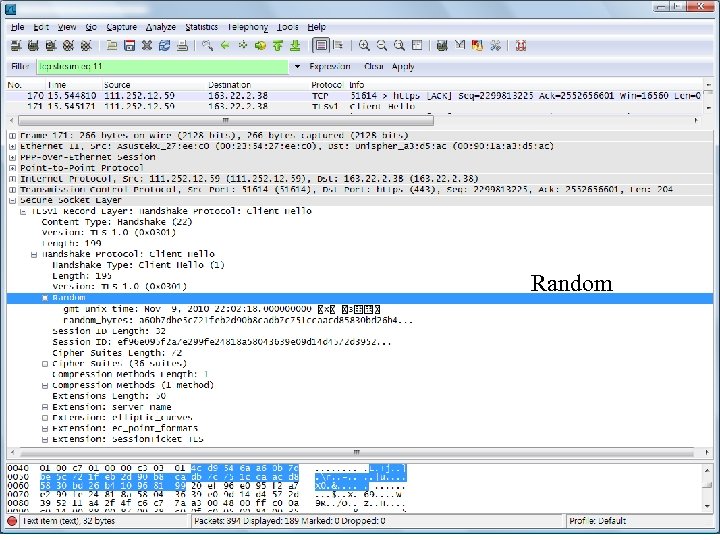 Random
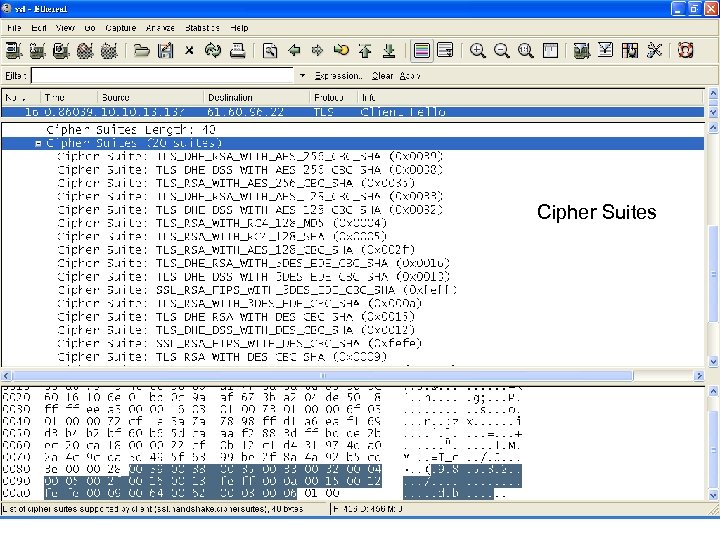 Cipher Suites
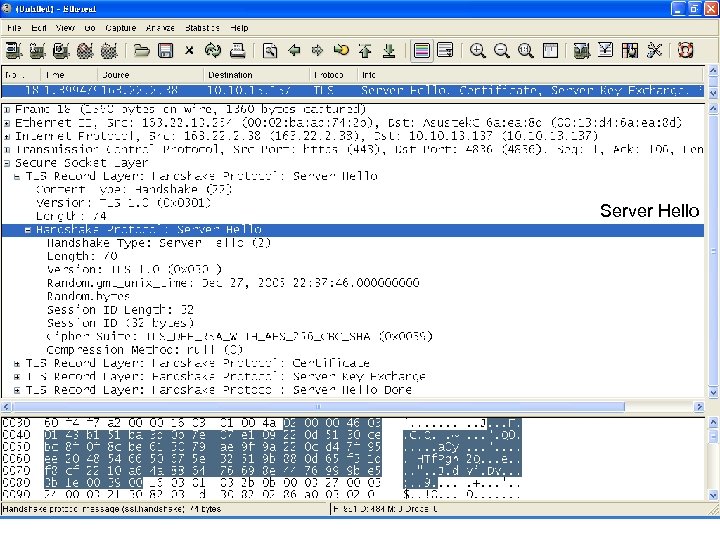 Server Hello
 Handshake Protocol – Phase 2, 3 • Phase 2 depends on underlying encryption scheme — Server sends certificate, key exchange, & a request for client certificate • Final message in Phase 2 is server_done — Required • Phase 3 — Upon receipt of server_done, client verifies certificate if required and check server_hello parameters — Client sends messages to server, depending on underlying public -key scheme • Certificate, key exchange, certificate verification
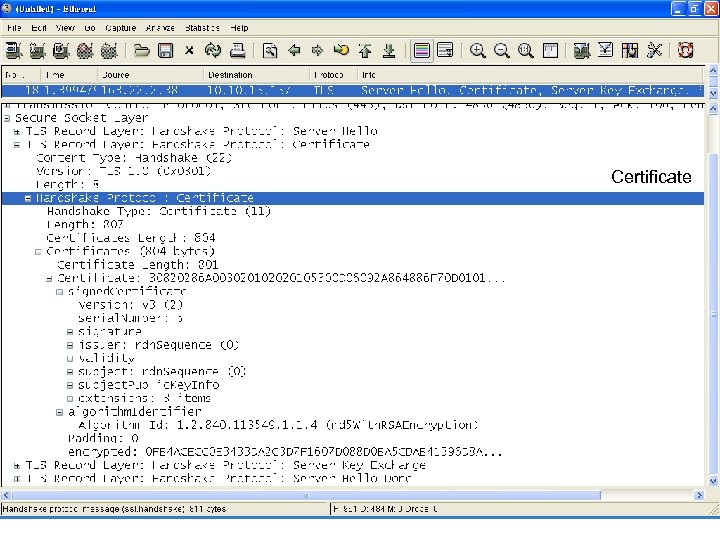 Certificate
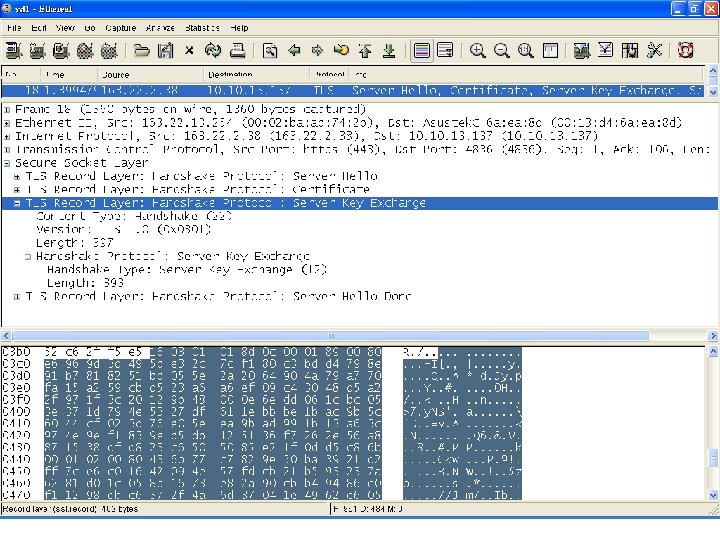
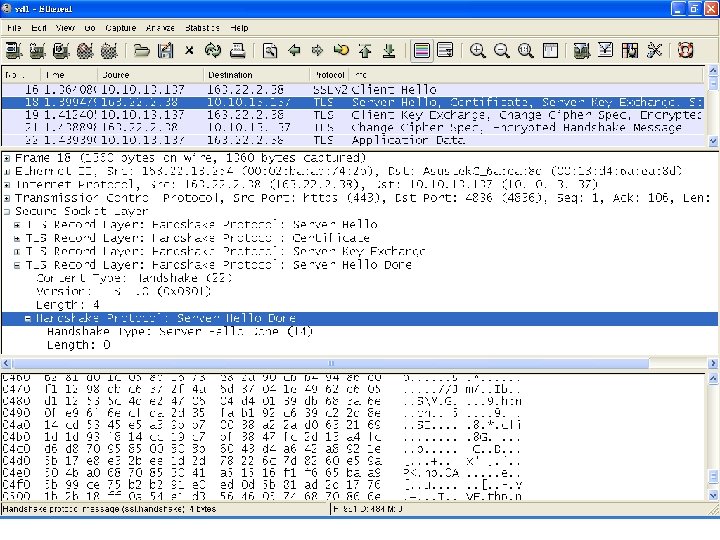
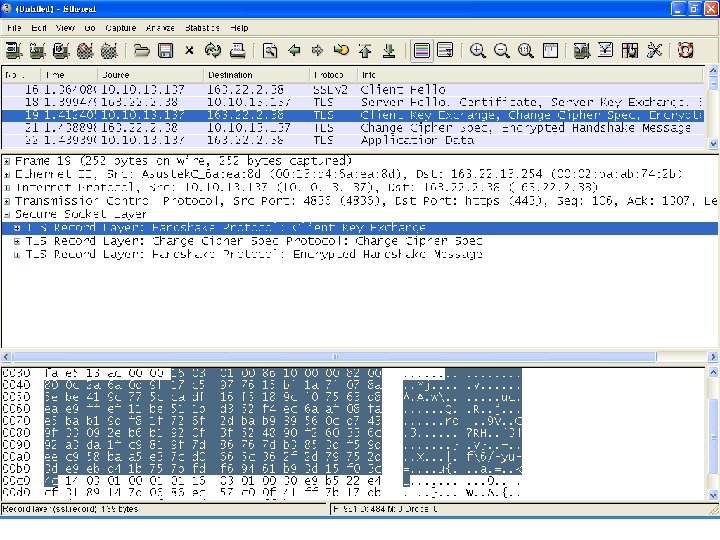
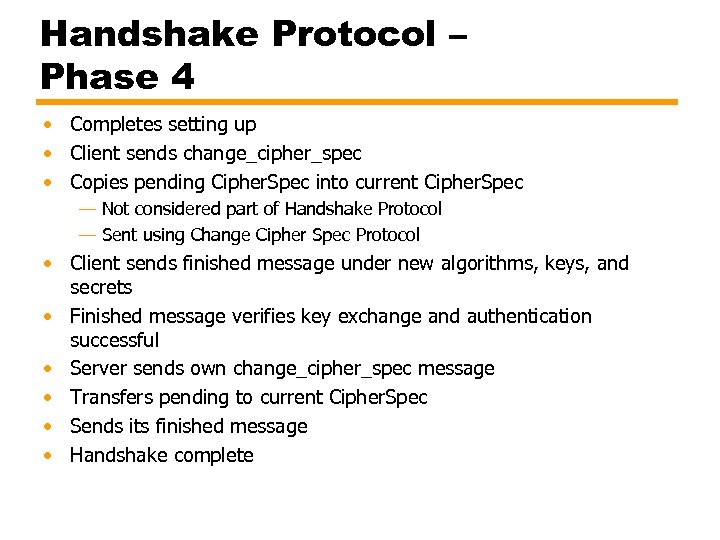 Handshake Protocol – Phase 4 • Completes setting up • Client sends change_cipher_spec • Copies pending Cipher. Spec into current Cipher. Spec — Not considered part of Handshake Protocol — Sent using Change Cipher Spec Protocol • Client sends finished message under new algorithms, keys, and secrets • Finished message verifies key exchange and authentication successful • Server sends own change_cipher_spec message • Transfers pending to current Cipher. Spec • Sends its finished message • Handshake complete
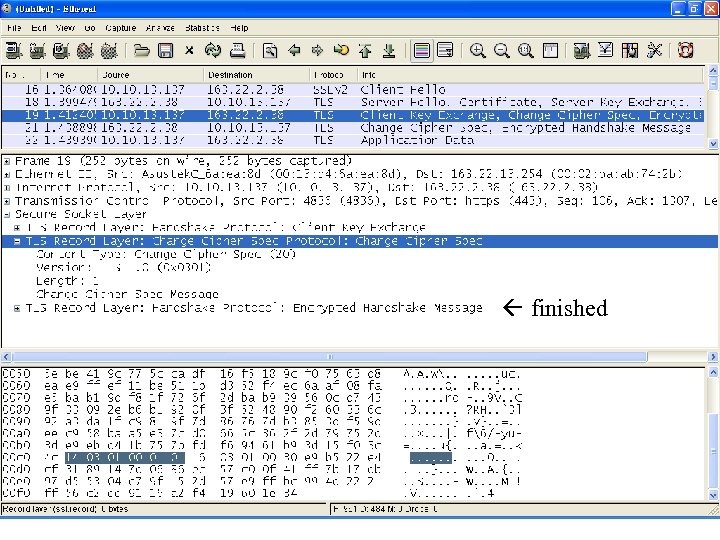 finished
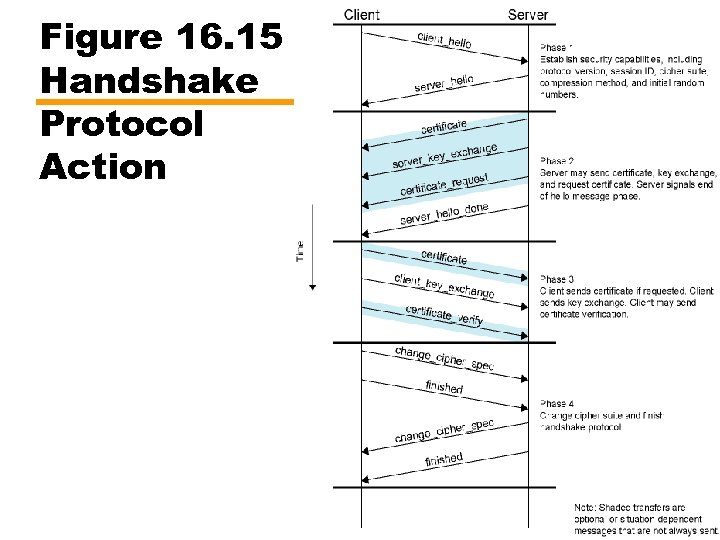 Figure 16. 15 Handshake Protocol Action
 IPv 4 and IPv 6 Security • IPSec • Example use: —Secure branch office connectivity over Internet —Secure remote access over Internet —Extranet and intranet connectivity —Enhanced electronic commerce security
 IPSec Scope • Three facilities: —Authentication-only • Authentication Header (AH) —Combined authentication/encryption • Encapsulated Security Payload (ESP) —Key exchange • RFC 2401, 2402, 2406, 2408
 Security Association • One way relationship between sender and receiver • For two way, two associations are required • Three SA identification parameters —Security parameter index (SPI) —IP destination address —Security protocol identifier (AH or ESP)
 SA Parameters for Each SP • • Sequence number counter Sequence counter overflow Anti-replay windows AH information ESP information Lifetime of this association IPSec protocol mode —Tunnel, transport or wildcard • Path MTU
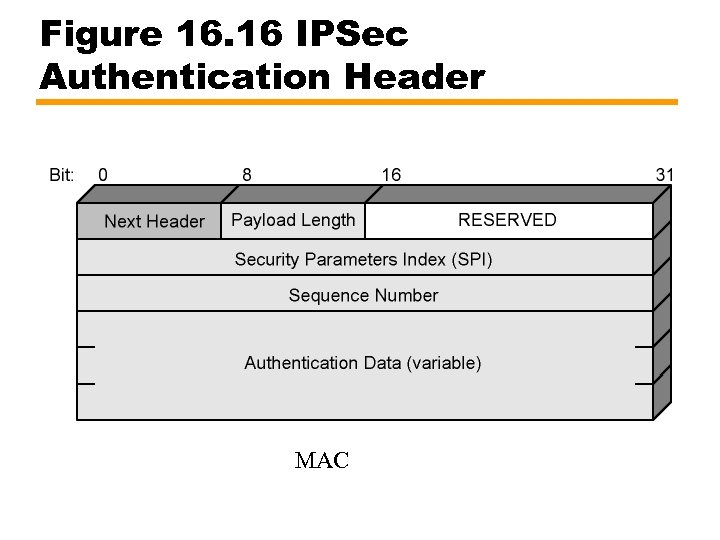 Figure 16. 16 IPSec Authentication Header MAC
 Encapsulating Security Payload • ESP • Confidentiality services • Fields —Security Parameters Index (SPI) —Sequence Number —Payload Data —Padding —Pad Length —Next Header
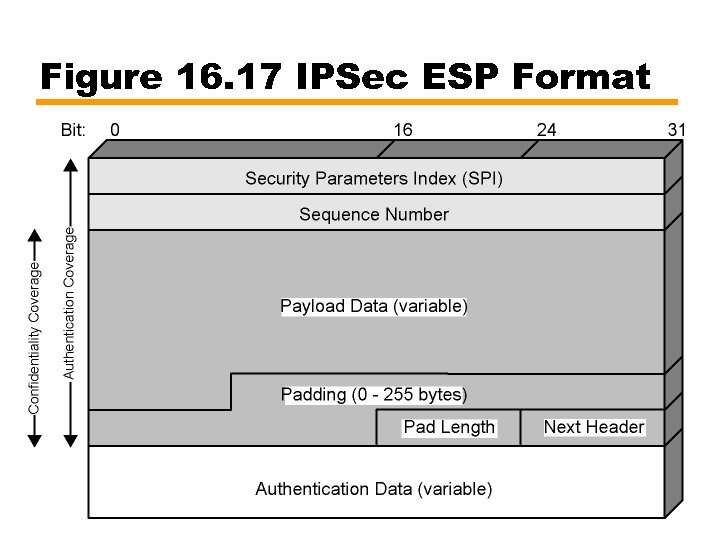 Figure 16. 17 IPSec ESP Format