


 Скачать презентацию Computer Networks Lesson 2 Data Transmission and Media
02b1a69abce560224fae2f92c976f436.ppt
- Количество слайдов: 55
 Computer Networks Lesson 2 Data Transmission and Media
 Terminology (1) Transmitter n Receiver n Medium n n Guided medium n e. g. twisted pair, optical fiber n Unguided medium n e. g. air, water, vacuum
 Terminology (2) n Direct link n n No intermediate devices Point-to-point Direct link n Only 2 devices share link n n Multi-point n More than two devices share the link
 Terminology (3) n Simplex n One direction n e. g. Television n Half duplex n Either direction, but only one way at a time n e. g. police radio n Full duplex n Both directions at the same time n e. g. telephone
 Frequency, Spectrum and Bandwidth n Time domain concepts n Continuous signal n Various in a smooth way over time n Discrete signal n Maintains a constant level then changes to another constant level n Periodic signal n Pattern repeated over time n Aperiodic signal n Pattern not repeated over time
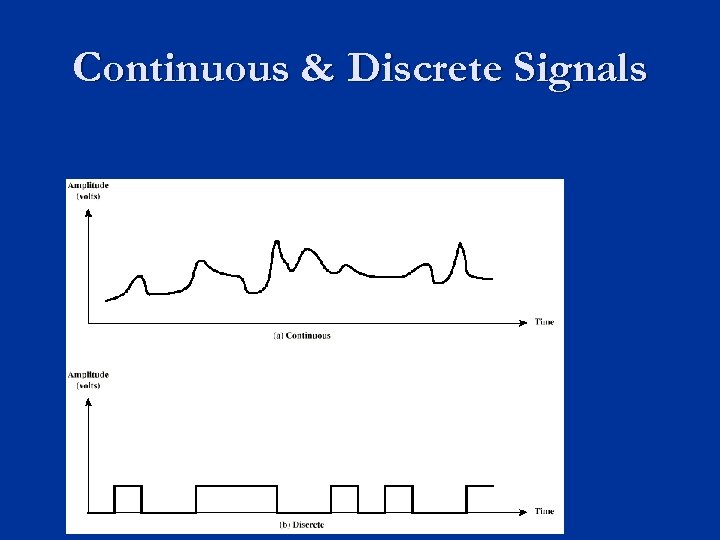 Continuous & Discrete Signals
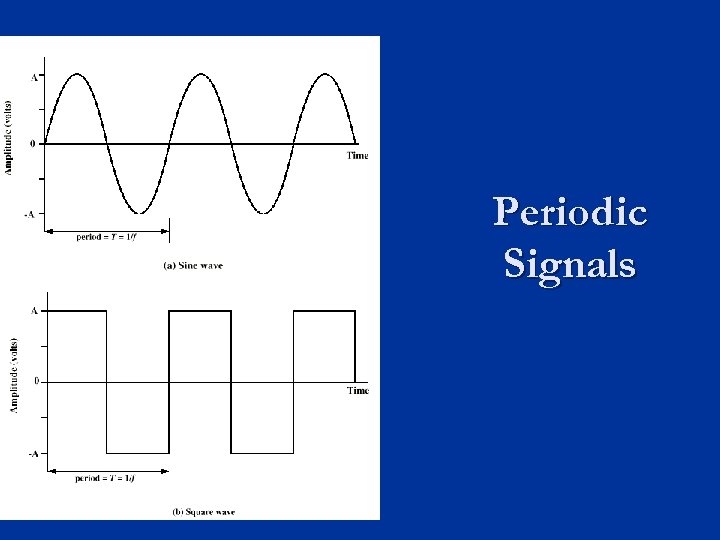 Periodic Signals
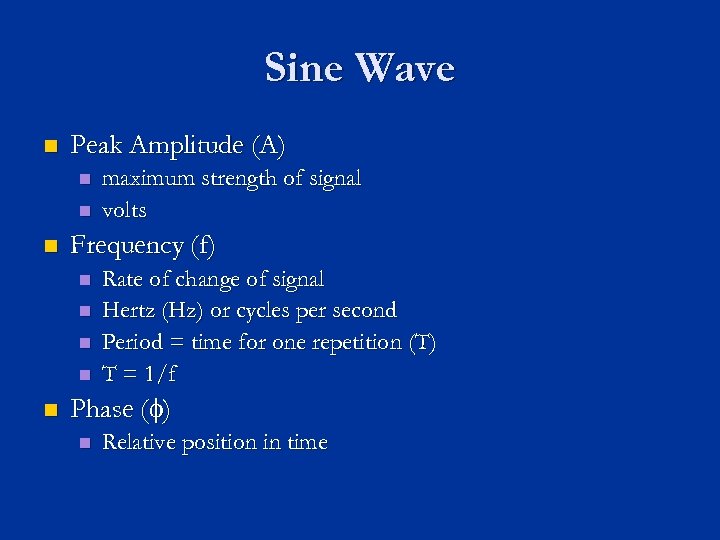 Sine Wave n Peak Amplitude (A) n n n Frequency (f) n n n maximum strength of signal volts Rate of change of signal Hertz (Hz) or cycles per second Period = time for one repetition (T) T = 1/f Phase ( ) n Relative position in time
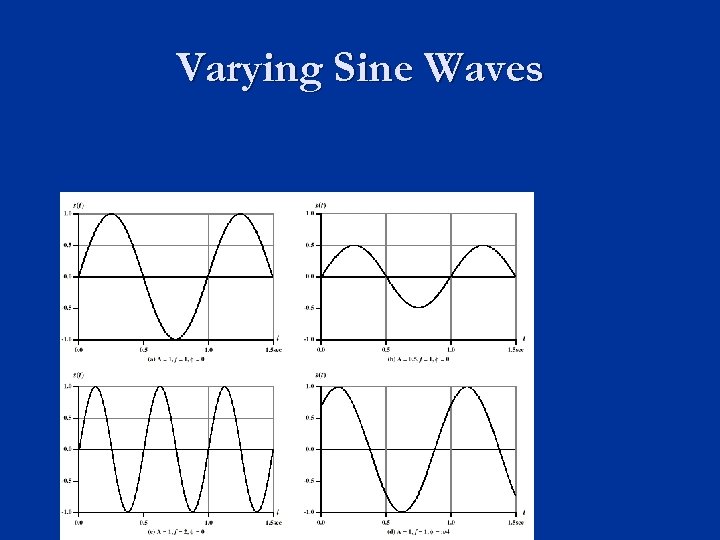 Varying Sine Waves
 Wavelength Distance occupied by one cycle n Distance between two points of corresponding phase in two consecutive cycles n n Assuming signal velocity v n = v. T n f = v n n c = 3*108 ms-1 (speed of light in free space)
 Frequency Domain Concepts Signal usually made up of many frequencies n Components are sine waves n Can be shown (Fourier analysis) that any signal is made up of component sine waves n Can plot frequency domain functions n
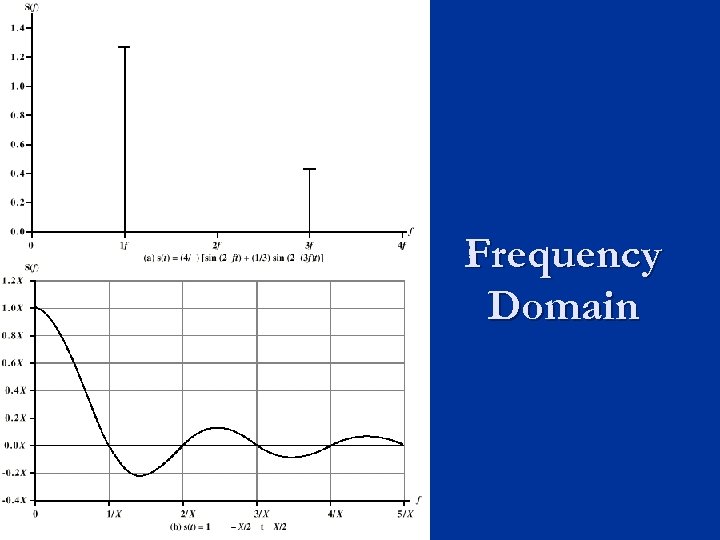 Frequency Domain
 Spectrum & Bandwidth n Spectrum n n Absolute bandwidth n n width of spectrum Effective bandwidth n Often just bandwidth n n range of frequencies contained in signal Narrow band of frequencies containing most of the energy DC Component n Component of zero frequency
 Data Rate and Bandwidth Any transmission system has a limited band of frequencies n This limits the data rate that can be carried n
 Analog and Digital Data Transmission n Data n n Signals n n Entities that convey meaning Electric or electromagnetic representations of data Transmission n Communication of data by propagation and processing of signals
 Data n Analog Continuous values within some interval n e. g. sound, video n n Digital Discrete values n e. g. text, integers n
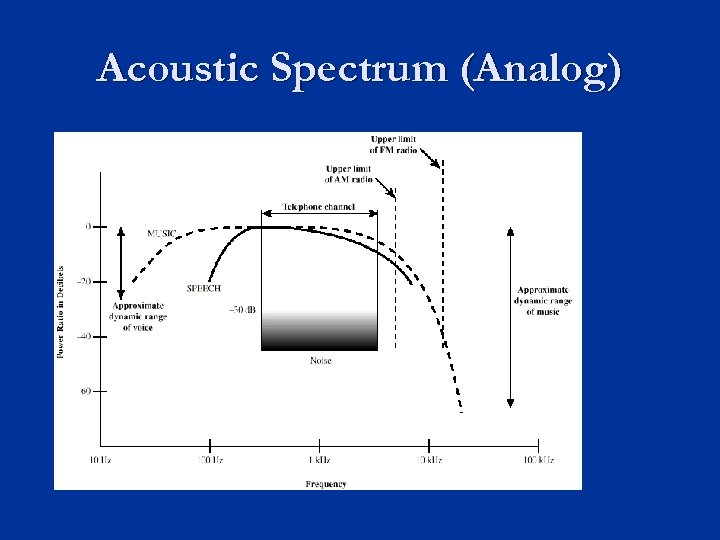 Acoustic Spectrum (Analog)
 Signals n n Means by which data are propagated Analog n n Continuously variable Various media n n n wire, fiber optic, space Speech bandwidth 100 Hz to 7 k. Hz Telephone bandwidth 300 Hz to 3400 Hz Video bandwidth 4 MHz Digital n Use two DC components
 Data and Signals Usually use digital signals for digital data and analog signals for analog data n Can use analog signal to carry digital data n n n Modem Can use digital signal to carry analog data n Compact Disc audio
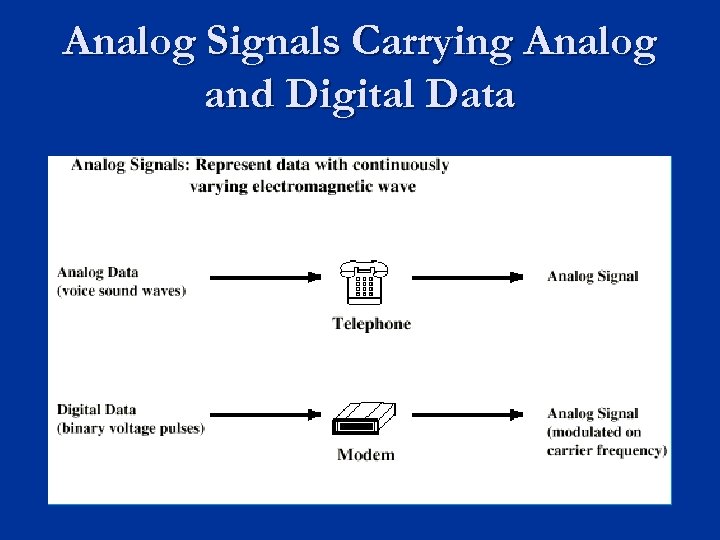 Analog Signals Carrying Analog and Digital Data
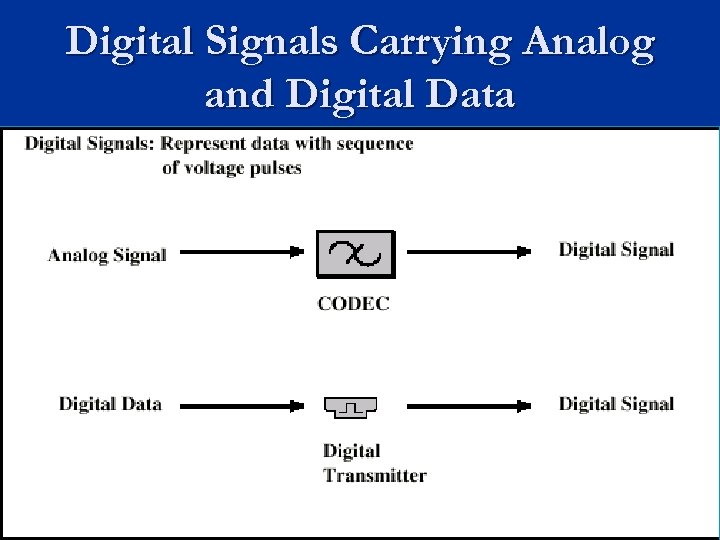 Digital Signals Carrying Analog and Digital Data
 Analog Transmission Analog signal transmitted without regard to content n May be analog or digital data n Attenuated over distance n Use amplifiers to boost signal n Also amplifies noise n
 Digital Transmission n n n n Concerned with content Integrity endangered by noise, attenuation etc. Repeaters used Repeater receives signal Extracts bit pattern Retransmits Attenuation is overcome Noise is not amplified
 Advantages of Digital Transmission n Digital technology n n Data integrity n n n High bandwidth links economical High degree of multiplexing easier with digital techniques Security & Privacy n n Longer distances over lower quality lines Capacity utilization n n Low cost LSI/VLSI technology Encryption Integration
 Transmission Impairments Signal received may differ from signal transmitted n Analog - degradation of signal quality n Digital - bit errors n Caused by n Attenuation and attenuation distortion n Delay distortion n Noise n
 Attenuation Signal strength falls off with distance n Depends on medium n Received signal strength: n must be enough to be detected n must be sufficiently higher than noise to be received without error n n Attenuation is an increasing function of frequency
 Delay Distortion Only in guided media n Propagation velocity varies with frequency n
 Noise (1) n n Additional signals inserted between transmitter and receiver Thermal n n Due to thermal agitation of electrons Uniformly distributed White noise Intermodulation n Signals that are the sum and difference of original frequencies sharing a medium
 Noise (2) n Crosstalk n n A signal from one line is picked up by another Impulse Irregular pulses or spikes n e. g. External electromagnetic interference n Short duration n High amplitude n
 Channel Capacity n Data rate In bits per second n Rate at which data can be communicated n n Bandwidth In cycles per second of Hertz n Constrained by transmitter and medium n
 Overview Guided - wire n Unguided - wireless n Characteristics and quality determined by medium and signal n For guided, the medium is more important n For unguided, the bandwidth produced by the antenna is more important n Key concerns are data rate and distance n
 Design Factors n Bandwidth n n Transmission impairments n n n Higher bandwidth gives higher data rate Attenuation Interference Number of receivers n n In guided media More receivers (multi-point) introduce more attenuation
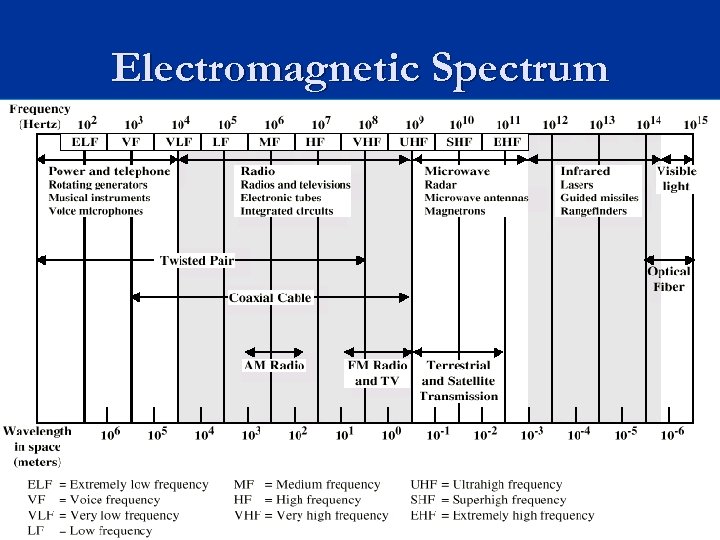 Electromagnetic Spectrum
 Guided Transmission Media Twisted Pair n Coaxial cable n Optical fiber n
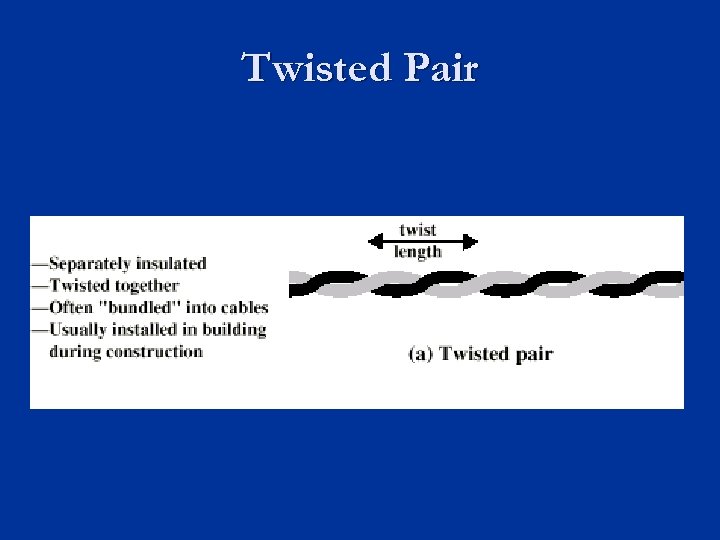 Twisted Pair
 Twisted Pair - Applications Most common medium n Telephone network n n n Within buildings n n Between house and local exchange (subscriber loop) To private branch exchange (PBX) For local area networks (LAN) n 10 Mbps or 100 Mbps
 Twisted Pair - Pros and Cons Cheap n Easy to work with n Low data rate n Short range n
 Twisted Pair - Transmission Characteristics n Analog n n Digital n n n Amplifiers every 5 km to 6 km Use either analog or digital signals repeater every 2 km or 3 km Limited distance Limited bandwidth (1 MHz) Limited data rate (100 MHz) Susceptible to interference and noise
 Unshielded and Shielded TP n Unshielded Twisted Pair (UTP) n n n Ordinary telephone wire Cheapest Easiest to install Suffers from external EM interference Shielded Twisted Pair (STP) n n n Metal braid or sheathing that reduces interference More expensive Harder to handle (thick, heavy)
 UTP Categories n Cat 3 n n Cat 4 n n up to 16 MHz Voice grade found in most offices Twist length of 7. 5 cm to 10 cm up to 20 MHz Cat 5 n n n up to 100 MHz Commonly pre-installed in new office buildings Twist length 0. 6 cm to 0. 85 cm
 Near End Crosstalk Coupling of signal from one pair to another n Coupling takes place when transmit signal entering the link couples back to receiving pair n i. e. near transmitted signal is picked up by near receiving pair n
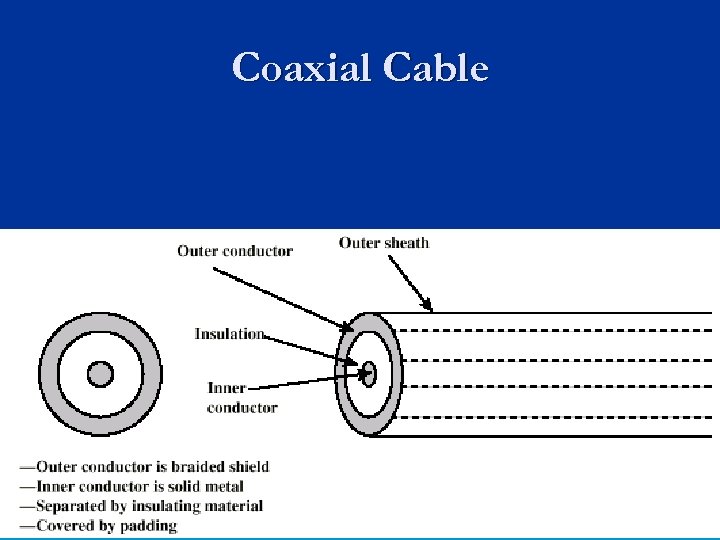 Coaxial Cable
 Coaxial Cable Applications n n Most versatile medium Television distribution n Long distance telephone transmission n n Ariel to TV Cable TV Can carry 10, 000 voice calls simultaneously Being replaced by fiber optic Short distance computer systems links Local area networks
 Coaxial Cable - Transmission Characteristics n Analog Amplifiers every few km n Closer if higher frequency n Up to 500 MHz n n Digital Repeater every 1 km n Closer for higher data rates n
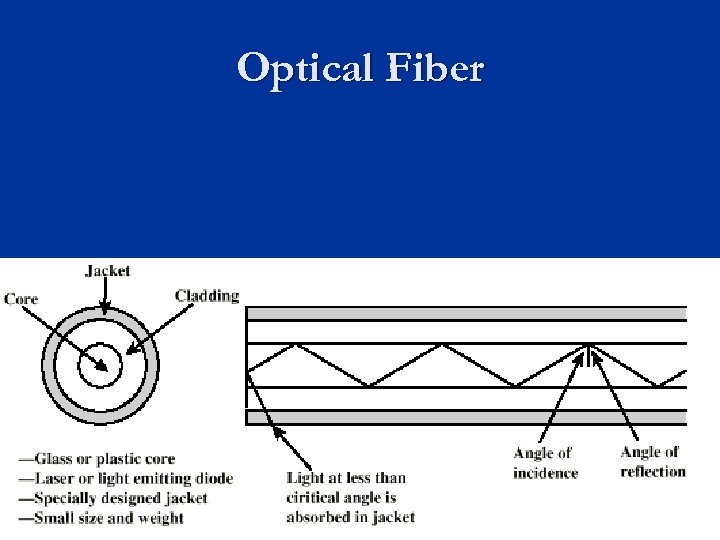 Optical Fiber
 Optical Fiber - Benefits n Greater capacity n Data rates of hundreds of Gbps Smaller size & weight n Lower attenuation n Electromagnetic isolation n Greater repeater spacing n n 10 s of km at least
 Optical Fiber - Applications Long-haul trunks n Metropolitan trunks n Rural exchange trunks n Subscriber loops n LANs n
 Optical Fiber - Transmission Characteristics n Act as wave guide for 1014 to 1015 Hz n n Light Emitting Diode (LED) n n Cheaper Wider operating temp range Last longer Injection Laser Diode (ILD) n n n Portions of infrared and visible spectrum More efficient Greater data rate Wavelength Division Multiplexing
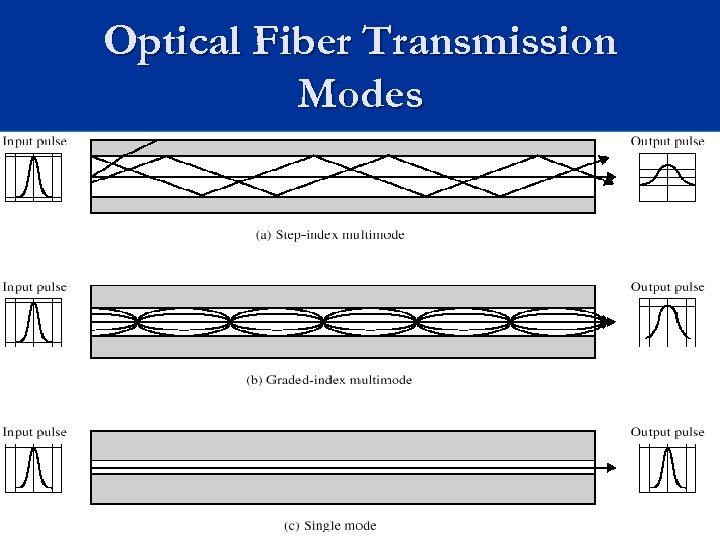 Optical Fiber Transmission Modes
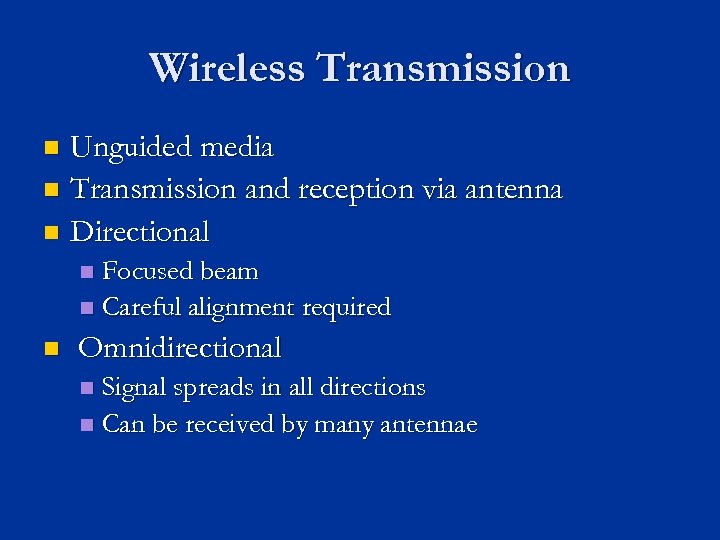 Wireless Transmission Unguided media n Transmission and reception via antenna n Directional n Focused beam n Careful alignment required n n Omnidirectional Signal spreads in all directions n Can be received by many antennae n
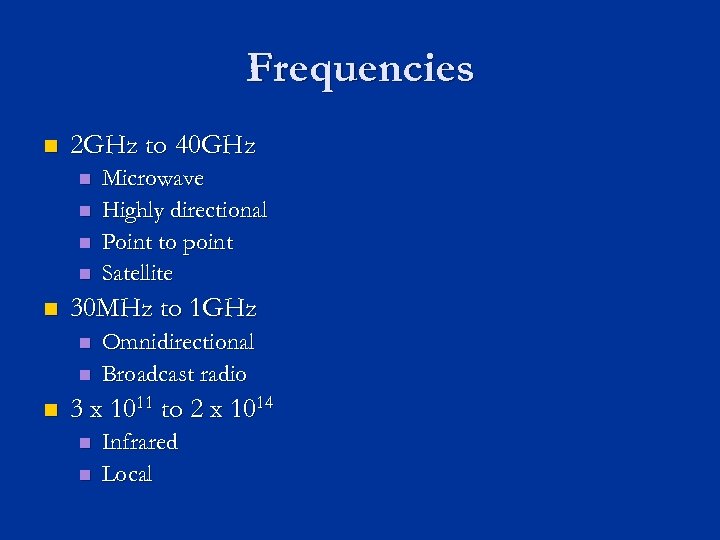 Frequencies n 2 GHz to 40 GHz n n n 30 MHz to 1 GHz n n n Microwave Highly directional Point to point Satellite Omnidirectional Broadcast radio 3 x 10¹¹ to 2 x 10¹⁴ n n Infrared Local
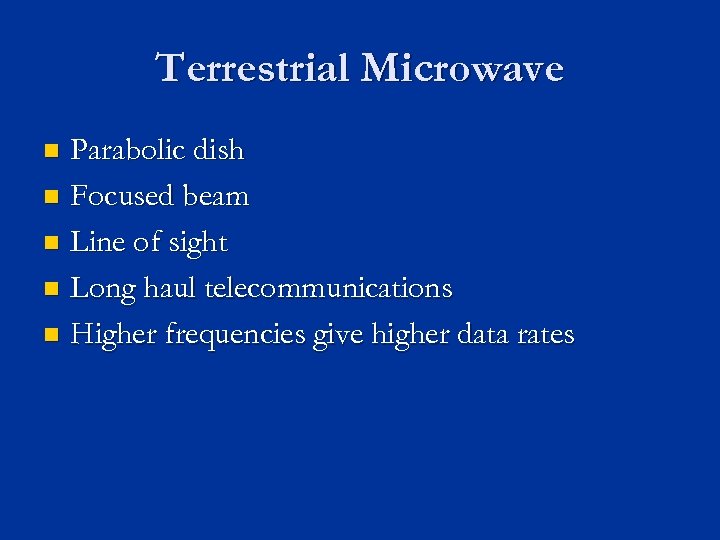 Terrestrial Microwave Parabolic dish n Focused beam n Line of sight n Long haul telecommunications n Higher frequencies give higher data rates n
 Satellite Microwave n n n Satellite is relay station Satellite receives on one frequency, amplifies or repeats signal and transmits on another frequency Requires geo-stationary orbit n n Height of 35, 784 km Television Long distance telephone Private business networks
 Broadcast Radio Omnidirectional n FM radio n UHF and VHF television n Line of sight n Suffers from multipath interference n n Reflections
 Infrared Modulate noncoherent infrared light n Line of sight (or reflection) n Blocked by walls n e. g. TV remote control, IRD port n