


 Скачать презентацию Computer Networking Prof Hanoch Levy hanoch at cs
d08863199a7cd0b14adf867f16a95e33.ppt
- Количество слайдов: 66
 Computer Networking Prof. Hanoch Levy (hanoch at cs. tau. ac. il) Teaching Assistant: Allon Wagner Lect. 1: Oct 14, 2013 1
 Lect. 1: Oct 14, 2013 Course Information Lectures: Wednesday 12 - 15 Dach 005 Exercises: Monday 10 – 11, 11 – 12 Shenkar – Physics 104 Web site: http: //www. cs. tau. ac. il/~allonwag/comnet 2014 A/index. html Books: • A Top-down Approach to Computer Networking / Kurouse-Ross 1. An Engineering Approach to Computer Networking / Keshav 2. Computer Networks / Tanenbaum 3. Data Networks / Bertsekas and Gallager 2/71
 Lect. 1: Oct 14, 2013 Practical Information Homework assignment: Mandatory Both theoretical and programming Grades: Final Exam: theory exercises: Programming exercises: 60% 20% 3/71
 Lect. 1: Oct 14, 2013 Motivation n Today’s economy n n manufacturing, distributing, and retailing goods but also creating and disseminating information n publishing banking film making…. part of the ‘information economy’ n Future economy is likely to be dominated by information! 4/71
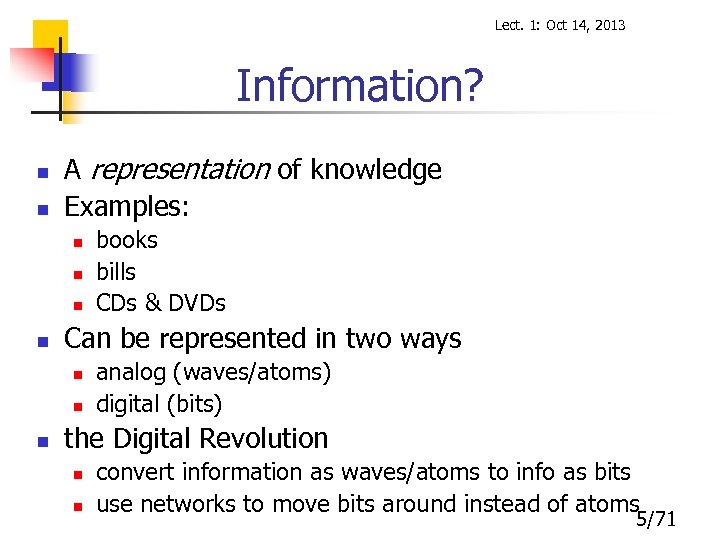 Lect. 1: Oct 14, 2013 Information? n n A representation of knowledge Examples: n n Can be represented in two ways n n n books bills CDs & DVDs analog (waves/atoms) digital (bits) the Digital Revolution n n convert information as waves/atoms to info as bits use networks to move bits around instead of atoms 5/71
 The Challenges t t Lect. 1: Oct 14, 2013 represent all types of information as bits. move the bits u u u In large quantities, everywhere, cheaply, Securely, with quality of service, …. 6/71
 Lect. 1: Oct 14, 2013 Today’s Networks are complex! t t t hosts routers links of various media applications protocols hardware, software Tomorrow’s will be even more! 7/71
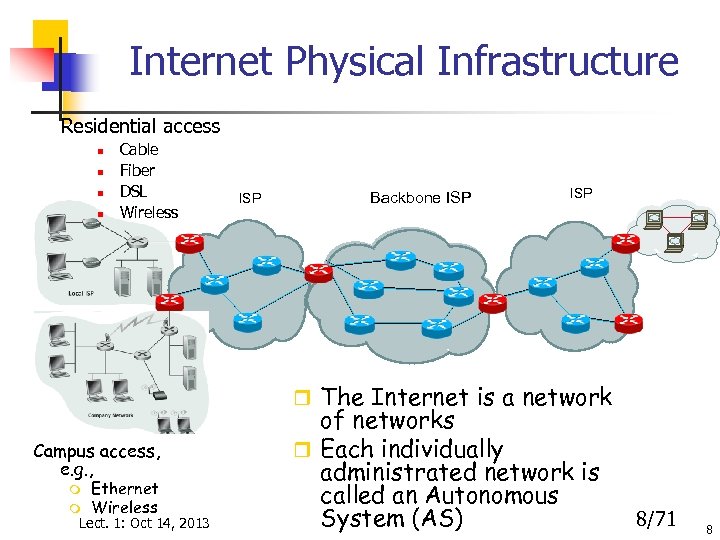 Internet Physical Infrastructure Residential access n n Cable Fiber DSL Wireless ISP Backbone ISP r The Internet is a network Campus access, e. g. , m m Ethernet Wireless Lect. 1: Oct 14, 2013 of networks r Each individually administrated network is called an Autonomous System (AS) 8/71 8
 Lect. 1: Oct 14, 2013 This course’s Challenge n n n To discuss this complexity in an organized way, that will make today’s computer networks (and their limitations) more comprehensive. identification, and understanding relationship of complex system’s pieces. Problems that are beyond a specific technology 9/71
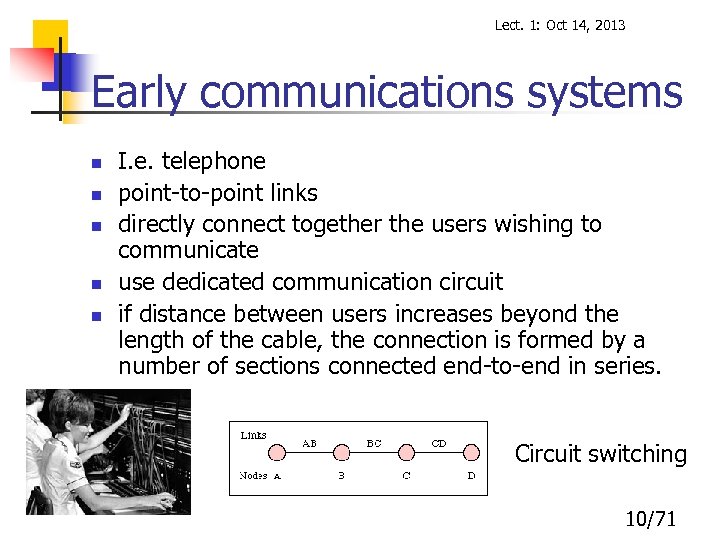 Lect. 1: Oct 14, 2013 Early communications systems n n n I. e. telephone point-to-point links directly connect together the users wishing to communicate use dedicated communication circuit if distance between users increases beyond the length of the cable, the connection is formed by a number of sections connected end-to-end in series. Circuit switching 10/71
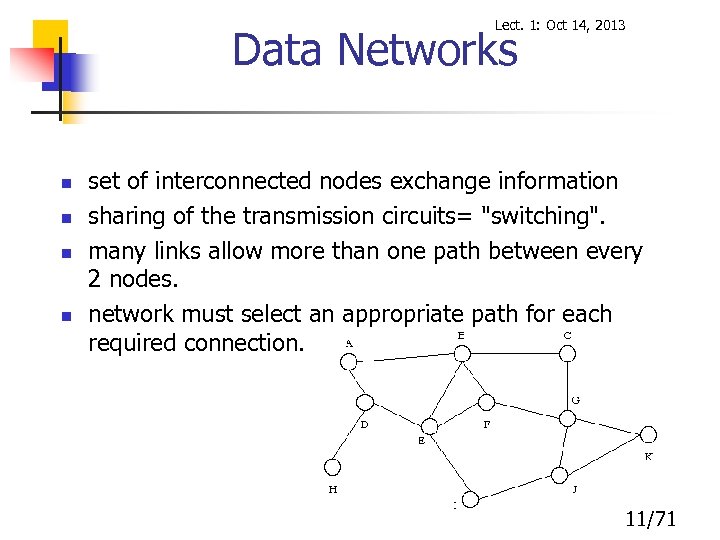 Lect. 1: Oct 14, 2013 Data Networks n n set of interconnected nodes exchange information sharing of the transmission circuits= "switching". many links allow more than one path between every 2 nodes. network must select an appropriate path for each required connection. 11/71
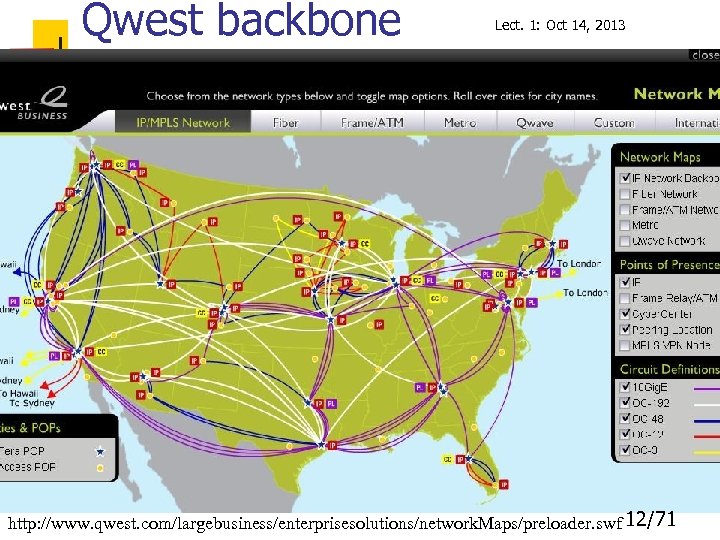 Qwest backbone Lect. 1: Oct 14, 2013 http: //www. qwest. com/largebusiness/enterprisesolutions/network. Maps/preloader. swf 12/71
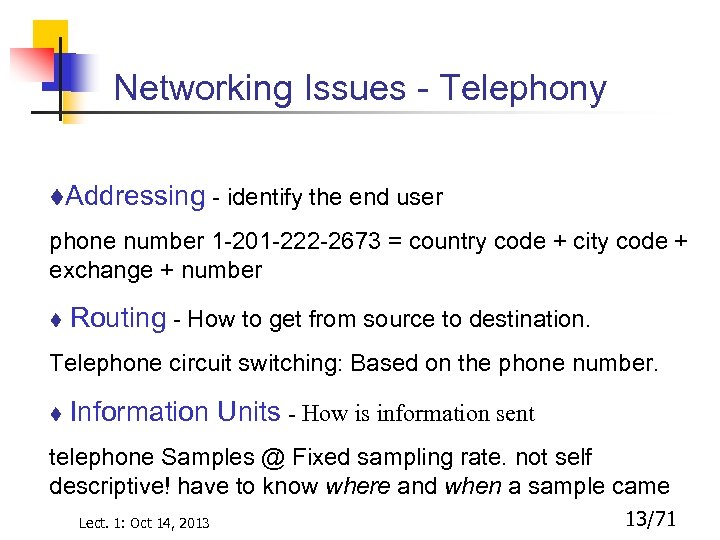 Networking Issues - Telephony t. Addressing - identify the end user phone number 1 -201 -222 -2673 = country code + city code + exchange + number t Routing - How to get from source to destination. Telephone circuit switching: Based on the phone number. t Information Units - How is information sent telephone Samples @ Fixed sampling rate. not self descriptive! have to know where and when a sample came Lect. 1: Oct 14, 2013 13/71
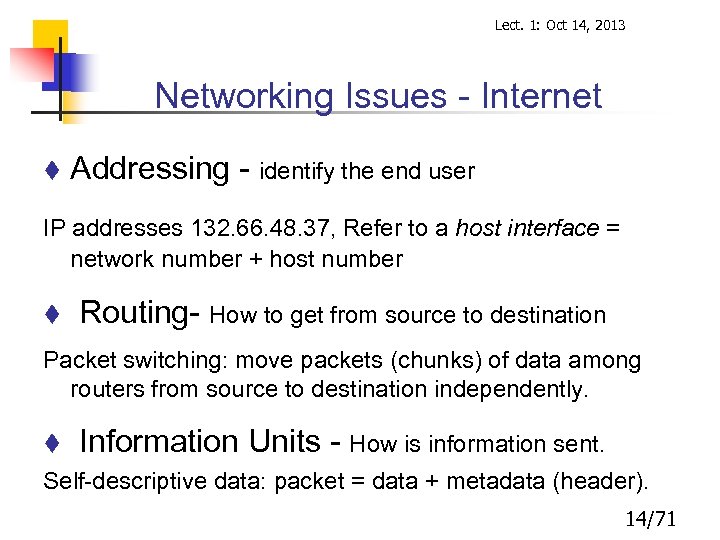 Lect. 1: Oct 14, 2013 Networking Issues - Internet t Addressing - identify the end user IP addresses 132. 66. 48. 37, Refer to a host interface = network number + host number t Routing- How to get from source to destination Packet switching: move packets (chunks) of data among routers from source to destination independently. t Information Units - How is information sent. Self-descriptive data: packet = data + metadata (header). 14/71
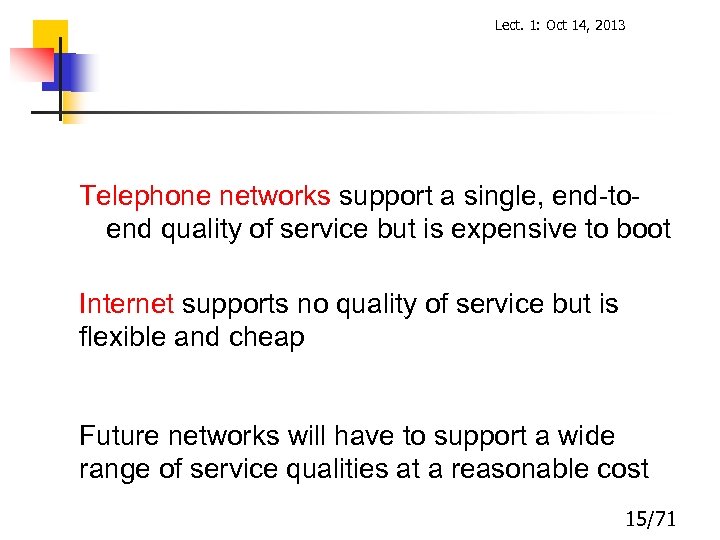 Lect. 1: Oct 14, 2013 Telephone networks support a single, end-toend quality of service but is expensive to boot Internet supports no quality of service but is flexible and cheap Future networks will have to support a wide range of service qualities at a reasonable cost 15/71
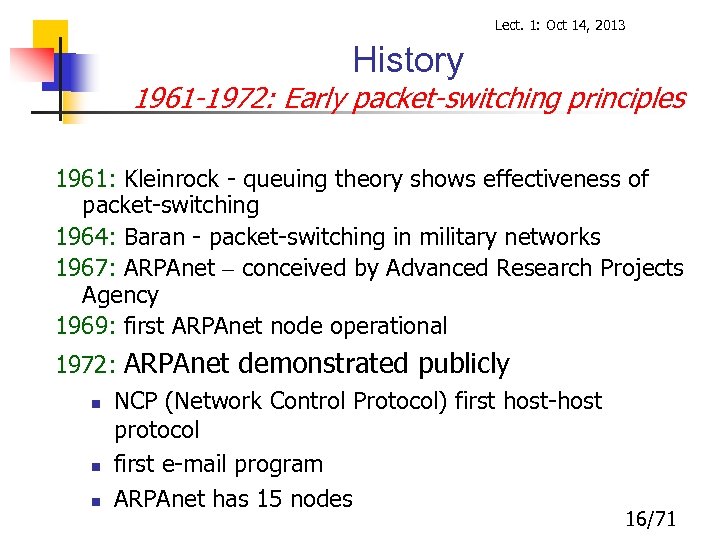 Lect. 1: Oct 14, 2013 History 1961 -1972: Early packet-switching principles 1961: Kleinrock - queuing theory shows effectiveness of packet-switching 1964: Baran - packet-switching in military networks 1967: ARPAnet – conceived by Advanced Research Projects Agency 1969: first ARPAnet node operational 1972: ARPAnet demonstrated publicly n NCP (Network Control Protocol) first host-host protocol n first e-mail program n ARPAnet has 15 nodes 16/71
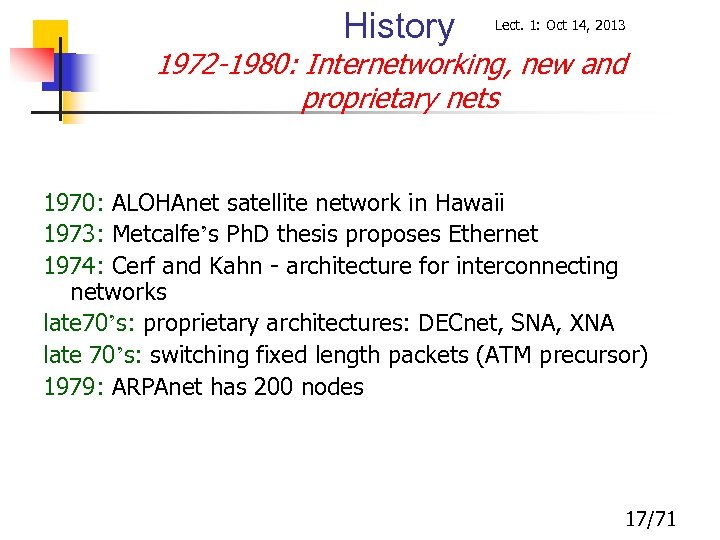 History Lect. 1: Oct 14, 2013 1972 -1980: Internetworking, new and proprietary nets 1970: ALOHAnet satellite network in Hawaii 1973: Metcalfe’s Ph. D thesis proposes Ethernet 1974: Cerf and Kahn - architecture for interconnecting networks late 70’s: proprietary architectures: DECnet, SNA, XNA late 70’s: switching fixed length packets (ATM precursor) 1979: ARPAnet has 200 nodes 17/71
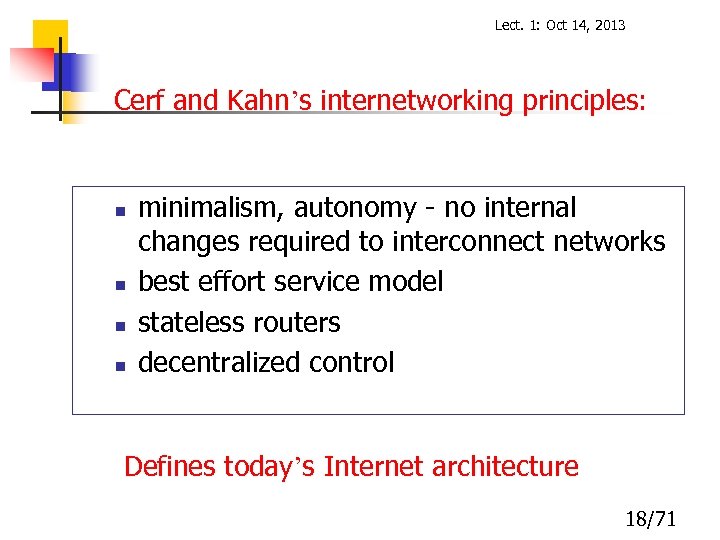 Lect. 1: Oct 14, 2013 Cerf and Kahn’s internetworking principles: n n minimalism, autonomy - no internal changes required to interconnect networks best effort service model stateless routers decentralized control Defines today’s Internet architecture 18/71
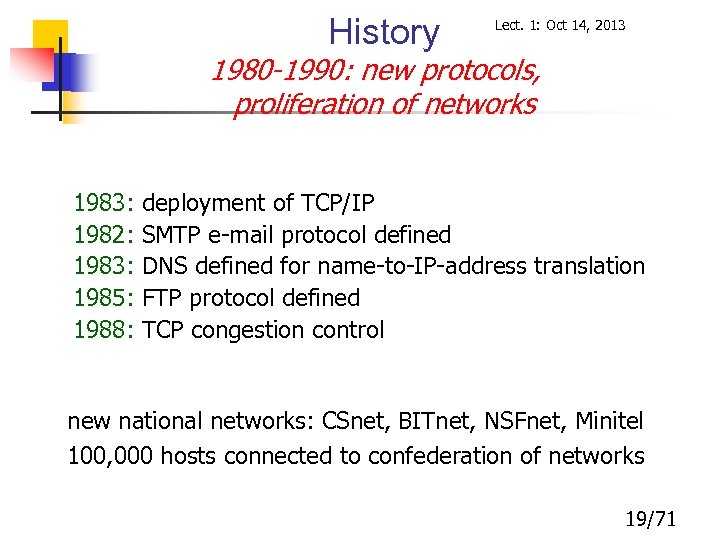 History Lect. 1: Oct 14, 2013 1980 -1990: new protocols, proliferation of networks 1983: 1982: 1983: 1985: 1988: deployment of TCP/IP SMTP e-mail protocol defined DNS defined for name-to-IP-address translation FTP protocol defined TCP congestion control new national networks: CSnet, BITnet, NSFnet, Minitel 100, 000 hosts connected to confederation of networks 19/71
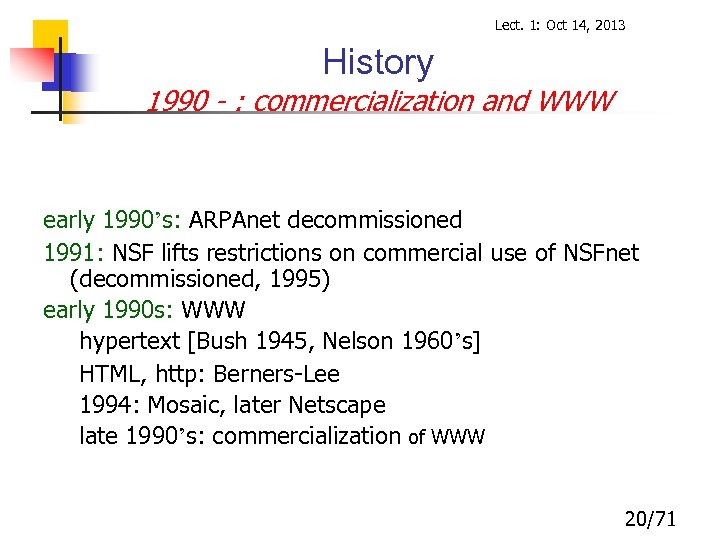 Lect. 1: Oct 14, 2013 History 1990 - : commercialization and WWW early 1990’s: ARPAnet decommissioned 1991: NSF lifts restrictions on commercial use of NSFnet (decommissioned, 1995) early 1990 s: WWW hypertext [Bush 1945, Nelson 1960’s] HTML, http: Berners-Lee 1994: Mosaic, later Netscape late 1990’s: commercialization of WWW 20/71
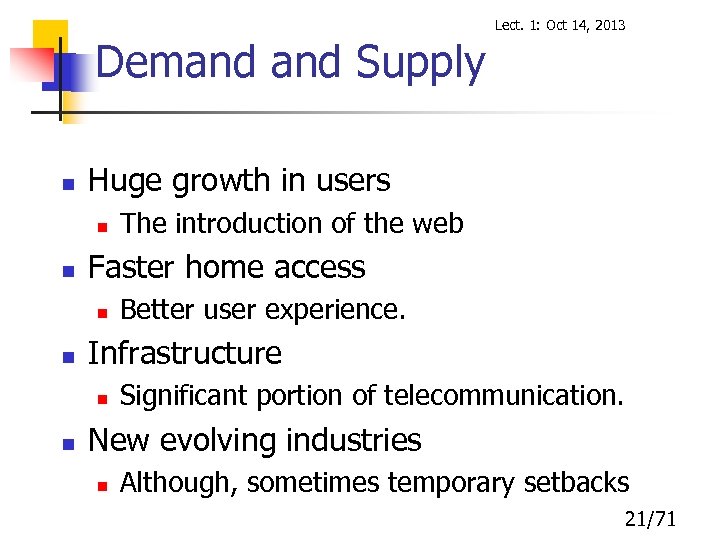 Lect. 1: Oct 14, 2013 Demand Supply n Huge growth in users n n Faster home access n n Better user experience. Infrastructure n n The introduction of the web Significant portion of telecommunication. New evolving industries n Although, sometimes temporary setbacks 21/71
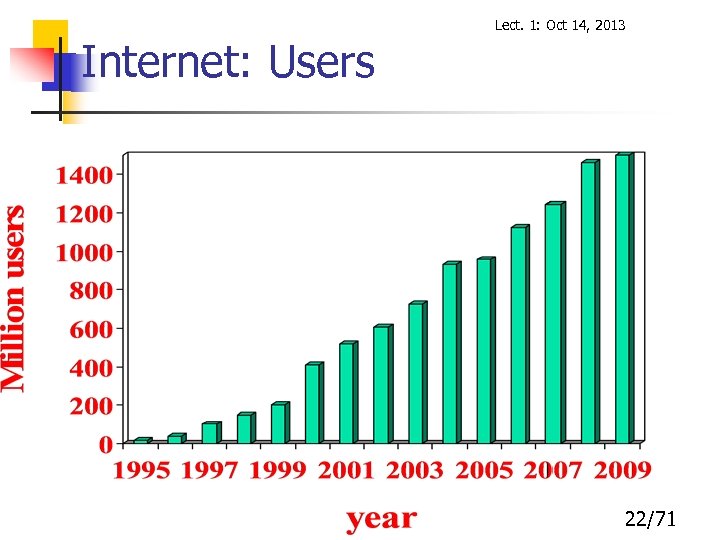 Lect. 1: Oct 14, 2013 Internet: Users 22/71
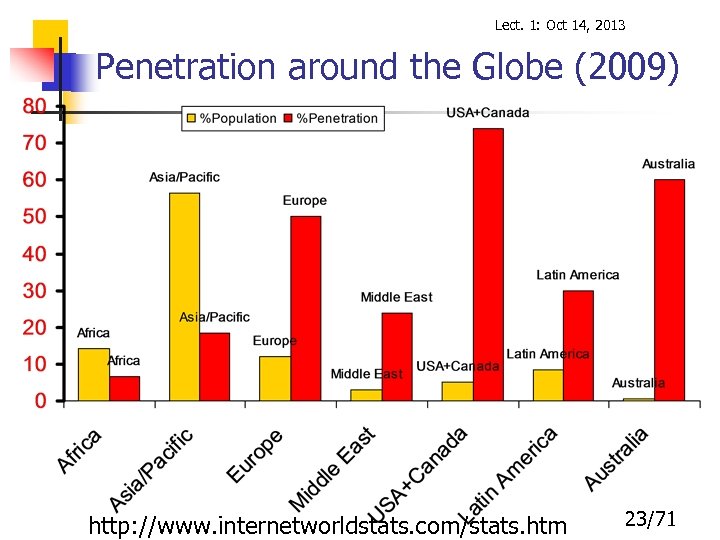 Lect. 1: Oct 14, 2013 Penetration around the Globe (2009) http: //www. internetworldstats. com/stats. htm 23/71
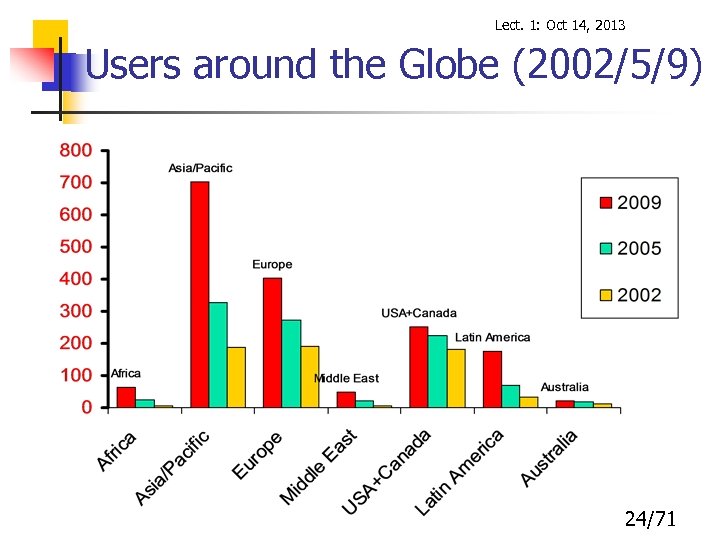 Lect. 1: Oct 14, 2013 Users around the Globe (2002/5/9) 24/71
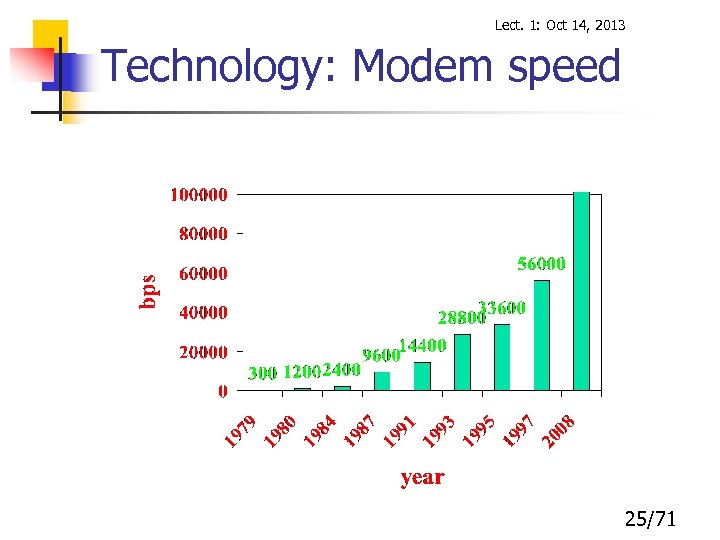 Lect. 1: Oct 14, 2013 Technology: Modem speed 25/71
 Today’s options n n Lect. 1: Oct 14, 2013 Modem: 56 K OBSOLETE ISDN: 64 K – 128 K Frame Relay: 56 K ++ Today High Speed Connections n n Cable, ADSL, Satellite. All are available at n n 5 Mb (2005) 30 Mb (2009) 26/71
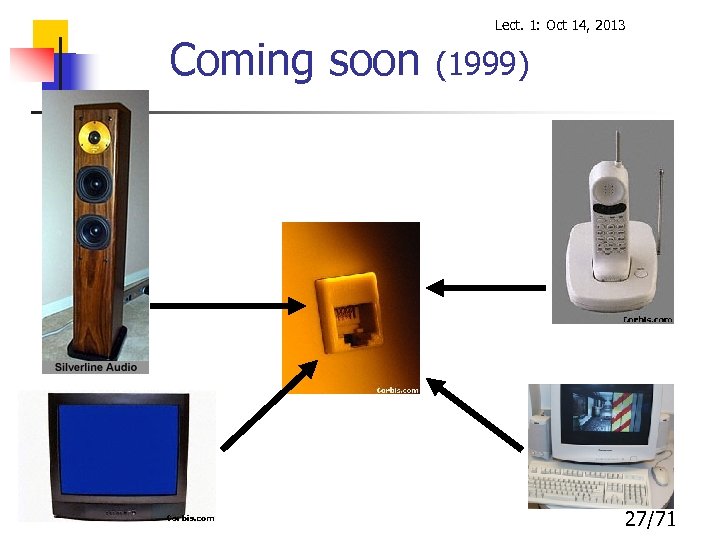 Coming soon Lect. 1: Oct 14, 2013 (1999) 27/71
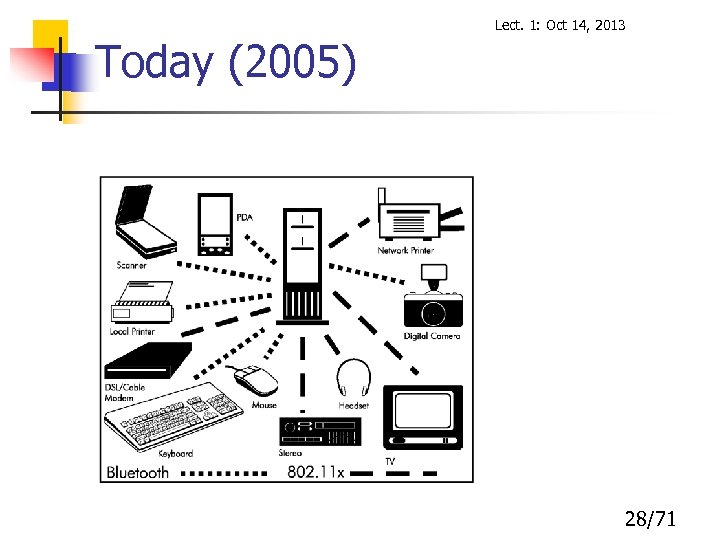 Lect. 1: Oct 14, 2013 Today (2005) 28/71
 Lect. 1: Oct 14, 2013 Why do we need Standards n n Networks (and other media) support communication between different entities Need agreement to ensure correct, efficient and meaningful communication 29/71
 Lect. 1: Oct 14, 2013 Various Organizations Issue Standards n IEEE (Institute for Electrical and Electronic Engineers) n IETF (Internet Engineering Task Force) n ITU (International Telecommunications Union) n ISO (International Organization for Standardization) n W 3 C (World Wide Web Consortium) 30/71
 Lect. 1: Oct 14, 2013 Protocol Layers n A way for organizing structure of network § … Or at least our discussion of networks n The idea: a series of steps 31/71
 Protocol Layering Lect. 1: Oct 14, protocols ~ Layering in 2013 Functions in programs n Necessary because communication is complex n Intended primarily for protocol designers n Divides the problem into intellectually manageable pieces n Provides a conceptual framework that can help us understand protocols n Think of layering as a guideline, not a rigid specification n Understand that optimizations may violate strict layering n Should be invisible to users 32/71
 Lect. 1: Oct 14, 2013 Mail system functionality 33/71
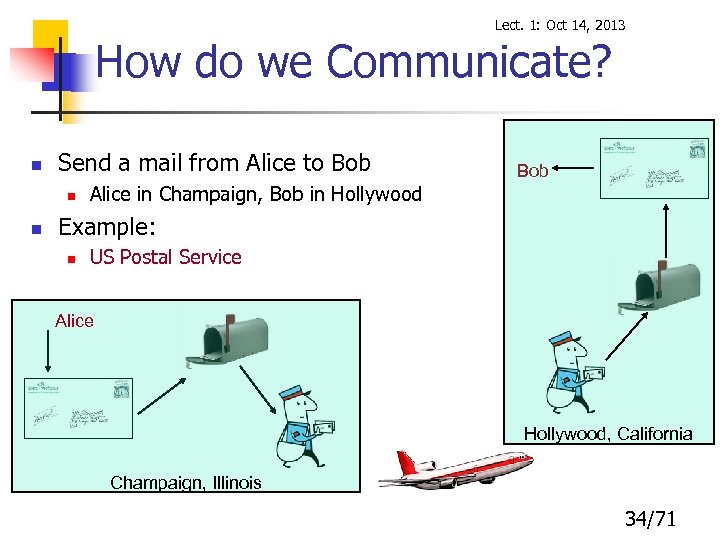 Lect. 1: Oct 14, 2013 How do we Communicate? n Send a mail from Alice to Bob n n Bob Alice in Champaign, Bob in Hollywood Example: n US Postal Service Alice Hollywood, California Champaign, Illinois 34/71
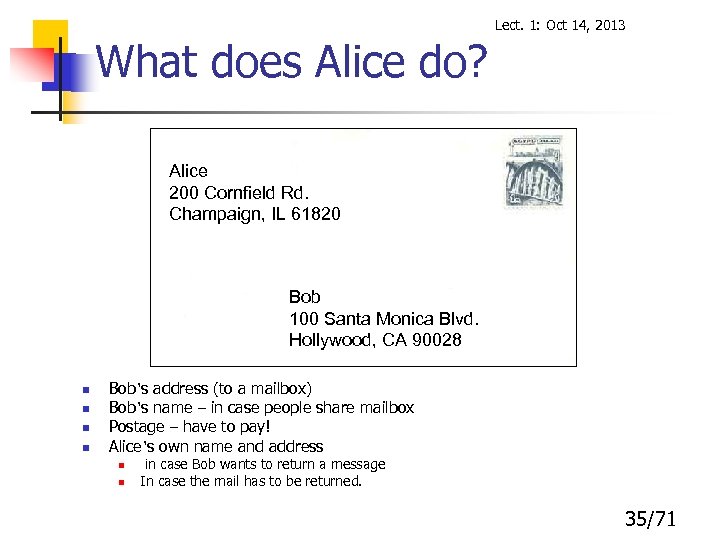 Lect. 1: Oct 14, 2013 What does Alice do? Alice 200 Cornfield Rd. Champaign, IL 61820 Bob 100 Santa Monica Blvd. Hollywood, CA 90028 n n Bob’s address (to a mailbox) Bob’s name – in case people share mailbox Postage – have to pay! Alice’s own name and address n n in case Bob wants to return a message In case the mail has to be returned. 35/71
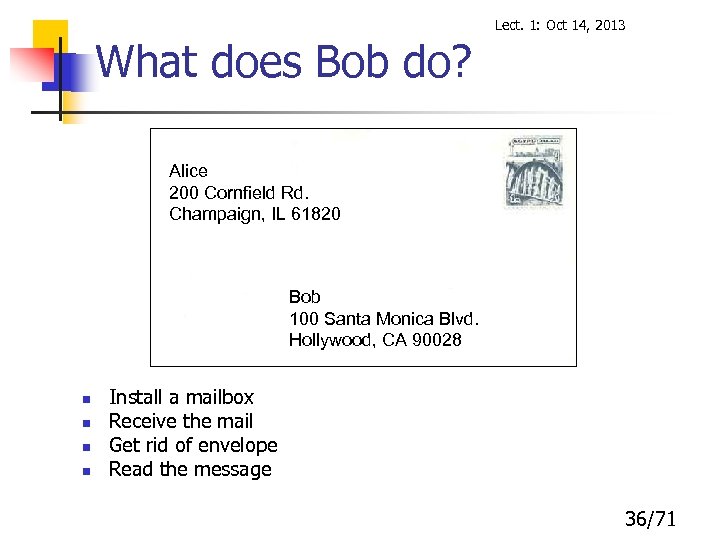 Lect. 1: Oct 14, 2013 What does Bob do? Alice 200 Cornfield Rd. Champaign, IL 61820 Bob 100 Santa Monica Blvd. Hollywood, CA 90028 n n Install a mailbox Receive the mail Get rid of envelope Read the message 36/71
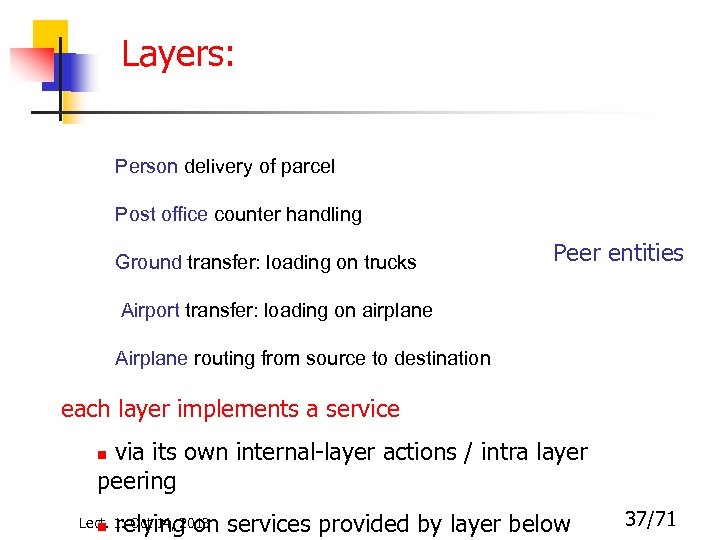 Layers: Person delivery of parcel Post office counter handling Ground transfer: loading on trucks Peer entities Airport transfer: loading on airplane Airplane routing from source to destination each layer implements a service via its own internal-layer actions / intra layer peering n relying on services provided by layer below Lect. 1: Oct 14, 2013 n 37/71
 Advantages of Layering n n n explicit structure allows identification & relationship of complex system’s pieces n layered reference model for discussion modularization eases maintenance & updating of system n change of implementation of layer’s service transparent to rest of system Disadvantage: low efficiency Lect. 1: Oct 14, 2013 38/71
 Lect. 1: Oct 14, 2013 Protocols n A protocol is a set of rules and formats that govern the communication between communicating peer n n n set of valid messages - syntax meaning of each message – semantics Necessary for any function that requires cooperation between peers e. g: Every car drives on the right 39/71
 Protocols n A protocol provides a service n n Lect. 1: Oct 14, 2013 For example: the post office protocol for reliable parcel transfer service Peer entities use a protocol to provide a service to a higher-level peer entity n E. g, truck company (drivers) uses a protocol to present post offices with the abstraction of an unreliable parcel transfer service 40/71
 Lect. 1: Oct 14, 2013 Protocol Layers n n n A network that provides many services needs many protocols Some services are independent, But others depend on each other A Protocol may use another protocol as a step in its execution n n for example, ground transfer is one step in the execution of the example reliable parcel transfer protocol This form of dependency is called layering n Post office handling is layered above parcel ground transfer protocol. 41/71
 Lect. 1: Oct 14, 2013 Open protocols and systems n A set of protocols is open if n n A system that implements open protocols is called an open system International Organization for Standards (ISO) prescribes a standard to connect open systems n n protocol details are publicly available changes are managed by an organization whose membership and transactions are open to the public open system interconnect (OSI) Has greatly influenced thinking on protocol stacks 42/71
 Lect. 1: Oct 14, 2013 ISO OSI reference model n Reference model n n Service architecture n n formally defines what is meant by a layer, a service etc. describes the services provided by each layer and the service access point Protocol architecture n n set of protocols that implement the service architecture compliant service architectures may still use noncompliant protocol architectures 43/71
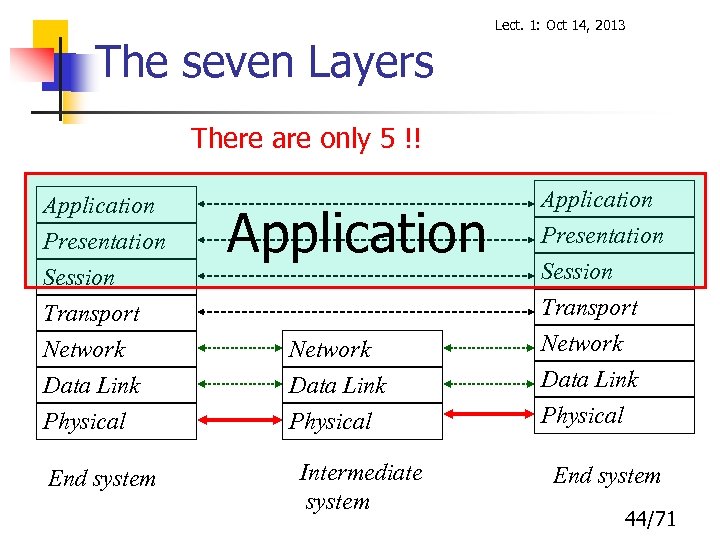 Lect. 1: Oct 14, 2013 The seven Layers There are only 5 !! Application Presentation Session Transport Network Data Link Physical Application End system Intermediate system Network Data Link Physical Application Presentation Session Transport Network Data Link Physical End system 44/71
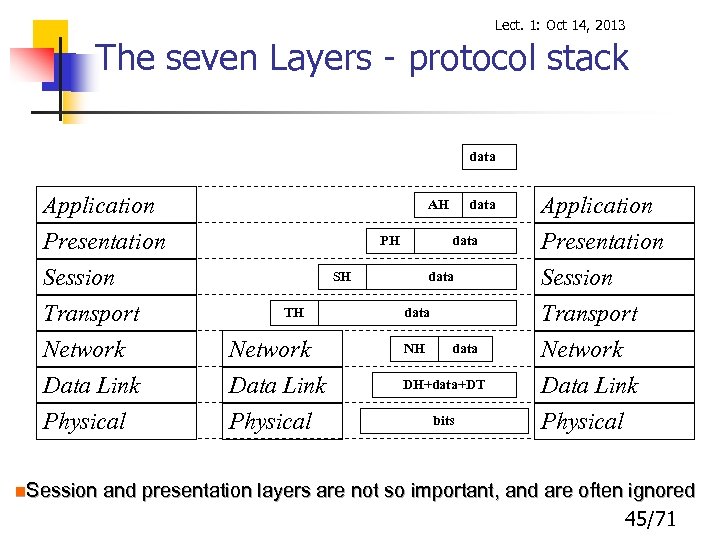 Lect. 1: Oct 14, 2013 The seven Layers - protocol stack data Application Presentation Session Transport Network Data Link Physical n. Session AH PH data SH TH Network Data Link Physical data NH data DH+data+DT bits Application Presentation Session Transport Network Data Link Physical and presentation layers are not so important, and are often ignored 45/71
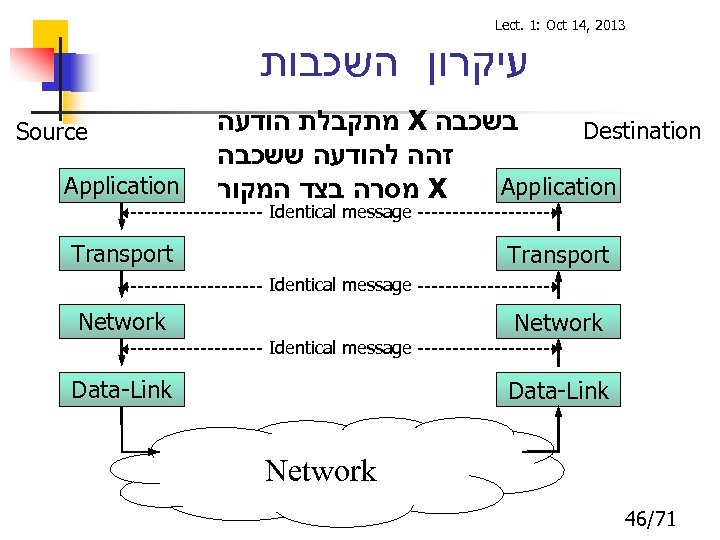 Lect. 1: Oct 14, 2013 עיקרון השכבות Source Application מתקבלת הודעה X בשכבה Destination זהה להודעה ששכבה Application מסרה בצד המקור X Identical message Transport Identical message Network Identical message Data-Link Network 46/71
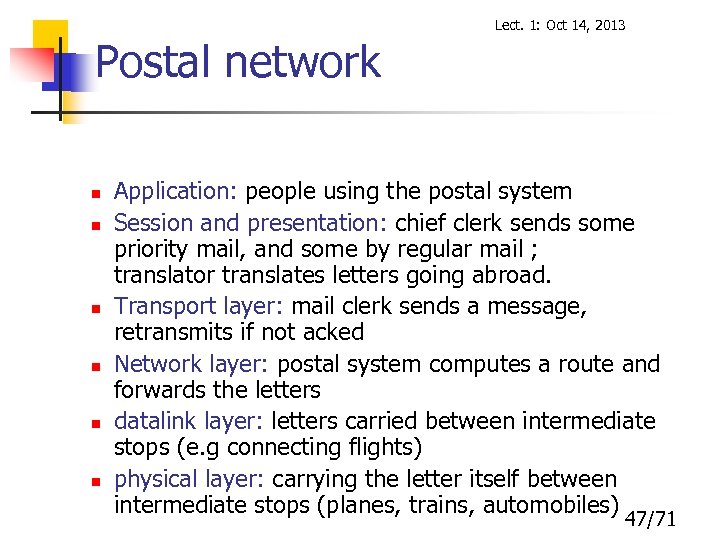 Lect. 1: Oct 14, 2013 Postal network n n n Application: people using the postal system Session and presentation: chief clerk sends some priority mail, and some by regular mail ; translator translates letters going abroad. Transport layer: mail clerk sends a message, retransmits if not acked Network layer: postal system computes a route and forwards the letters datalink layer: letters carried between intermediate stops (e. g connecting flights) physical layer: carrying the letter itself between intermediate stops (planes, trains, automobiles) 47/71
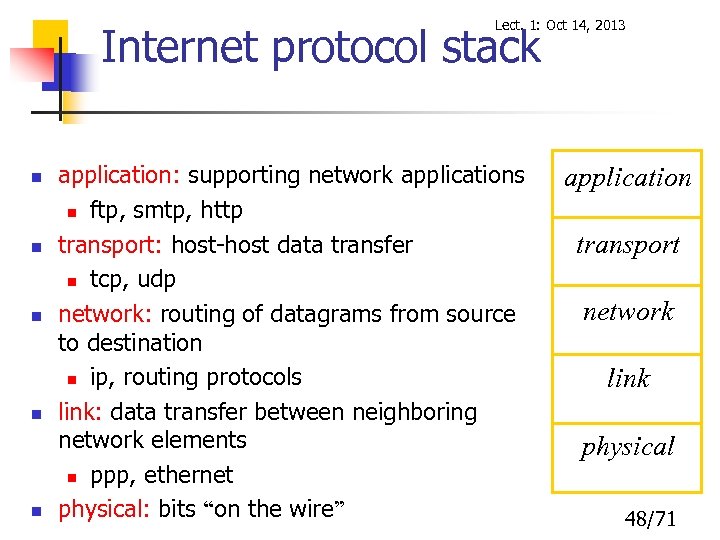 Lect. 1: Oct 14, 2013 Internet protocol stack n n n application: supporting network applications n ftp, smtp, http transport: host-host data transfer n tcp, udp network: routing of datagrams from source to destination n ip, routing protocols link: data transfer between neighboring network elements n ppp, ethernet physical: bits “on the wire” application transport network link physical 48/71
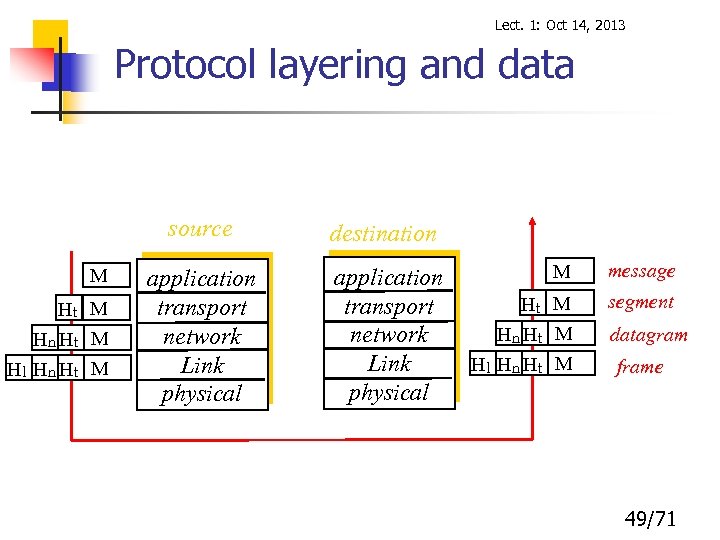 Lect. 1: Oct 14, 2013 Protocol layering and data source M Ht M Hn Ht M Hl Hn Ht M destination application transport network Link physical M message Ht M Hn Ht M segment Hl Hn Ht M datagram frame 49/71
 Lect. 1: Oct 14, 2013 Physical layer n n Physically Moves bits between physically connected end-systems Standard prescribes n n L 1 coding scheme to represent a bit shapes and sizes of connectors bit-level synchronization Internet n technology to move bits on a wire, wireless link, satellite channel etc. 50/71
 Lect. 1: Oct 14, 2013 Datalink layer n n L 2 (Reliable) communication over a single link. Introduces the notion of a frame n set of bits that belong together n Idle markers tell us that a link is not carrying a n Begin and end markers delimit a frame n Internet frame n n n a variety of datalink layer protocols most common is Ethernet (+access) others are FDDI, SONET, HDLC 51/71
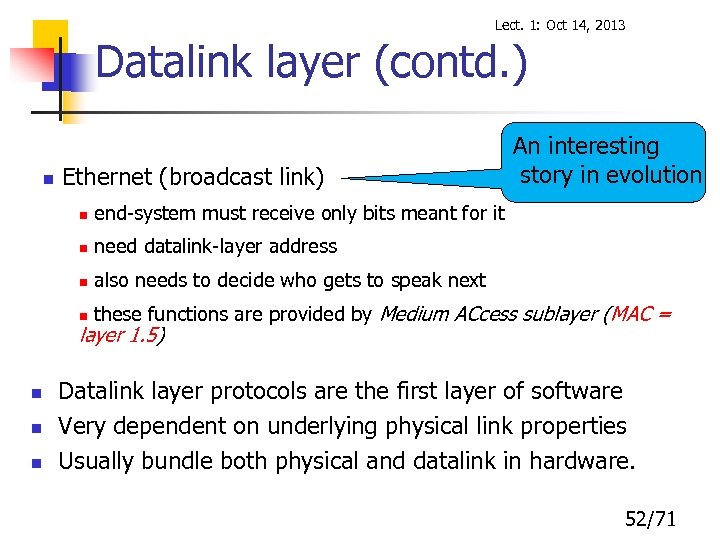 Lect. 1: Oct 14, 2013 Datalink layer (contd. ) n Ethernet (broadcast link) An interesting story in evolution n end-system must receive only bits meant for it n need datalink-layer address n also needs to decide who gets to speak next n these functions are provided by Medium ACcess sublayer (MAC = layer 1. 5) n n n Datalink layer protocols are the first layer of software Very dependent on underlying physical link properties Usually bundle both physical and datalink in hardware. 52/71
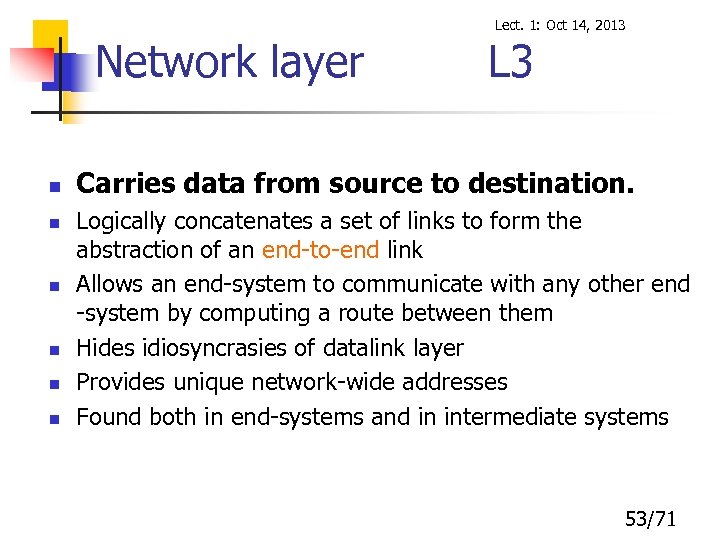 Lect. 1: Oct 14, 2013 Network layer n n n L 3 Carries data from source to destination. Logically concatenates a set of links to form the abstraction of an end-to-end link Allows an end-system to communicate with any other end -system by computing a route between them Hides idiosyncrasies of datalink layer Provides unique network-wide addresses Found both in end-systems and in intermediate systems 53/71
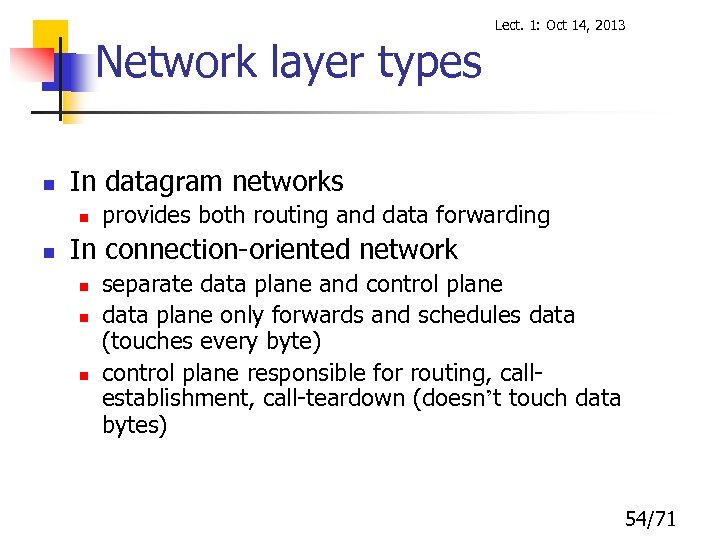 Lect. 1: Oct 14, 2013 Network layer types n In datagram networks n n provides both routing and data forwarding In connection-oriented network n n n separate data plane and control plane data plane only forwards and schedules data (touches every byte) control plane responsible for routing, callestablishment, call-teardown (doesn’t touch data bytes) 54/71
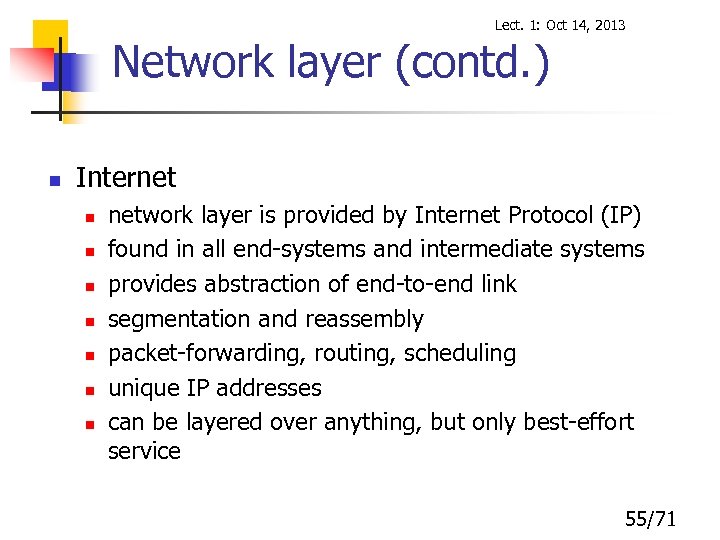 Lect. 1: Oct 14, 2013 Network layer (contd. ) n Internet n n n network layer is provided by Internet Protocol (IP) found in all end-systems and intermediate systems provides abstraction of end-to-end link segmentation and reassembly packet-forwarding, routing, scheduling unique IP addresses can be layered over anything, but only best-effort service 55/71
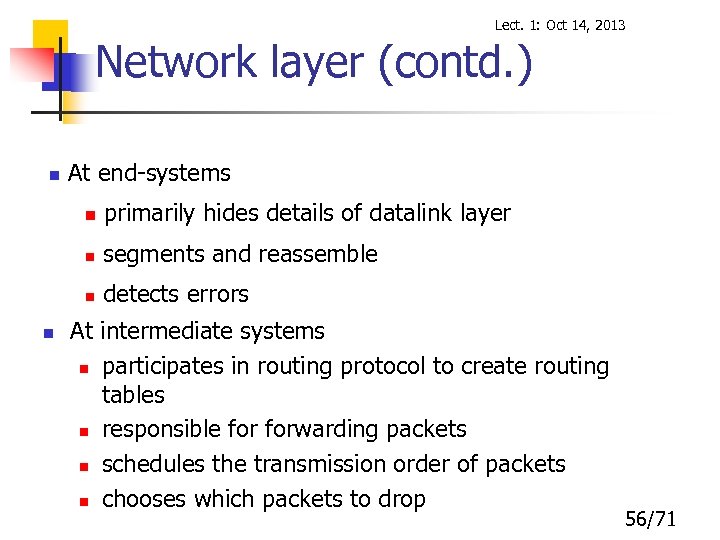 Lect. 1: Oct 14, 2013 Network layer (contd. ) n At end-systems n n segments and reassemble n n primarily hides details of datalink layer detects errors At intermediate systems n participates in routing protocol to create routing tables n responsible forwarding packets n schedules the transmission order of packets n chooses which packets to drop 56/71
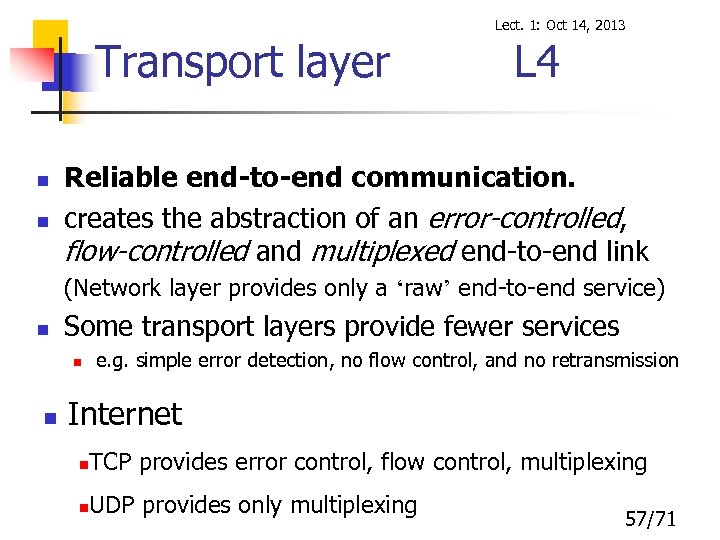 Lect. 1: Oct 14, 2013 Transport layer n n L 4 Reliable end-to-end communication. creates the abstraction of an error-controlled, flow-controlled and multiplexed end-to-end link (Network layer provides only a ‘raw’ end-to-end service) n Some transport layers provide fewer services n n e. g. simple error detection, no flow control, and no retransmission Internet n TCP provides error control, flow control, multiplexing n UDP provides only multiplexing 57/71
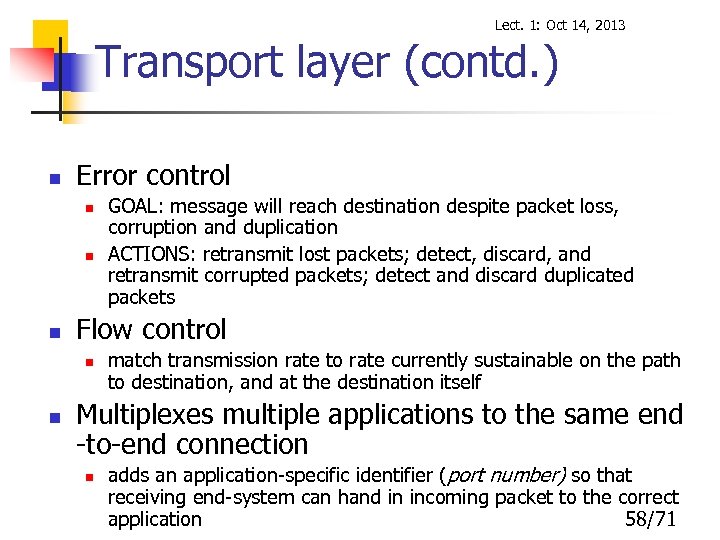 Lect. 1: Oct 14, 2013 Transport layer (contd. ) n Error control n n n Flow control n n GOAL: message will reach destination despite packet loss, corruption and duplication ACTIONS: retransmit lost packets; detect, discard, and retransmit corrupted packets; detect and discard duplicated packets match transmission rate to rate currently sustainable on the path to destination, and at the destination itself Multiplexes multiple applications to the same end -to-end connection n adds an application-specific identifier (port number) so that receiving end-system can hand in incoming packet to the correct application 58/71
 Lect. 1: Oct 14, 2013 Session layer n n n Not common Provides full-duplex service, expedited data delivery, and session synchronization Internet n doesn’t have a standard session layer 59/71
 Lect. 1: Oct 14, 2013 Session layer (cont. ) n Duplex n n Expedited data delivery n n if transport layer is simplex, concatenates two transport endpoints together allows some messages to skip ahead in end-system queues, by using a separate low-delay transport layer endpoint Synchronization n allows users to place marks in data stream and to roll back to a prespecified mark 60/71
 Lect. 1: Oct 14, 2013 Presentation layer n n Usually ad hoc Touches the application data (Unlike other layers which deal with headers) n Hides data representation differences between applications n n n characters (ASCII, unicode, EBCDIC. ) Can also encrypt data Internet n n no standard presentation layer only defines network byte order for 2 - and 4 -byte integers 61/71
 Lect. 1: Oct 14, 2013 Application layer n n The set of applications that use the network Doesn’t provide services to any other layer 62/71
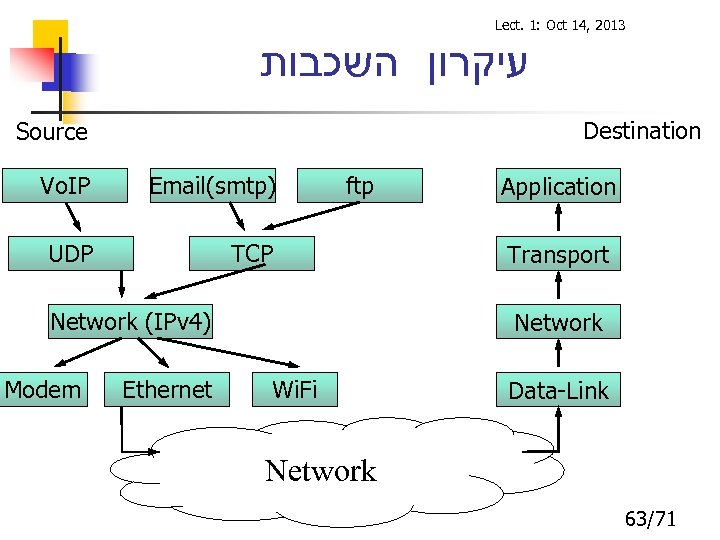 Lect. 1: Oct 14, 2013 עיקרון השכבות Destination Source Vo. IP Email(smtp) UDP ftp TCP Network (IPv 4) Modem Ethernet Application Transport Network Wi. Fi Data-Link Network 63/71
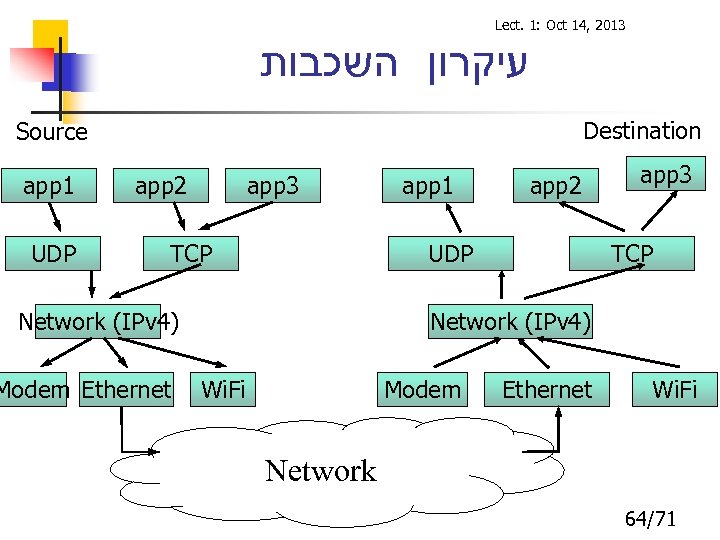 Lect. 1: Oct 14, 2013 עיקרון השכבות Destination Source app 1 UDP app 2 app 3 TCP app 2 UDP Network (IPv 4) Modem Ethernet app 1 app 3 TCP Network (IPv 4) Wi. Fi Modem Ethernet Wi. Fi Network 64/71
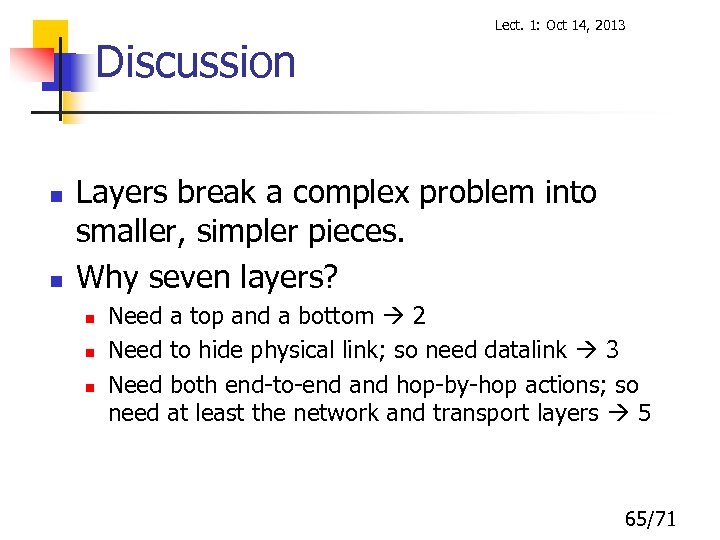 Lect. 1: Oct 14, 2013 Discussion n n Layers break a complex problem into smaller, simpler pieces. Why seven layers? n n n Need a top and a bottom 2 Need to hide physical link; so need datalink 3 Need both end-to-end and hop-by-hop actions; so need at least the network and transport layers 5 65/71
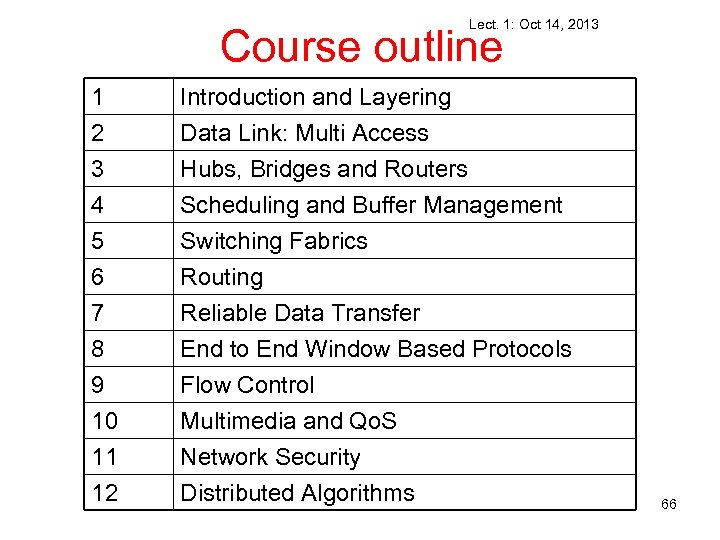 Lect. 1: Oct 14, 2013 Course outline 1 2 3 4 Introduction and Layering Data Link: Multi Access Hubs, Bridges and Routers Scheduling and Buffer Management 5 6 7 8 9 10 11 12 Switching Fabrics Routing Reliable Data Transfer End to End Window Based Protocols Flow Control Multimedia and Qo. S Network Security Distributed Algorithms 66