


 Скачать презентацию Computer Networking 1 Today s Networks are complex
17f7780224ae6f0e80627dc2804bb23f.ppt
- Количество слайдов: 40
 Computer Networking 1
 Today’s Networks are complex! t t t hosts routers links of various media applications protocols hardware, software Tomorrow’s will be even more! 2
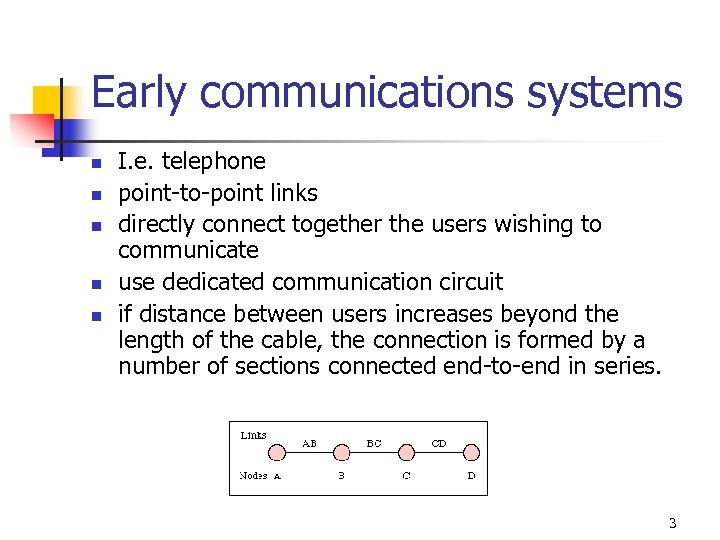 Early communications systems n n n I. e. telephone point-to-point links directly connect together the users wishing to communicate use dedicated communication circuit if distance between users increases beyond the length of the cable, the connection is formed by a number of sections connected end-to-end in series. 3
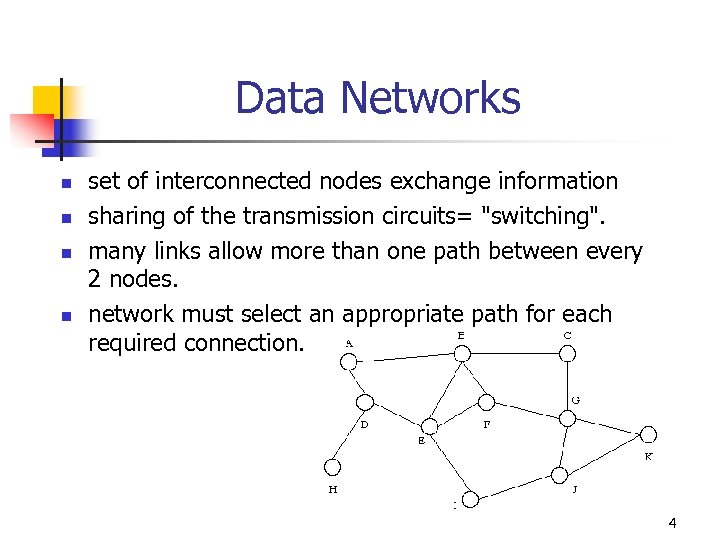 Data Networks n n set of interconnected nodes exchange information sharing of the transmission circuits= "switching". many links allow more than one path between every 2 nodes. network must select an appropriate path for each required connection. 4
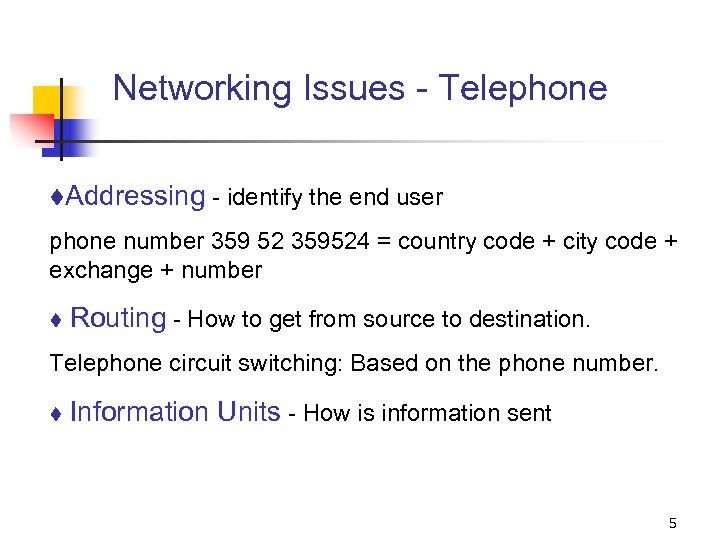 Networking Issues - Telephone t. Addressing - identify the end user phone number 359 52 359524 = country code + city code + exchange + number t Routing - How to get from source to destination. Telephone circuit switching: Based on the phone number. t Information Units - How is information sent 5
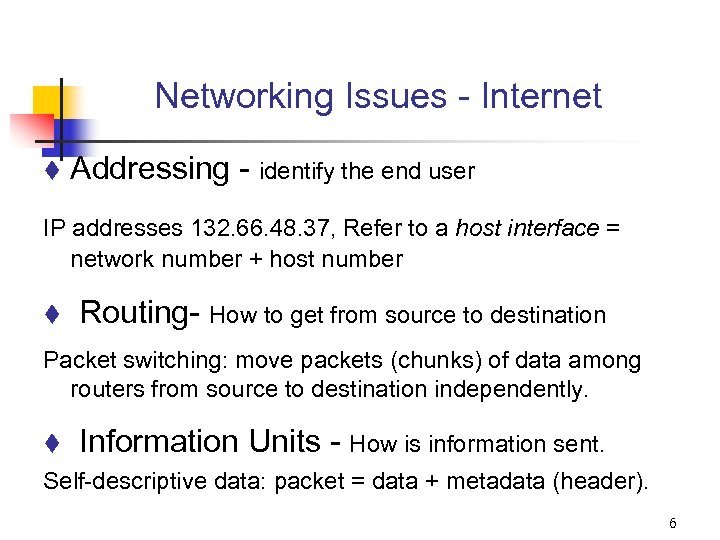 Networking Issues - Internet t Addressing - identify the end user IP addresses 132. 66. 48. 37, Refer to a host interface = network number + host number t Routing- How to get from source to destination Packet switching: move packets (chunks) of data among routers from source to destination independently. t Information Units - How is information sent. Self-descriptive data: packet = data + metadata (header). 6
 Telephone networks support a single, end-toend quality of service but is expensive to boot Internet supports no quality of service but is flexible and cheap Future networks will have to support a wide range of service qualities at a reasonable cost 7
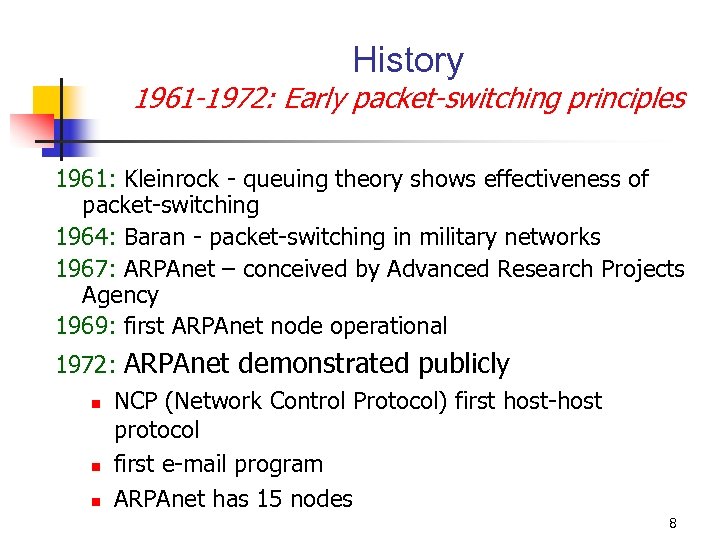 History 1961 -1972: Early packet-switching principles 1961: Kleinrock - queuing theory shows effectiveness of packet-switching 1964: Baran - packet-switching in military networks 1967: ARPAnet – conceived by Advanced Research Projects Agency 1969: first ARPAnet node operational 1972: ARPAnet demonstrated publicly n NCP (Network Control Protocol) first host-host protocol n first e-mail program n ARPAnet has 15 nodes 8
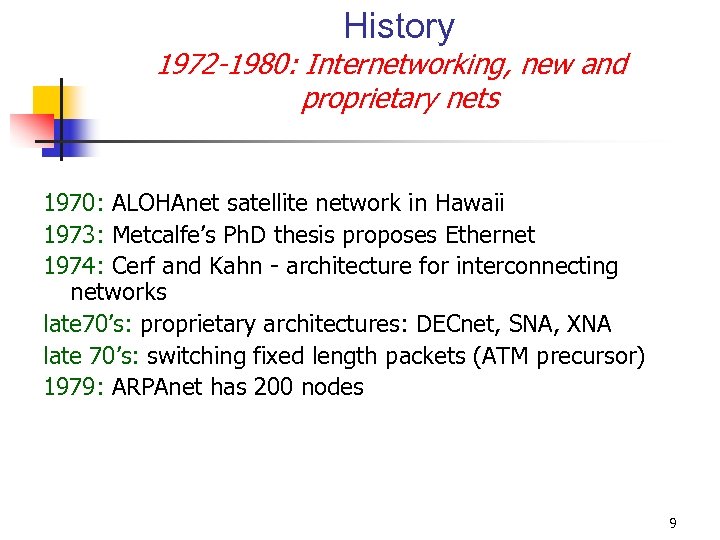 History 1972 -1980: Internetworking, new and proprietary nets 1970: ALOHAnet satellite network in Hawaii 1973: Metcalfe’s Ph. D thesis proposes Ethernet 1974: Cerf and Kahn - architecture for interconnecting networks late 70’s: proprietary architectures: DECnet, SNA, XNA late 70’s: switching fixed length packets (ATM precursor) 1979: ARPAnet has 200 nodes 9
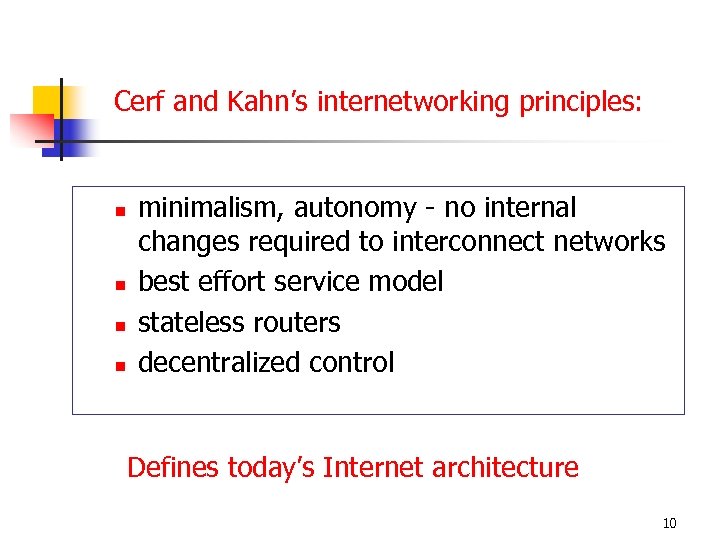 Cerf and Kahn’s internetworking principles: n n minimalism, autonomy - no internal changes required to interconnect networks best effort service model stateless routers decentralized control Defines today’s Internet architecture 10
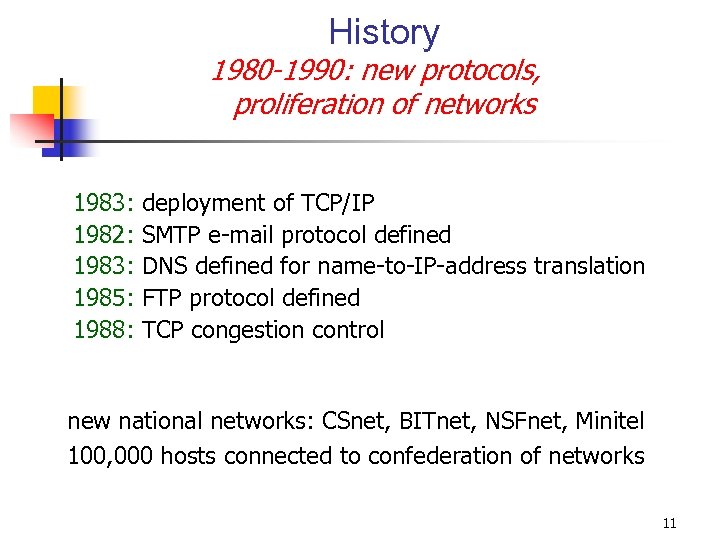 History 1980 -1990: new protocols, proliferation of networks 1983: 1982: 1983: 1985: 1988: deployment of TCP/IP SMTP e-mail protocol defined DNS defined for name-to-IP-address translation FTP protocol defined TCP congestion control new national networks: CSnet, BITnet, NSFnet, Minitel 100, 000 hosts connected to confederation of networks 11
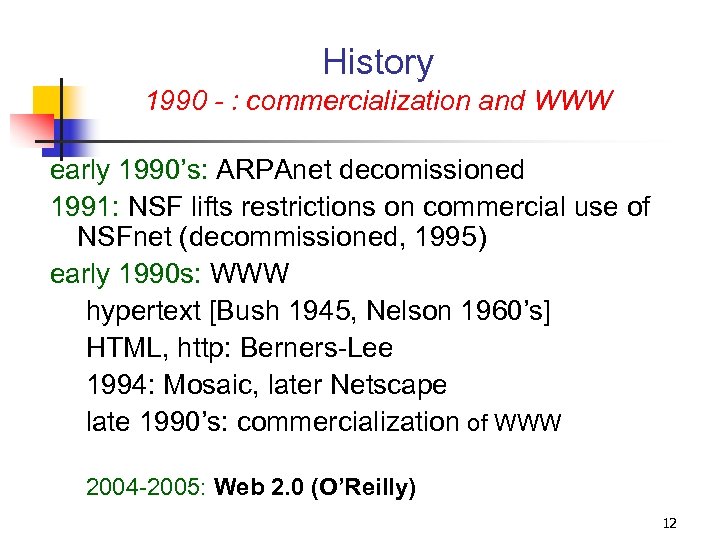 History 1990 - : commercialization and WWW early 1990’s: ARPAnet decomissioned 1991: NSF lifts restrictions on commercial use of NSFnet (decommissioned, 1995) early 1990 s: WWW hypertext [Bush 1945, Nelson 1960’s] HTML, http: Berners-Lee 1994: Mosaic, later Netscape late 1990’s: commercialization of WWW 2004 -2005: Web 2. 0 (O’Reilly) 12
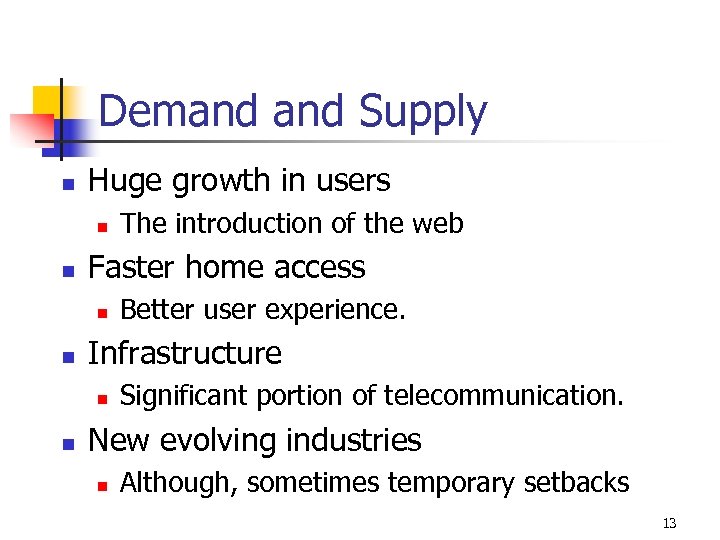 Demand Supply n Huge growth in users n n Faster home access n n Better user experience. Infrastructure n n The introduction of the web Significant portion of telecommunication. New evolving industries n Although, sometimes temporary setbacks 13
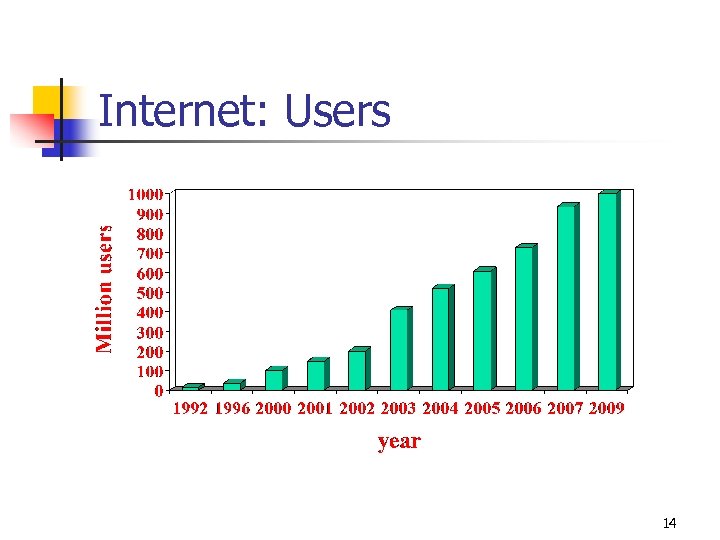 Internet: Users 14
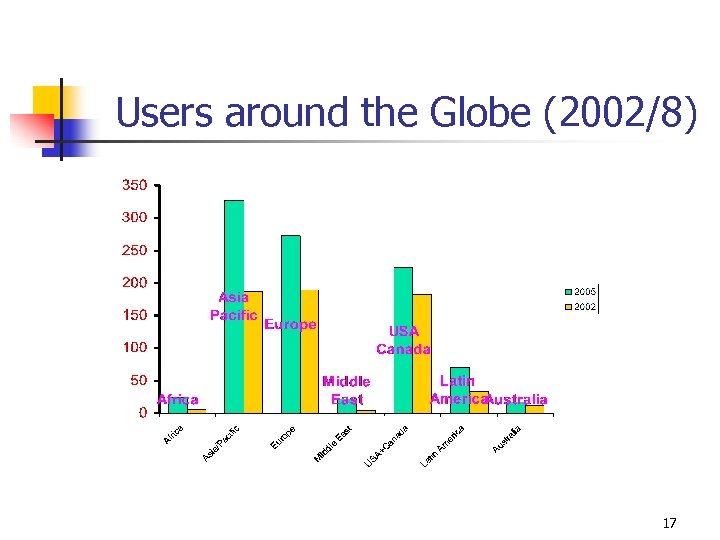 Users around the Globe (2002/8) 17
 Protocol Layers n A way for organizing structure of network § … Or at least our discussion of networks n The idea: a series of steps 18
 Advantages of Layering n n explicit structure allows identification & relationship of complex system’s pieces n layered reference model for discussion modularization eases maintenance & updating of system n change of implementation of layer’s service transparent to rest of system 19
 Protocols n A protocol is a set of rules and formats that govern the communication between communicating peers n n n set of valid messages meaning of each message Necessary for any function that requires cooperation between peers 20
 Protocols n A protocol provides a service n n For example: the post office protocol for reliable parcel transfer service Peer entities use a protocol to provide a service to a higher-level peer entity n for example, truck drivers use a protocol to present post offices with the abstraction of an unreliable parcel transfer service 21
 Protocol Layers n n n A network that provides many services needs many protocols Some services are independent, But others depend on each other A Protocol may use another protocol as a step in its execution n n for example, ground transfer is one step in the execution of the example reliable parcel transfer protocol This form of dependency is called layering n Post office handling is layered above parcel ground transfer protocol. 22
 Open protocols and systems n A set of protocols is open if n n A system that implements open protocols is called an open system International Organization for Standards (ISO) prescribes a standard to connect open systems n n protocol details are publicly available changes are managed by an organization whose membership and transactions are open to the public open system interconnect (OSI) Has greatly influenced thinking on protocol stacks 23
 ISO OSI reference model n Reference model n n Service architecture n n formally defines what is meant by a layer, a service etc. describes the services provided by each layer and the service access point Protocol architecture n n set of protocols that implement the service architecture compliant service architectures may still use noncompliant protocol architectures 24
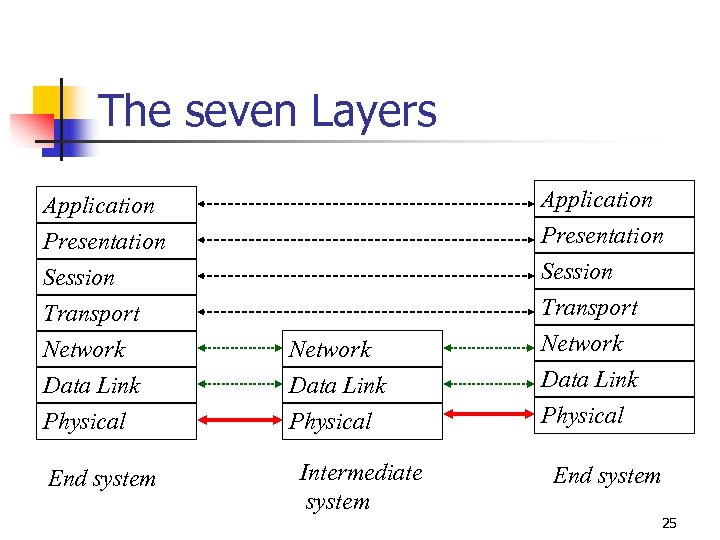 The seven Layers Application Presentation Session Transport Network Data Link Physical End system Network Data Link Physical Intermediate system Application Presentation Session Transport Network Data Link Physical End system 25
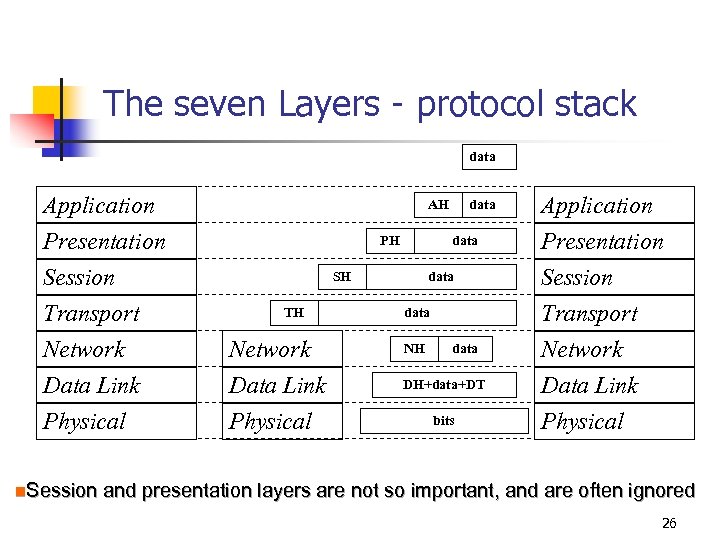 The seven Layers - protocol stack data Application Presentation Session Transport Network Data Link Physical n. Session AH PH data SH TH Network Data Link Physical data NH data DH+data+DT bits Application Presentation Session Transport Network Data Link Physical and presentation layers are not so important, and are often ignored 26
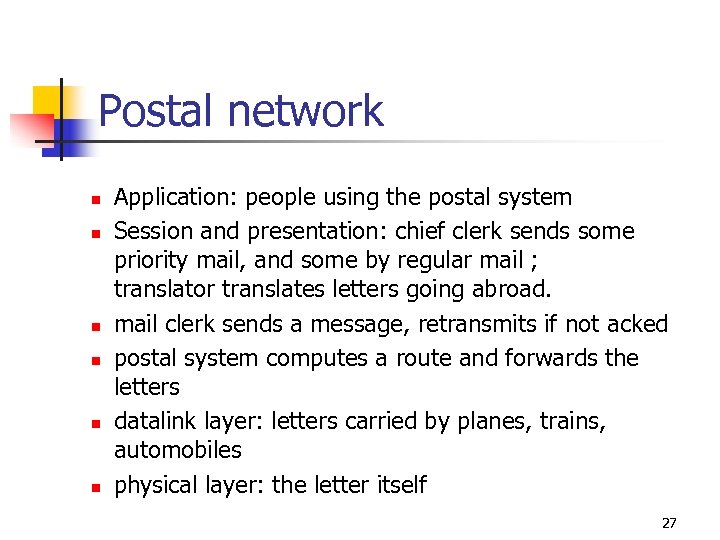 Postal network n n n Application: people using the postal system Session and presentation: chief clerk sends some priority mail, and some by regular mail ; translator translates letters going abroad. mail clerk sends a message, retransmits if not acked postal system computes a route and forwards the letters datalink layer: letters carried by planes, trains, automobiles physical layer: the letter itself 27
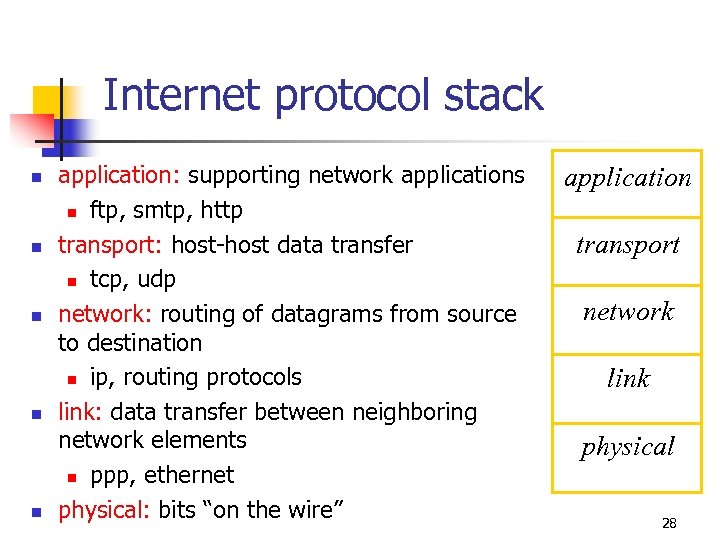 Internet protocol stack n n n application: supporting network applications n ftp, smtp, http transport: host-host data transfer n tcp, udp network: routing of datagrams from source to destination n ip, routing protocols link: data transfer between neighboring network elements n ppp, ethernet physical: bits “on the wire” application transport network link physical 28
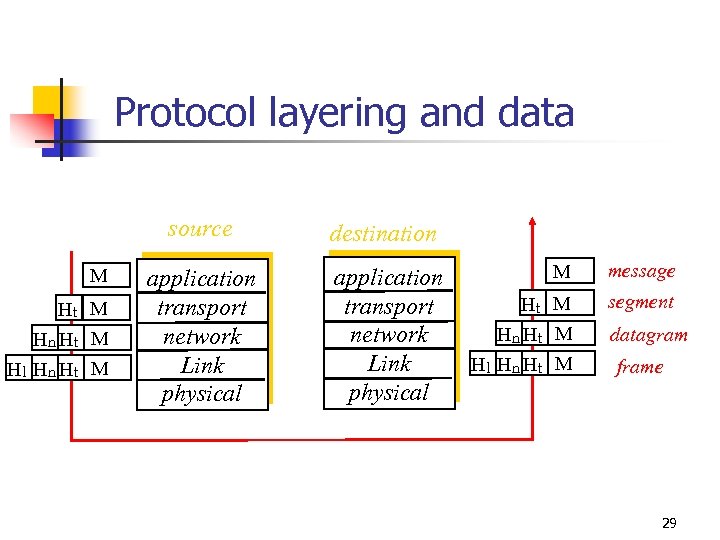 Protocol layering and data source M Ht M Hn Ht M Hl Hn Ht M destination application transport network Link physical M message Ht M Hn Ht M segment Hl Hn Ht M datagram frame 29
 Physical layer n n Moves bits between physically connected end-systems Standard prescribes n n coding scheme to represent a bit shapes and sizes of connectors bit-level synchronization Internet n technology to move bits on a wire, wireless link, satellite channel etc. 30
 Datalink layer n n (Reliable) communication over a single link. Introduces the notion of a frame n set of bits that belong together n Idle markers tell us that a link is not carrying a n Begin and end markers delimit a frame n Internet frame n n n a variety of datalink layer protocols most common is Ethernet others are FDDI, SONET, HDLC 31
 (. Datalink layer (contd n Ethernet (broadcast link) n n n also need to decide who gets to speak next n n need datalink-layer address n n end-system must receive only bits meant for it these functions are provided by Medium ACcess sublayer (MAC) Datalink layer protocols are the first layer of software Very dependent on underlying physical link properties Usually bundle both physical and datalink in hardware. 32
 Network layer n n n Carries data from source to destination. Logically concatenates a set of links to form the abstraction of an end-to-end link Allows an end-system to communicate with any other end -system by computing a route between them Hides idiosyncrasies of datalink layer Provides unique network-wide addresses Found both in end-systems and in intermediate systems 33
 Network layer types n In datagram networks n n provides both routing and data forwarding In connection-oriented network n n n separate data plane and control plane data plane only forwards and schedules data (touches every byte) control plane responsible for routing, callestablishment, call-teardown (doesn’t touch data bytes) 34
 (. Network layer (contd n Internet n n n network layer is provided by Internet Protocol (IP) found in all end-systems and intermediate systems provides abstraction of end-to-end link segmentation and reassembly packet-forwarding, routing, scheduling unique IP addresses can be layered over anything, but only best-effort service 35
 (. Network layer (contd n At end-systems n n segments and reassemble n n primarily hides details of datalink layer detects errors At intermediate systems n participates in routing protocol to create routing tables n responsible forwarding packets n schedules the transmission order of packets n chooses which packets to drop 36
 Transport layer n n Reliable end-to-end communication. creates the abstraction of an error-controlled, flow-controlled and multiplexed end-to-end link (Network layer provides only a ‘raw’ end-to-end service) n Some transport layers provide fewer services n n e. g. simple error detection, no flow control, and no retransmission Internet n TCP provides error control, flow control, multiplexing n UDP provides only multiplexing 37
 (. Transport layer (contd n Error control n n n Flow control n n GOAL: message will reach destination despite packet loss, corruption and duplication ACTIONS: retransmit lost packets; detect, discard, and retransmit corrupted packets; detect and discard duplicated packets match transmission rate to rate currently sustainable on the path to destination, and at the destination itself Multiplexes multiple applications to the same end -to-end connection n adds an application-specific identifier (port number) so that receiving end-system can hand in incoming packet to the correct application 38
 Session layer n n n Not common Provides full-duplex service, expedited data delivery, and session synchronization Internet n doesn’t have a standard session layer 39
 (. Session layer (cont n Duplex n n Expedited data delivery n n if transport layer is simplex, concatenates two transport endpoints together allows some messages to skip ahead in end-system queues, by using a separate low-delay transport layer endpoint Synchronization n allows users to place marks in data stream and to roll back to a prespecified mark 40
 Presentation layer n n Usually ad hoc Touches the application data (Unlike other layers which deal with headers) n Hides data representation differences between applications n n n characters (ASCII, unicode, EBCDIC. ) Can also encrypt data Internet n n no standard presentation layer only defines network byte order for 2 - and 4 -byte integers 41
 Application layer n n The set of applications that use the network Doesn’t provide services to any other layer 42