


 Скачать презентацию Computer Graphics An Introduction What s this course
206f593f88f40baf306bfca8f39cb327.ppt
- Количество слайдов: 42
 Computer Graphics An Introduction
 What’s this course all about? We will cover… Graphics programming and algorithms Graphics data structures Colour Applied geometry, modelling and rendering 3/19/2018 Lecture 1 2
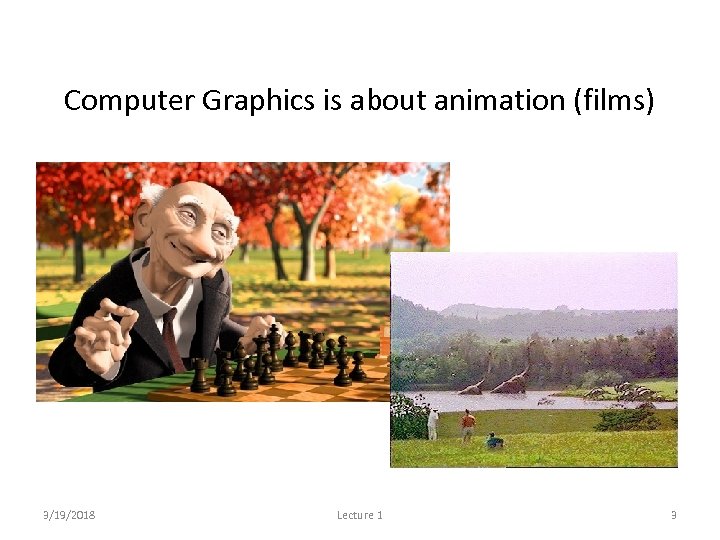 Computer Graphics is about animation (films) Major driving force now 3/19/2018 Lecture 1 3
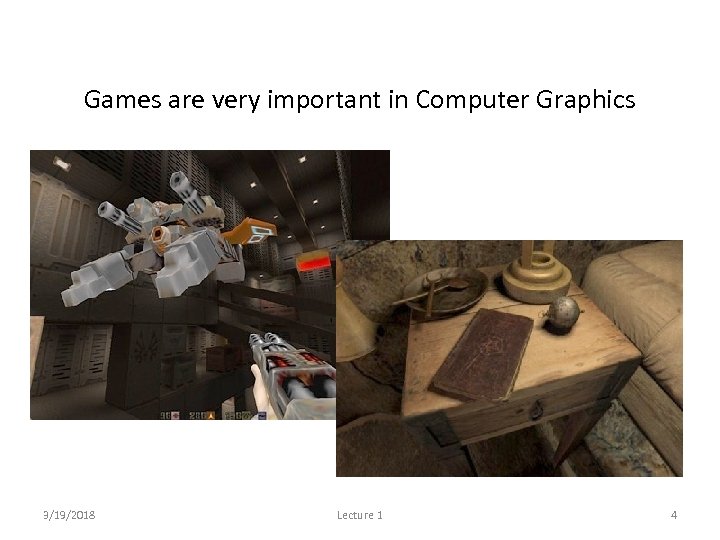 Games are very important in Computer Graphics 3/19/2018 Lecture 1 4
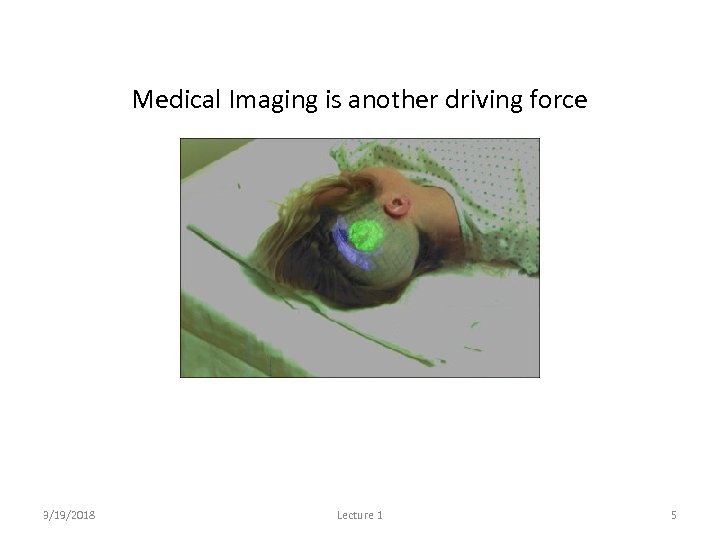 Medical Imaging is another driving force 3/19/2018 Lecture 1 5
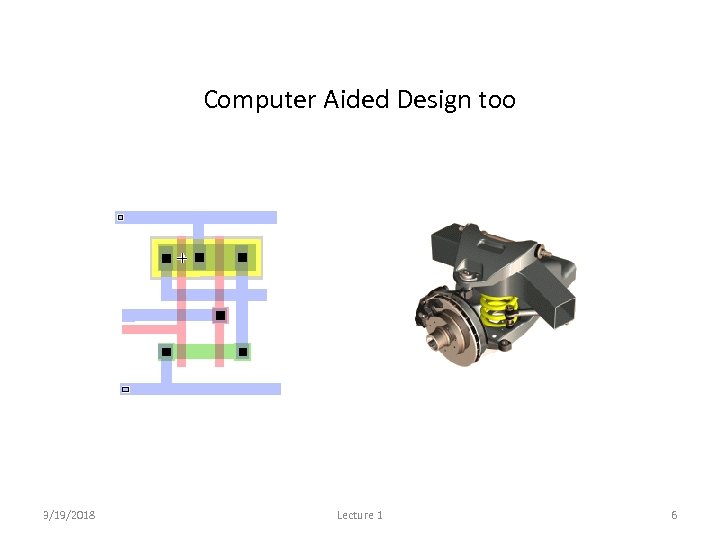 Computer Aided Design too 3/19/2018 Lecture 1 6
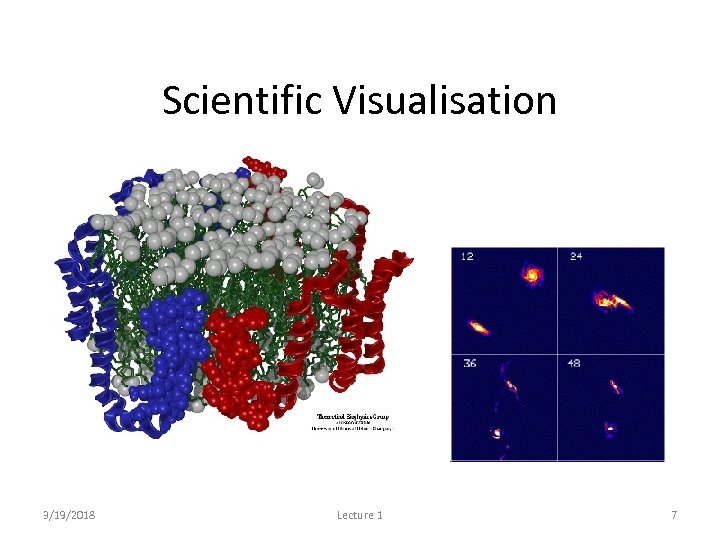 Scientific Visualisation To view below and above our visual range 3/19/2018 Lecture 1 7
 First Lecture • The graphics processes – What we will cover on this course • Some definitions – Fundamental units we use in these processes • First Practical 3/19/2018 Lecture 1 8
 Overview of the Course • Graphics Pipeline (Today) • Modelling – Surface / Curve modelling • (Local lighting effects) Illumination, lighting, shading, mirroring, shadowing • Rasterization (creating the image using the 3 D scene) • Ray tracing • Global illumination • Curves and Surfaces 3/19/2018 Lecture 1 9
 Graphics/Rendering Pipeline • Graphics processes generally execute sequentially • Pipelining the process means dividing it into stages • Especially when rendering in real-time, different hardware resources are assigned for each stage 3/19/2018 Lecture 1 10
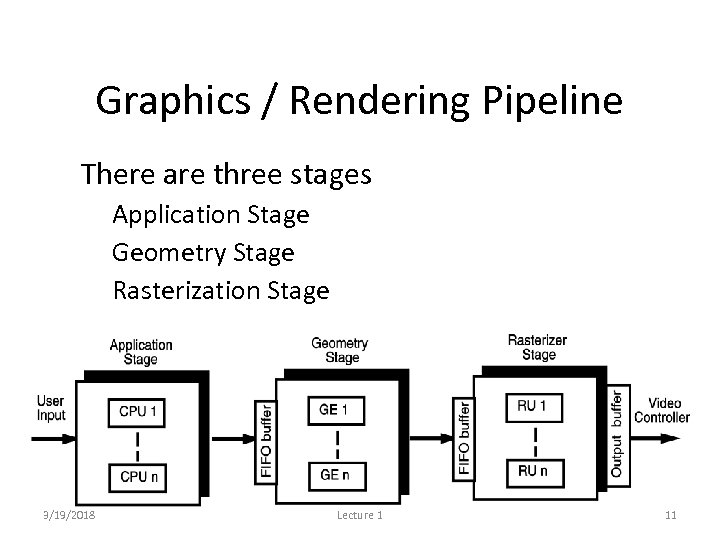 Graphics / Rendering Pipeline • There are three stages – Application Stage – Geometry Stage – Rasterization Stage 3/19/2018 Lecture 1 11
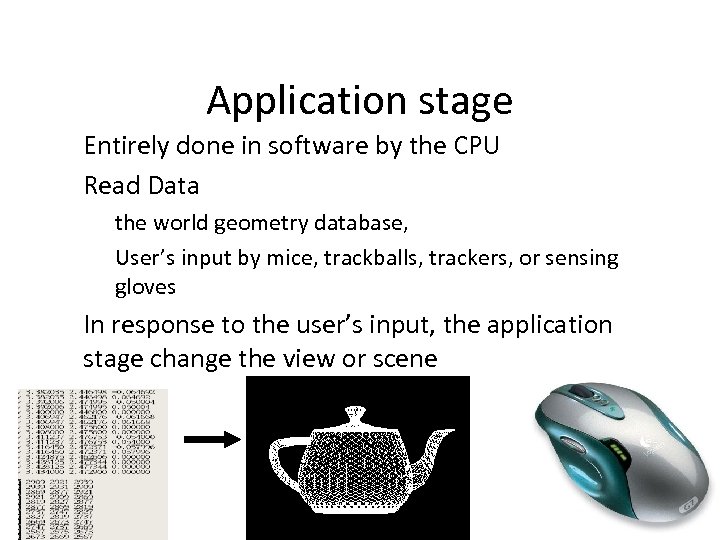 Application stage • Entirely done in software by the CPU • Read Data – the world geometry database, – User’s input by mice, trackballs, trackers, or sensing gloves • In response to the user’s input, the application stage change the view or scene 3/19/2018 Lecture 1 12
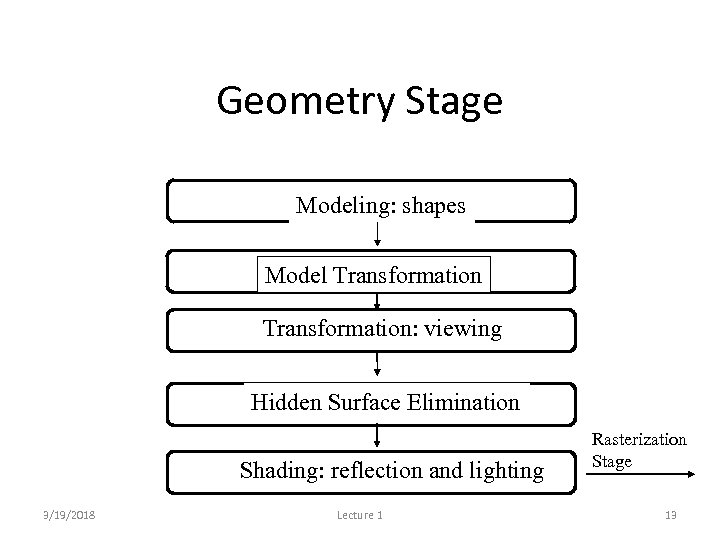 Geometry Stage Modeling: shapes Model Transformation: viewing Hidden Surface Elimination Shading: reflection and lighting 3/19/2018 Lecture 1 Rasterization Stage 13
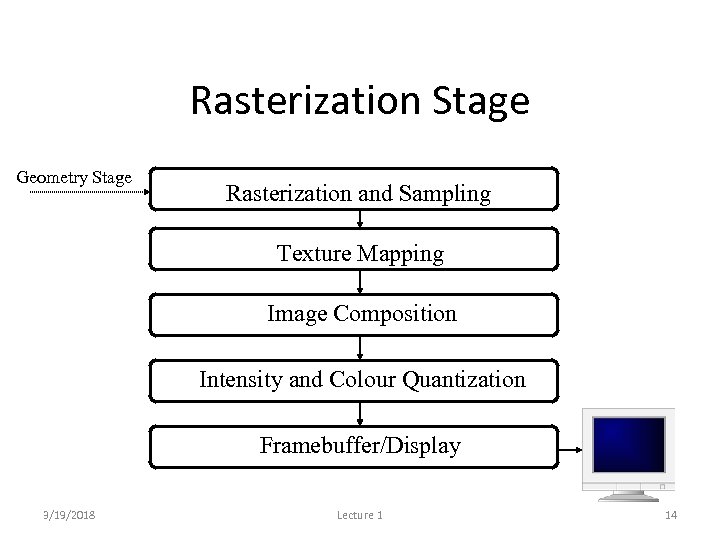 Rasterization Stage Geometry Stage Rasterization and Sampling Texture Mapping Image Composition Intensity and Colour Quantization Framebuffer/Display 3/19/2018 Lecture 1 14
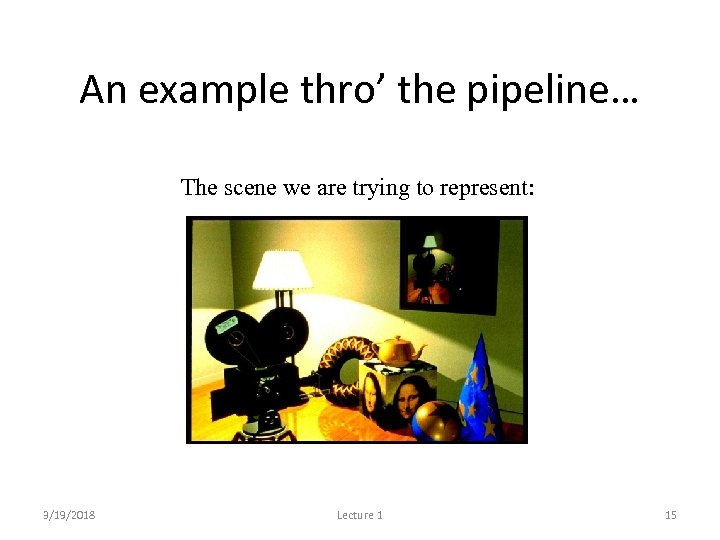 An example thro’ the pipeline… The scene we are trying to represent: Images courtesy of Picture Inc. 3/19/2018 Lecture 1 15
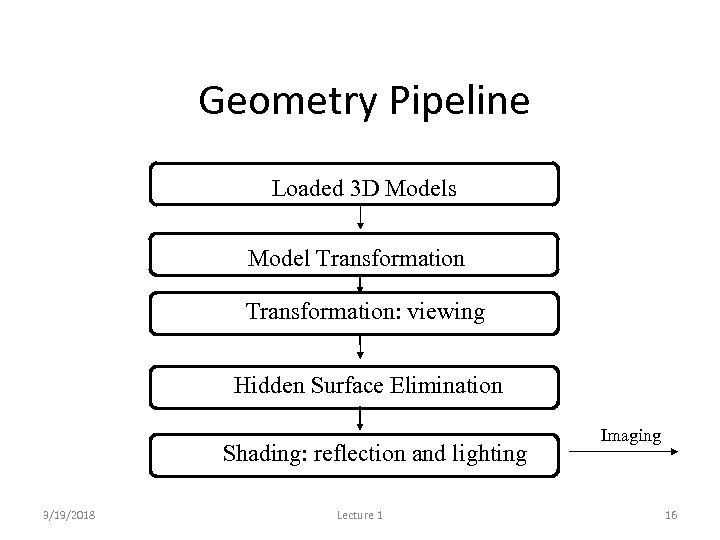 Geometry Pipeline Loaded 3 D Models Model Transformation: viewing Hidden Surface Elimination Shading: reflection and lighting 3/19/2018 Lecture 1 Imaging Pipeline 16
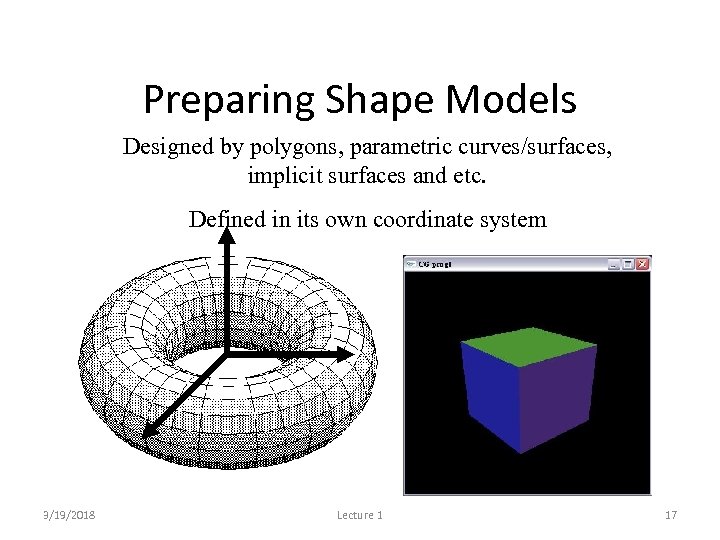 Preparing Shape Models Designed by polygons, parametric curves/surfaces, implicit surfaces and etc. Defined in its own coordinate system 3/19/2018 Lecture 1 17
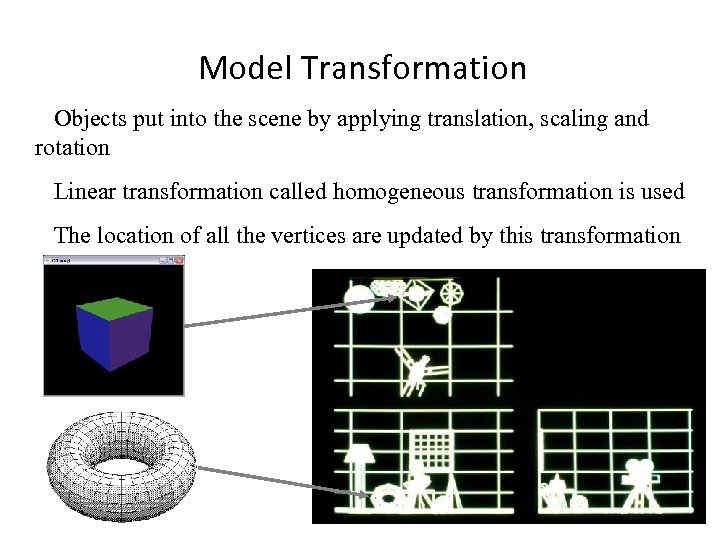 Model Transformation Objects put into the scene by applying translation, scaling and rotation Linear transformation called homogeneous transformation is used The location of all the vertices are updated by this transformation 3/19/2018 Lecture 1 18
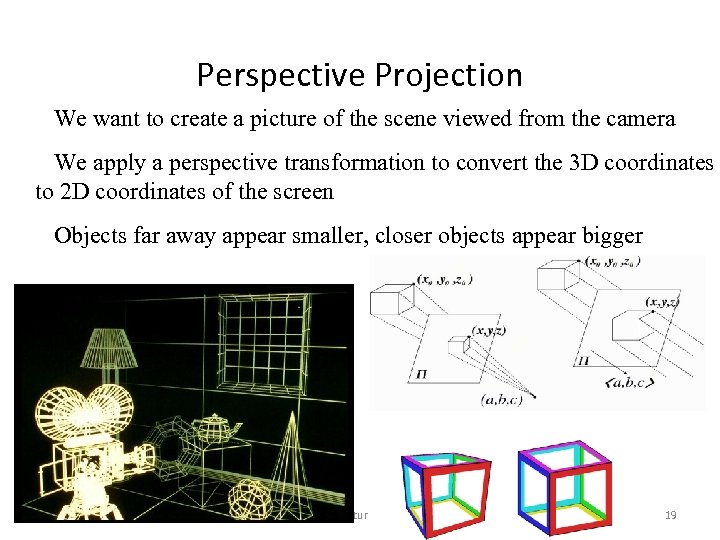 Perspective Projection We want to create a picture of the scene viewed from the camera We apply a perspective transformation to convert the 3 D coordinates to 2 D coordinates of the screen Objects far away appear smaller, closer objects appear bigger 3/19/2018 Lecture 1 19
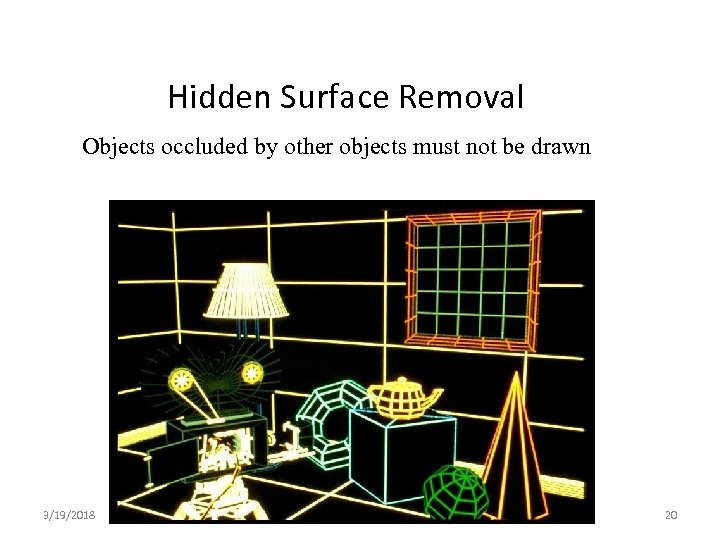 Hidden Surface Removal Objects occluded by other objects must not be drawn 3/19/2018 Lecture 1 20
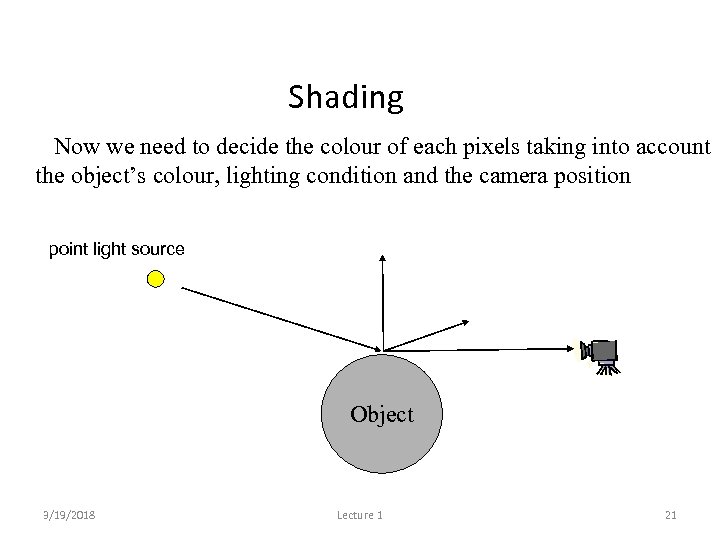 Shading Now we need to decide the colour of each pixels taking into account the object’s colour, lighting condition and the camera position point light source Object 3/19/2018 Lecture 1 21
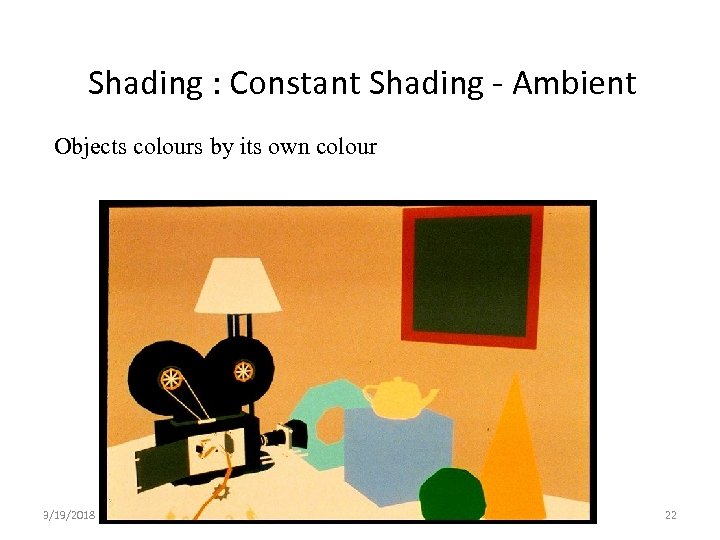 Shading : Constant Shading - Ambient Objects colours by its own colour 3/19/2018 Lecture 1 22
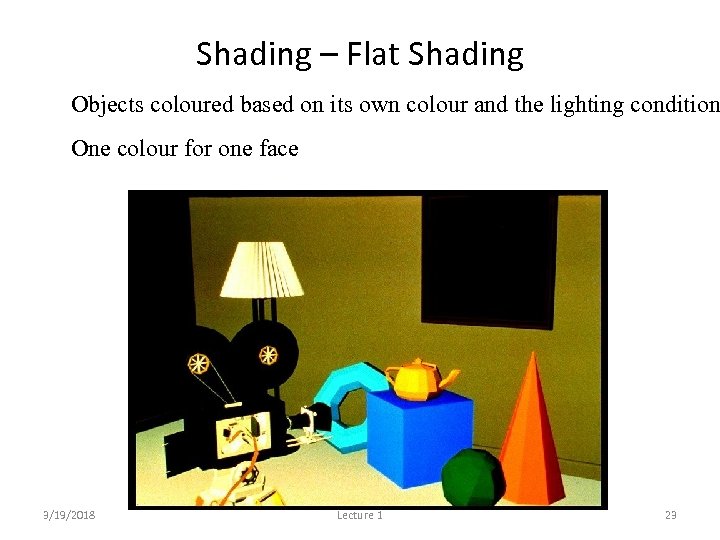 Shading – Flat Shading Objects coloured based on its own colour and the lighting condition One colour for one face 3/19/2018 Lecture 1 23
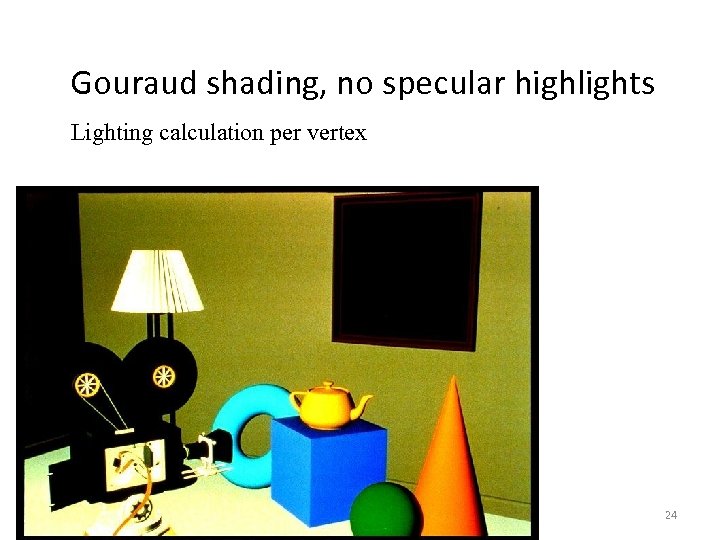 Gouraud shading, no specular highlights Lighting calculation per vertex 3/19/2018 Lecture 1 24
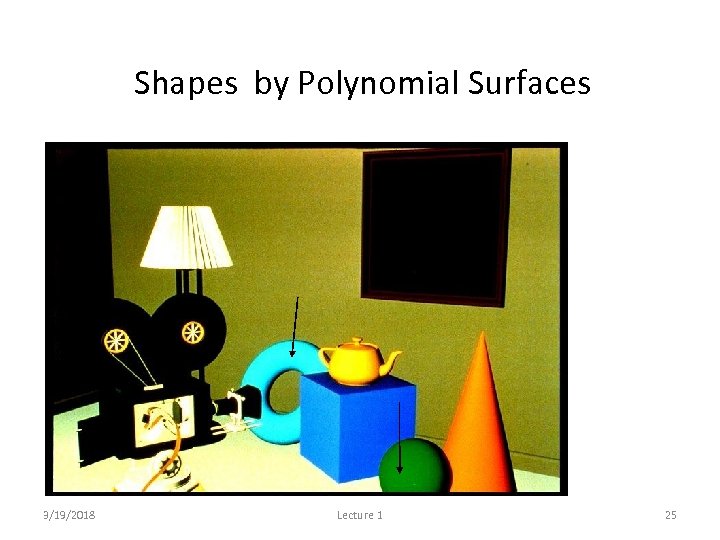 Shapes by Polynomial Surfaces 3/19/2018 Lecture 1 25
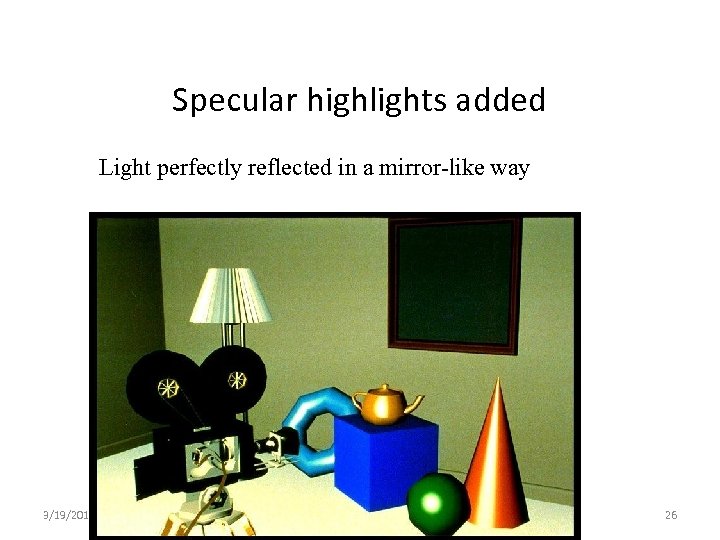 Specular highlights added Light perfectly reflected in a mirror-like way 3/19/2018 Lecture 1 26
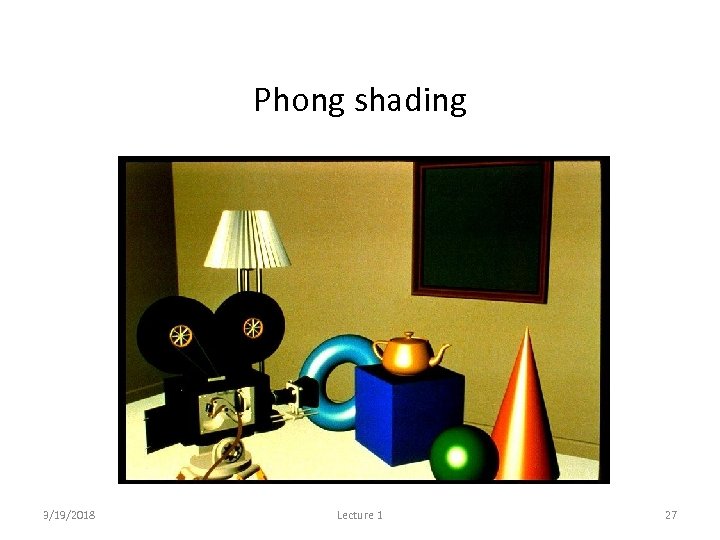 Phong shading 3/19/2018 Lecture 1 27
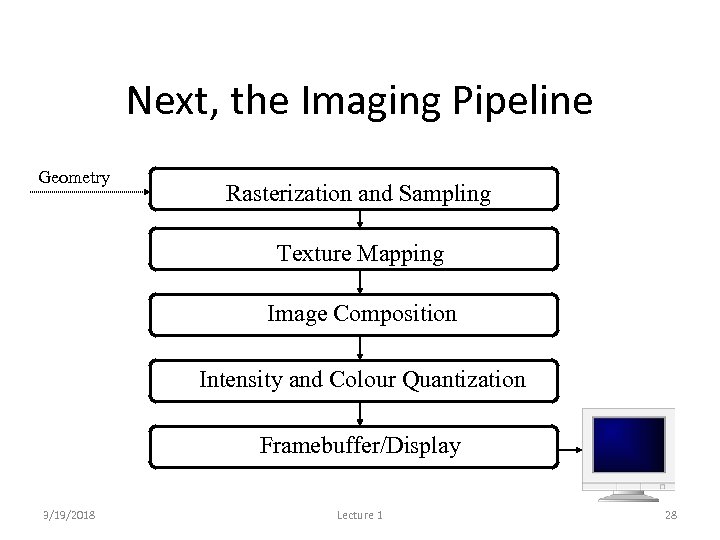 Next, the Imaging Pipeline Geometry Pipeline Rasterization and Sampling Texture Mapping Image Composition Intensity and Colour Quantization Framebuffer/Display 3/19/2018 Lecture 1 28
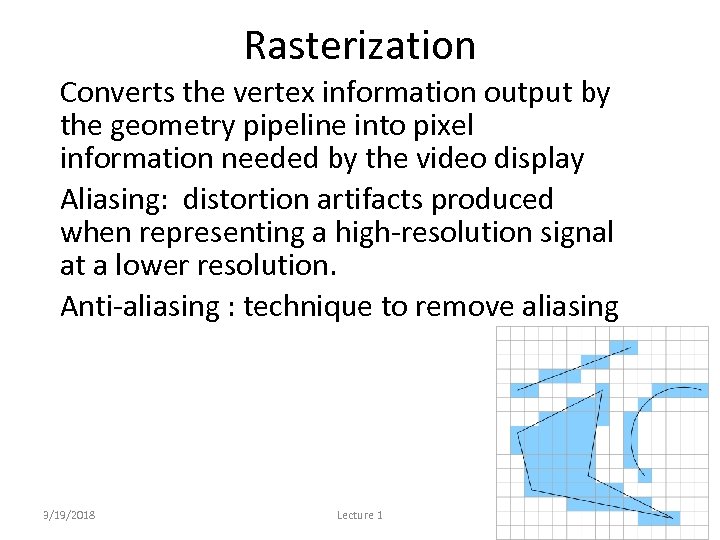 Rasterization • Converts the vertex information output by the geometry pipeline into pixel information needed by the video display • Aliasing: distortion artifacts produced when representing a high-resolution signal at a lower resolution. • Anti-aliasing : technique to remove aliasing 3/19/2018 Lecture 1 29
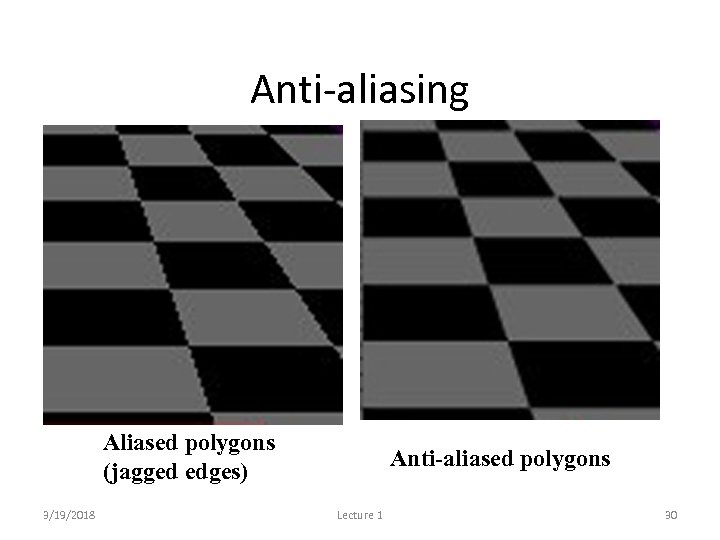 Anti-aliasing Aliased polygons (jagged edges) 3/19/2018 Anti-aliased polygons Lecture 1 30
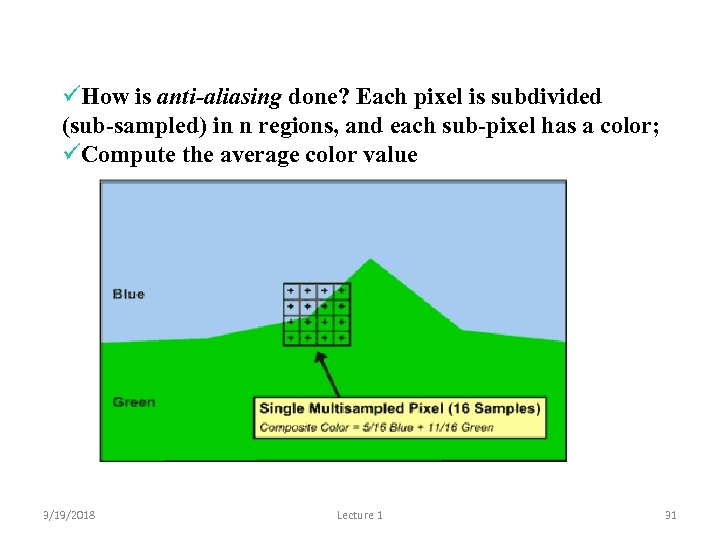 How is anti-aliasing done? Each pixel is subdivided (sub-sampled) in n regions, and each sub-pixel has a color; Compute the average color value 3/19/2018 Lecture 1 31
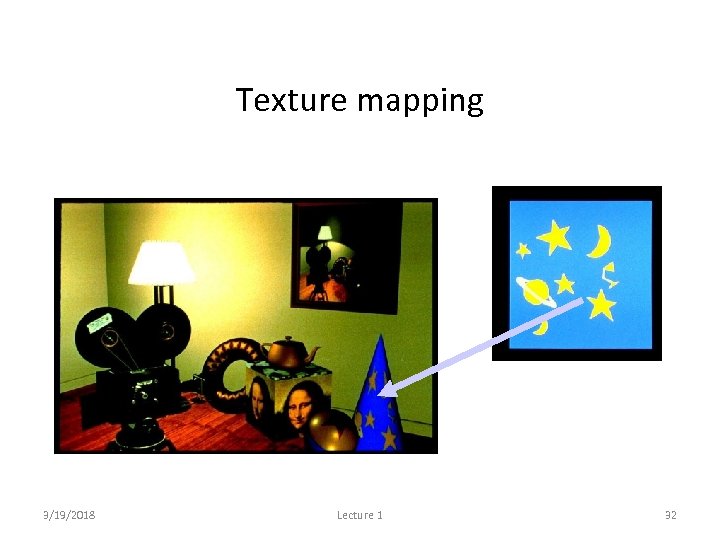 Texture mapping 3/19/2018 Lecture 1 32
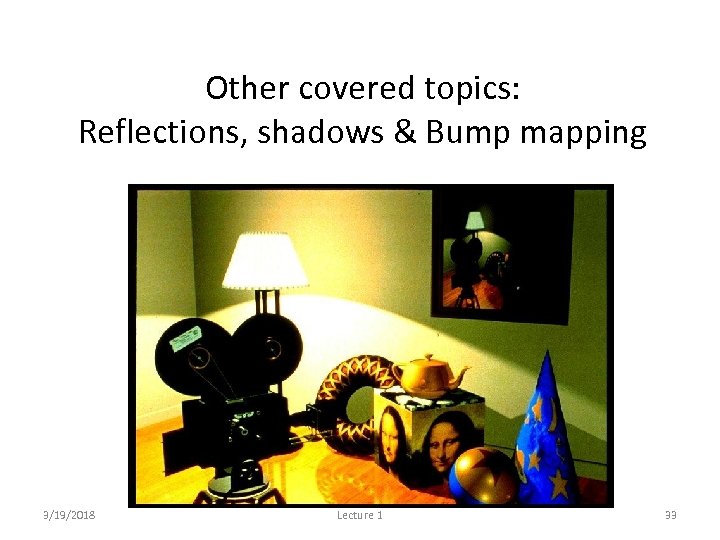 Other covered topics: Reflections, shadows & Bump mapping 3/19/2018 Lecture 1 33
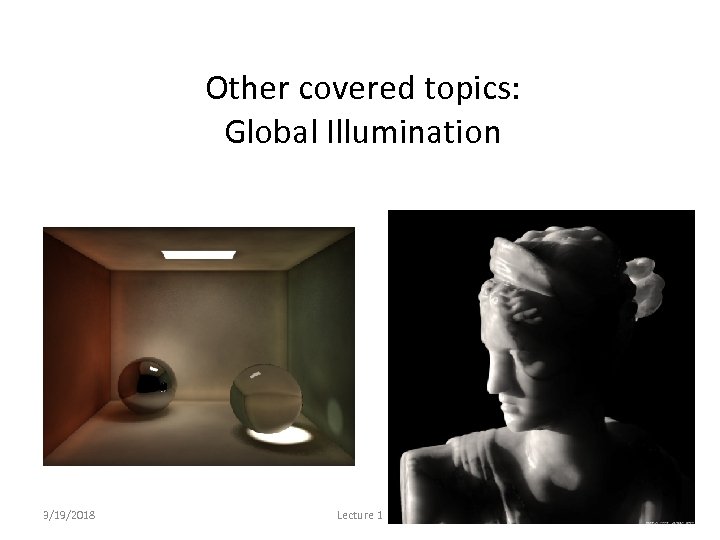 Other covered topics: Global Illumination 3/19/2018 Lecture 1 34
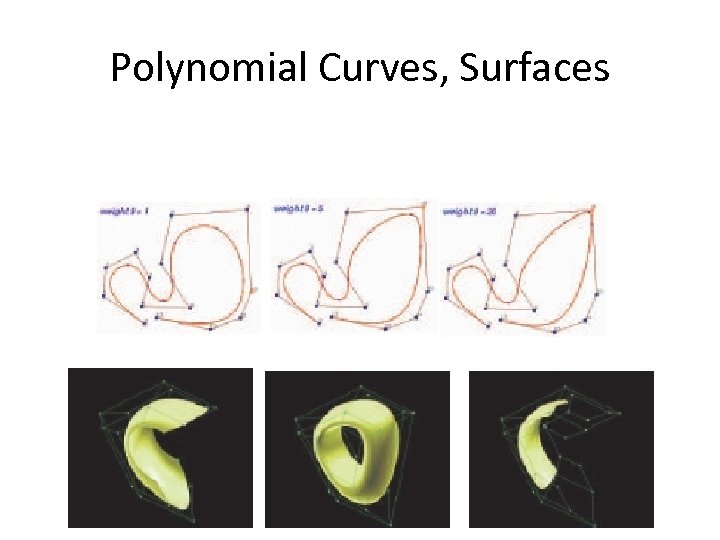 Polynomial Curves, Surfaces
 Graphics Definitions • Point – a location in space, 2 D or 3 D – sometimes denotes one pixel • Line – straight path connecting two points – infinitesimal width, consistent density – beginning and end on points 3/19/2018 Lecture 1 36
 • Vertex Graphics Definitions – point in 3 D • Edge – line in 3 D connecting two vertices • Polygon/Facet – arbitrary shape formed by connected vertices – fundamental unit of 3 D computer graphics • Mesh – set of connected polygons forming a surface (or object) –: 3/19/2018 Lecture 1 37
 Graphics Definitions • Rendering : process of generating an image from the model • Framebuffer : a video output device that drives a video display from a memory containing the color for every pixel 3/19/2018 Lecture 1 38
 Course support resources • Graphics course website • http: //www. inf. ed. ac. uk/teaching/courses/ cg 3/19/2018 – lecture material, – lecture log with general summary and recommended reading, – Links to support material for lectures and projects, – Practical description and resources Lecture 1 39
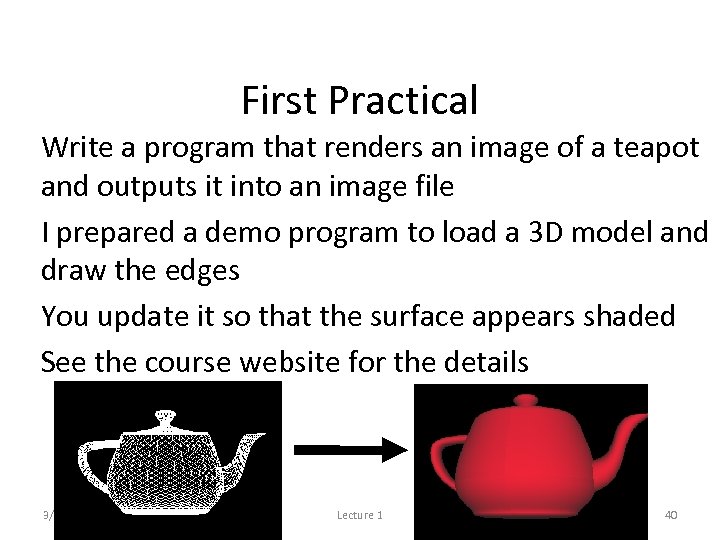 First Practical • Write a program that renders an image of a teapot and outputs it into an image file • I prepared a demo program to load a 3 D model and draw the edges • You update it so that the surface appears shaded • See the course website for the details 3/19/2018 Lecture 1 40
 Some notifications • 16 lectures in total • I need to visit Japan in the beginning of October so no lecture on 5 th October • Need to attend conferences on 16 th and 26 th of November so no lectures there
 Summary • The course is about algorithms, not applications • Lots of mathematics • Graphics execution is a pipelined approach • Basic definitions presented • Some support resources indicated 3/19/2018 Lecture 1 42