


 Скачать презентацию Computer Concepts A Computer is a device
b92c916c5ba6b6a50e79528d6ccc9416.ppt
- Количество слайдов: 63
 Computer Concepts
 A Computer is a device that • • accepts input processes data stores data produces output (all according to a series of stored instructions) 2
 Computer Functions Input • Words, symbols, numbers, sound, pictures, program instructions • Program calculates, sorts modifies data Process • Uses microprocessor or CPU Output Store • Results of processing • Reports, graphs, documents, pictures • Printer or monitor • Memory is temporary holding area (RAM) • Storage is permanent (disk) 3 • Note: “Memory” and “storage” are actually synonyms.
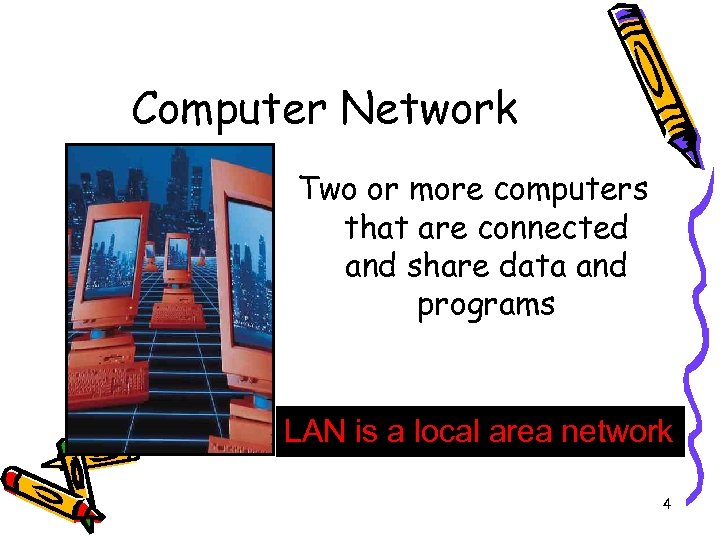 Computer Network Two or more computers that are connected and share data and programs LAN is a local area network 4
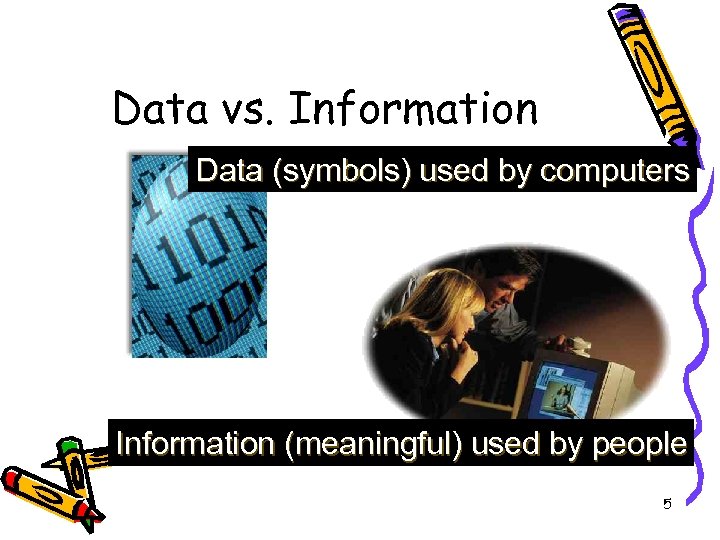 Data vs. Information Data (symbols) used by computers Information (meaningful) used by people 5
 Data • Binary number system to define electronic data • 0 or 1 • Bit • Byte (8 bits) 6
 Digital Data Representation • The form in which information is conceived, manipulated and recorded on a digital device. • Uses discrete digits/electronic signals - 1, 0 (bits - binary digits) - On/Off - Yes/No Byte = 8 bits = 1 character 7
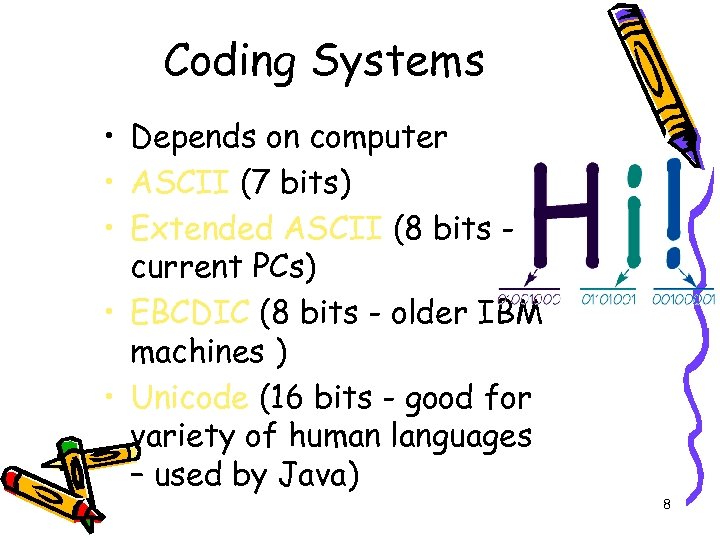 Coding Systems • Depends on computer • ASCII (7 bits) • Extended ASCII (8 bits current PCs) • EBCDIC (8 bits - older IBM machines ) • Unicode (16 bits - good for variety of human languages – used by Java) 8
 Quantifying Bytes and Bits • • Bit = b Nibble = Half of a byte Byte = B Kilobyte (KB) (1024 [210] or 1000 bytes) Megabyte (MB) (Million bytes) Gigabyte (GB) (Billion bytes) Terabyte (TB) (Trillion bytes) 9
 Files • Collection of data on a storage medium • Data file (passive) • Executable file (active) • Filename and extension Image. jpg Word. exe Resume. doc 10
 System Software • Helps the computer monitor itself in order to function efficiently • Operating system – Master controller of all computer activities • Popular operating systems – PCs: Microsoft Windows, Mac OS – Handhelds: Windows CE and Palm OS – Servers: Linux and UNIX 11
 Platform Microprocessor + Operating system • Mac and PC compatibility is an issue • Apple computer = Mac platform • Original IBM computer = Windows or PC platform 12
 Internet and World. Wide Web Technology 13
 Internet Basics (Cyberspace) Internet is a collection of local, regional, national and international computer networks that are linked together to exchange data and distribute processing tasks. 14
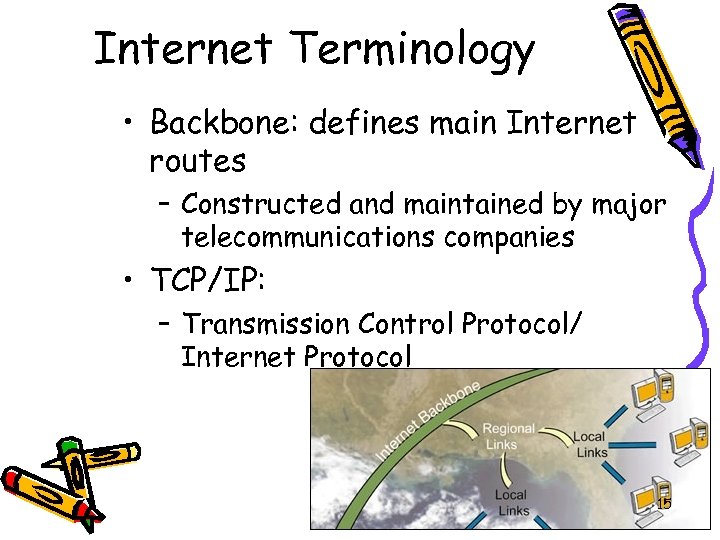 Internet Terminology • Backbone: defines main Internet routes – Constructed and maintained by major telecommunications companies • TCP/IP: – Transmission Control Protocol/ Internet Protocol 15
 Internet Terminology • Server/server software • IP Address: unique number for each Internet computer • Packets: small chunks of data ready to travel the Internet • Router: helps send along the packets to correct destination 16
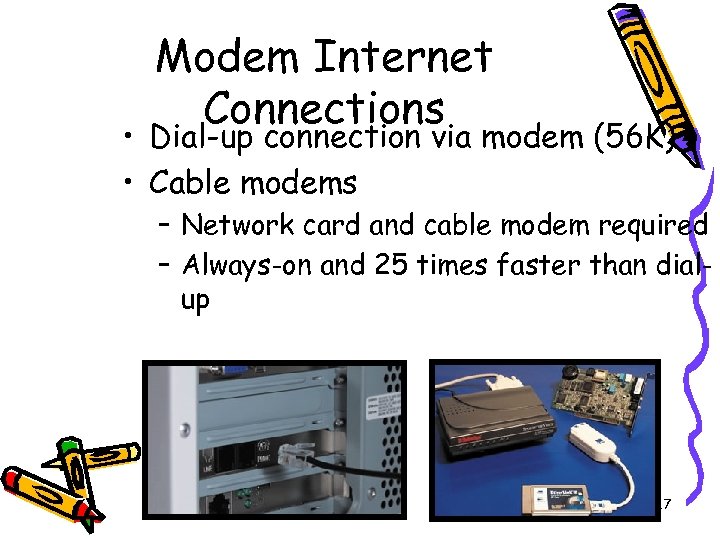 Modem Internet Connections • Dial-up connection via modem (56 K) • Cable modems – Network card and cable modem required – Always-on and 25 times faster than dialup 17
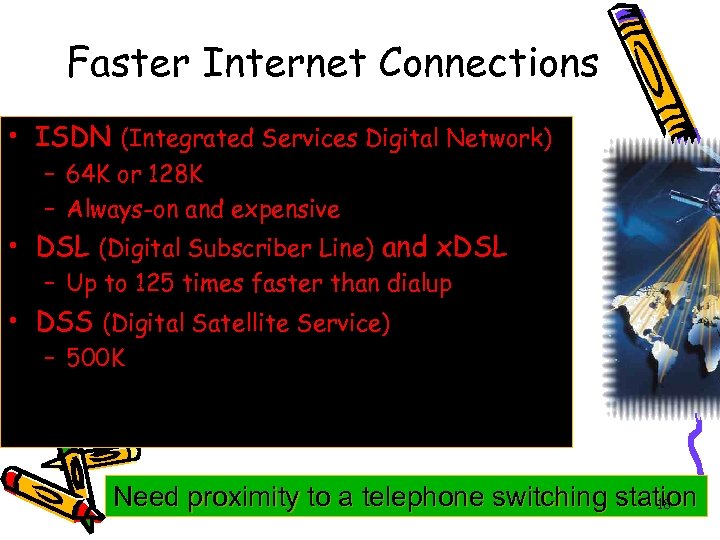 Faster Internet Connections • ISDN (Integrated Services Digital Network) – 64 K or 128 K – Always-on and expensive • DSL (Digital Subscriber Line) and x. DSL – Up to 125 times faster than dialup • DSS (Digital Satellite Service) – 500 K Need proximity to a telephone switching station 18
 Internet Service Provider (ISP) • Provides internet access to businesses, organizations and individuals • Provides telecommunications equipment • User ID and password required • Connects you to backbone • Email account monthly fee • Should have local access telephone numbers 19
 World Wide Web Basics • • • Files interconnected via hypertext Web pages make up a web site Home Page Links or hyperlinks Web servers 20
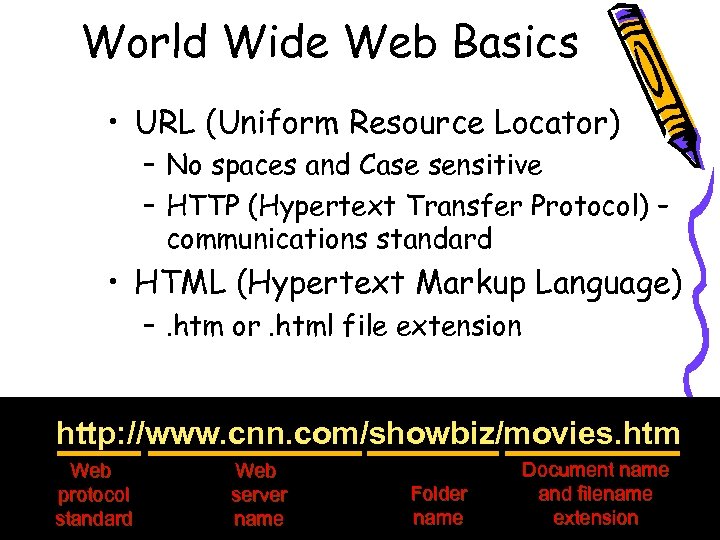 World Wide Web Basics • URL (Uniform Resource Locator) – No spaces and Case sensitive – HTTP (Hypertext Transfer Protocol) – communications standard • HTML (Hypertext Markup Language) –. htm or. html file extension http: //www. cnn. com/showbiz/movies. htm Web protocol standard Web server name Folder name Document name and filename 21 extension
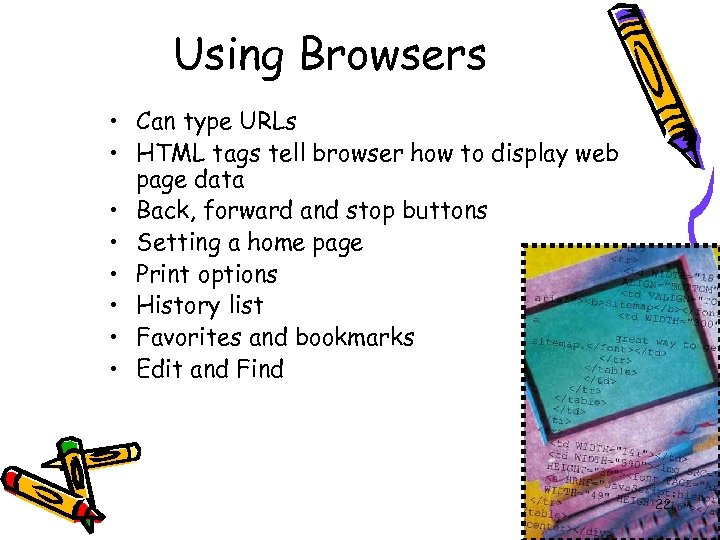 Using Browsers • Can type URLs • HTML tags tell browser how to display web page data • Back, forward and stop buttons • Setting a home page • Print options • History list • Favorites and bookmarks • Edit and Find 22
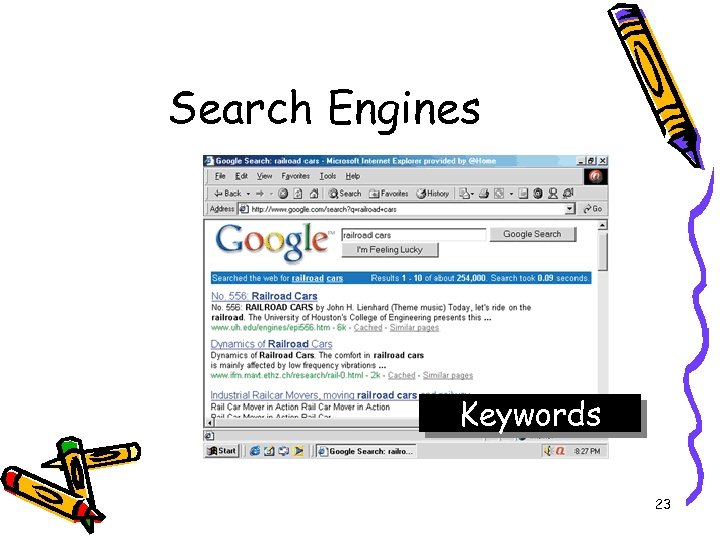 Search Engines Keywords 23
 E-mail Basics • • • Account = Mailbox userid@computer Message Attachment ASCII vs HTML format Netiquette 24
 E-mail System • E-mail servers • Store-and-forward technology • Types – POP (Post Office Protocol) used via ISP – IMAP (Internet Messaging Access Protocol) – Web-based like Hotmail 25
 Software 26
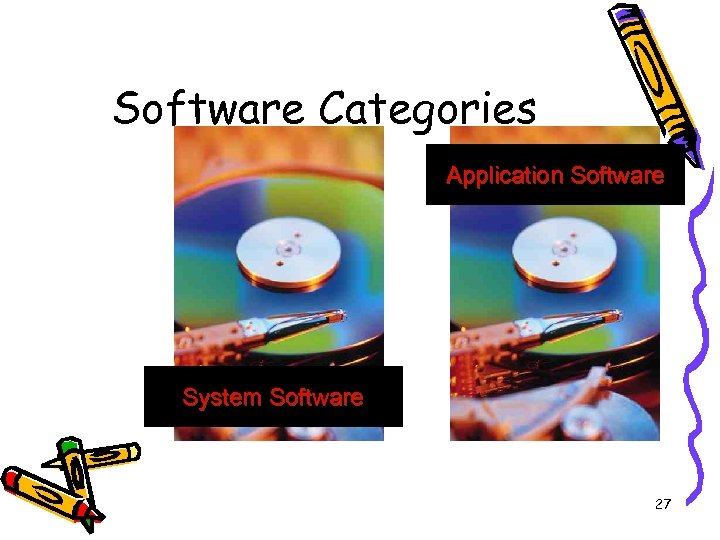 Software Categories Application Software System Software 27
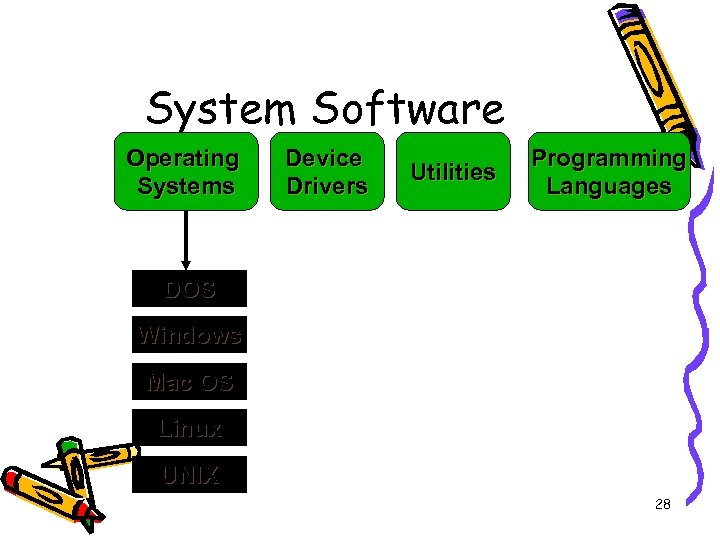 System Software Operating Systems Device Drivers Utilities Programming Languages DOS Windows Mac OS Linux UNIX 28
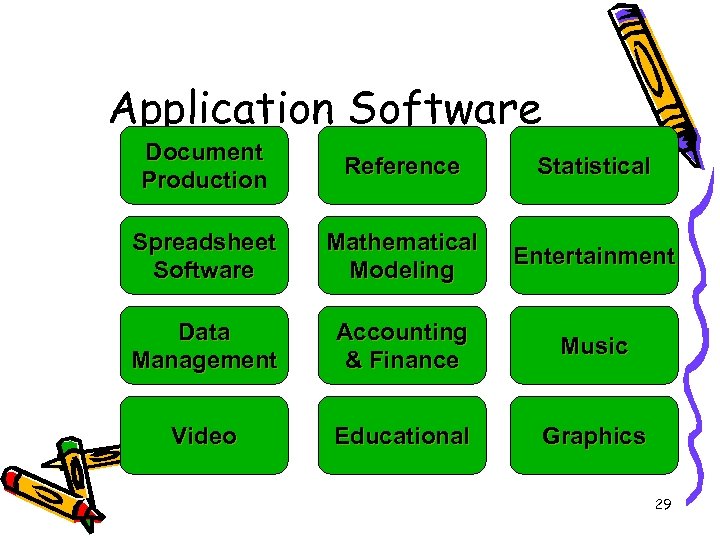 Application Software Document Production Reference Statistical Spreadsheet Software Mathematical Modeling Entertainment Data Management Accounting & Finance Music Video Educational Graphics 29
 Software Topics • Computer program – main executable program (. exe) • Support module – called by the program (. dll) • Data module – Example: a dictionary file or a file that is not supplied by the user 30
 How Computers Interpret Software • Computer languages – Source code – High-level languages: COBOL, C++, Java • Machine language • Compiler – Creates object code in single batch • Interpreter – Converts one instruction at a time – Common with web-based scripts (part of web page) 31
 Operating Systems • Interacts with application software, device drivers & hardware to manage computers resources • Multitasking • CTRL-ALT-DEL • GUI – graphical user interface • Utilities 32
 License vs. Copyright • Software License: a legal contract that defines the ways in which you may use a computer program. • Copyright: a form of legal protection that grants the author of an original work an exclusive right to copy, distribute, sell and modify that work. • Software piracy • For contract to take effect: – Open a shrink-wrap license product – Agree to an installation agreement 33
 Types of Copyright Protections • Shareware: try before you buy on the honor system • Freeware: no fee - can use, but not alter or sell • Open Source: uncompiled source code that can be changed - sold or free • Public Domain: can be copied, altered and resold 34
 Computer Memory 35
 RAM Random Access Memory • Temporary (volatile) holding area for data, application software and operating system • Less storage than disk • Capacity measured in MB (128 - 256 MB) • Speed in nanoseconds 36
 ROM Read-Only Memory • Permanent on a chip from manufacturer • Holds computer start up routine, which are hard-wired instructions 37
 Tech. Talk: Boot Process • Power up • ROM runs bootstrap program • POST (Power-on self-test) – Identifies and checks peripherals • ROM loads operating system from hard disk into RAM • Checks configuration and customization startup routines – Safe Mode if this process is not successful 38
 Files 39
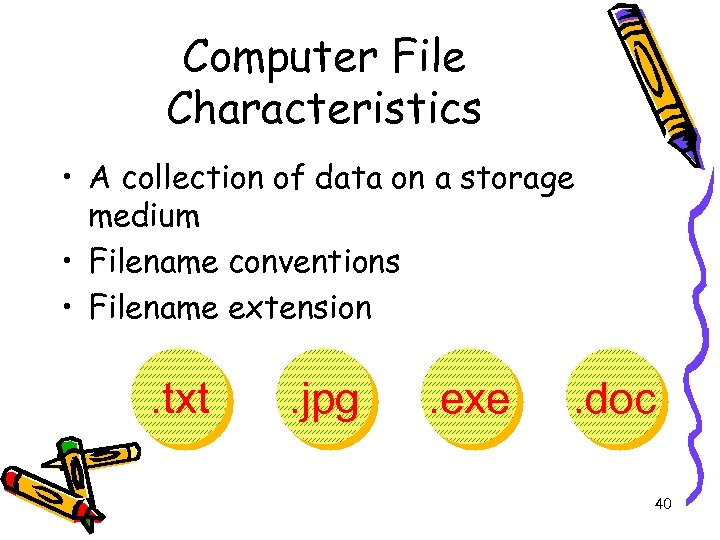 Computer File Characteristics • A collection of data on a storage medium • Filename conventions • Filename extension . txt . jpg . exe . doc 40
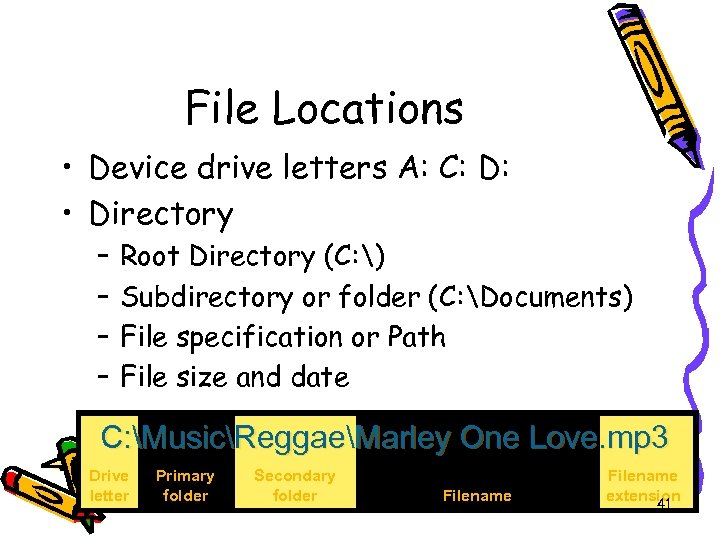 File Locations • Device drive letters A: C: D: • Directory – – Root Directory (C: ) Subdirectory or folder (C: Documents) File specification or Path File size and date C: MusicReggaeMarley One Love. mp 3 Drive letter Primary folder Secondary folder Filename extension 41
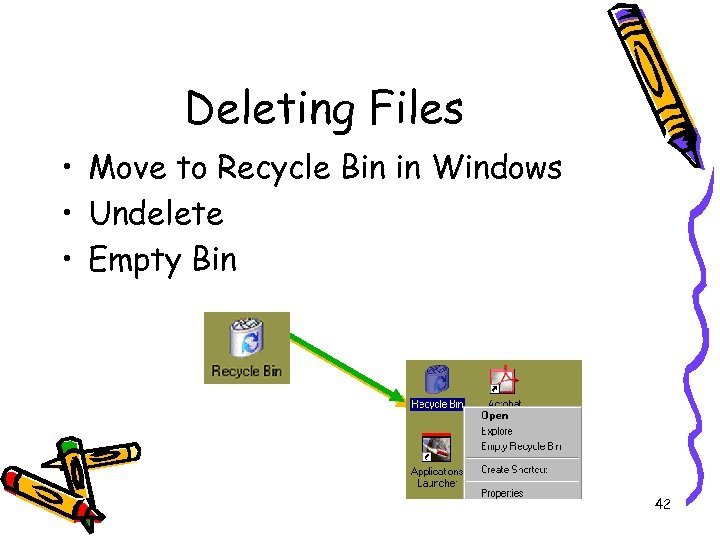 Deleting Files • Move to Recycle Bin in Windows • Undelete • Empty Bin 42
 File Management • Helps you organize your computer files • File/Save and File/Open • Utilities like Windows Explorer or MAC Finder – list, find, move, copy, delete, rename • Save vs. Save As 43
 Storage 44
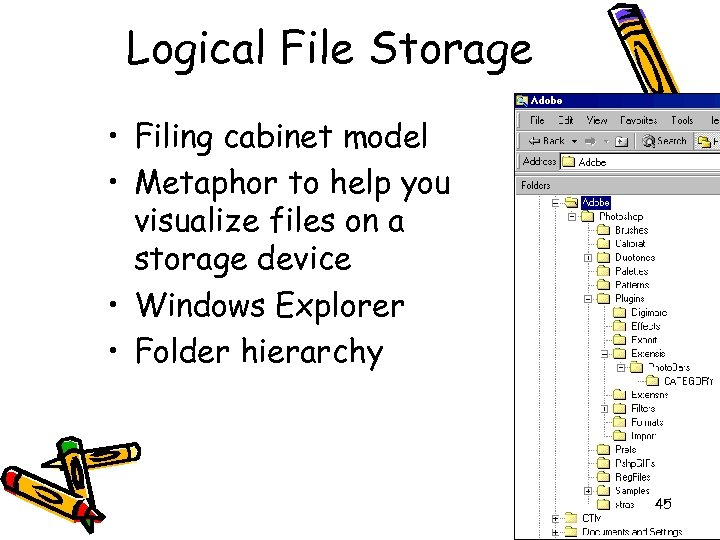 Logical File Storage • Filing cabinet model • Metaphor to help you visualize files on a storage device • Windows Explorer • Folder hierarchy 45
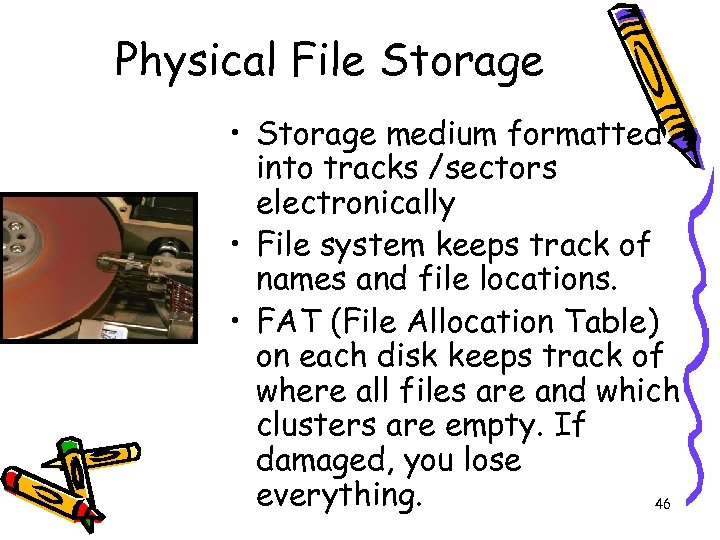 Physical File Storage • Storage medium formatted into tracks /sectors electronically • File system keeps track of names and file locations. • FAT (File Allocation Table) on each disk keeps track of where all files are and which clusters are empty. If damaged, you lose everything. 46
 Storage Technology • Storage Medium: disk, tape, CD, DVD – holds data • Storage Device: disk drives, CD drives – mechanical device • Storage = Medium + Device 47
 Storage Process • Data copied from storage device to RAM • Processed in RAM – volatile (temporary) high speed storage • Data copied back to storage medium (permanent) • Storing data is writing/saving file • Retrieving data is reading/loading/opening file 48
 Magnetic Storage • Magnetizes microscopic particles on medium surface • Permanent, but modifiable • Hard disk, floppy disk, zip disk and tape • Read-write head • Not very durable 49
 Optical Storage • Stores data as microscopic light and dark spots on disk surface • Pits and lands • Uses laser lights • More durable 50
 Comparing Storage Devices • Versatility – versatile devices can access data from several different media; i. e. , DVD drive – data DVDs, DVD movies, audio CDs, etc. • Durability – mishandling, environmental factors • Speed – access time – milliseconds (ms – thousandths of a second) – random versus sequential access – data transfer rate (600 KBps) 51
 Comparing Storage Devices • Capacity – – – KB (1024) MB (~1 million) GB (~ 1 billion) TB (~ 1 trillion) Disk density • closeness and size of particles 52
 Floppy Disk Technology • Most common – 3 ½” 1. 44 MB (1, 440, 000 bytes) • Write protect window • Others – zip disks (100 MB and 250 MB) – Super. Disks (120 MB) • Compatibility 53
 CD Technology • CD-ROM: Compact Disk Read-Only Memory – manufactured; cannot change; up to 680 MB; more durable • CD-R: Compact Disk Recordable – you record; cannot be erased or modified • CD-RW: Compact Disk Rewritable – you record; can erase and modify • Archiving Data – removing infrequently used data 54
 DVD Technology • Digital Video Disk – – originally an alternative to VCR 4. 7 GB Manufactured Can play CD-ROM and most CD-Rs and CD-RWs 55
 Solid State Storage • USB flash drive – Nonvolatile • Compact. Flash (CF) cards – high-end digital cameras • Multi. Media cards (MMC) – Smaller; mobile phones, pagers, cameras • Secure. Digital (SD) cards (and competing XD cards – MP 3 storage, digital camerals 56
 Peripherals 57
 Display Devices • CRT: Cathode Ray Tube – Inexpensive and dependable • LCD: Liquid Crystal Display – Expensive; found on notebooks – Limited viewing angles – Active Matrix or TFT (thin film transistor) • Plasma – Illuminates miniature fluorescent lights – Compact, light, expensive 58
 Display Device Image Quality • Screen size (13” to 21”) – measured diagonally – viewable image size (vis) • Dot pitch – measure of image clarity – smaller is better • Resolution – horizontal and vertical pixels displayed on the screen – 640 x 480, 800 x 600, 1024 x 768 (higher is better) • Color depth (or bit depth) – number of colors that can be displayed – 24 -bit (true color) = millions of colors 59
 Printer Comparison Criteria • • Resolution (dpi) Materials cost Speed (ppm or cps) Quality versus Price 60
 Device-handling • device driver • Plug and Play (Pn. P) 61
 Other Peripherals • • • Image scanner Webcam Digitizing tablet Barcode reader Touch screen • • Joystick Plotter Speakers Brain-computer interface 62
 Computer Concepts The End