


 Скачать презентацию Computer Architecture l l l l Instructor Wen-Hung
78b97602a775df777f8058f74280bbb9.ppt
- Количество слайдов: 15
 Computer Architecture l l l l Instructor: Wen-Hung Liao E-mail: whliao@cs. nccu. edu. tw Office: 大仁樓三樓 200312 Office hours: TBA Course web page: http: //www. cs. nccu. edu. tw/~whliao/cod 2005/ Textbook: Patterson and Hennessy, Computer Organization and Design, 3 rd Edition. Companion website
 Chapter 1 Computer Abstractions and Technology
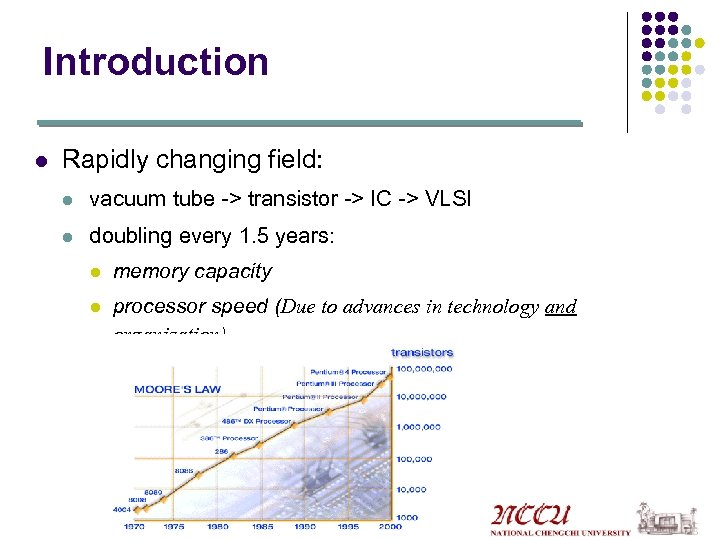 Introduction l Rapidly changing field: l vacuum tube -> transistor -> IC -> VLSI l doubling every 1. 5 years: l memory capacity l processor speed (Due to advances in technology and organization)
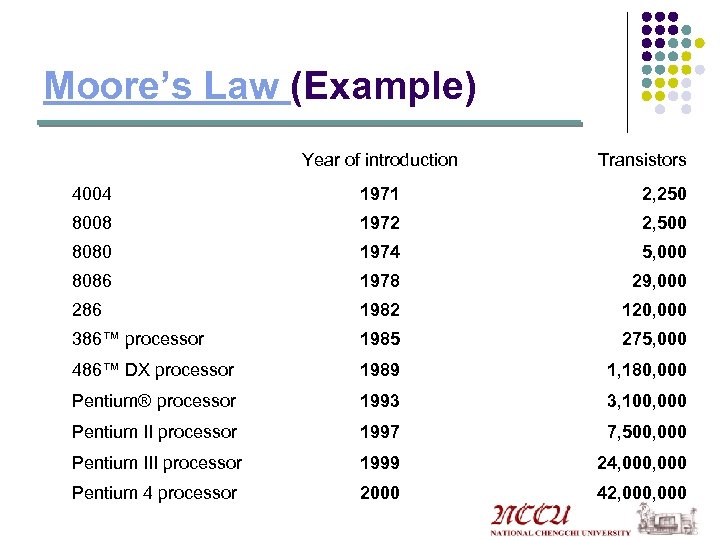 Moore’s Law (Example) Year of introduction Transistors 4004 1971 2, 250 8008 1972 2, 500 8080 1974 5, 000 8086 1978 29, 000 286 1982 120, 000 386™ processor 1985 275, 000 486™ DX processor 1989 1, 180, 000 Pentium® processor 1993 3, 100, 000 Pentium II processor 1997 7, 500, 000 Pentium III processor 1999 24, 000 Pentium 4 processor 2000 42, 000
 Things you’ll be learning l How computers work, a basic foundation l How to analyze their performance l Issues affecting modern processors (caches, pipelines, parallel computing)
 Why learn this stuff? l you want to call yourself a “computer scientist” l you want to build software people use (need performance) l you need to make a purchasing decision or offer “expert” advice
 Prerequisite l l l Some background in assembly language Boolean algebra Logic design
 What is a computer? l l Components: l input (mouse, keyboard. . . ) l output (display, printer. . . ) l storage(disk drives, CD…) l memory (DRAM, SRAM. . . ) l data path l control l network Our primary focus: the processor (data path and control) l implemented using millions of transistors l Impossible to understand by looking at each transistor
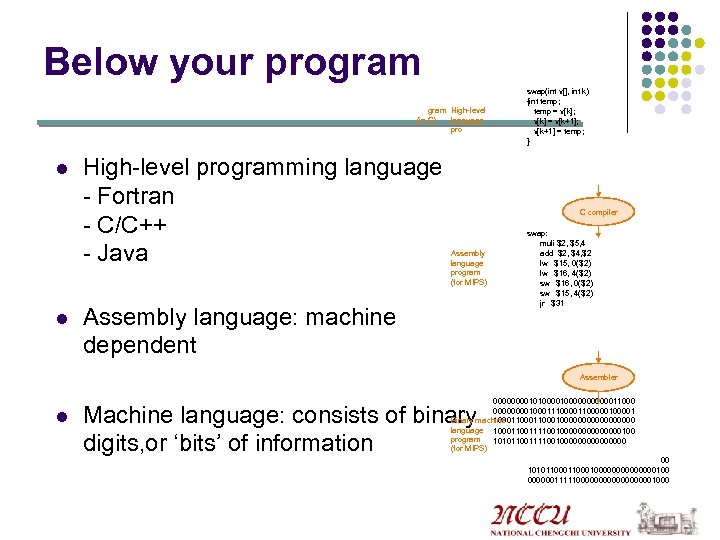 Below your program High-level (in C) language pro l l High-level programming language - Fortran - C/C++ - Java swap(int v[], int k) {int temp; temp = v[k]; v[k] = v[k+1]; v[k+1] = temp; } C compiler Assembly language program (for MIPS) Assembly language: machine dependent swap: muli $2, $5, 4 add $2, $4, $2 lw $15, 0($2) lw $16, 4($2) sw $16, 0($2) sw $15, 4($2) jr $31 Assembler l 0000101000000011000 0000100011100000100001 Binary machine 1000110000000000 language 100011110010000000100 program 10101100111100100000000 (for MIPS) Machine language: consists of binary digits, or ‘bits’ of information 00 10101100010000000100 000000111110000000001000
 Instruction Set Architecture l A very important abstraction l interface between hardware and low-level software l standardizes instructions, machine language bit patterns, etc. l Advantage: different implementations of the same architecture l Disadvantage: sometimes prevents using new innovations
 Modern instruction set architectures l l 80 x 86/Pentium/K 6, Power. PC, DEC Alpha, MIPS, SPARC, HP, IA-64 RISC vs. CISC architecture
 Where we are headed l l l l A specific instruction set architecture (Chapter 2) Arithmetic and how to build an ALU (Chapter 3) Assessing and understanding performance (Chapter 4) Constructing a processor to execute our instructions (Chapter 5) Pipelining to improve performance (Chapter 6) Memory: caches and virtual memory (Chapter 7) Storage, Networks, and Other Peripherals (Chapter 8) Multiprocessors (Chapter 9)
 Homework l l Read Chapter 1 of textbook. Download appropriate SPIM simulator for your computer.
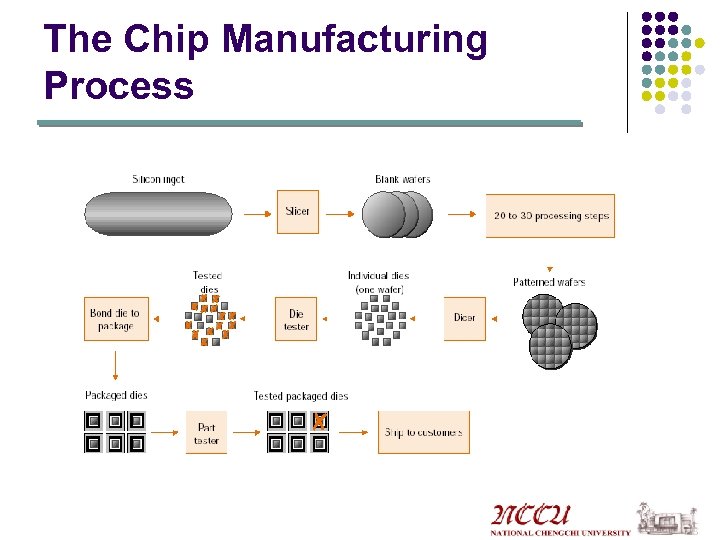 The Chip Manufacturing Process
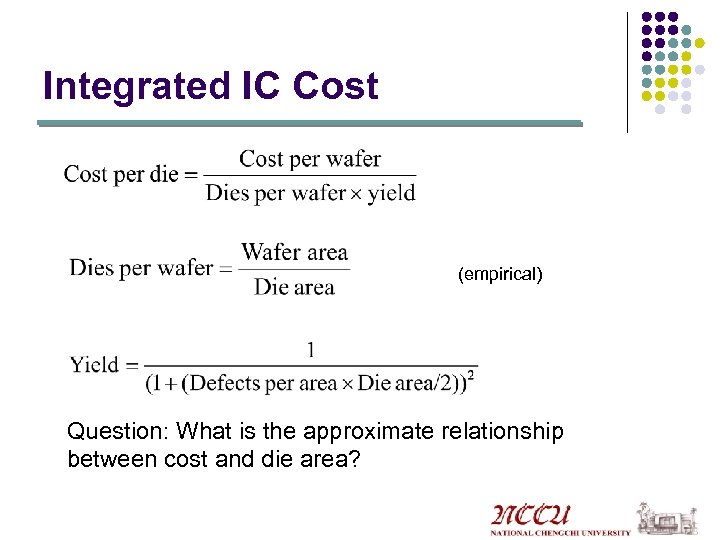 Integrated IC Cost (empirical) Question: What is the approximate relationship between cost and die area?