 Скачать презентацию Computational Methods in Astrophysics Dr Rob Thacker AT
816933eb2e66eb0ef757609a9107e0f3.ppt
- Количество слайдов: 31



Computational Methods in Astrophysics Dr Rob Thacker (AT 319 E) thacker@ap. smu. ca
Parallel Libraries/Toolkits n n BLACS Sca. LAPACK Higher level approaches like PETSc CACTUS
Netlib n The Netlib repository contains n n freely available software, documents, databases of interest to the numerical & scientific computing communities The repository is maintained by n n The collection is mirrored at several sites around the world n n AT&T Bell Laboratories University of Tennessee Oak Ridge National Laboratory Kept synchronized Effective search engine to help locate software of potential use
High Performance LINPACK n n Portable and freely available implementation of the LINPACK Benchmark – used for Top 500 ranking Developed at UTK Innovative Computing Laboratory n n HPL solves a (random) dense linear system in double precision (64 bits) arithmetic on distributed-memory computers n n n A. Petitet, R. C. Whaley, J. Dongarra, A. Cleary Requires MPI 1. 1 be installed Also requires an implementation of either the BLAS or the Vector Signal Image Processing Library VSIPL Provides a testing and timing program n Quantifies the accuracy of the obtained solution as well as the time it took to compute it
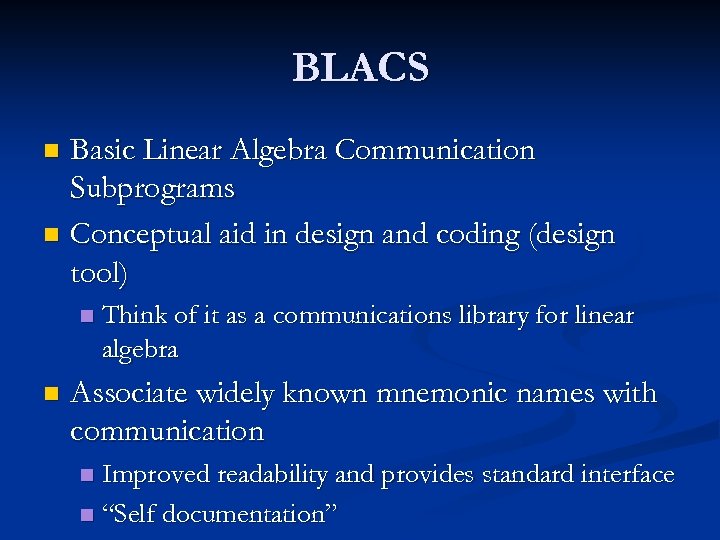
BLACS Basic Linear Algebra Communication Subprograms n Conceptual aid in design and coding (design tool) n n n Think of it as a communications library for linear algebra Associate widely known mnemonic names with communication Improved readability and provides standard interface n “Self documentation” n
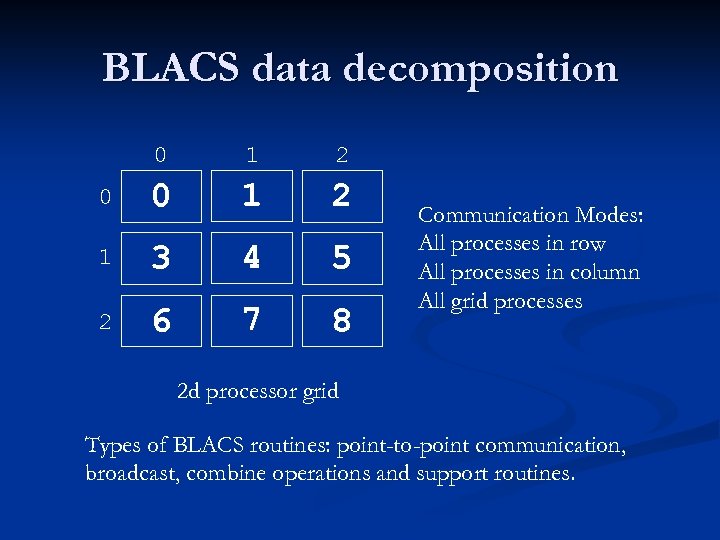
BLACS data decomposition 0 1 2 0 0 1 2 1 3 4 5 2 6 7 8 Communication Modes: All processes in row All processes in column All grid processes 2 d processor grid Types of BLACS routines: point-to-point communication, broadcast, combine operations and support routines.
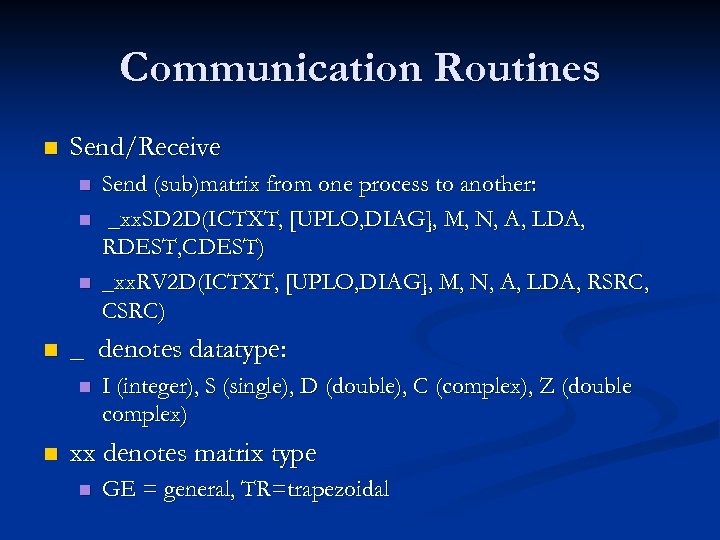
Communication Routines n Send/Receive n n _ denotes datatype: n n Send (sub)matrix from one process to another: _xx. SD 2 D(ICTXT, [UPLO, DIAG], M, N, A, LDA, RDEST, CDEST) _xx. RV 2 D(ICTXT, [UPLO, DIAG], M, N, A, LDA, RSRC, CSRC) I (integer), S (single), D (double), C (complex), Z (double complex) xx denotes matrix type n GE = general, TR=trapezoidal
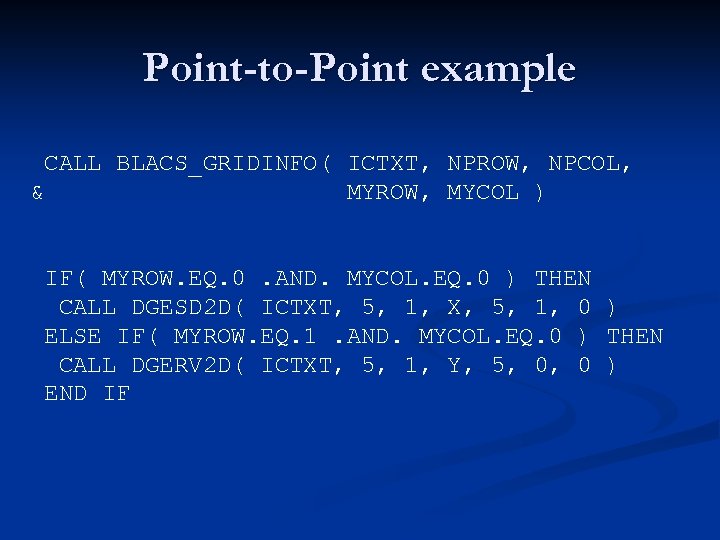
Point-to-Point example CALL BLACS_GRIDINFO( ICTXT, NPROW, NPCOL, & MYROW, MYCOL ) IF( MYROW. EQ. 0. AND. MYCOL. EQ. 0 ) THEN CALL DGESD 2 D( ICTXT, 5, 1, X, 5, 1, 0 ) ELSE IF( MYROW. EQ. 1. AND. MYCOL. EQ. 0 ) THEN CALL DGERV 2 D( ICTXT, 5, 1, Y, 5, 0, 0 ) END IF
Contexts n n The concept of a communicator is imbedded within BLACS as a “context” Contexts are thus the mechanism by which you: n n Create arbitrary groups of processes upon which to execute Create an indeterminate number of overlapping or disjoint grids Isolate each grid so that grids do not interfere with each other Initialization routines return a context (integer) which is then passed to the communication routines n Equivalent to specifying COMM in MPI calls
ID less communication n Messages with BLACS are tagless n n Why is this an issue? n n Generated internally within the library If tags are not unique it is possible to create not deterministic behaviour (have race conditions on message arrival) BLACS allows the user to specify what range of IDs can use n This ensures it can be used with other packages
Sca. LAPACK n n Scalable LAPACK Development team n n University of Tennessee University of California at Berkeley ORNL, Rice U. , UCLA, UIUC etc. Support in Commercial Packages n n Intel MKL and AMD ACML IBM PESSL CRAY Scientific Library +others
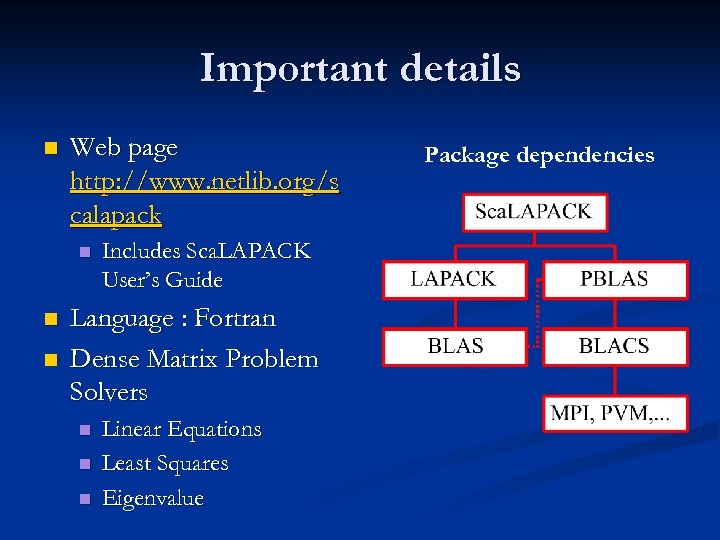
Important details n Web page http: //www. netlib. org/s calapack n n n Includes Sca. LAPACK User’s Guide Language : Fortran Dense Matrix Problem Solvers n n n Linear Equations Least Squares Eigenvalue Package dependencies
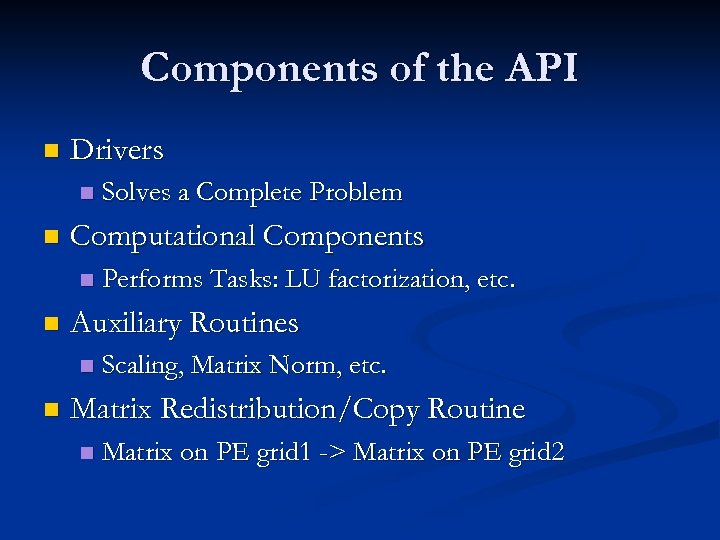
Components of the API n Drivers n n Computational Components n n Performs Tasks: LU factorization, etc. Auxiliary Routines n n Solves a Complete Problem Scaling, Matrix Norm, etc. Matrix Redistribution/Copy Routine n Matrix on PE grid 1 -> Matrix on PE grid 2
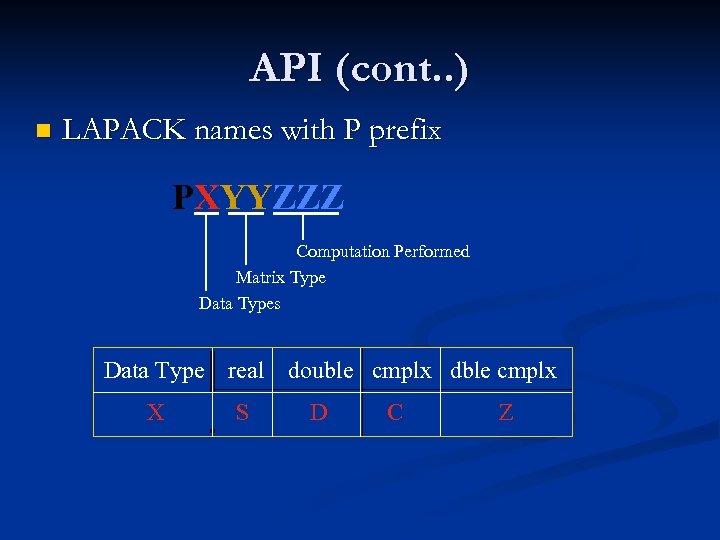
API (cont. . ) n LAPACK names with P prefix PXYYZZZ Computation Performed Matrix Type Data Types Data Type real X S double cmplx dble cmplx D C Z
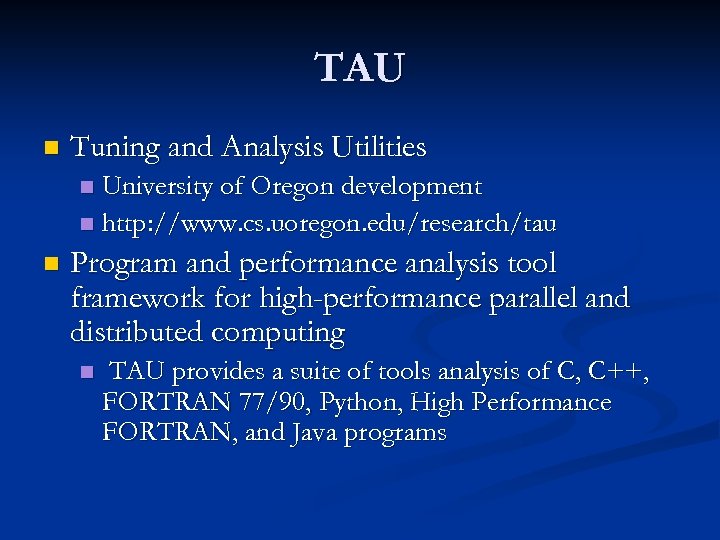
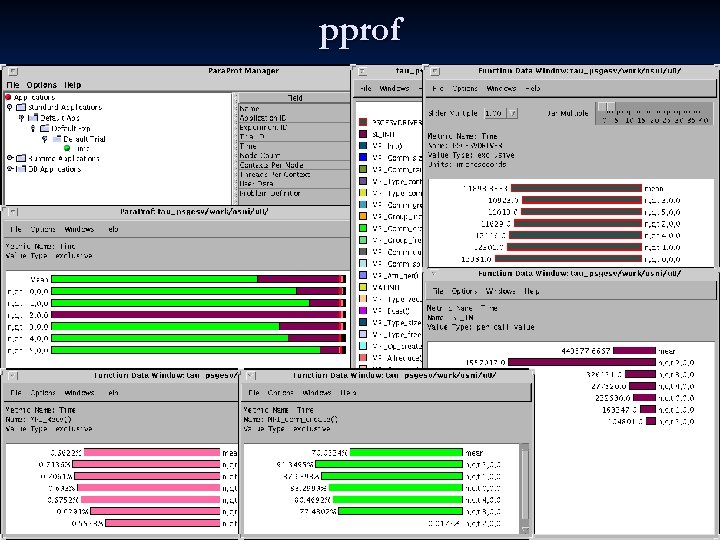
TAU n Tuning and Analysis Utilities University of Oregon development n http: //www. cs. uoregon. edu/research/tau n n Program and performance analysis tool framework for high-performance parallel and distributed computing n TAU provides a suite of tools analysis of C, C++, FORTRAN 77/90, Python, High Performance FORTRAN, and Java programs
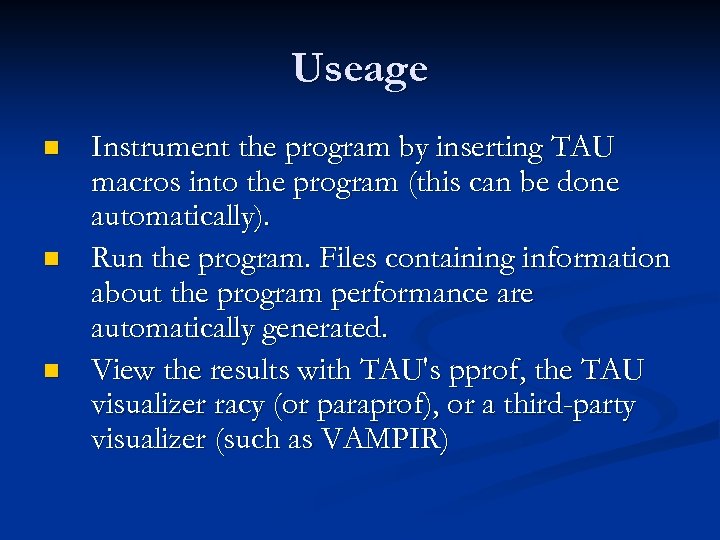
Useage n n n Instrument the program by inserting TAU macros into the program (this can be done automatically). Run the program. Files containing information about the program performance are automatically generated. View the results with TAU's pprof, the TAU visualizer racy (or paraprof), or a third-party visualizer (such as VAMPIR)
pprof
Additional facilities n TAU collects much more information than what is available through prof or gprof, the standard Unix utilities. Also available through TAU are: n n n n n Per-process, per-thread and per-host information (supports pthreads) Inclusive and exclusive function times Profiling groups that allow you to organize data collection Access to hardware counters on some systems Per-class and per-instance information Separate data for each template instantiation Start/stop timers for profiling arbitrary sections of code Support for collection of statistics on user-defined events TAU is designed so that when you turn off profiling (by disabling TAU macros) there is no overhead
PETSc n Portable, Extensible Toolkit for Scientific Computation n n Suite of data structures and routines for the scalable (parallel) solution of PDEs n n n https: //www. mcs. anl. gov/petsc/ Argonne lab development – used in 763 papers to date 20 years old! Approach must have good points! Intended for use in large-scale application projects Not a black box solution though Easily interfaces with solvers written in C, FORTRAN and C++ All components are designed to be interoperable Works in distributed memory environment using MPI
Levels of Abstraction in Mathematical Software n Application-specific interface n n Programmer manipulates objects associated with the application High-level mathematics interface n Programmer manipulates mathematical objects n n Algorithmic and discrete mathematics interface n PETSc emphasis Programmer manipulates mathematical objects n n Sparse matrices, nonlinear equations Programmer manipulates algorithmic objects n n Weak forms, boundary conditions, meshes Solvers Low-level computational kernels n n BLAS-type operations FFT
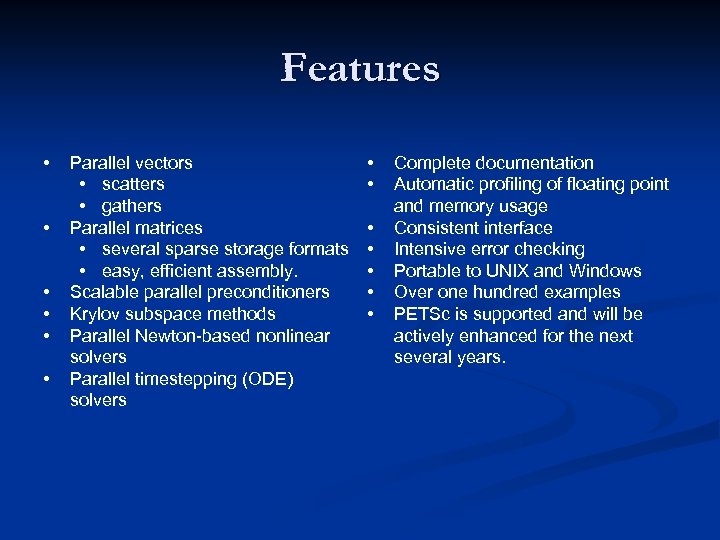
Features • • • Parallel vectors • scatters • gathers Parallel matrices • several sparse storage formats • easy, efficient assembly. Scalable parallel preconditioners Krylov subspace methods Parallel Newton-based nonlinear solvers Parallel timestepping (ODE) solvers • • Complete documentation Automatic profiling of floating point and memory usage Consistent interface Intensive error checking Portable to UNIX and Windows Over one hundred examples PETSc is supported and will be actively enhanced for the next several years.
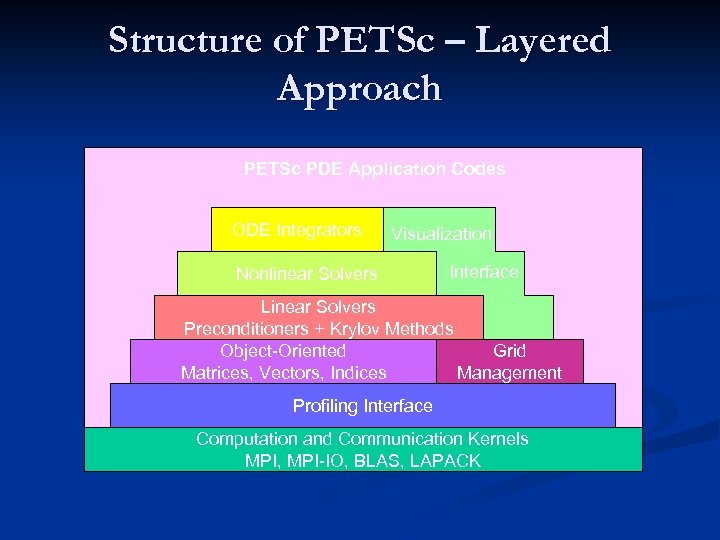
Structure of PETSc – Layered Approach PETSc PDE Application Codes ODE Integrators Visualization Nonlinear Solvers Interface Linear Solvers Preconditioners + Krylov Methods Object-Oriented Grid Matrices, Vectors, Indices Management Profiling Interface Computation and Communication Kernels MPI, MPI-IO, BLAS, LAPACK
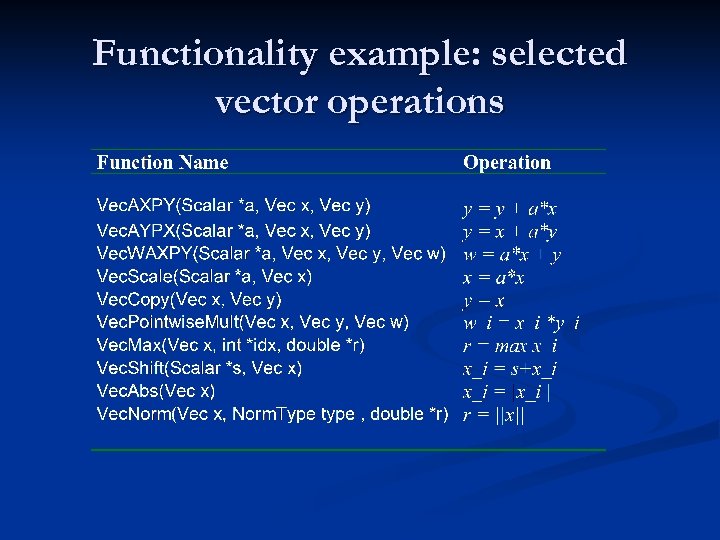
Functionality example: selected vector operations
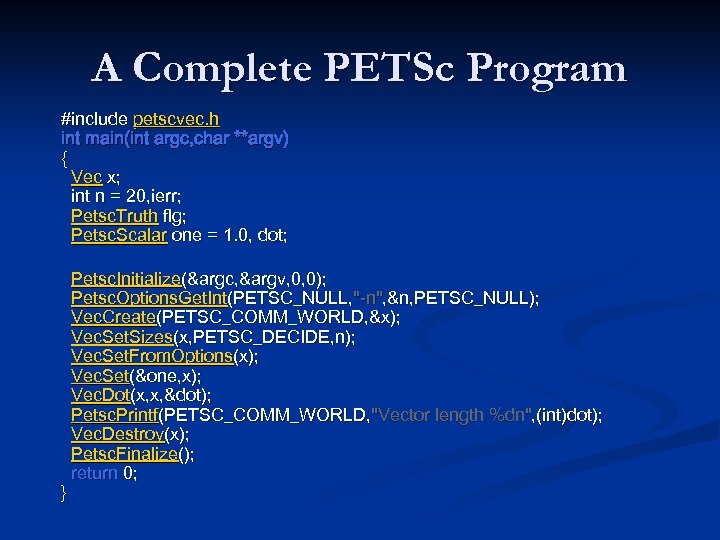
A Complete PETSc Program #include petscvec. h int main(int argc, char **argv) { Vec x; int n = 20, ierr; Petsc. Truth flg; Petsc. Scalar one = 1. 0, dot; } Petsc. Initialize(&argc, &argv, 0, 0); Petsc. Options. Get. Int(PETSC_NULL, "-n", &n, PETSC_NULL); Vec. Create(PETSC_COMM_WORLD, &x); Vec. Set. Sizes(x, PETSC_DECIDE, n); Vec. Set. From. Options(x); Vec. Set(&one, x); Vec. Dot(x, x, &dot); Petsc. Printf(PETSC_COMM_WORLD, "Vector length %dn", (int)dot); Vec. Destroy(x); Petsc. Finalize(); return 0;
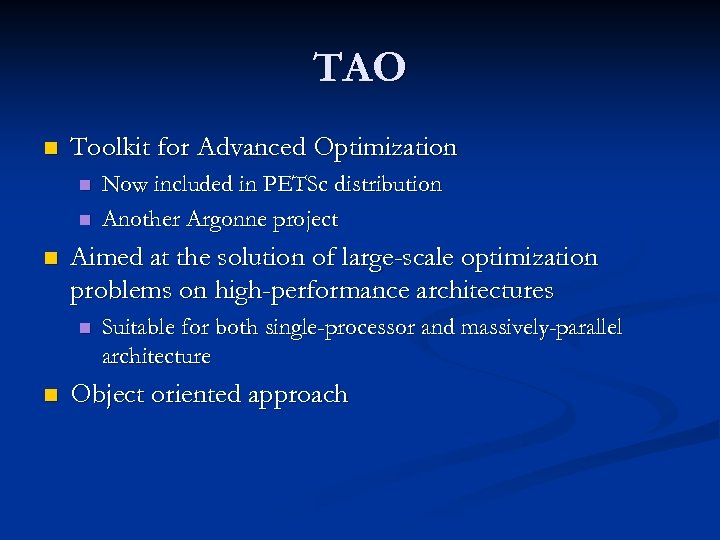
TAO n Toolkit for Advanced Optimization n Aimed at the solution of large-scale optimization problems on high-performance architectures n n Now included in PETSc distribution Another Argonne project Suitable for both single-processor and massively-parallel architecture Object oriented approach
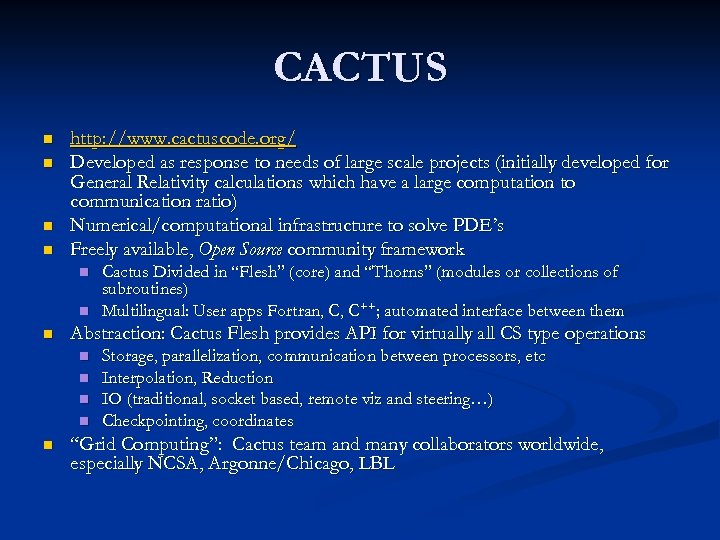
CACTUS n n http: //www. cactuscode. org/ Developed as response to needs of large scale projects (initially developed for General Relativity calculations which have a large computation to communication ratio) Numerical/computational infrastructure to solve PDE’s Freely available, Open Source community framework n n n Abstraction: Cactus Flesh provides API for virtually all CS type operations n n n Cactus Divided in “Flesh” (core) and “Thorns” (modules or collections of subroutines) Multilingual: User apps Fortran, C, C++; automated interface between them Storage, parallelization, communication between processors, etc Interpolation, Reduction IO (traditional, socket based, remote viz and steering…) Checkpointing, coordinates “Grid Computing”: Cactus team and many collaborators worldwide, especially NCSA, Argonne/Chicago, LBL
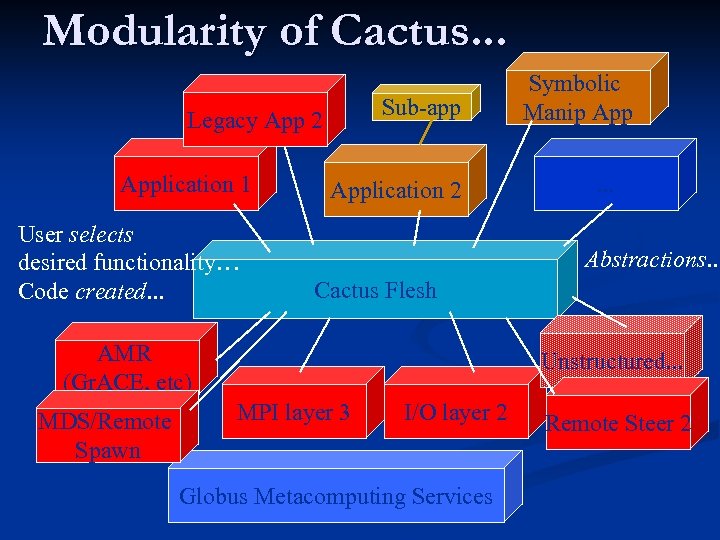
Modularity of Cactus. . . Sub-app Legacy App 2 Application 1 User selects desired functionality… Code created. . . Application 2 . . . Abstractions. . . Cactus Flesh AMR (Gr. ACE, etc) MDS/Remote Spawn Symbolic Manip App Unstructured. . . MPI layer 3 I/O layer 2 Globus Metacomputing Services Remote Steer 2
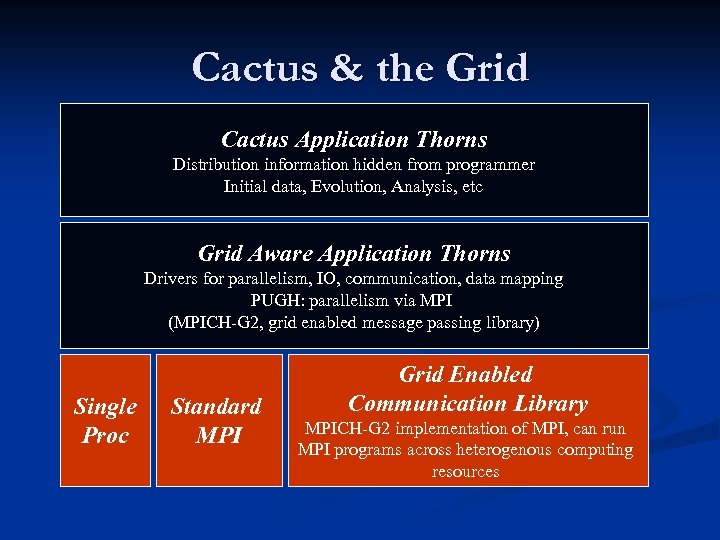
Cactus & the Grid Cactus Application Thorns Distribution information hidden from programmer Initial data, Evolution, Analysis, etc Grid Aware Application Thorns Drivers for parallelism, IO, communication, data mapping PUGH: parallelism via MPI (MPICH-G 2, grid enabled message passing library) Single Proc Standard MPI Grid Enabled Communication Library MPICH-G 2 implementation of MPI, can run MPI programs across heterogenous computing resources
The Flesh n n n Abstract API n evolve the same PDE with unigrid, AMR (MPI or shared memory, etc) without having to change any of the application code. Interfaces n set of data structures that a thorn exports to the world (global), to its friends (protected) and to nobody (private) and how these are inherited. Implementations n Different thorns may implement e. g. the evolution of the same PDE and we select the one we want at runtime. Scheduling n call in a certain order the routines of every thorn and how to handle their interdependencies. Parameters n many types of parameters and all of their essential consistency checked before running
VTK n The Visualization Toolkit n n Portable open-source software system for 3 D computer graphics, image processing, and visualization n n http: //public. kitware. com/VTK/what-is-vtk. php Object-oriented approach VTK is at a higher level of abstraction than rendering libraries like Open. GL VTK applications can be written directly in C++, Tcl, Java, or Python Large user community n Many source code contributions
Summary n n One interesting note – portability continues to be a real issue with the design of APIs at a higher level of abstraction If you want to do big linear algebra there are numerous well optimized libraries n n n Lots of knowledge out there too PDEs are also reasonably well supported within existing library frameworks – but variety of available solvers is always an issue Packages with strong utility seem to survive
Скачать презентацию Computational Methods in Astrophysics Dr Rob Thacker AT
816933eb2e66eb0ef757609a9107e0f3.ppt