


 Скачать презентацию Computational Head Modeling for Integrated High-Resolution Neuroimaging Allen
08fb0be3b00b60adf1b77d3941c89489.ppt
- Количество слайдов: 49
 Computational Head Modeling for Integrated High-Resolution Neuroimaging Allen D. Malony Department of Computer and Information Science Neuroinformatics Center University of Oregon
 New Euro and the G-20 Heads of State r r Global economic crisis G-20 meeting in London r Obama concerned with acceptance r Reaction from G-20 Heads of State Can not be just $ + € NSA-funded “hidden” study r Propose a global currency Based on Euro model “New Euro” (NEURO) Build computational models of Heads of G-20 Determine integrated response to NEURO imagining Can release findings today (properly cleared audience)
 Who Am I? r r r Professor, Dept. Computer and Information Science Director, Neuroinformatics Center University of Oregon Ph. D. , University of Illinois, Urbana-Champaign Fulbright Research Scholar (The Netherlands, Austria) Alexander von Humboldt Research Award National Science Foundation Young Investigator Research interests Parallel performance analysis, high-performance computing, scalable parallel software and tools Computational science, neuroinformatics
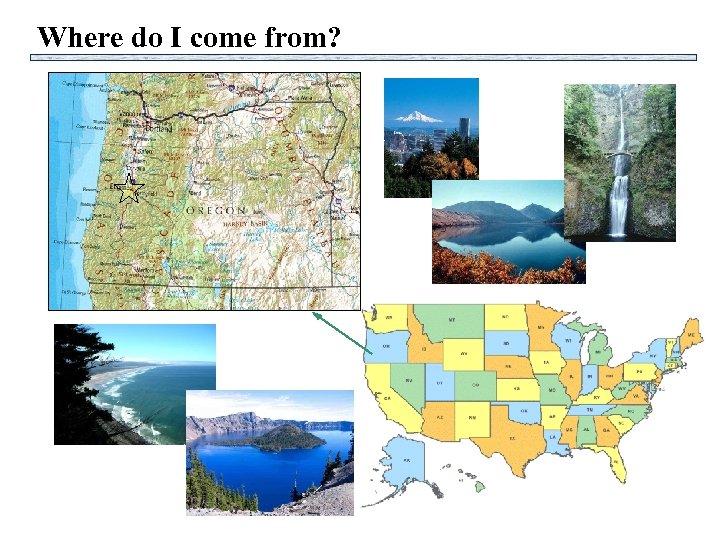 Where do I come from?
 Neuroscience and Neuroinformatics r r Understanding of brain organization and function Integration of information across many levels r Challenges in brain observation and modeling r r Physical and functional Gene to behavior Microscopic to macroscopic scales Structure and organization (imaging) Operational and functional dynamics (temporal/spatial) Physical, functional, and cognitive operation (models) Challenges in interpreting brain states and dynamics How to create and maintain of integrated views of the brain for both scientific and clinical purposes?
 Human Brain Dynamics Analysis Problem r Understand functional operation of the human cortex r Need for coupled/integrated modeling and analysis r Dynamic cortex activation Link to sensory/motor and cognitive activities Multiple experimental paradigms and methods Multiple research, clinical, and medical domains Multi-modal observation (electromagnetic, MR, optical) Physical brain models and theoretical cognitive models Need for robust tools Complex analysis of large multi-model data Reasoning and interpretation of brain behavior Problem solving environment for brain analysis
 Neuro. Informatics Center (NIC) at UO r Computational science applied to human neuroscience r Integration of neuroimaging methods and technology r Tools to help understand dynamic brain function Tools to help diagnosis brain-related disorders HPC simulation, complex data analysis, medical services Coupled measures and evaluation (EEG/MEG, MR, ERP) Advanced statistical signal analysis (PCA, ICA) Advanced image analysis (segmentation, anatomy) Computational head modeling (electromagnetics, FDM) Source localization modeling (dipole, linear inverse) Internet-based capabilities for brain analysis services, data archiving, and data mining
 NIC Organization r r r Allen D. Malony, Director Don M. Tucker, Associate Director Sergei Turovets, Computational Physicist Bob Frank, Senior Data Analyst Kai Li, Computer Scientist Chris Hoge, Computational Software Engineer Matt Sottile, Computer Scientist, CIS Department Dejing Dou, Computer Scientist, CIS Department Gwen Frishkoff, Neuro Scientist, Wisconsin Medical C. Brad Davidson, Systems administrator Adnan Salman, Ph. D. student, Computer Science Jason Sydes, Ph. D. student, Computer Science
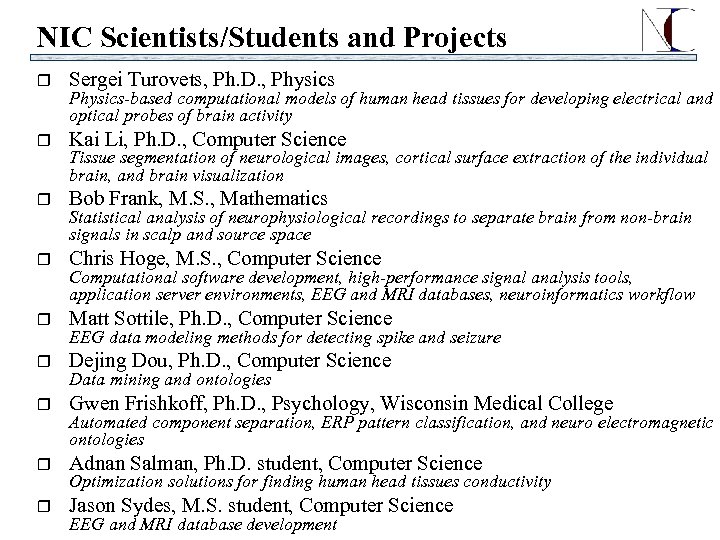 NIC Scientists/Students and Projects r Sergei Turovets, Ph. D. , Physics r Kai Li, Ph. D. , Computer Science r Bob Frank, M. S. , Mathematics r Chris Hoge, M. S. , Computer Science r Matt Sottile, Ph. D. , Computer Science r Dejing Dou, Ph. D. , Computer Science r Gwen Frishkoff, Ph. D. , Psychology, Wisconsin Medical College r Adnan Salman, Ph. D. student, Computer Science r Jason Sydes, M. S. student, Computer Science Physics-based computational models of human head tissues for developing electrical and optical probes of brain activity Tissue segmentation of neurological images, cortical surface extraction of the individual brain, and brain visualization Statistical analysis of neurophysiological recordings to separate brain from non-brain signals in scalp and source space Computational software development, high-performance signal analysis tools, application server environments, EEG and MRI databases, neuroinformatics workflow EEG data modeling methods for detecting spike and seizure Data mining and ontologies Automated component separation, ERP pattern classification, and neuro electromagnetic ontologies Optimization solutions for finding human head tissues conductivity EEG and MRI database development
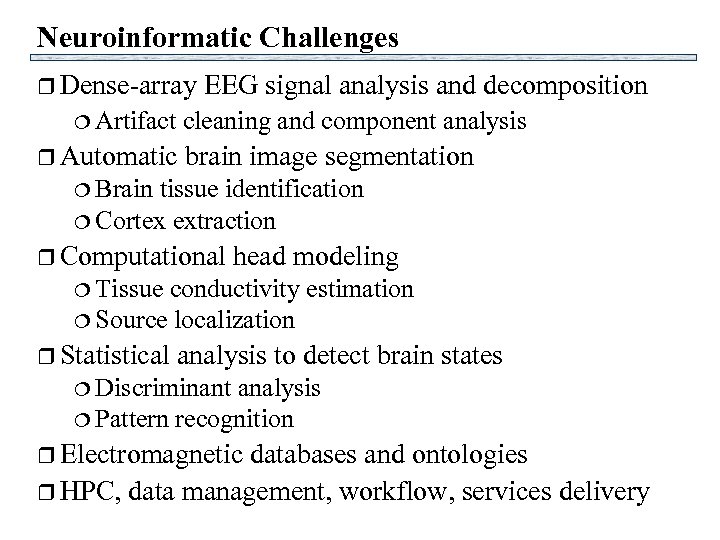 Neuroinformatic Challenges r Dense-array Artifact EEG signal analysis and decomposition cleaning and component analysis r Automatic brain image segmentation Brain tissue identification Cortex extraction r Computational head modeling Tissue conductivity estimation Source localization r Statistical analysis to detect brain states Discriminant analysis Pattern recognition r Electromagnetic databases and ontologies r HPC, data management, workflow, services delivery
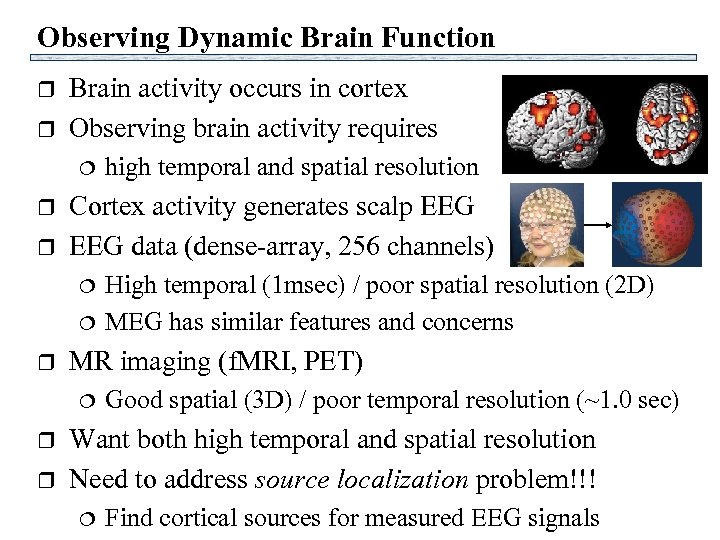 Observing Dynamic Brain Function r r Brain activity occurs in cortex Observing brain activity requires r r Cortex activity generates scalp EEG data (dense-array, 256 channels) r r High temporal (1 msec) / poor spatial resolution (2 D) MEG has similar features and concerns MR imaging (f. MRI, PET) r high temporal and spatial resolution Good spatial (3 D) / poor temporal resolution (~1. 0 sec) Want both high temporal and spatial resolution Need to address source localization problem!!! Find cortical sources for measured EEG signals
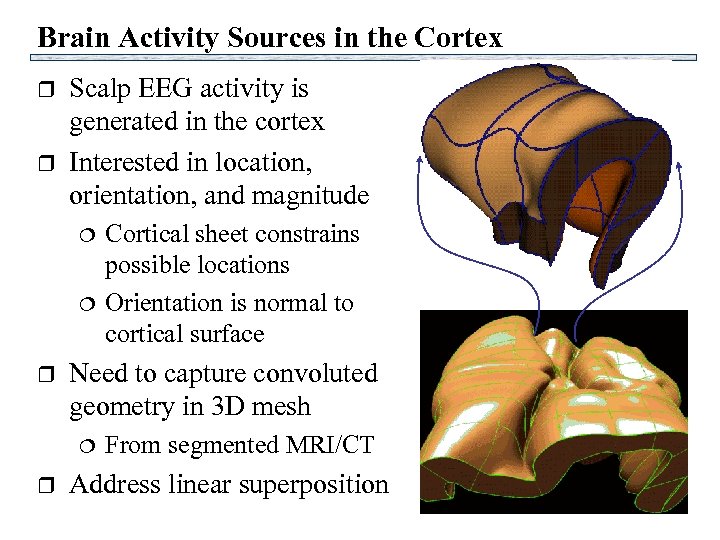 Brain Activity Sources in the Cortex r r Scalp EEG activity is generated in the cortex Interested in location, orientation, and magnitude r Need to capture convoluted geometry in 3 D mesh r Cortical sheet constrains possible locations Orientation is normal to cortical surface From segmented MRI/CT Address linear superposition
 Source Localization r Mapping of scalp potentials to cortical generators r Signal decomposition (addressing superposition) Anatomical source modeling (localization) Source modeling Anatomical constraints Accurate head model and physics Computational head model formulation Mathematical constraints Criteria r (e. g. , smoothness, coherence) to constrain solution Current solutions limited by Simplistic geometry Assumptions of conductivities
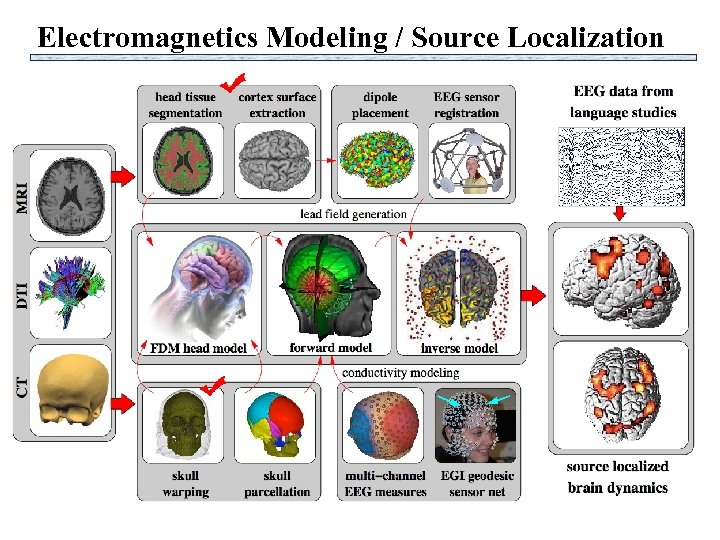
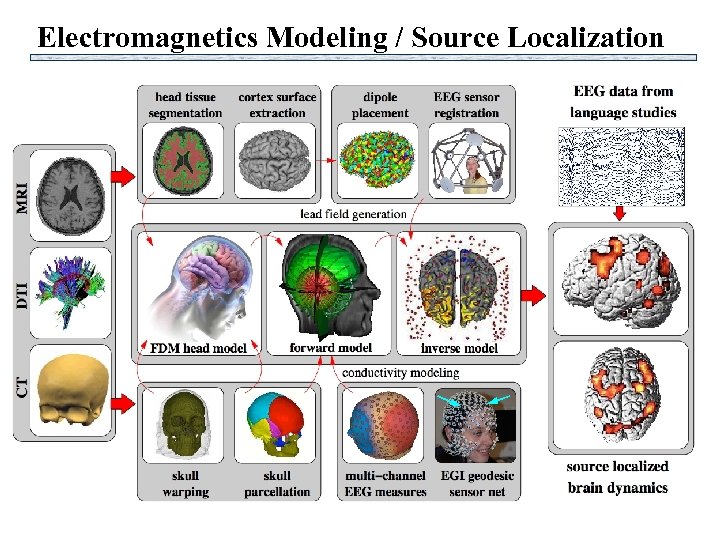 Electromagnetics Modeling / Source Localization
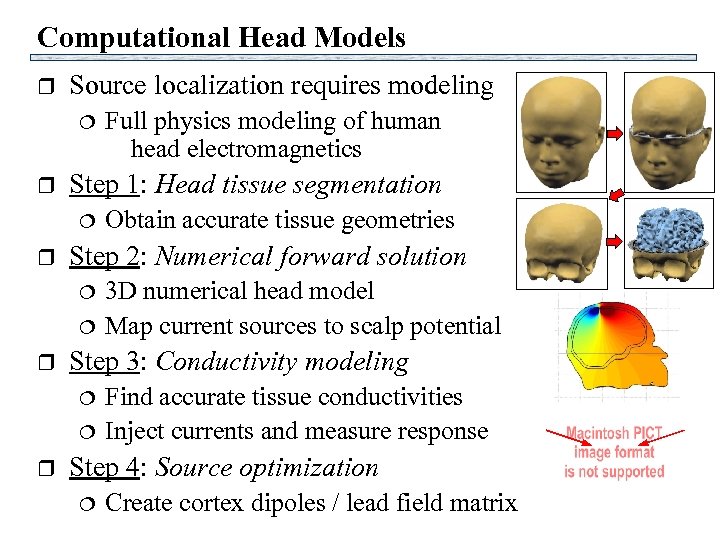 Computational Head Models r Source localization requires modeling r Step 1: Head tissue segmentation r 3 D numerical head model Map current sources to scalp potential Step 3: Conductivity modeling r Obtain accurate tissue geometries Step 2: Numerical forward solution r Full physics modeling of human head electromagnetics Find accurate tissue conductivities Inject currents and measure response Step 4: Source optimization Create cortex dipoles / lead field matrix
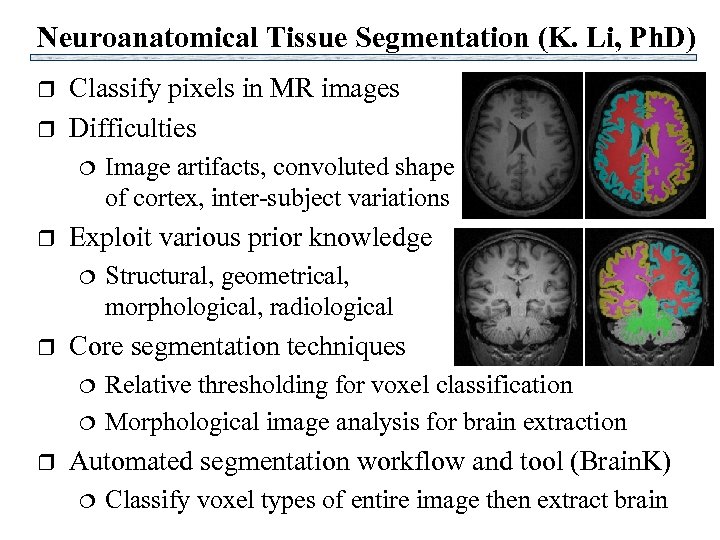 Neuroanatomical Tissue Segmentation (K. Li, Ph. D) r r Classify pixels in MR images Difficulties r Exploit various prior knowledge r Structural, geometrical, morphological, radiological Core segmentation techniques r Image artifacts, convoluted shape of cortex, inter-subject variations Relative thresholding for voxel classification Morphological image analysis for brain extraction Automated segmentation workflow and tool (Brain. K) Classify voxel types of entire image then extract brain
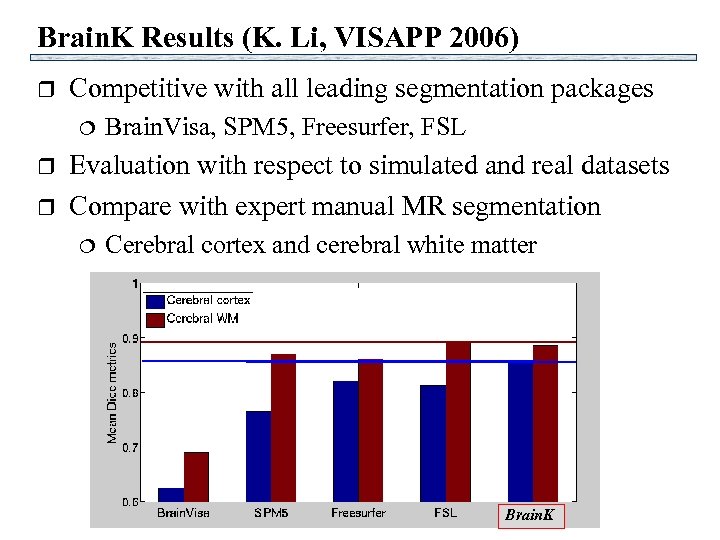 Brain. K Results (K. Li, VISAPP 2006) r Competitive with all leading segmentation packages r r Brain. Visa, SPM 5, Freesurfer, FSL Evaluation with respect to simulated and real datasets Compare with expert manual MR segmentation Cerebral cortex and cerebral white matter Brain. K
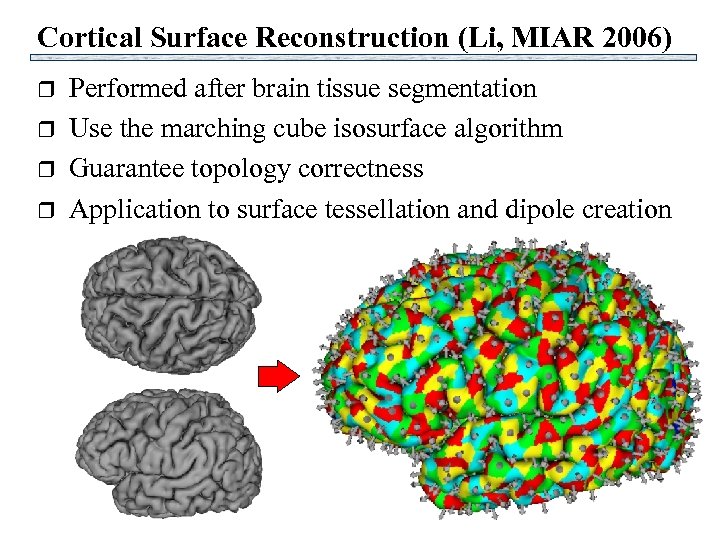 Cortical Surface Reconstruction (Li, MIAR 2006) r r Performed after brain tissue segmentation Use the marching cube isosurface algorithm Guarantee topology correctness Application to surface tessellation and dipole creation
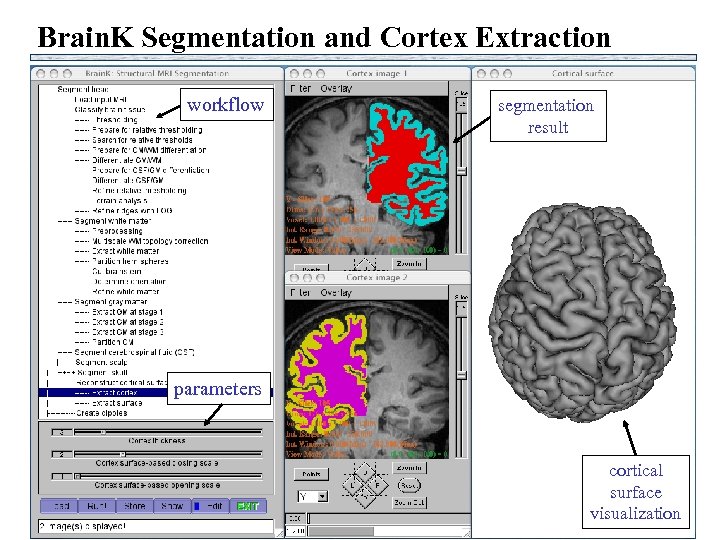 Brain. K Segmentation and Cortex Extraction workflow segmentation result parameters cortical surface visualization
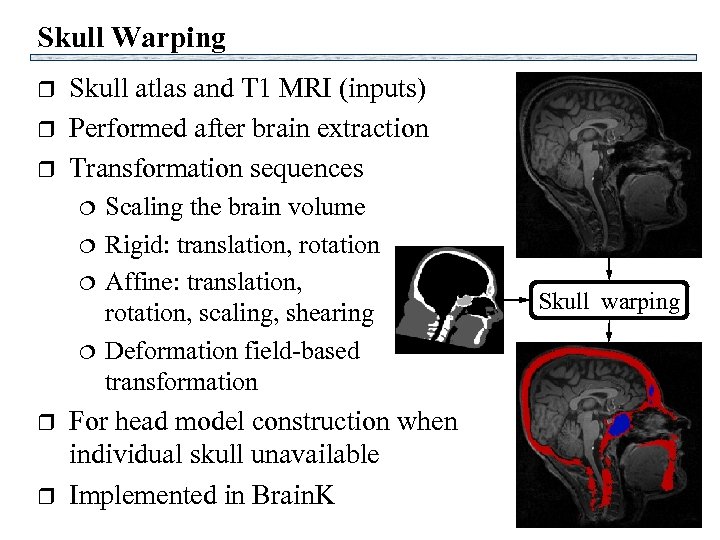 Skull Warping r r r Skull atlas and T 1 MRI (inputs) Performed after brain extraction Transformation sequences r r Scaling the brain volume Rigid: translation, rotation Affine: translation, rotation, scaling, shearing Deformation field-based transformation For head model construction when individual skull unavailable Implemented in Brain. K Skull warping
 Electromagnetics Modeling / Source Localization
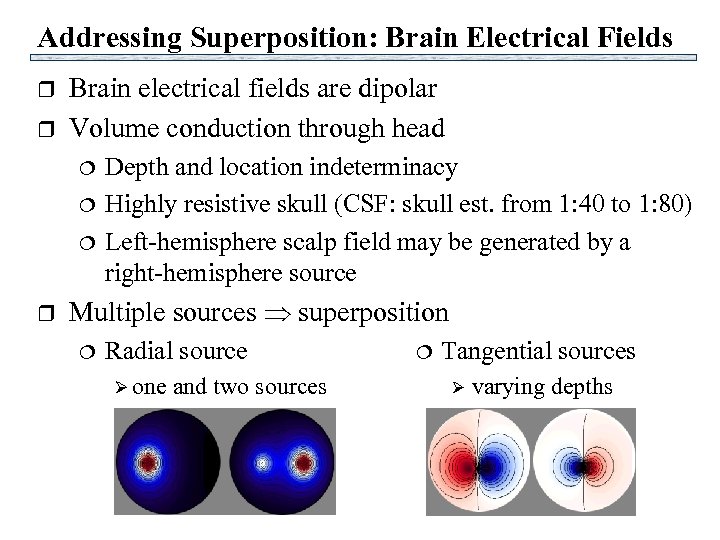 Addressing Superposition: Brain Electrical Fields r r Brain electrical fields are dipolar Volume conduction through head r Depth and location indeterminacy Highly resistive skull (CSF: skull est. from 1: 40 to 1: 80) Left-hemisphere scalp field may be generated by a right-hemisphere source Multiple sources superposition Radial source one and two sources Tangential sources varying depths
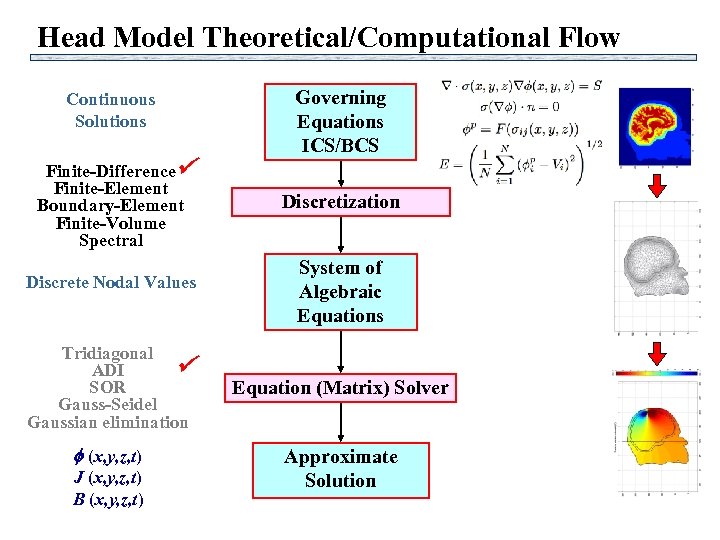 Head Model Theoretical/Computational Flow Continuous Solutions Finite-Difference Finite-Element Boundary-Element Finite-Volume Spectral Discrete Nodal Values Tridiagonal ADI SOR Gauss-Seidel Gaussian elimination (x, y, z, t) J (x, y, z, t) B (x, y, z, t) Governing Equations ICS/BCS Discretization System of Algebraic Equations Equation (Matrix) Solver Approximate Solution
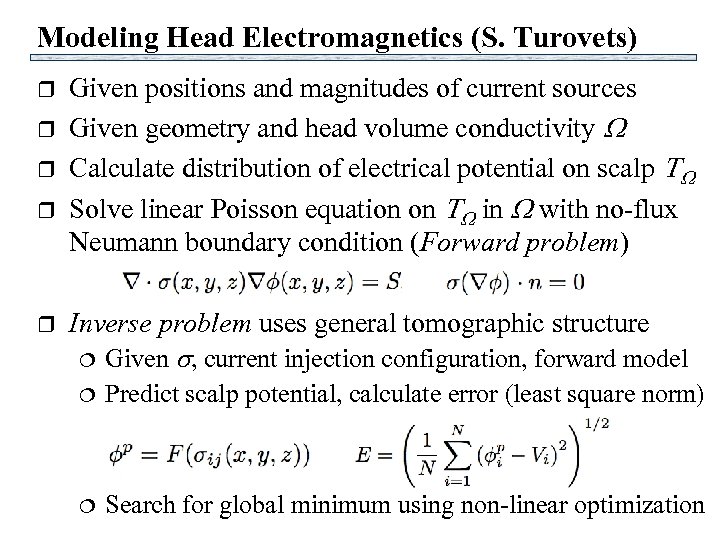 Modeling Head Electromagnetics (S. Turovets) r r r Given positions and magnitudes of current sources Given geometry and head volume conductivity Calculate distribution of electrical potential on scalp Solve linear Poisson equation on in with no-flux Neumann boundary condition (Forward problem) Inverse problem uses general tomographic structure Given , current injection configuration, forward model Predict scalp potential, calculate error (least square norm) Search for global minimum using non-linear optimization
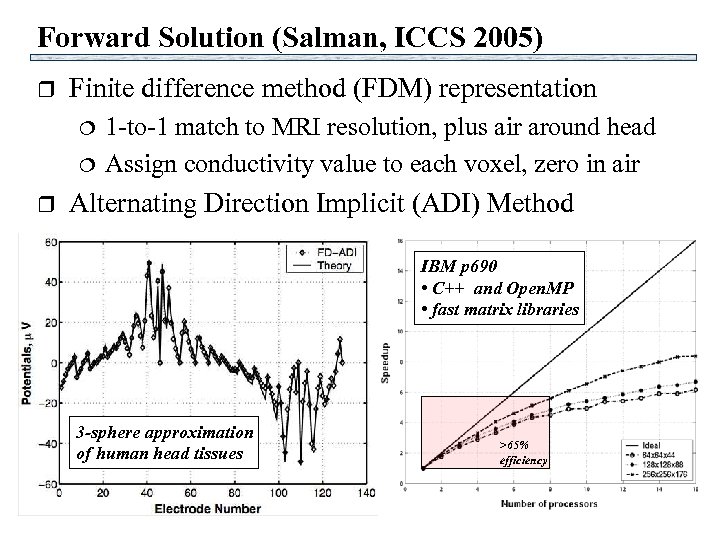 Forward Solution (Salman, ICCS 2005) r Finite difference method (FDM) representation r 1 -to-1 match to MRI resolution, plus air around head Assign conductivity value to each voxel, zero in air Alternating Direction Implicit (ADI) Method IBM p 690 • C++ and Open. MP • fast matrix libraries 3 -sphere approximation of human head tissues >65% efficiency
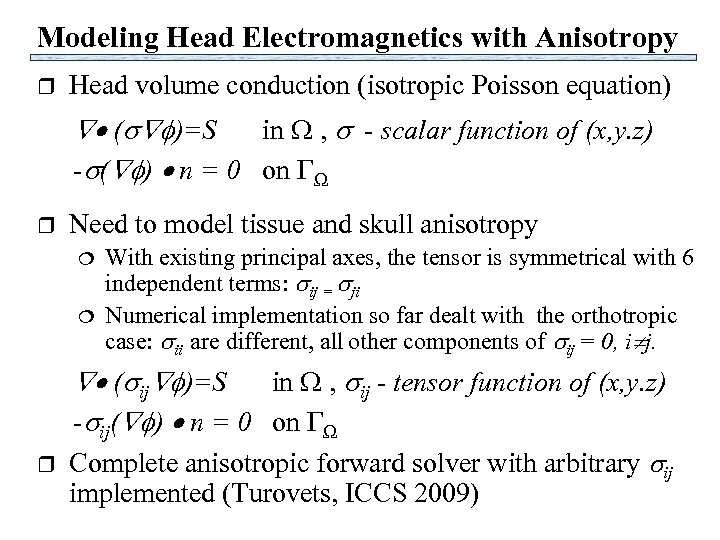 Modeling Head Electromagnetics with Anisotropy r Head volume conduction (isotropic Poisson equation) ( )=S in , - scalar function of (x, y. z) - ( ) n = 0 on r Need to model tissue and skull anisotropy With existing principal axes, the tensor is symmetrical with 6 independent terms: ij = ji Numerical implementation so far dealt with the orthotropic case: ii are different, all other components of ij = 0, i j. ( ij )=S in , ij - tensor function of (x, y. z) - ij( ) n = 0 on r Complete anisotropic forward solver with arbitrary ij implemented (Turovets, ICCS 2009)
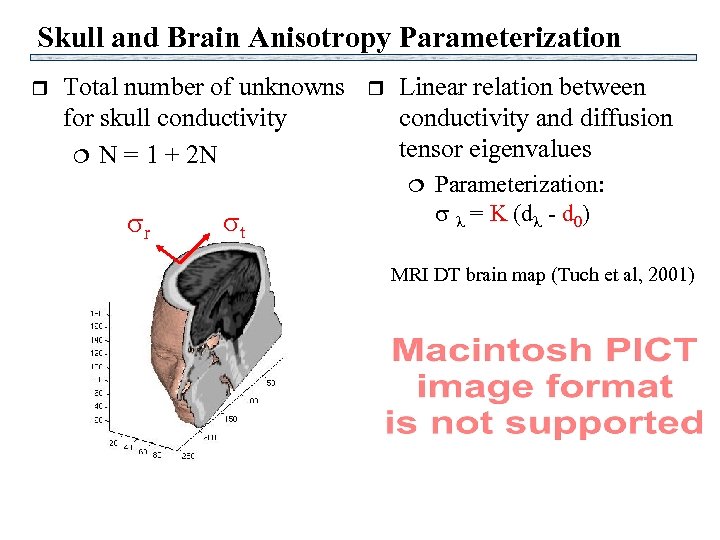 Skull and Brain Anisotropy Parameterization r Total number of unknowns for skull conductivity N = 1 + 2 N r Linear relation between conductivity and diffusion tensor eigenvalues r t Parameterization: = K (d - d 0) MRI DT brain map (Tuch et al, 2001)
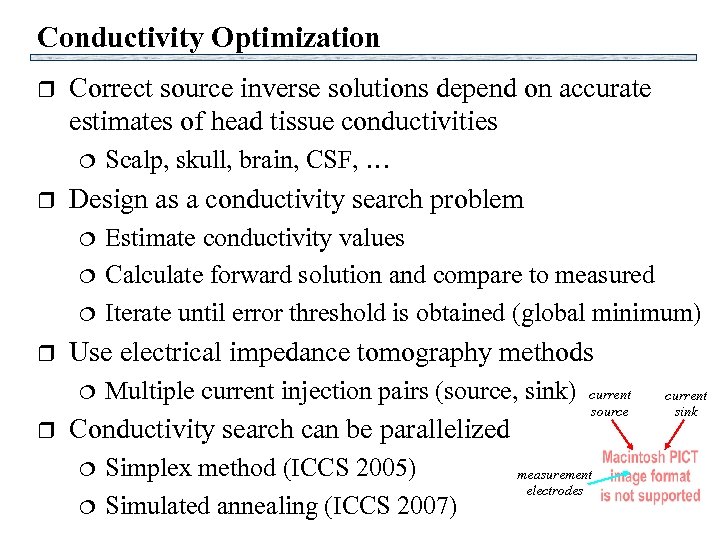 Conductivity Optimization r Correct source inverse solutions depend on accurate estimates of head tissue conductivities r Design as a conductivity search problem r Estimate conductivity values Calculate forward solution and compare to measured Iterate until error threshold is obtained (global minimum) Use electrical impedance tomography methods r Scalp, skull, brain, CSF, … Multiple current injection pairs (source, sink) Conductivity search can be parallelized Simplex method (ICCS 2005) Simulated annealing (ICCS 2007) current source measurement electrodes current sink
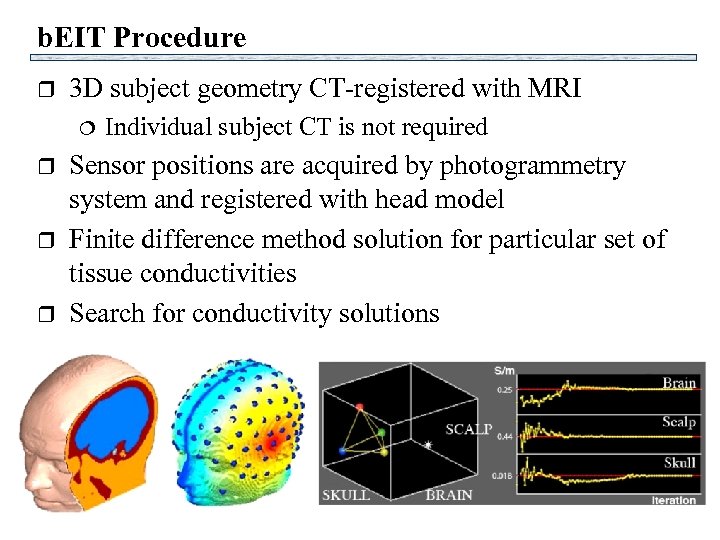 b. EIT Procedure r 3 D subject geometry CT-registered with MRI r r r Individual subject CT is not required Sensor positions are acquired by photogrammetry system and registered with head model Finite difference method solution for particular set of tissue conductivities Search for conductivity solutions
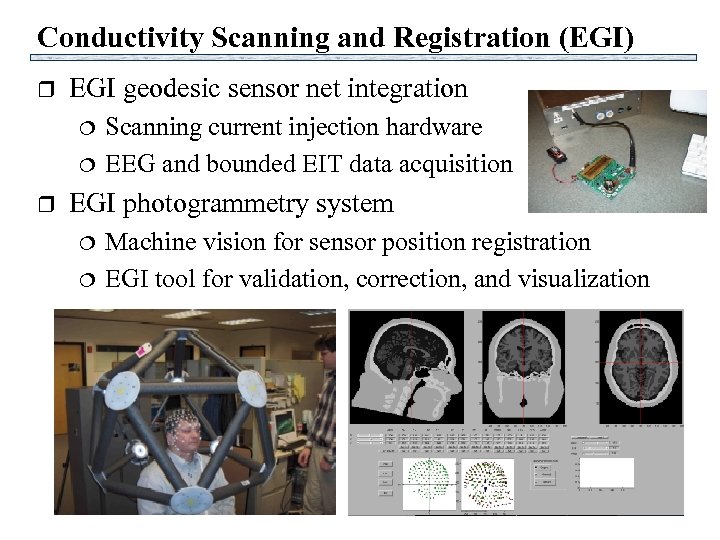 Conductivity Scanning and Registration (EGI) r EGI geodesic sensor net integration r Scanning current injection hardware EEG and bounded EIT data acquisition EGI photogrammetry system Machine vision for sensor position registration EGI tool for validation, correction, and visualization
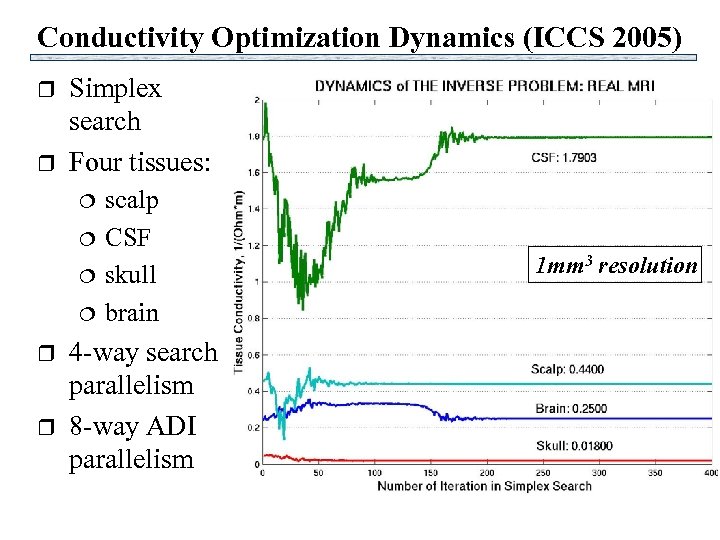 Conductivity Optimization Dynamics (ICCS 2005) r r Simplex search Four tissues: r r scalp CSF skull brain 4 -way search parallelism 8 -way ADI parallelism 1 mm 3 resolution
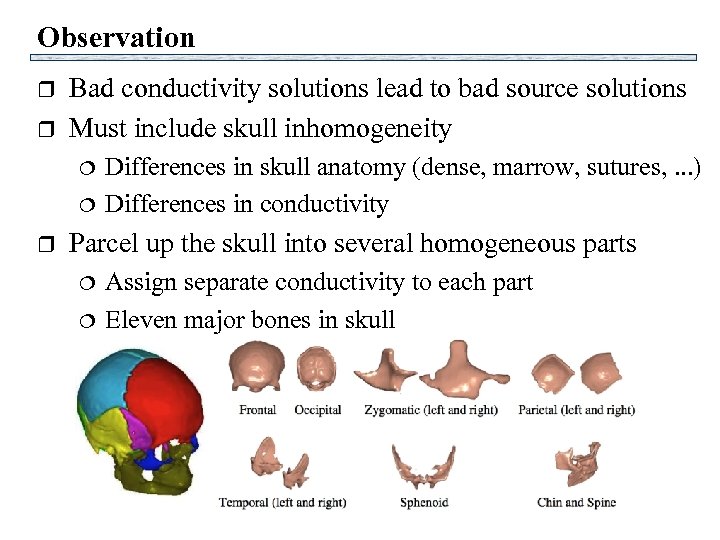 Observation r r Bad conductivity solutions lead to bad source solutions Must include skull inhomogeneity r Differences in skull anatomy (dense, marrow, sutures, . . . ) Differences in conductivity Parcel up the skull into several homogeneous parts Assign separate conductivity to each part Eleven major bones in skull
 Conductivity Search Complexity (ICCS 2007) r r r Mores tissues to model increases search complexity Number of parameters in the inverse solver increase Simplex search reaches performance limits quickly r r Switch to simulated annealing for search optimization Include skull inhomogeneity r Forward and inverse solution Validate with 13 preset conductivity values r 5 tissues: fails to converge in a practical time 6 tissues: fails to converge at all! 11 skull, CSF, scalp, brain SA is finds 11 head tissues successfully
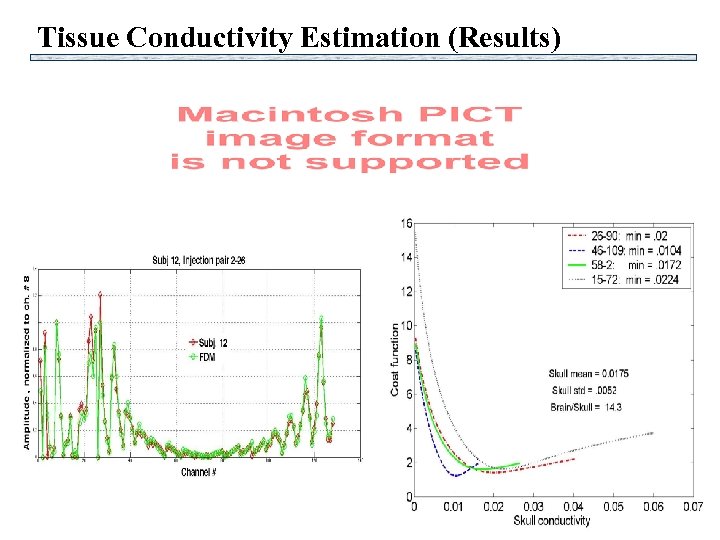 Tissue Conductivity Estimation (Results)
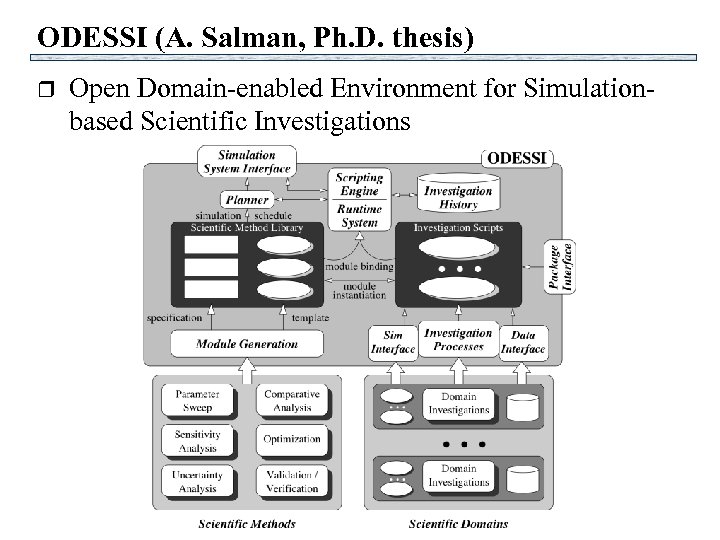 ODESSI (A. Salman, Ph. D. thesis) r Open Domain-enabled Environment for Simulationbased Scientific Investigations
 Domain Problems in Neuroscience for ODESSI r Scientific investigations Verification forward and inverse solvers (4 -shell sphere) grid convergence, time step, special step Validation phantoms, Uncertainty and sensitivity analysis sensor r animal experiments, data from surgery position, injected current, tissue conductivities, … Parameter sweep Optimization, extract optimal parameters to fit the data Comparative analysis Data management Geometry MRI/CT, current injection, results
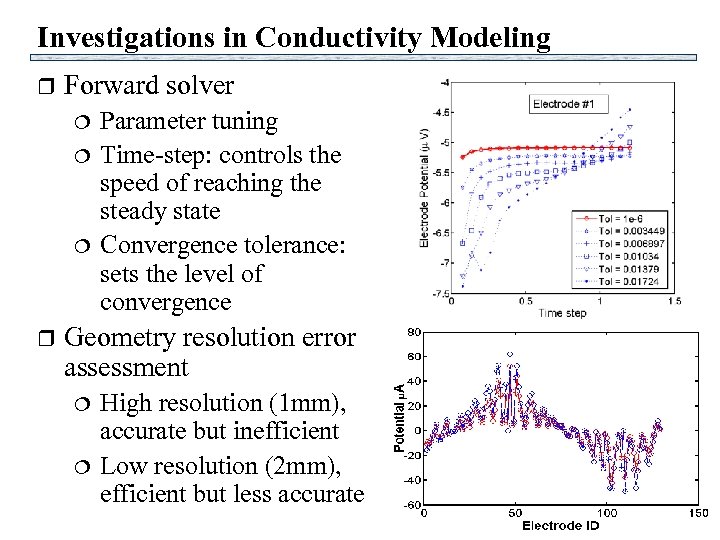 Investigations in Conductivity Modeling r Forward solver r Parameter tuning Time-step: controls the speed of reaching the steady state Convergence tolerance: sets the level of convergence Geometry resolution error assessment High resolution (1 mm), accurate but inefficient Low resolution (2 mm), efficient but less accurate
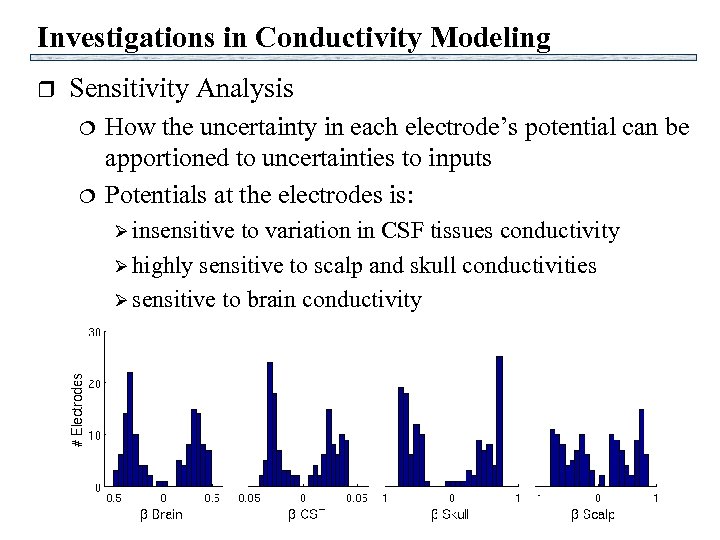 Investigations in Conductivity Modeling r Sensitivity Analysis How the uncertainty in each electrode’s potential can be apportioned to uncertainties to inputs Potentials at the electrodes is: insensitive to variation in CSF tissues conductivity highly sensitive to scalp and skull conductivities sensitive to brain conductivity
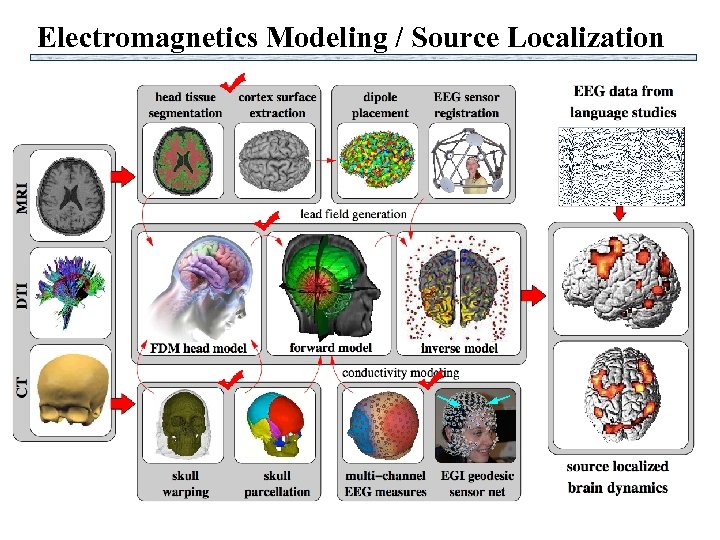 Electromagnetics Modeling / Source Localization
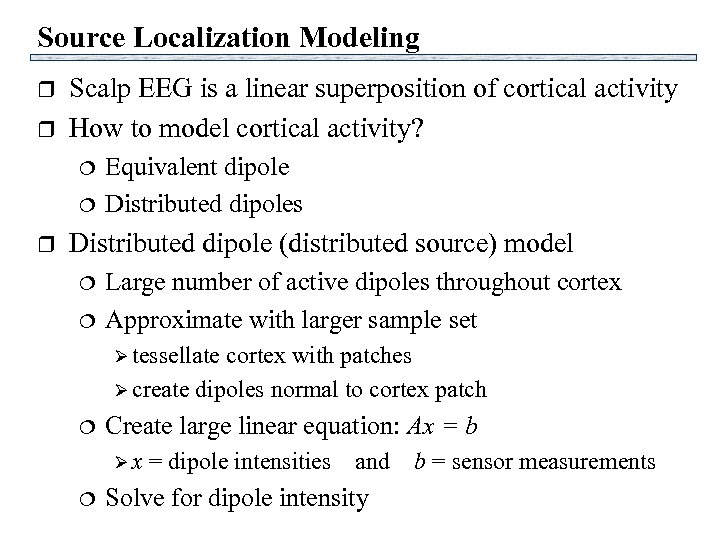 Source Localization Modeling r r Scalp EEG is a linear superposition of cortical activity How to model cortical activity? r Equivalent dipole Distributed dipoles Distributed dipole (distributed source) model Large number of active dipoles throughout cortex Approximate with larger sample set tessellate cortex with patches create dipoles normal to cortex patch Create large linear equation: Ax = b x = dipole intensities and Solve for dipole intensity b = sensor measurements
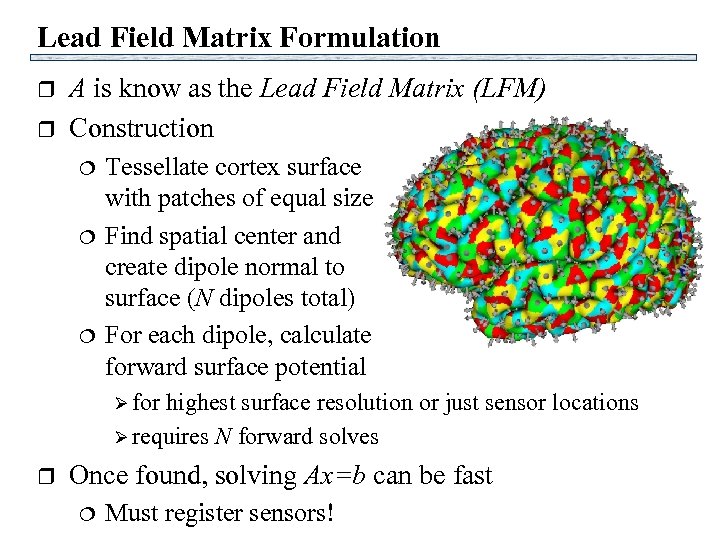 Lead Field Matrix Formulation r r A is know as the Lead Field Matrix (LFM) Construction Tessellate cortex surface with patches of equal size Find spatial center and create dipole normal to surface (N dipoles total) For each dipole, calculate forward surface potential for highest surface resolution or just sensor locations requires N forward solves r Once found, solving Ax=b can be fast Must register sensors!
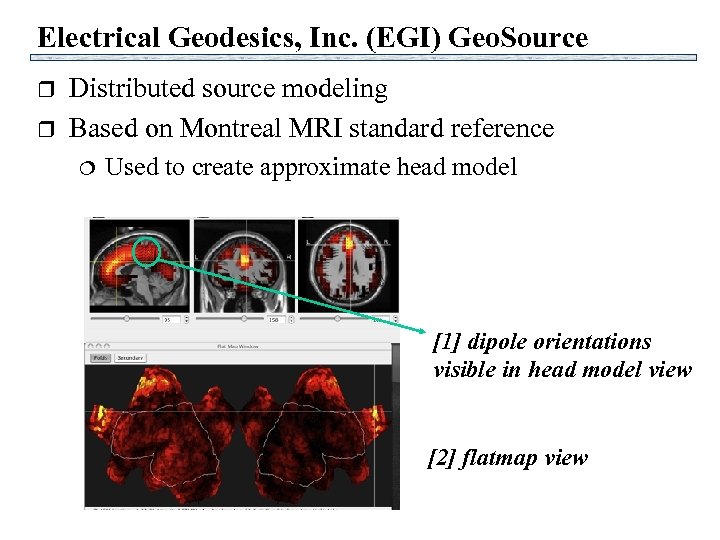 Electrical Geodesics, Inc. (EGI) Geo. Source r r Distributed source modeling Based on Montreal MRI standard reference Used to create approximate head model [1] dipole orientations visible in head model view [2] flatmap view
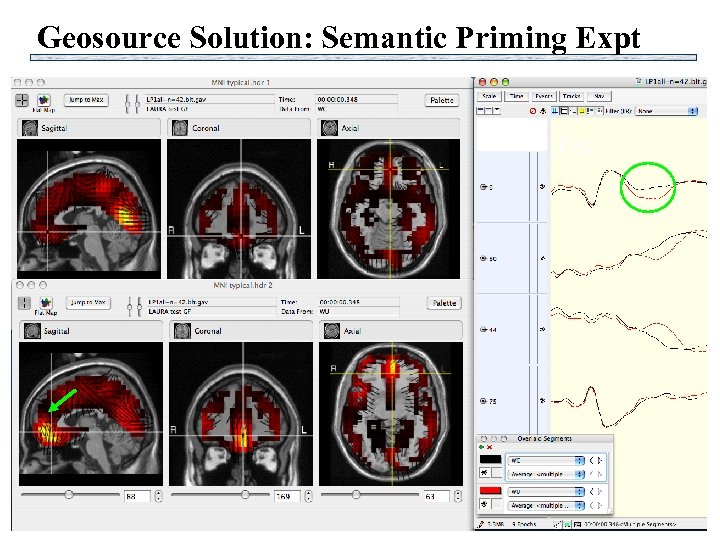 Geosource Solution: Semantic Priming Expt Fcz
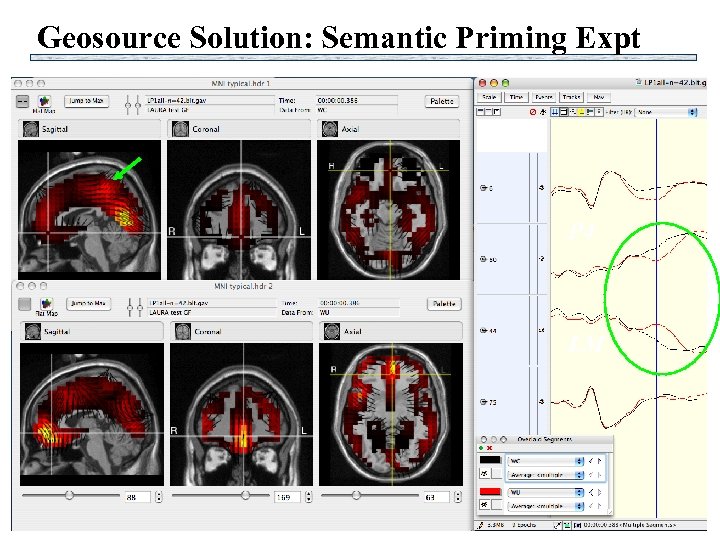 Geosource Solution: Semantic Priming Expt P 4 LM
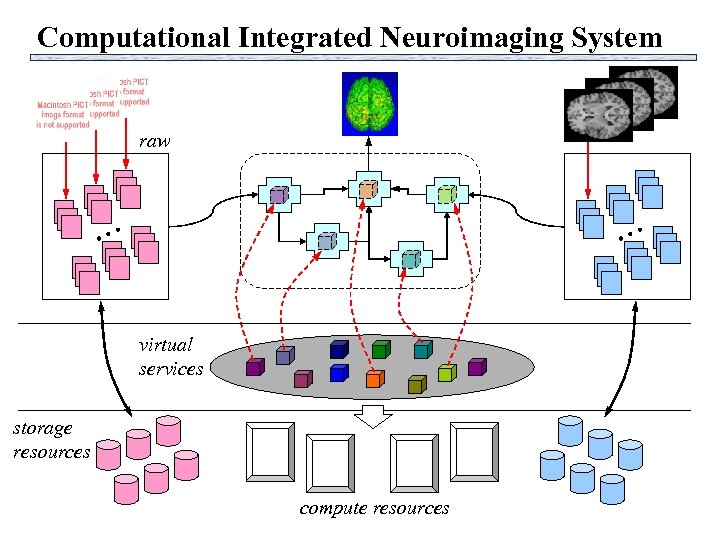 Computational Integrated Neuroimaging System raw … … virtual services storage resources compute resources
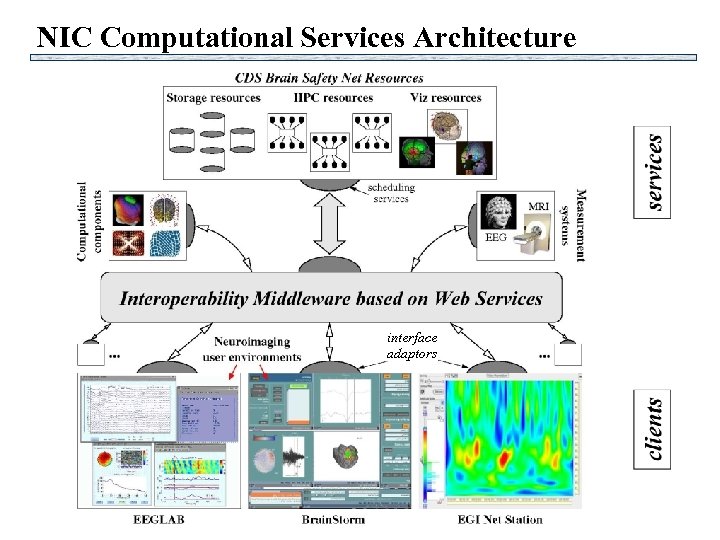 NIC Computational Services Architecture interface adaptors
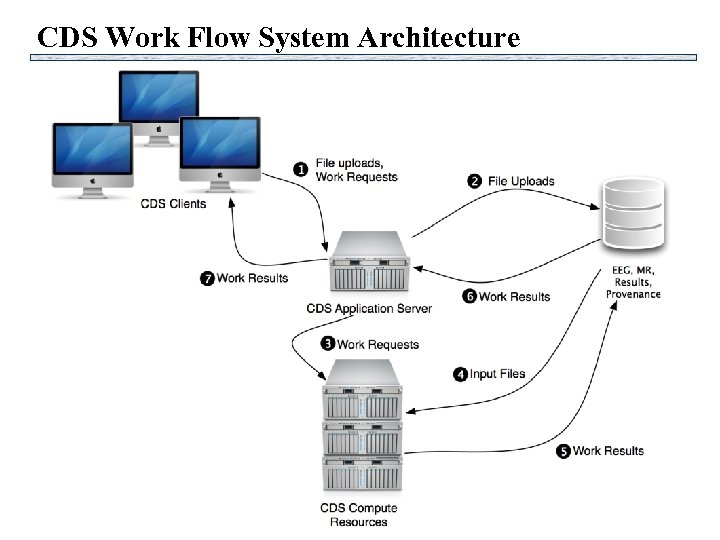 CDS Work Flow System Architecture
 Papers r r r r A. Salman, S. Turovets, A. Malony, J. Eriksen, and D. Tucker, “Computational Modeling of Human Head Conductivity, ” International Conference on Computational Science (ICCS), May 2005. (Best paper) A. Salman, S. Turovets, A. Malony, V. Vasilov, “Multi-Cluster, Mixed-Mode Computational Modeling of Human Head Conductivity, ” International Workshop on Open. MP (IWOMP), June 2005. K. Li, A. Malony, and D. Tucker, “Automatic Brain MR Image Segmentation with Relative Thresholding and Morphological Image Analysis, ” International Conference on Computer Vision Theory and Applications (VISAPP), Setúbal, Portugal, February 2006. K. Li, A. Malony, and D. Tucker, “A Multiscale Morphological Approach to Topology Correction of Cortical Surfaces, ” International Workshop on Medical Imaging and Augmented Reality (MIAR 2006), August 2006. S. Turovets, A. Salman, A. Malony, P. Poolman, C. Davey, D. Tucker, “Anatomically Constrained Conductivity Estimation of the Human Head in Vivo: Computational Procedure and Preliminary Experiments, ” Electrical Impedance Tomography (EIT), July 2006. A. Salman, A. Malony, S. Turovets, and D. Tucker, “Parallel Simulated Annealing for Computational Modeling of Human Head Conductivity, ” International Conference on Computational Science (ICCS), May 2007. (Best paper) P. Poolman, R. Frank, and S. Turovets. “Modified Lock-in Detection for Extraction of Impressed EEG Signals in Low Frequency Bounded-EIT Studies of the Human Head, ” International Congress on Image and Signal Processing (CISP), Vol. 1 , pp. 174183, 2008.
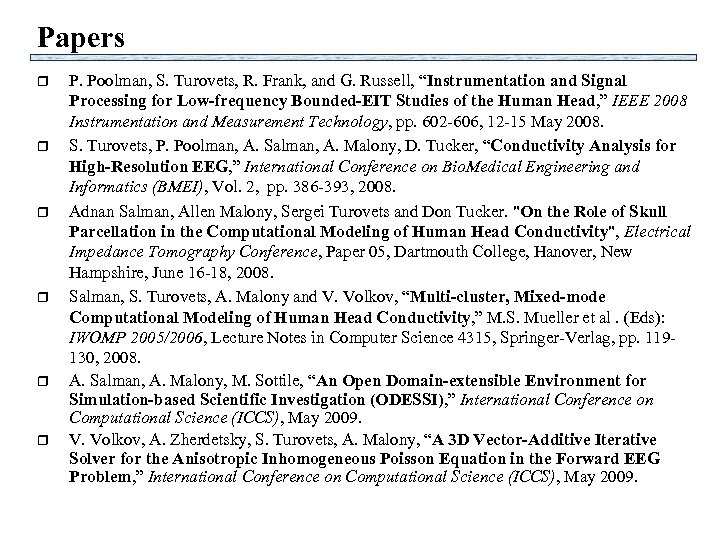 Papers r r r P. Poolman, S. Turovets, R. Frank, and G. Russell, “Instrumentation and Signal Processing for Low-frequency Bounded-EIT Studies of the Human Head, ” IEEE 2008 Instrumentation and Measurement Technology, pp. 602 -606, 12 -15 May 2008. S. Turovets, P. Poolman, A. Salman, A. Malony, D. Tucker, “Conductivity Analysis for High-Resolution EEG, ” International Conference on Bio. Medical Engineering and Informatics (BMEI), Vol. 2, pp. 386 -393, 2008. Adnan Salman, Allen Malony, Sergei Turovets and Don Tucker. "On the Role of Skull Parcellation in the Computational Modeling of Human Head Conductivity", Electrical Impedance Tomography Conference, Paper 05, Dartmouth College, Hanover, New Hampshire, June 16 -18, 2008. Salman, S. Turovets, A. Malony and V. Volkov, “Multi-cluster, Mixed-mode Computational Modeling of Human Head Conductivity, ” M. S. Mueller et al. (Eds): IWOMP 2005/2006, Lecture Notes in Computer Science 4315, Springer-Verlag, pp. 119130, 2008. A. Salman, A. Malony, M. Sottile, “An Open Domain-extensible Environment for Simulation-based Scientific Investigation (ODESSI), ” International Conference on Computational Science (ICCS), May 2009. V. Volkov, A. Zherdetsky, S. Turovets, A. Malony, “A 3 D Vector-Additive Iterative Solver for the Anisotropic Inhomogeneous Poisson Equation in the Forward EEG Problem, ” International Conference on Computational Science (ICCS), May 2009.