


 Скачать презентацию Computational Geometry and Spatial Data Mining Marc van
d647b8c7f60c9e15637a5c82578036ab.ppt
- Количество слайдов: 88
 Computational Geometry and Spatial Data Mining Marc van Kreveld Department of Information and Computing Sciences Utrecht University
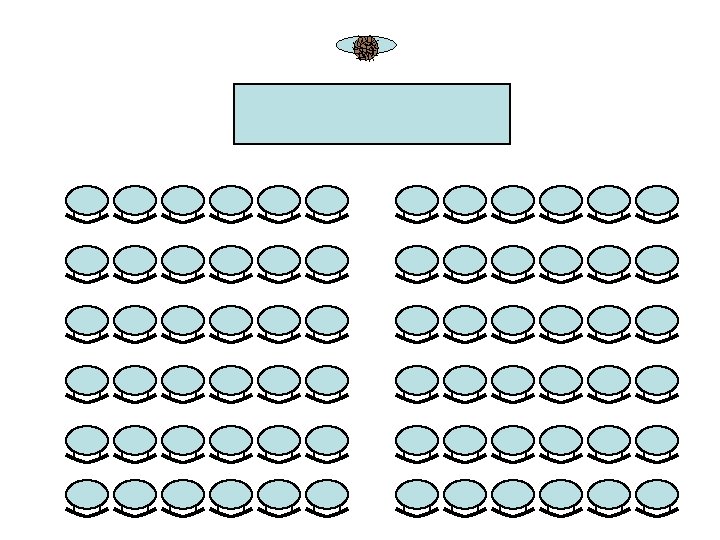
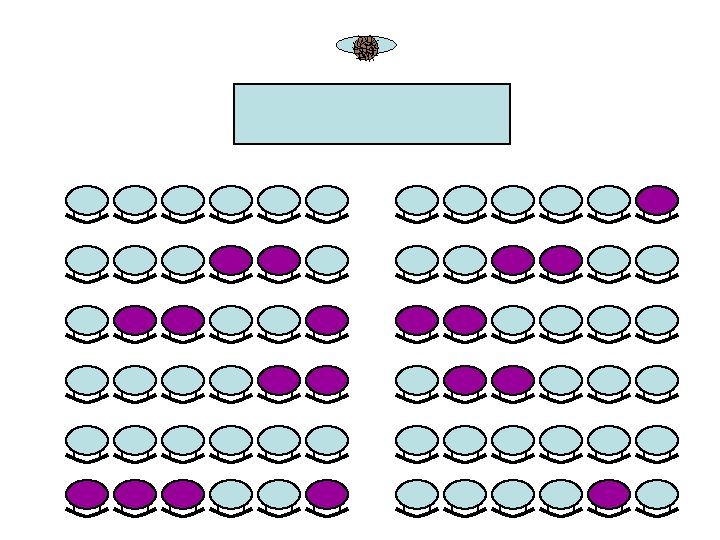
 Clustering? • Are the people clustered in this room? How do we define a cluster? • In spatial data mining we have objects/ entities with a location given by coordinates • Cluster definitions involve distance between locations
 Clustering - options • • Determine whether clustering occurs Determine the degree of clustering Determine the clusters Determine the largest cluster • Determine the outliers
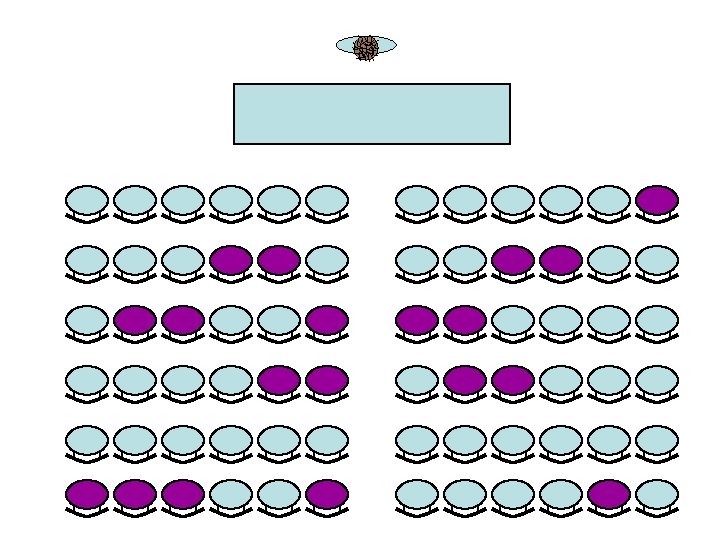
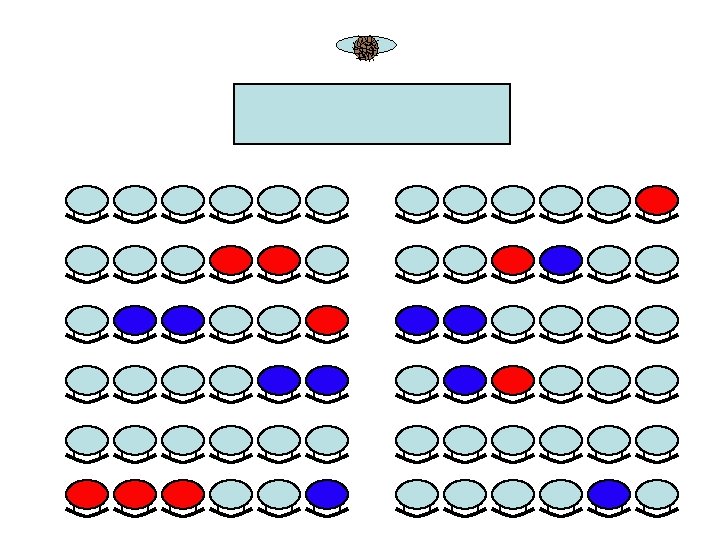
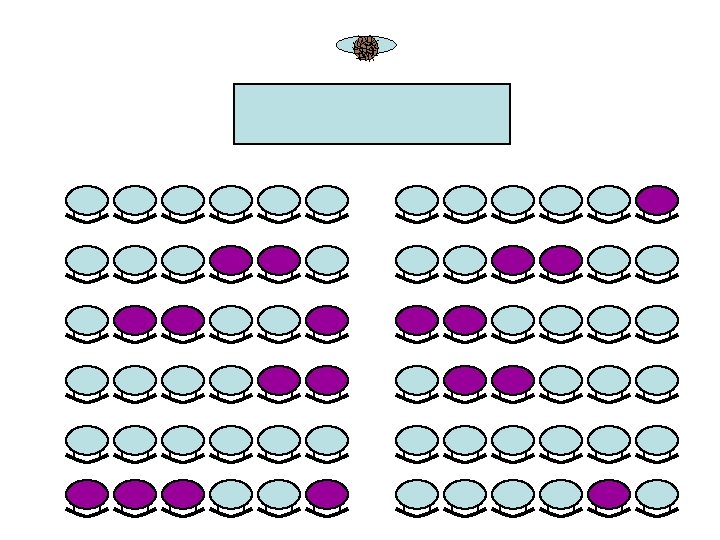
 Co-location • Are the men clustered? • Are the women clustered? • Is there a co-location of men and women?
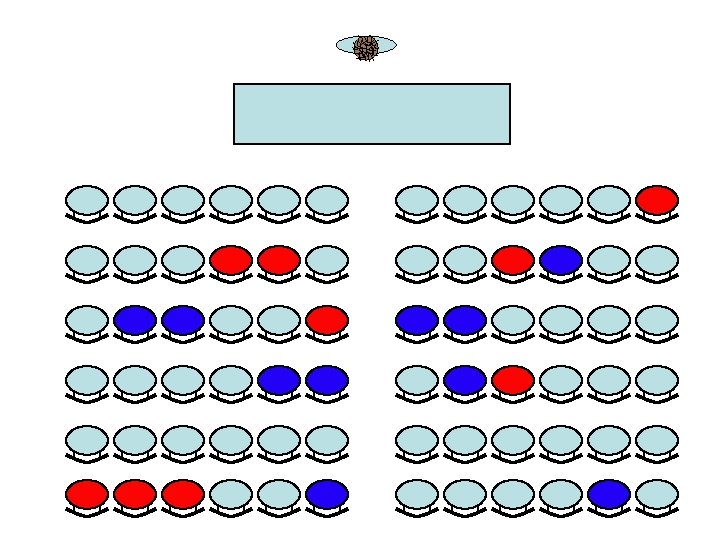
 Co-location • Like before, we may be interested in – is there co-location? – the degree of co-location – the largest co-location – the co-locations themselves – the objects not involved in co-location
 Spatio-temporal data • Locations have a time stamp • Interesting patterns involve space and time
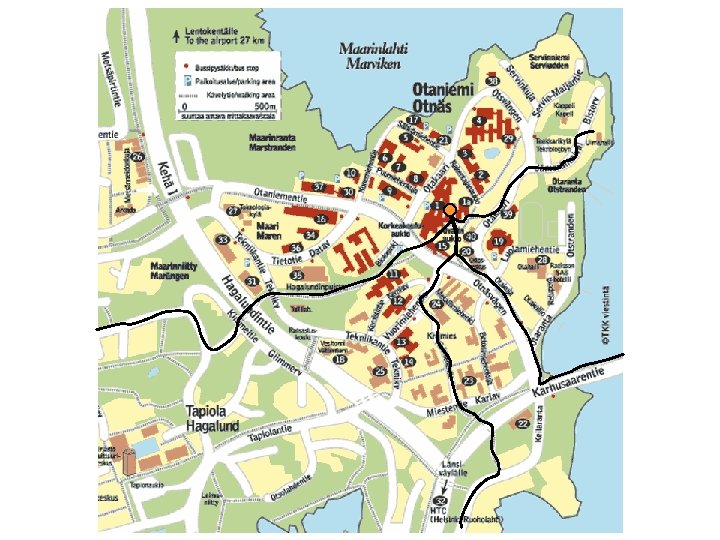
 Trajectory data • Entities with a trajectory (time-stamped motion path) • Interesting patterns involve subgroups with similar heading, expected arrival, joint motion, . . . • n entities = trajectories; n = 10 – 100, 000 • t time steps; t = 10 – 100, 000 input size is nt • m size subgroup (unknown); m = 10 – 100, 000
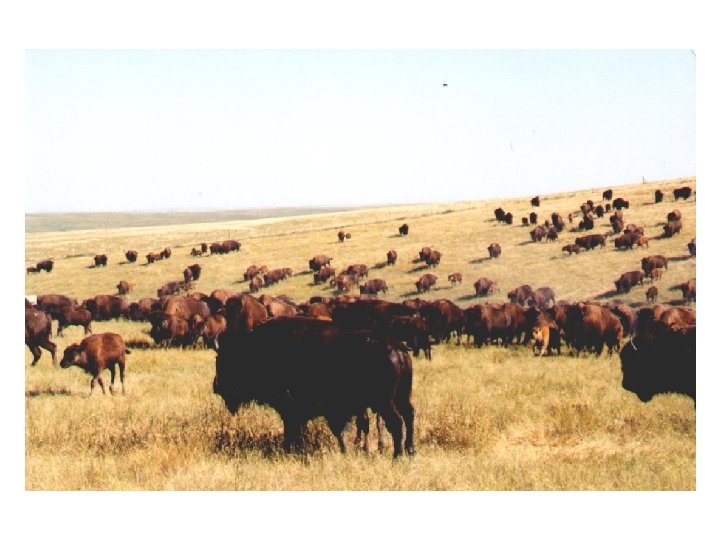
 Examples of trajectory data • • • Tracked animals (buffalo, birds, . . . ) Tracked people (potential terrorists) Tracked GSMs (e. g. for traffic purposes) Trajectories of tornadoes Sports scene analysis (players on a soccer field)
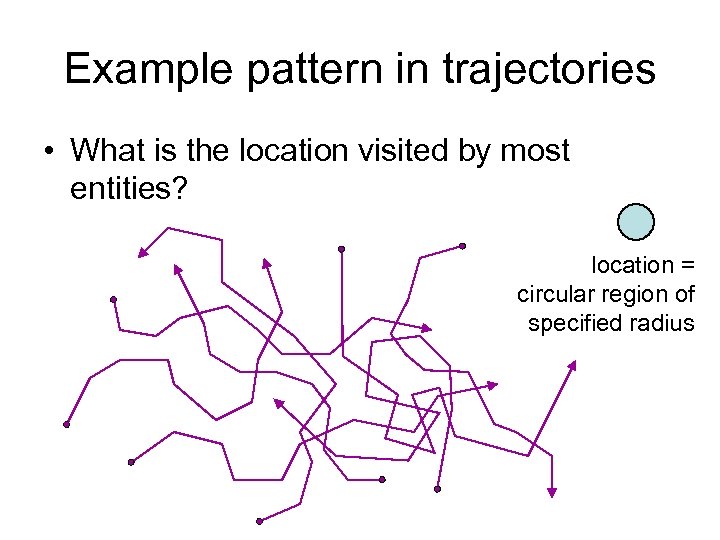 Example pattern in trajectories • What is the location visited by most entities? location = circular region of specified radius
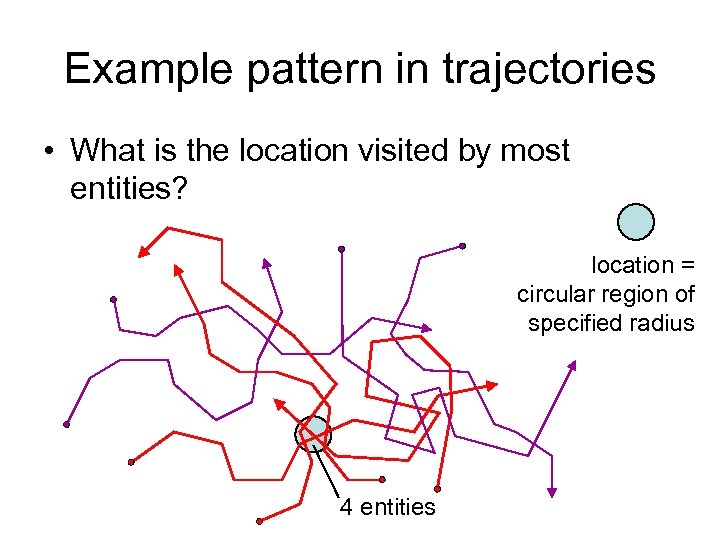 Example pattern in trajectories • What is the location visited by most entities? location = circular region of specified radius 4 entities
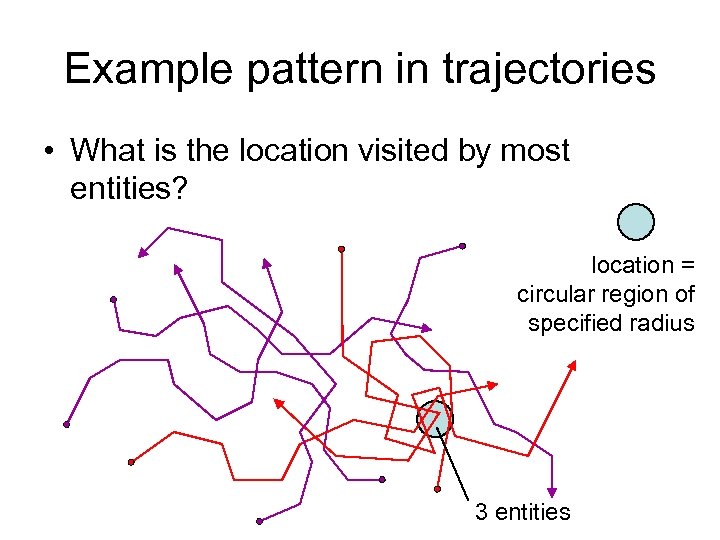 Example pattern in trajectories • What is the location visited by most entities? location = circular region of specified radius 3 entities
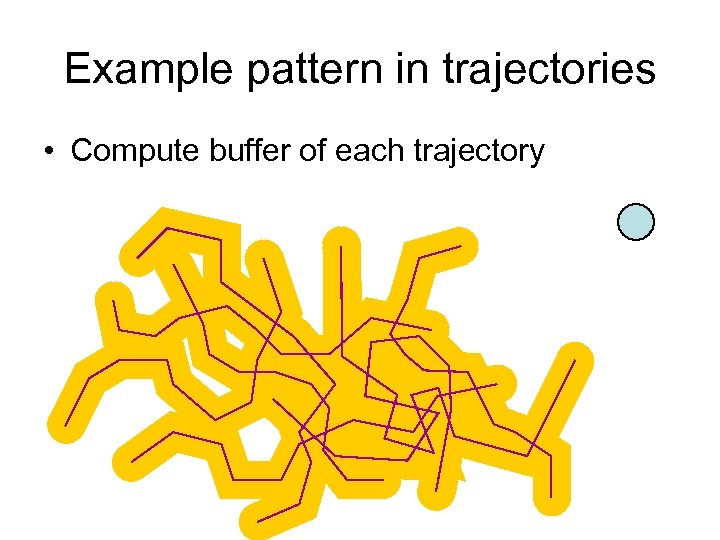 Example pattern in trajectories • Compute buffer of each trajectory
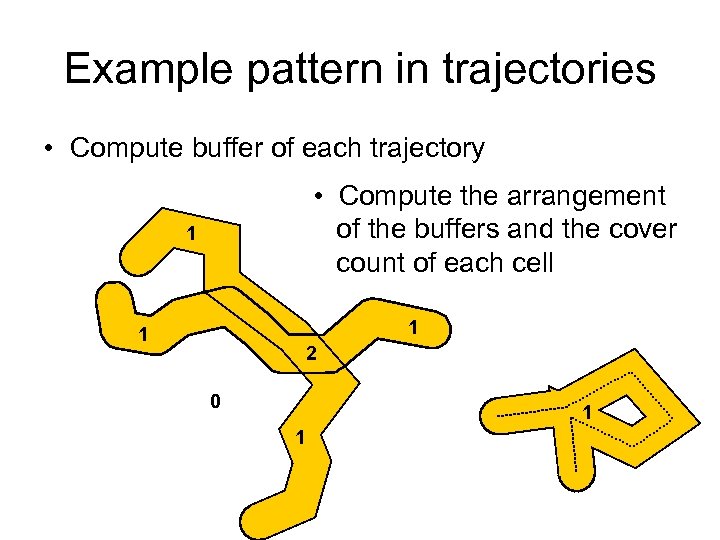 Example pattern in trajectories • Compute buffer of each trajectory • Compute the arrangement of the buffers and the cover count of each cell 1 1 1 2 0 1 1
 Example pattern in trajectories • One trajectory has t time stamps; its buffer can be computed in O(t log t) time • All buffers can be computed in O(nt log t) time • The arrangement can be computed in O(nt log (nt) + k) time, where k = O( (nt)2 ) is the complexity of the arrangement • Cell cover counts are determined in O(k) time
 Example pattern in trajectories • Total: O(nt log (nt) + k) time • If the most visited location is visited by m entities, this is O(nt log (nt) + ntm) • Note: input size is nt ; n entities, each with location at t moments
 Patterns in entity data Spatial data Spatio-temporal data • n points (locations) • Distance is important • n trajectories, each has t time steps • Distance is timedependent – clustering pattern • Presence of attributes (e. g. man/woman): – co-location patterns – flock pattern – meet pattern • Heading and speed are important and are also time-dependent
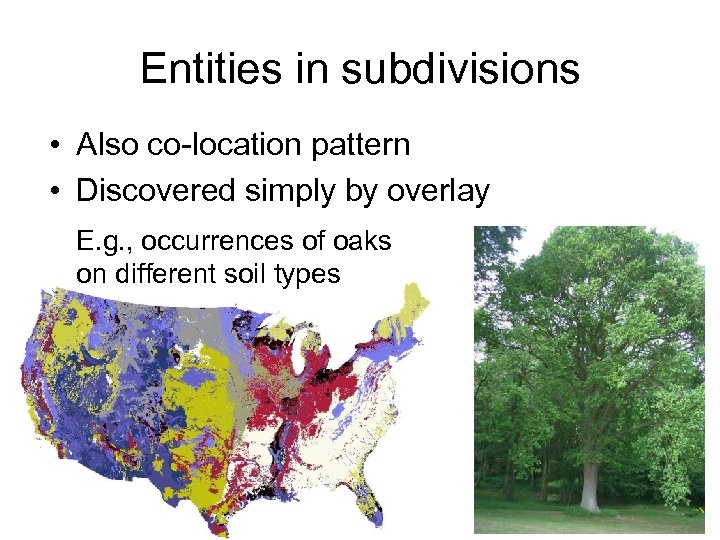 Entities in subdivisions • Also co-location pattern • Discovered simply by overlay E. g. , occurrences of oaks on different soil types
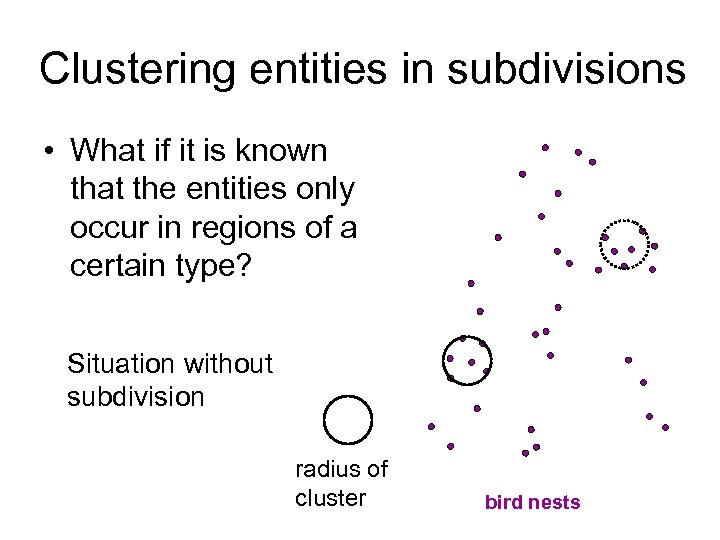 Clustering entities in subdivisions • What if it is known that the entities only occur in regions of a certain type? Situation without subdivision radius of cluster bird nests
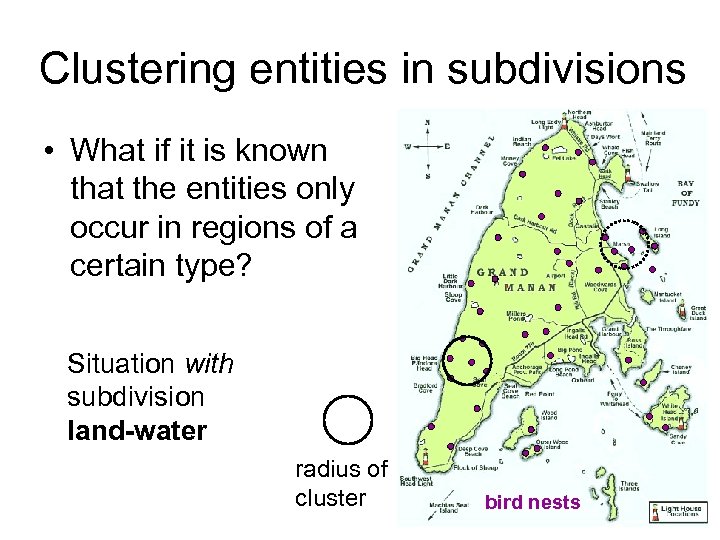 Clustering entities in subdivisions • What if it is known that the entities only occur in regions of a certain type? Situation with subdivision land-water radius of cluster bird nests
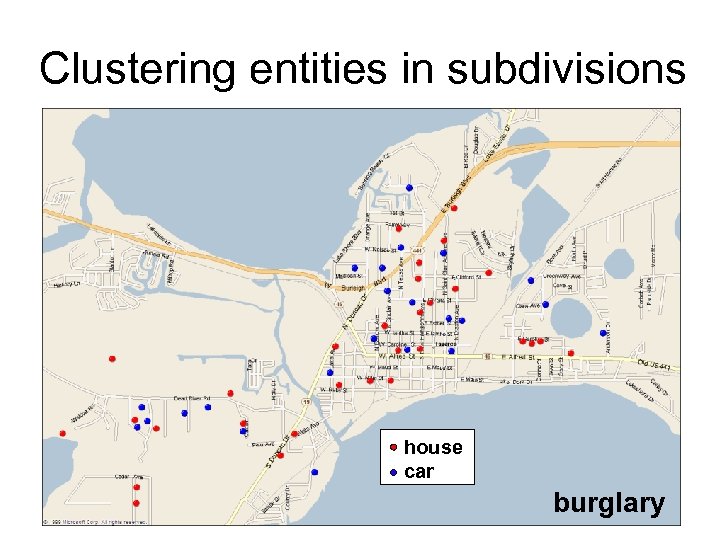 Clustering entities in subdivisions house car burglary
 Region-restricted clustering Joint research with Joachim Gudmundsson (NICTA, Sydney) and Giri Narasimhan (U of F, Miami), 2006 • Determine clusters in point sets that are sensitive to the geographic context (at least, for the relevant aspects) Assume that a set of regions is given where points can only be, how should we define clusters?
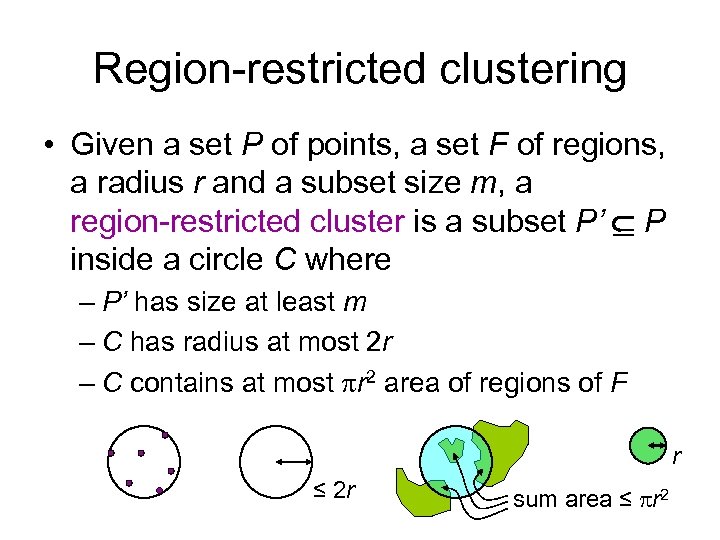 Region-restricted clustering • Given a set P of points, a set F of regions, a radius r and a subset size m, a region-restricted cluster is a subset P’ P inside a circle C where – P’ has size at least m – C has radius at most 2 r – C contains at most r 2 area of regions of F r ≤ 2 r sum area ≤ r 2
 Region-restricted clustering • Given a set P of n points, a set F of polygons with nf edges in total, and values for r and m, report all region-restricted clusters of exactly m points • Exactly m points? • “Real” clustering (partition)? • Outliers?
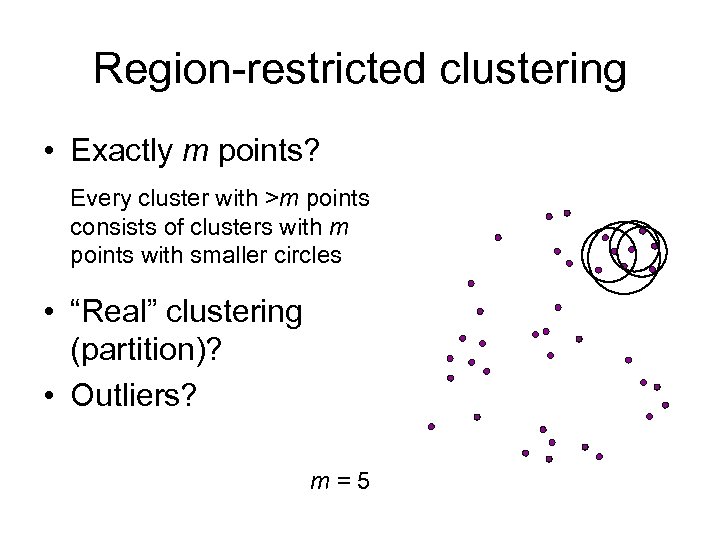 Region-restricted clustering • Exactly m points? Every cluster with >m points consists of clusters with m points with smaller circles • “Real” clustering (partition)? • Outliers? m=5
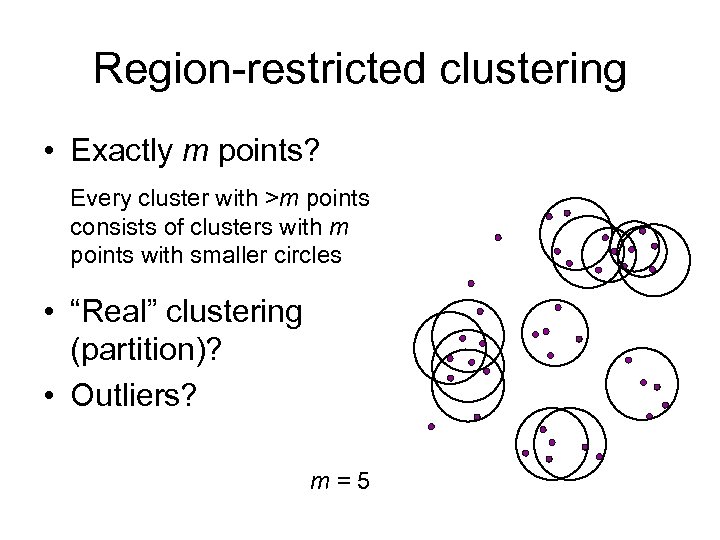 Region-restricted clustering • Exactly m points? Every cluster with >m points consists of clusters with m points with smaller circles • “Real” clustering (partition)? • Outliers? m=5
 Region-restricted clustering 1. Determine all smallest circles with m points of P inside 2. Test if the radius is ≤ r (report) or > 2 r (discard) 3. If the radius is in between, determine the area of regions of F inside
 Region-restricted clustering 1. Determine all smallest circles with m points of P inside • • Use (m-2)-th order Voronoi diagram: cells where the same (m-2) points are closest Its vertices are centers of smallest circles around exactly m points
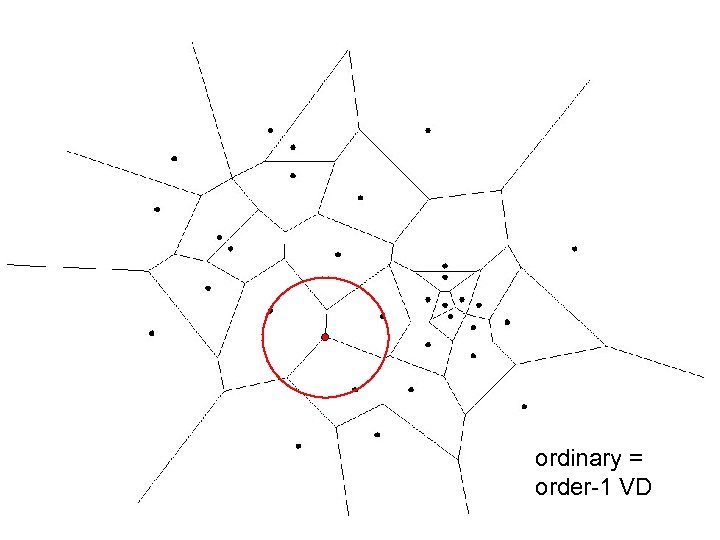 ordinary = order-1 VD
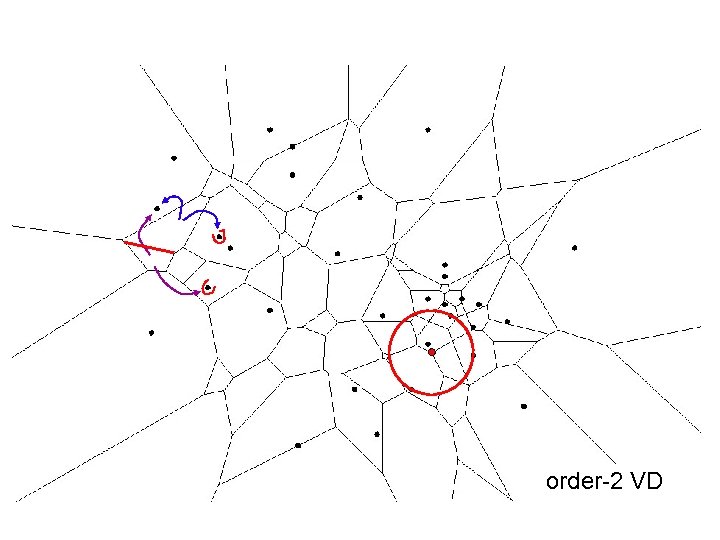 order-2 VD
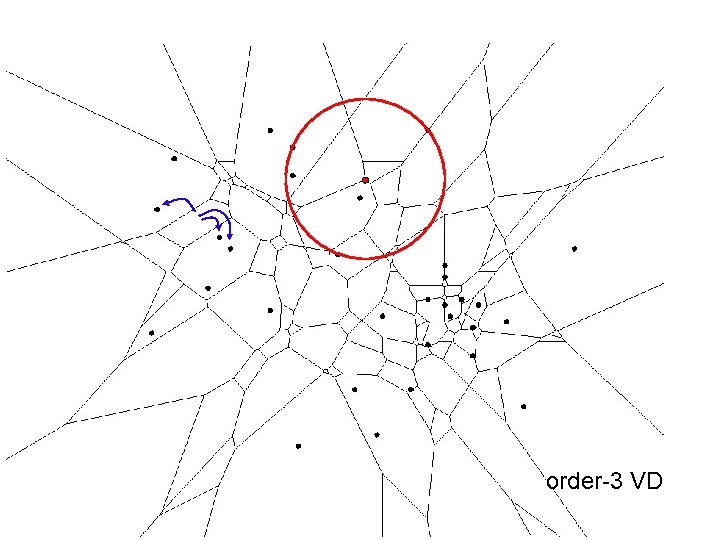 order-3 VD
 Region-restricted clustering • The m-th order Voronoi diagram (or (m-2)) has O(nm) cells, edges, and vertices • It can be constructed in O(nm log n) time we get O(nm) smallest circles with m points inside; for each we also know the radius
 Region-restricted clustering 2. Test if the radius is ≤ r (report) or > 2 r (discard) Trivial in O(1) time per circle, so in O(nm) time overall
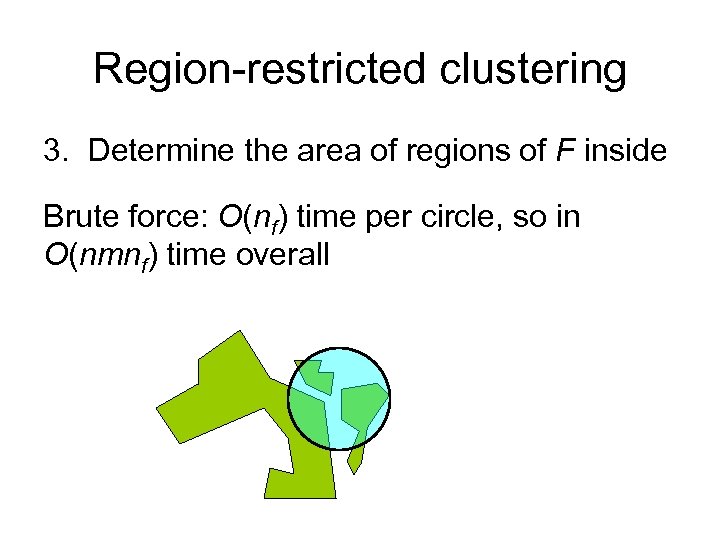 Region-restricted clustering 3. Determine the area of regions of F inside Brute force: O(nf) time per circle, so in O(nmnf) time overall
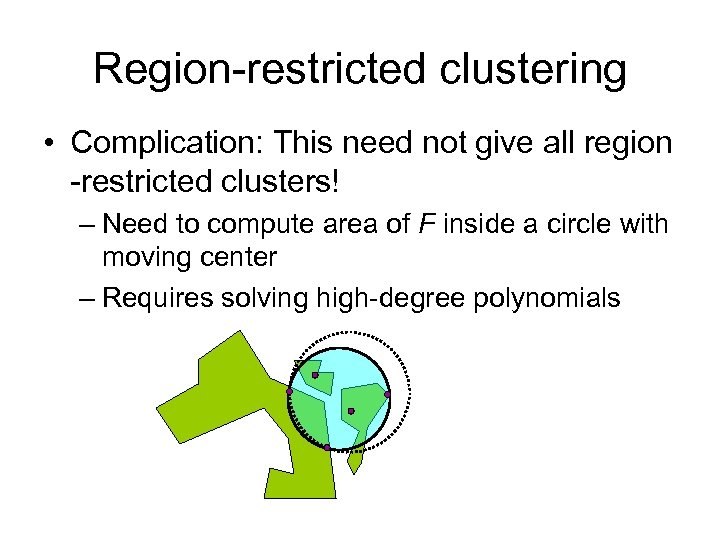 Region-restricted clustering • Complication: This need not give all region -restricted clusters! – Need to compute area of F inside a circle with moving center – Requires solving high-degree polynomials
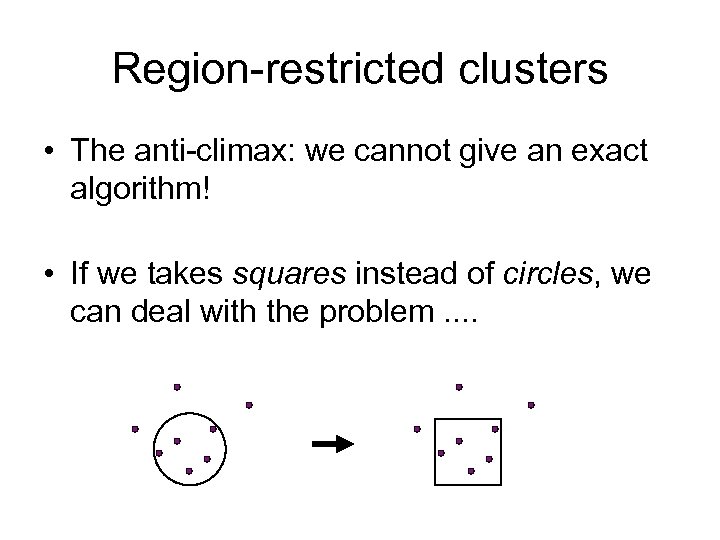 Region-restricted clusters • The anti-climax: we cannot give an exact algorithm! • If we takes squares instead of circles, we can deal with the problem. .
 Region-restricted clustering 3. Determine the area of regions of F inside Brute force: O(nf) time per square, so in O(nmnf) time overall The total time for steps 1, 2, and 3 is O(nm log n) + O(nmnf) = O(nm log n + nmnf) time
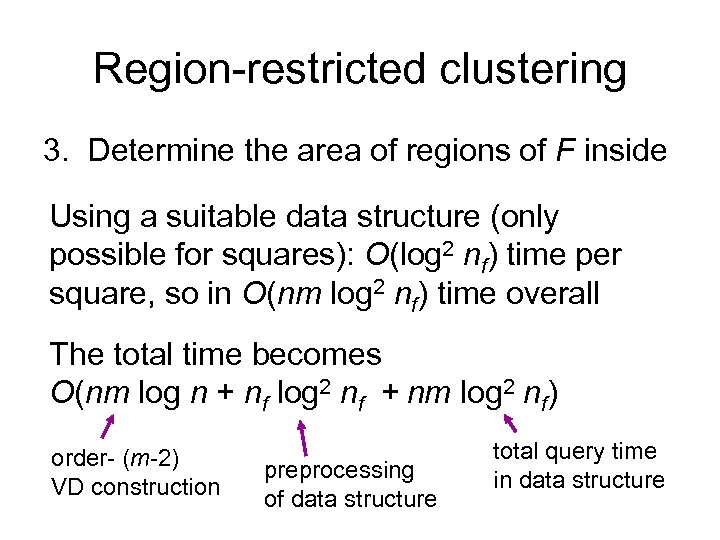 Region-restricted clustering 3. Determine the area of regions of F inside Using a suitable data structure (only possible for squares): O(log 2 nf) time per square, so in O(nm log 2 nf) time overall The total time becomes O(nm log n + nf log 2 nf + nm log 2 nf) order- (m-2) VD construction preprocessing of data structure total query time in data structure
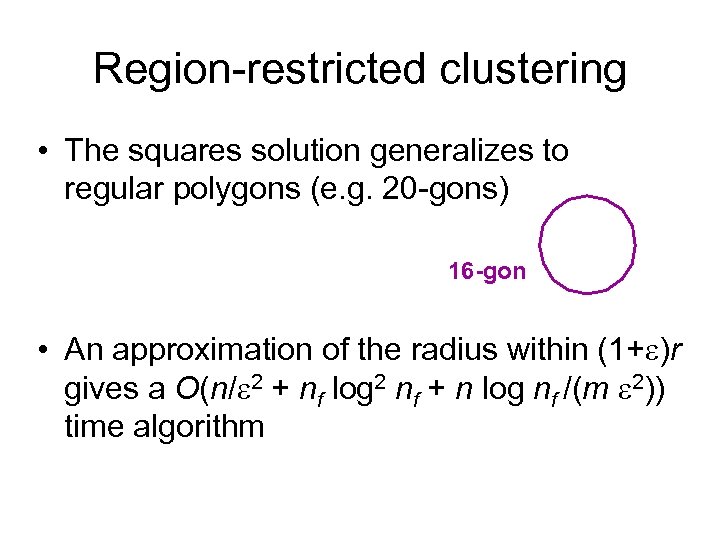 Region-restricted clustering • The squares solution generalizes to regular polygons (e. g. 20 -gons) 16 -gon • An approximation of the radius within (1+ )r gives a O(n/ 2 + nf log 2 nf + n log nf /(m 2)) time algorithm
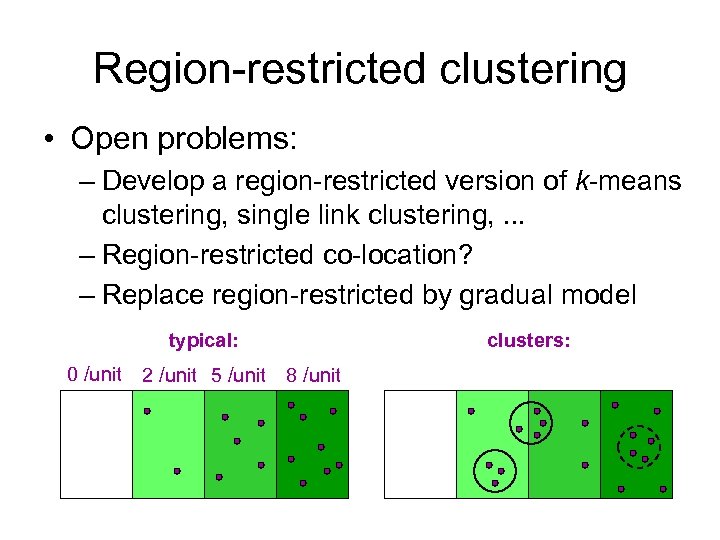 Region-restricted clustering • Open problems: – Develop a region-restricted version of k-means clustering, single link clustering, . . . – Region-restricted co-location? – Replace region-restricted by gradual model typical: 0 /unit 2 /unit 5 /unit clusters: 8 /unit
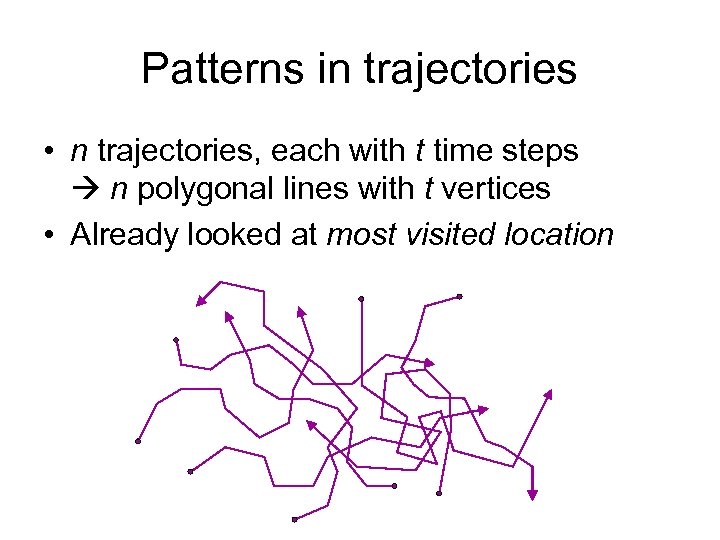 Patterns in trajectories • n trajectories, each with t time steps n polygonal lines with t vertices • Already looked at most visited location
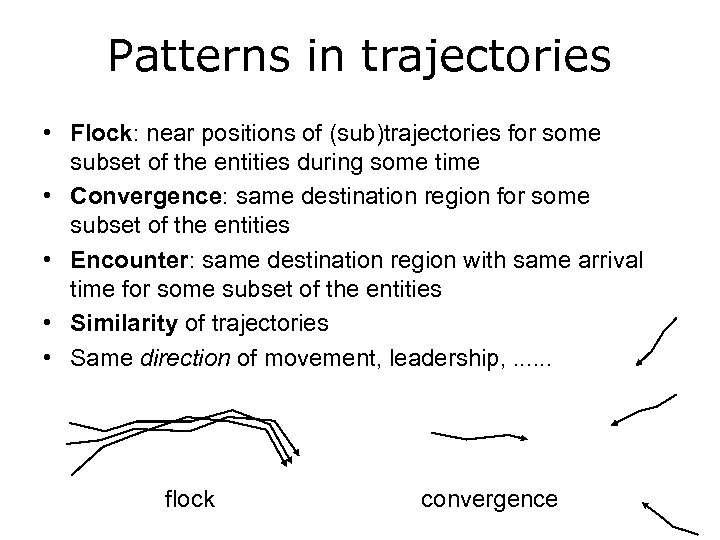 Patterns in trajectories • Flock: near positions of (sub)trajectories for some subset of the entities during some time • Convergence: same destination region for some subset of the entities • Encounter: same destination region with same arrival time for some subset of the entities • Similarity of trajectories • Same direction of movement, leadership, . . . flock convergence
 Patterns in trajectories • Flocking, convergence, encounter patterns – – Laube, van Kreveld, Imfeld (SDH 2004) Gudmundsson, van Kreveld, Speckmann (ACM GIS 2004) Benkert, Gudmundsson, Huebner, Wolle (ESA 2006). . . • Similarity of trajectories – Vlachos, Kollios, Gunopulos (ICDE 2002) – Shim, Chang (WAIM 2003) –. . . • Lifelines, motion mining, modeling motion – – Mountain, Raper (Geo. Computation 2001) Kollios, Scaroff, Betke (DM&KD 2001) Frank (GISDATA 8, 2001). . .
 Patterns in trajectories • Flock: near positions of (sub)trajectories for some subset of the entities during some time – clustering-type pattern – different definitions are used • Given: radius r, subset size m, and duration T, a flock is a subset of size m that is inside a (moving) circle of radius r for a duration T
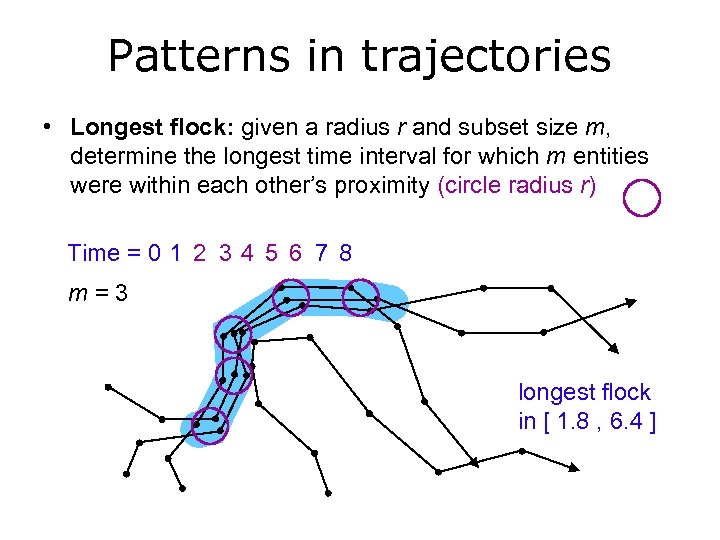 Patterns in trajectories • Longest flock: given a radius r and subset size m, determine the longest time interval for which m entities were within each other’s proximity (circle radius r) Time = 0 1 2 3 4 5 6 7 8 m=3 longest flock in [ 1. 8 , 6. 4 ]
 Patterns in trajectories • Meet: near some position of (sub)trajectories for some subset of the entities – clustering-type pattern • Given: radius r, subset size m, and duration T, a meet is a subset of size m that is inside a (stationary) circle of radius r for a duration T this was “moving” for flock
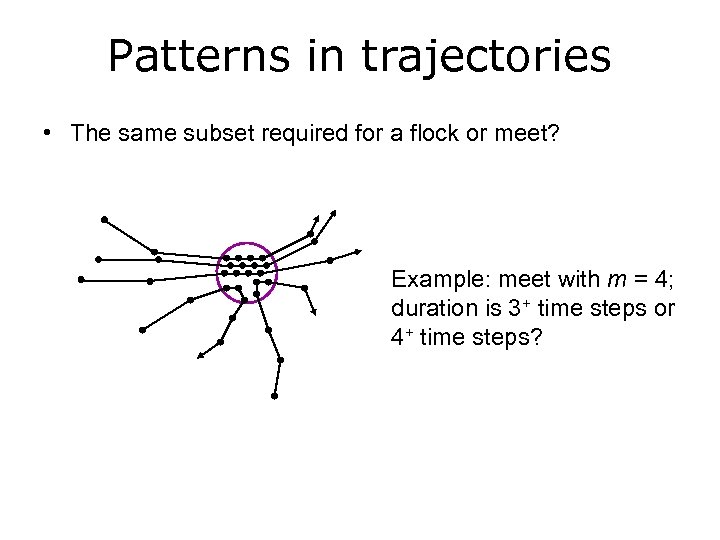 Patterns in trajectories • The same subset required for a flock or meet? Example: meet with m = 4; duration is 3+ time steps or 4+ time steps?
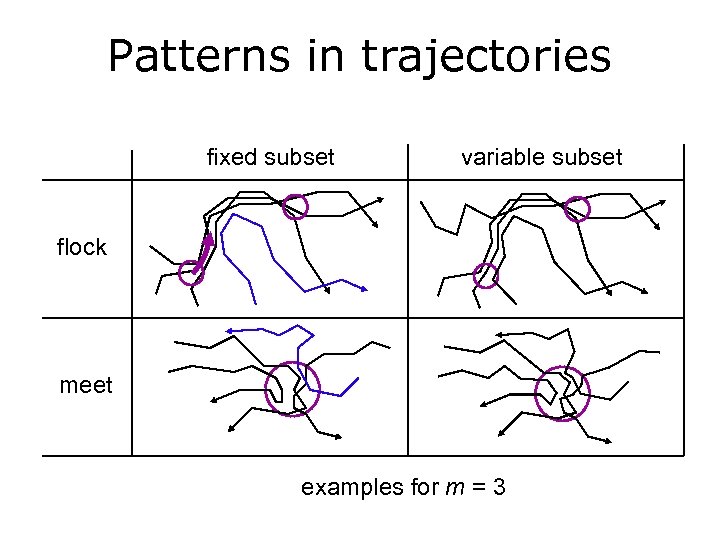 Patterns in trajectories fixed subset variable subset flock meet examples for m = 3
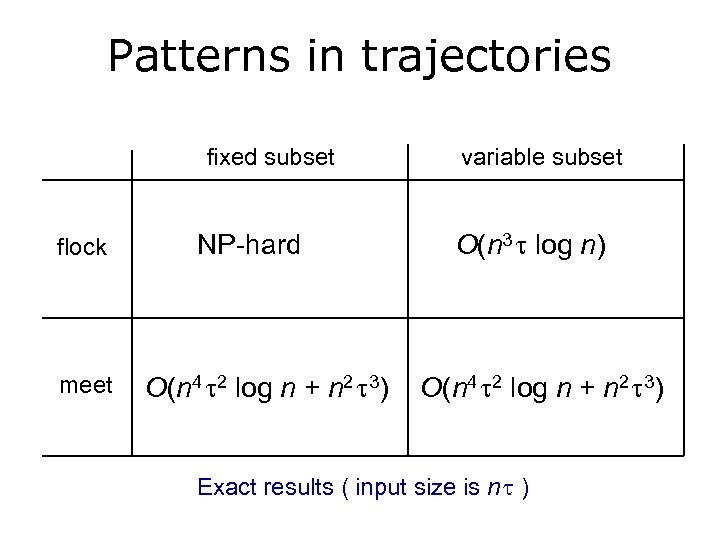 Patterns in trajectories fixed subset flock meet NP-hard O(n 4 2 log n + n 2 3) variable subset O(n 3 log n) O(n 4 2 log n + n 2 3) Exact results ( input size is n )
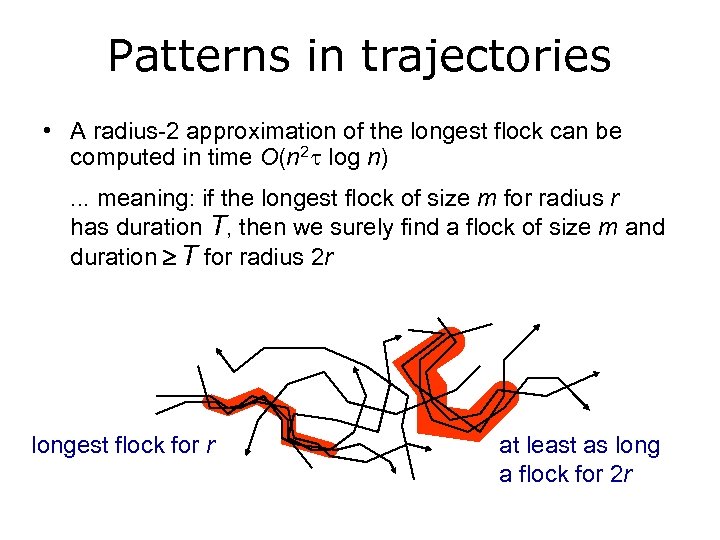 Patterns in trajectories • A radius-2 approximation of the longest flock can be computed in time O(n 2 log n). . . meaning: if the longest flock of size m for radius r has duration T, then we surely find a flock of size m and duration T for radius 2 r longest flock for r at least as long a flock for 2 r
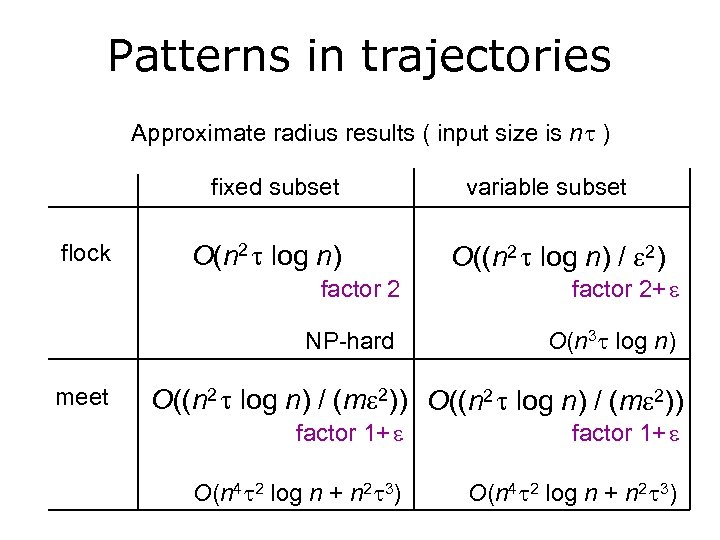 Patterns in trajectories Approximate radius results ( input size is n ) fixed subset flock O(n 2 log n) variable subset O((n 2 log n) / 2) factor 2 NP-hard meet factor 2+ O(n 3 log n) O((n 2 log n) / (m 2)) factor 1+ O(n 4 2 log n + n 2 3)
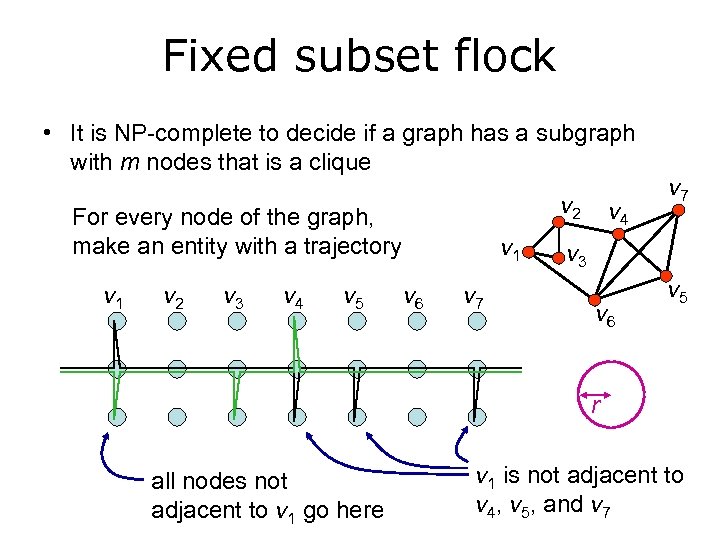 Fixed subset flock • It is NP-complete to decide if a graph has a subgraph with m nodes that is a clique v 2 For every node of the graph, make an entity with a trajectory v 1 v 2 v 3 v 4 v 5 v 1 v 6 v 7 v 4 v 7 v 3 v 6 v 5 r all nodes not adjacent to v 1 go here v 1 is not adjacent to v 4, v 5, and v 7
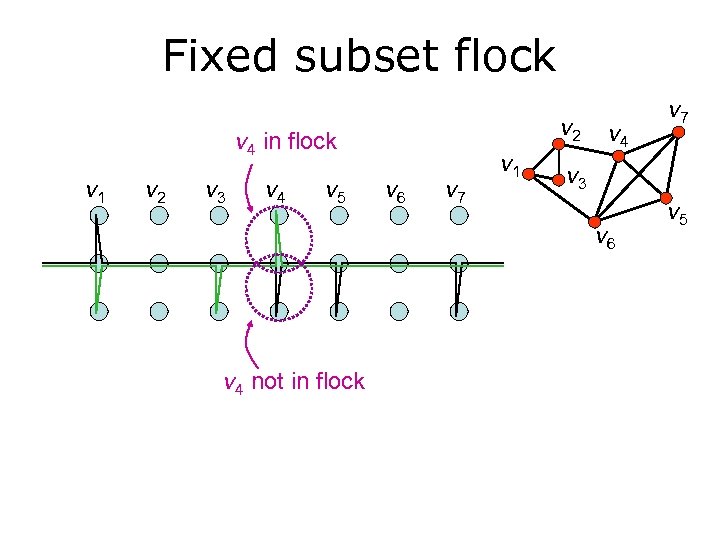 Fixed subset flock v 2 v 4 in flock v 1 v 2 v 3 v 4 v 5 v 6 v 7 v 1 v 4 v 3 v 6 v 4 not in flock v 7 v 5
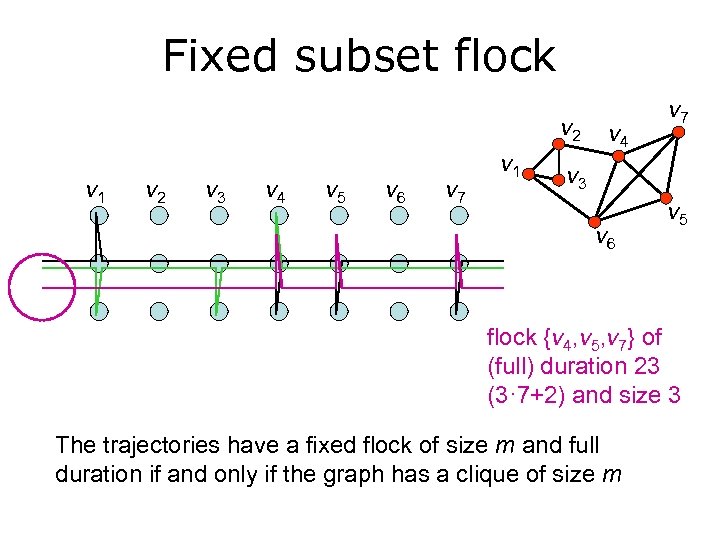 Fixed subset flock v 2 v 1 v 2 v 3 v 4 v 5 v 6 v 7 v 1 v 4 v 7 v 3 v 6 v 5 flock {v 4, v 5, v 7} of (full) duration 23 (3· 7+2) and size 3 The trajectories have a fixed flock of size m and full duration if and only if the graph has a clique of size m
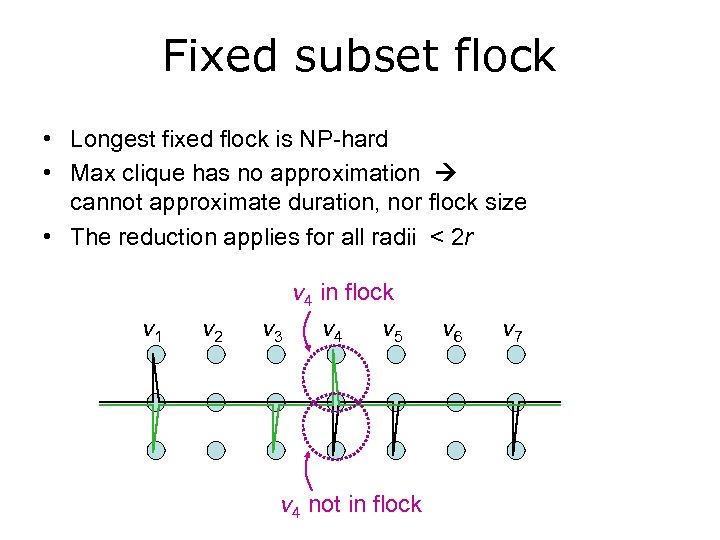 Fixed subset flock • Longest fixed flock is NP-hard • Max clique has no approximation cannot approximate duration, nor flock size • The reduction applies for all radii < 2 r v 1 v 2 v 4 in flock v 3 v 4 v 5 v 4 not in flock v 6 v 7
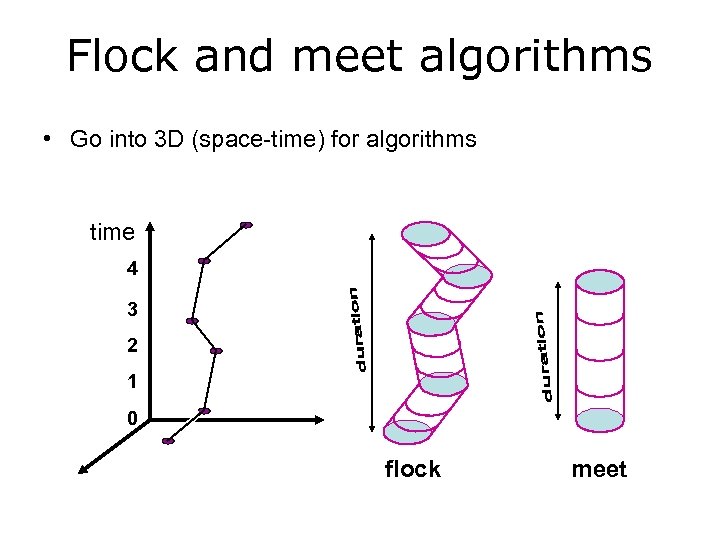 Flock and meet algorithms • Go into 3 D (space-time) for algorithms time 4 3 2 1 0 flock meet
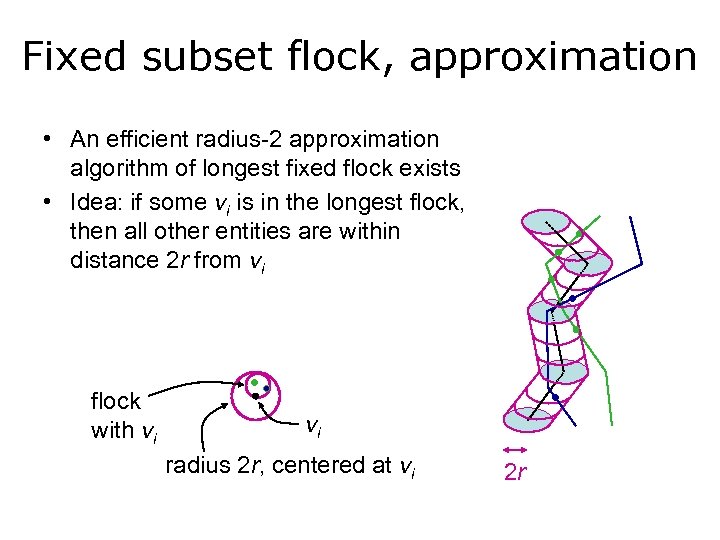 Fixed subset flock, approximation • An efficient radius-2 approximation algorithm of longest fixed flock exists • Idea: if some vi is in the longest flock, then all other entities are within distance 2 r from vi flock with vi vi radius 2 r, centered at vi 2 r
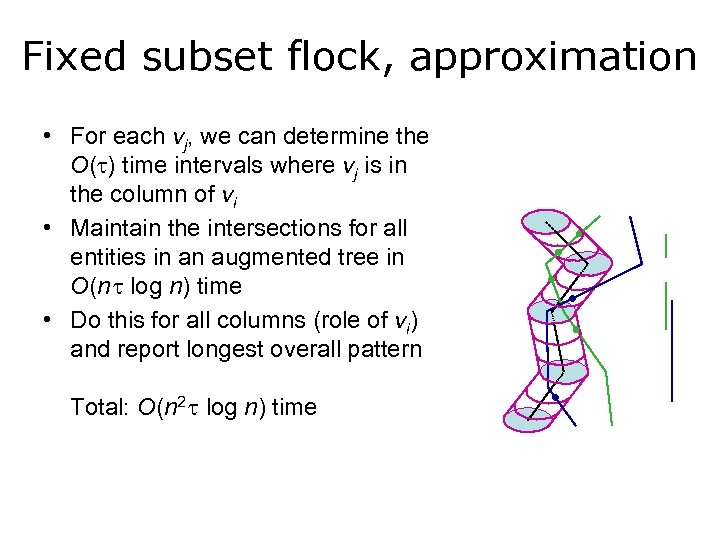 Fixed subset flock, approximation • For each vj, we can determine the O( ) time intervals where vj is in the column of vi • Maintain the intersections for all entities in an augmented tree in O(n log n) time • Do this for all columns (role of vi) and report longest overall pattern Total: O(n 2 log n) time
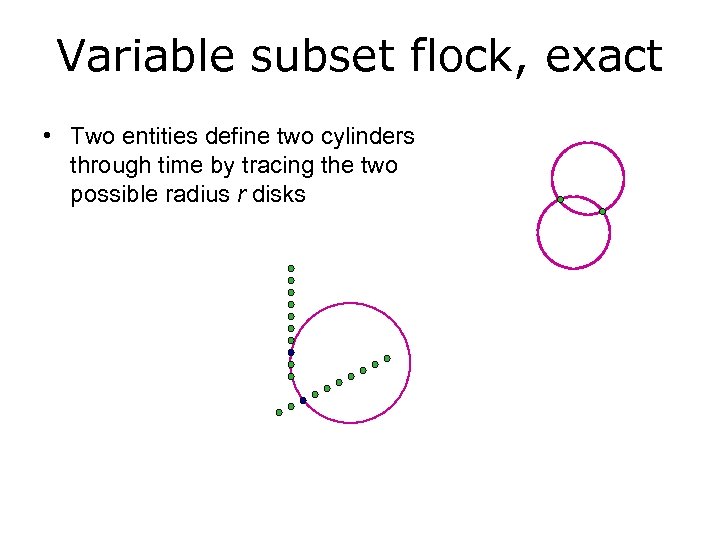
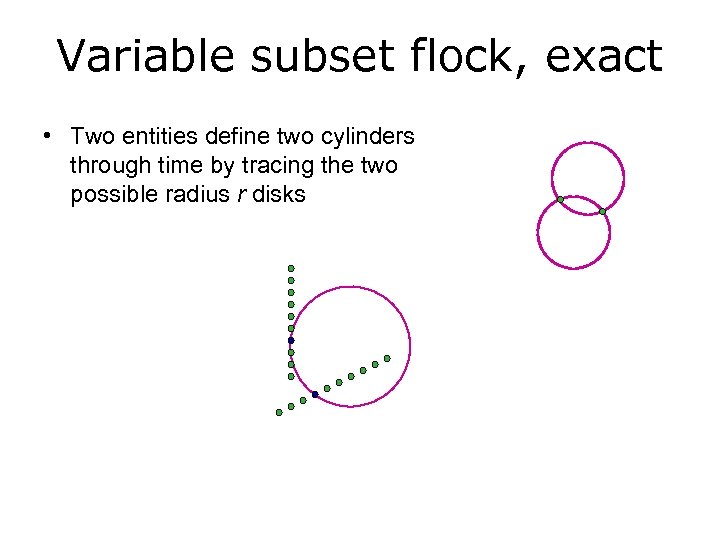
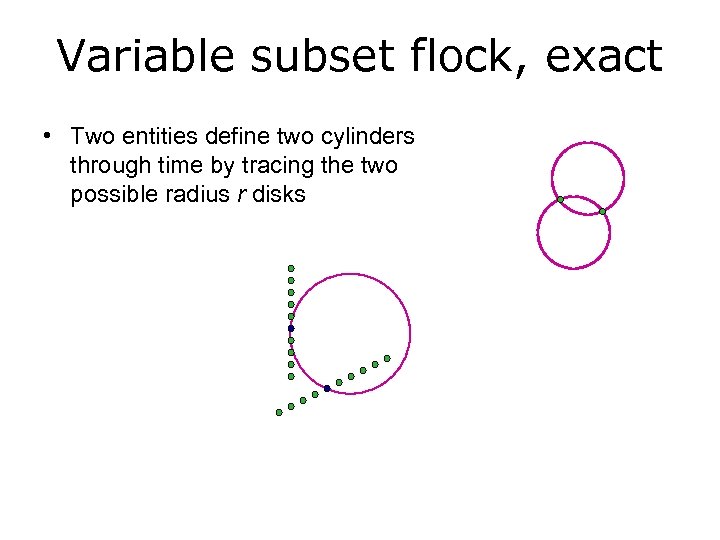
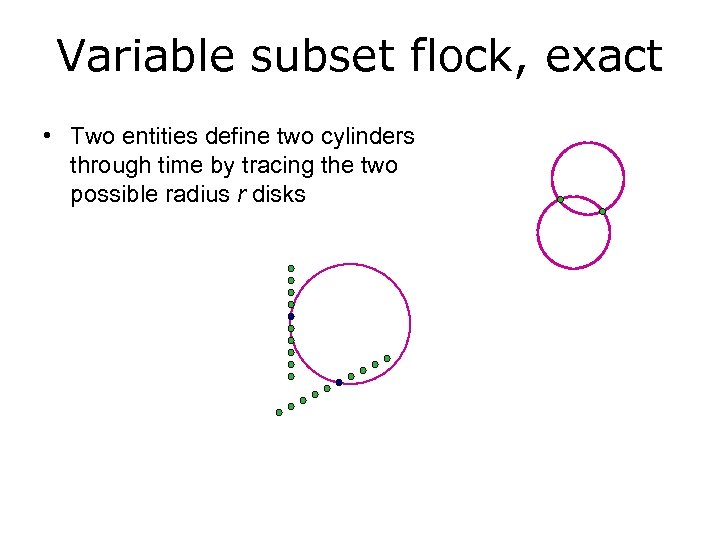
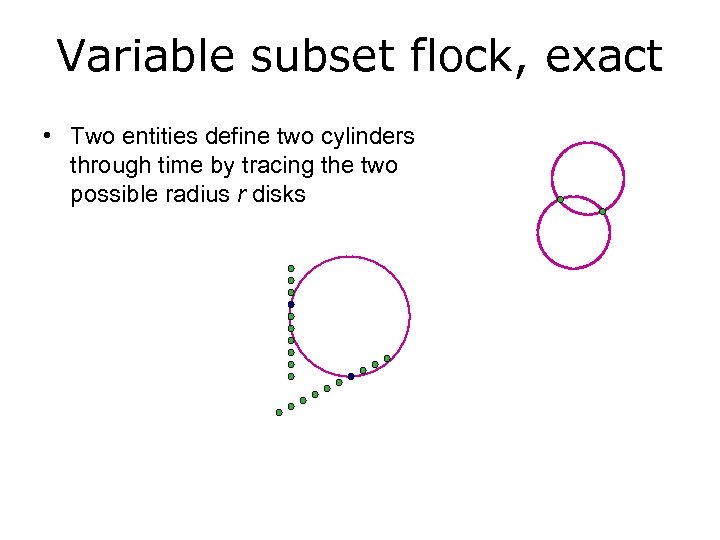
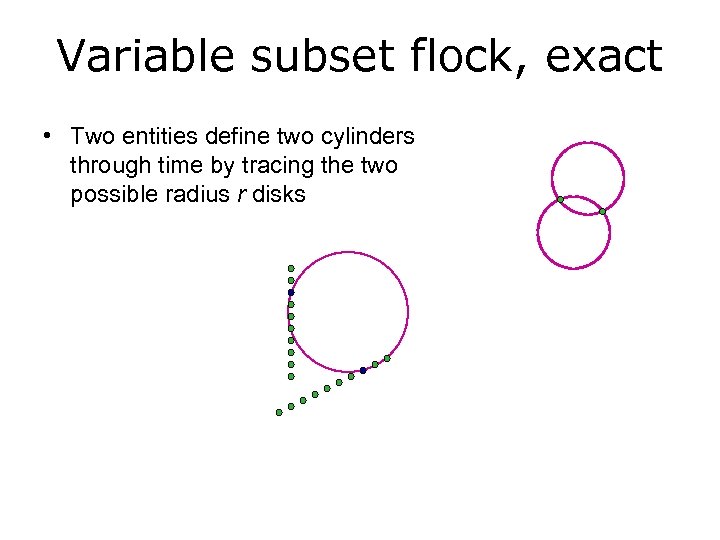
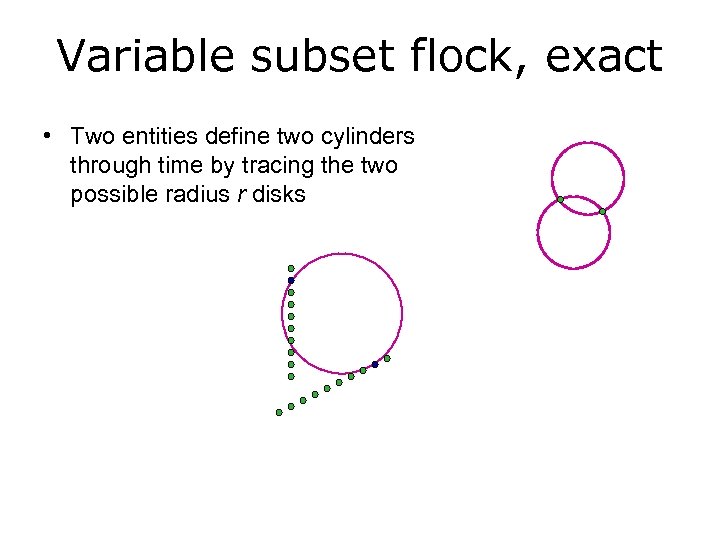
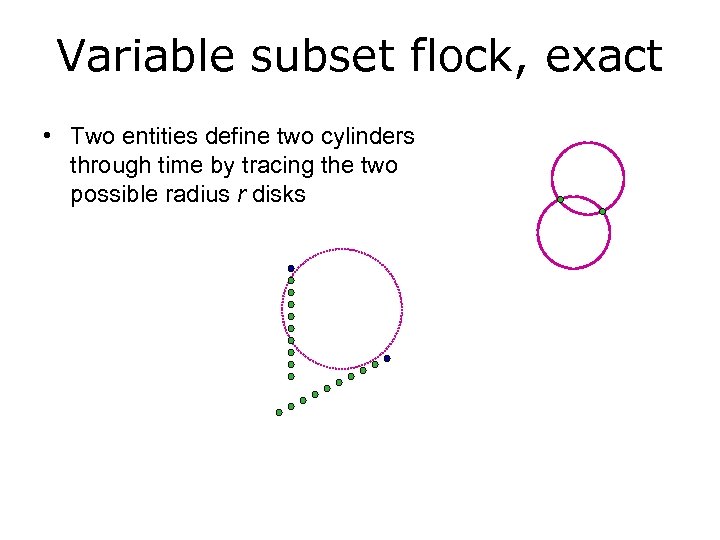
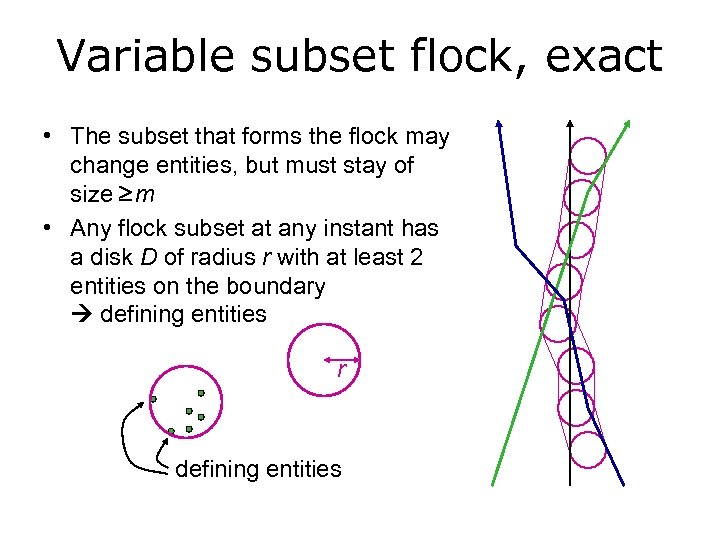 Variable subset flock, exact • The subset that forms the flock may change entities, but must stay of size m • Any flock subset at any instant has a disk D of radius r with at least 2 entities on the boundary defining entities r defining entities
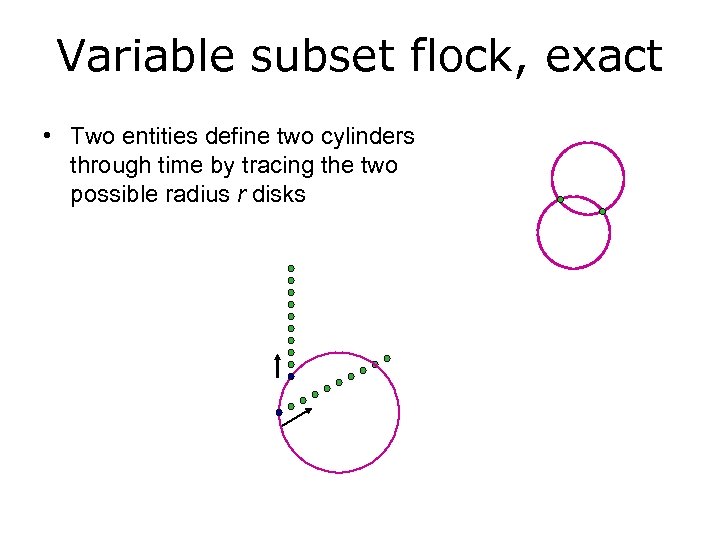 Variable subset flock, exact • Two entities define two cylinders through time by tracing the two possible radius r disks
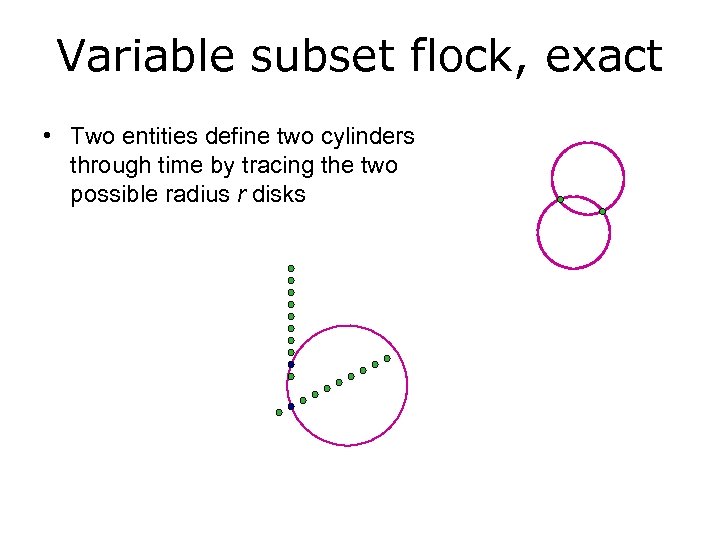 Variable subset flock, exact • Two entities define two cylinders through time by tracing the two possible radius r disks
 Variable subset flock, exact • Two entities define two cylinders through time by tracing the two possible radius r disks
 Variable subset flock, exact • Two entities define two cylinders through time by tracing the two possible radius r disks
 Variable subset flock, exact • Two entities define two cylinders through time by tracing the two possible radius r disks
 Variable subset flock, exact • Two entities define two cylinders through time by tracing the two possible radius r disks
 Variable subset flock, exact • Two entities define two cylinders through time by tracing the two possible radius r disks
 Variable subset flock, exact • Two entities define two cylinders through time by tracing the two possible radius r disks
 Variable subset flock, exact • Two entities define two cylinders through time by tracing the two possible radius r disks
 Variable subset flock, exact • Two entities define two cylinders through time by tracing the two possible radius r disks
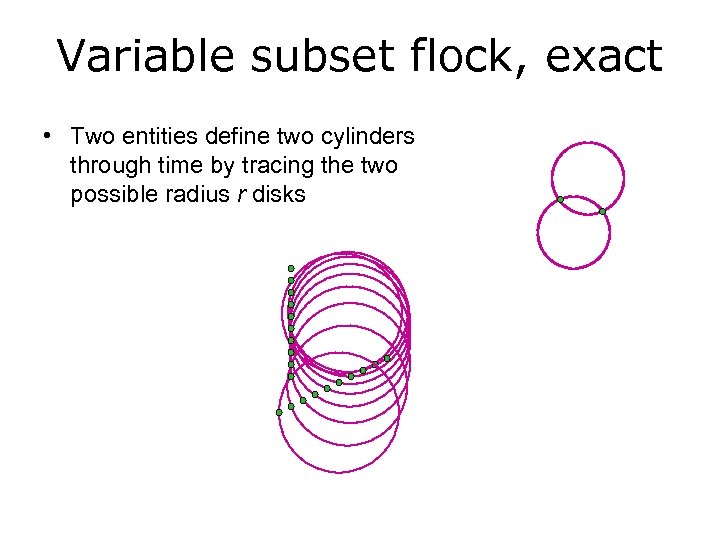 Variable subset flock, exact • Two entities define two cylinders through time by tracing the two possible radius r disks
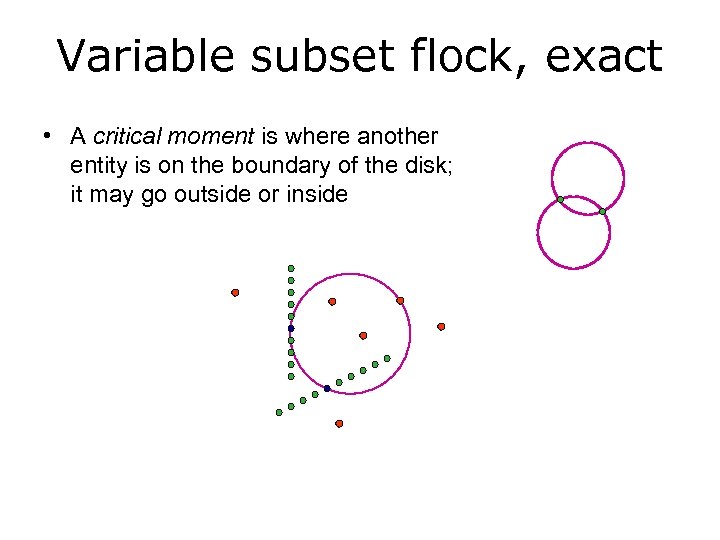 Variable subset flock, exact • A critical moment is where another entity is on the boundary of the disk; it may go outside or inside
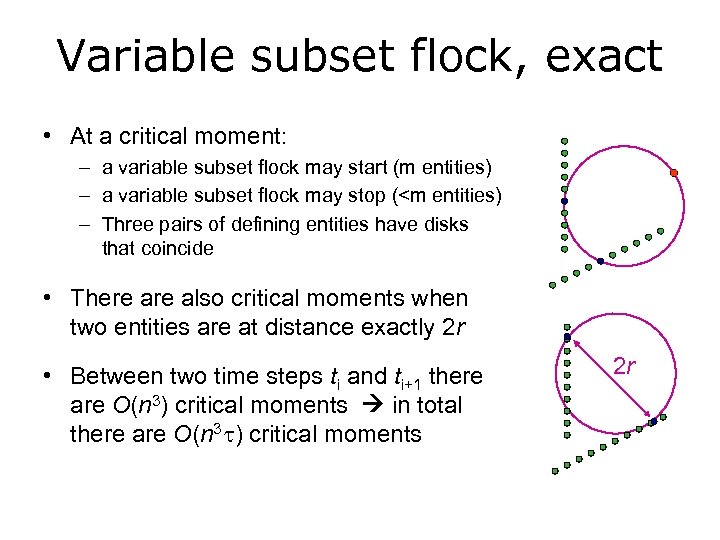 Variable subset flock, exact • At a critical moment: – a variable subset flock may start (m entities) – a variable subset flock may stop (
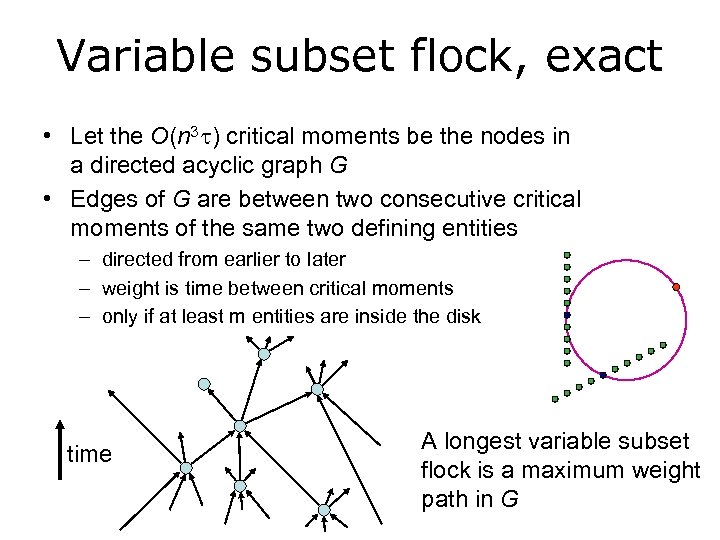 Variable subset flock, exact • Let the O(n 3 ) critical moments be the nodes in a directed acyclic graph G • Edges of G are between two consecutive critical moments of the same two defining entities – directed from earlier to later – weight is time between critical moments – only if at least m entities are inside the disk time A longest variable subset flock is a maximum weight path in G
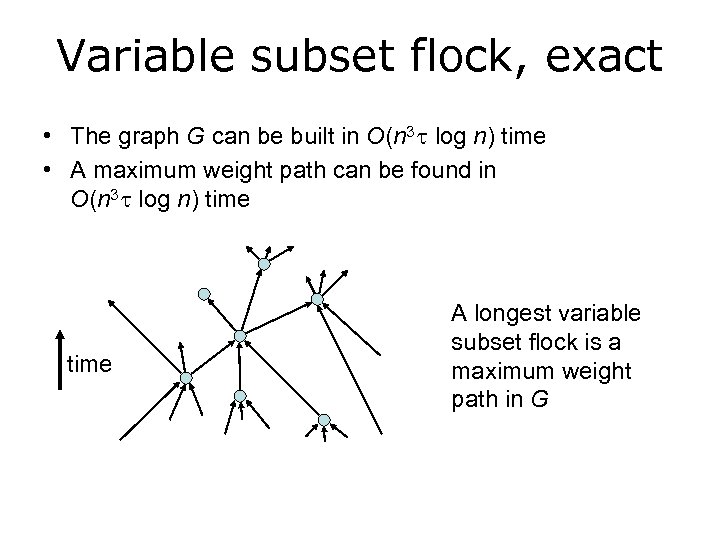 Variable subset flock, exact • The graph G can be built in O(n 3 log n) time • A maximum weight path can be found in O(n 3 log n) time A longest variable subset flock is a maximum weight path in G
 Patterns in trajectories, summary • Flock and meet patterns require algorithms in 3 dimensional space (space-time) • Exact algorithms are inefficient only suitable for smaller data sets • Approximation can reduce running time with one or two orders of magnitude
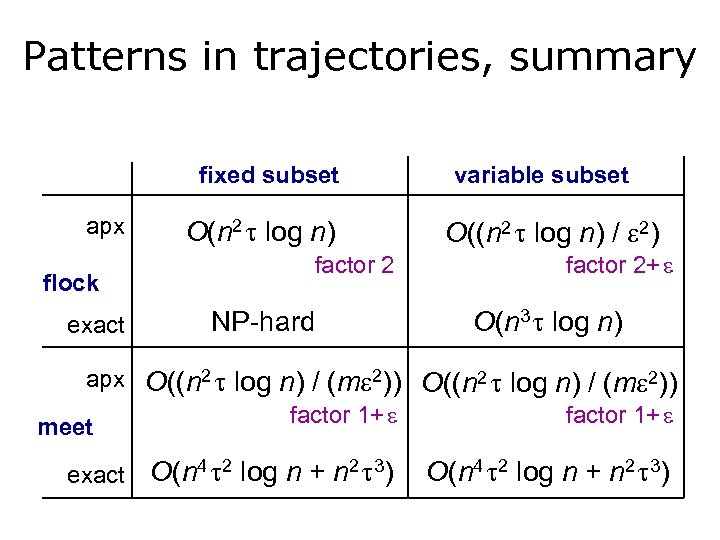 Patterns in trajectories, summary fixed subset apx flock exact O(n 2 log n) factor 2 NP-hard variable subset O((n 2 log n) / 2) factor 2+ O(n 3 log n) apx O((n 2 log n) / (m 2)) factor 1+ meet exact O(n 4 2 log n + n 2 3)
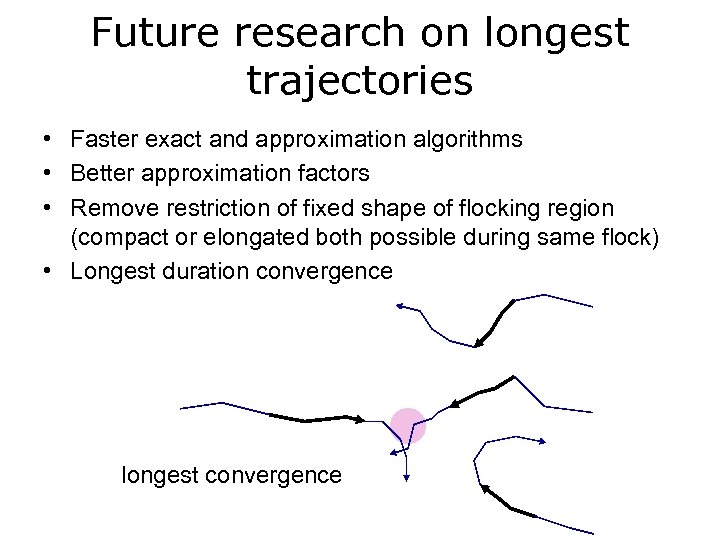 Future research on longest trajectories • Faster exact and approximation algorithms • Better approximation factors • Remove restriction of fixed shape of flocking region (compact or elongated both possible during same flock) • Longest duration convergence longest convergence
 Patterns in trajectories • Flock and meet patterns require algorithms in 3 dimensional space (space-time) • Exact algorithms are inefficient only suitable for smaller data sets • Approximation can reduce running time with an order of magnitude
 To conclude • With an exact definition of a spatial or spatiotemporal pattern, geometric algorithms can be used to compute all patterns • Many known structures from computational geometry are useful (Voronoi diagrams, arrangements, . . . ) • Since the (exact) algorithms may be inefficient, approximation may be a solution
 To discuss • What patterns must be detected in practice (both spatial and spatio-temporal)? • What is the most appropriate definition (formalization) of these? • Spatial association rules, auto-correlation, irregularities, classification, . . . and other computable things in spatial/spatio-temporal data mining