


 Скачать презентацию Computational Finance Panos Parpas Imperial College London Computational
b27cf5225ac507b8143ee3e479bb21c8.ppt
- Количество слайдов: 36
 Computational Finance Panos Parpas Imperial College London Computational Finance 1/36
 Computational Finance Course v. Contact Panos Parpas (Huxley Building, Room 347) Email: pp 500@doc. ic. ac. uk and tutorial helpers. v Look at the web for lecture notes and tutorials http: //www. doc. ic. ac. uk/~pp 500 v. Course material courtesy of Nalan Gulpinar. Computational Finance 2/36
 Course will provide vto bring a level of confidence to students to the finance field van experience of formulating finance problems into computational problem vto introduce the computational issues in financial problems van illustration of the role of optimization in computational finance such as single period mean-variance portfolio management van introduction to numerical techniques for valuation, pricing and hedging of financial investment instruments such as options Computational Finance 3/36
 Useful Information The course will be mainly based on lecture notes v Recommended Books v D. Duffie, Dynamic Asset Pricing Theory, Princeton University Press, 1996. E. J. , Elton, M. J. Gruber, Modern Portfolio Theory and Investment Analysis, 1995. J. Hull, Options, Futures, and Other Derivative Securities, Prentice Hall, 2000. D. G. Luenberger, Investment Science, 1998. S. Pliska, Discrete Time Models in Finance, 1998. P. Wilmott, Derivatives: Theory and Practice of Financial Engineering, 1998. P. Wilmott, Option Pricing: Mathematical Models and Computation, 1993. Two course works v MEng test - for MEng students v Final exam - for BEng, BSci, and MSc students v Computational Finance 4/36
 Contents of the Course 1. Introduction to Investment Theory 2. Bonds and Valuation 3. Stocks and Valuation 4. Single-period Markowitz Model 5. The Asset Pricing Models 6. Derivatives 7. Option Pricing Models: Binomial Lattices Computational Finance 5/36
 Introduction to Investment Theory Panos Parpas Imperial College London Computational Finance 6/36 381 Computational Finance
 Topics Covered v Basic terminology and investment problems v The basic theory of interest rates v simple interest v compound interest v Future Value v Present Value v Annuity and Perpetuity Valuation Computational Finance 7/36
 Terminology v Finance – commercial or government activity of managing money, debt, credit and investment v Investment – the current commitment of resources in order to achieve later benefits present commitment of money for the purpose of receiving more money later – invest amount of money then your capital will increase ØInvestor is a person or an organisation that buys shares or pays money into a bank in order to receive a profit Ø v. Investment Science – application of scientific tools to investments primarily mathematical tools – modelling and solving financial problem Ø –optimisation –statistics Computational Finance 8/36
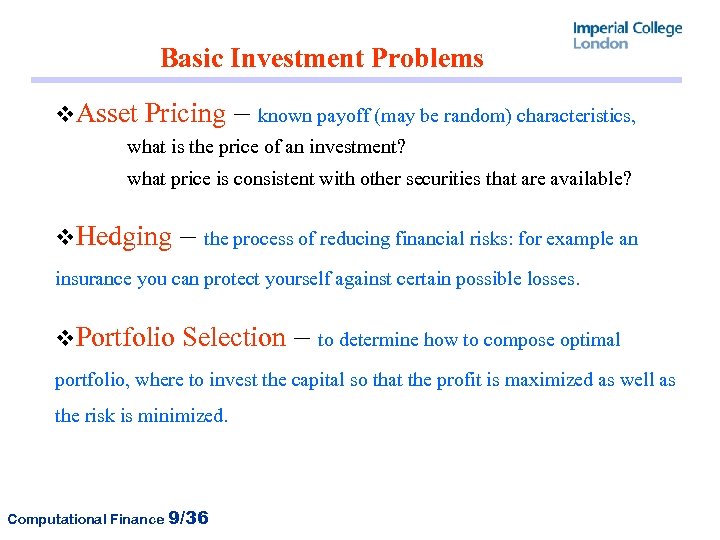 Basic Investment Problems v. Asset Pricing – known payoff (may be random) characteristics, what is the price of an investment? what price is consistent with other securities that are available? v. Hedging – the process of reducing financial risks: for example an insurance you can protect yourself against certain possible losses. v. Portfolio Selection – to determine how to compose optimal portfolio, where to invest the capital so that the profit is maximized as well as the risk is minimized. Computational Finance 9/36
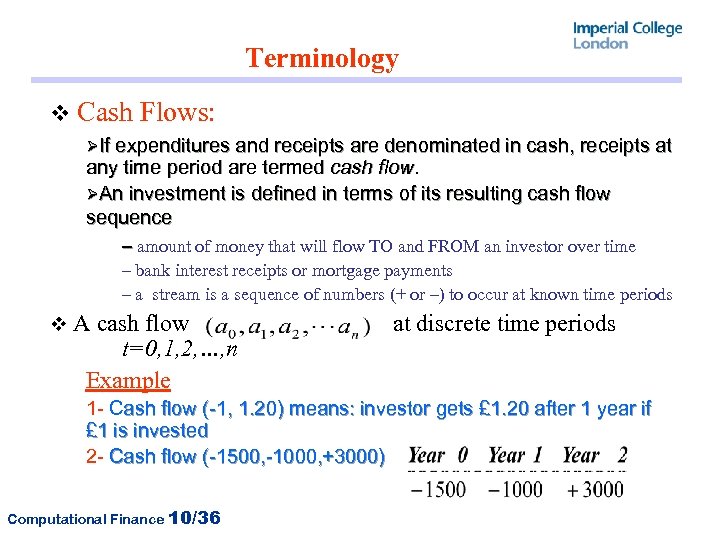 Terminology v Cash Flows: ØIf expenditures and receipts are denominated in cash, receipts at any time period are termed cash flow. ØAn investment is defined in terms of its resulting cash flow sequence – amount of money that will flow TO and FROM an investor over time – bank interest receipts or mortgage payments – a stream is a sequence of numbers (+ or –) to occur at known time periods v A cash flow t=0, 1, 2, …, n Example at discrete time periods 1 - Cash flow (-1, 1. 20) means: investor gets £ 1. 20 after 1 year if £ 1 is invested 2 - Cash flow (-1500, -1000, +3000) Computational Finance 10/36
 Interest Rates v. Interest – defined as the time value of money Øin financial market, it is the price for credit determined by demand supply of credit Øsummarizes the returns over the different time periods Øuseful comparing investments and scales the initial amount Ødifferent markets use different measures in terms of year, month, week, day, hour, even seconds v. Simple interest and Compound interest Computational Finance 11/36
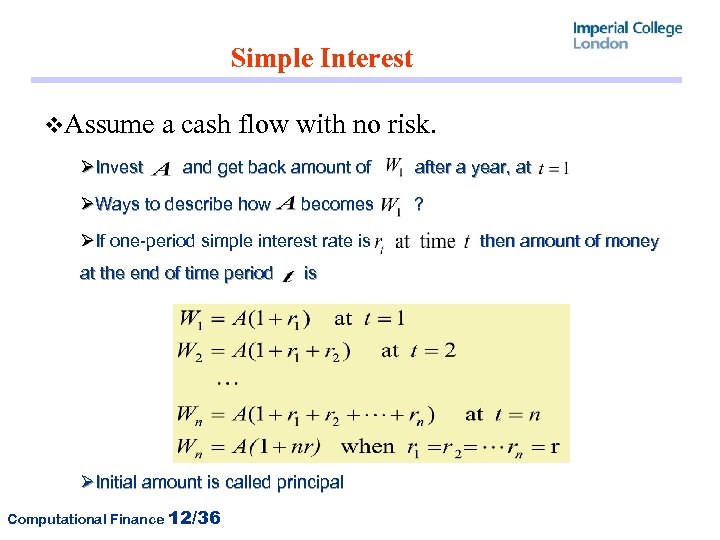 Simple Interest v. Assume ØInvest a cash flow with no risk. and get back amount of ØWays to describe how becomes ØIf one-period simple interest rate is at the end of time period is ØInitial amount is called principal Computational Finance 12/36 after a year, at ? then amount of money
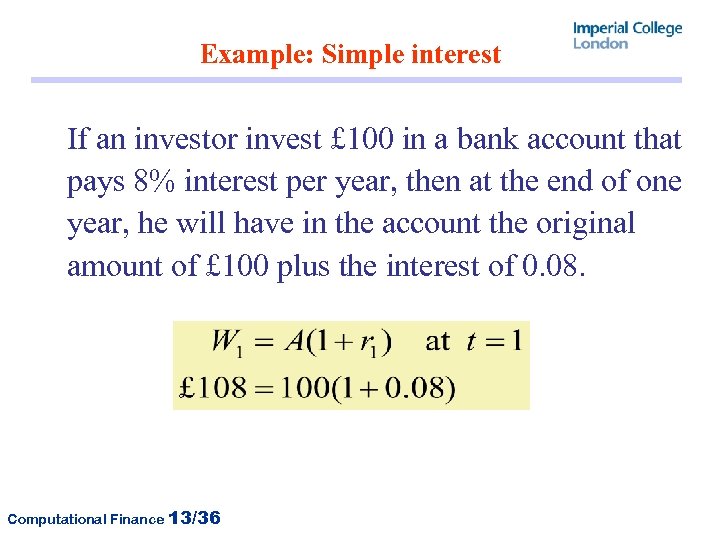 Example: Simple interest If an investor invest £ 100 in a bank account that pays 8% interest per year, then at the end of one year, he will have in the account the original amount of £ 100 plus the interest of 0. 08. Computational Finance 13/36
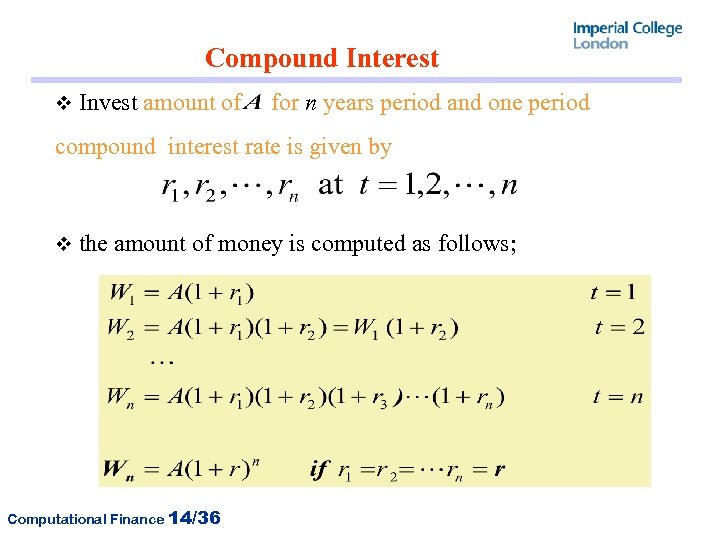 Compound Interest v Invest amount of for n years period and one period compound interest rate is given by v the amount of money is computed as follows; Computational Finance 14/36
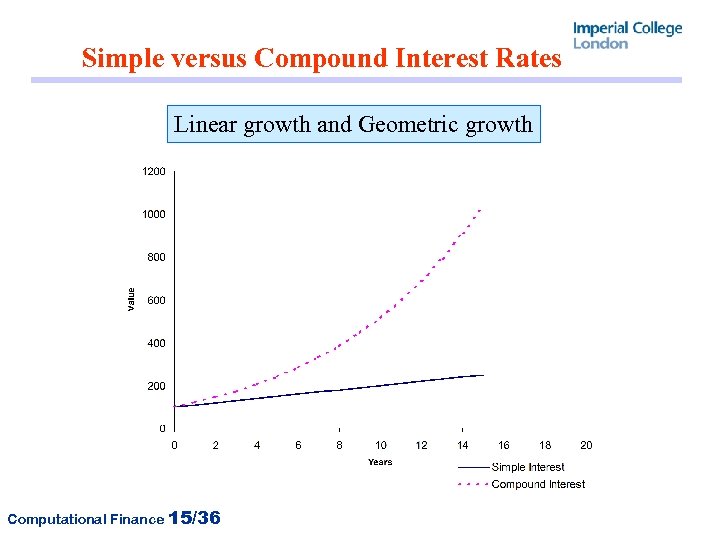 Simple versus Compound Interest Rates Linear growth and Geometric growth Computational Finance 15/36
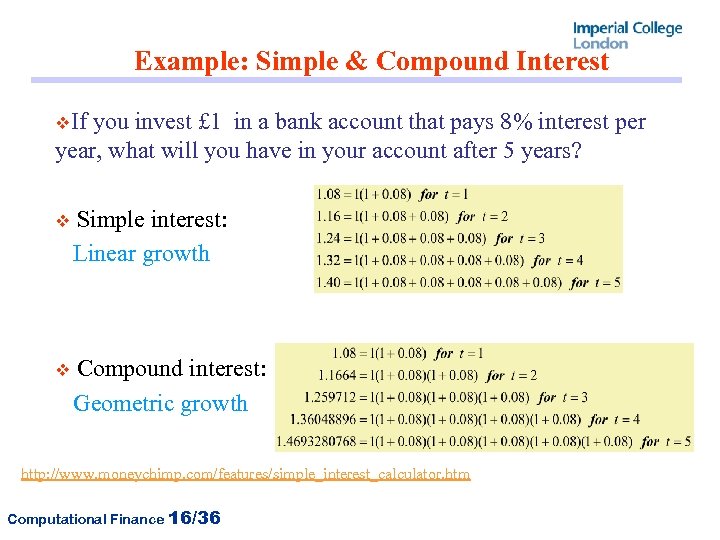 Example: Simple & Compound Interest v. If you invest £ 1 in a bank account that pays 8% interest per year, what will you have in your account after 5 years? v Simple interest: Linear growth v Compound interest: Geometric growth http: //www. moneychimp. com/features/simple_interest_calculator. htm Computational Finance 16/36
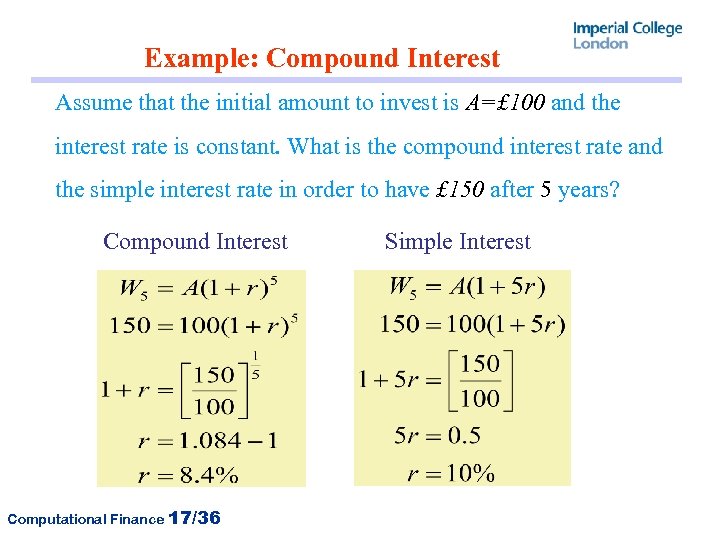 Example: Compound Interest Assume that the initial amount to invest is A=£ 100 and the interest rate is constant. What is the compound interest rate and the simple interest rate in order to have £ 150 after 5 years? Compound Interest Computational Finance 17/36 Simple Interest
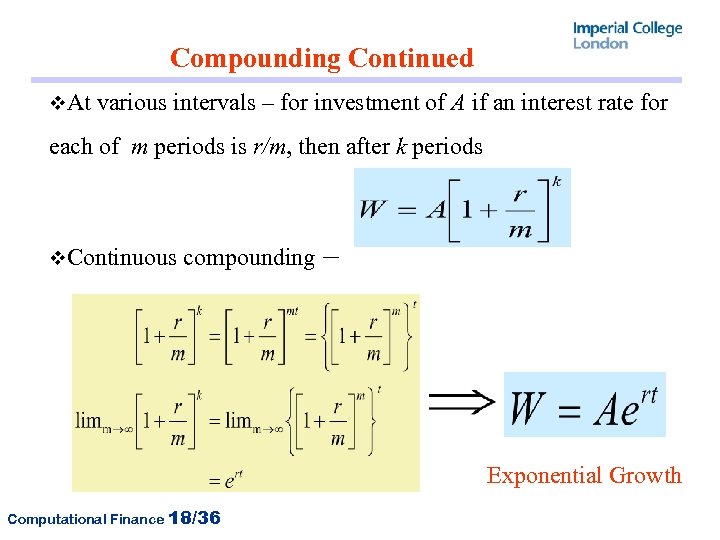 Compounding Continued v. At various intervals – for investment of A if an interest rate for each of m periods is r/m, then after k periods v. Continuous compounding – Exponential Growth Computational Finance 18/36
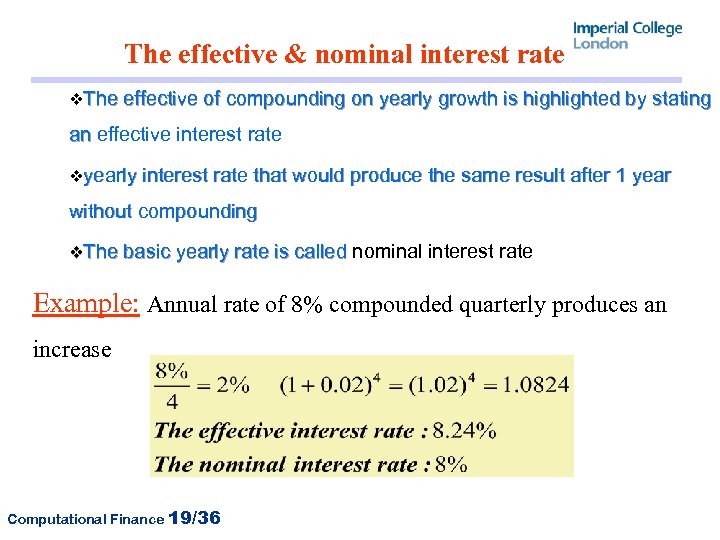 The effective & nominal interest rate v. The effective of compounding on yearly growth is highlighted by stating an effective interest rate vyearly interest rate that would produce the same result after 1 year without compounding v. The basic yearly rate is called nominal interest rate Example: Annual rate of 8% compounded quarterly produces an increase Computational Finance 19/36
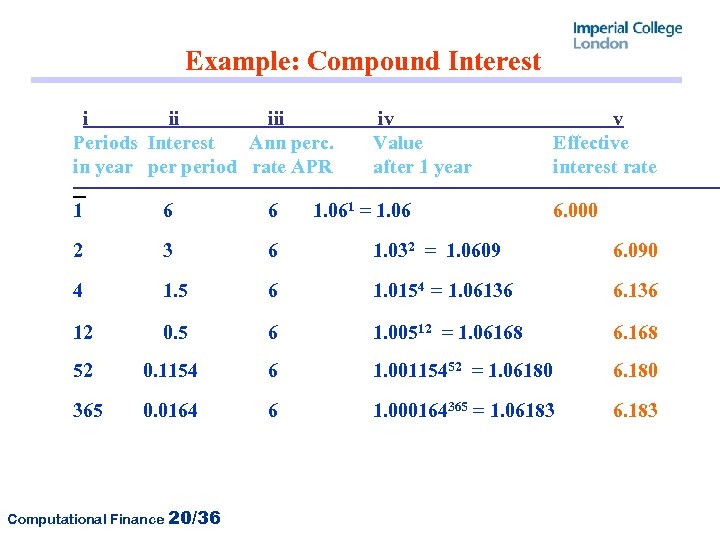 Example: Compound Interest i ii iii Periods Interest Ann perc. in year period rate APR iv Value after 1 year 1 6 6 2 3 6 1. 032 = 1. 0609 6. 090 4 1. 5 6 1. 0154 = 1. 06136 6. 136 12 0. 5 6 1. 00512 = 1. 06168 6. 168 52 0. 1154 6 1. 00115452 = 1. 06180 6. 180 365 0. 0164 6 1. 000164365 = 1. 06183 6. 183 Computational Finance 20/36 1. 061 = 1. 06 v Effective interest rate 6. 000

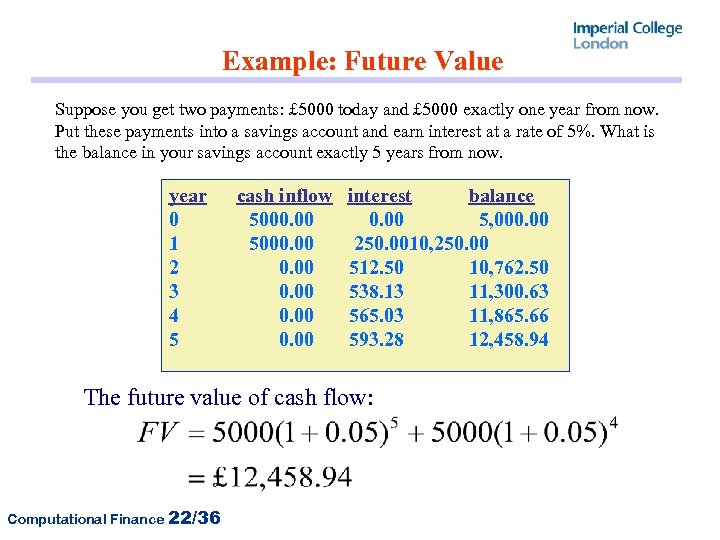 Example: Future Value Suppose you get two payments: £ 5000 today and £ 5000 exactly one year from now. Put these payments into a savings account and earn interest at a rate of 5%. What is the balance in your savings account exactly 5 years from now. year 0 1 2 3 4 5 cash inflow 5000. 00 interest balance 0. 00 5, 000. 00 250. 0010, 250. 00 512. 50 10, 762. 50 538. 13 11, 300. 63 565. 03 11, 865. 66 593. 28 12, 458. 94 The future value of cash flow: Computational Finance 22/36
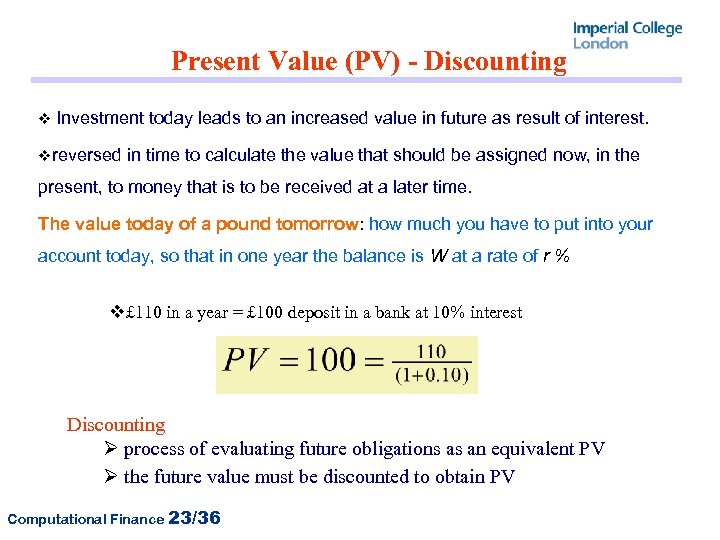 Present Value (PV) - Discounting v Investment today leads to an increased value in future as result of interest. vreversed in time to calculate the value that should be assigned now, in the present, to money that is to be received at a later time. The value today of a pound tomorrow: how much you have to put into your account today, so that in one year the balance is W at a rate of r % v£ 110 in a year = £ 100 deposit in a bank at 10% interest Discounting Ø process of evaluating future obligations as an equivalent PV Ø the future value must be discounted to obtain PV Computational Finance 23/36
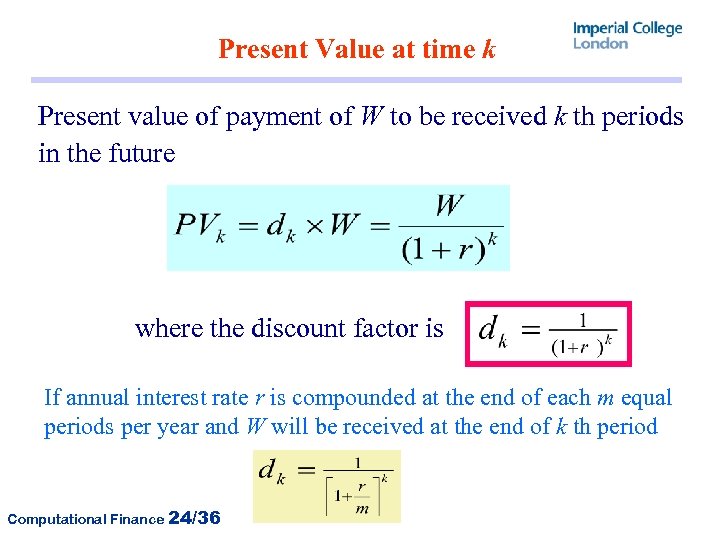 Present Value at time k Present value of payment of W to be received k th periods in the future where the discount factor is If annual interest rate r is compounded at the end of each m equal periods per year and W will be received at the end of k th period Computational Finance 24/36

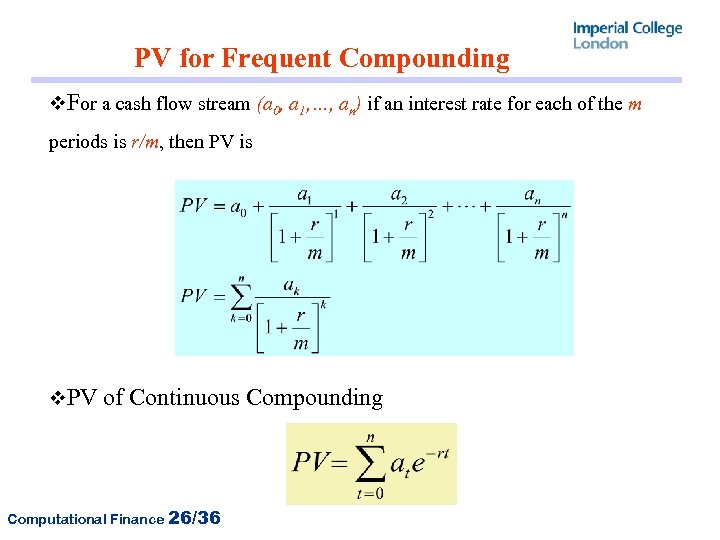 PV for Frequent Compounding v. For a cash flow stream (a 0, a 1, …, an) if an interest rate for each of the m periods is r/m, then PV is v. PV of Continuous Compounding Computational Finance 26/36
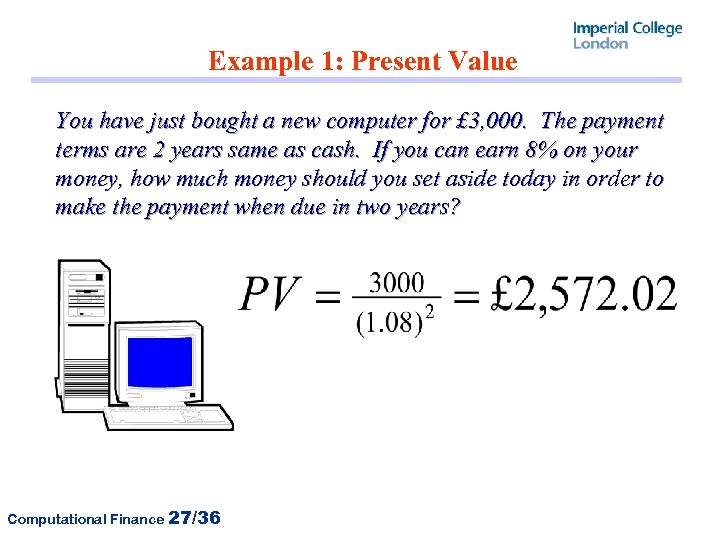 Example 1: Present Value You have just bought a new computer for £ 3, 000. The payment terms are 2 years same as cash. If you can earn 8% on your money, how much money should you set aside today in order to make the payment when due in two years? Computational Finance 27/36
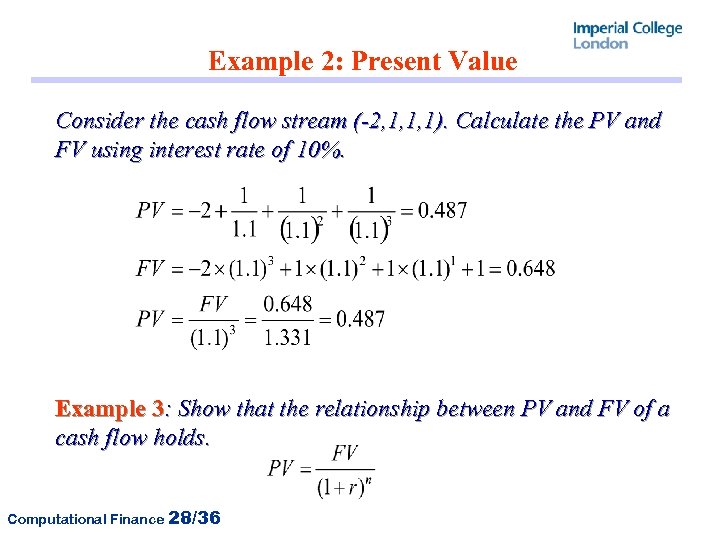 Example 2: Present Value Consider the cash flow stream (-2, 1, 1, 1). Calculate the PV and FV using interest rate of 10%. Example 3: Show that the relationship between PV and FV of a cash flow holds. Computational Finance 28/36
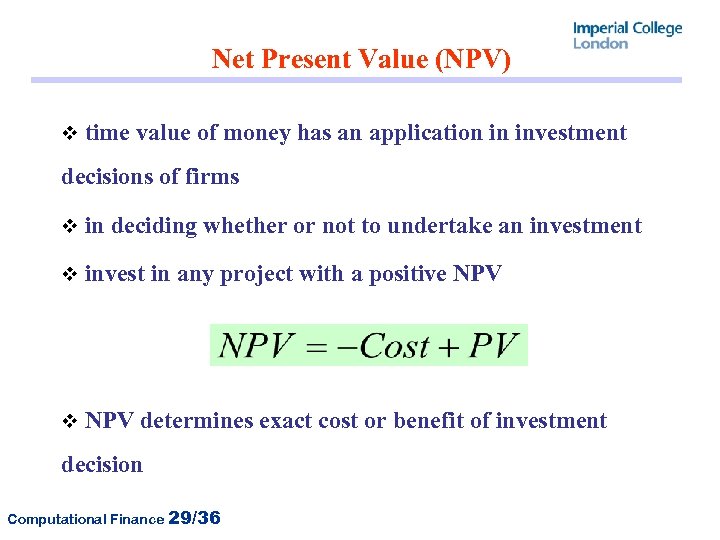 Net Present Value (NPV) v time value of money has an application in investment decisions of firms v in deciding whether or not to undertake an investment v invest in any project with a positive NPV v NPV determines exact cost or benefit of investment decision Computational Finance 29/36
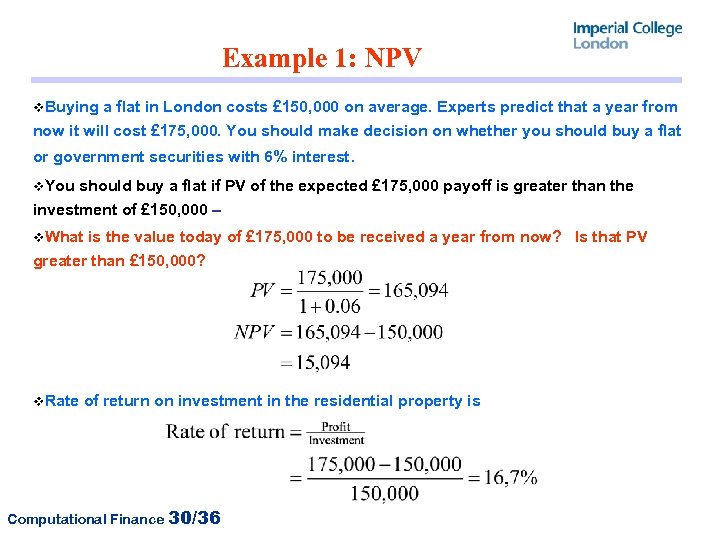 Example 1: NPV v. Buying a flat in London costs £ 150, 000 on average. Experts predict that a year from now it will cost £ 175, 000. You should make decision on whether you should buy a flat or government securities with 6% interest. v. You should buy a flat if PV of the expected £ 175, 000 payoff is greater than the investment of £ 150, 000 – v. What is the value today of £ 175, 000 to be received a year from now? Is that PV greater than £ 150, 000? v. Rate of return on investment in the residential property is Computational Finance 30/36
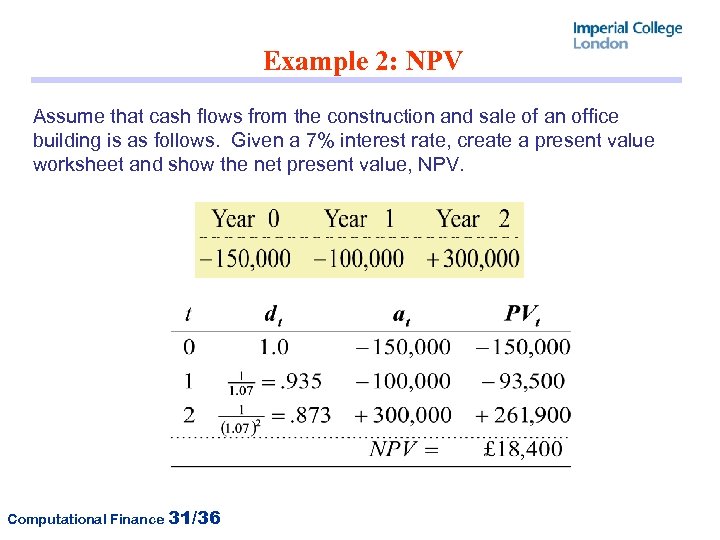 Example 2: NPV Assume that cash flows from the construction and sale of an office building is as follows. Given a 7% interest rate, create a present value worksheet and show the net present value, NPV. Computational Finance 31/36
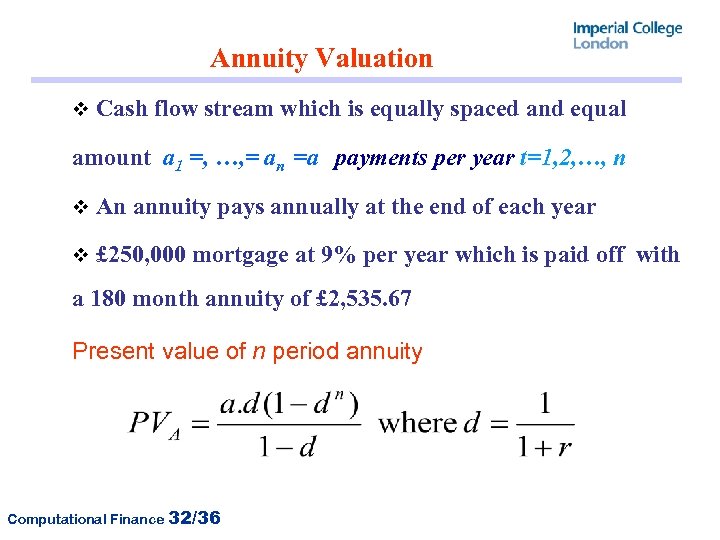 Annuity Valuation v Cash flow stream which is equally spaced and equal amount a 1 =, …, = an =a payments per year t=1, 2, …, n v An annuity pays annually at the end of each year v £ 250, 000 mortgage at 9% per year which is paid off with a 180 month annuity of £ 2, 535. 67 Present value of n period annuity Computational Finance 32/36
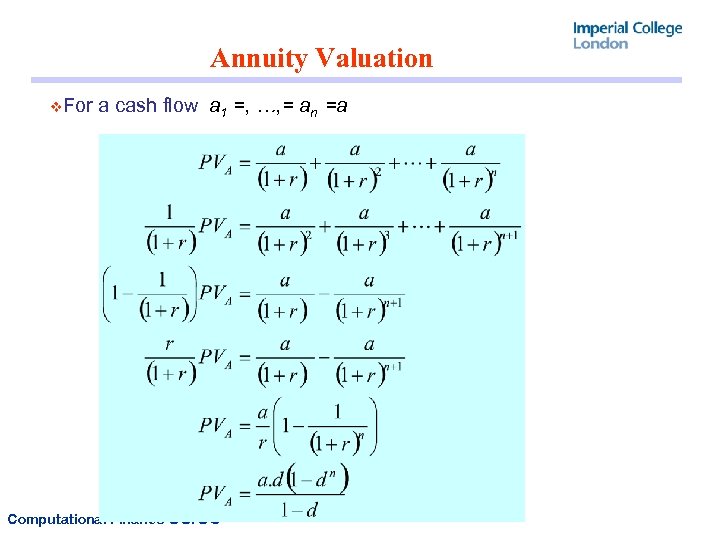 Annuity Valuation v. For a cash flow a 1 =, …, = an =a Computational Finance 33/36
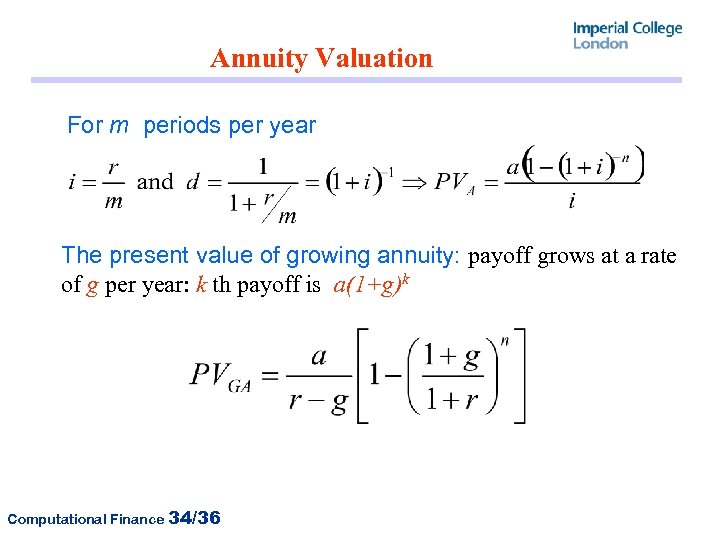 Annuity Valuation For m periods per year The present value of growing annuity: payoff grows at a rate of g per year: k th payoff is a(1+g)k Computational Finance 34/36
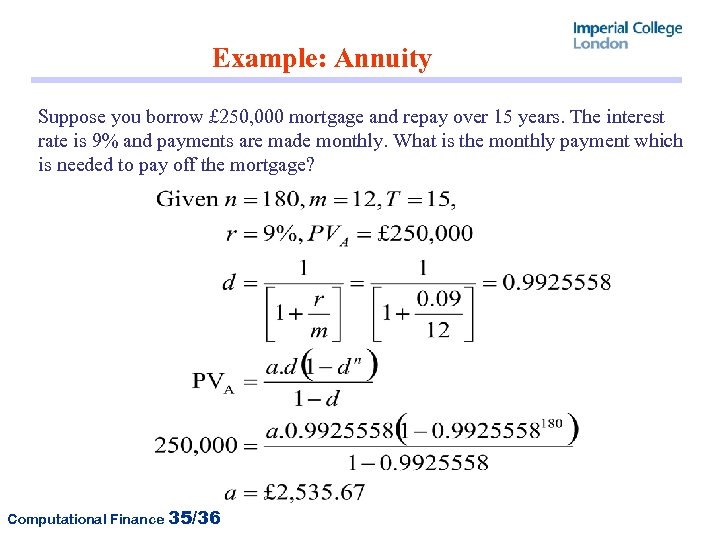 Example: Annuity Suppose you borrow £ 250, 000 mortgage and repay over 15 years. The interest rate is 9% and payments are made monthly. What is the monthly payment which is needed to pay off the mortgage? Computational Finance 35/36
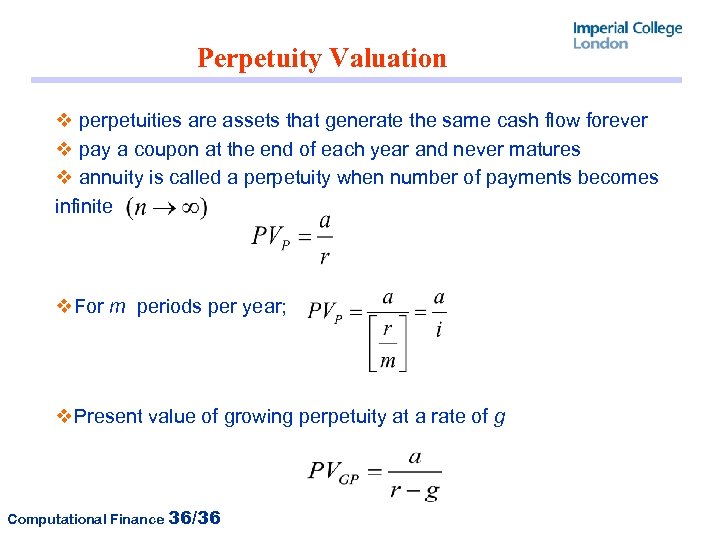 Perpetuity Valuation v perpetuities are assets that generate the same cash flow forever v pay a coupon at the end of each year and never matures v annuity is called a perpetuity when number of payments becomes infinite v. For m periods per year; v. Present value of growing perpetuity at a rate of g Computational Finance 36/36