


 Скачать презентацию Computational Engineering at Rolls-Royce Terry Hewitt EDS an
bf278e1546380d32d20183570c41af1e.ppt
- Количество слайдов: 30
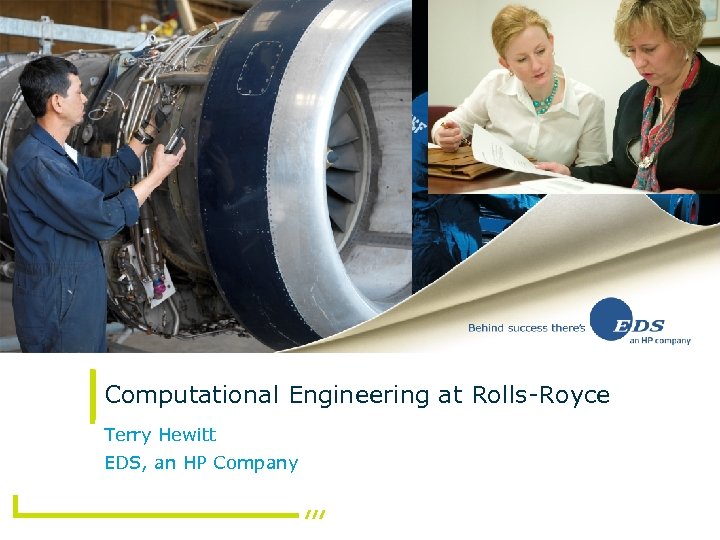 Computational Engineering at Rolls-Royce Terry Hewitt EDS, an HP Company
 Agenda EDS, an HP Company & Rolls-Royce Why do Rolls-Royce need HPC? What are the business benefits? HPC architecture Future Challenges Computational Engineering at Rolls-Royce - IDC 2 / October 2008 /
 Who EDS, an HP Company Division of HP that provides IT services • Some customers • GM, Department of Work & Pensions (UK), MOD, SKF, Rolls-Royce • Acquired • Me: April 2008 • EDS: September 2008 • Computational Engineering • HPC + visualization, data management, gird computing, engineering applications, workflow, …. Computational Engineering at Rolls-Royce - IDC 3 / October 2008 /
 WHY DO ROLLS-ROYCE NEED HPC? Computational Engineering at Rolls-Royce - IDC 4 / October 2008 /
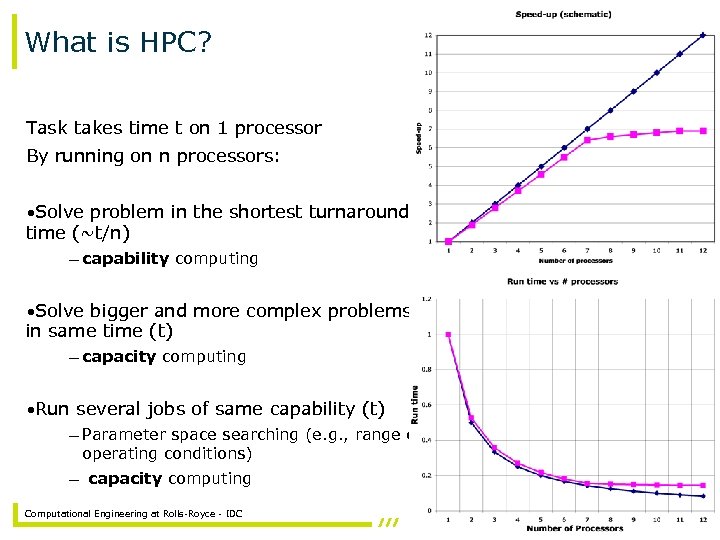 What is HPC? Task takes time t on 1 processor By running on n processors: • Solve problem in the shortest turnaround time (~t/n) — capability computing • Solve bigger and more complex problems in same time (t) — capacity computing • Run several jobs of same capability (t) — Parameter space searching (e. g. , range of operating conditions) — capacity computing Computational Engineering at Rolls-Royce - IDC 5 / October 2008 /
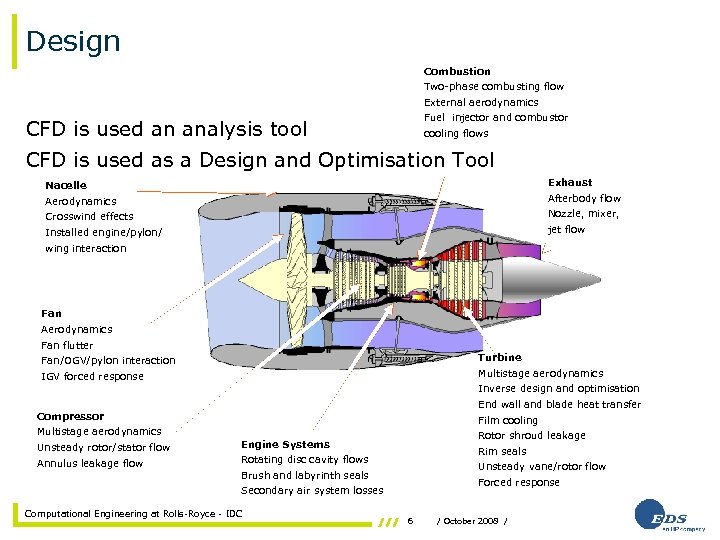 Design Combustion Two-phase combusting flow External aerodynamics Fuel injector and combustor CFD is used an analysis tool cooling flows CFD is used as a Design and Optimisation Tool Nacelle Exhaust Aerodynamics Afterbody flow Crosswind effects Nozzle, mixer, Installed engine/pylon/ jet flow wing interaction Fan Aerodynamics Fan flutter Fan/OGV/pylon interaction Turbine IGV forced response Multistage aerodynamics Inverse design and optimisation End wall and blade heat transfer Compressor Film cooling Multistage aerodynamics Unsteady rotor/stator flow Annulus leakage flow Rotor shroud leakage Engine Systems Rotating disc cavity flows Rim seals Unsteady vane/rotor flow Brush and labyrinth seals Forced response Secondary air system losses Computational Engineering at Rolls-Royce - IDC 6 / October 2008 /
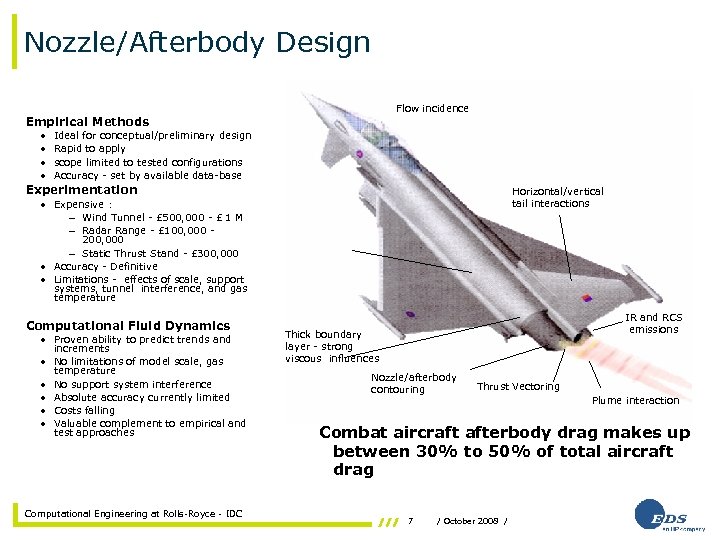 Nozzle/Afterbody Design Flow incidence Empirical Methods • • Ideal for conceptual/preliminary design Rapid to apply scope limited to tested configurations Accuracy - set by available data-base Experimentation Horizontal/vertical tail interactions • Expensive : — Wind Tunnel - £ 500, 000 - £ 1 M — Radar Range - £ 100, 000 - 200, 000 — Static Thrust Stand - £ 300, 000 • Accuracy - Definitive • Limitations - effects of scale, support systems, tunnel interference, and gas temperature Computational Fluid Dynamics • Proven ability to predict trends and increments • No limitations of model scale, gas temperature • No support system interference • Absolute accuracy currently limited • Costs falling • Valuable complement to empirical and test approaches Computational Engineering at Rolls-Royce - IDC IR and RCS emissions Thick boundary layer - strong viscous influences Nozzle/afterbody contouring Thrust Vectoring Plume interaction Combat aircraft afterbody drag makes up between 30% to 50% of total aircraft drag 7 / October 2008 /
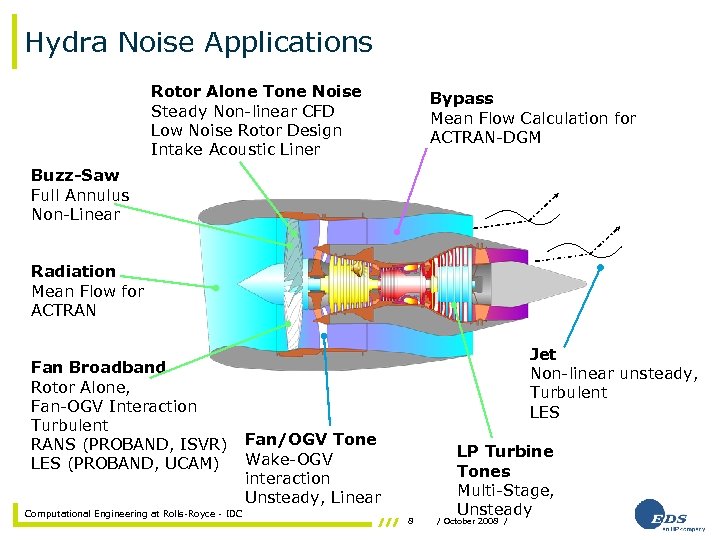 Hydra Noise Applications Rotor Alone Tone Noise Steady Non-linear CFD Low Noise Rotor Design Intake Acoustic Liner Bypass Mean Flow Calculation for ACTRAN-DGM Buzz-Saw Full Annulus Non-Linear Radiation Mean Flow for ACTRAN Fan Broadband Rotor Alone, Fan-OGV Interaction Turbulent RANS (PROBAND, ISVR) LES (PROBAND, UCAM) Computational Engineering at Rolls-Royce - IDC Jet Non-linear unsteady, Turbulent LES Fan/OGV Tone Wake-OGV interaction Unsteady, Linear 8 LP Turbine Tones Multi-Stage, Unsteady / October 2008 /
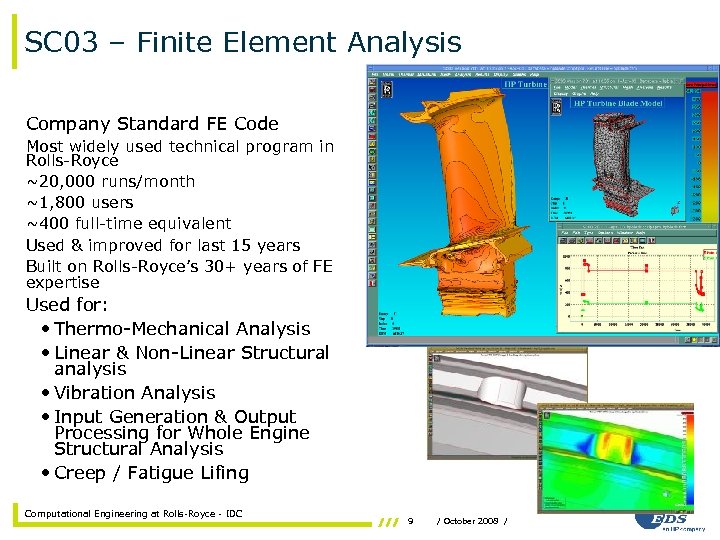 SC 03 – Finite Element Analysis Company Standard FE Code Most widely used technical program in Rolls-Royce ~20, 000 runs/month ~1, 800 users ~400 full-time equivalent Used & improved for last 15 years Built on Rolls-Royce’s 30+ years of FE expertise Used for: • Thermo-Mechanical Analysis • Linear & Non-Linear Structural analysis • Vibration Analysis • Input Generation & Output Processing for Whole Engine Structural Analysis • Creep / Fatigue Lifing Computational Engineering at Rolls-Royce - IDC 9 / October 2008 /
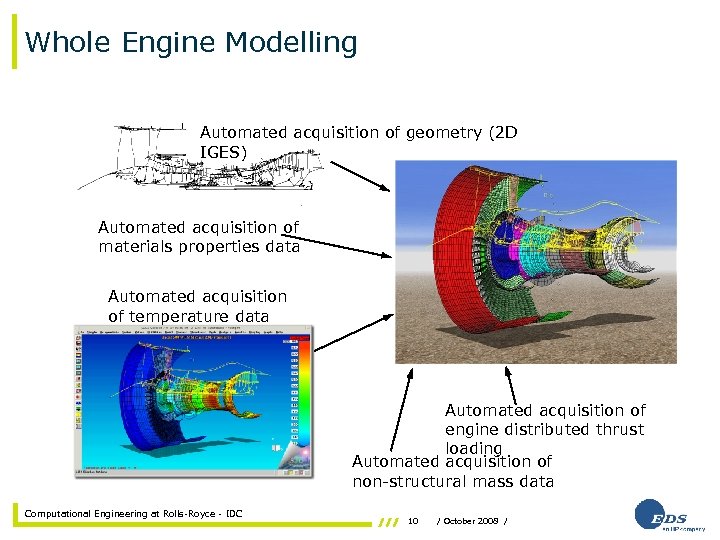 Whole Engine Modelling Automated acquisition of geometry (2 D IGES) Automated acquisition of materials properties data Automated acquisition of temperature data Automated acquisition of engine distributed thrust loading Automated acquisition of non-structural mass data Computational Engineering at Rolls-Royce - IDC 10 / October 2008 /
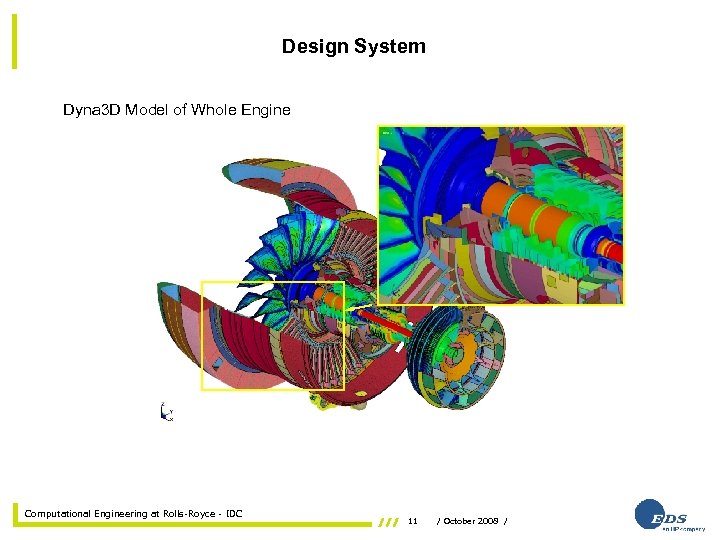 Design System Dyna 3 D Model of Whole Engine Computational Engineering at Rolls-Royce - IDC 11 / October 2008 /
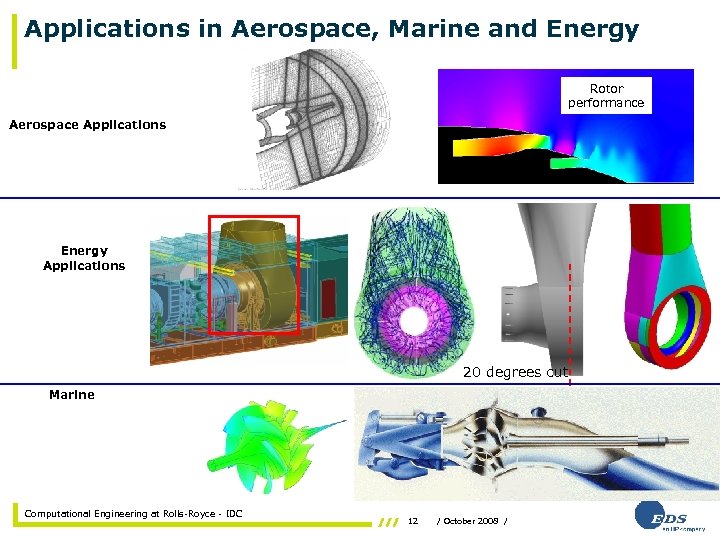 Applications in Aerospace, Marine and Energy Rotor performance Aerospace Applications Energy Applications 20 degrees cut Marine Computational Engineering at Rolls-Royce - IDC 12 / October 2008 /
 BUSINESS BENEFITS
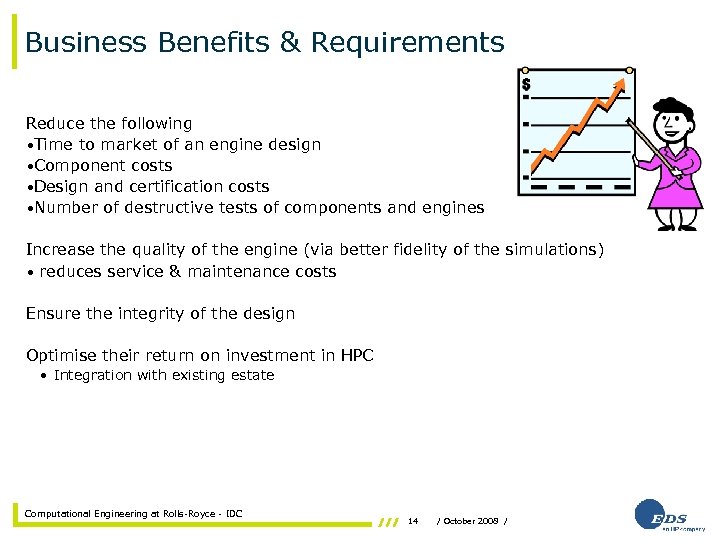 Business Benefits & Requirements Reduce the following • Time to market of an engine design • Component costs • Design and certification costs • Number of destructive tests of components and engines Increase the quality of the engine (via better fidelity of the simulations) • reduces service & maintenance costs Ensure the integrity of the design Optimise their return on investment in HPC • Integration with existing estate Computational Engineering at Rolls-Royce - IDC 14 / October 2008 /
 HPC ARCHITECTURE
 A brief note on status The material presented is in one of the following states • Installed & working • On Order (delivery within some weeks) • Planned (have the money but must do above 1 st) • Aspirational (we haven’t got the money yet) Computational Engineering at Rolls-Royce - IDC 16 / October 2008 /
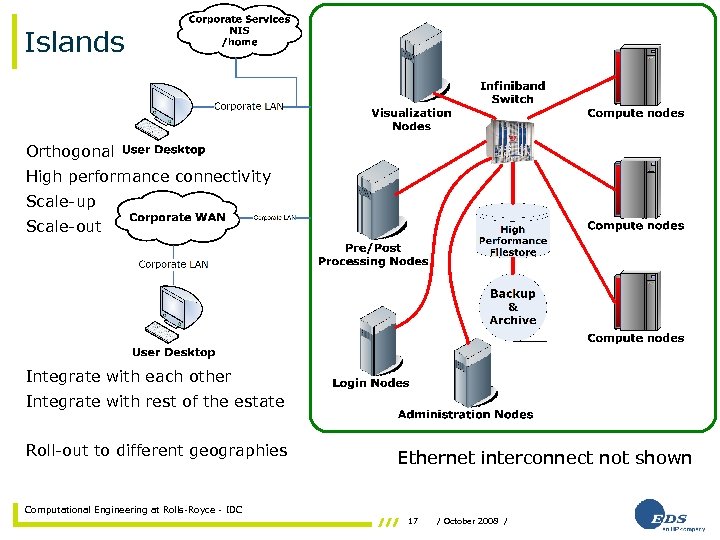 Islands Orthogonal High performance connectivity Scale-up Scale-out Integrate with each other Integrate with rest of the estate Roll-out to different geographies Ethernet interconnect not shown Computational Engineering at Rolls-Royce - IDC 17 / October 2008 /
 Administration/Information Island Hosts Sun Grid Engine Master – Job management Hosts resource management • allocation, modification, reporting Must provide failover Provide an Information Service • availability of nodes No user logins! More commonly know as Head nodes Computational Engineering at Rolls-Royce - IDC 18 / October 2008 /
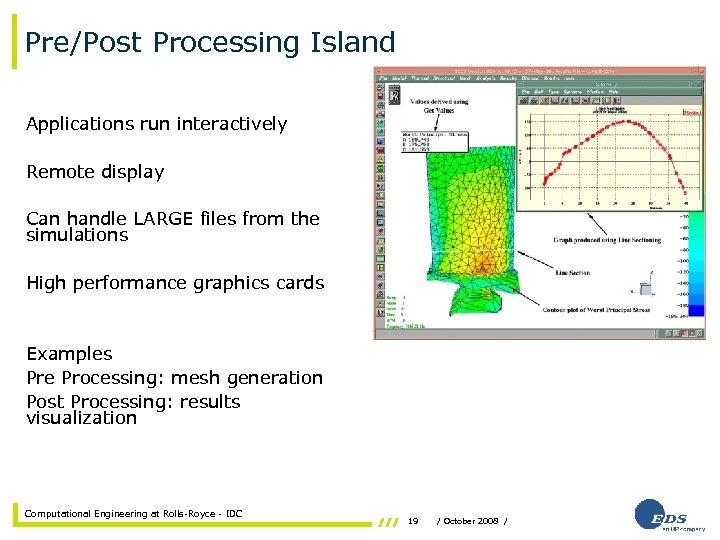 Pre/Post Processing Island Applications run interactively Remote display Can handle LARGE files from the simulations High performance graphics cards Examples Pre Processing: mesh generation Post Processing: results visualization Computational Engineering at Rolls-Royce - IDC 19 / October 2008 /
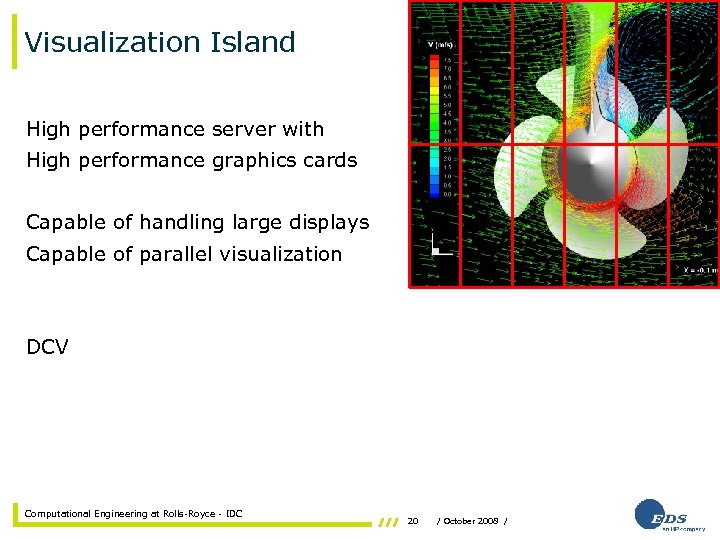 Visualization Island High performance server with High performance graphics cards Capable of handling large displays Capable of parallel visualization DCV Computational Engineering at Rolls-Royce - IDC 20 / October 2008 /
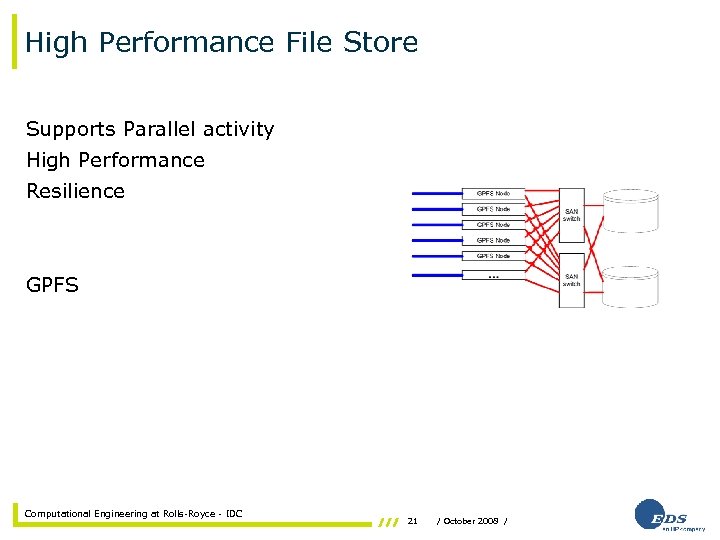 High Performance File Store Supports Parallel activity High Performance Resilience GPFS Computational Engineering at Rolls-Royce - IDC 21 / October 2008 /
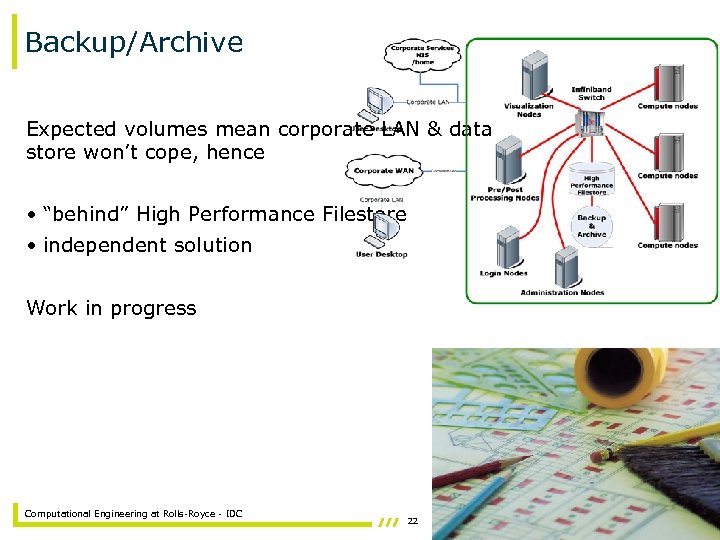 Backup/Archive Expected volumes mean corporate LAN & data store won’t cope, hence • “behind” High Performance Filestore • independent solution Work in progress Computational Engineering at Rolls-Royce - IDC 22 / October 2008 /
 Compute Island Each Compute Island may have different processor architectures to reflect different application requirements different purchase points Differences • Processor (sockets/node, # cores, clock frequency) • Memory • Interconnect Computational Engineering at Rolls-Royce - IDC 23 / October 2008 /
 WHY DOES HPC WORK? Computational Engineering at Rolls-Royce - IDC 24 / October 2008 /
 What made HPC successful? Champions in Rolls-Royce • Vision • Develop a suitable business case • Management prepared to take a risk Applicable software available • Relationship with academia to fill gaps Some problems can’t be solved any other way Expertise in EDS Computational Engineering at Rolls-Royce - IDC 25 / October 2008 /
 FUTURE PROBLEMS Computational Engineering at Rolls-Royce - IDC 26 / October 2008 /
 Internal Problems • Space & Power Maintain coherency as architectures change Join the islands together around the world Use desktops overnight to supplement capacity ISV vs in-House codes • reduce s/w development/maintenance costs by using ISV in lieu of in-house codes • possible lack of competitive edge (in-house codes contain features not in ISVs) Computational Engineering at Rolls-Royce - IDC 27 / October 2008 /
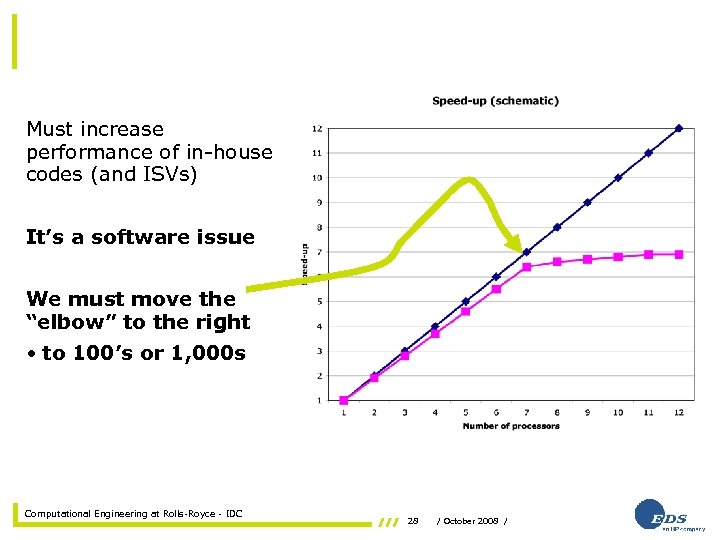 Must increase performance of in-house codes (and ISVs) It’s a software issue We must move the “elbow” to the right • to 100’s or 1, 000 s Computational Engineering at Rolls-Royce - IDC 28 / October 2008 /
 THANK YOU FOR LISTENING
 EDS 5400 Legacy Drive Plano, TX 75024 +1 972 605 6000 (optional) first. lastname@eds. com or eds. com EDS and the EDS logo are registered trademarks of Hewlett-Packard Development Company, LP. HP is an equal opportunity employer and values the diversity of its people. © 2008 Hewlett-Packard Development Company, LP. Computational Engineering at Rolls-Royce - IDC 30 / October 2008 /