 Скачать презентацию Computability and Complexity 13 -1 The Class NP
414dba9fde3496b88c585ad97a8e4b5a.ppt
- Количество слайдов: 20



Computability and Complexity 13 -1 The Class NP Computability and Complexity Andrei Bulatov
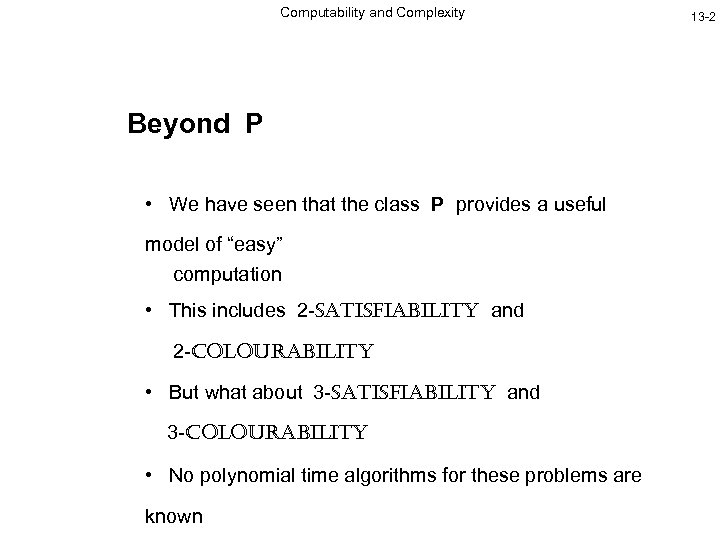
Computability and Complexity Beyond P • We have seen that the class P provides a useful model of “easy” computation • This includes 2 -satisfiability and 2 -colourability • But what about 3 -satisfiability and 3 -colourability • No polynomial time algorithms for these problems are known 13 -2
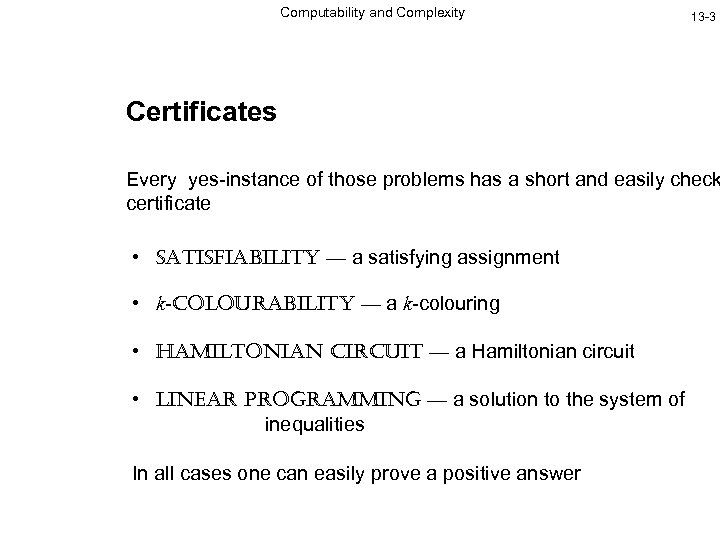
Computability and Complexity 13 -3 Certificates Every yes-instance of those problems has a short and easily check certificate • satisfiability — a satisfying assignment • k-colourability — a k-colouring • Hamiltonian circuit — a Hamiltonian circuit • linear Programming — a solution to the system of inequalities In all cases one can easily prove a positive answer
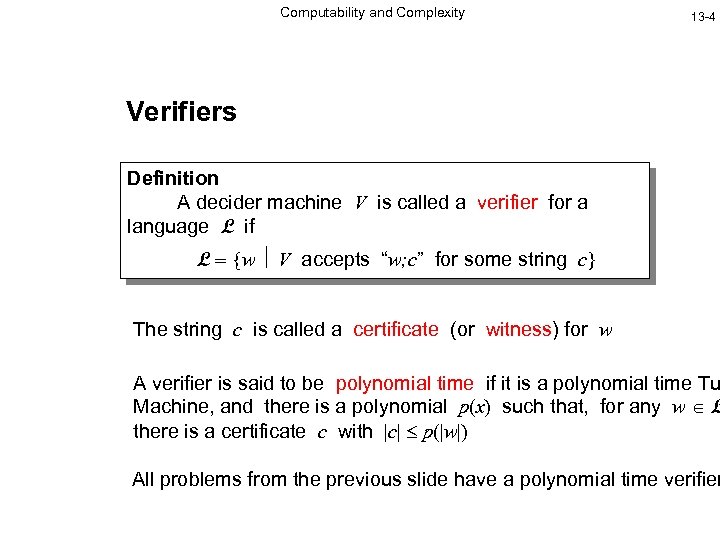
Computability and Complexity 13 -4 Verifiers Definition A decider machine V is called a verifier for a language L if L w V accepts “w; c” for some string c The string c is called a certificate (or witness) for w A verifier is said to be polynomial time if it is a polynomial time Tu Machine, and there is a polynomial p(x) such that, for any w L there is a certificate c with |c| p(|w|) All problems from the previous slide have a polynomial time verifier
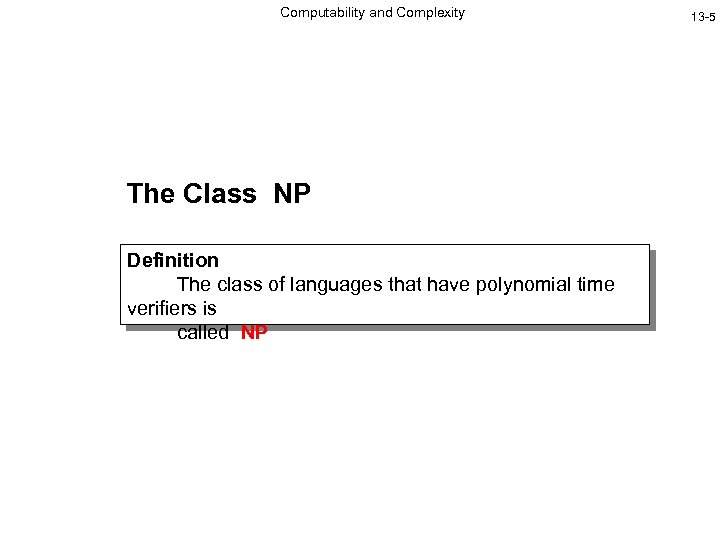
Computability and Complexity The Class NP Definition The class of languages that have polynomial time verifiers is called NP 13 -5
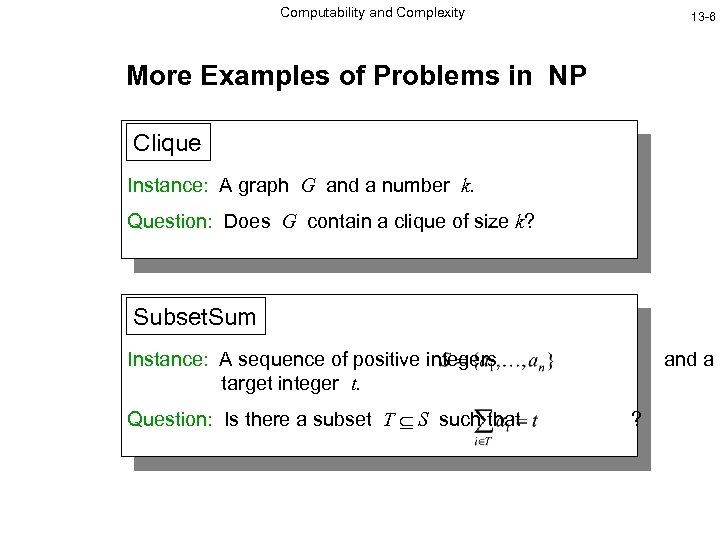
Computability and Complexity 13 -6 More Examples of Problems in NP Clique Instance: A graph G and a number k. Question: Does G contain a clique of size k? Subset. Sum Instance: A sequence of positive integers target integer t. Question: Is there a subset T S such that and a ?
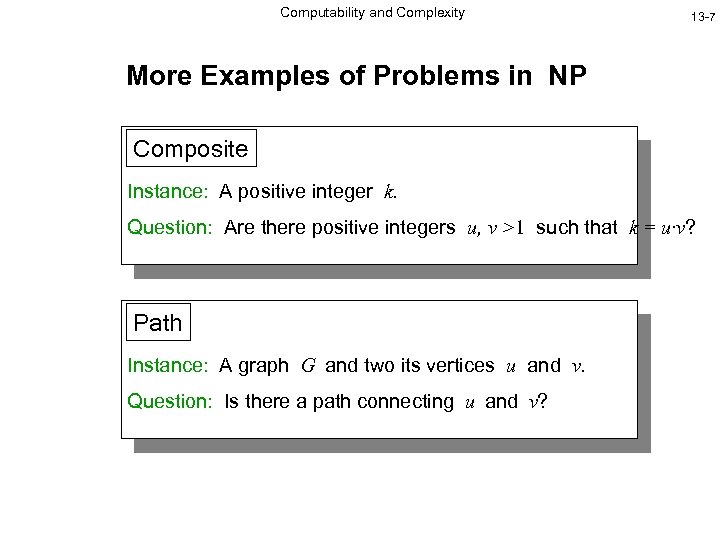
Computability and Complexity 13 -7 More Examples of Problems in NP Composite Instance: A positive integer k. Question: Are there positive integers u, v >1 such that k = u·v? Path Instance: A graph G and two its vertices u and v. Question: Is there a path connecting u and v?
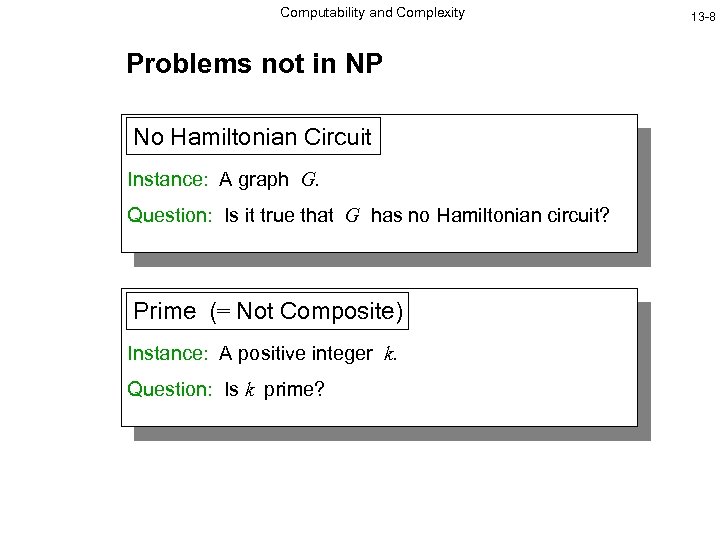
Computability and Complexity Problems not in NP No Hamiltonian Circuit Instance: A graph G. Question: Is it true that G has no Hamiltonian circuit? Prime (= Not Composite) Instance: A positive integer k. Question: Is k prime? 13 -8
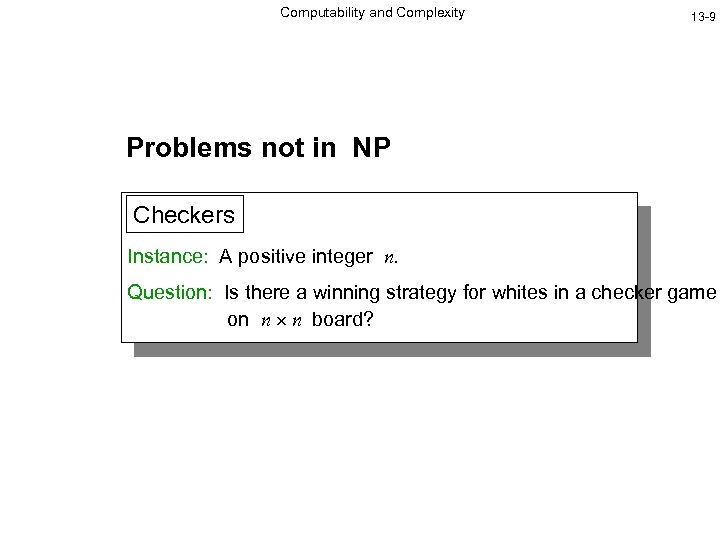
Computability and Complexity 13 -9 Problems not in NP Checkers Instance: A positive integer n. Question: Is there a winning strategy for whites in a checker game on n n board?
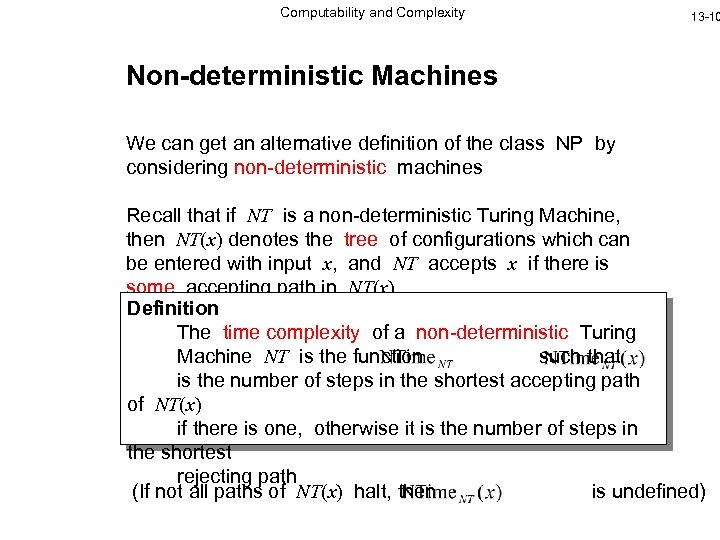
Computability and Complexity 13 -10 Non-deterministic Machines We can get an alternative definition of the class NP by considering non-deterministic machines Recall that if NT is a non-deterministic Turing Machine, then NT(x) denotes the tree of configurations which can be entered with input x, and NT accepts x if there is some accepting path in NT(x) Definition The time complexity of a non-deterministic Turing Machine NT is the function such that is the number of steps in the shortest accepting path of NT(x) if there is one, otherwise it is the number of steps in the shortest rejecting path (If not all paths of NT(x) halt, then is undefined)
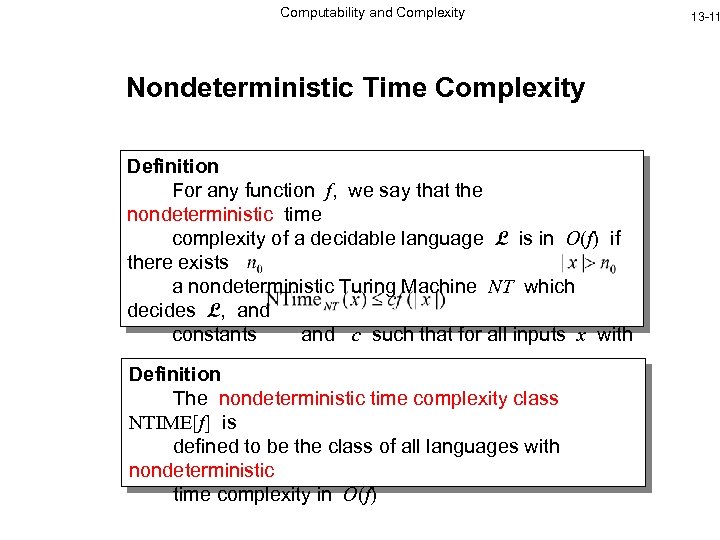
Computability and Complexity Nondeterministic Time Complexity Definition For any function f, we say that the nondeterministic time complexity of a decidable language L is in O(f) if there exists a nondeterministic Turing Machine NT which decides L, and constants and c such that for all inputs x with Definition The nondeterministic time complexity class NTIME[f] is defined to be the class of all languages with nondeterministic time complexity in O(f) 13 -11
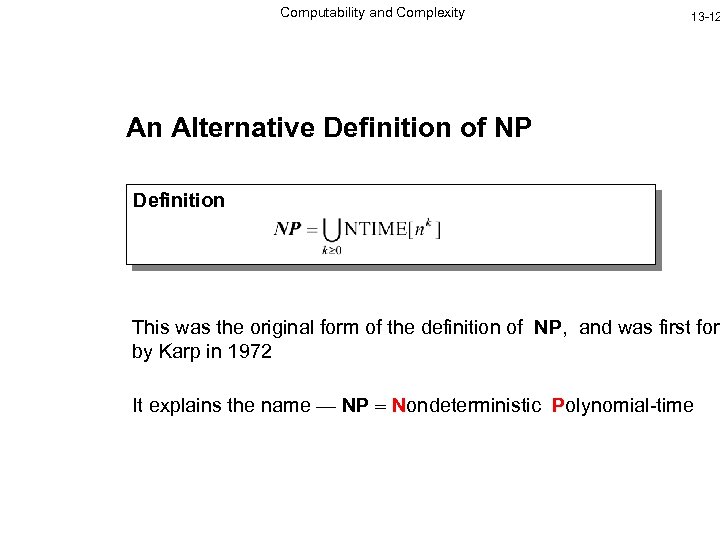
Computability and Complexity 13 -12 An Alternative Definition of NP Definition This was the original form of the definition of NP, and was first form by Karp in 1972 It explains the name — NP Nondeterministic Polynomial-time
Computability and Complexity 13 -13 Equivalence Theorem The two definitions of NP are equivalent Proof: • If , then there is a nondeterministic mach NT such that x L if and only if there is an accepting compu path in NT(x). Furthermore, the length of these paths is in Using (some encoding of) these computation paths as the cer we can construct a polynomial time verifier for L which simpl that each step of the computation path is valid
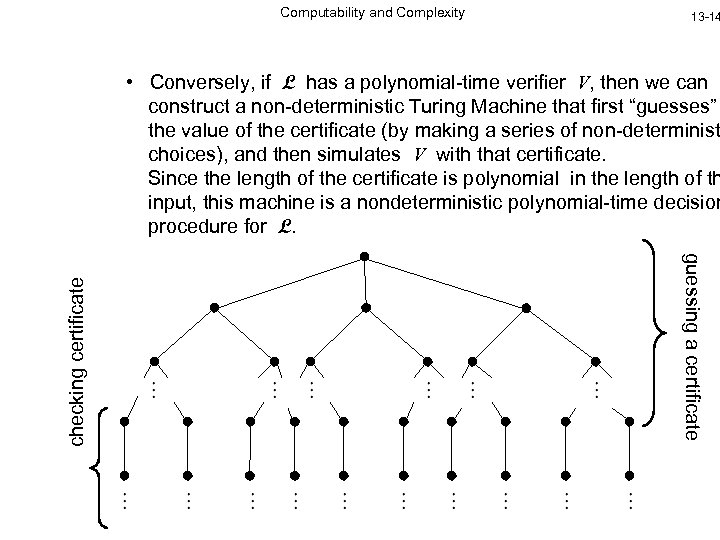
Computability and Complexity 13 -14 guessing a certificate checking certificate • Conversely, if L has a polynomial-time verifier V, then we can construct a non-deterministic Turing Machine that first “guesses” the value of the certificate (by making a series of non-determinist choices), and then simulates V with that certificate. Since the length of the certificate is polynomial in the length of th input, this machine is a nondeterministic polynomial-time decision procedure for L.
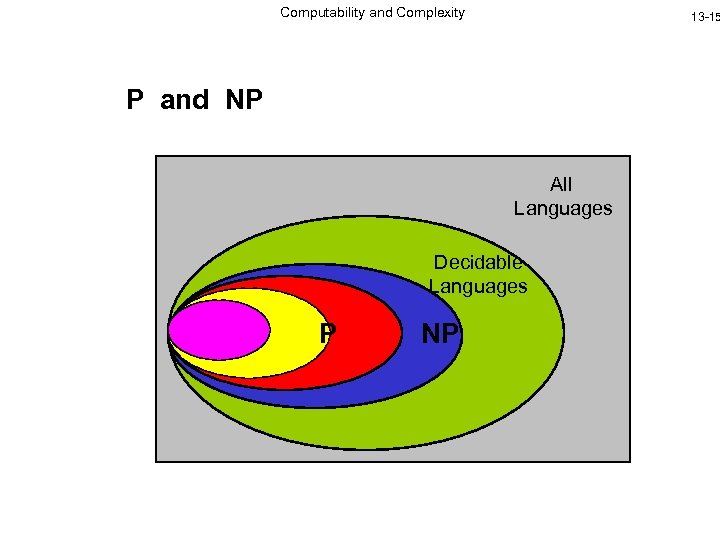
Computability and Complexity 13 -15 P and NP All Languages Decidable Languages P NP
Computability and Complexity 13 -16 P NP? The question of whether or not P NP is one of the biggest open problems in computer science • It is equivalent to determining whether or not the existence of a solution guarantees an efficient way to find that solution • Virtually everyone is convinced that P NP, but after 30 years of effort there is still no proof • Resolving this question (either way) would win a prize of $1 mill see http: //www. claymath. org/prize_problems
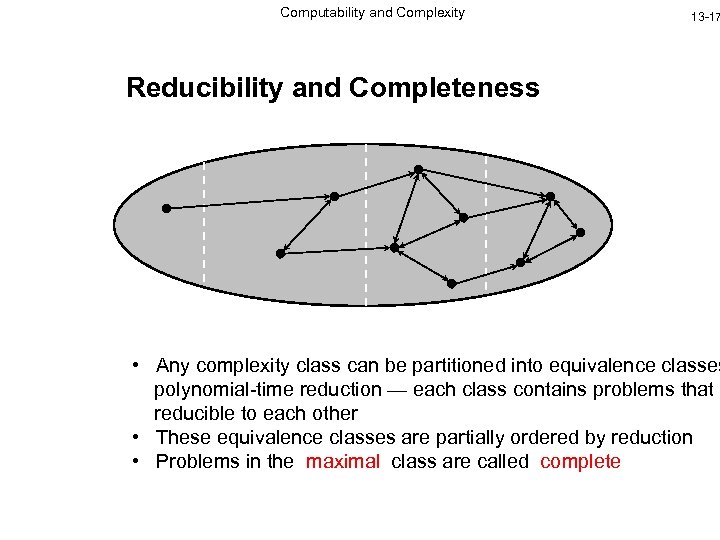
Computability and Complexity 13 -17 Reducibility and Completeness • Any complexity class can be partitioned into equivalence classes polynomial-time reduction — each class contains problems that a reducible to each other • These equivalence classes are partially ordered by reduction • Problems in the maximal class are called complete
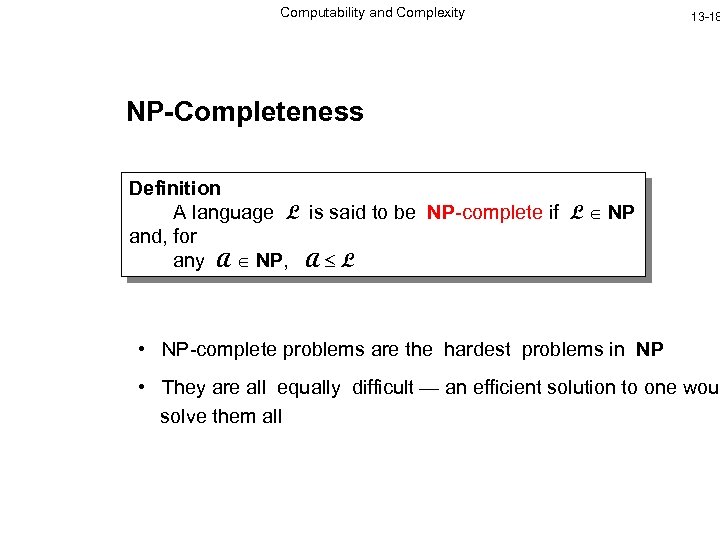
Computability and Complexity 13 -18 NP-Completeness Definition A language L is said to be NP-complete if L NP and, for any A NP, A L • NP-complete problems are the hardest problems in NP • They are all equally difficult — an efficient solution to one woul solve them all
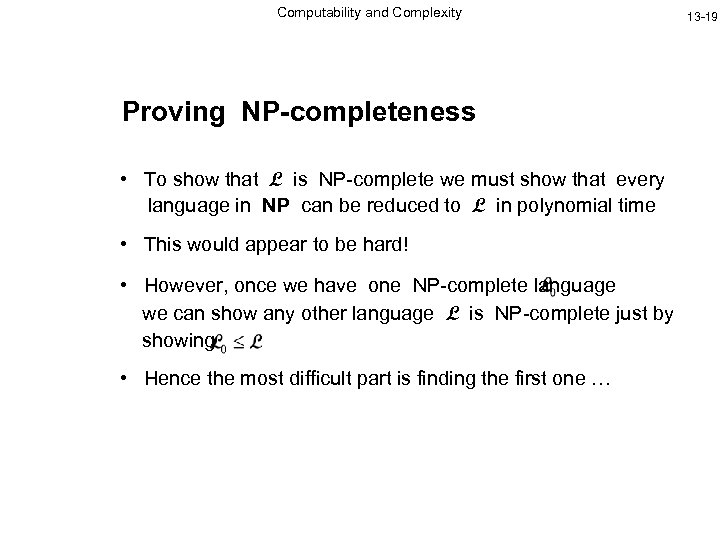
Computability and Complexity Proving NP-completeness • To show that L is NP-complete we must show that every language in NP can be reduced to L in polynomial time • This would appear to be hard! • However, once we have one NP-complete language we can show any other language L is NP-complete just by showing • Hence the most difficult part is finding the first one … 13 -19
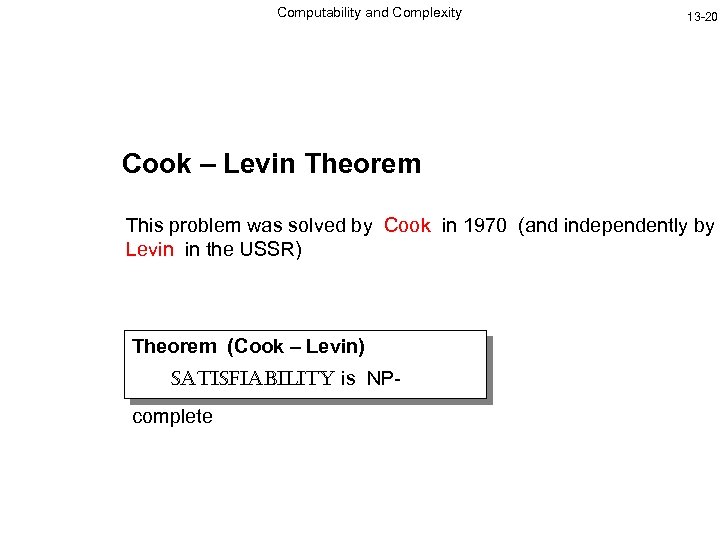
Computability and Complexity 13 -20 Cook – Levin Theorem This problem was solved by Cook in 1970 (and independently by Levin in the USSR) Theorem (Cook – Levin) satisfiability is NPcomplete
Скачать презентацию Computability and Complexity 13 -1 The Class NP
414dba9fde3496b88c585ad97a8e4b5a.ppt