


 Скачать презентацию Composting Systems An Overview Michael Massey Horse Manure
16fb920100d76575a4fdbf052d86f8d0.ppt
- Количество слайдов: 24
 Composting Systems: An Overview Michael Massey Horse Manure Mgmt. , Spring 2007 February 1, 2007
 Composting Systems? • Theory is nice, but how do you do it? • Each system is site-specific • Your system is “engineered” to fit your situation • Different types involve tradeoffs between numerous factors such as management requirements, cost, and performance
 Factors to Consider • • Number of horses (amount of manure) Bedding volume/type Space limitations, equipment size Local climate (rainy? Semi-arid like CO? ) Budget (initial and operating costs) Labor and management requirements Neighbors, odor issues, local regulations Water quality (keep away from streams, etc. )
 Common Ways to Compost
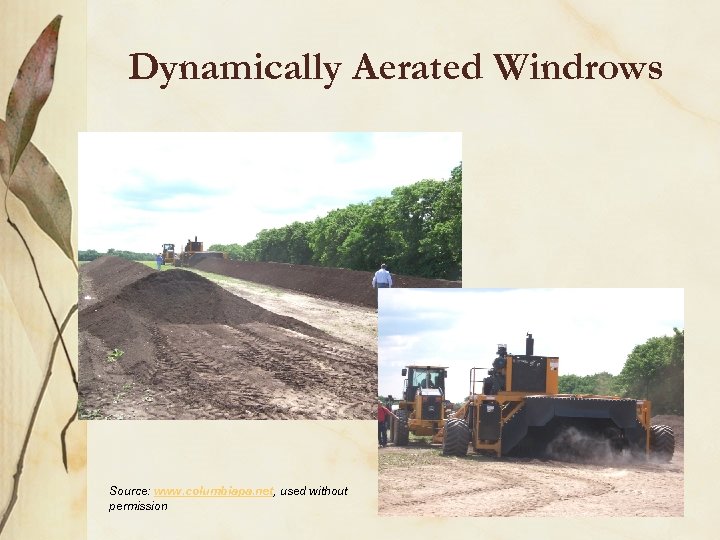 Dynamically Aerated Windrows Source: www. columbiapa. net, used without permission
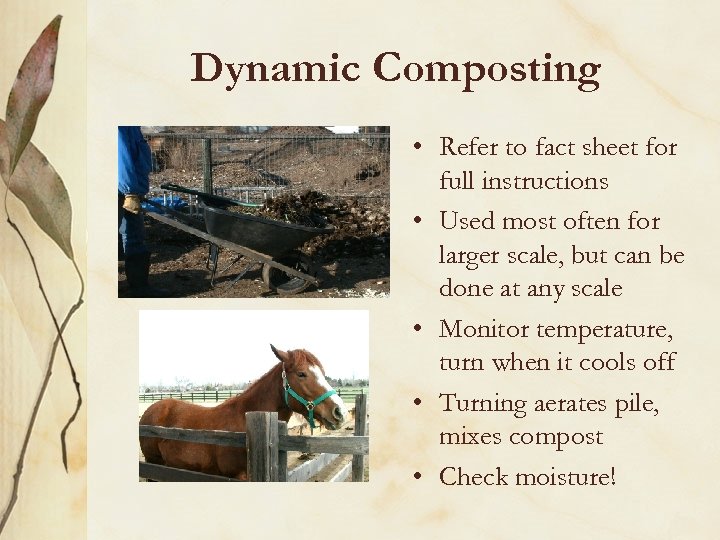 Dynamic Composting • Refer to fact sheet for full instructions • Used most often for larger scale, but can be done at any scale • Monitor temperature, turn when it cools off • Turning aerates pile, mixes compost • Check moisture!
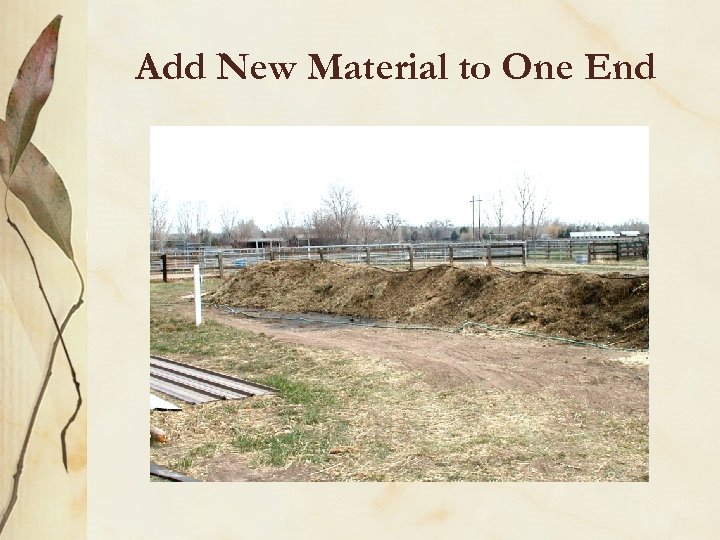 Add New Material to One End
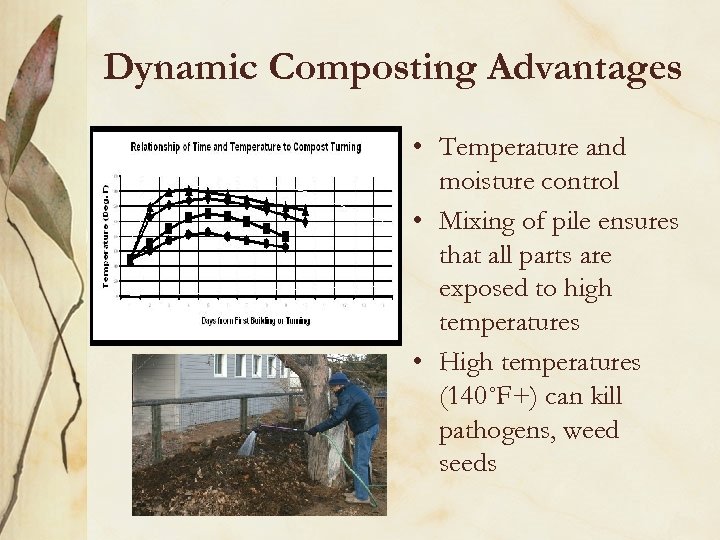 Dynamic Composting Advantages • Temperature and moisture control • Mixing of pile ensures that all parts are exposed to high temperatures • High temperatures (140˚F+) can kill pathogens, weed seeds
 What’s the Catch? • Dynamic composting requires either equipment (such as a compost turner, front end loader, etc. ) or a lot of sweat! • Equipment is expensive to purchase and maintain, and is not always properly sized to be practical for smaller operations • Fuel cost, labor time
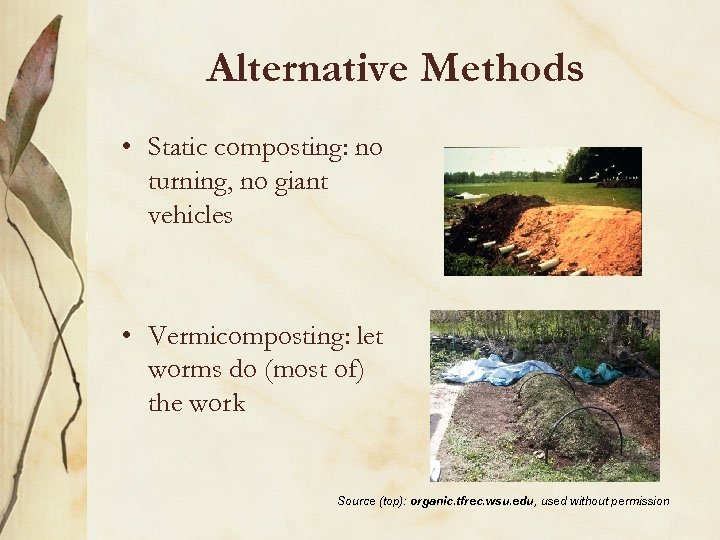 Alternative Methods • Static composting: no turning, no giant vehicles • Vermicomposting: let worms do (most of) the work Source (top): organic. tfrec. wsu. edu, used without permission
 Types of Static Composting • Passive aeration (PA): Air is drawn up into the compost through “perforated pipes” at the bottom of the pile • Forced (“active”) aeration (FA): Air is pumped in with a fan or blower • Natural aeration (NA): There is no method for delivery of air to the compost, only diffusion from the surrounding air
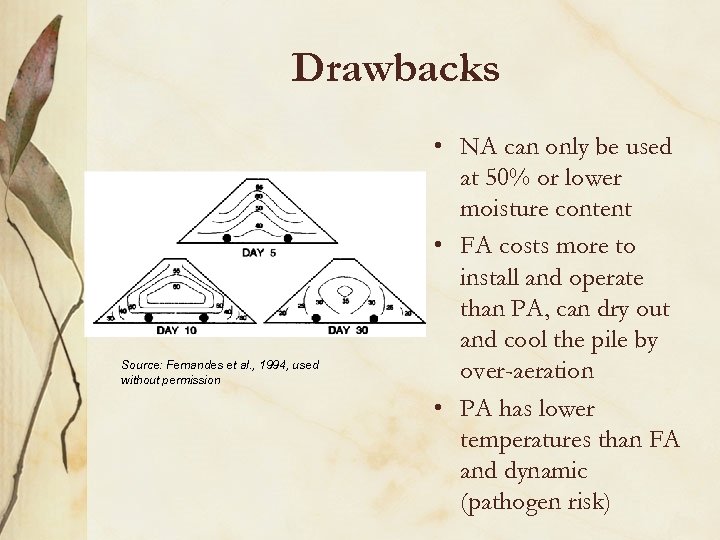 Drawbacks Source: Fernandes et al. , 1994, used without permission • NA can only be used at 50% or lower moisture content • FA costs more to install and operate than PA, can dry out and cool the pile by over-aeration • PA has lower temperatures than FA and dynamic (pathogen risk)
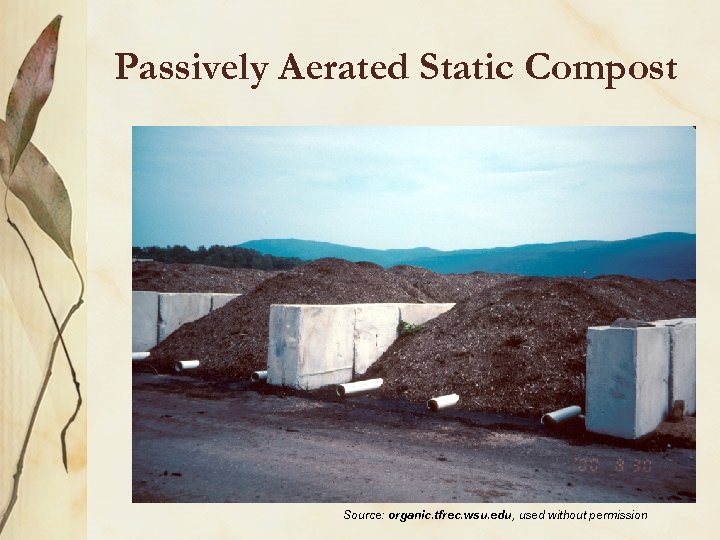 Passively Aerated Static Compost Source: organic. tfrec. wsu. edu, used without permission
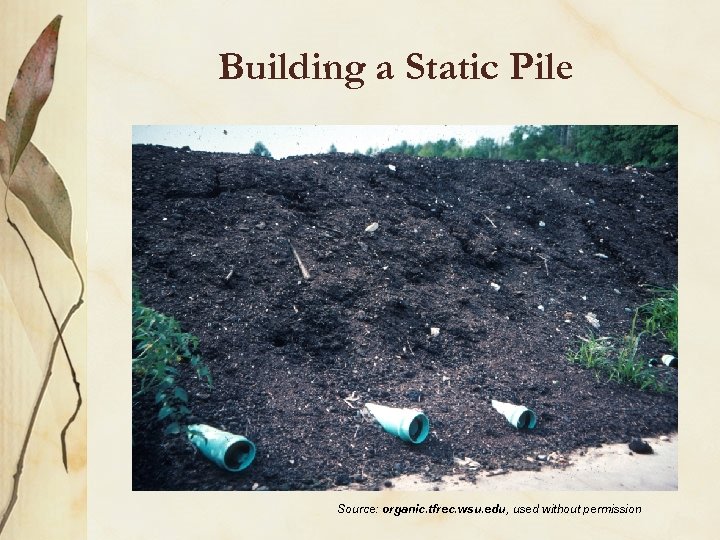 Building a Static Pile Source: organic. tfrec. wsu. edu, used without permission
 How to Build a Static Pile • • • Porous bottom layer Evenly spaced perforated pipes Layers of manure, bedding, etc. Mulch or finished compost layer on top See details in extension publication 1. 226 For active aeration, attach aeration pipe(s) to fan or blower (hopefully with timer)
 Shopping List for Passively Aerated Static Composting • 10 cm (4”) diameter perforated pipes (PVC or metal) with 0. 5 -1” holes spaced 6 -12” apart, 10’ long • Screen to cover holes if facing upward • Wood chips, finished compost, or peat to make base layer and to cover outside of pile
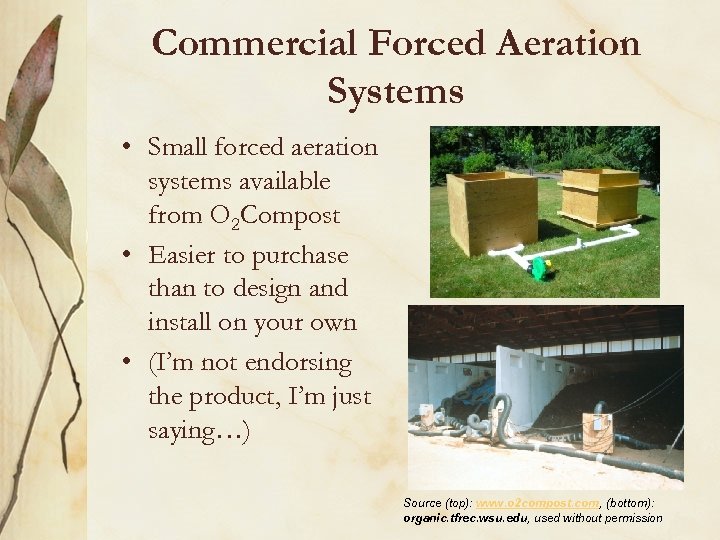 Commercial Forced Aeration Systems • Small forced aeration systems available from O 2 Compost • Easier to purchase than to design and install on your own • (I’m not endorsing the product, I’m just saying…) Source (top): www. o 2 compost. com, (bottom): organic. tfrec. wsu. edu, used without permission
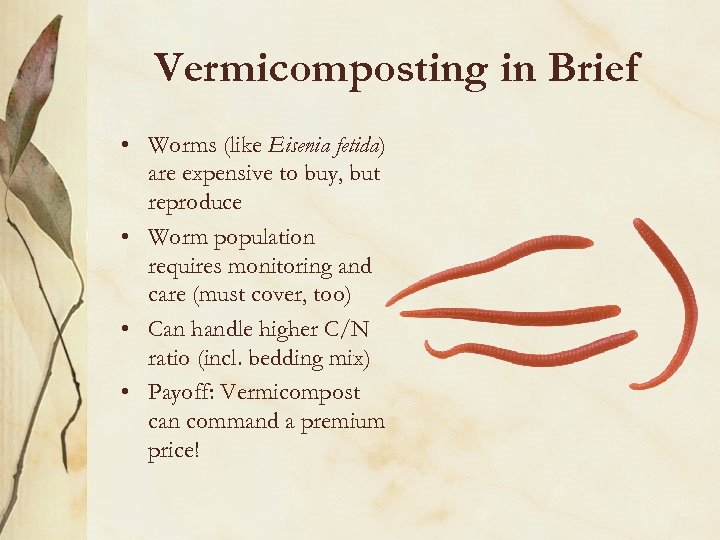 Vermicomposting in Brief • Worms (like Eisenia fetida) are expensive to buy, but reproduce • Worm population requires monitoring and care (must cover, too) • Can handle higher C/N ratio (incl. bedding mix) • Payoff: Vermicompost can command a premium price!
 Pathogens in Vermicomposting • Pathogenic bacteria, etc. may not all be destroyed when they pass through a worm’s digestive tract • Static composting of the material for one week before adding worms has been found to destroy pathogens, weed seeds, etc. more effectively due to heat • Worms naturally move in when it cools
 If you want to try worms… There a lot of great resources on vermicomposting, one of which is CSU extension publication number 1. 224, “Vermicomposting Horse Manure”.
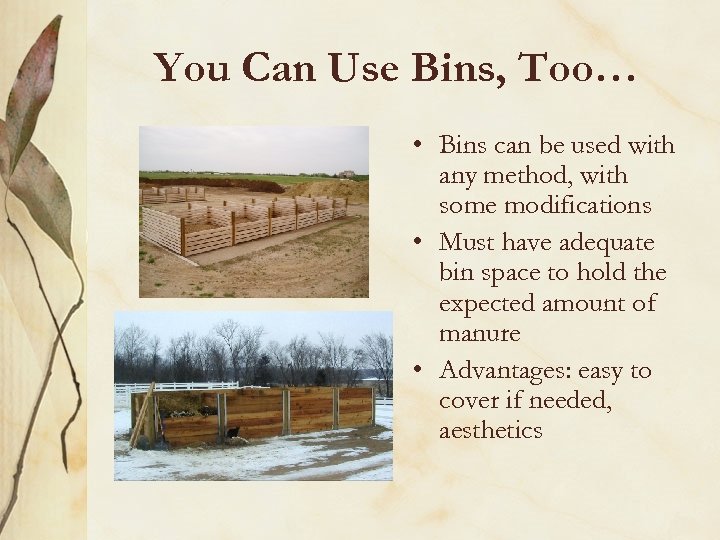 You Can Use Bins, Too… • Bins can be used with any method, with some modifications • Must have adequate bin space to hold the expected amount of manure • Advantages: easy to cover if needed, aesthetics
 So Which is “Best”? • Depends on your situation! • Lowest management requirement: static composting (esp. passively aerated) • Best pathogen and weed seed destruction: dynamic windrows • Premium price: vermicomposting • Compromise: actively aerated static compost (don’t overdo it!)
 Keep in Mind… • The right composting system for you will depend on how much space, manure and bedding you have, your goals, budget, how much time you want to spend managing it • Climate affects design and management (wet areas: cover to prevent water logging, dry areas: add water, prevent evaporation) • Composting can save you money, and keeps your manure out of the landfill! Choosing the right system for your situation is important
 Further Reading Bansal, S. and Kapoor, K. K. 2000. Vermicomposting of Crop Residues and Cattle Dung with Eisenia foetida. Bioresource Technology 73, 95 -98. Barrington, S. , D. Choiniere, M. Trigui, and W. Knight. 2003. Compost Convective Airflow Under Passive Aeration. Bioresource Technology 86, 259 -266. Card, A. B. J. V. Anderson, and J. G. Davis. 2002. 1. 224, Vermicomposting Horse Manure. Colorado State University Cooperative Extension. Card, A. B. and J. G. Davis. 2002. 1. 225, Composting Horse Manure in Dynamic Windrows. Colorado State University Cooperative Extension. Card, A. B. and J. G. Davis. 2002. 1. 226, Composting Horse Manure in Static Windrows: Passively Aerated Windrow Method. Colorado State University Cooperative Extension. Contreras-Ramos, S. M. , E. M. Escamilla-Silva, and L. Dendooven. 2005. Vermicomposting of Biosolids with Cow Manure and Oat Straw. Biol. Fertil. Soils 41, 190 -198. Davis, J. G. and A. M. Swinker. 1996. 1. 219, Horse Manure Management. Colorado State University Cooperative Extension. Fernandes, L. , W. Zhan, N. K. Patni, and P. Y. Jui. 1994. Temperature Distribution and Variation in Passively Aerated Static Compost Piles. Transactions of the ASAE 48, 257 -263. Larney, F. J. , L. J. Yanke, J. J. Miller, and T. A. Mc. Allister. 2003. Fate of Coliform Bacteria in Composted Beef Cattle Feedlot Manure. Journal of Environmental Quality 32, 1508 -1515. Larney, F. J. , A. F. Olson, A. A. Carcamo, and C. Chang. 2000. Physical Changes During Active and Passive Composting of Beef Feedlot Manure in Winter and Summer. Bioresource Technology 75, 139 -148. Lynch, N. J. and R. S. Cherry. 1996. Design of Passively Aerated Compost Piles: Vertical Air Velocities Between the Pipes. Biotechnol. Prog. 12, 624 -629. Mitchell, A. 1997. Production of Eisenia Fetida and Vermicompost from Feed-Lot Cattle Manure. Soil Bioogy and Biochemistry 29, 763 -766. Mote, C. R. , B. L. Emerton, J. S. Allison, H. H. Dowlen, and S. P. Oliver. 1988. Survival of Coliform Bacteria in Static Compost Piles of Dairy Waste Solids Intended for Freestall Bedding. Journal of Dairy Science 71, 1676 -1681. O 2 Compost forced aeration compost systems. http: //www. o 2 compost. com (accessed Dec 2006). Sartaj, M. , L. Fernandes and N. K. Patni. 1997. Performance of Forced, Passive, and Natural Aeration Methods for Composting Manure Slurries. Transactions of the ASAE 40, 457 -463.